

This week Brian LePort at Near Emmaus is providing and hosting some theological thinking about the National Football League.
I’m honored to have been included in the series today, with a post called “Of Linebackers and Liturgy.” Read it here.
This week Brian LePort at Near Emmaus is providing and hosting some theological thinking about the National Football League.
I’m honored to have been included in the series today, with a post called “Of Linebackers and Liturgy.” Read it here.

Perpetua was a nursing mother who rejected her father’s pleadings to deny her Christian faith and make the requisite sacrifice to the Roman emperor. As the story goes, depicted above, she had to help guide the sword of her trembling executioner to her throat.
The book 131 Christians Everyone Should Know, by Mark Galli and Christian History magazine, recounts her story:
Her father immediately came to her in prison. He was a pagan, and he saw an easy way for Perpetua to save herself. He entreated her simply to deny she was a Christian.
“Father, do you see this vase here?” she replied. “Could it be called by any other name than what it is?”
“No,” he replied.
“Well, neither can I be called anything other than what I am, a Christian.”
In the next days, Perpetua was moved to a better part of the prison and allowed to breastfeed her child. With her hearing approaching, her father visited again, this time, pleading more passionately….
The day of the hearing arrived; Perpetua and her friends were marched before the governor, Hilarianus. Perpetua’s friends were questioned first, and each in turn admitted to being a Christian, and each in turn refused to make a sacrifice (an act of emperor worship). Then the governor turned to question Perpetua.
At that moment, her father, carrying Perpetua’s son in his arms, burst into the room. He grabbed Perpetua and pleaded, “Perform the sacrifice. Have pity on your baby!”
…When [Perpetua and her friends] entered the stadium, wild beasts and gladiators roamed the arena floor, and in the stands, crowds roared to see blood. They didn’t have to wait long.
Immediately a wild heifer charged the group. Perpetua was tossed into the air and onto her back. She sat up, adjusted her ripped tunic, and walked over to help Felicitas. Then a leopard was let loose, and it wasn’t long before the tunics of the Christians were stained with blood.
This was too deliberate for the impatient crowd, which began calling for death for the Christians. So Perpetua, Felicitas, and friends were lined up, and one by one, were slain by the sword.
The whole account can be found here.
It’s easy for me to “want to be in that number” when saints like Perpetua “go marching in,” but the courage and faithfulness she exhibited in the moments leading up to her martyrdom are qualities I can only pray to attain. The Wisdom of Solomon passage I quoted yesterday is apropos:
But the souls of the righteous are in the hand of God,
and no torment will ever touch them.In the eyes of the foolish they seemed to have died,
and their departure was considered to be suffering,and their going from us to be destruction,
but they are at peace.
As All Saints Day approaches tomorrow, I find myself moved and inspired by this committed follower of Jesus. Perpetua, though she was mercilessly separated from her husband, family, and precious little baby, is at peace.

November 1 is All Saints Day. It’s a holiday in the church calendar of multiple Christian traditions: Catholic, Anglican, Lutheran, Methodist, and others. Halloween gets its name from All Saints Day. All Saints Day used to be known as All Hallows Day, and Halloween was a contraction of All-Hallows-Even, or All Hallows Eve.
All Saints Day is meant to remember the saints, or fellow believers, who have gone on before us, walking in the way of Jesus. The author of Hebrews writes, “We are surrounded by such a great cloud of witnesses.” We have the example of men and women who have walked with God, who have struggled with God, and who have triumphed in life with God. As we look ahead to All Saints Day we can pause today to remember their example, and ask God to strengthen our faith, too. We are part of that number.
Psalm 85:8 in the NIV says, “I will listen to what God the LORD will say; he promises peace to his people, his saints.” Some 30 times Paul addresses congregations of believers as “saints.” We who follow Jesus are rightfully called “saints.” We are part of a narrative that is much bigger than ourselves, much bigger than any one community, and much bigger than this period in history. We are a part of a timeless, worldwide communion of saints—the body of Christ.
Wisdom of Solomon (yes, it’s from the Septuagint!) puts it beautifully:
But the souls of the righteous are in the hand of God,
and no torment will ever touch them.In the eyes of the foolish they seemed to have died,
and their departure was considered to be suffering,and their going from us to be destruction,
but they are at peace.For even if in the sight of human beings they were punished,
their hope is full of immortality,and having been disciplined a little, they will be greatly benefited,
because God tested them and found them worthy of himself;as gold in the furnace, he tested them,
and as a sacrificial whole burnt offering, he accepted them.And in the time of their visitation they will shine out,
and as sparks through the stubble, they will run about.They will judge nations and rule over peoples,
and the Lord will be king over them for ever.Those who trust in him will understand truth,
and the faithful will remain with him in love,because grace and mercy are upon his holy ones,
and he watches over his chosen ones.–Wisdom of Solomon 3:1-9 (NETS)
In the coming days I’ll post about a series of lesser-known “saints” in the Church’s history, righteous ones whose “souls…are in the hand of God.”
 We have a winner in the giveaway contest at Words on the Word for Zondervan’s primary source compendium, Christian Apologetics: An Anthology of Primary Sources, edited by Khaldoun A. Sweis and Chad V. Meister.
I have weathered the storm, several flickers of the power on and off, and have selected the winner at random. (Actually, a random number generator is to thank/blame.)
And the winner is… Matthew Hamrick! Congratulations, Matthew, and enjoy the book. Thank you to everyone who participated and spread the word.
I reviewed the book here if you’d like to learn more.
Almost every Monday at Words on the Word (and other days, too) I review new books in the field of biblical studies, original languages, and theology. I also review Bible software. Check or bookmark this link to see all my reviews.

Head over to Near Emmaus this week for some theological thinking about the National Football League. Day one’s reflections are here. Brian LePort writes:
Some people may brush off these questions. “It’s just a game.” “Enjoy it, don’t over-think it!” But games matter to people (we fill stadiums with thousands to watch these events) and if the unexamined life isn’t worth living that includes our pastimes!
I’ve submitted a contribution called “Of Linebackers and Liturgy” that will appear later this week. I’ll include a link to that later here at Words on the Word, and I’m sure that everything at Near Emmaus will be worth reading and engaging this week.

Here, collected in one place, are all six parts of my review of the Bible software program Logos 4.
Part 1: Logos 4 Review: Install and Initial Impressions
Part 2: Logos 4 Review: The Septuagint
Part 3: The Original Languages Library in Logos 4
Part 4: Using the Exegetical Guide and Passage Guide in Logos 4
Part 5 (excursus): Logos 4: a quick note about a portable library
Part 6: Searching in Logos Bible software (concluding part of my Logos 4 review)
UPDATE: Go here to see my Logos 5 reviews.
UPDATE: Go here to see my comparative review of BibleWorks, Accordance, and Logos.
Thanks again to Logos for the review copy of the Original Languages Library.
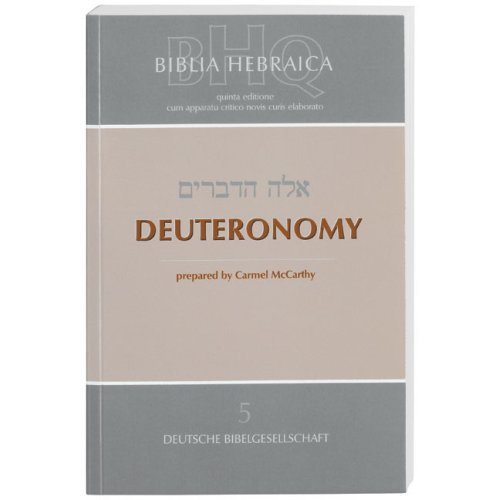
The next generation of the Biblia Hebraica Stuttgartensia (BHS) is the Biblia Hebraica Quinta (BHQ). I’ve written more generally about scholarly editions of the Hebrew Bible, and have reviewed the BHS module in Accordance already. In this post I review BHQ in Accordance.
Some excellent scholarly treatments of the BHQ have already appeared. Anyone serious about learning how to use this resource discerningly (as all text critics must be discerning) will do well to avail themselves to these, probably in this order:
Taking the BHQ for a spin alongside the BHS is perhaps the most helpful way to see how the two compare. It’s easy to have both side-by-side in Accordance. Here’s my workspace for reading the Hebrew Bible with BHS, BHQ, the apparatus for each, and the BHQ commentary. You can click or open in a new tab to enlarge.

You can see that the text of Deuteronomy 6:4-5 above is unchanged in the BHQ. Consonants, vowels, and cantillation marks are all the same. As the BHQ is based on the Leningrad Codex, just as the BHS is, the text itself is largely unchanged. (The BHQ, however, corrects the BHS to the Leningrad Codex based on new color photographs.)
Note that abbreviations in the BHQ apparatus are now abbreviations of English, not Latin. Those who have learned how to make use of the abbreviated Latin in the BHS apparatus may be somewhat disappointed to not be able to put that knowledge to use (and to have to learn a new system), but in the end this makes for a more widely accessible apparatus, in my view.
A comparison between the BHS apparatus and the BHQ apparatus at the same point is instructive. For Deuteronomy 6:4 BHS has a superscript “a” in the text after שְׁמַ֖ע, directing to footnote a, which reads: “𝔊 pr nonn vb.” I write here about the use of Accordance to quickly decipher the abbreviated Latin in the BHS critical apparatus. “𝔊 pr nonn vb” means something like, “The Old Greek/Septuagint puts before [שְׁמַ֖ע] several words.”
It’s easy enough, especially in the workspace how I have it set up above, to find out what these Greek words in question are: Καὶ ταῦτα τὰ δικαιώματα καὶ τὰ κρίματα, ὅσα ἐνετείλατο κύριος τοῖς υἱοῖς Ισραηλ ἐν τῇ ἐρήμῳ ἐξελθόντων αὐτῶν ἐκ γῆς Αἰγύπτου. But the BHS alone does not give the reader much more guidance than that.
The BHQ apparatus, however, reads: “שְׁמַ֖ע Smr V S T | prec 4:45 Nash G ✝ •” Note that instead of a superscript letter in the text with the same letter as a footnote in the apparatus, the text of the BHQ is unmarked, and the apparatus note simply preceded by the word (שְׁמַ֖ע) under consideration. Some will find this gives the text an uncluttered feel; others may find it takes extra time to match text to apparatus. Hovering over the (all in English!) abbreviations in the BHQ in Accordance shows that the note says something like, “The Samaritan Pentateuch, Vulgate, Syriac, and Targumim all begin with just שְׁמַ֖ע. In the Nash Papyrus and Old Greek שְׁמַ֖ע is preceded by the text from Deut. 4:45.” Then the ✝ notes that the BHQ commentary gives the matter more discussion. For text criticism, I have been thrilled about the addition of an included-in-the-book commentary on the text and apparatus.
The BHQ commentary at this verse reads:
The Shemaʿ in both the Nash Papyrus and G is prefaced by an introduction taken from 4:45 with the following differences: both attest a cj. before אלה; both omit העדות and the cj. attached to the following word; both read צוה for דבר, but with “the Lord” as subject in G, whereas the Nash Pappyrus and some G Mss follow M in reading “Moses”; finally, both insert במדבר after “Israel.” For further background to the combination of certain biblical passages for liturgical reading, with particular reference to this addition in G and the Nash Papyrus, see Elbogen, Jewish Liturgy, 193. The six extant phylacteries follow M.
Thumbs up here for the additional detail provided in the BHQ apparatus and commentary and for Accordance’s presentation of it. In the print edition the commentary is in a section of the fascicle that is separate from the apparatus. In Accordance you can easily lay it all out together and see it at once.
Just as BHS was, BHQ is being published in fascicles, so a bit at a time. The following six already exist in print:
The BHQ module in Accordance has fascicles 5 (Deuteronomy), 18 (General Introduction and Megilloth), and 20 (Ezra and Nehemiah) so far. 13 (The Twelve Minor Prophets) and 17 (Proverbs) will be added free of charge to those who have the BHQ package. They exist in print but have not yet come from the German Bible Society to Accordance for digitization. When Judges comes to Accordance, it and future fascicles will be available as paid upgrades.
Accordance has produced a short video that shows a couple ways to use the BHQ, including a comparison with the print edition. It’s worth watching, since it explores not only the text, apparatus, and commentary that I cite above, but also the Masorah Magna (below the text in the print edition) and the Masorah Parva (at the margins of the print edition). Note especially (early in the video) how Accordance merges the Notes on the Masorah to eliminate the user’s need to go back and forth between references:
The place for the BHQ user to start is probably with the three articles at the beginning of this post. Then, the General Introduction contained in Fascicle 18 should be consulted. As with its other commentaries and books, Accordance has it presented beautifully. The English introduction tells what BHQ is, gives advice on how to use it (including full explanations of sigla and abbreviations), and tells a bit of background on the editorial processes leading to the BHQ as it is now. Click on the below for a larger image of the general introduction:

BHQ in Accordance is not morphologically tagged; Accordance does not currently have plans to tag it. But this is because the text is so similar to that of BHS already. Because I am so used to BHS and BHQ is still so new on the scene, I always have both open anyway, so I can easily get morphological tagging information from BHS. A tagged BHQ would be ideal, but it’s not a huge loss.
BHQ has less conjectural emendation than BHS. Case in point, “prp” (=”propositum”=”it has been proposed”) occurs 2,146 times in the BHS apparatus (a search that is exceedingly easy to do in Accordance). In BHQ what goes into “prp” is teased out a bit more. From the introduction to BHQ:
In cases where the editor proposes that a reading other than that of the base text is to be preferred, this is presented in the concluding portion of the entry following a double vertical stroke and the abbreviation “pref” (for “preferred reading”). The evidence supporting the preferred reading is recapitulated. If the preferred reading is not directly attested by any of the extant witnesses, but is only implied by their evidence, it is marked by the signal “(origin)”, i.e., that it is the indirectly attested origin of the extant readings. If the grammatical form of the preferred reading is not found otherwise in Hebrew of the biblical period, it is marked either as “unattest” (= “unattested”) or as “conjec-phil” (= “philological conjecture”), depending on the kind of external support for the reading. Where the proposed reading is a conjecture, it is not introduced by the abbreviation “pref” (= “preferred reading”), but by the abbreviation “conjec” (= “conjecture”). In line with the focus of the apparatus on the evidence of the text’s transmission, proposals for preferred readings will not seek to reconstruct the literary history of a text. Readings that are judged to derive from another literary tradition for a book will be characterized as “lit” (see the definitions of characterizations below).
Also,
Since the apparatus is devoted to the presentation and evaluation of the concrete evidence for the text’s transmission, a hypothetical reading (i.e., a conjecture) will have place in the apparatus of BHQ only when it is the only explanation of the extant readings in a case.
“Pref” occurs 201 times in the apparatus in the three fascicles so far published in Accordance. A primary difference in BHQ, though, is the level of textual or manuscript-based explanation given for why a certain reading is to be preferred. As someone who tries to be a cautious textual critic, I appreciate this.
Here are some additional resources for using BHQ:
At least three things make it worth seriously considering adding BHQ in Accordance to your library. First, BHQ is a significant advance over BHS. Second, Accordance’s presentation of BHQ makes using it easier than it is in print. Third, the print editions would cost you just as much as or more than buying BHQ in Accordance. And, of course, an Accordance module is word-searchable, lighter to carry around, and so on.
All in all, BHQ in Accordance is well-produced, easy to use, and a great aid in textual criticism of the Hebrew Bible.
Thank you to Accordance for providing me with a copy of the BHS and BHQ modules for review. At the time of this writing, the sale price for that package was $149.99, an excellent deal. See all the parts of my Accordance 10 review (including the Beale/Carson commentary module) here. I reviewed BHQ’s predecessor, BHS, here.
I own a concordance, but it’s packed away in a box somewhere. Useful as a print concordance is, with sites like the NET Bible and Bible Gateway, not to mention various software programs available, I can do any word or phrase searching quickly at a computer.
This post will mark the completion of my multiple-part reviews of three major Bible software programs: BibleWorks 9, Accordance 10, and Logos 4. In this final part of my Logos review, I look at the searching features available in Logos. No print concordance necessary.
Here is the search function in action:
The above highlights four search categories: Basic, Bible, Morph, Syntax. A “Basic” search searches your library; “Bible” is just what it says it is. “Morph” can search according to a word’s inflection. “Syntax” can perform more complex grammatical searches.
There are multiple ways to search for and look up things in Logos. There’s a useful instructional video here with more information about how to do a “Basic Search” in Logos, i.e., search every resource in your library. And you can look here to watch a video that explains how to utilize the command bar on the home screen for searches.

You can also right click on a word in an open resource and search from where you are, looking it up in that resource, in all open resources, in your whole library, etc.
I was pleasantly surprised by the versatile ways one can search in Logos. The control+F search function is easy to use and remember–it’s how I search .pdfs and open Web pages already.
What was unpleasantly surprising, though, was how long some of the searches took. (Click below to enlarge.)

Nearly five seconds to return search results for a word. Granted, the above is the most frequently occurring word in the Hebrew Bible, but using different software I’ve been able to perform such a search significantly faster.
Lack of speed is perhaps the chief weakness in Logos. Part of this, I think, is because of one of its strengths, which is its massive library. Logos says, “The central metaphor Logos Bible Software is the universal digital library.” While this is a commendable project, and while the resources available in Logos are quite impressive (as I wrote here), it does seem to be at the expense of quickness of searches. Or perhaps it’s not just a library issue; it could be in the coding or some other.
Either way I hope future editions of Logos will improve upon search speed. This seems to be a vital need. I’ve had searches that turned up results faster than 5 seconds (a couple in under a second), but I also did a Bible search today that took more than 20 seconds to return results.
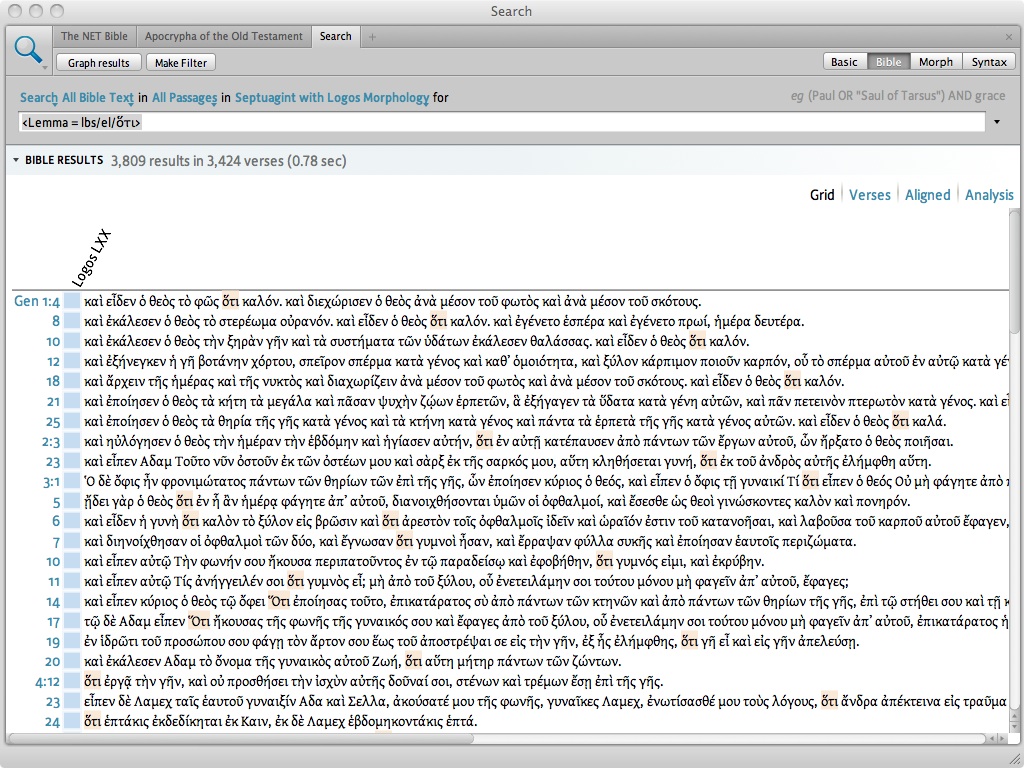
Once you have your search results, there are some fun ways to be able to manipulate and view the data. With a Septuagint search for ὅτι, I can view the results as a “Grid”:
as “Verses”:

as “Aligned”:
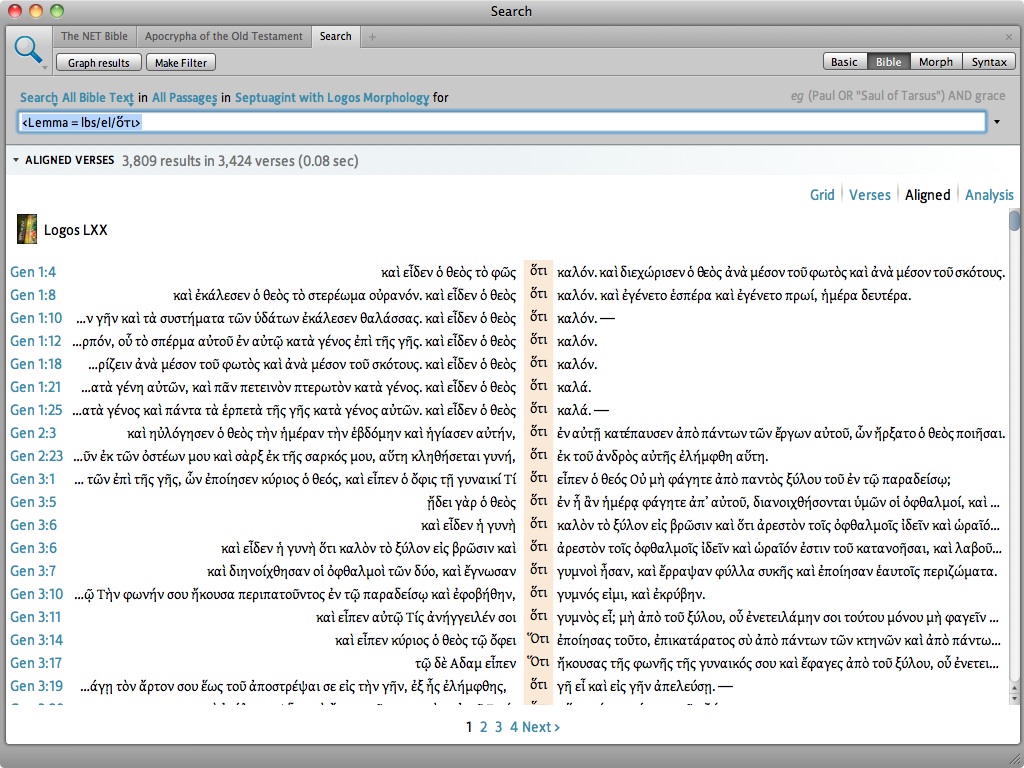
or as “Analysis”:
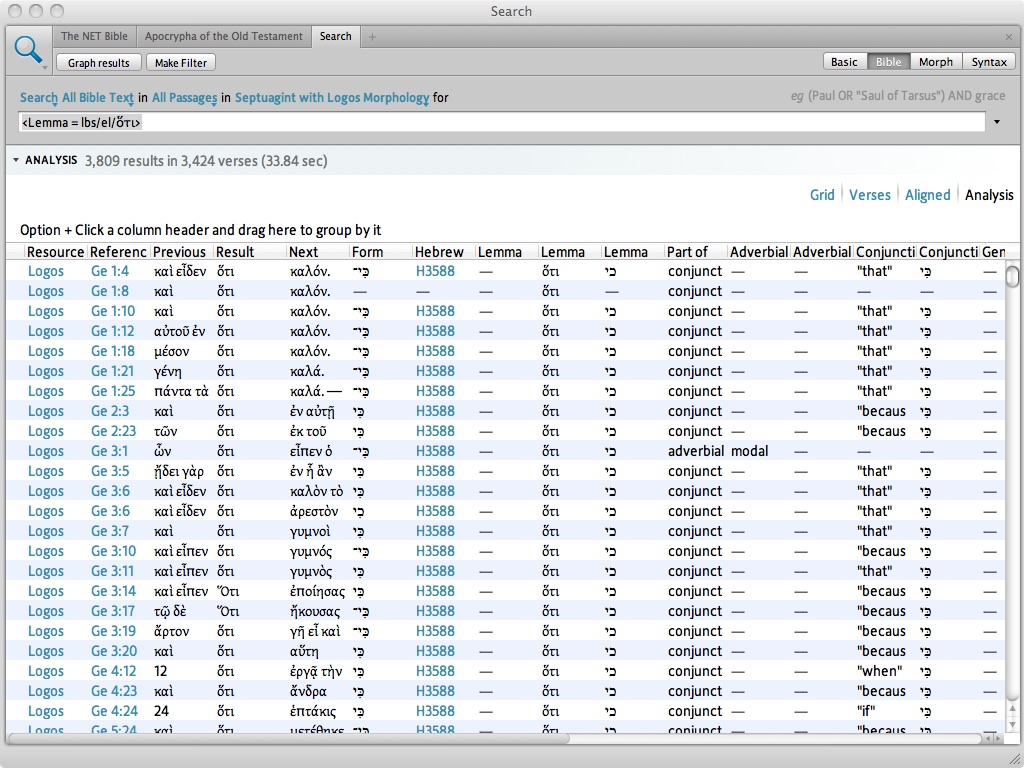
I have found the “Analysis” sorting the most helpful, since you can click on any of the column headers above and it re-sorts in the same way an Excel spreadsheet would.
A few concluding thoughts on Logos 4:
One other thing to note is that Logos offers a good discount program.
For more on Logos, this promotional pdf is a helpful introduction. You can also visit logos.com.
Thanks to Logos for the review copy of Logos 4 with the Original Languages Library included. For the review copy I have been giving my honest impressions of the program in a multi-part review (here, here, here, here, and here), which this installment concludes. Look in coming weeks to this blog for a comparison of Logos, BibleWorks, and Accordance.

One good giveaway deserves another.
The other day I noted that Zondervan has just put out a primary source compendium called Christian Apologetics: An Anthology of Primary Sources, edited by Khaldoun A. Sweis and Chad V. Meister.
I have an extra copy to give away (not my review copy). It’s a good resource to have on the shelf, and I know I’ll be turning to it in the future for the work and ministry I do in a college setting.
I reviewed the book here.
I will choose a winner at random. To enter the drawing, simply comment on this blog post with your greetings, thoughts about apologetics, favorite philosopher/theologian, etc. I will accept entries through Monday afternoon, with 3pm EST being the cutoff.
Then if you link to this post on your Facebook, Twitter, blog, etc., come back here to tell me in the comments section that you did, and you’ll receive a second entry. I will announce the winner just before 5pm EST Monday.


 Words on the Word