Congratulations to…

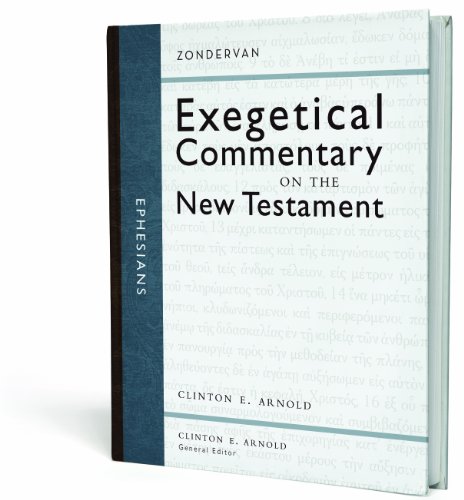
… Clifford Kvidahl, the winner of the Ephesians ZECNT commentary giveaway. Congratulations, Clifford, and enjoy your new book!

Thank you to everyone who entered the giveaway. I’ll do another one in the not-so-distant future, so keep coming back. You can subscribe to this blog using the “Follow” button on the right sidebar, or follow me on Twitter. Here’s my weekend recap of Words on the Word posts:

BibleWorks and the Septuagint / How to Speed Read / Best pastoring site

Also, in today’s Magnificent Monograph Monday, I review Leslie C. Allen’s “Pastoral Commentary” on Lamentations, A Liturgy of Grief (amazon). Review here.

By the way, what I would ask Paul over coffee: “Can you tell me more about Junia?”

Good Grief (a review of A Liturgy of Grief)

There is a Yiddish proverb that calls tears the soap of the soul. The release, rather than the bottling up, of inarticulate emotion is a valuable first aid to be applied over and over again to the raw wounds of grief.

A Liturgy of Grief, p. 2

My boss and I have recently lamented together the lack of good lament liturgies for the Church. Worshiping communities seem to be good at celebration and constant in intercession–maybe even at times confession–but lament? We’re too scared or too complacent to adopt that difficult posture. We may think that even if we wanted to lament, we don’t have the words with which to do it. “Contemporary Western culture,” Leslie C. Allen says in his Liturgy of Grief, “provides little space for grief.”

And yet we do have resources, scripts to help us unbottle the anguish and woe we inevitably experience. Allen, whose book is aptly subtitled A Pastoral Commentary on Lamentations, writes, “The book of Lamentations is best understood as the script of a liturgy intended as a therapeutic ritual.”

A Liturgy of Grief is a unique kind of commentary. Though Allen has written technical commentaries and contributed to commentary sets (a few are here), this book is a monograph, a singular contribution to Lamentations commentaries. Baker Academic publishes it, but it is not so academic or technical so as to exclude readers who have only a passing familiarity with Lamentations or the Old Testament.

The book includes the full English text of Lamentations, in Allen’s own translation. Though he often references the Hebrew he translates, he rarely lists the Hebrew words themselves. Language and translation buffs, however, will be happy to see nine pages of translation notes in an appendix. (This language buff appreciated that Allen saved his longest translation note for the single English word “but” in the last verse of Lamentations.)

Allen has written lengthy technical commentaries, yet this is not that, nor is it intended to be. However, Allen does not neglect to thoroughly elucidate the text. He understands the five chapters of Lamentations as “five poems,” each with their own distinctive theme and contribution to the larger book. The climax of the book comes in the fifth poem. Here the grieving community, having heard the model prayers of a pastoral mentor/liturgist (Allen calls him “the reporter”), at last can pray to God in their grief.

Allen weaves together narratives past and present, from the 6th century B.C. to today, in order to guide the reader section-by-section through the book of Lamentations. In addition to being Senior Professor of Old Testament at Fuller Theological Seminary, he is a hospital chaplain. Nicholas Wolterstorff comments in the foreword, “[Allen] brings to his commentary an understanding of grief that was already deeply informed both by the contemporary literature on grief, all of which he seems to have read, and by his own activities as a hospital chaplain.” In reference to the repeated expressions of grief in the first poem (chapter 1 of Lamentations), Allen writes:

For those who grieve, but not for their regular hearers, the old story is ever new, always filling their consciousness and needing to be told once more, as intensely as it was the first time. Patience is the prime virtue that empathy requires.

Any preacher, liturgist, or worship leader will appreciate Allen’s commentary. He gives attention to the approach and words of “the reporter”/liturgist in Lamentations, drawing important conclusions that can guide today’s liturgist in helping a community deal with grief:

In this [third] poem a wounded healer offers his knowledge of God’s ways and his experience of them in a context of suffering. At beginning and end he ministers out of his own suffering and presents himself as an object lesson. A fellow sufferer, he points the congregation forward to a new wholeness that both he and they yearn to attain. In turn, we readers who are wounded have the potential to be wounded healers.

A Liturgy of Grief is a special book and a gift to the Church, both its leaders and its members. Contrary to lament-free churches or a Western culture which knows not how to grieve, Allen opens up a space for readers to recall and feel their hurt and the hurt of others. The commentary is “pastoral,” just as it promises, with Allen a pastor to any who will receive the ministry he has to offer through this book. “When believers find themselves in such a fearfully dark valley,” Allen concludes, “the biblical tradition is there, providing challenging words for souls in pain to use.” In addition to Lamentations, Allen evokes the biblical traditions of Isaiah, Jeremiah, Joel, and makes reference to numerous lament Psalms.

Allen illuminates all these “challenging words” of Scripture beautifully. His final chapter perfectly matches the surprising ending of Lamentations. (No spoilers here, but I will say that all I could write in the margins was, “This is real, true, holy.”) I finally realized hours after finishing the book that, all along, Allen as author plays the same role to reader as “the reporter”/liturgist in Lamentations did to his 6th century B.C. worshiping community:

He mentors members of the community by giving expression to the grief he and they have in common, turning incoherent feelings into words and explaining the experiences they have all been through. …He is also interpreter of their loss…. and finally involves them in a creative response of their own that they are ready to make in the final poem…

…that of prayer to God. As a result, A Liturgy of Grief serves as its own sort of book of Lamentations for the 21st century, with Allen “giving expression to the grief” of his readers, interpreting their loss and–finally–guiding them into a response of prayer.

I offer my thanks to Baker Academic for providing me with a free review copy in exchange for an unbiased review. A Liturgy of Grief is available at Amazon.

UPDATE: I interview the author here.

BibleWorks and the Septuagint

I recently blogged on why you need the Septuagint. And here are some great resources to begin and further pursue Septuagint study.

One indispensable resource for Septuagint study that I use almost daily is the computer program BibleWorks. I have not yet made the upgrade from version 8 to version 9, but much if not all of what I have to say here will still be applicable to users of version 9 (and 7, for that matter).

Here is what my BibleWorks looks like for 1 Maccabees (click or open in a new tab to view larger):

The following features help me navigate my way through the Septuagint:

  • A nice, big Browse Window (middle column in the top window) so that I can see the whole Greek verse easily at once, with English translations below. Both the LXA (Brenton’s Septuagint with Apocrypha, in English) and the NRS (NRSV, which includes the Apocrypha) are part of BibleWorks.
  • A stand-alone Word Analysis Window (bottom right of the screen) so I can better use my other columns. I set the default lexicon to LEH (Lust/Eynikel/Hauspie’s Greek-English Lexicon of the Septuagint, Revised Edition).
    Not only is this a fantastic Septuagint-specific lexicon; it also includes word frequency counts. What I particularly like about this is that I can use the Stats window (in the Analysis Window, the right column in the top window) to find out how many times a word appears in the whole Greek Bible (LXX+New Testament). Then using the LEH frequency counts, I can get a quick number on how many times a word is used in the LXX and the NT. This is helpful if I see an LXX word that occurs 200+ times, have never heard of it, and then see it only appears 10 times in the NT.
  • The Resource Summary Window (bottom left of the screen). Here I can access Conybeare’s Grammar of Septuagint Greek, which comes with BibleWorks and is hyperlinked both by part of speech and Scripture index. Another nice feature is that I can pull up BibleWorks paradigms quickly for a given part of speech–a helpful grammatical refresher! The IVP Dictionary of Jesus and the Gospels in that window is an add-on from WordSearch, but their IVP Dictionary package has a bunch of great Septuagint articles.
  • Note: There is no punctuation in the BibleWorks Septuagint text. This is not a display error; it’s just how it is. There are accents and breathing marks, though. And, the way I see it, even if Rahlfs in print has punctuation, the original manuscripts did not, so no huge loss.
  • I hesitate to write too much more about the Analysis window (right column in the top window), because BibleWorks 9 has significantly changed (=improved) the layout. In fact, there are now four columns, as seen here. However, for anyone using 8 or less, the above configuration allows you to work with the LXX profitably. For BibleWorks 9, I’m sure you could use the above layout as is (BW9 lets you use just three columns if you want, I believe) or make whatever modifications you wanted in BW9.

1 Maccabees has no existing Hebrew text. The scholars I’ve read on it all think that the Greek of 1 Maccabees has the flavor of translation Greek, and so translated a Hebrew original. But we don’t have it. (BibleWorks is powerful, but not quite that powerful!)

How I use the LXX when there is a corresponding Hebrew text (e.g., when I’m reading Micah) looks a little different. For example, in addition to the above, I’ll have the Hebrew text and English translation displayed. BibleWorks has the amazing Tov-Polak Parallel Hebrew/LXX Database, too, that comes with the base package.

BibleWorks allows me to read through the Septuagint in Greek with English translations displayed underneath. (I can also hide them–that’s what my “No Eng.” tab is in the left column of the top window.) It gives me instant word analysis (its parsing and then word definition and frequency count through LEH). I get grammatical helps from Conybeare and BibleWorks paradigms. I can search on a word to see how it’s used throughout the Septuagint and/or New Testament (note the highlighted word above). And with the IVP add-ons, I get historical background, too.

Using BibleWorks is a fabulous way to read through the Septuagint. I feel very blessed to have access to such a tool as this.

And I know there is much more BibleWorks can do. Fellow BibleWorks users and lovers of the Septuagint, how do you use BibleWorks for LXX success?

Septuagint Sunday is a regular feature of Words on the Word. All my LXX posts are here. The full contents of BibleWorks (now in version 9) are listed here. You can buy the program here or here.

How to Speed Read (Or, at least, how I am learning to speed read)

I have often watched in awe as my wife sped through the book she was reading while I slogged through mine. But I have been teaching myself to speed read lately. The number of books I’ve been able to review for Words on the Word in the last month is perhaps evidence that what I’m trying is working.

Here’s what I’m doing to increase my reading speed:

  • I am pushing myself to read faster than is comfortable for me. This may sound like an obvious thing to do; it is. And it works great. I am still at the stages of sacrificing a bit of comprehension for the sake of speed, but my comprehension is already increasing as I practice more.
  • I try to discipline myself not to go back over words I’ve already read. It’s a temptation to go back, especially since I’m pushing myself to read faster, but it defeats the purpose. Keep moving forward.
  • I “silence the inner voice” that I hear when I read. I got this idea from the speed-reading site Spreeder (as well as the above two thoughts). At first I thought it just sounded cheesy, but then I realized they were right. Spreeder makes the point that when many of us first learned to read, we read out loud. With time we could read silently, but still with an inner voice pacing us. This means we will only ever read as fast as we can speak. But I want to be able to read faster than that. So far, so good.
  • I read as fast as I possibly can for less essential reading. If I’m reading a theology book for class or reviewing a commentary for this site, I can’t generally afford to lose comprehension. But if I’m reading a newspaper or magazine article, or something online, or a book for fun, I try to really push myself.
  • I glance through the entire book I’m about to read before diving in. I actually learned this from one of my college philosophy professors. Even 10 minutes glancing through the book, looking carefully at the table of contents, and poking around for the thesis in the introduction or first chapter helps me frame the book in such a way that I can better read it quickly.
  • I try to speed read when I’m well-rested. Ha. We just had our third child. “Well-rested” is relative here. But I do find that I speed read much better in the morning or early afternoon than at, say, 10:00 at night.
  • I don’t beat myself up if I decide to slow down for a section. Especially when comprehension and eventual recall is important, I let myself slow down if I need to. No need to stress.

As an encouragement, let me say that if a previously slow reader like me can learn to speed read, you can too! I had to demystify the process by just trying… and then trying some more. It’s not as hard or magical as it seems. But it sure makes reading more enjoyable, and I get to read more of what I want.

UPDATE: More lessons learned on speed reading here.

Free Book! Ephesians commentary by Arnold (Zondervan)

I am giving away a book at Words on the Word this weekend. It’s a commentary on Ephesians by Clinton E. Arnold, from Zondervan’s Exegetical Commentary on the New Testament series.

Last weekend I reviewed Luke from that same series. You can read that review to find out more about the structure and layout of each book in the series. Anyone who is preaching, teaching, or just studying their own way through Ephesians will find this book illuminating. Those who know even a little Greek will benefit most from this book, but Arnold translates everything, so those who know no Greek will benefit, too.

I will choose a winner at random. To enter the drawing, comment on this blog post with your answer to the question, “If you had a chance to sit down for a cup of coffee or tea with the apostle Paul today, what is the first thing you would ask him?” (I know what I would ask!)

Then if you link to this post on your Facebook, Twitter, blog, etc., come back here to tell me in the comments section that you did, and you’ll receive a second entry. I will announce the winner on the blog first thing Monday morning.

If you want to skip the giveaway contest and just buy the book for yourself, you can find it here.

Talking to a four-year-old about sex?

How do you talk to a four and a half-year-old about sex?

Before I had kids, I would have said… you don’t.

But then my four-year-old son started asking about whence his younger brother (and now a younger sister) came.

My wife, good science student that she is, opted for the straight-up biological explanation: There is an egg, it gets fertilized, baby grows inside mommy, baby comes out.

That held him for a little while. But then today, this conversation ensued:

4.5-year-old son: Daddy, how did you fertilize the egg?

Me (stammering): Uh… egg?

He: Yeah, how did you fertilize mommy’s egg?

Me: Well, there’s just a special way that mommy and daddy show love to each other that makes that happen.

He: Can I watch?

Me: No, it’s private.

He: Then can I watch from the wall?

That’s as far as I’m willing to go in explaining sex to a kid that young… on the one hand, I want him to hear it from me before he hears heaven-knows-what descriptions from his peers when he starts going to school all day. On the other hand, I’m not sure he’d be able to handle all the details (or that it’s appropriate to share them at this point). I can see him sharing his newfound knowledge with someone else at an inopportune time.

So parenting pros (or even parenting novices)… how do you talk to your kids about sex? How much do you say and when?

Zondervan Book Giveaway

Head over to Koinonia, Zondervan Academic’s blog, for another Wednesday giveaway. This time they are giving away the forthcoming Four Views on the Apostle Paul. Details are here.

I’m especially grateful to Zondervan for their featuring one of my reviews on their blog recently.

Koinonia is accepting submissions until Thursday midnight.