

There’s the cover image. Looks mighty nice. This is the Septuagint and the Greek New Testament under one cover. (I had posted about it here.)
It’s listed now at Eisenbrauns. (HT: Jim West)
G(r)eeks, rejoice!
There’s the cover image. Looks mighty nice. This is the Septuagint and the Greek New Testament under one cover. (I had posted about it here.)
It’s listed now at Eisenbrauns. (HT: Jim West)
G(r)eeks, rejoice!


My friend Ben Rey has made a really attractive site for praying Morning Prayer from the Book of Common Prayer. The site is in beta right now, but you can use it to pray each day–it’s got the liturgy and Scriptures. Ben says:
Thanks again for participating in the Morning Prayer (MP) beta testing. The initial goal of this site is to provide individuals and communities access to Morning Prayer in its simplest form. Simple both in terms of the selected liturgy/scripture readings, and in terms of the layout for your tablet or mobile device.
Your feedback will either reinforce or change that vision. Think of this as your Morning Prayer site. What do you want for yourself, for your church, for your friends and family? So please complete the brief feedback form on the website at some point in the first week.
The readings start for this coming Sunday, March 7 and will be updated automatically. We will launch the website onto it’s own domain in a few weeks with changes made based on your feedback. Please feel free to share this link/email with others, as the more the merrier in beta testing.


I hope this is real:
Just found this on @christianbook.com – christianbook.com/Christian/Book… Someone likes you, @drjewest LXX/NA28! #lxx #na28
— Chuck Grantham (@ChuckGrantham) April 8, 2013
(via Jim West)
Yes, this does appear to be a Greek Old Testament (LXX) and Greek New Testament (NA28) under one cover. Here’s the product page. The thing is more than 3,000 pages and expensive. And those dimensions of 18.4 x 13.3 (inches) can’t possibly be right.
But we’ll see. I know a guy who knows a guy, and he’s asking to see if it’s real. I’ll post again here if what we’re really seeing is just a remnant of an April Fool’s Joke on CBD….
UPDATE: Note the comment below from Rick Brannan of Logos, reproduced here: “FWIW, I asked a guy I know at Hendrickson about this and he said it was real, said it would be at SBL in Baltimore, and reported the issue with dimensions (the dimensions are likely in centimeters and not inches).”
Nice!
SECOND UPDATE: A few more product details here.

I’ve been spending some time the last few weeks with InterVarsity Press’s Dictionary of the Old Testament: Pentateuch in Logos Bible Software. You can read part 1 of my review here and part 2 here; those help provide context for this third and final part to the review.
In this post I summarize and briefly interact with three more articles: “Warfare,” “Book of Genesis,” and “Haran.” Then I offer my concluding thoughts.
Warfare
A.C. Emery’s article explores “the conduct of warfare found in the Pentateuch, as well as instructions provided for the waging of warfare in Israel” (877). He notes, “Conflict is a common event recorded within the OT” (877), even if the student of ancient warfare tactics may not find much in the Pentateuch. To wit: “With rare exception the battle is described more for the divine intervention than for its technical conduct, which is the particular interest of this article” (878-9). God himself is described “as a warrior” (877) in the Pentateuch.
Emery looks at common Hebrew words that the Pentateuch uses to describe warfare and battles, with qārab (“draw near”) being the most common. He explores Pentateuchal “battle accounts” (879), from Abraham in Genesis 14 to Amalek in Exodus 17 and the “Canaanite king of Arad” and Og, king of Bashan, in Numbers 21-25 (879-80). There are “various instructions with regard to activities related to warfare” (880), including “the need to be… emotionally and religiously prepared for the dangers of combat” and the mechanics of negotiations and siege warfare (880). Emery’s final section examines the ethical difficulty that warfare poses.
Surprisingly, Emery does not in his ethics section mention the difficult Deuteronomy 7:2 with its “show them no mercy” command. He also has an article in the dictionary (“ḤĒREM”) that covers that passage, but his treatment of warfare ethics in “Warfare” was briefer than I would have liked. But, as with the rest of the dictionary, the few-page article still offers a decent jumping-off point for further research, even if it’s not a one-stop shop.
Book of Genesis
The entry on the book of Genesis examines the book with special reference to structure, plot, and theology (350). L.A. Turner’s key assumption is: “Genesis is a narrative book, and its theology is conveyed through features such as its structure, plot and characterization, rather than through set pieces of divine promulgation, as in legal or prophetic texts” (356).
Regarding structure, though there are varying theories, most agree that “Genesis is composed of two distinct blocks of unequal size” (350). The first runs roughly through Genesis 11 or the first few verses of Genesis 12 and is about humanity generally. Genesis 12 onward picks up the story of Abraham. The “main sections” in Genesis, according to Turner, are “the Abraham story (Gen 11:27–25:18), the Jacob story (Gen 25:19–37:1) and the story of Jacob’s family (Gen 37:2–50:26)” (350). The Hebrew word tôlĕdôt (genealogy) is a structural marker throughout Genesis.
The plot of Genesis has “progressive complexity” (352), moving from early human history to complex characters and families by the end of the book. “Divine promises and blessings” constitute “the book’s central core” (353) for Turner, and set the stage for the rest of the Bible (358). Regarding theology, he notes the tension “between divine sovereignty (as exemplified in the genealogies) and human free will (as demonstrated in the narratives)” (357).
I wanted to be sure to review a longer article in the dictionary. I was unexpectedly riveted as Turner walked through Genesis (10 pages in print). I found his contention that the book’s structure has theological import to be particularly compelling.
Haran
“Haran” in English could refer either to a place or to a person, though the spelling is different between each word in Hebrew (379). Both the place and the person are in Genesis 11:27-32, so M.W. Chavalas treats them together (379).
Haran the place is where Abraham lived after leaving Ur and before departing for Canaan (379). He also sought a wife for Isaac there, and Jacob found Rachel and Leah there, too. Similar to Ur, Haran centered on lunar worship. Haran is located in what today is southeastern Turkey. There is “only a small amount of archaeological evidence…for the city, and even less for patriarchal times” (379). It seems to have been inhabited already well before Abraham’s time, perhaps by some 20,000 people (379). Chavalas notes its likely founding “as a merchant outpost by the Sumerian city of Ur in the late third millennium B.C.” (379).
Haran the person has “very little biblical or extrabiblical information” recorded about him. He was Terah’s son, Lot’s father, and Abram’s brother. It was Haran’s death at Ur that led Lot to go to Haran with Abram. Haran also had two daughters, Iscah and Milcah.
The more I research Abraham and the Pentateuch, the more I realize how important Lot was to him. His desire to bear a family perhaps through Lot seems to be what led to his rescue of Lot in Genesis 14. Several dictionary articles point this out nicely. Chavalas covers Haran fairly thoroughly in a short amount of space (just two or three print pages).
**********
I hope Logos will update the dictionary so that the sidebar Table of Contents can expand to include all the article sub-points. Another thing that would make the product better is an easier way to find out about contributors from within an article. Having their names hyperlinked with their biographical information would be nice. As it is, one has to move between the article and the separate “Contributors” section to find out more about each author. [EDIT: Author names have hyperlinks in the Accordance production of this module.]
The Logos edition of the IVP Dictionary of the Old Testament: Pentateuch is overall a good module. Being able to have it open to both Hebrew and English biblical texts saves considerable time compared to using the print edition. The Dictionary is a solid first place to go on issues, themes, and people in the Pentateuch.
The Dictionary is on Amazon here (in print) and at Logos here. My thanks to Logos for the review copy. Read part 1 of my review here and part 2 here.
 This week in Greek Isaiah in a Year covers Isaiah 24:6-25:12.
Here is the schedule and text for Monday through Friday, using again the text from R.R. Ottley’s Book of Isaiah According to the Septuagint. Ottley is also here in Logos (reviewed here) and here as a free, downloadable pdf in the public domain. The full reading plan for our group is here (pdf).
Monday, April 8: Isa 24:6-11
6 διὰ τοῦτο ἀρὰ ἔδεται τὴν γῆν, ὅτι ἡμάρτοσαν οἱ κατοικοῦντες αὐτήν· διὰ τοῦτο πτωχοὶ ἔσονται οἱ ἐνοικοῦντες ἐν τῇ γῇ, καὶ καταλειφθήσονται ἄνθρωποι ὀλίγοι. 7 πενθήσει οἶνος, πενθήσει ἄμπελος, στενάξουσιν πάντες οἱ εὐφραινόμενοι τὴν ψυχήν. 8 πέπαυται εὐφροσύνη τυμπάνων, πέπαυται αὐθαδία καὶ πλοῦτος ἀσεβῶν, πέπαυται φωνὴ κιθάρας. 9 ᾐσχύνθησαν, οὐκ ἔπιον οἶνον, ποκρὸν ἐγένετο τὸ σίκερα τοῖς πίνουσιν. 10 ἠρημώθη πᾶσα πόλις, κλείσει οἰκίαν τοῦ μὴ εἰσελθεῖν. 11 ὀλολύζετε περὶ τοῦ οἴνου πανταχῇ· πέπαυται πᾶσα εὐφροσύνη τῆς γῆς
Tuesday, April 9: Isa 24:12-17
12 καὶ καταλειφθήσονται πόλεις ἔρημοι, καὶ οἶκοι ἐγκαταλελιμμένοι ἀπολοῦνται. 13 ταῦτα πάντα ἔσται ἐν τῇ γῇ ἐν μέσῳ τῶν ἐθνῶν· ὅν τρόπον ἐάν τις καλαμήσηται ἐλαίαν, οὕτως καλαμήσονται αὐτούς· καὶ ἐὰν παύσηται ὁ τρυγητός. 14 οὗτοι φωνῇ βοήσονται, οἱ δὲ καταλειφθέντες ἐπὶ τῆς γῆς εὐφρανθήσονται ἅμα τῇ δόξῃ Κυρίου, ταραχθήσεται τὸ ὕδωρ τῆς θαλάσσης. 15 διὰ τοῦτο ἡ δόξα Κυρίου ἐν ταῖς νήσοις ἔσται τῆς θαλάσσης, τὸ ὄνομα Κυρίου ἔνδοξον ἔσται. 16 Κύριε ὁ θεὸς Ἰσραήλ, ἀπὸ τῶν πτερύγων τῆς γῆς τέρατα ἠκούσαμεν, Ἐλπὶς τῷ εὐσεβεῖ. καὶ ἐροῦσιν Οὐαὶ τοῖς ἀθετοῦσιν· οἱ ἀθετοῦντες τὸν νόμον, 17 φόβος καὶ βόθυνος καὶ παγὶς ἐφʼ ὑμᾶς τοὺς ἐνοικοῦντας ἐπὶ τῆς γῆς.
Wednesday, April 10: Isa 24:18-23
18 καὶ ἔσται ὁ φεύγων τὸν φόβον ἐμπεσεῖται εἰς τὸν βόθυνον· ὁ δὲ ἐκβαίνων ἐκ τοῦ βοθύνου ἁλώσεται ὑπὸ τῆς παγίδος· ὅτι θυρίδες ἐκ τοῦ οὐρανοῦ ἠνεῴχθησαν, καὶ σεισθήσεται τὰ θεμέλια τῆς γῆς. 19 ταραχῇ ταραχθήσεται ἡ γῆ, καὶ ἀπορίᾳ ἀπορηθήσεται ἡ γῆ. 20 ἔκλινεν καὶ σεισθήσεται ὡς ὀπωροφυλάκιον ἡ γῆ, ὡς ὁ μεθύων καὶ ὁ κραιπαλῶν, καὶ πεσεῖται, καὶ οὐ μὴ δύνηται ἀναστῆναι· κατίσχυσεν γὰρ ἐπʼ αὐτῆς ἡ ἀνομία. 21 Καὶ ἐπάξει ὁ θεὸς ἐπὶ τὸν κόσμον τοῦ οὐρανοῦ τὴν χεῖρα καὶ ἐπὶ τοὺς βασιλεῖς τῆς γῆς. 22 καὶ συνάξουσιν καὶ ἀποκλείσουσιν εἰς ὀχύρωμα καὶ εἰς δεσμωτήριον· διὰ πολλῶν γενεῶν ἐπισκοπὴ ἔσταο αὐτῶν. 23 καὶ τακήσεται ἡ πλίνθος, καὶ πεσεῖται τὸ τεῖχοι· ὅτι βασιλεύσει Κύριος ἐν Σιὼν καὶ ἐν Ἰερουσαλήμ, καὶ ἐναντίον τῶν πρεσβυτέρων δοξασθήσεται.
Thursday, April 11: Isa 25:1-6
Ὠιδή
25 1 Κύριε ὁ θεός μου, δοξάσω σε, ὑμνήσω τὸ ὄνομά σου, ὅτι ἐποίησας θαυμαστὰ πράγματα, βουλὴν ἀρχαίαν ἀληθινήν· γένοιτο, Κύριε. 2 ὅτι ἔθηκας πόλεις εἰς χῶμα, πολεῖς ὀχυρὰς τοῦ πεσεῖν αὐτῶν τὰ θεμέλια· τῶν ἀσεβῶν πόλις τὸν αἰῶνα οὐ μὴ οἰκοδομηθῇ. 3 διὰ τοῦτο εὐλογήσει σε ὁ λαὸς ὁ πτωχός, καὶ πόλεις ἀνθρώπων ἀδικουμένων εὐλογήσουσίν σε. 4 ἐγένου γὰρ πάσῃ πόλει ταπεινῇ βοηθός, καὶ τοῖς ἀθυμήσασιν διʼ ἔνδειαν σκέπη, ἀπὸ ἀνθρώπων πονηρῶν ῥύσῃ αὐτούς· σκέπη διψώντων, καὶ πνεῦμα ἀνθρώπων ἀδικουμένων, [εὐλογήσουσίν σε,] 5 ὡς ἄνθρωποι ὀλιγόψυχοι διψῶντες ἐν Σιὼν ἀπὸ ἀνθρώπων ἀσεβῶν, οἷς ἡμᾶς παρέδωκας. 6 καὶ ποιήσει Κύριος σαβαὼθ πᾶσι τοῖς ἔθνεσιν· ἐπὶ τὸ ὄρος τοῦτο πίονται εὐφροσύνην, πίονται οἶνον·
Friday, April 12: Isa 25:7-12
7 χρίσονται μύρον ἐν τῷ ὄρει τούτῳ παράδος ταῦτα πάντα τοῖς ἔθνεσιν· ἡ γὰρ βουλὴ αὕτη ἐπὶ πάντα τὰ ἔθνη. 8 κατέπιεν ὁ θάνατος ἰσχύσας, καὶ πάλιν ἀφεῖλεν ὁ θεὸς πᾶν δάκρυον ἀπὸ παντὸς προσώπου· τὸ ὄνειδος τοῦ λαοῦ ἀφεῖλεν ἁπὸ πάσης τῆς γῆς, τὸ γὰρ στόμα Κυρίου ἐλάλησεν. 9 καὶ ἐροῦσιν ἐν τῇ ἡμέρᾳ ἐκείνῃ Ἰδοὺ ὁ θεὸς ἡμῶν ἐφʼ ᾧ ἠλπίζομεν, καὶ ἠγαλλιώμεθα καὶ εὐφράνθημεν ἐπὶ τῇ σωτηρίᾳ ἡμῶν. 10 ὅτι ἀνάπαυσιν δώσει ὁ θεὸς ἐπὶ τὸ ὄρος τοῦτο, καὶ καταπατηθήσεται ἡ Μωαβῖτις ὅν τρόπον πατοῦσιν ἅλωνα ἐν ἁμάξαις· 11 καὶ ἀνήσει τὰς χεῖρας αὐτοῦ, ὅν τρόπον καὶ αὐτὸς ἐταπείνωσεν τοῦ ἀπολέσαι, καὶ ταπεινώσει τὴν ὕβριν αὐτοῦ ἐφʼ ἃ τὰς χεῖρας ἐπέβαλεν· 12 καὶ τὸ ὕψος τῆς καταφυγῆς τοῦ τοίχου σου ταπεινώσει, καὶ καταβήσεται ἕως τοῦ ἐδάφους.
See here for more resources and links to texts for Greek Isaiah.
And here are the Week 19 readings above, in pdf form.

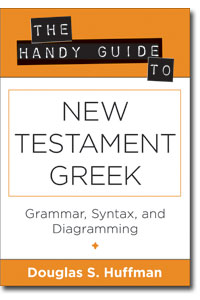
Recently my Greek reading has improved due to spending regular time refreshing my memory on verb paradigms, rules of syntax, and so on. The tool I’ve been using is Douglas S. Huffman’s Handy Guide to New Testament Greek (Kregel, 2012). Huffman’s Handy Guide consists of three parts:
“A Select Bibliography” concludes the guide and points beginning, intermediate, and advanced Greek readers to grammar texts, reading resources, diagramming helps, and more.
Handy Guide to New Testament Greek joins a number of similar little books already on the market for reviewing and retaining Koine Greek. There is Biblical Greek: A Compact Guide, a helpful and portable distillation of Mounce’s popular grammar. One might also consider Dale Russell Bowne’s Paradigms and Principal Parts for the Greek New Testament, Paul Fullmer and Robert H. Smith’s Greek at a Glance, and even the back of Kubo’s Reader’s Lexicon for its solid summary of Greek grammar with paradigm charts.
How does Huffman’s offering differ? Unlike Paradigms and Principal Parts or Greek at a Glance, the Handy Guide consists of more than simply verb paradigms or noun declension charts. It includes those, but with accompanying explanation along the way. In this regard it is similar to Mounce’s Compact Guide.
Different from Mounce, however, is the lack of any vocabulary-related helps in Huffman. It’s hard to imagine someone wanting a “handy guide” to “New Testament Greek” who doesn’t also want some treatment of vocabulary, which Mounce’s guide accomplishes nicely with its included brief lexicon. Huffman does include information about how words are formed, in his chart on comparative and superlative adjectives, for example:

But vocabulary is otherwise absent from the guide.
Part 1, “Greek Grammar Reminder,” covers everything from accents and breathing marks to nouns, adjectives, adverbs, and verb declensions. (Verb paradigm charts take up the majority of part 1.)
Huffman’s “Verb Usage Guide” (from part 2) contains a refreshing amount of detail on Greek verbs for such a short guide. For example, he lists 20 categories of participles followed by a “Participle Usage Identification Guide” to help readers of Greek texts determine what kind of participle is at hand. Part 2 also explains noun case usage. His explanations of nominative, genitive, dative, accusative, and vocative cases are short, clear, and include plenty of examples with Scripture references.
Where Huffman is really unique (and what makes this guide desirable especially for a second-year Greek student or pastor) is in his part 3 on diagramming. He briefly treats “technical diagramming” (the kind some of us had to do for English in 5th grade–showing syntactical relationships at the word level) and arcing, then moves into a rich, 22-page description of “phrase diagramming,” which looks like this:
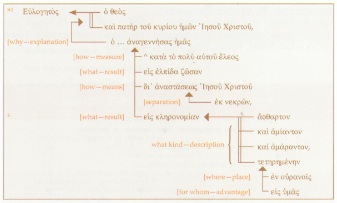
The goal of this kind of diagramming is “to grasp the writer’s general flow of thought and argument, which he has expressed in particular words and sentences” (85). Huffman’s eight steps to phrase diagramming explain the process so that even a beginner can understand it well. His “Special & Problem Issues” section is the icing on the cake of part 3.
The guide is truly “handy”; it fits nicely together with a Greek New Testament, so one can keep it close at hand. The color-coding in the paradigms is done well, so that verb endings stand out for an easy refresher course.
An unfortunate and fairly noticeable drawback to this guide, in my view, is in the layout and color scheme. The orange theme, as attractive as it looks on the cover (pictured above), gets to be an eyesore after looking at more than a page or two. It’s too bright to read comfortably, and there are charts with at least four different shades of orange.
When there is Greek in black font (in grammatical category explanations), it looks great. But the Greek in the charts in orange has a fuzzy or slightly blurry, pixelated appearance. There are also quite a few charts that are in landscape orientation (rather than the default portrait orientation), so that the reader has to flip the book sideways. That alone would not be a huge deal, but the orange was distracting to me.
Hopefully there will be demand for future printings, and hopefully future printings will make the layout and fonts more useable. And despite the omission of vocabulary, this guide has great content. Resources on sentence and phrase diagramming for Greek are few and far between, but Huffman’s guide covers that territory well, and having that coupled with quick-reference charts will help just about anyone seeking to retain and improve their biblical Greek.
Kregel sent me a copy of the book for review. Its product page is here, and it’s on Amazon here. The Table of Contents are here (pdf); read an excerpt here (pdf).
From This is Colossal:
Sound designer and composer Diego Stocco (warning: lots of sound) continues his ongoing project of making music from uncommon objects and places with this new video using loops recorded from a local dry cleaner. Stocco has also made music from a tree, from sand, and even a a bonsai, among others. Of all of them I really think this is his finest. Make sure you make it past the 2:10 mark. (via neatorama)
Here’s the video:
Sarah, Melchizedek, and the language of the Pentateuch. Last week I reviewed the articles on each of those topics in InterVarsity Press’s Dictionary of the Old Testament: Pentateuch in Logos Bible Software.
Here’s what the IVP page says about the dictionary in its book description:
The Dictionary of the Old Testament: Pentateuch is the first in a four-volume series covering the text of the Old Testament. Following in the tradition of the four award-winning IVP dictionaries focused on the New Testament and its background, this encyclopedic work is characterized by close attention to the text of the Old Testament and the ongoing conversation of contemporary scholarship. In exploring the major themes and issues of the Pentateuch, editors T. Desmond Alexander and David W.Baker, with an international and expert group of scholars, inform and challenge through authoritative overviews, detailed examinations and new insights from the world of the ancient Near East.
My first review contains an initial evaluation of the dictionary specifically in Logos Bible Software; you can read that here. In this post I summarize and briefly interact with three more articles: “Terah,” “Lot,” and “Ur.”
Terah
Terah was Abram’s father and Lot’s grandfather. He also fathered Nahor and Haran. M.W. Chavalas notes that Terah was “the family head,” since “all of the material in Genesis 11:27-25:11 is prefaced by the statement, ‘This is the family history of Terah’” (829). Chavalas considers Terah in three parts: the etymology of his name, his time in the city of Ur, and “Terah and Later Traditions.”
Chavalas considers several options for the meaning and linguistic source of “Terah,” but concludes, “An understanding of the etymology of the name Terah has proved to be difficult” (829). It does seem to have “associations with a place name in northern Mesopotamia” (830) and perhaps some associations with lunar worship (though perhaps not). Similarly, Ur, from which Terah comes, has been difficult to pinpoint. Chavalas places it in southern Mesopotamia. Chavalas finally considers the challenge that Acts 7:4 and Philo pose regarding chronology and location.
Chavalas manages to cover most of the essential territory on Terah in a short space. There is not much biblical material on Terah, but this article contains an overview of it all. There is little content in the “Terah and Later Traditions” section, and the article’s bibliography does not point to more resources to explore Abram’s father, for example, in rabbinical tradition. Detailed research on Terah would have to be supplemented with other resources.
Lot
Lot was Terah’s grandson and Abram’s nephew. J.I. Lawlor notes that Lot traveled with his grandfather Terah from Ur to Haran because his own father has died (556).
Lawlor primarily takes a literary and narrative approach to understanding Lot’s place in the Abram/Abraham material. He notes “two ‘paired sets’” of Lot material that “have been integrated, one set in each half of the Abraham story” (556). The author/compiler of Genesis does this, Lawlor notes, to “suggest and hold open the possibility of Lot as Abraham’s heir” (556), later dismissing the possibility as Isaac becomes heir (557).
Genesis 14:17-24 marks Abram’s encounter with Melchizedek, occasioned because Abram had gone to battle due to the Mesopotamian kings’ kidnapping of Lot. Abram rescued Lot in Gen. 14, then rescued him again, in a way, by interceding on behalf of Sodom and Gomorrah in Gen. 18-19 (557-8).
Due to an incestuous drunken encounter with his daughters, Lot gave rise to two groups of people, the Moabites and Ammonites, which Lawlor briefly discusses.
Lawlor’s most helpful contribution is in his situating of Lot in the larger flow of Genesis 12-19, where Lot serves as a possible answer to the question, Who will be an heir to Abram and Sarai? His reading of the “two paired sets” of Lot material is illuminating.
Ur
Like Chavalas in the “Terah” article, Osborne locates Ur in southern Mesopotamia as one of its “oldest and most famous” cities (875). Today the two-millenia old city of Ur is “modern Tell al-Muqayyar, located on the Euphrates in southern Mesopotamia” (875). Osborne looks at the archaeology of Ur as well as its place in patriarchal times.
Based on an early 20th century exploration of the tell (hill/remains) where Ur once was, archaeologists think that Ur was “not…one of the most extensive cities of its time” (875), with a population of just under 25,000. Ur was a center of lunar worship in Mesopotamia, as was Haran, where Terah would go from Ur (875). Tomb excavations have shown a wealthy city, which “was most probably derived from its lucrative involvement in trade along the Gulf” (876). Osborne also explores the debate over the birthplace of Abraham, whether it was northern or southern Mesopotamia (he favors the latter). He notes that the Genesis text does not say why Terah and his family left Ur.
Archaeology is not my primary interest within biblical studies, but Osborne introduces the basic archaeological finds to the reader in a short space, and does a good job of it. The bibliography at the end of the article offers titles for further reading.
**********
My impression of the dictionary continues to be positive. At the same time it is becoming clear to me that it is not comprehensive in the subjects it treats. So researchers, exegetes, writers, and teachers will want to consider using it alongside other resources. However, its ability to summarize much detail in a succinct way is a strong point of the dictionary.
I’ll do at least one other installment in my review of Dictionary of the Old Testament: Pentateuch, and include some concluding thoughts there. See the first part of my review here.
The Dictionary is on Amazon here (in print) and at Logos here. My thanks to Logos for the review copy.
This week in Greek Isaiah in a Year covers Isaiah 23:1-24:5.
Here is the schedule and text for Monday through Friday, using again the text from R.R. Ottley’s Book of Isaiah According to the Septuagint. Ottley is also here in Logos (reviewed here) and here as a free, downloadable pdf in the public domain. The full reading plan for our group is here (pdf).
Monday, April 1: Isa 23:1-4
Τὸ ὅραμα Τύρου
23 1 Ὀλολύζετε, πλοῖα Καρχηδόνος, ὅτι ἀπώλετο, καὶ οὐκέτι ἔρχονται ἐκ γῆς Κητιαίων· ἦκται αἰχμάλωτος. 2 τίνι ὅμοιοι γεγόνασιν οἱ ἐνοικοῦντες ἐν τῇ νήσῳ, μεταβόλοι Φοινίκης, διαπερῶντες τὴν θάλασσαν 3 ἐν ὕδατι πολλῷ, σπέρμα μεταβόλων; ὡς ἀμητοῦ εἰσφερομένου οἱ μεταβόλοι τῶν ἐθνῶν. 4 αἰσχύνθητι, Σιδών, εἶπεν ἡ θάλασσα· ἡ δὲ ἰσχὺς τῆς θαλάσσης εἶπεν Οὐκ ὤδινον, οὐδὲ ἔτεκον, οὐδὲ ἐξέθρεψα νεανίσκους, οὐδὲ ὕψωσα παρθένους.
Tuesday, April 2: Isa 23:5-9
5 ὅταν δὲ ἀκουστὸν γένηται ἐν Αἰγύπτῳ, λήμψεται αὐτοὺς ὀδύνη περὶ Τύρου. 6 ἀπέλθατε εἰς Καρχηδόνα, ὀλολύζετε, οἱ ἐνοικοῦντες ἐν τῇ νήσῳ ταύτῃ. 7 οὐχ αὕτη ὑμῶν ἦν ἡ ὕβρις ἡ ἀπʼ ἀρχῆς, πρὶν ἢ παραδοθῆναι αὐτήν; 8 τίς ταῦτα ἐβούλευσεν ἐπὶ Τύρον; μὴ ἥσσων ἐστίν, ἢ οὐκ ἰσχύει; οἱ ἔμποροι αὐτῆς ἔνδοξοι, ἄρχοντες τῆς γῆς. 9 Κύριος σαβαὼθ ἐβουλεύσατο παραλῦσαι τὴν ὕβριν τῶν ἐνδόξων καὶ ἀτιμάσαι πᾶν ἔνδοξον ἐπὶ τῆς γῆς.
Wednesday, April 3: Isa 23:10-13
10 ἐργάζου τὴν γῆν σου, καὶ γὰρ πλοῖα οὐκέτι ἔρχονται ἐκ Καρχηδόνος. 11 ἡ δὲ χείρ σου οὐκέτι ἰσχύει κατὰ θάλασσαν, ἡ παροξύνουσα βασιλεῖς· Κύριος σαβαὼθ ἐνετείλατο περὶ Χανάαν ἀπολέσαι αὐτῆς τὴν ἰσχύν. 12 καὶ ἐροῦσιν Οὐκέτι μὴ προσθῆτε τοῦ ὑβρίζειν καὶ ἀδικεῖν τὴν θυγατέρα Σιών· καὶ ἐὰν ἀπέλθῃς εἰς Κητιείμ, οὐδὲ ἐκεῖ σοι ἀνάπαυσις ἔσται· 13 καὶ εἰς γῆν Χαλδαίων, [ἣ] καὶ αὕτη ἠρήμωται ἀπὸ τῶν Ἀσσυρίων, οὐδὲ ἐκεῖ σοι ἀνάπαυσις ἔσται, ὅτι ὁ τοῖχος αὐτῆς πέπτωκεν.
Thursday, April 4: Isa 23:14-18
14 ὀλολύζετε, πλοῖα Καρχηδόνος, ὅτι ἀπώλετο τὸ ὀχύρωμα ὑμῶν. 15 καὶ ἔσται ἐν τῇ ἡμέρᾳ ἐκείνῃ καταλειφθήσεται Τύρος ἔτη ἑβδομήκοντα, ὡς χρόνος βασιλέως, ὡς χρόνος ἀνθρώπου· καὶ ἔσται μετὰ ἑβδομήκοντα <ἔτη> ἔσται Τύρος ὡς ᾆσμα πόρνης. 16 λάβε κιθάραν, ῥέμβευσον, πόλις πόρνη ἐπιλελησμένη, καλῶς κιθάρισον, πολλὰ ᾆσον, ἵνα σου ἡ μνεία γένηται. καὶ ἔσται μετὰ ἑβδομήκοντα ἔτη ἐπισκοπὴν ποιήσει ὁ θεὸς Τύρου, καὶ πάλιν ἀποκαταστήσεται εἰς τὸ ἀρχαῖον, 17 καὶ ἔσται ἐμπόριον πάσαις ταῖς βασιλείαις τῆς οἰκουμένης. 18 καὶ ἔσται αὐτῆς ἡ ἐμπορία καὶ ὁ μισθὸς ἅγιον τῷ Κυρίῳ, οὐκ αὐτοῖς συναχθήσεται ἀλλὰ τοῖς κατοικοῦσιν ἔναντι Κυρίου, πᾶσα ἡ ἐμπορία αὐτῆς, φαγεῖν καὶ πιεῖν καὶ ἐμπλησθῆναι, εἰς συμβολὴν μνημόσυνον <ἔναντι Κυρίου>.
Friday, April 5: Isa 24:1-5
24 1 Ἰδοὺ Κύριος καταφθείρει τὴν οἰκουμένην, καὶ ἐρημώσει αὐτήν, καὶ ἀνακαλύψει τὸ πρόσωπον αὐτῆς, καὶ διασπερεῖ τοὺς ἐνοικοῦντας ἐν αὐτῇ. 2 καὶ ἔσται ὁ λαὸς ὡς ὁ ἱερεύς, καὶ ὁ παῖς ὡς ὁ κύριος, καὶ ἡ θεράπαινα ὡς ἡ κυρία· ἔσται ὁ ἀγοράζων ὡς ὁ πωλῶν, καὶ ὁ δανίζων ὡς ὁ δανιζόμενος, καὶ ὁ ὀφείλων ὡς ᾧ ὀφίλει. 3 φθορᾷ φθαρήσεται ἡ γῆ, καὶ προνομῇ προνομευθήσεται ἡ γῆ· τὸ γὰρ στόμα Κυρίου ἐλάλησεν ταῦτα. 4 ἐπένθησεν ἡ γῆ, καὶ ἐφθάρη ἡ οἰκουμένη, καὶ ἐπένθησαν οἱ ὑψηλοὶ τῆς γῆς. 5 ἡ δὲ γῆ ἠνόμησεν διὰ τοὺς κατοικοῦντας αὐτήν, διότι παρέβησαν τὸν νόμον καὶ ἤλλαξαν τὰ προστάγματα Κυρίου, διαθήκην αἰώνιον.
See here for more resources and links to texts for Greek Isaiah.
And here are the Week 18 readings above, in pdf form.


 Words on the Word