
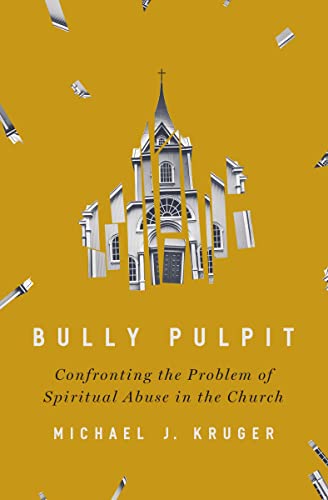
New Testament scholar Michael J. Kruger didn’t expect to write a book about spiritual abuse in the church, but—a couple of chapters in to his new book Bully Pulpit—I’m glad he did.
Kruger says:
I never expected to write a book on Christian leadership. And I certainly never expected to write this one. After all, my prior writing projects have been more on the academic side of the spectrum—mainly on early Christianity and the origins of the New Testament—and not on practical aspects of Christian ministry.
But what does any of us really know about what God might some day call us to? In lines that resonate with me, he goes on:
But sometimes God leads you down pathways you never imagined you would take. And sometimes you do things not because you want to but because they need to be done.
I know the feeling: I could only write each of these posts after firsthand and secondhand experience.
Bully Pulpit’s sub-title is: Confronting the Problem of Spiritual Abuse in the Church. Here’s Kruger’s definition of spiritual abuse:
Spiritual abuse is when a spiritual leader—such as a pastor, elder, or head of a Christian organization—wields his position of spiritual authority in such a way that he manipulates, domineers, bullies, and intimidates those under him as a means of maintaining his own power and control, even if he is convinced he is seeking biblical and kingdom-related goals.
Then he unpacks the definition:
- “Spiritual abuse involves someone in a position of spiritual authority” (more on this below)
- “Spiritual abuse involves sinful methods of controlling and domineering others” (i.e., the abuser is hypercritical, cruel, threatening, defensive, manipulative)
- “Spiritual abusers seem to be building God’s kingdom (but are really building their own)”—this allows for an important intent vs. impact distinction
Kruger notes that defining spiritual abuse can be tricky, but that shouldn’t keep us from trying:
But sins that are more difficult to spot are still sins. Pride may be one of the worst sins, and yet it is remarkably difficult to prove in any given individual. Yet if such difficult-to-spot sins would disqualify a person from ministry (1 Tim. 3:3; Titus 1:7; 1 Peter 5:3; 2 Tim. 2:24), then the church is obligated to assess them even if the task of doing so requires more nuance and care. Can the church ignore these requirements merely because they are more subjective than others? One might argue that the pileup of churches wrecked by domineering leaders over the last decade shows that the church needs to do better in this area. We have ignored these requirements at our peril.
One element I especially appreciate in Kruger’s definition of spiritual abuse is that the abuser can be a person “in a position of [any] spiritual authority.” The abuser may not be in a positional of formal authority in the church, in other words. Their power may come from years of spiritual influence in a congregation. They may be a beloved church musician with informal authority but lots of power. They may be a long-serving elder or lay leader or popular Sunday school teacher who has waited out multiple pastors over the decades.
Kruger will come to focus, I think, on lead pastors or organization heads. This is as it should be, although I eagerly await someone’s book on spiritual abuse perpetuated from the so-called second chair–and the pew.
Either way, whoever spiritually abuses does so because they have spiritual power in a community, and they take drastic, hurtful measures to maintain it.
Jesus’s “Not so with you!” is a great refrain already in Kruger’s book. He will build to a positive vision of “creating a culture that resists spiritual abuse.”
For now, though, I’m grateful for his delineating what spiritual abuse is, since it offers shared, specific language for a practice that causes real and lasting harm.

 Words on the Word