
I enjoyed presenting and discussing the HOPE framework with a group at the Medford Public Library last night!
HOPE stands for Healthy Outcomes from Positive Experiences. While Adverse Childhood Experiences (ACEs) correlate with poor mental health in adulthood, Positive Childhood Experiences (PCEs) correlate with good mental health in adulthood.1
And PCEs may serve a protective function: even in the presence of ACEs, they correlate with better mental health outcomes.
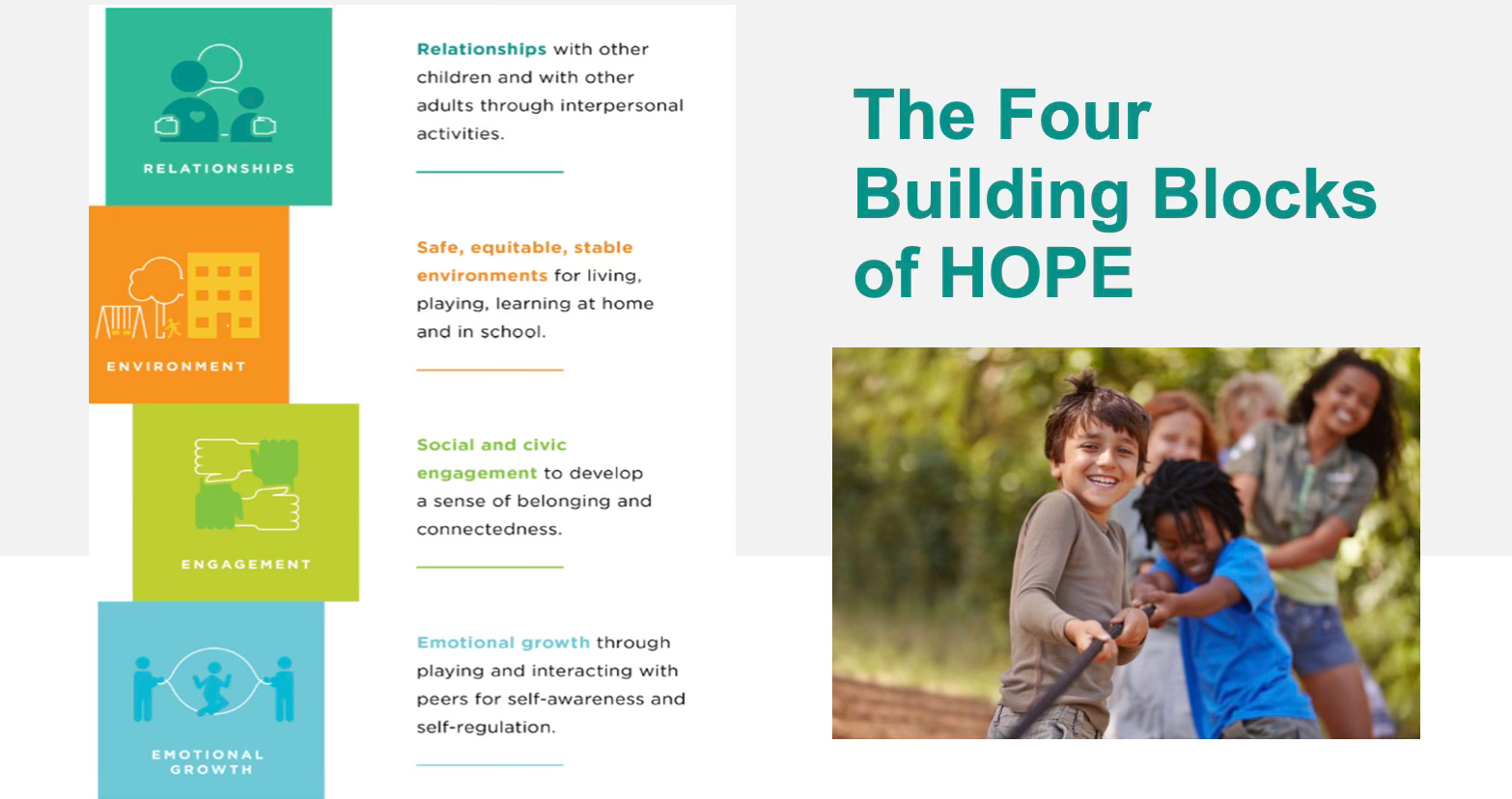
These are the four building blocks of the HOPE framework, all PCEs we want to promote:
As much as I love presenting this good news, I was even more encouraged to hear how folks in the group were already bringing these building blocks to life in their day-to-day.
You can read more about HOPE here.

The above is cross-posted at Healing Pastors.
- I noted last night and note again now: ACEs are not necessarily determinative of any outcome. Correlation is not causation blah blah blah, but more important, we don’t want to be fatalistic about folks’ future… even while we look with great compassion and trauma-sensitivity on their past. ↩︎


Wow, Abram! I bumped into you through RL Stollar’s blog and seeing your response to his latest post yesterday. Nice to make your (vague) acquaintance.
I had never heard of HOPE or PCEs before. I only heard of ACEs maybe six months ago or so and they kind of “broke” me. I, myself, preached a sermon in which I listed the ACEs and, as I did so, one of the men in the congregation kept lifting his hand: “Yep. That one. . . . And that one, too!” Every one. It devastated me.
I have been trying to put together a thorough list of assets a person or family might possess. My list was growing longer and longer and more complex. I listed PERSONAL capital (from personality structure and temperament, to values, convictions and core commitments, to strengths, giftings and capacities, to motivations, drive and sense and use of personal agency, to self-awareness and internal insights. . . . The list of forms of Personal capital continues); MENTAL / INTELLECTUAL capital; SOCIAL / RELATIONAL capital; SPIRITUAL capital; MORAL / ETHICAL capital; CHRONOLOGICAL / TEMPORAL capital; NATURAL MATERIAL and/or ENVIRONMENTAL capital; CULTURAL / ARTISTIC capital; LEGAL capital; ECONOMIC / FINANCIAL capital; GEOGRAPHICAL / POSITIONAL capital; RECREATIONAL capital; FAMILY CONTINUITY capital. . . .
In every case, it seemed one could have more or less of this, that, or the next thing. The more you have of this, that, or the next thing, the wealthier you are, the less you have, the poorer you are.
But then, a little over a year ago, while reading Danny Silk’s Culture of Honor, I bumped into Ruby K. Payne’s A Framework for Understanding Poverty. She presented me with a whole new set of items I could account for in my list of potential assets. Except, for the first time, I was aware of what I am now calling “negative” capital—“negative,” “inverse,” or “adverse” assets: items, the more of which one possesses, the less wealthy you are. Indeed, I want to call out their effects for what they are: these kinds of “assets” actively impoverish you; they make it harder for you to acquire positive wealth. These things—ACEs being some of them—create massive drag on your life. They suck your personal, spiritual, chronological/temporal (and every other form of positive capital one might form) directly away from you. . . .
I had never thought to look for PCEs that might neutralize or, even (possibly?) heal ACEs. . . .
Thanks for this post. It does, indeed, bring me hope!
Hi, John! Thanks so much for this comment and the encouragement and great connections you make here. If your sermon re: ACEs is online, I’d love it if you posted it here in the comments so I can check it out. I’m going to look at the resources you suggest, too.
Speaking of assets–are you familiar with Search Institutes work on (40) developmental assets? https://searchinstitute.org/resources-hub/developmental-assets-framework
You’ve given me (and others reading) a lot of good stuff to think about here! I’ll be coming back to this comment to think about it some more.
!!! No. I had not heard of Search Institute. What a great list! Thank you for that resource!
I’m a member of a very small, semi-formed congregation on the island of Ambergris Caye in Belize. The last two weeks, fewer than 10 people were present. The most I have ever seen were about 30. Every now and then, the founding pastor, a recovering alcoholic and drug addict who turned his life over to Jesus about 12 years ago, asks me to preach.
I happened to record my ACEs sermon: “God’s Loving Fatherhood,” based on Zephaniah 3:17-18 and inspired by Jim Wilder’s Growing a More Human Community, Vol 1, Growing ME: Becoming a Child. I have not posted it anywhere online. Though maybe I can store it on Dropbox and create a link. . . .