Some good advice here: before you preach a book of the Bible, try to live “inside” it first.
In line with the way one ought to prepare to preach any book of the Bible, the preacher needs to live inside a Gospel for a while before trying to preach any part of it. Reading it through at a single setting, several times, is a great way to begin; for those who have the training, working carefully through the text in Greek during preceding months will prove personally rewarding and homiletically enriching.
Even though Zacchaeus was “a wee little man”–he was not “wee” or “little” in terms of his financial standing.
Luke 19:1-2 Jesus entered Jericho and was passing through. A man was there by the name of Zacchaeus; he was a chief tax collector and was wealthy.
He was “a chief tax collector” and he “was wealthy.” Those two things are actually three strikes against Zacchaeus.
Strike one: He was a tax collector.
Tax collectors made out pretty well in Jesus’ day. They contracted with the Roman state to collect taxes from their fellow Jews. As long as the tax collectors paid the Romans a certain amount, they could charge whatever commission they wanted.
Strike two: He was a chief tax collector.
A chief tax collector oversaw other tax collectors. Zacchaeus had a prime position.
There was really little regulation here. This is sort of like pre-2008 subprime mortgage lending. Only it’s worse, because Zacchaeus as chief tax collector has a lot of other tax collectors doing the dirty work for him. And not only are they getting rich from people’s hard-earned cash, they’re even giving some of it to an imperial power–Rome. And who knows what non-kosher godlessness that money is going to!
Strike three: Zacchaeus was rich.
He was a tax collector, he was a chief tax collector, and he was rich. There’s nothing wrong with being rich, of course, but generally in Luke’s Gospel, the rich people Jesus meets have a hard time loving God on account of all their money.
Zacchaeus got rich off of other people’s money. Think: Ebenezer Scrooge.
As with the tax collector last week, the listeners expect this chief tax collector to be the antagonist.
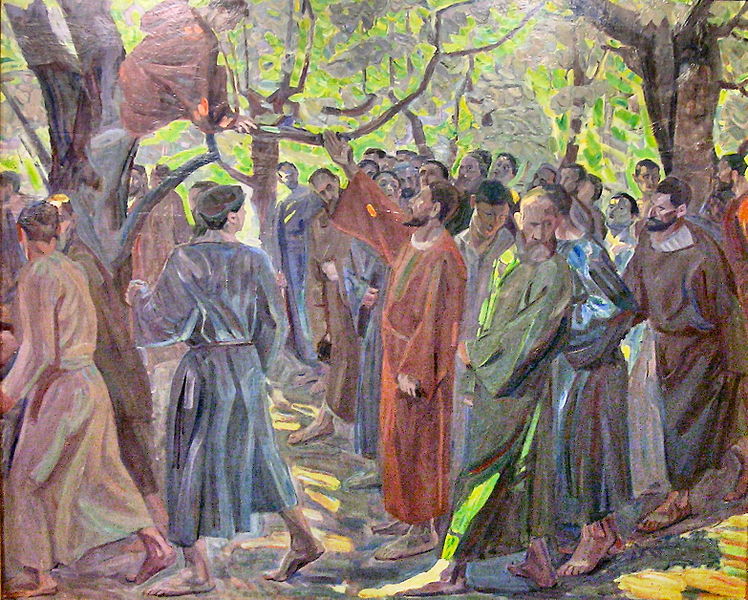
So it’s no surprise in verse 3 when Zacchaeus can’t see Jesus. Sure, he’s short–probably not even 5 feet tall–but even if he were 6 feet tall, I’ll bet the crowd wouldn’t have made way for a guy like him.
Luke 19:3 He wanted to see who Jesus was, but being a short man he could not, because of the crowd.
Source: Adrienne Lavidor-Berman (Boston Globe)
These people are waiting to see Jesus! This is even more exciting than watching Big Papi and the Red Sox get on a duck boat! No way they’re going to make room for Zacchaeus.
The crowd blocks his line of sight. But Luke says he wanted to see Jesus. He seems to have these three strikes against him, but maybe this is a bit of character development here? Another translation says, “He wanted to see Jesus, who he was.”
He wants to figure out who Jesus is. He’s interested. He’s what church growth gurus in the 1980s and 90s referred to as “a seeker.”
The Motif of Urgency
Luke 19:4 So he ran ahead and climbed a sycamore-fig tree to see him, since Jesus was coming that way.
Zacchaeus runs ahead. He seems to be eager to see Jesus.
It wasn’t until I’d read this passage at least a dozen times and went for a long walk that I picked up on this motif of urgency.
The story picks up the pace at this point. Jesus is on his way to Jerusalem. He’s about to die. And rise again. He’s aware of what’s coming; his disciples are not, really.
But this is Jesus’ last face-to-face encounter till he gets to Jerusalem. So Luke as a writer is going to pack in as much as he can.
We’ve got lots of Luke’s themes here:
Wealth can keep you from God, or you can use it to worship him and serve others
Belief in God always leads to action and compassion for others
Jesus came to save the lost
God is a seeker, who goes after the ones he loves
In Luke this is a sort of final crescendo to close out this movement, before Jesus’ triumphal entry into Jerusalem, and then the events of Holy Week. All those themes are here, and Luke the storyteller notes that they are all important–urgently important.
verse 4: Zacchaeus runs ahead
verse 5: Jesus tells him to come down immediately…
verse 5 again: Jesus must stay at his house today
verse 6: Zacchaeus comes down at once
verse 8: Zacchaeus re-directs his giving and quits his cheating ways, and he metes out this retributive justice “here and now,” he says
“Today,” Jesus says in verse 9, “salvation has come to this house”
So keep that motif in mind as we work through the rest of the passage. Zacchaeus runs up the tree, and Jesus sees him.
Jesus Invites Himself Over
Luke 19:5b “Zacchaeus, come down immediately. I must stay at your house today.”
This culture valued hospitality, but there are still ways to do hospitality and ways not to do it. What you don’t do is invite yourself over to someone’s house. That’s still true today.
But Jesus has to–Jesus must–stay at his house. Forget the conventions of hospitality. Forget the conventions of not eating with unclean sinners. Forget that Zacchaeus was a traitor and that there were some in the crowd who just wanted Jesus to be Che Guevera and overthrow Rome.
How does Jesus know Zacchaeus’s name? Luke doesn’t tell us. Jesus other knew him through divine omniscience or through Zacchaeus’s reputation. But he’s got to get to Zacchaeus’s house.
Why? We’ll come to that in a bit.
Already we’re struck by Jesus’ offer of fellowship. His offer to fellowship with him is a standing offer, but as with Zacchaeus, it’s also an offer he wants us to take him up on right now. This very day. This very minute. Jesus wants to come to us, to enter the homes of our hearts and minds, and have communion with us.
God calls the ones he has made good. And when we go bad–as Zacchaeus did–he does not turn away from us, but continues to pursue us, and invite himself into our homes, our work, our daily routines, our lives.
Zacchaeus models a response to Jesus. He comes down with the same urgency Jesus had in calling him.
Luke 19:6 So he came down at once and welcomed him gladly.
He receives Jesus into his home as an esteemed guest. No delay. There’s not putting it off till another time. Zacchaeus comes down have fellowship with Jesus right now.
The people in the crowd don’t like this, of course.
Luke 19:7 All the people saw this and began to mutter, “He has gone to be the guest of a ‘sinner.’”
They grumble against Jesus. But haven’t they figured out by now that this is the sort of thing Jesus does? Have we learned that yet?
Zacchaeus’s Immediate Response
And then, more urgency:
Luke 19:8 But Zacchaeus stood up and said to the Lord, “Look, Lord! Here and now I give half of my possessions to the poor, and if I have cheated anybody out of anything, I will pay back four times the amount.”
Right now–on the spot, Zacchaeus pays it all back. Retributive justice, it’s called. He makes amends in a way that is appropriate to the crime. Redistribution of ill-gotten wealth was the only way for him to do this.
Saint Augustine once wrote of grace that it “is bestowed on us, not because we have done good works, but that we may be able to do them.”
This is another side of the coin when we consider last week’s tax collector and his uttered prayer. “God, have mercy on me, a sinner.” This prayer of faith made him right with God, Jesus said. Here, there is action, which always accompanies belief. Salvation has come, Jesus says, and that is evident because of what Zacchaeus is doing with his money.
He literally puts his money where his mouth is. His profession of faith is only truly complete as he acts on it. And he acts on it “here and now.”
He held his money loosely. He embodied that offertory prayer: “All things come from thee, O Lord, and of thine own have we given thee.”
Zacchaeus is going to lose a ton of money here–and think of all the logistics in making sure everyone gets repaid properly.
But no matter–he is eager to express his love toward God through his vocation and his giving.
Luke 19:9-10 Jesus said to him, “Today salvation has come to this house, because this man, too, is a son of Abraham. For the Son of Man came to seek and to save what was lost.”
Remember how Jesus said, “I must stay at your house today”? Or, as another translation puts it, “It is necessary” for Jesus to stay?
This is because Jesus’ fellowship with Zacchaeus was “mission-critical.” It was the core of Jesus’ mission to “seek and to save what was lost.” He’s doing that here. He has done that here. He sought Zacchaeus, and saved him– “Today salvation has come to this house.”
Zacchaeus did his part, of course–he climbed a tree, pledged to give back money he had extorted from people.
But Jesus is the ultimate initiator, I think. He could have passed by that tree… pretended not to see Zacchaeus.
The Prodigal Son Returns, Rembrandt
“The Son of Man [Jesus] came to seek and to save what was lost.”
The 1 sheep, lost and wandering away from the other 99. The 1 coin, lost on a dusty floor. The 1 son, lost in his youthful rebellion and waywardness. A despised chief tax collector. Prostitutes. People with diseases. Gentiles. You. Me. Jesus comes to seek and to get all of these.
Our Mission with Jesus
Jesus’ mission is “to seek and to save what was lost.”
This has now become the mission of the church, as the visible expression of Jesus’ body on earth.
Faith and action go hand in hand, as they did with Zacchaeus. For him, following Jesus necessarily entailed that he do all he could to bring about justice. The kingdom ethics of Jesus transformed the way he thought about his business relationships. It revolutionized the way he worked.
Zacchaeus responded to Jesus immediately. There was a sense of urgency in his desire to make things right before God.
And he responded to Jesus with joy.
May we be inspired by this unlikely hero. Zacchaeus allowed his whole life to be transformed by his encounter with Jesus, in the very moment of Christ’s coming to him. Salvation has come to our house today. Let’s receive him with joy.
The above is adapted from the sermon I preached this Sunday on Luke 19:1-10, covering the story of Zacchaeus’s encounter with Jesus. All Scripture quotations come from the NIV (1984). See my other sermons, if you desire, here.
“Lord Jesus Christ, Son of God, have mercy on me, a sinner!”
“Lord Jesus Christ, Son of God, have mercy on me, a sinner!”
“Lord Jesus Christ, Son of God, have mercy on me, a sinner!”
It’s a surprising source, but I have J.D. Salinger to thank for introducing me to the Jesus Prayer in his book Franny and Zooey.
“Lord Jesus Christ, Son of God, have mercy on me, a sinner!”
In a simplified form, that is the prayer of the tax collector in Jesus’ parable of the Pharisee and the tax collector (Luke 18:9-14): “God, have mercy on me, a sinner.” It has become known as the Jesus Prayer.
The tax collector is a model for prayer, though if this character in Jesus’ story were worshiping with us today, he’d never let us hold him up as an exemplar.
Two Guys Walk into the Temple to Pray….
Luke 18:9 To some who were confident of their own righteousness and looked down on everybody else, Jesus told this parable:
Note the phrases, “confident of their own righteousness” and, “looked down on everybody else.”
The Old Testament prophet Isaiah speaks of such people:
They say, “Keep to yourself!
Don’t get near me, for I am holier than you!”
These people are like smoke in my nostrils,
like a fire that keeps burning all day long. (Isa 65:5)
Luke 18:10 Two men went up to the temple to pray, one a Pharisee and the other a tax collector.
Of these two men, who do the listeners think is going to be the hero? The Pharisee. Just about everyone hated tax collectors.
Oh, this is going to be good, the self-righteous listeners must have thought. Jesus is about to validate us, as he should!
Jesus isn’t out to bash Pharisees with this parable. We have to be careful about this as we read the Gospels. In fact, as one commentator points out, “The Pharisees were admired by the common folk for their piety and devotion to the Mosaic Law. Our contemporary equation of Pharisaism with hypocrisy would not have been made by a first-century Jew.”
It’s the same kind of setup as you get in the Good Samaritan parable–the religious person ends up showing us what not to do, while the real sinner becomes the example.
God Is Lucky to Have Him
Luke 18:11 The Pharisee stood up and prayed about himself: “God, I thank you that I am not like other men—robbers, evildoers, adulterers—or even like this tax collector.
Some of the listeners in the audience are saying, “Amen! Good prayer! Jesus gets it!”
This Pharisee starts his prayer out in the right way–“God, I thank you,” a typical beginning to Jewish prayers.
But it never really was an actual thanking of God for who God is. It was a thanking of God for who the Pharisee was.
He’s at the temple praying, standing up. This is a posture that suggests he was praying for others to hear him.
Note that it says he “prayed about himself.” This is much more soliloquy than prayer. Dear God–but enough about you. Here’s who I am and what I bring to the table. He mentions God, prays to him, but God quickly becomes just a footnote in the prayer. He continuses:
Luke 18:12 “I fast twice a week and give a tenth of all I get.”
What a good, religious guy! No, really–he is living an exemplary life, in terms of spiritual practices.
And he might well be sincere in his fasting and tithing. His fasting twice a week was more than was required. Designating a tenth of everything to God is an Old Testament practice that many continue today when they consider financial giving to their churches.
But he’s missing the point.
The primary subject and actor in this prayer is… the one praying. Not the one he prays to.
He addresses his prayer to “God,” but after that, he thanks God for who he is not. He’s telling God what he’s doing for God, and he’s also making sure to remind God of how rotten these other people are. God, you’re lucky to have me!
This guy’s understanding of himself is interesting to me. He defines himself before God in two primary ways:
(a) who he is not (these other people) and
(b) what he has done.
The guy has identity issues. Can he only be secure in himself by putting others down? Or maybe he’s a little more sincere than that. Maybe he’s like the older brother in the Prodigal Son story–he does his duty, says his prayers, fasts, tithes… but the people around him are moral slackers. And he just can’t stand it.
He’s still missing the point. The despised tax collector, however, really does get it.
He Can’t Even Look at God
The Pharisee and the Tax Collector, by Gustave Doré (1832–1883)
Luke 18:13 But the tax collector stood at a distance. He would not even look up to heaven, but beat his breast and said, “God, have mercy on me, a sinner.”
With the Pharisee, the primary subject and actor in his prayer was… the one praying. The subject and primary actor in this prayer is God. “God, have mercy on me, a sinner.”
That’s it. It’s much shorter prayer than the Pharisee’s prayer.
Before he even prays, he beats his chest, a sign of lament. He did not stand where everyone could see him. The Message version says he was “slumped in the shadows.”
Clearly he was “supposed to” be the antagonist of the story. A tax collector was in collusion with the Roman occupiers. Assuming he was Jewish, he took money from his own people to pay a foreign power, often with a kickback for himself.
He knows he’s supposed to be the antagonist in the story–he knows his sin too well. He confesses his sin to God.
An Old Testament prayer goes: “O my God, I am too ashamed and embarrassed to lift my face to you, my God, for our iniquities have risen higher than our heads, and our guilt has mounted up to the heavens” (Ezra 9:6).
But God–and all the listeners to this story knew this–God is a God who forgives wrongdoings. He welcomes the wayward sinner home.
Jesus concludes:
Luke 18:14 “I tell you that this man, rather than the other, went home justified before God. For everyone who exalts himself will be humbled, and he who humbles himself will be exalted.”
Remember how the story started? “To some who were confident of their own righteousness and looked down on everybody else, Jesus told this parable.”
They were confident in their own righteousness, their own right standing, their peace with God. But, look, Jesus says, you don’t get that from yourself, so stop trying. If you hold yourself up as righteous, you’ll humbled. But if you are humble, you will be exalted–not a sort of fame or glory with other people, but if you are humble, you will be truly justified before God. You will have peace with God.
“God, have mercy on me, a sinner.”
Where We Fit in the Parable
One writer (quoting another for the first portion below) says that because we know the end of the story:
“We identify with the tax collector and feel silent gratitude that we are decent and humble rather than being self-righteous like that shameful Pharisee.” We can be like the Sunday school teacher who goes through the lesson and says at the end, “Now, children, let us bow our heads and thank God we are not like that Pharisee.”
And that’s one of our reactions reading this text, isn’t it?
Well, yeah, I’d never actually name people in my prayer and say, “God, thank you that I’m not like him or her or those people.” And maybe that’s true. Maybe we don’t explicitly pray prayers like that, certainly not out loud.
But we might think thoughts like that. This same loathing of others that the Pharisee brings to God… we may do this in more subtle ways.
We might smugly watch the people going for long walks on a Sunday morning while we drive to church. We might watch the way a parent scolds their child and think: well, I would never do anything like that. We might work hard in the office or even here at the church, and secretly resent those who don’t seem to be as productive as we are. Or we might just look at someone with pseudo-pity and say to ourselves, “I am sure glad I don’t have to be that person.”
“God, have mercy on me, a sinner.” This is the sort of attitude, the kind of prayer that brings us into fellowship with God.
This prayer, in various forms, has inspired people ever since the tax collector prayed it. Ironically enough–the prayer of this humble man has been exalted and used by many.
What Salinger’s Franny Knew About Prayer
J.D. Salinger first wrote Franny and Zooey in the late 1950s as two separate shorts in The New Yorker magazine. Franny is a college student who is becoming disillusioned with college–not with her studies, per se, but with other college students. She thinks they’re fake, shallow, and egotistical. Her boyfriend Lane isn’t much better.
He’s a name-dropper, a complainer. He boasts in his own achievements–his good grades and his upcoming paper he’s going to publish. He’s sort of like the Pharisee in the parable.
What Franny read
Franny is in the middle of an existential crisis. At the recommendation of a prof, she’s been reading The Way of a Pilgrim, a 19th century Russian story about a pilgrim who wants to know how to “pray without ceasing,” as one verse says. He finally finds a spiritual advisor who tells him to repeatedly pray a version of the tax collector’s prayer: “Lord Jesus Christ, Son of God, have mercy on me, a sinner.” The idea is to make this prayer move from the lips to the heart, so that, as Salinger puts it, the prayer “becomes an automatic function in the person, right along with the heartbeat.”
Franny has been experimenting with the prayer, and at the end of the story, she faints. When she comes to, with boyfriend Lane by her side, she is mouthing the words: “Lord Jesus Christ, Son of God, have mercy on me, a sinner.”
Various Christian traditions suggest praying the prayer repeatedly, as the Russian pilgrim did, and as Franny tried to do.
As one devotes 5, 15, then 30 minutes to praying this prayer, different words stand out each time. Jesus Christ is Lord. Jesus is the Son of God. I am a sinner. Mercy–Jesus has mercy on us, or shows us grace when we don’t deserve it. “Lord Jesus Christ, Son of God, have mercy on me, a sinner.”
Some recommend breathing in as you pray the first half of the prayer–inhale with “Lord Jesus Christ, Son of God,” then exhale as you pray the second half–”have mercy on me, a sinner.” You internalize this prayer, so that its words become as natural to you as breathing.
But humility is a tricky thing. Just as soon as we think we are humble, we are tempted to congratulate ourselves on our humility. Maybe not loudly, but quietly. So we cling to the message of this parable, summarized elsewhere in Scripture: “God opposes the proud, but gives grace to the humble.”
I wonder if Salinger’s character Franny knew that: even as she saw occasion to criticize shallowness and inauthenticity around her, she clung to the prayer of humility. It moved from her lips to her heart. It became not just a prayer, but a posture. It wasn’t a formula, but her very breath.
It is Christ’s mercy, his “unmerited favor,” as some have defined it, that sets us right with God. We remind ourselves of that mercy each time we confess our sins and call on God for his aid.
“Not to us, Lord, not to us, but to your name be the glory.” (Ps. 115:1)
The above is adapted from the sermon I preached today on Luke 18:9-14, covering the Parable of the Pharisee and the Tax Collector. All Scripture quotations come from the NIV (1984). See my other sermons, if you desire, here.
With St. Francis of Assisi, another patron saint of Italy
“When my goodness saw that you could be drawn in no other way, I sent him to be lifted onto the wood of the cross. I made of that cross an anvil where this child of humankind could be hammered into an instrument to release humankind from death and restore it to the life of grace. In this way he drew everything to himself: for he proved his unspeakable love, and the human heart is always drawn by love.”
–Catherine of Siena (1347-1380)
We are spending six weeks in our adult Sunday School with Foster and Smith’s Devotional Classics book. Here are the writers we’ve looked at each session:
“If the worth of our prayer life depended upon the maintenance of a constant high level of feeling or understanding, we would be in a dangerous place. Though these often seem to fail us, the reigning will remains. Even when our heart is cold and our mind is dim, prayer is still possible to us.”
–Evelyn Underhill (1875-1941)
For the first six weeks I am teaching/leading adult Sunday School at my church. We are spending those six weeks with Foster and Smith’s Devotional Classics book. Here are the writers for each session:
Week 4: Apocryphal Literature
(This is not in Devotional Classics. But we’ll look at Ecclesiasticus (Sirach), Wisdom of Solomon, and the Prayer of Manasseh.)
Week 5: Catherine of Siena
Week 6: Kathleen Norris
Each week we do a short bio of the writer, some reading, some discussion, and some prayer.
“Your mind is a beautiful thing. Learn to trust it less and you’ll make better use of it.”
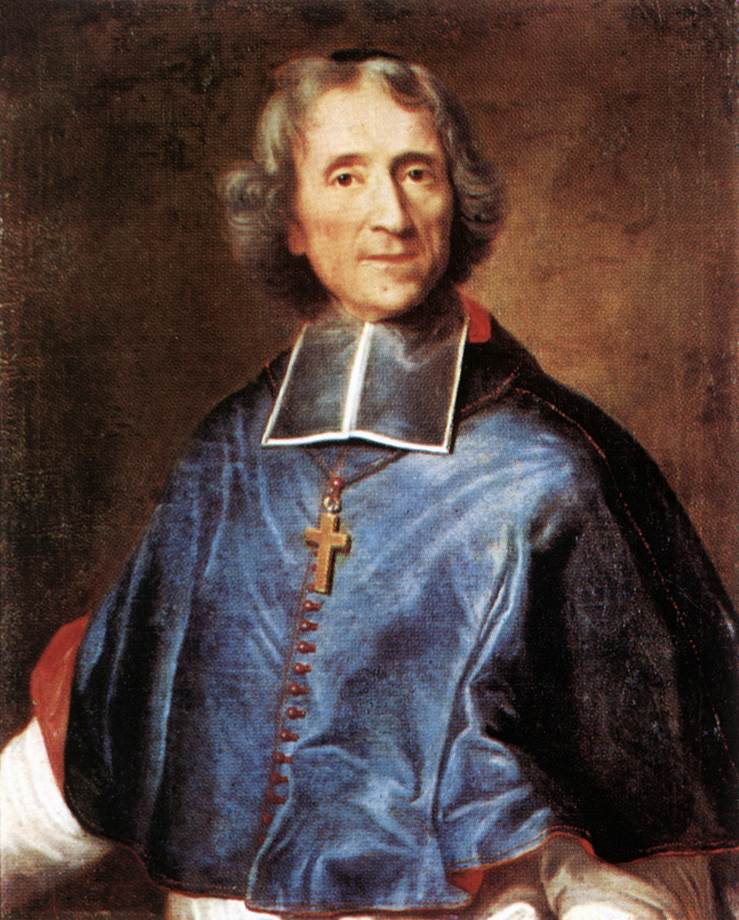
So went my introduction some dozen years ago to François Fénelon, royal tutor, priest, archbishop, and wise theologian.
For the first six weeks I am teaching/leading adult Sunday School at my church. We are spending those six weeks with Foster and Smith’s Devotional Classics book. Here are the writers for each session:
Week 4: Apocryphal Literature
(This is not in Devotional Classics. But we’ll look at Ecclesiasticus (Sirach), Wisdom of Solomon, and the Prayer of Manasseh.)
Week 5: Catherine of Siena
Week 6: Kathleen Norris
Each week we do a short bio of the writer, some reading, some discussion, and some prayer.
Yesterday we started fall Sunday School. For the first six weeks I am teaching/leading the adult class. We’ll spend those six weeks with Foster and Smith’s Devotional Classics book. Here are the writers for each session:
Week 1: St. Augustine
Week 2: François Fénelon
Week 3: Evelyn Underhill
Week 4: Apocryphal Literature
(This is not in Devotional Classics. But we’ll look at Ecclesiasticus (Sirach), Wisdom of Solomon, and the Prayer of Manasseh.)
Week 5: Catherine of Siena
Week 6: Kathleen Norris
The first class covered Augustine and his Confessions. They key quote (which also serves as an (if not the) overriding theme of the book) is the best-known one, which comes from Book I, chapter 1, first paragraph:
Can any praise be worthy of the Lord’s majesty? How magnificent his strength! How inscrutable his wisdom! Man is one of your creatures, Lord, and his instinct is to praise you. He bears about him the mark of death, the sign of his own sin, to remind him that you thwart the proud. But still, since he is a part of your creation, he wishes to praise you. The thought of you stirs him so deeply that he cannot be content unless he praises you, because you made us for yourself and our hearts find no peace until they rest in you.
That’s Pine-Coffin’s translation (with the now outdated generic “he” and “man”). Italics represent Scripture quotations.
Each week we’ll do a short bio of the writer, some reading, some discussion, and some prayer.
The following is adapted from the sermon I preached today on Luke 15:1-10, covering the Parable of the Lost Sheep and the Parable of the Lost Coin.
Luke 15:1 Now the tax collectors and “sinners” were all gathering around to hear [Jesus].
The tax collectors and “sinners” in Luke 15 were about as despised as you could get. Tax collectors were sometimes mentioned in the same sentence as prostitutes. Continue reading “Hound of Heaven on Our Trail”→
The recipients of Hebrews had a good history of hospitality. The author of Hebrews encourages them to keep it up:
Heb 13:1-2 Keep on loving each other as brothers. Do not forget to entertain strangers, for by so doing some people have entertained angels without knowing it.
Love each other as brothers and sisters. There’s one word for this that the author uses, and it’s a word that most people know–philadelphia. Brotherly (or sisterly) love. Think of the city of Philadelphia. Filial love–it’s the love that family members show to each other.
Every time philadelphia shows up in the New Testament (Rom. 12:10; 1 Thess. 4:9; Heb. 13:1; 1 Pet. 1:22; 2 Pet. 1:7), it’s in a letter addressed to Christians, telling them to love each other. It’s the kind of love a family shows to each other. In this case, it’s the family of God. In fact, the New Testament does kind of a new thing in using this word. In other Greek literature up to this point, philadelphia was just used to refer to a literal family, for example, the bond that brothers and sisters share from nursing at the same breast.
When we are in Christ, we become part of the family of God. We are really brothers and sisters. So let’s love each other like that, Hebrews says.
And yet, don’t forget about the “strangers,” too. It will be a stunted love if we just show love to the family, to those who are “one of us.”
Do not forget to entertain strangers, for by so doing some people have entertained angels without knowing it.
Verse 1 is about love of brother and sister. Verse 2 is about love of the stranger, of the foreigner, the other. Don’t forget about those outside our zone of comfort and familiarity.
A Friendly Church vs. A Church of Friends
My father, who is himself a minister, has said that there is a difference between a friendly church and a church of friends. A church of friends does well with verse 1–love of the family. A friendly church does verse 1 and verse 2–loving each other, and being friendly to anyone with whom they cross paths. Even strangers.
Hospitality (Rublev’s Trinity)
It sure seems like the author of Hebrews has Genesis 18 in mind. Genesis 18 is the story of Abraham and the three visitors who turned out to be angels of the LORD, though Abraham didn’t realize it at the time.
You never know when an unannounced visitor is going to turn out to be an angel, the author says. There’s something divine about good hospitality, so Hebrews encourages its readers (and us) to show it.
We hear echoes here of the passage in Matthew where Jesus himself says, “I was hungry, and you gave me food; I was thirsty, and you gave me a drink; I was a stranger, and you welcomed me.”
If hospitality isn’t its own motivation, Hebrews is saying, realize the stakes may actually even be higher than you think!
The early church was supposed to be a beacon of hospitality for travelers, visitors, strangers. Their brotherly and sisterly love was supposed to be so strong that it overflowed beyond their community into strangerly love, we might say.
And travelers in the ancient world needed good hospitality, too. There were hostels for travelers to stay in, but they weren’t exactly renowned for their hygiene. It could be a pretty seedy scene. Early inns were immoral. And expensive!
Hebrews calls for Christians to welcome in those who need hospitality.
Jesus in Prison and Today’s Prisons of Isolation
Heb 13:3Remember those in prison as if you were their fellow prisoners, and those who are mistreated as if you yourselves were suffering.
We think of Jesus again: “I was in prison, and you came to me; I was naked, and you clothed me; I was sick and you visited me.” This is hospitality that leaves home. It’s possible that this verse means not just to call to mind those who are in prison, but to go visit them, to help provide for their daily needs of food and sustenance.
This could be literal prison, and we might also think metaphorically of the kinds of prisons of isolation that some people today live in. Catholic theologian Raymond Brown, in his commentary on this verse, says:
We also need to be reminded that some of our own neighbours may be suffering from other forms of ‘imprisonment’, less stark but no less distressing. Many elderly people are desperately ‘cut off’.
Brown goes on to quote the words of an 81-year-old widow:
I am still terribly lonely. It’s the evenings. The club closes at 4.30 p.m. and there’s nothing but long, empty hours until bed-time … I’ve heard so many old people say ‘There’s nothing for us now’. You’ve got to eat to sort of keep alive. But there’s nothing. The time is so long … the evenings … the weekends. I’ve heard several people say ‘I don’t care how soon the end comes for me’… I know lots of people. But that isn’t the same as a close friend.
Sex and Money… and Hospitality?
Heb 13:4Marriage should be honored by all, and the marriage bed kept pure, for God will judge the adulterer and all the sexually immoral. 5aKeep your lives free from the love of money and be content with what you have…
These are dual threats to the faithful Christian life–sex and money. Or, not necessarily sex and money per se, but the misuse and abuse of sex and money.
Sex and marriage are a God-given good–a great good–to be “honored” and “kept pure” by all. Because God will judge the ones who do not keep “the marriage bed” “pure.”
And money–it’s not a bad thing in and of itself. But when we allow the love of money and the love of continuing to acquire new things–more things–then we run the risk of replacing our God with a new one.
It’s fairly common for epistles in the New Testament to close with a string of parting commands like this, that the author may not take the time to fully unpack. If you were going to take a trip for a week and leave your family behind, you’d probably do the same thing– “Don’t forget to water the plants. Check the mail. The plumber is coming on Tuesday; let him in.” And so on. So that’s what the author is doing here.
But even so, the author seems to be tying all these things together–
verse 1: love of brothers and sisters in Christ.
verse 2: love of strangers, hospitality.
verse 3: love of those who suffer.
verse 4: love your spouse faithfully.
verse 5: don’t love money and let it crowd out contentment.
This passage seems to be about a right ordering of love. This is what love looks like.
When Plans are Interrupted
Heb 11:5b because God has said,
“Never will I leave you;
never will I forsake you.”
We can love because God is with us. “We love because he first loved us,” John would write in a letter.
Our love-energies, then, rather than being focused on the things and stuff and possessions of our lives, can then be spent on caring for others. Rather than storing up things for ourselves, we can be generous with our time, attention, and resources, and give it to our families–husband and wife, brother and sister. We can even give our time, attention, and resources to strangers.
So we make plans to do this.
Interrupting Cow
I was just talking the other day to a pastor friend of mine. I told him how my wife and I were this close to having our fall schedule worked out, where ministry and her school and the kids and their school and moving in would all fit together each week, down to the hour. As soon as I said that, he and I just both started laughing. I think we both realized that one can only make plans to a certain degree in life.
You know the old cliche: “Life is what happens to us while we are making other plans.”
And that’s the tough thing about hospitality. That’s the challenging thing about visitors or guests sometimes… they can be unannounced. They come to us not on our schedule, but on their schedule. We may experience other people’s claims for our attention as interruptions, not invitations to offer hospitality.
“Lord, when did we see you hungry? When did we see you a stranger?”
This can happen on a large or small scale. Parents, especially we parents of young children, encounter what can feel like a steady barrage of interruptions when trying to get something done. Or when trying to make a phone call.
And, of course, there are times when our kids do need to listen to us and stop interrupting, but it’s still our noble goal to be gracious in how we handle that interruption.
Remember Mary and Martha? Martha was showing Jesus generous hospitality by having her into her home, but Jesus came before she was ready. He interrupted her preparations. She could only see a set of tasks, not a guest. Mary, the one who sat with Jesus, received him, accepted his interruption, is the one in the story who seems to show true hospitality and welcome.
There have to be boundaries, of course. We all need time by ourselves, time when we are not interrupted, or are uninterruptible. But hospitality as a posture, as a leaning of the heart, is open to receive interruptions. Life is not just what’s on the schedule.
Hospitality is about attitude. It’s about the proclivity of our heart. It’s about being open and receptive. Hospitality is about submission.
They Might Be Angels… Or Not
It’s often said that Jesus had a “ministry of interruptions.” How many miracles or healings of Jesus begin with, “As he was on his way from (point A) to (point B)…”? For Jesus it started to seem, as someone put it, like the interruptions were the job; they were the ministry. Not just the things that happened along the way.
As I’ve been meditating on this passage this week, I’ve been challenged, as I’m sure the first readers were, to try to handle the unexpected “interruptions” of life well. It’s not easy. It can be unsettling, even unnerving, to enter into another’s world, to allow them access to our attention and energies. A ministry of interruptions–a hospitality toward even unexpected guests–can be disorienting.
One commentator says, “These strangers might be ‘angels,’ but they might not. This call to hospitality is a call to ongoing vulnerability to the unknown other.”
But here’s the anchor. Verse 8: Jesus Christ is the same yesterday and today and forever.
He is steady. He is unchanging. For Jesus, nothing is really unexpected, or a surprise, or unknown.
And as we strive to offer generous hospitality to our church family and to strangers alike, we know that God is with us, wherever that takes us. Verse 5:
God has said, “Never will I leave you; never will I forsake you.”
We can open ourselves to interruptions, to the unexpected and unpredictable needs of our brother and sisters in Christ. We can receive the stranger who comes in to our familiar space, who doesn’t really belong, whom we might otherwise wish to ignore. Because God’s presence with us is uninterrupted.
And God is pleased when we “do not forget to do good and share with others”–whether we are sharing time, attention, or resources. In so doing, we give God praise.
The above is adapted from the sermon I preached this past Sunday. See my other sermons, if you desire, here.
We’ve had quite the readings today. We get people sawed in half, passing through a sea, and a prostitute being saved because of her faith. People are getting raised from the dead, standing up to grisly torture, and beating armies that they didn’t stand a chance against.
And it’s all because of their faith. These heroes of our religious tradition put everything on the line because they believed in God and in the promises of God.
We might add to this chapter all the stories of men and women around the world today who by faith are looking forward to a heavenly city: followers of Jesus in China who advocate for human rights, under threat of arrest; Coptic Christians whose churches and houses and business are being burned by extremists as the unrest and violence in Egypt continues.
I’m amazed at the faith of some of our brothers and sisters, past and present.
So is the author of Hebrews. This well-known and well-loved faith chapter, Hebrews 11, seems to just build and build with the inspirational stories of saints and martyrs who have gone on before us.
Abel, Enoch, Noah, Abraham, Isaac, Jacob, Joseph, Moses, Joshua… Rahab–a prostitute! After praising the faith of each of these, the author goes on:
“And what more shall I say? I do not have time to tell about Gideon, Barak, Samson, Jephthah, David, Samuel and the prophets, who through faith conquered kingdoms, administered justice, and gained what was promised; who shut the mouths of lions, quenched the fury of the flames, and escaped the edge of the sword; whose weakness was turned to strength; and who became powerful in battle and routed foreign armies.”
Hebrews 11:39 ends the chapter just like it began, by echoing Hebrews 11:2–these women and men were all commended for their faith.
What’s the Author Doing Now?
I had a college professor, a philosophy professor, who told us in the first few days of class that none of us knew how to read a book.
Well, obviously, Dr. Talbot, we know how to read, or we wouldn’t be here.
(Philosophy majors generally have a pretty high estimation of their own intelligence.)
But he said (and I paraphrase), “I’ll bet you haven’t been taught how to really sit down and wrestle with a text. To read it slowly. To follow the logic and argument of a text.” Dr. Talbot said when you read you should always be asking, “What’s the author doing now? What’s the author doing now? What’s the author doing now?”
And he always said it like that, in threes–”What’s the author doing now? What’s the author doing now? What’s the author doing now?” Seared into my memory.
As I was reading the end of Hebrews 11 this week, I found myself asking, why is the author of Hebrews spending so much time talking about faith? Why so many examples of acts of faith? What’s the author doing now?
In one sense it’s a hard question to answer, since we don’t know who wrote Hebrews.
Was it Paul? Barnabas? Clement? Priscilla?
Probably not this guy
There have been various theories over the years. The go-to author for a New Testament letter would be Paul. But virtually all Biblical scholars today agree that it wasn’t Paul, because the language and style of Hebrews is different than what Paul used. Not only that, but the author of Hebrews writes as one who is depending on others’ eyewitness testimony regarding Jesus, whereas Paul in his letters speaks about seeing Jesus firsthand, about having had direct revelation from Jesus himself; think about his conversion on the road to Damascus, for example. Others have suggested Barnabas, one of Paul’s companions, Luke, Clement (an early Bishop of Rome), or sort of a fringe theory is Priscilla. She was another companion of Paul’s who theoretically would have left any letter she wrote anonymous, because a female author would have been culturally unacceptable at the time Hebrews was written.
There’s no way to prove any of these authors, and as early as the 3rd century, theologian and teacher Origen summed it up: “Who wrote this epistle? Only God knows!”
But we can still make some progress on the question, “What’s the author doing now?” even if we don’t know who the author is. All this talk of faith in Hebrews 11 seems to come because the recipients of the letter were lacking in faith.
Both inward and outward pressures led to the very real possibility that the readers of Hebrews would lose faith, some in small ways, others perhaps in bigger ways. The readers are told not to “drift away” or “neglect” their salvation. They are to “hold firm.” They are in a “struggle against sin,” the author writes.
Who You Are
So what’s the author doing now? What, in chapter 11, is he (or she) trying to accomplish with this group of readers?
The author is reminding them of who they are. Hebrews 11 tells story after story of faith throughout the Scriptures.
And there’s some pretty extreme stuff.
Gideon, for example, a judge and leader of Israel. In Judges 7 he sets out with 32,000 soldiers to take on the Midianites and God tells him to reduce his army to 300 people, so that when they win the battle, Israel can’t brag, because only God can win a battle with an army that small. That took faith on Gideon’s part. A really gutsy faith.
Daniel’s Answer to the King, by Briton Rivière, 1890
As for Daniel and his gutsy faith, someone once said, “The faith that will shut the mouth of lions must be more than a pious hope that they will not bite.”
Hebrews just rattles off these names quickly–“Gideon, Barak, Samson, Jephthah, David, Samuel and the prophets.” There’s more where that came from, the author seems to be saying–I’m just giving you a sampling.
And it doesn’t seem that the readers of Hebrews are in the same kind of mortal danger. So if men and women can withstand torture, war, beatings, etc., then the readers of the Hebrews can have faith to face smaller things.
Faith may lead believers into physically dangerous and psychologically threatening situations. Faith may call you to uproot and leave everything familiar to follow God. We saw this two weeks ago when we looked at the faith story of Abraham and Sarah.
Or… faith may have you stay right here. Having faith can be a very local activity. It happens right where you are. Maybe God’s not really calling you to go anywhere else right now, in a geographical sense, but to invest more deeply in the relationships and situations you’re already in. And so we long for a wholehearted faith that infiltrates our everyday routines, activities, and interactions.
4th century church father John Chrysostom said, “Faithfulness in little things is a big thing.”
“Makes Me Wanna Buy School Supplies”
I’d wager that a number of us find ourselves in such a position, as a new school year begins. We enter back into a familiar routine. And there’s excitement early on.
I love that line from You’ve Got Mail, where Tom Hanks says, “Don’t you love New York in the fall? It makes me wanna buy school supplies. I would send you a bouquet of newly sharpened pencils if I knew your name and address.”
But it doesn’t take long for excitement and novelty to turn into daily routine. Those newly sharpened pencils get worn down a bit, but we still have to find a way to write.
Hebrews calls for a redoubling of efforts, a reaffirmation of trust in God in the midst of the unknown and the familiar. “Faith is being sure of what we hope for and certain of what we do not see.”
Faith doesn’t always mean going somewhere else. Sometimes it takes all the faith and trust you can muster to apply yourself to a situation or set of questions or relationships that are already at hand. Faith is local.
The readers of Hebrews were being called to be faithful right where they were.
Great Cloud of Witnesses, “Watching Us from the Grandstands”
And then, the grand finale to the faith section, Hebrews 12:1-2:
Therefore, since we are surrounded by such a great cloud of witnesses, let us throw off everything that hinders and the sin that so easily entangles, and let us run with perseverance the race marked out for us. Let us fix our eyes on Jesus, the author and perfecter of our faith, who for the joy set before him endured the cross, scorning its shame, and sat down at the right hand of the throne of God.
“Let us run with perseverance the race marked out for us”–Let us run with steadfast endurance. Never give up. “Never, never, never, never give up.” Some have pointed out in this passage that perseverance, when mentioned in the context of running a race, probably speaks to a long-distance race rather than a sprint. You have to pace yourself, but stay steady.
We want to “throw off” all hindrances and sin, which so sneakily and deceptively tries to just pull us in.
And we can have a persevering faith because in some timeless, global sense we are surrounded by this “great cloud of witnesses.” It’s a massive support network, past and present, of people who have been in similar situations to ours–and worse–and somehow have managed to keep their trust in God.
Think of what they call “cloud computing”–iCloud, Dropbox, Google Drive, Amazon Cloud. If we get it set up right, we can access our same set of data from our phone, computer, and tablets. “The cloud” is everywhere, when it comes to computing.
We are surrounded by a “great cloud of witnesses.” They’re everywhere, just like data! In some sense, the women and men, past and present, local and global, who inspire us, are present to us… surrounding us.
Denominations have been divided over questions like this–who are the saints? To what extent are they present? Can they hear our prayers? Receive them? Should we pray for dead Christians?
But the unknown author of Hebrews seems not to really be concerned with those questions. The author just says, “We are surrounded by such a great cloud of witnesses.”
We get the imagery of a stadium here. We’re running a race. This isn’t a run alone in the woods (as much as we might love those); this is a run in a stadium with a massive crowd of witnesses–of faith examples–surrounding us as we run, cheering us on. When we’re tired we can look at them and recall their successful races, and get a new boost to keep going ourselves.
The Living Bible translation says: “[W]e have such a huge crowd of men [and women] of faith watching us from the grandstands.”
The Greatest Witness in the Whole Cloud
The chief of these witnesses is Jesus. He is the “author” of our faith–the very reason we can have faith to begin with. He is the “perfecter” of our faith–he “[carries] on to completion” the good work he started in us.
Men and women in Hebrews 11 may have stared down deep waters, undergone beatings, been ridiculed, and more… but Jesus “endured the cross” because of “the joy set before him.”
Jesus is the ultimate exemplar of faith. Out of the great cloud of witnesses, he is the greatest witness.
Whether having faith in God leads us into places far or near, situations dangerous or fairly safe, we find inspiration in that great grandstand of saints who have gone before us. We receive encouragement from those saints sitting next to us each week in church.
As we run, may we keep focused on Jesus, who enables our faith and can even increase it. May God give us faith for where we are, right now, until that day when at last we see Jesus, at the right hand of the throne of God.
The above is adapted from the sermon I preached this past Sunday. See my other sermons, if you desire, here.

















 Words on the Word