Dietrich Bonhoeffer was hanged in the Nazi concentration camp of Flossenbürg on April 9, 1945, just two weeks before the U.S. military came to liberate it.
John W. de Gruchy describes the lead-up to that day in his Editor’s Introduction to Letters and Papers from Prison (Dietrich Bonhoeffer Works, volume 8):
On October 8 [of 1944], Bonhoeffer was taken to the cellar of the Gestapo prison on Prinz-Albrecht-Straße, where he stayed until February 7, 1945. From then on, all correspondence came to an end, and contact between Bonhoeffer and the family and [Eberhard] Bethge was broken. From there Bonhoeffer was taken first to Buchenwald and then, via the village of Schönberg in Bavaria, to the Flossenbürg concentration camp, where he arrived on April 8. That evening he was tried by a hastily rigged court and condemned to death. Early the next morning Bonhoeffer was executed along with several other coconspirators.
He was hanged April 9. His family would not learn about it for several months.
The July before he had written to his trusted friend (and later biographer) Eberhard Bethge, one day after the failed assassination attempt on Hitler’s life. He wrote:
How should one become arrogant over successes or shaken by one’s failures when one shares in God’s suffering in the life of this world? You understand what I mean even when I put it so briefly. I am grateful that I have been allowed this insight, and I know that it is only on the path that I have finally taken that I was able to learn this. So I am thinking gratefully and with peace of mind about past as well as present things. …
May God lead us kindly through these times, but above all, may God lead us to himself.
His final recorded words before his hanging are especially appropriate in these days that follow Easter Sunday:
This is the end–for me the beginning of life.
This post is adapted from a post I wrote around this time two years ago, as part of the “Tuesdays in Lent with Bonhoeffer” I was doing. See other gathered posts here.
Who is prayer for? Or if we’re going to be grammatically proper and stylistically sensitive, “For whom is prayer?”
I want to suggest:
Prayer is for us.
Prayer is for God.
Prayer is for the world.
1. Prayer Is for Us
It’s not selfish to say that prayer is for us.
Prayer changes us and shapes us into God’s image.
When we spend time with another person, they rub off on us. This is especially true with a family member, close friend, or romantic partner. A relationship with God works this way, too. The more we spend time with God–and prayer is a way we do this–the more like God we can become.
To pray is to change. Prayer is the central avenue that God uses to transform us…. In prayer we learn to think God’s thoughts after Him: to desire the things He desires, to love the things He loves, to do the things He wills.
Prayer centers us.
How many times have you been in the throes of indecision or stress or frustration, and realized that you hadn’t prayed about it… and you stop and pray… and even if all of life’s challenges don’t go away, you feel focused. A little bit more at peace. Re-calibrated. Prayer centers us.
Prayer is how we express our need for God, and how God responds.
To pray, then, is to build a relationship with God.
Thomas Keating, a Catholic who is perhaps best known for his work on centering prayer, puts it like this:
When we say, ‘Let us pray,’ we mean, ‘Let us enter into a relationship with God,’ or, ‘Let us deepen the relationship we have,’ or, ‘Let us exercise our relationship with God.’
Prayer is for us. It changes us and shapes us into God’s image. Prayer centers us. And prayer is the way we cultivate our relationship with God.
2. Prayer Is for God
Our praying is for God, too. Prayer is an offering we give to God. With our tithes and offerings in church we pray, “All things come from thee, O Lord, and of thine own have we given thee.” This is true not just about our money but about our time, about our very selves.
To pray when we would rather be thinking about nothing, or thinking about something else, or plotting our own course by our own wits–to pray is to sacrifice. It’s to give our time to God. It is to devote our attention to God. It is to be ready for an encounter where our desires, instincts, and inclinations may be changed. To pray is to seek to grow our relationship with God.
Because of who we know God to be, we return thanks, we praise him, we glorify him, we honor him… prayer, in this sense, is for God.
3. Prayer is for the World
Finally, if prayer is for us, and if prayer is for God, then it’s also for the world.
What better way is there for us to link together the grace of God with the hurts of others? You don’t even have to ask a person’s permission to start praying for them! You can just do it.
Intercessory prayer can be thought of as incarnational prayer. It saves us from the worst kind of fixation on internal states by turning us outward, and in that turn, finding ourselves turned Godward, gathering the needs and suffering of others, reconnecting them to a Divine Source. That Presence in turn catches us up in its living, out-reaching activity.
Through prayer we connect the grace of God to the needs of others.
I suspect every preacher (let alone blogger!) has a hobby horse or two. As much as we pastors try to preach the whole counsel of God, and as much as we try to offer variety… these are the things we keep repeating, knowingly and unknowingly.
For me, one of these truths worth repeating is that prayer is not something you do before you act or after you act or even as you act. To pray is to act. To pray for another is to act on that person’s behalf. To pray for justice is to work for justice. Prayer is action. It’s not the only kind of action God wants us to take… but in and of itself, it is perhaps the most important kind of action. Because in prayer we connect ourselves and our efforts to a power and a love that is far greater than anything we ourselves have to offer.
In this way, to pray is to act for the good of the world.
We pray for our own sake… we pray as homage to God… and we pray for the good of the world.
The above is adapted from the first half of a sermon I preached Sunday.
The set covers four classics: Discipleship, Life Together, Ethics, and Letters and Papers from Prison.
Here is the full publisher’s description:
Using the acclaimed Dietrich Bonhoeffer Works English translation and adapted to a more accessible format, these new editions of Discipleship, Ethics, Letters and Papers from Prison, and Life Together feature the latest translations of Bonhoeffer’s works, supplemental material from Victoria J. Barnett, and insightful introductions by Geffrey B. Kelly, Clifford J. Green, and John W. de Gruchy.
Originally published in 1937, Discipleship soon became a classic exposition of what it means to follow Christ in a modern world beset by a dangerous and criminal government.
Life Together gathers Bonhoeffer’s 1938 reflections on the character of Christian community, based on the common life experienced at the Finkenwalde Seminary and in the “Brother’s House” there.
Ethics embodies the culmination of Dietrich Bonhoeffer’s theological and personal odyssey and is one of the most important works of Christian ethics of the last century.
Letters and Papers from Prison presents the full array of Bonhoeffer’s 1943–1945 prison letters and theological writings, introducing his novel ideas of religionless Christianity, his theological appraisal of Christian doctrines, and his sturdy faith in the face of uncertainty and doubt.
This four-volume set of Bonhoeffer’s classic works allows all readers to appreciate the cogency and relevance of his vision.
If you’re new to Bonhoeffer, I’ve got a collection of posts gathered here. The Dietrich Bonhoeffer Works is already a well-done series; the idea of an even more accessible, annotated Bonhoeffer is also appealing.
Check out more here, and when you click on the individual book images on the right side of the page, you can read samples from each of the volumes.
Let us, with thanksgiving that we have been heard, with thanksgiving for what we have received and taken and now hold as ours, continue steadfast in believing prayer that the blessing, which has already been given us, and which we hold in faith, may break through and fill our whole being. It is in such believing thanksgiving and prayer, that our soul opens up for the Spirit to take entire and undisturbed possession.
There was once a couple who was not able to have children together. The woman felt alone and mourned regularly. Her husband loved her deeply.
It was her habit to go into a local sanctuary that had open prayer times during the day. Another woman in town, if you can believe it, would tease and provoke her over her not being able to bear children. So she wept bitterly and would go long periods of time without eating.
One day her husband said to her, “Why do you weep? Why do you not eat? Why is your heart sad?”
She could not respond, except to go back to that sanctuary and pray.
* * * * * * *
One day the priest was there, close to where she was praying.
The woman was utterly distressed and prayed to God, weeping openly as she prayed.
She made a promise of sorts: “O Almighty God, if only you will look on the misery of your servant, and remember me, and not forget your servant, but will give me a child… I will devote him entirely to you.”
As she prayed the priest started watching her mouth. He noticed that she prayed silently. Her lips were moving, but he couldn’t hear any sound come out of her mouth. He thought maybe she was drunk.
* * * * * * *
So the priest, a man named Eli, said to her, “Hannah, How long will you make a drunken spectacle of yourself? Put away your wine.”
She responded:
No, my lord, I am a woman deeply troubled; I have drunk neither wine nor strong drink, but I have been pouring out my soul before the Lord. Do not regard your servant as a worthless woman, for I have been speaking out of my great anxiety and vexation all this time.
Eli responded, as with a change of heart, “Go in peace; the God of Israel grant the petition you have made to him.”
* * * * * * *
Prayer, as it turns out, is not a silent, impotent act.
Even those prayers we can’t fully voice—where our lips are barely moving—reach God.
The prayer of one of God’s beloved is powerful and effective, as Jesus’ brother James tells us.
So keep praying. Keep your lips moving, even if no sound is coming out.
Keep praying though you are in despair. Keep praying when you feel helpless and hopeless and powerless. Keep praying when evil seems to have the upper hand.
Keep praying in times of drought, in times of death and destruction, in times of violence and terror, and in times of fear and confusion and sadness.
Through our prayers and the prayers of others, we are healed. Our words uttered to God plant us in the soil of his love, and we are saved. The prayers of God’s children are powerful and effective.
A prayer for schools and students from the Book of Common Prayer, “For Schools and Colleges”:
O Eternal God, bless all schools, colleges, and universities [and especially ______.], that they may be lively centers for sound learning, new discovery, and the pursuit of wisdom; and grant that those who teach and those who learn may find you to be the source of all truth; through Jesus Christ our Lord. Amen.
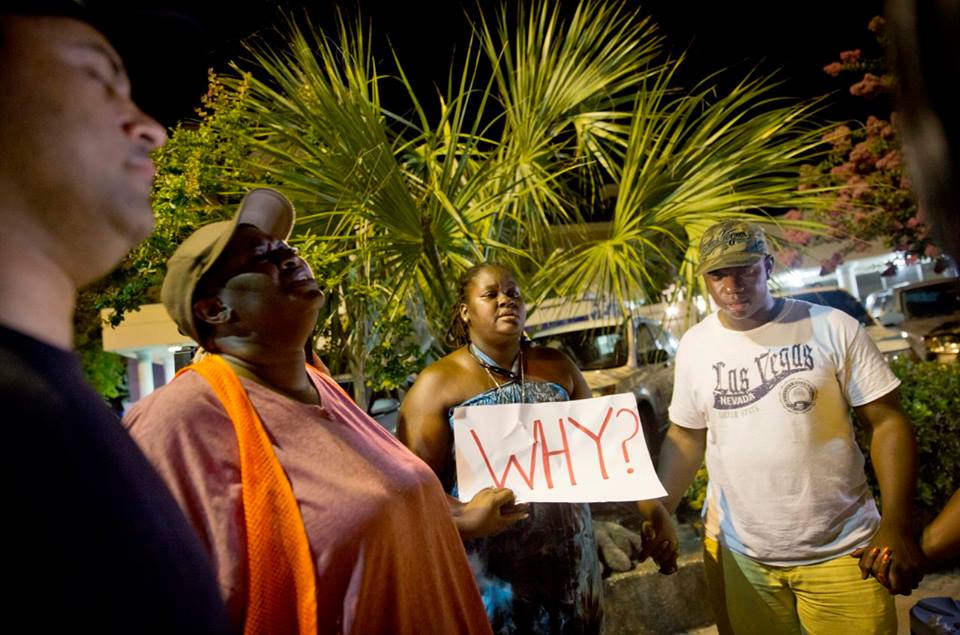
In the wake of yet another mass shooting in the U.S. on Wednesday night—which was also an act of racism—I suspect many of us have found ourselves at a loss for words. Scripture’s language of lament can come to our aid in the aftermath of violence and tragedy. Of course, the Psalmists who turned their pain and puzzlement into prayers did not see lament as a panacea for all the world’s evils. Even if God were to vanquish all of David’s enemies on the spot, he knew he still had the sin of his own heart to contend with.
Psalms and prayers of lament do, however, help the one praying make the important move of deliberately entering God’s presence in a state of deep pain, confusion, frustration, exhaustion, and exasperation. If you are tired of praying, “How long?” and “Why?” and “Please come to our aid quickly, O Lord!”, I wonder whether the Psalm writers might simply advise us to redouble our efforts and pray those same prayers once more.
Psalm 74 says, in part:
How long will the enemy mock you, God?
Will the foe revile your name forever?
Why do you hold back your hand, your right hand?
Take it from the folds of your garment and destroy them!
But God is my King from long ago;
he brings salvation on the earth.
Psalms of lament—with a couple noteworthy exceptions—end with an affirmation that God is still King, and his ability to bring salvation cannot be compromised. I’ve often imagined that when the authors of such Psalms came to the reaffirmation section of their laments, they wrote with trembling hand, watering eyes, and a fast-beating heart that clung desperately—hope against hope—to the truth of God’s sovereignty.
Now is the time to pray such laments—especially on behalf of others and the injustice and pain they undergo. Though all life is valuable and the taking of another life is tragic in any setting, the victims at Mother Emanuel African Methodist Episcopal Church in Charleston were brothers and sisters in Christ, bonding together in prayer in their final moments of life on earth.
Their prayer and study of the Word of God is now transformed into something more than they could have imagined, as they meet the One who is called the Word, face to face, in all his glory.
But there’s more to respond to—the shooter appears to have been a white supremacist who targeted his victims specifically because they were African Americans. It’s stupefying how people of color in our country continue to be targeted. Our prayers and support are needed.
I know it can feel like “it’s getting old” to make lamentations, and we can get tired of praying the same prayers (over and over) for justice and healing around issues of racism and hatred in all its forms. But battle after battle, injustice after injustice, threat after threat, that’s what the Psalmists did. They kept turning their pain to prayer—kept bringing complaints about injustice into the presence of God.
Let’s not lose heart in praying that God’s kingdom would come, in all its fullness.
The above is adapted from what I wrote to our congregation this morning: a call at a time when words fall short to engage the lament language of Scripture.
Super-sweet image via Fortress Press (click to enlarge)
Big news for Bonhoeffer aficionados/as: Fortress Press, publishers of the 17-volume Dietrich Bonhoeffer Works (English edition), has just announced the Fall 2015 publication of Reader’s Edition volumes of Discipleship, Life Together, Ethics, and Letters and Papers from Prison.
I haven’t seen a ton of information yet, but here’s the publisher’s description:
Featuring the acclaimed DBWE translation and adapted for a more accessible format, the new Reader’s Edition volumes include supplemental material from DBWE general editor, Victoria J. Barnett, as well as insightful introductions by Bonhoeffer scholars which clarify the theological meaning and importance of his work.
New to Bonhoeffer? I collected some reflections on his writings after spending much of one Lent reading him. All my Bonhoeffer posts are gathered here. I reviewed the amazing Life Together and Prayerbook of the Bible (DBWE 5) here.
It’s hard to imagine how the editors of the DBWE set could offer anything to improve upon those exceptional volumes, but I do like the idea of a more accessible, annotated Bonhoeffer. Check it all out here.
Dietrich Bonhoeffer was hanged in the Nazi concentration camp of Flossenbürg on April 9, 1945, just two weeks before the U.S. military came to liberate it.
John W. de Gruchy describes the lead-up to that day in his Editor’s Introduction to Letters and Papers from Prison (Dietrich Bonhoeffer Works, volume 8):
On October 8 [of 1944], Bonhoeffer was taken to the cellar of the Gestapo prison on Prinz-Albrecht-Straße, where he stayed until February 7, 1945. From then on, all correspondence came to an end, and contact between Bonhoeffer and the family and [Eberhard] Bethge was broken. From there Bonhoeffer was taken first to Buchenwald and then, via the village of Schönberg in Bavaria, to the Flossenbürg concentration camp, where he arrived on April 8. That evening he was tried by a hastily rigged court and condemned to death. Early the next morning Bonhoeffer was executed along with several other coconspirators.
He was hanged April 9. His family would not learn about it for several months.
The July before he had written to his trusted friend (and later biographer) Eberhard Bethge, one day after the failed assassination attempt on Hitler’s life. He wrote:
How should one become arrogant over successes or shaken by one’s failures when one shares in God’s suffering in the life of this world? You understand what I mean even when I put it so briefly. I am grateful that I have been allowed this insight, and I know that it is only on the path that I have finally taken that I was able to learn this. So I am thinking gratefully and with peace of mind about past as well as present things. …
May God lead us kindly through these times, but above all, may God lead us to himself.
His final recorded words before his hanging are especially appropriate in these days that follow Easter Sunday:
This is the end–for me the beginning of life.
This post is adapted from a post I wrote around this time last year, as part of the “Tuesdays in Lent with Bonhoeffer” I was doing. See other gathered posts here.
School is starting soon. (Groans ensue.) But new school year, new possibilities, right?
Regardless of how you feel about going back, the start of a new school year is an occasion for prayer. One of the most popular Web searches that leads to this blog is “prayer for the first day of school,” which lands here.
Below is an adapted version of that prayer. It can be used responsively with your family, in a congregational worship setting, or individually. The prayer offers both gratitude and intercession to God at the beginning of the new academic year.
Prayer for the First Day of School
For the start of a new semester and all the promise that it holds:
We give you thanks, our God.
For the joy we have in seeing friends and teachers again:
We give you thanks, our God.
For those with whom we live and share meals:
We give you thanks, our God.
For the chance to come to you freely in prayer and worship:
We give you thanks, our God.
For all that we will learn, in the classroom, in labs, in practice rooms, in the library, on the field, in relationships, at school and away from it:
We give you thanks, our God.
For wisdom for all students, staff, and teachers, as they seek to offer their best in all they do:
Lord, please be near us.
For family relationships that now transition in their expression:
Lord, please be near us.
For perseverance and diligence in studies:
Lord, please be near us.
For healthy sleep patterns, motivation to play and exercise, and self-control in eating good, healthy foods:
Lord, please be near us.
For those areas of life in which we struggle, where we despair, and for those things of which we are ashamed:









 Words on the Word