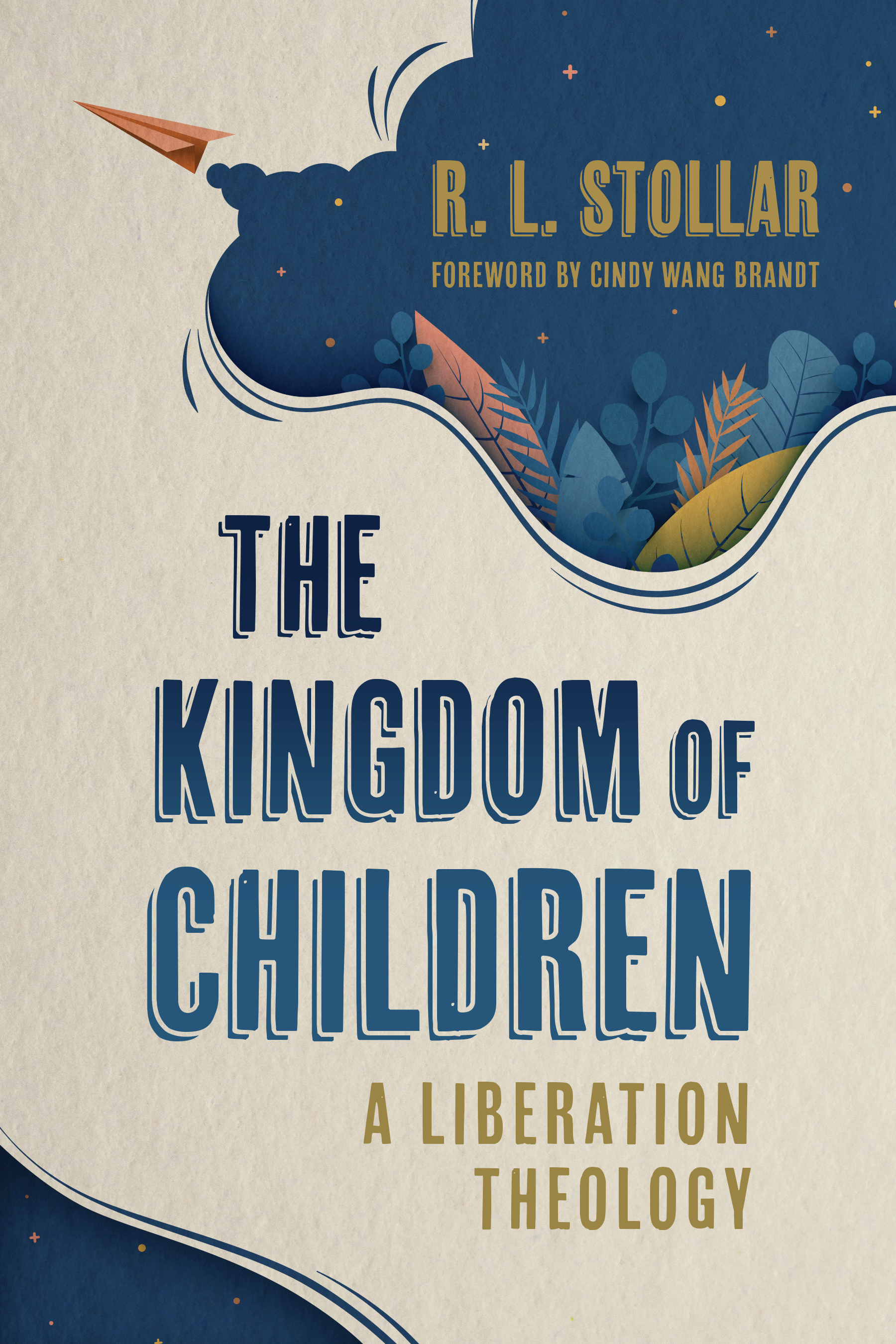
First, my review of Stollar’s book, The Kingdom of Children: A Liberation Theology, is published in print and online at TheChristian Century.
Second, the Century was kind enough to interview me about the review and child liberation theology more generally. That is linked here and below at the thumbnail:
Third, I interact with Stollar and Jesus and Rabbi Irving Greenberg and others in Currents in Theology and Mission. Best part: a cameo paragraph by my pre-teen daughter. The article is free to access, linked here. It’s called: “A Burning Child in the Midst: The Promise and Power of R.L. Stollar’s Child Liberation Theology.”
What I’m most excited about in all of the above is my daughter’s writing. What I’m next-most excited about is my realization that Jesus’s healing of a child in Mark 9 directly and literally satisfies Rabbi Greenberg’s halting claim: “No statement, theological or otherwise, should be made that would not be credible in the presence of burning children.” I want to expand on this later.
I have come to see the Kingdom of God anew through the lens of childhood and actual children, which has influenced how I see and interact with the world and people around me. The above three pieces will give you just a taste.
Early in 2023 I re-read the Gospels, paying close attention to how Jesus interacted with children. Going back to how much Jesus loved and honored children in his ministry has been transformative for me.
Now I’m leading a five-session Webinar series: A Little Child Shall Lead Them: A Biblical Theology of Children and the Kingdom of God. It’s free, and I’m offering it in the hopes that all of us might grow in how we understand, love, and advocate for children.
The series uses Accordance Bible Software’s Webinar platform, but you don’t need to have Accordance to participate. Details are in this one-pager; you can go straight to the registration landing page here. First session is this Wednesday (12/20) at 12p Eastern (Christmas-themed!), and then the first four Wednesdays in January.
R.L. Stollar’s new book vaulted into my Top 5 Books Ever before I’d even finished reading it. It’s called The Kingdom of Children: A Liberation Theology. (Publisher product page / $4.99 on Kindle now (affiliate link))
Book review and additional interaction forthcoming. For now: I haven’t stopped thinking about The Kingdom of Children since reading it. It’s already having the same impact on my thinking and pastoral practice as I’ve experienced from Paulo Freire’s Pedagogy of the Oppressed and from the late Sang Hyun Lee’s From a Liminal Place. I wrote more about this here, with—I hope—more to follow.
Pais is the first—and only—theologian to dedicate an entire book to a child liberation theology to date. While various individuals and organizations have explored a theology of childhood or advocated for child theology, the specific topic of child liberation theology has received very little attention. My goal with this book is to change that and bring the vital conversation about child liberation theology forward to a new generation.
Time will tell to what extent Stollar meets his goal, but I’m 100% behind it. And for what it’s worth, both theorizing and practicing child liberation theology are now front and center with me. And for that I am grateful.
Too many to count were the college papers I finished writing at 3:00 a.m. that I knew were brilliant. Just stunning stuff that was going to land me in a peer-reviewed academic journal as an undergraduate.
Not only was I never published as an undergrad, but most of those papers—even as I groggily re-read them while walking to class later in the morning—turned out to be… not as amazing as I’d thought. My twilight assessment had been clouded by lack of sleep, caffeine, adrenaline, and repeat listens to Coldplay’s first album (you know, the good one).
A rare exception is a paper I wrote my senior year in Spanish, an extended review of Paulo Freire’s 1974 essay, “Las iglesias, la educación, y el proceso de liberación humana en la historia” (“Churches, Education, and the Process of Human Liberation in History”).
I titled my essay, “Gritar con los oprimidos: Una teoría de liberación para la juventud en el ministerio,” which in English is, “Shouting with the Oppressed: A Theory of Liberation for Youth in Ministry.” In true liberation theology fashion, I wrote the paper while active in youth ministry. And falling short of liberation theology ideals, I did not quote or amplify actual voices of young people in my essay. But I set out a theoretical framework that, in practice, powerfully shaped my ministry with youth in a well-to-do, predominantly white suburb.
I concluded (grandiosely, or inspired—let the reader decide):
In this model, we do not start with ourselves, but we start with listening to the voice of the oppressed person. In this way, the voice of the oppressed will be heard throughout the world. We use power in the fight with them against the elites and towards a new historical reality, constituted by us, and that reflects the glory of God on earth.
Today Freire’s longer Pedagogy of the Oppressed remains one of books that has most shaped me. I particularly thrilled, a few years ago, to be able to discuss Freire’s work and approach in detail with school educators in my congregation. I like to think that led to all of our teaching—in our respective spheres—shaping a reality more in line with the liberation Jesus longs to bring to the world.
Still, since writing my (real or imagined) pièce de résistance 20+ years ago, I’ve often found myself lulled into accepting the status quo in church settings. Liberation theology has been an afterthought. An after-praxis.
But our God is a liberating God, and that beautiful and powerful reality is brought to bear on God’s people throughout the pages of Scripture. And today, too: God still liberates—and longs to liberate—those who are oppressed and kept from living what Jesus called “life to the fullest.”
Having nearly forgotten my writing (and practice) around “Liberation for Youth,” I recently discovered child liberation theology. It’s awesome, Christocentric, generative, and powerful.
Here are four sources that I’ve loved sitting with as I seek to reintegrate this important framework—liberation theology—into my own life and ministry, with a particular focus on children:
1. The Gospels
Recently I slowly re-read the Gospels with an eye toward how Jesus interacted with children and other vulnerable populations. The read-through has been transformative for me. And not just temporarily so.
This week what’s really sticking out to me are two sayings of Jesus, both of which call for a centering of children in the Kingdom of God and in our own lives:
Let the little children come to me, and do not hinder them, for the kingdom of God belongs to such as these.
— Matthew 19:14 // Mark 10:14 // Luke 18:16
And this gem, which I’ve seen less frequently cited, even in literature talking about Jesus and children:
Truly I tell you, unless you change and become like little children, you will never enter the kingdom of heaven.
—Matthew 18:3
Unless you change! This is not just Jesus talking about how he loves children, or about how we adults should love children, but about how we should become like little children. To be faithful to Jesus, we have to stop and ask: How are little children, that we can become like them? In what ways do children know and wonder about and access and experience God, and how can I do the same?
Yes, we are to love children like Jesus does. And we are to love children like we love Jesus. But Matthew 18:3 is saying also: love Jesus like children do. We adults have a long ways to go on this one.
2. R. L. Stollar
I’ve spent hours reading his site already. But perhaps start here, with “Towards a Child Liberation Theology.” Take, for example, just this extraordinary paragraph, that is already beginning to invigorate how I read the Bible:
Child liberation theology thus begins with the Child that is Jesus and the children of all histories and locations who bear God’s image. And it places these children at the center of religious texts. It asks us to consider religious texts from the vantage point of those children — from the vantage point of Jesus as the God Child and all children as God images. Thus we must read our texts from the interpretive lens of these children. Children become the point from which all our exegesis and praxis must begin and end.
He has a great, accessible 8-page PDF called “Child Liberation Theology” that is freely available here.
EDIT: Especially valuable is Dr. Nessan’s summary of the method of liberation theology:
The method of liberation theologies consists of five elements: 1) identification with particular forms of oppression and suffering, 2) prophetic critique of that condition, 3) social analysis of the causes of oppression and suffering, 4) biblical and theological engagement to address that suffering and overcome that oppression, and 5) advocacy of structural change toward a greater approximation of justice.
4. My Children
Perhaps most important of all, I’ve found that as I’ve engaged with child liberation theology recently, I’ve become more likely to be with—and enjoy being with—my own children in an unhurried, unpressured way. How do they know and love God? How do they experience God’s love and talk about it? What insights do they want to share with me? What questions are they asking, and what questions and longings are behind those questions?
Child liberation theology offers hope not just for structures and for the world and for the church, but for individual family relationships. And child liberation theology is a powerful framework—rooted in the words and person of Jesus himself—that God uses to fulfill the glorious promise in Malachi 4:6:
He will turn the hearts of parents to their children and the hearts of children to their parents, so that I will not come and strike the land with a curse.
TW: Abuse, Sexual Assault, Secondary Trauma Caused by Inept Institutions
Given their appalling history of enabling sexual abuse, one would wish Michigan State University would take care to do better than today’s letter firing football coach Mel Tucker.
MSU says it is firing Tucker “for cause.” The cause: sexually harassing a woman who survived sexual violence and was now working with MSU football in her job as an advocate and trainer for sexual violence prevention.
Had you not engaged in this inappropriate and unprofessional conduct, the University would not be subject to public disrespect and ridicule regarding your actions.
There it is—MSU paints itself as the victim. The offense? “Public disrespect and ridicule.”
Here is a missed opportunity to send a message of hope and healing to people who have survived sexual violence. Here is a missed opportunity to name specific behaviors and abuse dynamics and roundly condemn them. MSU needs to be asking: “How can we do right by a woman victimized by our football coach?” and, “How can we do right by all the survivors of sexual violence on our campus?” and, “How can we do right by all those young football players who take abuse prevention seriously?” and, “How can we affirm our commitment to safety and care at MSU?” Instead, it seems they are asking, “How can we save face and protect our university?”
And if the response is that they have to be judicious/cautious/whatever in writing, because they stakes are so high legally, consider: MSU could set a really positive example here by expressing care for those having experienced trauma and by standing against sexual abuse and harassment even while (especially while) under potential threat of a lawsuit. “The time is always right to do what is right.”
Let’s re-center Brenda Tracy, for a moment, whom I quote here because she has willingly gone on the record with USA Today:
The idea that someone could know me and say they understand my trauma but then re-inflict that trauma on me is so disgusting to me, it’s hard for me to even wrap my mind around it. It’s like he sought me out just to betray me.”
So allow me—a lowly blogger, but also a pastor and someone who longs for a world that better loves survivors of sexual violence—allow me to subject Michigan State University to some “public disrespect and ridicule” (better: to call them to repentance), but not for the reasons they have in mind:
MSU should apologize today for expressing more concern about its own reputation than about the impact of Coach Tucker’s abuse.
There is a Bible verse that always stops me in my tracks:
Herod was furious when he realized that the wise men had outwitted him. He sent soldiers to kill all the boys in and around Bethlehem who were two years old and under, based on the wise men’s report of the star’s first appearance.
—Matthew 2:16 (New Living Translation)
This is some of the most heinous evil the Bible reports. Can you imagine?
Herod couldn’t find Jesus, but he knew Jesus was in Bethlehem or nearby, and he knew Jesus was two years old or under. So Herod just took that whole group of people and had them killed. It’s an egregious abuse of power.
The Gospels record attempts on Jesus’s life once he is active in ministry, but it’s a miracle that Jesus even made it to adulthood. He emerged from an entire generation of babies that Herod ordered murdered.
The story of those babies and their families doesn’t stop with their murder. The parents had to live with the death of their children for the rest of their lives. All the birthdays, yearly feasts, and celebrations: gone. Two high school graduations—class of ’13 and class of ’14—cancelled, because no one was there to graduate. A murderous, abusive, vindictive tyrant stole those kids from their parents.
Jesus’s birth was surrounded by child abuse.
“O Little Town of Bethlehem, how still we see thee lie”? Nope. At least not for long. Herod was making that little town a cesspool of death and trauma. There’s no stillness in what Matthew goes on to describe, quoting the prophet Jeremiah:
“A cry was heard in Ramah— weeping and great mourning. Rachel weeps for her children, refusing to be comforted, for they are dead.”
Did Mary and Joseph and Jesus have survivor’s guilt? How awful must Mary and Joseph have felt about all this? And what was Jesus’s reaction when he realized the circumstances surrounding his birth? Surely this did not look like the salvation the angel had promised Jesus would bring—maybe even its opposite.
I’ve started wondering: all this killing of little babies… did this shape Jesus’s passion for ministering to children? Was it a deeply formative experience for how Jesus would live in the world?
More specifically, did the abuse and trauma Jesus learned about inspire him to especially love the abused and traumatized? Did the erasure of children and complete destruction of their rights lead him to become a champion of children?
Reading against such a backdrop, these words of Jesus strike me as even more poignant—and powerful:
“Let the little children come, and do not forbid them, for of such is the kingdom of heaven.”
“If anyone causes one of these little ones—those who believe in me—to stumble, it would be better for them to have a large millstone hung around their neck and to be drowned in the depths of the sea.”
“Truly I tell you, whoever does not receive the kingdom of God as a little child will never enter it.
And this powerful moment:
And he took them up in his arms, laid his hands on them, and blessed them.
I have to think Jesus carried all the death and grief and trauma that others experienced, not just at the cross, but from the very time he was born. When he looked at the children coming to him, did he remember all the children that would never have a chance to approach him? When he blessed the children, was it a deliberate undoing of the curse Herod had pronounced?
Miraculously, Jesus survived citywide infanticide. He lived through that systemic abuse. Now he would prioritize the well-being of children. He would make sure they could truly live.







 Words on the Word