What Jonah, Honest Toddler, McNulty, and Choose Your Own Adventure Novels Have in Common

Honest ToddlerI have Honest Toddler to thank for helping me keep my wits about me as the father of three young kids. Here’s a recent Facebook status of this all-too familiar personality:

Good Morning! Wow it’s like it has been forever. …. Anyway for breakfast I’ll have 6 plain pancakes … on the red plate. Not the red one with the green trim or the brick colored one, RED. Yes, the one that shattered yesterday. I’m sure you’ll figure something out. God help you if I see a crack. Also, I would like my pancake intact but in bite-sized pieces. Don’t break my pancakes but please cut them. I want them undamaged but in small pieces so I can eat. Do you see what I’m saying? Perfect but altered. It’s not hard. Follow your heart but keep in mind that if you get it wrong I’ll make today hard. Ok I’ll be in the family room sitting in your lap while you also cook in the kitchen. Love you. (so hungry)

Toddlers can somehow seamlessly embody two (or more) mutually exclusive desires at the same time.

I want to wear that shirt, but I don’t want it covering my top half.

I want milk on my cereal, but I don’t want my Cheerios to be wet!


 Nuanced Characters


I have a hard time knowing what to do when someone I’m responsible for wants me to do their top button, but at the same time leave it unbuttoned.

McNultyBut when it comes to literature, film, music, and narrative TV, I love highly nuanced and complex characters.

I appreciate people like Elsa, Jimmy McNulty, Robert Duvall in The Apostle, any character by Flannery O’Connor.

Good literature, good film, and good TV all blur the line between “good guys” and “bad guys,” because those categories aren’t so clear in real life.

Jonah’s a fascinating character in that regard. We’re not really sure what to make of him. Is he a good prophet, a bad prophet, or some of both, depending on the day? His portrayal is not an even one, or an easy one to detect. He’s a bundle of contradictions and love and judgmentalism and frustration and eagerness and obedience…. He runs away from Nineveh, but then goes flying towards it, preaching repentance as he walks into the city. And then with his message successful, he flees the city again, to watch it from afar.


Jonah: Loves God’s Compassion (for him),
Hates It (for others)
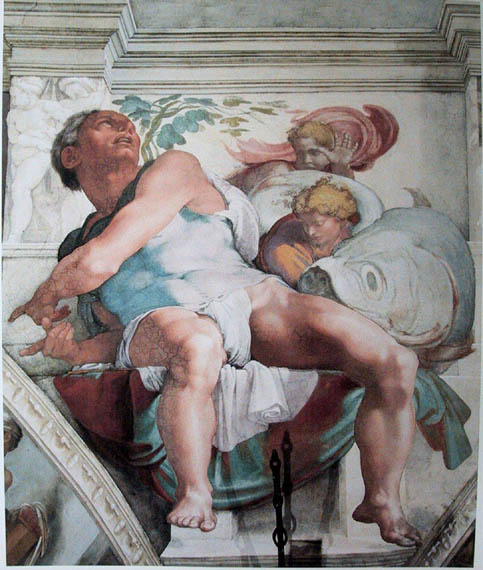
 

Jonah / Michelangelo / Sistine Chapel

God’s compassion is what Jonah loves most about God… when it comes to Jonah. It was God’s predisposition toward second chances, after all, that has kept Jonah alive throughout this book.

Jonah shows in Jonah 4 that he knew one of Israel’s creeds quite well: “I knew that you are a gracious and compassionate God, slow to anger and abounding in love, a God who relents from sending calamity.” And he rightly takes the shade-giving vine as God’s provision for him.

But if God’s provision and compassion toward Jonah is what keeps Jonah coming back to God, the Lord’s mercy toward despised others is what keeps Jonah running away from God.

Three times in this chapter Jonah tells God he’d rather die than watch his repentant enemies receive God’s clemency.

It almost makes you think about Peter’s three-fold denial of knowing Jesus. Jonah tries to deny God the opportunity to forgive whomever he wants to forgive.


Even the Animals


Jonah is angry enough to die. But God is concerned enough to save a clueless city…. even the animals!

Like in Jonah 4:11. Another translation follows the word order of the Hebrew a little more closely than the NIV, and punctuates the book’s ending with a mention of the animals!

“Should I not be even more concerned about Nineveh, this enormous city? There are more than one hundred twenty thousand people in it who do not know right from wrong, as well as many animals!”

A Heathen Animal of Nineveh, Pre-Repentance

Animals—there they are again! Putting on their sackcloth and mooing their repentance to the Lord.

Jonah loved the whale that saved him, but the worm that ate his shade—this animal he hated.

A vine that came up overnight, that Jonah had nothing to do with—he latched onto and cried when it withered. But a city full of hopeless people… well, he wanted them to wither like that vine… to go down into the depths and be consumed by worms.

But God loves all that he has made—evildoing humans, whales, worms, withered vines, and cursing sailors. Not one being is outside the scope of God’s loving care.


Good Theology, Bad Heart


Jonah gets a lot of things right. He’s right, I think, to be so angry at the perpetrators of injustice and oppression. He’s like every other God-inspired prophet who railed against those who tipped the scales to keep others down.

And he’s right about who God is, in verse 2 of the final chapter of the book: “a gracious and compassionate God, slow to anger and abounding in love, a God who relents from sending calamity.”

But not everything in Jonah’s head has made its way down into his heart. His theology at the beginning of this chapter sounds right, but he wants to apply the attributes of God just to himself.

It’s as if Jonah turns God’s words against him. He recites a well known formula, an articulation of who God is, but in a mocking tone of voice. In conflict resolution terminology, that’s called invalidating.

He’s like the prodigal son, who can’t stand watching lavish grace poured out on people who should have long ago forfeited the opportunity by their behavior. He’s the good guy, they’re the bad guys–why would God show them favor?

Which leads to an important question: Whom is God for? For whom exactly does God intend his salvation?


Whom is Christmas For?


And we might seasonally appropriate that question: Whom is Advent for? Whom is Christmas for?

Whose Light?
Whose Light?

It would be easy in a season of preparation, to tend so much to our own hearts and lives, that we think only of how we receive Jesus for ourselves. We can spend so much time tending the vine, that we forget about the city we live in.

And we may be tempted to keep God’s compassion to ourselves and begrudge him when he shows mercy to those who have wronged us (and then turned to God). Well, we just wanted to see them get what was coming to them!

A Jewish commenter on this passage says, “It is not unusual for people to be so intent on the punishment of others that they lose their own way and are disappointed when people change their ways for the better.”

Jesus came into the world, offering light and life to anyone who would turn away from the darkness and turn toward him. And there are some really scummy people included in this invitation. How do we feel about that? What do we think of God’s way too liberal compassion? (I mean, he should pace himself more, right?)

Will we hide it under a bushel? Is God’s grace a proprietary character trait, only meant for the people of God? Jonah tried to hide under a vine, a divinely created shelter that he wanted only for himself.

But God sent a little worm to eat that thing up, in an effort to shake Jonah out of his self-focused slumber.


Choose Your Own Adventure


I like these stories with nuanced characters, ones whose interior lives are complex. I think this sort of storytelling is truer to the human condition.

And I resonate with Jonah. He gets it some of the time; other times, not so much. He really has a hard time just letting God be God.

One other thing that good storytellers do, besides writing full and complex characters, is to write compelling endings.

You can probably recall endings to novels that left you with goosebumps, because the last few lines of the story actually described a new beginning:


So we beat on, boats against the current, borne back ceaselessly into the past.


After all, tomorrow is another day.


Where the Wild Things AreMax stepped into his private boat and waved goodbye and sailed back over a year and in and out of weeks and through a day and into the night of his very own room where he found his supper waiting for him—and it was still hot.

These stories show characters with the hope of boats going on, even if into the past… they show the hope of a new day, the hope of a still-hot dinner, waiting in his room.

The narrator of Jonah is writing a new beginning into the end of the story.

But Nineveh has more than a hundred and twenty thousand people who cannot tell their right hand from their left, and many cattle as well. Should I not be concerned about that great city?

This is no tidy conclusion. It’s a question. It’s a rhetorical question, and we know the answer, just like Jonah knew the “right answer” in verse 2. But even as a rhetorical question, it invites—even demands—our response.

We have no idea how Jonah ends for Jonah. We don’t know if he’ll continue in his anger, or if he’s changed for the better.

Choose Your Own AdventureBut it really doesn’t matter… because it’s not just Jonah’s new day that the author concerned about… it’s ours. This is not The Great Gatsby or Gone with the Wind or Where the Wild Things Are. Jonah reads much more like a Choose Your Own Adventure book, where you, the reader, decide how the story ends for you.

The conclusion to Jonah requires our participation.

God has compassion on evil agents of empire when they come clean. The compassion that was always ours is now theirs—we have decide if we’re okay with sharing.

We are left with having to answer God’s question ourselves. The main character of the book of Jonah has always been God, with Jonah the most prominent supporting actor. But now we become the supporting cast, as we hear God ask:


“Should I not be concerned about that great city?”


Should I not be concerned about people who are killing each other, enslaving the innocent, beating the helpless, oppressing the poor, and destroying the environment?


Did I not come to earth to set despised evildoers free, too, should they accept my love?


Do you have any right to be angry at my gratuitous acts of incarnation, crucifixion, and resurrection for the life of the world?


Is this not the way, God asks, of my breaking in on earth, that I should have mercy on whom I will have mercy, and compassion on whomever I please?


This doesn’t mean there won’t still be justice, but do you have any right to be angry, God asks, when I decide to save the ones who should be smitten down?


The book of Jonah all boils down to that burning question: What will your response be, O reader, to the ways and work of God? Can you only accept it on your own terms, and keep God’s grace close to home? Or can you see Jesus as coming to earth for everyone, a gift of love for anyone who would believe?

Jonah ends here—but for us, the revelation of God’s concern for oppressors is not a period, but an ellipsis….


When Jesus comes, will we receive him largely for ourselves? Or can we receive him on his own terms, and open our hearts to his compassion so that we overflow with love toward even the most corrupt parts of God’s creation?


The skilled storyteller invites us now to take up the pen…

…to write—and to live—our response.


Go to the Mattresses with God (Wrestling for a Blessing)

This is the sermon I preached Sunday on Jacob, us, and wrestling with God. Text: Genesis 32:22-32.

Jacob was a trickster. He had managed to trade a meal of lentil stew for his older brother Esau’s birthright, to be next in line in his family. Lentil stew! I like lentils, but as soup goes, this wasn’t even chicken tortilla soup.

With the help of his mother, Rebekah, he tricked his blind father Isaac into blessing him instead of Esau. Esau was getting ready to go all Cain and Abel on his brother Jacob.


Esau Comin’


Since Esau had made a vow to kill his brother—the Bible says, “Esau hated Jacob”—Jacob left his home and his family. He moved in with his uncle Laban and started a family of his own.

Some 20 years later, Jacob is coming back home. He’s days away from meeting up with Esau, so has sent ahead some gifts—you know, the usual: goats, sheep, cows… bowls of piping hot lentil stew. (No, wait, I shouldn’t send him that!)

Jacob knows Esau is coming.

Jacob and his crew come up to a river. It’s dark. The majestic mountains on either side of them and the starry night overhead are no match for the utter fear that grips Jacob now.

He helps his family cross to safety, and then in v. 24: “So Jacob was left alone.”

“So Jacob was left alone.”

Before he could worry whether Esau would pounce on him in his vulnerable state, a man jumps out of the shadows and they start to wrestle. Surely this is Esau! Jacob must be thinking.

There’s a well-represented strand of Jewish interpretation that sees this mysterious man as Esau’s patron angel… a proxy for Esau. But the story goes on to reveal this is more of a divine than human character he is wrestling with.

The fight seems to be pretty even. Verse 25 says, “The man saw that he could not overpower [Jacob],” but then he pops him in the hip so that Jacob begins to limp.

Jacob—ever the trickster, ever the procurer of blessings where they are not his to procure—says to the guy he has in a headlock, “I will not let you go unless you bless me.”


Come to Jesus


“What is your name?” the man asks him. “What is your name?”

The answer is, “Jacob,” but naming in the book of Genesis and Ancient Near East was deeply significant. Your name was your personality. Your name was your reputation. Your name was your future calling and destiny. Your name was who you are.

“What is your name?” the godlike wrestler said. “Who are you?”

Jacob has a come-to-Jesus moment here, to use a religiously anachronistic phrase.

At this point he can dodge the question. He can say, “I’m not telling you that. Why should you know anything about me?” He can run off, though he’ll be hobbling and probably won’t get very far. He can lie and say he is somebody else.

“What is your name? Who are you?”

“I’m Jacob—I’m a trickster. I don’t trust people very well. My family was dysfunctional, my parents played favorites, and my family role was the conniving one. I want so deeply to be loved, that I’ll cheat, lie, and steal my way to it.”

Just one word in the text, “Jacob,” he says, but when I visualize this encounter, I think of Jacob’s answer as almost a confession of who he is, warts and all. By this point, surely, he must realize it’s not Esau he’s been wrestling with. “I saw God face to face,” Jacob would say at the end of this encounter, and face-to-face with God, he tells God his name. By saying, “I am Jacob,” he admits to God—freely—who he is, what he’s done, what his own internal struggles have been.


Go to the Mattresses


Tom HanksGrowing up my family had a few go-to movies that we’d watch on a Friday night. One of them was You’ve Got Mail. Tom Hanks and Meg Ryan are two competing bookstore owners who also happen to be falling in love over AOL’s now archaic Instant Messenger service online, under the screen names of “ShopGirl” and “NY152.” They don’t at first that they already know each other in real life, too.

Meg Ryan’s character complains from her computer screen, as ShopGirl, to Tom Hanks’s character, as NY152, about Hanks’s ruthless efforts to put her local, neighborhood bookstore out of business.

Hanks’s character summons the Godfather and tells her, “Go to the mattresses.”

Befuddled at that reference, she asks him about it and he replies:

The Godfather is the I Ching. The Godfather is the sum of all wisdom. The Godfather is the answer to any question. What should I pack for my summer vacation? “Leave the gun, take the cannoli.” What day of the week is it? “Maunday, Tuesday, Thursday, Wednesday.” And the answer to your question is “Go to the mattresses.” You’re at war. “It’s not personal, it’s business. It’s not personal it’s business.” Recite that to yourself every time you feel you’re losing your nerve. I know you worry about being brave, this is your chance. Fight. Fight to the death.

(Watch the scene here.)

Jacob has gone to the mattresses. He’s fighting—if not to the death, then he’s fighting for some favor. He’s wrestling for a blessing.

Let’s not forget how the book of Genesis started—the God of the universe separated vast expanses of sky, water, and land; he created light; he made all kinds of beings and vegetation, culminating in the creation of male and female in his image.

This Lord of the cosmos, this magnificent God of the universe who spoke and breathed all things and people into being—this could be a God we puny humans choose to avoid. Out of fear. Out of a sense of unworthiness. Due to a notion that we don’t want to trouble God with our concerns, our struggles, our anxieties. Maybe we think we have to be strong, or keep it together, or look like we’re keeping it together.

Maybe we feel guilty for the questions we have, for how distant we’ve been, for how hard it is to pray.

But if that’s you, go to the mattresses. Go to the mattresses with God.

Are you angry, at your brother or sister, or at God? Are you nervous about your life? Go to the mattresses—take it to God. Do you feel betrayed, passed over, or left out to dry by God? Go to the mattresses—take it up with him and have it out.

Go to the mattresses with God, if you think you have a need to clear the air.

Go be alone, like Jacob was, and wrestle a little bit.


Jacob Wrestles
Jacob Wrestles with the Angel of the LORD, Eugène Delacroix (1798–1863)


The stakes are higher for us than in the Godfather because we can’t say, “It’s not personal; it’s business.” With God, it’s all personal, and the blessing of our future seems to entirely depend on whether we can have an encounter with God.

I realize this is potentially dangerous advice to give to a group of Christians, to encourage us to go to the mattresses with God. You see Jacob limping around here, with a strained hip. And who wants another injury to have to worry about?

But there’s something about this human-divine struggle that is holy. There’s something sacred about grappling more deeply with the wonder and the mystery–even the sometimes elusive nature–of God.


Jacob Became Who He Was Always Supposed to Be


Jacob, the trickster, the one who contends on his own behalf, receives the new name Israel, meaning, “God strives,” “God contends,” “God struggles for you and for your good.”

Jacob became even more of who he was always called to be.

I think there are two main reasons we don’t go to the mattresses with God when we know we should, or could.

First, we think that God can’t handle it. We’re worried that the whole edifice will come crumbling down and we’ll have nothing left to believe in, when we really examine just who this God is, and just what this Word is, and just why justice does not prevail as it should in the world. We think God is either easily offended, quickly angered, or readily deconstructed, and so we stay at home. We don’t fight. We don’t engage in the struggle that is needed.

But if God is truly omniscient, if God really knows everything, then he already knows your questions, your frustrations, the things you protest about him, or others, or about the world. So why not give voice to them?

God can handle our frustrations, our consternation, our jadedness, even if we see him as the source of it.

Another reason we don’t go to the mattresses with God is we think we can’t handle it. We’re nervous that we’re right about God not being able to handle our complaints, our indictments, our protestations, and what would I have left anymore if that were true?

But if you’re keeping a midnight, solo encounter with God at bay for fear of what will happen—what do you have left anymore right now, anyway?

God can handle the struggle. You can manage to get in the ring—respectfully, of course—and go a few rounds.

Jacob, on that long, dark night, became even more of who he was always called to be. From the struggle emerged a new expression of God’s favor. From the wrestling came a blessing. Because he dared to face God—in all his honesty and uncertainty, and with all his passion—God gave him a new name, an altered identity, and declared Jacob to be a new person in God.

When we wrangle with God, we are not the same afterwards. We may come out of a period of holy wrestling a little worse for the wear, as Jacob did with his limp—which healed in due time—but we do so with a blessing. We get back up with a new name, a refined identity.

So if you need to, go to the mattresses with God. You don’t have to do it alone, like Jacob did; take a friend with you. Make a vulnerable new step of really chasing down some of your unfinished business with God, and sharing that journey with a friend, inviting them to walk with you, to pick you up and carry you when you’re limping.

And as the sun rises after your dark night, you will be able to rejoice at the new name and the even more abundant blessings you’ve received from God.

But sometimes, to get there, you’ve got to be willing to wrestle.

The Real Reason We Don’t Take a Sabbath

Traffic Jam
One of the many things New Englanders are good at is taking a summer vacation. You see the evidence of this if you are driving on 128, 95, or 93 on a Sunday afternoon or evening, when everyone is coming back from a weekend or day away.

Nonetheless, our life’s work can easily take over if we’re not careful. We forget the truths of Psalm 127—that it is God who makes our work truly come alive. We do our work with a sort of Tower of Babel mentality… I’m just going to get this done really quick by myself.
 

Unless the Lord Builds….

 
Psalm 127:1-2 says:

Unless the LORD builds the house,
      its builders labor in vain.
Unless the LORD watches over the city,
      the watchmen stand guard in vain.
In vain you rise early
      and stay up late,
toiling for food to eat—
      for he grants sleep to those he loves.

The other day I finished an intensive summer class on Cross Cultural Counseling. The final paper I turned in was in its 7th or 8th draft when I finally clicked the Send button to submit it to my professor.

So recently I can relate to “rise early and stay up late.” If your life’s work involves taking care of other people, early mornings or late nights when they are asleep might be your best time to work through your task list. These two verses don’t say not to do that. But they do caution us against squeezing more hours out of our day without deliberately inviting and acknowledging God’s presence in those working hours.

I can stand watch early over my work, but that work is good only because God stands watch with me. Work without God, Solomon says, is in vain.

Besides that, you need to sleep. God knows that. Sleep is part of the benefits package, if you will, of those who work with the God of Israel.

“He grants sleep to those he loves.”  (I.e., to everyone.)

Our bodies have an amazing way of getting sleep when they need it. If we go for too long without enough sleep, our bodies just shut down. We may fall asleep involuntarily. This is one of the ways, I think, that God grants sleep to those he loves: When we’re tired enough, our bodies will sleep, whether we want them to or not. So you might as well get out of your chair or off the couch, brush your teeth, and get in your bed.
 

Why We Should Take a Sabbath

 
Another manifestation of God’s granting of sleep—rest—to the ones he loves is the gift of a Sabbath day. A Sabbath day of rest is part of the natural, biological rhythm that God set up from the very beginning of creation. God did his work—created the heavens and the earth, life and all that is in them—in six days. And on the seventh day, he rested. He didn’t do or create anything. Six days on, one day off.

Psalms of SummerWe don’t need much intellectual convincing of the value of Sabbath-keeping. We know that practicing the Sabbath follows God’s pattern of six days on, one day off. (Work and rest, work and rest… not: work and work, work and work.)
We know that keeping a Sabbath re-orients us to God, in case we forgot about God during the rest of the week. We experience Sabbath as a gift of refreshment when we most need it, part of the full life that Jesus promised. (A Sabbath-less life is really only half a life.)

And who wants to eat what verse 2 of this Psalm calls “the bread of anxious toil”? We’ve ordered and eaten that dish, right? It’s disgusting. The bread of anxious toil leaves a bad aftertaste; it gives you heartburn.

Besides, we can’t really be productive 7 days a week anyway. Even multitasking doesn’t really give us an edge. A New York Times article says, “In fact, multitasking is a misnomer. In most situations, the person juggling e-mail, text messaging, [on] Facebook and [at] a meeting is really doing something called ‘rapid toggling between tasks,’ and is engaged in constant context switching.” We can’t just keep switching contexts and rapidly “[toggle] between tasks” for 7 days. That’s exhausting.
 

Sabbath: Not Just a Day, A Mindset

 
The practice and mentality and posture of Sabbath-keeping is not just for one day, but we can practice a Sabbath mindset in all of life, turning to God and acknowledging his presence in our work and in our rest, in our waking hours and in our sleeping hours.

Clement of Alexandria, one of those highly quotable early church dudes, said,

Practice husbandry if you’re a husbandman, but while you till your fields, know God.  Sail the sea, you who are devoted to navigation, yet call the while on the heavenly pilot.

Here’s how The Message puts Jesus’ words in Matthew:

Are you tired? Worn out? Burned out…? Come to me. Get away with me and you’ll recover your life. I’ll show you how to take a real rest. Walk with me and work with me—watch how I do it. Learn the unforced rhythms of grace. I won’t lay anything heavy or ill-fitting on you. Keep company with me and you’ll learn to live freely and lightly.

That’s what we want. That sounds amazing. We need no convincing whatsoever of the value of Sabbath-keeping, both as a distinct day of the week and as an ongoing daily mindset.
 

Why We Don’t Keep Sabbath, Really: Internal Competing Values

 
And yet, we don’t take a Sabbath as we should. Or we do, but three days into the week, we forget to practice a daily Sabbath orientation toward God with complete reliance on him. We turn to our own inner resources to face our life’s work.

Euguene Peterson warns against “un-Sabbathed workplace” when he says,

[W]ithout a Sabbath…the workplace is soon emptied of any sense of the presence of God. The work itself becomes an end in itself. It is this ‘end in itself’ that makes an un-Sabbathed workplace a breeding ground for idols. We make idols in our workplaces when we reduce our relationships to functions that we can manage. We make idols in our workplaces when we reduce work to the dimensions of our egos and our control.

Why do we do this? We don’t really think about other people as just relationships to be managed, do we? We’re not really egomaniacs, right? At least, in the depths of our beings, we don’t want to live like that.

Is this as simple as just saying, “Okay, well, I guess we need to take a Sabbath more. We should practice a Sabbath mentality more often in our daily endeavors”? We’re just a forgetful and disobedient people and we need to obey to this 4th commandment.

There is some truth to that. But I don’t think it’s just disobedience or forgetfulness or laziness that leads to an un-Sabbathed life.

I think the main Christians don’t take a Sabbath, or don’t practice a daily Sabbath mentality, is because of our competing internal values.

Kegan and LaheyTwo educators at Harvard—Kegan and Lahey—have a diagnostic grid that I’ve found immensely helpful for unearthing my sometimes subtle competing values. It’s from their book How the Way We Talk Can Change the Way We Work.

The essence of their diagnostic is to begin with a commitment or value or belief—something where we say it’s really great if this happens. In this case, to adapt their language, “We are committed to the value or importance of… Sabbath-keeping,” both as a distinct day and as a mentality throughout the week.

Then we ask, “What are we doing or not doing that prevents this from happening?” So think for a moment, what are you doing or not doing that prevents Sabbath-keeping and rest from happening?

There may be some forces outside of your control—small children, an overbearing boss. But what are you doing that prevents a Sabbath rhythm in your life?

Underneath the answer to that question is a competing commitment or value or belief. Based on what I’m doing to undermine my Sabbath-keeping—checking email on a day off, not calling in anyone else for help–“I may also be committed to…” getting everything done myself and making sure it gets done right. Or, “I may also be committed to” just keeping going, because I have to.

Where Kegan and Lahey’s grid gets really fascinating is in what comes after you’ve unearthed your competing value. They suggest that each competing value carries with it a big assumption that may or may not be true.

If I don’t do this task, it will never get done, and there is no one else in the entire universe who can do it as well as I would.

Or, I’m committed to working 7 days a week (competing value), because (here’s the big assumption) if I stop and take a Sabbath, I’ll be so stressed out the day after the Sabbath with catching up, that it won’t have been worth it.

Or, if I slow down enough to practice a Sabbath mentality, I might become less productive.

Walter Bruegemmann talks about this kind of assumption as a scarcity mentality. He says:

There’s never enough time; there’s never a moment’s rest. … But how willing are we to practice Sabbath? A Sabbath spent catching up on chores we were too busy to do during the week is hardly a testimony to abundance. [It] does nothing to weaken the domain of scarcity. Honoring the Sabbath is a form of witness. It tells the world that ‘there is enough.’”

There is enough. There is enough time for us to stop on the 7th day, and to slow down on the other 6 days and to dwell in the watching presence of God.

It’s true that we have a bundle of competing values, commitments, and assumptions that keep us from fully practicing God’s call to a Sabbath rest.

But ultimately, a Sabbath way of life acknowledges that God is God and we are not.

God can and does complete building projects that we cannot finish. God can and does stay awake watching, guarding, protecting, so we can sleep.
 

A Modest Experiment: Four Weeks of Sabbath

 
Here’s the final square in Kegan and Lahey’s competing values diagnostic: Try “a modest, safe test.”

back to school
NO.

I had to pinch myself the other day when I saw a “Back to School” sign up at the store. Our summer just started! But we’re just a few weeks away from Labor Day.

It’s time to start planning your fall, if you haven’t already. And I would propose that as you do, you try a “modest, safe test,” with regard to Sabbath-keeping.

Plan a Sabbath each week for the next four weeks and keep it. Make it a Sabbath from technology. From your job. From household chores. And after four weeks, evaluate it. See how it went. See if all the things you thought would go wrong (if you took a break), actually did go wrong.

Or… see if you find yourself refreshed and living with a heightened awareness of God’s watching presence. See if you find the scarcity you feared… or, if you find instead an abundance of good gifts from the God who gives rest to the ones he loves.

I preached on Psalm 127:1-2 this last Sunday, from which the above is adapted. See my other Psalms sermons here.

When Your World Gives Way, Sing it ALAMOTH (Or, Why Obscure Liturgical Notes at the Top of the Psalms Matter)

 
Psalms of Summer
 
Psalm 46 begins with some liturgical instructions, one of which is unclear. Here is the superscription to the Psalm, a sort of post-it note tacked onto the sheet music:

For the director of music. Of the Sons of Korah. According to Alamoth. A song.

The Psalm itself will divide thematically this way:

  1. Natural Disasters: 
But God is a strong refuge 
(vv. 1-3)
  2. Human Violence and Tragedies: 
But God rules over violence
 (vv. 4-7)
  3. Be Still and Know: 
Despite both of the above, God is God; God is with us
 (vv. 8-11)

11 Psalms are attributed to the Sons of Korah. Korah himself is not a major Biblical figure, but he and his descendants were Levites, involved in musical leadership. This portion of the inscription is clear enough—it’s “a song.”

Alamoth, a Hebrew word that goes untranslated in the 1984 NIV, means “young women.” Alamoth could have been just the name of a musical setting—like singing the doxology to the tune of Old 100th. Or Alamoth could have meant that this song was to be sung by young women—by sopranos—and so it is high-pitched. (HT: P. C. Craigie)

Or Alamoth could have just been how the choirmaster preferred to take his apple pie.

(Sorry.)

But—back to business—the fact that this is a song, and marked as a song, with details about how to sing it, is significant.

Here you have a people confronted with natural disasters, human violence, and tragedies… and their worship leaders call them in response to sing!

Lord, open our lips.
And our mouth shall proclaim your praise.
 
I preached on Psalm 46 this last Sunday, from which the above is adapted. This is the final of three posts this week about that Psalm. I wrote about it here and here, too.

The First Youth Ministry Talk I Never Gave

A Day of Hope cover slide.001

On September 16, 2001, I was planning to deliver my first ever message as a vocational youth minister. It would have been about Philippians 3.

I had just taken a position at an Episcopal church in Illinois as part-time youth minister. In my excitement to start ministering among youth and families, I invited all the parents of youth to come to our first youth worship service that Sunday. In the weeks leading up to that service I worked hard on my sermon, which was going to be about Paul’s pressing on toward the goal and striving to know Jesus Christ more and more. I hoped this would be a central theme in my new ministry.

On Monday, September 10, 2001, I went for a long run and mapped out the outline to my talk. I came back from my run refreshed and ready to go; I couldn’t wait to begin that Sunday.

The next morning, as I walked to a youth ministry class, my friend Michael asked me if I had heard the news. What news, I asked? He told me about a plane, commandeered by terrorists, crashing into the Twin Towers of the World Trade Center in New York, taking the lives of thousands of people. When I arrived at class, my professor turned on the TV as our session was set to begin and just said, “I’m going to stay here and watch the news about this; feel free to stay if you like; feel free to go home if you need to.”

Maybe it goes without saying, but I didn’t preach to the youth and their families that following Sunday about Philippians. Instead, I turned to Psalm 46, and tried to convey some sense of hope, because of the strength we can find in God, even when awful things happen.

To try to do that I used a collection of projected images (that we had been seeing in the news all week anyway), with the text of Psalm 46, bit-by-bit, underneath, next to, or on top of the images.

Here is a .pdf version (unedited since then) of our worship focus that morning. Though it’s been almost 13 years since that Sunday, I’ve found myself–still–turning to this Psalm in the wake of tragic events.

I preached on Psalm 46 this last Sunday, from which the above is adapted. See also here.

An Interculturally Aware Read of Psalm 46 (Location, Location, Location)

Psalms of Summer

As I have read and preached on some Psalms this summer, I’ve appreciated the importance of trying to practice intercultural sensitivity in reading the Bible (and in all of life).

I am working on a course on intercultural counseling this summer, one purpose of which has been to help build intercultural competence and sensitivity.

The readings, lectures, and class discussions have reminded me of the important truth that reading and interpreting the Bible is an exercise–whether we realize it or not–in intercultural relations.

Intercultural Sensitivity=Better Bible Reading

The culture, values, and practices, for instance, of ancient Israel differ from those of 21st century North America in a number of ways. If I read a passage with only an awareness of the cultural values I carry with me, I very well may miss an important truth or robust reading of a text. Or I may map a “truth” or value judgment onto the text that the author didn’t necessarily intend to be there. (I’m not discounting the potential value of so-called reader-response criticism, but I am suggesting we seek to avoid a monocultural or culturally hegemonic interpretation of a text, if possible.)

In a 2008 article for Journal of Spiritual Formation & Soul Care (“Relational Spirituality and Transformation: Risking Intimacy and Alterity”), Steven J. Sandage, Mary L. Jensen, and Daniel Jass write:

Since hermeneutical understanding is always intercultural and contextual, cultural self-awareness is a prerequisite to responsibly interpreting Scripture and spiritual experience.

I mentioned here how the idea of intercultural sensitivity helped me read Psalm 23 in a fuller way. The same thing happened as I prepared to preach on Psalm 46 this week. I got a little extra help this time from a Bible atlas I’ve been reading.

Psalm 46: God Is Our Refuge

Psalm 46 begins:

 1 God is our refuge and strength,
an ever-present help in trouble.
2 Therefore we will not fear, though the earth give way
and the mountains fall into the heart of the sea,
3 though its waters roar and foam
and the mountains quake with their surging.

How should we understand the scenario the Sons of Korah (writers of this Psalm) describe?

Mountain and WaterThe sons of Korah don’t just paint a picture of tragic events befalling God’s people—it’s the complete disintegration of all of life that is the dominant metaphor in these verses. A number of commentators point out here that the effective merging of the land (mountains) and waters (sea) harken back to the pre-creation state of chaos that existed before God separated the land from the waters, bringing order to life. The sons of Korah, then, describe a sort of uncreation.

But even in the midst of an envisioned chaos and uncreation of the world (!), “God is our refuge and strength.”

Verse 2 says, “though the earth give way,” or, though the land give way. Here is where an interculturally aware read of the Psalm helps it to come alive even more profoundly. (The below was inspired, in part, by Paul H. Wright’s Rose Then And Now Bible Map Atlas® With Biblical Background And Culture.)

Life for Israel: Location, Location, Location

Before there was such a thing as real estate, life for Israel already was location, location, location.

The topography or shape of the land had a lot to do with whether a given area would be suitable for habitation. Mountains, in particular, provided a sort of natural buffer of protection against enemies… a hiding place to run to, if need be. Water, of course, was necessary for life and the production of crops.

Mountains in Edom (photo: Garo Nalbandian, from Carta's Sacred Bridge atlas)
Mountains in Edom (photo: Garo Nalbandian, from Carta’s Sacred Bridge atlas)

The congregation of Israelites who would sing this Psalm understood their identity as intricately tied to the land. The land—which God had given them—was part and parcel of his covenant relationship with them. It was part of his blessing, a sign of his love. If we don’t have this land, how can we really call ourselves God’s people? This is still a live question for many.

Yet even if we were to lose this fundamental aspect of our identity, the Psalm declares, even if the world were to be uncreated and fall back into chaos, “we will not fear.”

The congregation can still say—can still sing, “God is our refuge and strength, an ever-present help in trouble.”

Given how important land was to the people of Israel and the construction of their collectivistic identity, this is an amazing affirmation of trust in God.

Intercultural Insight from a Bible Atlas

Paul Wright AtlasPaul H. Wright’s cultural awareness and sensitivity is present from the very first chapter (“The Landed Context of the Biblical Story”) of his biographically-arranged atlas:

To start, it is perhaps appropriate to define a few aspects of location that have impacted living conditions in the lands of the Bible over time. The building blocks of biblical geography include the following….

He lists topography, climate, and available resources. He goes on:

The particular mix of elements such as these plays a significant role in determining whether any given plot of ground can support permanent settlements and how large and well-established these might have become, or if the land is better suited for herding or desert lifestyles.

Here’s the intercultural piece, which I so appreciated:

Specific geographical realities have also helped to shape cultural values and norms that defined individual societies. For instance, protocols of cooperation, hospitality and defense that functioned well in arid, shepherding societies in biblical times developed differently than did those that attained to urban centers located in fertile areas, or to sailors who frequented foreign ports-of-call. And aspects of geography gave rise to specific images that biblical writers used to describe God and the people of ancient Israel.

Understanding the value of land to the people singing Psalm 46–it was an essential component of their identity and experience of God’s love for them!–makes the affirmation of trust in this Psalm even more remarkable.

Though the sons of Korah envision a scenario in which their land is gone–having slipped into the ocean–they call on the congregation to praise God still.

The above is adapted from a portion of a sermon I preached yesterday. Rose Publishing has sent me the Wright atlas for review purposes. A full review is forthcoming. You can find the atlas in the following places: Rose Publishing, Amazon (affiliate link), Carta (as Greatness, Grace, and Glory: Carta’s Atlas of Biblical Biography), and Eisenbrauns (same title as Carta).

How My 2-Year-Old Helped Me Practice What I Preach (or, Saying Psalm 23 Through Gritted Teeth)

My two-year-old gave me an unexpected opportunity yesterday to practice what I just preached Sunday. I noted in my sermon that I had been understanding Psalm 23 as a “counter-circumstantial prayer of defiance,” a “subversive prayer when you compare it to what you see around you.”

I mentioned some potential circumstances which make us feel far from the idyllic pastoral imagery of the Psalm, and then suggested that those are some of the best times to (defiantly) pray Psalm 23:

When you hear about wars and rumors of wars, say this Psalm.

When your best friend gets sick, say this Psalm.

When someone in your family grieves you by their seeming lack of care for you, say this Psalm.

When you don’t know what the next year of your life holds, say this Psalm.

An instance I didn’t think to include was:

When your two-year-old daughter draws with permanent marker all over the brand-new cork floor that the church graciously put in last year in the parsonage kitchen… say this Psalm.

When I noticed the damage, this image is about the opposite of how I was feeling:

Image Credit: LifeintheHolyLand.com (Todd Bolen), used with permission

I was feeling more like this:

The Scream

For at least 10 minutes as I frantically scrubbed, I didn’t even remember there was a Psalm 23, let alone think to say it.

But then I took a step back (by God’s grace) and began to quietly say–through gritted teeth:

The LORD is my shepherd, I shall not be in want.

He makes me lie down in green pastures,
he leads me beside quiet waters,
he restores my soul….

And when my gracious and patient wife came home, she gently reminded me of the “magic sponge” we have under the sink that takes permanent marker off of everything. Within minutes, the green marker drawing on the floor was gone. Gone. The cork floor is good as new.

True, there are much darker valleys in life to walk through, but I think sometimes in parenting those little mini-valleys of frustration and exasperation can add up pretty quickly. And for us parents, they can be the regular “stuff” of our everyday existence. We need good Psalms to pray for the big valleys, and good Psalms to pray for the little valleys.

For those moments–should my two-year-old again somehow elude my watch like she has been so eager to do lately–I will try again (and again) to remember to “say this Psalm.”

Psalm 23: Psalm of Trust, Psalm of Defiance

Psalms of Summer

Psalm 23 is a Psalm of Trust. A Declaration of Confidence in God.

The imagery and tone of the Psalm are peaceful: “green pastures,” “quiet waters,” a restored soul, the promise of God’s presence even when death and darkness are near. The LORD is my shepherd: he provides, he guides, he restores, he is with his sheep, and he comforts.

“He makes me lie down in green pastures.” With God as my comforting shepherd, there is time to rest. Time to stop. Time to be still.

Image Credit: LifeintheHolyLand.com (Todd Bolen), used with permission

Typically a shepherd leads sheep to a pasture where they can graze. The sheep still do work; the shepherd does the leading but not necessarily the feeding. As the Psalm progresses, God as comforting shepherd becomes welcoming host, who sets out a whole banquet for his flock.

Image Credit: LifeintheHolyLand.com (Todd Bolen), used with permission

Psalm 23: It Just Got Personal

Psalm 23 is intensely personal. It’s a prayer of an individual to God; a song from one soul, who recognizes that the ruling king of the universe has taken the time to lead him to a restful spot to get a drink… to rest.

The LORD is my shepherd, I shall not be in want.
He makes me lie down in green pastures,
he leads me beside quiet waters,
he restores my soul….

David uses the first person singular pronoun throughout the Psalm. God is the shepherd of each individual who would follow him.

This may seem slightly unremarkable to us. We live in a North American society that already tends toward individualism. Our cultural construction of the self tends to be individually-focused.

The culture in which David found himself was much more communally-oriented. The sins of an individual and the corporate sins of the community were not always distinguished. A person’s sense of self was constructed and informed and shaped in a communal context.

Identity for a Hebrew man or woman had much more to do with being a part of a chosen and called-out community. A chosen people, plural.

Even in other Psalms, when God is prayed to as shepherd, there’s a sense in which he’s understood as a shepherd of a whole people:

For he is our God,
and we are the people of his pasture,
and the sheep of his hand.

So it’s at least a little remarkable, in the larger context of Hebrew worshiping society, that David begins–the Lord is MY shepherd.

The idea of God as personal shepherd is consistent with Jesus’ interpretation of himself as shepherd. You remember the Christlike image of the shepherd who–even though he has 100 sheep–will stop and go find the one who goes missing.

So it really is okay, and probably even closest to the original intent of this Psalm, to put your own name in there as you read it.

Psalm 23 as Prayer of Defiance

Maybe it’s because I’ve been reading this Psalm through the lens of the news this week, but I’m beginning more and more to see Psalm 23 not only as an affirmation of trust and confidence in God, but also as a counter-circumstantial prayer of defiance. It’s a subversive prayer when you compare it to what you see around you.

Verse 4 says, “Even though I walk through the valley of the shadow of death…” David seems to just take it as a given that life contains dark and death-filled valleys.

11,002 ThingsI saw in a bookstore yesterday a little book called 11,002 Things to Be Miserable About. It’s a work of satire, mostly, though not all of it is. Here are a few of the things it listed:

  • Exaggerated vows of love
  • Abysses of regret
  • Tipping over backward in your chair
  • The misery of goldfish
  • Heel pain caused by flip-flops

But we don’t need a book to think of all the ways in which life is full of dark valleys.

You’ve been in a dark valley before. Maybe you’re in one now. It can be a valley of darkness and shadows that you’ve found yourself in due to no choice of your own: some hurt or frustration someone has caused you; prayers that continue to go unanswered in the way you’d like to see answered; illness and physical ailment; unexpected and sudden grief.

You could be in a valley of darkness and shadows that is more of your own making, too. Maybe your whole life doesn’t feel like a valley, but maybe you’re aware of your “shadow side” that you wouldn’t dare bring to church, that part or those parts of you that you don’t want anyone to see. Maybe you’ve looked inside and seen something in your heart that—it pains you to see—doesn’t please God.

Or, to see some “valleys of the shadow of death,” you could just pay attention to global events this week. 4 children in Gaza—cousins—playing at the beach and shot dead from the ocean. An Israeli ground invasion into the Gaza Strip. Another Malaysian Airline plane crash full of passengers, this one shot down by a ground to air missile as it was flying over Ukraine.

And if you really want to lose some faith in humanity, you probably have already heard that that airplane had something like 100 of the world’s top HIV/Aids researchers on their way to an international Aids conference.

So, yes, there are plenty of valleys of the shadow of death and darkness that we walk through.

And yet, even though—“even though I walk through through the valley of the shadow of death, I will fear no evil, for you are with me.” “Even though,” David says, in a hope-filled prayer of defiance.

There’s an old story of a young preacher who was preaching in a rural church in Louisiana during the depression. This church had just one lightbulb coming down from the ceiling that gave light to the whole sanctuary. As Pastor Taylor was preaching, the electricity went out. He was a newish preacher and didn’t know what to do in the now-dark sanctuary. But an elderly deacon in the church, from the back of the room, shouted, “Preach on, preacher! We can still see Jesus in the dark.”

“We can still see Jesus in the dark.”

For whatever reason, when I hear “shepherd,” there’s part of me that thinks of a humble, young boy (or girl) walking sheep through beautiful country fields on a quiet, sunny day.  And that’s right. Leading your sheep to serenity is part and parcel of what it means to be a shepherd.

But there’s this fascinating passage of Scripture, Micah 5, which says:

When the Assyrian invades our land
a
nd marches through our fortresses,
we will raise against him seven shepherds,
even eight leaders of men.

Maybe it’s just me, but reading about a coming invasion by an Assyrian superpower, my first reaction is: What kind of a country would send their shepherds out to battle?

But Micah is drawing on a rich tradition in the Scripture—especially in the Old Testament—of using “shepherd” imagery to describe kings, to describe commanders, to describe strong and mighty leaders.

When Micah says “shepherd,” he is talking about a ruling king who goes to battle for his people.

David, as a ruler himself, surely had this aspect of shepherding in mind. The readers and prayers and singers of this Psalm surely saw not just a shepherd to comfort me, not just a host to welcome me, but God as a ruler to protect me. This ruler won’t do away with all of life’s dark valleys—not yet, anyway—but he will be with me while I walk through them.

The Lord is my shepherd, and his rod and his staff—weapons of protection in the hands of a skilled shepherd—fend off that which would attack us.

When Jesus describes himself as the Good Shepherd, we see his gentleness in his willingness to lay down his life for the sheep, and we see his ferocity, his power, his authority over all things when he says, “No one can snatch them out of my hand.”

Even the presence of enemies in verse 5 cannot keep this ruling shepherd from playing banquet host, setting out a feast for the ones he loves.

So good shepherds are not to be trifled with, because they protect their flock. They walk with them through darkness. The Good Shepherd is a ruling king, and he keeps our modern-day enemies—shame, guilt, fear, anxiety, the accusations of others, stress, hatred… he keeps our modern-day enemies at bay. Even though life is full of valleys of the shadow of death, tens of thousands of things to potentially be miserable about, Jesus the Good Shepherd is a ruling king who STILL is sovereign over all he has made, no matter how fouled up it gets.

“We can still see Jesus in the dark.”

So—when you’re riddled with doubt and self-loathing, or just questioning your worth? Say this Psalm.

When you hear about wars and rumors of wars, say this Psalm.

When your best friend gets sick, say this Psalm.

When someone in your family grieves you by their seeming lack of care for you, say this Psalm.

When you don’t know what the next year of your life holds, say this Psalm.

When you have to do the hard work of reconciling with someone you have hurt or that has hurt you, say this Psalm.

When you can’t pay your mortgage on time, say this Psalm.

When you don’t want to get out of bed in the morning, say this Psalm.

When you get scared of the dark, say this Psalm.

As a holy act of defiance against the darkness,
as an affirmation of trust and confidence in Jesus,
when you come up on one of life’s dark valleys,
get ready to walk through….and say:

The LORD is my shepherd, I shall not be in want.

He makes me lie down in green pastures,
he leads me beside quiet waters,
he restores my soul.

He guides me in paths of righteousness
for his name’s sake.

Even though I walk
through the valley of the shadow of death,
I will fear no evil,
for you are with me;
your rod and your staff,
they comfort me.

You prepare a table before me
in the presence of my enemies.
You anoint my head with oil;
my cup overflows.

Surely goodness and love will follow me
all the days of my life,
and I will dwell in the house of the LORD
forever.

The above is adapted from the sermon I preached today. Scripture quotations are from the 1984 NIV. See my other sermons gathered here, including the first Psalm of Summer sermon here.

Change Your “Pas5w0rd,” Change Your Life

Psalms of Summer

This summer we’re going to delve more deeply into the Psalms. “The Psalms of Summer,” I’m calling the preaching series. (Or, as a pastor friend of mine called it, the Psalms of Psummer.)

We’ll find ourselves here in these poems and see our heart’s desires expressed in the Psalms. Some days we’ll walk out of church with new prayers to pray: prayers we’ve been longing to pray and have already been feeling, but maybe couldn’t put words to.

We’ll seek, too, to be shaped and formed by these prayers.

Psalm 1 as Preface, and Picking a Password

Psalm 1 is, as one early church theologian called it, the “foundation” of the house. It sets up the whole book of 150 Psalms. You could almost even think of it as a sort of “Psalm 0.”

The ones who are blessed, this Psalm says, the ones with the richest, most God-filled lives, the ones who flourish, are the ones who meditate on God’s word. Over and over.

Blessed are those… who delight in the law of the LORD and meditate on his law day and night.

I found myself this week being redirected to an article on NBC’s Today Website, because I had to click on the link that said, “How a password changed one man’s life for the better.”

And how can you not click on that, you know?

Mauricio Estrella had just gone through a painful divorce and was depressed. He says:

One day I walk into the office, and my computer screen showed me the following message:

“Your password has expired. Click ‘Change password’ to change your password.”

His work required a change of password every 30 days. He writes:

I was furious that morning. A sizzling hot Tuesday, it was 9:40 a.m and I was late to work. I was still wearing my bike helmet and had forgotten to eat breakfast. I needed to get things done before a 10 a.m. meeting and changing passwords was going to be a huge waste of time.

As the input field with the pulsating cursor was waiting for me to type a password — something I’d use many times during every day — I remembered a tip I heard from my former boss.

And I decided: I’m gonna use a password to change my life.

He reasoned like this–he has to type in his password several times a day–when his screen saver came up or his lock screen kicked in when he was away from his desk for extended periods of time.

So, freshly wounded from the divorce, he set a password: “Forgive her.”

Except he had to have at least one capital letter, one lowercase letter, one symbol, and one number, so it was “Forgive@h3r.”

Every day for a month he wrote, “Forgive her.” And Estrella said:

That simple action changed the way I looked at my ex wife. That constant reminder that I should forgive her led me to accept the way things happened at the end of my marriage, and embrace a new way of dealing with the depression that I was drowning into.

A month later, his password expired, so his new password–reflecting a new mantra he wanted to take on–became: Quit@smoking4ever.

It was a great article–a little self-help-y for my tastes, and it is true that we find ourselves in way too many situations that we can’t just positive think our way out of. But Mauricio Estrella knew what the writer of Psalm 1 knew–what we meditate on has the power to transform us. 

Two Ways

Here is one way of outlining Psalm 1:

What are the two ways? (Ps. 1:1-2)

What are they like? (Ps. 1:3-4)

What do they lead to? (Ps. 1:5-6)

This Psalm tells us, especially, that what we meditate on has the power to transform us.

What are the two ways? (Ps. 1:1-2)

Ps 1:1    Blessed are those
who do not walk in step with the wicked
or stand in the way that sinners take
or sit in the company of mockers,

2 but who delight in the law of the LORD
and meditate on his law day and night.

Or, get this–I’d never read Psalm 1 in this translation until this week:

Happy the man
who did not walk by the counsel of the impious,
and in the way of sinners did not stand,
and on the seat of pestiferous people did not sit down.

(Stay away from the pestiferous ones!)

Walk… stand…sit. There’s a progression into wickedness here. At first you might be walking on by, just taking a look at–thinking about–going down a road you shouldn’t. If you slow down enough to stand there and look at the way of the wicked–that’s worse… when you stop to sit in the chair of those pestiferous people, well, then… you’re done for. Because what we meditate on has the power to transform us. And the ones that we spend time with also have the power to transform us, for better or for worse.

These are the two ways: the way of the wicked, the way of the righteous.

Righteous ones “delight in the law of the LORD and meditate on [it] day and night.”

Remove@clothingm1ldew?

Later Psalms will echo this. In Psalm 119, verse 97, it says, “Oh, how I love your law! I meditate on it all day long.” Then in verse 103, the Psalmist writes, “How sweet are your words to my taste, sweeter than honey to my mouth!”

I suspect that this idea of loving the law of God can sound a bit strange to us. We all see the value in laws and rules and regulations, sure, but to love somebody’s laws more than the summer season’s first ice cream?

We hear the word “law” and might think about some of the detailed instructions given in, say, Leviticus, regarding physical hygiene and ritual purity, such as Leviticus 14, which is about cleansing from infectious skin diseases and what to do when you notice mildew on your clothes.

So your new computer password becomes: Remove@clothingm1ldew.

Or we hear the word “law” and think of it as opposed to “grace.”  They were living under “law”; we are living under “grace.”

So what’s the Psalmist talking about?

He’s talking about his equivalent to our Bible. The Torah–the first five books: Genesis, Exodus, Leviticus, Numbers, Deuteronomy. This is “the Law”–it’s “God’s Word.” And not just the laws part of God’s law–but the revelation of God that it brings, the story that it tells of a compassionate God who is, in fact, slow to anger and eager to show compassion on all he has made.

In meditating on God’s law–God’s very words–the Psalmist is meditating on God: his guidance, instructions, blessings, love, character.

And I think Psalm 1 is self-referential, too–those who meditate on these Psalms will be blessed, will experience the favor of God.

What are they like? (Ps. 1:3-4)

3 [The righteous] are like a tree planted by streams of water,
which yields its fruit in season
and whose leaf does not wither—
whatever they do prospers.

4
Not so the wicked!
They are like chaff
that the wind blows away.

Those who meditate on God’s word are rooted, strong, nourished, bearers of good and visible fruit to all who walk by them. The wicked–in this case those who ignore God’s truth and go their own way–they are the chaff that has fallen to the floor. The grain is kept and preserved, the chaff just blows away. No roots, no fruit, no nothing.

What do they lead to? (Ps. 1:5-6)

5 Therefore the wicked will not stand in the judgment,
nor sinners in the assembly of the righteous.

6 For the LORD watches over the way of the righteous,
but the way of the wicked will be destroyed.

Then in verses 5 and 6 there is what one interpreter calls a “parting of the ways.” God watches over them. What we meditate on has the power to transform us, so the righteous one now is a rooted and well-watered tree, bearing fruit like it should. She or he receives God’s blessing, God’s preservation.

The wicked one has been transformed by the bad company he keeps, so he just floats away with the next wind, on his way to judgment.

It’s God who does the planting and watering and blessing here, but it’s the righteous person who has done his or her part to meditate on God’s word. And that meditation has caused a transformation.

Scripture Memory

Over the last month or so I’ve gotten back into Scripture memory. I have these little cards I bring in my pocket with verses on them. The pocket is a great place for them because I might reach for my phone to check for messages, and I’ll feel the little packet of cards instead. This is a prompt for me to either pull a card out and learn a verse, or if I already know it, to try to say it and pray it.

There are many ways to meditate on God’s Word. We’re going to try one particular way this summer, and that is Scripture memory….

[AKJ note: Here we looked at some Scripture memory cards I made up for Psalm 1:1-2, as a way to put into practice what this Psalm preaches. Make your own, using this document, if you want!]

The above is adapted from the sermon I preached last Sunday. Scripture quotations are from the TNIV. See my other sermons gathered here.

Before and After #NoFilter

A sermon on Romans 6:1-11, on the day of ocean baptisms.

I’ve always been a little suspicious of Before and After photos. It’s as if Before photos are bad on purpose, and After photos do everything they can to try to enhance the actual improvements that have taken place, whether the subject is a human body or a newly improved, re-stained back deck.

I just found an article about a Before and After set of photos of an Australian fitness trainer. On first glance the After photo looks like about three months worth of exercise and nutritional improvement, compared to the Before.

Before and After

But, in fact, one scrolls down past the Before and After to see a note: “Check out my transformation! It took me 15 minutes.” Meaning, the Before and After photos were 15 minutes apart.

A paragraph accompanying the photos goes on, in part:

Wanna know my secret?  I…. smothered on some fake tan, clipped in my hair extensions, stood up a bit taller, sucked in my guts, popped my hip, threw in a skinny arm, stood a bit wider…pulled my shoulders back…Zoomed in on the before pic, zoomed out on the after and added a filter. Cause filters make everything awesome.

It seems that actual transformation–whether it’s of our bodies or of our inner selves–is elusive. We often try to short-change the process, or make things look better than they really are. And yet it’s a burning human desire to be different, to look better, to grow, to change.

Paul’s Before and After

The apostle Paul understands that. He speaks in Romans 6 of true transformation, a fundamental shift in the selfhood of the one who believes in Jesus. There is no doctoring of Before or After photos needed, because the picture of transformation that Paul paints is the most real kind of personal change there is.

For we know that our old self was crucified with him so that the body of sin might be done away with, that we should no longer be slaves to sin—because anyone who has died has been freed from sin.

When we give ourselves to Jesus, we understand that sin does not rule over us. We are free from having to sin. We are free from the inevitability of it.

In the same way, count yourselves dead to sin but alive to God in Christ Jesus.

Even as we are being sanctified, we’re far from sinless–and the next chapter in Romans will emphasize this frustrating reality. But we are to consider ourselves dead to sin, or, we might say, that sin is dead to us, because we are “alive to God in Christ Jesus.”

This is “Before and After” for the child of God:

Before: living in a body of sin, slaves to sin, an old, listless, aimless self.

After: dead to sin, alive to God, united with Jesus in his death, and so united also with him–and other Christians–in his resurrection glory, in new life.

This true transformation, the Christian’s inward change, Paul points out, is marked by baptism:

Or don’t you know that all of us who were baptized into Christ Jesus were baptized into his death? We were therefore buried with him through baptism into death in order that, just as Christ was raised from the dead through the glory of the Father, we too may live a new life.

The old self walks to the edge of the water, wades in, is dipped under–washed in the ocean of God’s love and forgiveness–and the new self comes up, freed to live a new life in Jesus.

Or as God’s prophet Ezekiel so eloquently put it:

I will sprinkle clean water on you, and you will be clean; I will cleanse you from all your impurities and from all your idols. I will give you a new heart and put a new spirit in you; I will remove from you your heart of stone and give you a heart of flesh.

What Baptism Is

Baptism is a physical, visible, experiential sign of this inward transformation that takes place when a person says, “Yes,” to the gift of God’s grace.

In just a few moments I will ask our candidates, “Do you renounce the powers of evil and desire the freedom of new life in Christ?” They will say, “I do.” Before: we were slaves to sin, afraid to even try to cast off the “powers of evil.” Or maybe we didn’t want to. After: we have renounced those powers. We celebrate our freedom. We have new life in Christ.

Also in just a few moments, all of us, as a congregation, will say: “Out of the waters of baptism, we rise with new life, forgiven of sin, and one in Christ, members of Christ’s body.” We affirm this “Before and After” that baptism represents, and we do it in a larger, communal context. We are “one in Christ, members of Christ’s body.”

Ancient Baptismal Pool (Source: Zondervan Illustrated Bible Backgrounds Commentary)

As we’ve gone through our high school confirmation class last month and this month, we’ve been talking about baptism and confirmation as a multi-faceted commitment. On the one hand, baptismal candidates and confirmands are themselves making a public commitment to God in the presence of us, the church. And on the other hand, we promise our commitment to them as they seek to carry out their baptismal vows. Ultimately, the waters of baptism signify God’s commitment to us to continue and one day complete his work in us.

So please do support these young people who are about to be baptized, as best you are able. When they go out of state for college and then come back on breaks to worship here, ask them how they’re doing–not just in school, but in their relationship to God. Seek them out during coffee hours in future Sundays. Commit to pray for them. You might even pick one or two of the folks you see being baptized today and decide that you will pray for them by name, for the next month, six months, two years.

Identity

We began our confirmation class with a short teaching video and discussion centered around the question, “Who Am I?” How do I understand my identity as a person? We watched and discussed a short video by a teacher from Grand Rapids, Michigan named Rob Bell.

Bell talked about our tendencies to compare ourselves with others, to measure ourselves against those around us. As he talked, the camera followed a cast of actors who had t-shirts with a single word printed on the back: baker, consultant, double degree, Southern, apathetic, ashamed, listener… single words that can define how we think about ourselves, especially in relation to others.

But Bell says:

We need to be saved from all the times we haven’t been our true selves. All the times we’ve tried to be someone else.

All of the lies we’ve believed about who God made when God made us. All the times we’ve asked the wrong questions:

‘What about him? What about her? What about them?’

And we’ve missed the voice of Jesus saying, ‘You, follow me.’

To those who are about to be baptized, I want to say, this is who you are: one who is loved dearly by God, one who is saying “yes” to Jesus’ invitation to follow him. You are choosing to not miss that voice. You are saying, “Yes, I will follow.”

Your decision to be baptized means that you are affirming your identity in Jesus–as one who is “forgiven of sin, and one in Christ with the members of Christ’s body, the church.” “The old has gone, the new has come,” as Scripture says. Baptism is a physical sign of the ultimate “Before and After” transformation.

Remember Your Baptism

This Baptism Sunday is also a chance us who have already been baptized to remember our baptism. We know that we at times wander away from God, but we can never be un-baptized. We always come back to our fundamental identity as ones forgiven by God’s grace, and given new life.

So, whether your baptism was years ago or is about to happen today: remember your baptism.

Whenever you look at the ocean, may God remind you of the cleansing, washing power of his forgiveness.

May the vast waters call to mind the immensity and intensity of Christ’s love for you.

Remember who you were before you said “yes” to following Jesus, but especially remember the new life to which you are now called.

Just as Jesus Christ died, was buried, and rose again, “In the same way, Paul says, “count yourselves dead to sin but alive to God in Christ Jesus.

Scripture quotations above are from the 1984 NIV. See my other sermons gathered here.