New Bonhoeffer Title: Engaging Bonhoeffer

Engaging Bonhoeffer


I learned today of a new Bonhoeffer studies title releasing (in days!) from Fortress Press. It’s called Engaging Bonhoeffer: The Impact and Influence of Bonhoeffer’s Life and Thought. Here’s the blurb:

Engaging Bonhoeffer documents the extraordinary impact of Dietrich Bonhoeffer’s life and writing on later thought. Despite his lasting legacy, little substantial scholarship has been conducted in this area. In this magisterial collection, leading international scholars fill this striking gap and critically demonstrate the ways in which Bonhoeffer has been one of the most original, inspirational, and provocative writers of the twentieth century.

Bonhoeffer’s work has proved foundational for a wide variety of thinkers and movements across such areas as ecclesiology, Christology, spirituality, ethics, hermeneutics, phenomenology, epistemology, and systematic theology more generally. Whether one considers his writings to have been faithfully interpreted, critically adopted or justifiably rejected, Engaging Bonhoeffer describes those who have engaged with Bonhoeffer’s work, been inspired by his actions, and found a way to express and explain their own ideas through interacting with his life and thought. In addition to shedding light on the different theological trajectories that Bonhoeffer’s work may forge, this challenging volume offers a critical window through which to view and appreciate the ideas of many leading voices of modern theology.

There are 15 essays in all, the titles of which are all here. The ones I’m particularly interested in are:

1. A Tale of Two Bonhoeffers?—Keith W. Clements
2. Dietrich Bonhoeffer and the Death of God Theologians—Eleanor McLaughlin
7. Dietrich Bonhoeffer and Liberation Theologies—Geffrey B. Kelly and Matthew D. Kirkpatrick
14. On the Phenomenology of CreationJohn Panteleimon Manoussakis
15. “Let your light so shine”Medi Ann Volpe and Jennifer Moberly

Kudos to Fortress Press for keeping the Bonhoeffer goodness coming! Last fall they published reader’s editions of four classic Bonhoeffer titles. Kudos also to Fortress for publishing a Bonhoeffer book with a fresh photo of the man! Looks like a young Bonhoeffer, probably when he was a teenager getting ready to fire off a couple of dissertations.

If/as I learn more about Engaging Bonhoeffer, I’ll post again here. In the meantime, the publisher’s book page is here. It’s on Amazon here.

Bonhoeffer’s Last Words, Before He Was Hanged (71 Years Ago Today)


Source: German Federal Archive


Dietrich Bonhoeffer was hanged in the Nazi concentration camp of Flossenbürg on April 9, 1945, just two weeks before the U.S. military came to liberate it.

John W. de Gruchy describes the lead-up to that day in his Editor’s Introduction to Letters and Papers from Prison (Dietrich Bonhoeffer Works, volume 8):

On October 8 [of 1944], Bonhoeffer was taken to the cellar of the Gestapo prison on Prinz-Albrecht-Straße, where he stayed until February 7, 1945. From then on, all correspondence came to an end, and contact between Bonhoeffer and the family and [Eberhard] Bethge was broken. From there Bonhoeffer was taken first to Buchenwald and then, via the village of Schönberg in Bavaria, to the Flossenbürg concentration camp, where he arrived on April 8. That evening he was tried by a hastily rigged court and condemned to death. Early the next morning Bonhoeffer was executed along with several other coconspirators.

He was hanged April 9. His family would not learn about it for several months.

The July before he had written to his trusted friend (and later biographer) Eberhard Bethge, one day after the failed assassination attempt on Hitler’s life. He wrote:

How should one become arrogant over successes or shaken by one’s failures when one shares in God’s suffering in the life of this world? You understand what I mean even when I put it so briefly. I am grateful that I have been allowed this insight, and I know that it is only on the path that I have finally taken that I was able to learn this. So I am thinking gratefully and with peace of mind about past as well as present things. …

May God lead us kindly through these times, but above all, may God lead us to himself.

His final recorded words before his hanging are especially appropriate in these days that follow Easter Sunday:

This is the end–for me the beginning of life.


This post is adapted from a post I wrote around this time two years ago, as part of the “Tuesdays in Lent with Bonhoeffer” I was doing. See other gathered posts here.

Christmas in the Middle of Something

image


And there were shepherds living out in the fields nearby, keeping watch over their flocks at night. An angel of the Lord appeared to them, and the glory of the Lord shone around them, and they were terrified. But the angel said to them, “Do not be afraid. I bring you good news that will cause great joy for all the people. Today in the town of David a Savior has been born to you; he is the Messiah, the Lord. This will be a sign to you: You will find a baby wrapped in cloths and lying in a manger.”

Suddenly a great company of the heavenly host appeared with the angel, praising God and saying,“Glory to God in the highest heaven, and on earth peace to those on whom his favor rests.”

When the angels had left them and gone into heaven, the shepherds said to one another, “Let’s go to Bethlehem and see this thing that has happened, which the Lord has told us about.”

—Luke 2:8-15

Where were you the first time you remember hearing about Jesus? Or if you can’t remember a “first time,” what are some early memories you have of encounters with the God who came to earth? And just as important: how and where and in whom have you seen Jesus these last few weeks, days, and even hours?

The shepherds were just minding their own business, really. They were “keeping watch over their flocks at night.” That phrasing has become virtually poetic to us now, so tied is it to this beautiful story. It’s merely a preamble to the glory of the angels and of the Lord, a glory improbably made manifest in a “baby wrapped in cloths and lying in a manger.”

But this is also just like saying, “They were at work when God’s glory found them.” Or, “They were standing at the sink washing dishes when the Lord’s invitation came.” Or, “They were fixing a chain on a bicycle when Christ came to them.” Or, “They were practicing their caregiving role when they caught a sudden glimpse of God’s great love.”

No matter how well saturated we are with Scripture, no matter how solid our Christology, no matter how long we’ve been following Jesus, we simply do not know all the times and places where Christ is going to meet us. Chances are he will come to us while we’re in the middle of something else.

Encounters with the living God can be intense. But just as Luke is keen to point out Mary’s obedience to a seemingly bizarre call, he is eager to show us the willingness of the shepherds to drop their staffs (and leave their sheep momentarily unattended? or bring them along?) to “go… and see this thing that has happened,” which God told them about.

Christ has come to earth! He came in the form of a servant, taking on human likeness. Christ will come again! He will come in a glory that will surpass even that of the “great company of the heavenly host.” Christ comes to us! He comes and visits us each day in myriad ways, big and small, obvious and subtle, extraordinary and mundane.

Like these shepherds who were surely caught off guard by the interruption, may we have the willingness to see Christ whenever and however he comes to us. And may we hasten to the places where he is today, running to his feet, bowing down, and worshiping him.


The above is adapted from an Advent reflection I wrote as part of a devotional our church’s Deacons prepared for our congregation this Advent.

Advent: At Least It’s Not Lent!

If branding and marketing tag lines had been a thing when Advent found its way into the church calendar, the church of the late sixth century could have used: “Advent: At Least It’s Not Lent!”

It’s true—December just feels more exciting than February-March, and the four Sundays of Advent seem to get to the point more efficiently than what can seem like the 40-day slog of Lent. Besides, who’s ever heard of fasting from sweets in the weeks leading up to Christmas?

But both Advent and Lent share an important—if at times challenging—characteristic: they offer us church folk a chance to carve out deliberate spaces to look inward to our own spiritual state and outward to the person and work of Jesus.


advent wreath


We remind ourselves in Advent that we live in a waiting room of sorts. We have the fortunate lot in life to not have to wait for the coming of Jesus to earth—we know it happened and we still have the eyewitness accounts! But, ah… that second coming. No one knows when it will be. Even Jesus-on-earth said he didn’t know the hour.

So we wait. And wait. And wait. Each Advent that comes and goes is a poignant reminder that the kingdom is (still!) not yet fully present among us.

But that’s no reason to give up hope and stop waiting. On the contrary, we wait all the more eagerly. Luke 12 says:

Be dressed ready for service and keep your lamps burning, like servants waiting for their master to return from a wedding banquet, so that when he comes and knocks they can immediately open the door for him. It will be good for those servants whose master finds them watching when he comes. …You also must be ready, because the Son of Man will come at an hour when you do not expect him.

To our waiting we add watching and making ready.

The master has not yet returned, and our lamps too often dim when we forget to tend to them in the rush of other commitments. This Advent, may we keep our lamps brightly lit, persistent in our waiting, watching, and making ready for the coming of our King.


The above is adapted from an Advent reflection I wrote as part of a devotional our church’s Deacons prepared for our congregation this Advent.

Bonhoeffer Reader’s Editions: Now Published, and a Look Inside

Bonhoeffer Reader's Editions
They’re here!


The Bonhoeffer Reader’s Editions are now available for public edification. Check out the details here.

The set covers four classics: Discipleship, Life Together, Ethics, and Letters and Papers from Prison.

Here is the full publisher’s description:

Using the acclaimed Dietrich Bonhoeffer Works English translation and adapted to a more accessible format, these new editions of Discipleship, Ethics, Letters and Papers from Prison, and Life Together feature the latest translations of Bonhoeffer’s works, supplemental material from Victoria J. Barnett, and insightful introductions by Geffrey B. Kelly, Clifford J. Green, and John W. de Gruchy.

Originally published in 1937, Discipleship soon became a classic exposition of what it means to follow Christ in a modern world beset by a dangerous and criminal government.

Life Together gathers Bonhoeffer’s 1938 reflections on the character of Christian community, based on the common life experienced at the Finkenwalde Seminary and in the “Brother’s House” there.

Ethics embodies the culmination of Dietrich Bonhoeffer’s theological and personal odyssey and is one of the most important works of Christian ethics of the last century.

Letters and Papers from Prison presents the full array of Bonhoeffer’s 1943–1945 prison letters and theological writings, introducing his novel ideas of religionless Christianity, his theological appraisal of Christian doctrines, and his sturdy faith in the face of uncertainty and doubt.

This four-volume set of Bonhoeffer’s classic works allows all readers to appreciate the cogency and relevance of his vision.

If you’re new to Bonhoeffer, I’ve got a collection of posts gathered here. The Dietrich Bonhoeffer Works is already a well-done series; the idea of an even more accessible, annotated Bonhoeffer is also appealing.

Check out more here, and when you click on the individual book images on the right side of the page, you can read samples from each of the volumes.

31. For Schools and Colleges

pencils


A prayer for schools and students from the Book of Common Prayer, “For Schools and Colleges”:


O Eternal God, bless all schools, colleges, and universities [and especially ______.], that they may be lively centers for sound learning, new discovery, and the pursuit of wisdom; and grant that those who teach and those who learn may find you to be the source of all truth; through Jesus Christ our Lord. Amen.


Is 2 Samuel 7 About Jesus?

I know–taken from the vantage point of Christian interpretation, it might seem a dumb question. So bear with me. Here is 2 Samuel 7:11b-16:

“Moreover the LORD declares to you that the LORD will make you a house. When your days are fulfilled and you lie down with your ancestors, I will raise up your offspring after you, who shall come forth from your body, and I will establish his kingdom. He shall build a house for my name, and I will establish the throne of his kingdom forever. I will be a father to him, and he shall be a son to me. When he commits iniquity, I will punish him with a rod such as mortals use, with blows inflicted by human beings.

This could all so easily be about Jesus, until you get to: “When he commits iniquity, I will punish him with a rod such as mortals use, with blows inflicted by human beings.”

Even if you want to say God somehow punished Jesus on the cross (uhh…), Christians don’t (generally) believe Jesus committed any iniquity.

So that part, at least, has to be about David’s literal next-of-kin descendant, Solomon.

Verses 15 and 16 go on:

But I will not take my steadfast love from him, as I took it from Saul, whom I put away from before you. Your house and your kingdom shall be made sure forever before me; your throne shall be established forever.

There are at least Messianic undertones to this whole passage, though. Surely God had more than just Solomon in mind when he spoke these words. He is, after all, promising a throne to David forever. Two other things:

1. The lectionary reading stops after v. 14a (!), so you don’t get the stuff about punishment. Is this to intentionally make it read more like it’s about Jesus?

2. The parallel passage in 1 Chronicles 17 also omits the iniquity part… does this mean the Chronicler was taking it to be a Messianic promise (only), too?

What say you, O readers? I’m still mulling this one over.

How Can the Ark of the LORD Ever Come to Me?


I. “How can the ark of the LORD ever come to me?”


David, now King over all Israel in 2 Samuel 6, asks a poignant question, “How can the ark of the LORD ever come to me?” (6:9) “How can the ark of the LORD ever come to me?”

The ark of the covenant was the adorned chest in the tabernacle that symbolized the presence of God. It went with and settled among God’s people wherever they wandered. It contained the two tablets with the 10 commandments, a jar of manna—representing God’s provision in the wilderness, and Aaron’s rod—a sign of the authority and sovereignty of God to make for himself a people of his own.

There’s a weightiness in David’s question: “How can the ark of the LORD ever come to me?” There’s a sincerity to it, a desire in David’s heart to truly commune with God. But there’s also fear and frustration. The verse before says, “Then David was angry because the LORD’s wrath had broken out against Uzzah…” (6:8).


II. A God of David’s Own Choosing?


We’re still in the part of 2 Samuel that narrates David’s rise to power, and his initial establishment of his kingdom. Most outlines of 2 Samuel have this chapter in the “successes” part of the David story. His moral failings and infidelity–to God and others–really start with the Bathsheba account.

There’s some truth to that. But already here, while David is still setting up shop as King, the complexity of his spiritual life begins to emerge. Sometimes he is inspiringly faithful, sometimes he’s not-so-faithful. No wonder so many have so deeply resonated with this historical character.


A. Faithful David


Let’s trace a portion of this narrative account to look at both David’s faithfulness to God, as well as ways in which he was already “prone to wander, prone to leave the God [he loved]”… just like we are. Let’s look first at the faithfulness of David.

1. David Practiced God’s Presence (5:10)

First, we saw last week that the key to David’s ability to lead, even before he was King, was his practice of the presence of God. 2 Samuel 5:10 says, “And he became more and more powerful, because the LORD God Almighty was with him.” David was rooted and grounded in the presence of God. Out of the assurance that God was with him, David led faithfully.

2. David Attributed His Success to God (5:12, 20)

Second, David attributed his success to God. 2 Samuel 5:12 says, “And David knew that the LORD had established him as king over Israel and had exalted his kingdom for the sake of his people Israel.” David knew that “every good and perfect gift comes from above,” as the New Testament says. And in verse 20, David says it is the LORD who has defeated his enemies.

He did not take credit for his own military success, or leadership effectiveness. He knew that it was God’s doing.

3. David “Inquired of the LORD” (5:19, 23)

A third way we see David’s faithfulness so far is in 2 Sam 5:19, 23. Both of these verses, before David makes a major decision, have the phrase, “[S]o David inquired of the LORD.” “[S]o David inquired of the LORD.”

Having sought the presence of God, having affirmed that his success was from God, he continued to regularly inquire of the LORD. And it doesn’t stretch the imagination too much to assume there are even other decisions and situations not described here where David inquired of the LORD some more.

4. David Got Rid of Philistine Idols (5:21)

Here is another sign of David’s obedience to God: chapter 5, verse 21 says, “The Philistines abandoned their idols there, and David and his men carried them off.” We have trouble with some of the militarism of the Old Testament, but perhaps it helps, at least a little, to realize that this was as much as anything, a sort of war of gods… a contest as to which god is really able to save a people.

Some of God’s people get in trouble in other passages for defeating an enemy, but then failing to destroy their idols. David does right here, and carries them off… completely removes them from the scene to physically show—there is no God but Yahweh. God is the best god out of all the gods, or, so-called gods. David removed the idols that others set up against the LORD God Almighty.

5. David Did What God Commanded (5:25)

And then, check out verse 25 of chapter 5: “So David did as the LORD commanded him, and he struck down the Philistines all the way from Gibeon to Gezer.” Again—we struggle with this “struck down” language, especially when we consider the value of every human life. But the Philistines are cast here as an oppressive people who want nothing more than to destroy a chosen people, worshiping gods who cannot save and who bring not life but death. David “did as the LORD commanded him” and went up against even Israel’s terrifying oppressors.

6. Praises Wholeheartedly; Leads Others in Same (6:5)

Finally, coming to our reading today, chapter 6, we see a portrait of a David as Spirit-filled worship leader. 2 Samuel 6:5 reads, ”David and the whole house of Israel were celebrating with all their might before the LORD, with songs and with harps, lyres, tambourines, sistrums [a kind of hand-held shaker] and cymbals.”

Israel celebrates the defeat of their oppressors, and especially rejoices in the presence of God, moving alongside them, symbolized by the ark of the covenant. They went all out in praising God.


B. Not-So-Faithful David


But a picture of a not-so-faithful David also starts to come into view in chapters 5 and 6.

1. David “Took” More Women (5:13)

2 Samuel 5:13 says, “After he left Hebron, David took more concubines and wives in Jerusalem, and more sons and daughters were born to him.”

Deuteronomy had already said rulers were not to multiply wives for themselves. And we know that David would eventually kill a man to cover up his adultery with the man’s wife, later on. This would lead to severe consequences for him and his family, and would prove a major breach of his relationship with God. One of David’s moral flaws is already visible.

2. David Did Not (Always) “Inquire of the LORD” (6:1)

Second, and you can see this in your outline, too: David did not always inquire of the LORD. You remember that in 2 Samuel 5:19 and 23, it said, “so David inquired of the LORD.”

As this new chapter, chapter 6 begins, the attentive listener or reader may notice that that little formula (“so David inquired of the LORD”) is not here. Like in those two instances, here David was gathering people for a major task—this time the moving of the ark. This time, however, he does not inquire of the LORD, at least as far as we can tell.

3. David Put the Ark on A New Cart (6:3-4)

A third instance of David’s being not-so-faithful comes in chapter 6, verses 3 and 4. Look at those verses:

They set the ark of God on a new cart and brought it from the house of Abinadab, which was on the hill. Uzzah and Ahio, sons of Abinadab, were guiding the new cart with the ark of God on it, and Ahio was walking in front of it.

What could be better than a sweet new ride for the sacred ark of the covenant? Well… a better question is: did the ark of God, the ark of the covenant need a new cart? No. It didn’t.

It had been in the house of Abinadab, after it had zapped some other irreverent Philistines who didn’t take it seriously. David didn’t inquire of the LORD before bringing the ark to Jerusalem, but moving the ark to Jerusalem itself seems to be okay. He’s bringing it to the city from which he will rule, as if to show that it is really God who is king.

However…the ark had rings and places for horizontal-running poles that were to be used to carry it. David, for whatever reason, is ignoring that instruction.

Had it been carried by its poles and not balanced on a cart, Uzzah probably wouldn’t have needed to reach for it, because it would have been more stable and likely wouldn’t have fallen in the first place.        (HT: this commentary)

Not only that, but Uzzah does not appear to have been a Levite. He was not from the clan that God had commanded to be the ones to oversee the ark. So he was the wrong guy, carrying the ark the wrong way, and then he was at the wrong place at the wrong time.

Maybe his intentions were good, but so holy is this ark, says God, which symbolizes my presence, that you are not supposed to even touch it. Uzzah’s demise all begins with David’s carelessness in overseeing the transportation of the ark in the first place. David and company were not taking God totally seriously.

As king, as spiritual leader of Israel, David is in an ultimate sense responsible for this whole debacle.

4. Wants the Ark (Presence) Only for its Blessing? (6:10-11)

This event leads to the fourth and probably the biggest way in which we see David as a deeply flawed hero. Look at verses 10 and 11:

He was not willing to take the ark of the LORD to be with him in the City of David. Instead, he took it aside to the house of Obed-edom the Gittite. The ark of the LORD remained in the house of Obed-edom the Gittite for three months, and the LORD blessed him and his entire household.

David now does not want anything to do with the ark, because he is afraid, but also because he is angry at God. He’s angry that Uzzah is struck down, but I wonder, too, if he’s angry that he got called out for trying to control God. One commentator says, “The ark would become central to Israel’s worship, but David needed to learn that it was not his to control.” He’s learned this lesson, but he’s learned it the hard way, so he sends the ark away.

Once it blesses the house to which it was banished, David wants it back after all!


III. A Fundamental Choice: 
Welcoming God’s Presence on God’s Own Terms


David, I think, realizes the folly of his ways. Now he dances in a priest’s robe, worshiping God with all his might. And verse 13 tells us that just six steps in to their Take 2 of moving the ark, they offer sacrifices to God. Now David seems to realize the utter care with which he must transport the sacred ark of the covenant, that symbol of God’s history and presence with Israel… a sign of God’s love and provision, but also his holiness that no human could ever attain to.

As I sit with this text and work with it and try to let it work on me, I keep hearing David’s haunting question in chapter 6, verse 9: “How can the ark of the LORD ever come to me?”

And I ask, “How can the presence of the LORD ever come to me?”

The answer, or at least the answer that this passage gives, is: on its own terms.  God comes to us as God comes to us, not how we wish God would come to us. God comes to us when God comes to us, now when we wish God would come to us. God comes to us, fully under his own control, not in manifestations that we can control or completely delineate, or fully understand. God will not be confined by the parameters we seek to impose.

Like David, we have a fundamental choice to make—it’s a choice which arrives many times a day, actually: will we welcome God’s presence on God’s own terms? Can the ark of the LORD, the presence of God, ever come to us? Will we welcome God’s presence when it appears as a challenge, as a rebuke, as a perplexing state of affairs over which God is somehow supposed to be superintending? Or, will we receive God when he shows mercy to the ones we wish would suffer the fate of Uzzah?

Tim Keller, a Gordon-Conwell grad and pastor in New York, says, “If your god never disagrees with you, you might just be worshiping an idealized version of yourself.”

It is precisely David’s initial comfort with accepting God on David’s terms that will lead to even more trouble. And who of us cannot point to a time when we had God wrong, or realized that—either intentionally or not—we were worshiping an idealized version of ourselves? Or following just a God of our own understanding or, worse, a God of our own choosing?

Yet even after David fouls this up, chapter 7, which we’ll read next week—is one of the most beautiful and important scenes in all of Scripture. God reiterates his covenant with David and promises him a throne that will last forever–being fulfilled at last in the Kingship of Jesus.

While it is gravely important that we seek through the power of the Holy Spirit to be faithful to God—while that is a most serious undertaking, we do not, we have not, we cannot, and we will not consistently get it right. We connect so well with David not because of his military exploits or womanizing or deceitful and murderous impulse (did I miss anything?), but we connect with him because we see in him a heart like ours… a heart which at its core may be very much trained on God, but is so “prone to wander,” prone to walk off, “prone to leave the God [we] love” that we sometimes wonder if we will ever be able to find our way back to him.

Good thing being at peace with God does not depend on our choosing God always, but on God’s having chosen us. Our salvation, the letter to Titus proclaims, is “not because of righteous things we had done, but because of [God our Savior’s] mercy.”

So even when we spend more time on the not-so-faithful side of the spectrum, it is not our actions or consistency in faithfulness that actually redeems us. It is God who chooses, God who saves, and God who has mercy. On that basis we are called his own dearly-loved children, just as God would promise to be like a father to David and his family for all time.

“How can the presence [of God] ever come to us?” Only on God’s own terms, terms which include holiness and a call to lifelong obedience… and terms which also include great mercy and never-ending love, and a relentless drive to continue to pursue us. God will yet make his home among us as sovereign LORD and King.

May God give us strength, courage, faithfulness, and the openness we need to welcome God’s own presence exactly as it comes to us.


The above is adapted from the sermon I preached today at church.

They That Go Down to the Sea in Ships

Joy vs. Facts, Sleeping in a Storm

 
One place I like to go, from time to time, to rouse my spirits and draw me closer to the heart of God is Wendell Berry’s Manifesto: The Mad Farmer Liberation Front.

I’ve been chewing on one line in particular the last part of this week: “Be joyful though you have considered all the facts.”

Berry’s words are good for us to hear right now, because “all the facts” include the reality of living in a country with a deeply ingrained racism habit that we just can’t seem to kick. The Deacons and I were praying Wednesday night in the back of our sanctuary, right about the same time another group of believers was praying in a Charleston, South Carolina church…. People of color in this country continue to suffer at the hands of racist persons and racist systems that perpetuate their mistreatment.

But, Berry says, “Be joyful though you have considered all the facts.”

If Wendell Berry were narrating Jesus’ state of mind in Mark 4:35-41, he would have said, “Jesus relaxed and took a nap, though he had considered all the facts.”

The disciples are thinking, “Oooh, nice—we’re going to go out in a boat with Jesus into this serene lake:”
 

Sea of Galilee


Whereas Jesus probably knows that this was in the offing:


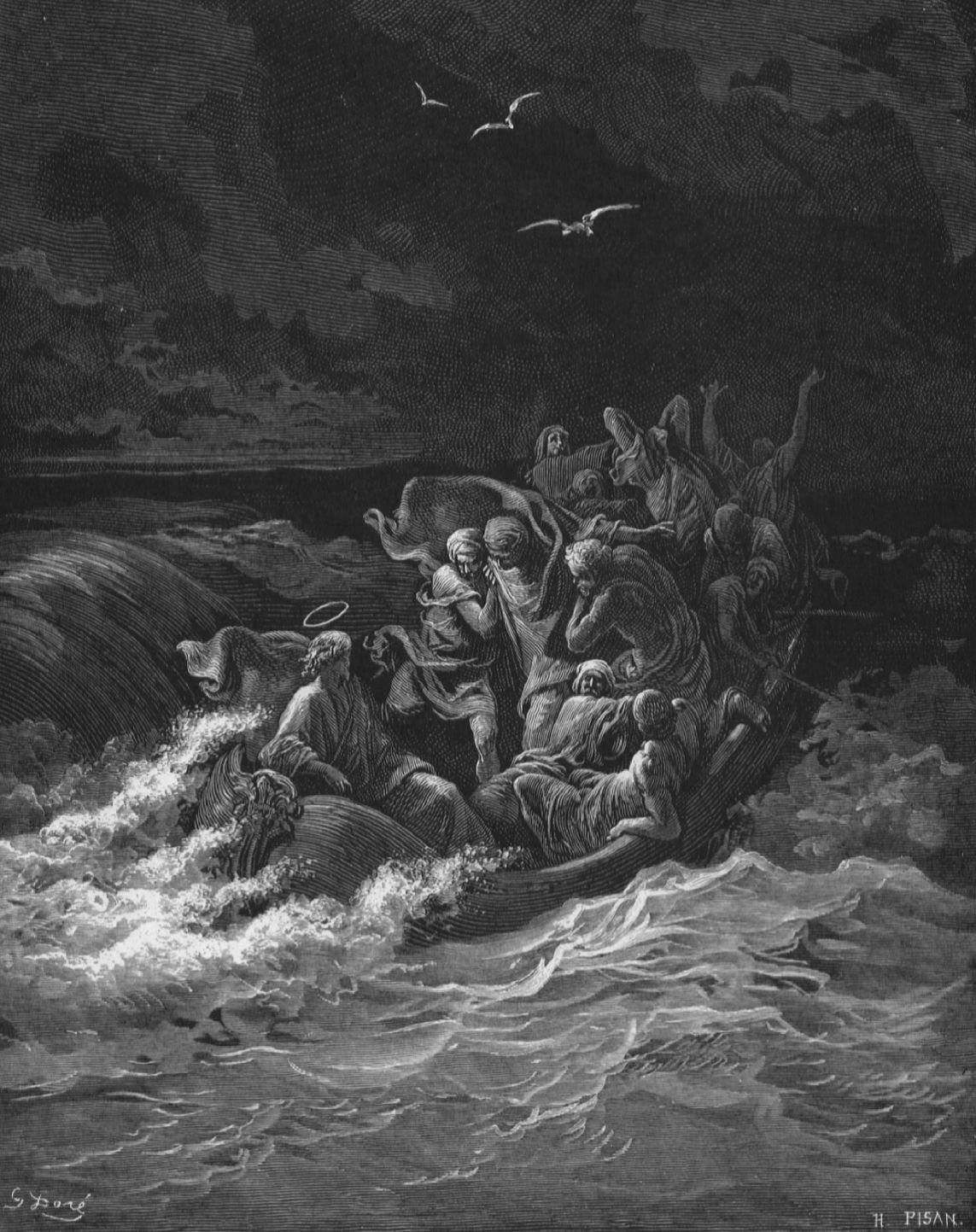
Jesus Calms the Storm, Gustave Doré


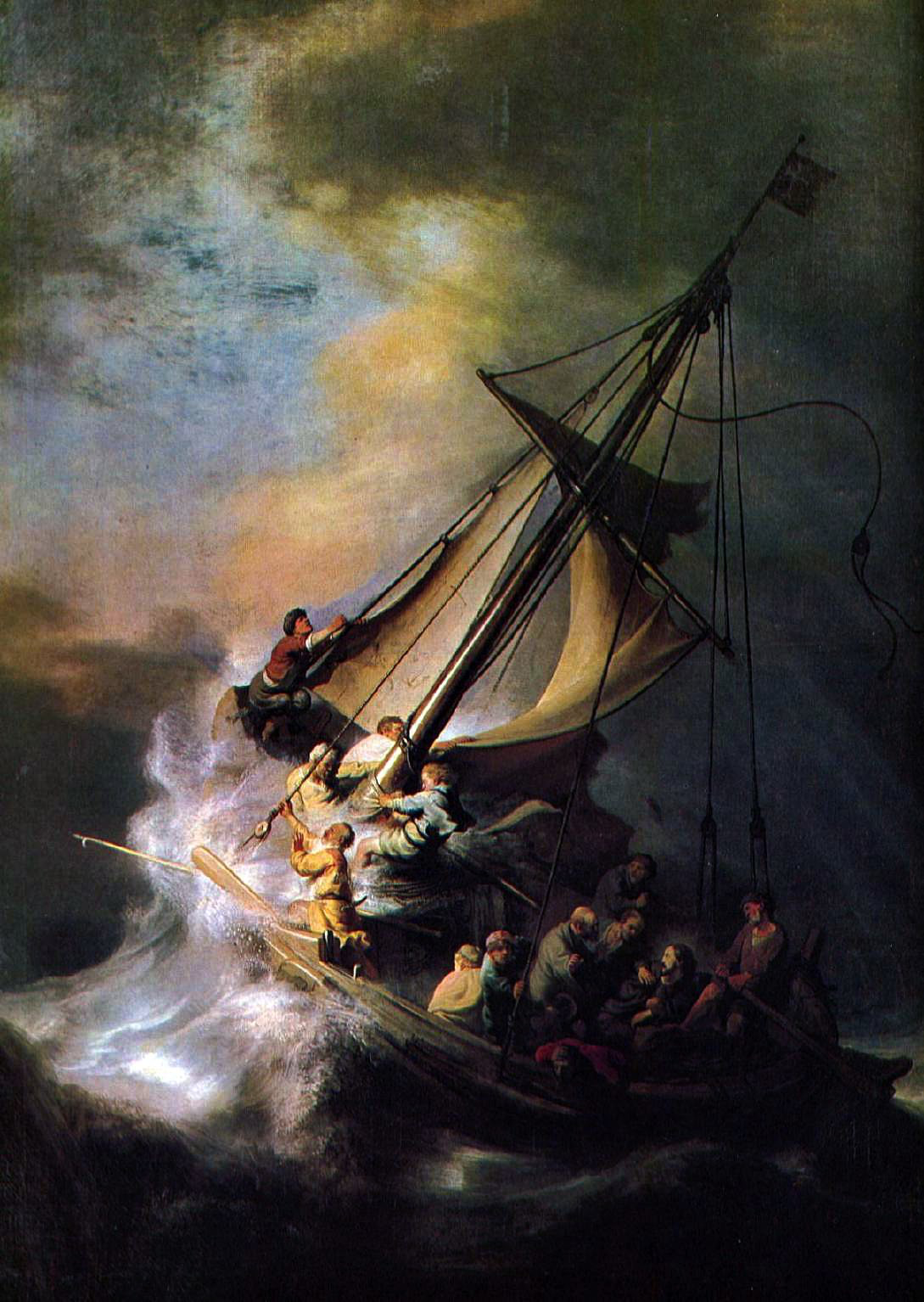
Here’s Rembrandt’s rendition of it:


The Storm on the Sea of Galiee


And yet Jesus “lies down and sleeps in peace,” as the Psalm says.


A Furious Squall…


Mark 4:35 says, “That day when evening came, [Jesus] said to his disciples, ‘Let us go over to the other side.’” From what I can tell, evening can be a good time to catch fish, but to traverse a lake…? When you’re out camping and sunset comes, you try to set up camp, not embark on a new leg of your expedition.

But God’s ways are not our ways, and Jesus’ ways are not the disciples’ ways, so off they go. Verse 36 says, “Leaving the crowd behind, they took him along, just as he was, in the boat. There were also other boats with him.”

“Just as he was”—it’s like when you’ve made a spontaneous decision to pick up a friend and go out for coffee, and you are in a hurry and you say, “Just come like that, just come how you are. Atomic Cafe doesn’t care if you wear your pajama pants and fleece-lined Crocs. Get in the car.”

Jesus and the disciples just went.

Next verse, verse 37: “A furious squall came up, and the waves broke over the boat, so that it was nearly swamped.”

I love this genius storytelling of Mark. If you’re reading or listening to this story, you don’t know yet where Jesus is. “A furious squall came up, and the waves broke over the boat, so that it was nearly swamped.” And then, you expect, verse 38 will say, “And Jesus, with power and authority, stood up and made the waves stand still.”

But, no, verse 38 says, “Jesus was in the stern, sleeping on a cushion.” He needed his introvert time. He found a pillow, or a big sandbag, and put his head on it.

The disciples take this as apathy, some kind of a cruel joke.

If the boat is nearly swamped, and Jesus is still sleeping, he must not be wet yet. It’s possible the stern was raised. The boat could have looked something like this:


Raised Stern


Which probably makes the disciples all the more upset. You wonder… if Jesus knew this storm was coming, is that why he was at the stern, elevated above the rest of the boat? And if so, the reader of this text wonders, why didn’t he quell the storm before it started? Or give the disciples a heads-up? Mark doesn’t tell us.

But his students ask, “Teacher, don’t you care if we down?”

The specific wording Mark uses in the text suggests that the boat was filled “to the extent of its capacity” (HT).

And doesn’t this imagery of a flooding boat go against the axiom that “God won’t give you more than you can handle?” Maybe it’s more like, “Sometimes we get more than we can handle, and God’s not necessarily the one who gave it to us, but he’ll be right by our side anyway.”


…And an Omnipotent God


If Mark’s given us the full humanity of Jesus—he was sleeping on a cushion—now we see his full divinity. Verse 39 says, “He got up, rebuked the wind and said to the waves, ‘Quiet! Be still!’ Then the wind died down and it was completely calm.”

“Who is this?” the disciples ask. “Even the wind and the waves obey him!”

The text says it goes from a “great” windstorm to a “great” calm.

Jesus talks directly to the wind and the waves. Can you think of another person in biblical history who talked to the waves and the sea, and told them to do something?

Jesus, they are starting to see, is more than just an amazing teacher. Listen to how God questioned Job:

Who shut up the sea behind doors
when it burst forth from the womb,
when I made the clouds its garment
and wrapped it in thick darkness,
when I fixed limits for it
and set its doors and bars in place,
when I said, ‘This far you may come and no farther;
here is where your proud waves halt’?

I don’t know if the disciples, in that moment of fear, would have had Job in mind, but the kind of thing Jesus is doing in this passage is the kind of thing that only the LORD God Almighty does.

Here he is. God himself, in the boat with the disciples.

Psalm 107 says, “He stilled the storm to a whisper; the waves of the sea were hushed.”
 

But They That Go Down to the Sea in Ships…


I wonder if Jesus had this Psalm in mind as he went out into the Sea of Galilee with his disciples. Maybe he thought, “Alright—it’s Psalm 107 time. Let me show these young ‘uns what I can do.”

Listen to part of Psalm 107 in the King James Version:

They that go down to the sea in ships,
that do business in great waters;
These see the works of the LORD, and his wonders in the deep.
For he commandeth, and raiseth the stormy wind,
which lifteth up the waves thereof.
They mount up to the heaven,
they go down again to the depths: their soul is melted
because of trouble.
They reel to and fro, and stagger like a drunken man,
and are at their wits’ end.
Then they cry unto the LORD in their trouble,
and he bringeth them out of their distresses.
He maketh the storm a calm, so that the waves thereof are still.

Did part of that ring a bell? You might recognize this guy:


FishermanMemorialGloucester


Here’s a close-up of the Fisherman Memorial overlooking the Harbor:


They That Go Down


“They that go down to the sea in ships,” the inscription reads, 1623-1923.

They that go down to the sea in ships, that do business in great waters;
These see the works of the LORD, and his wonders in the deep.


…These See the Works of the LORD


What about those who go unrescued?

And the Psalm goes on to describe the wind and the waves. Those at sea “reel to and fro… and are at their wits’ end.” Surely this describes the lives of those lost at sea from 1623 to 1923, and before and since.

Then they cry unto the LORD in their trouble,
and he bringeth them out of their distresses.
He maketh the storm a calm,
so that the waves thereof are still.

That very much sums up the experience of the disciples in Mark 4. They’re living out that Psalm with Jesus

But herein lies a theological difficulty. I don’t know how many fishermen cried “unto the LORD in their trouble” in stormy seas, but the memorial in Gloucester stands there to honor those who were not brought out of their distress… or at least, not brought out of a storm. There are some storms–literal and metaphorical–that God just does not make calm. Unlike the ones the Psalm 107 goes on to describe, these men and women that the man at the wheel stands for were not rescued.

“Teacher, don’t you care if [they] drown? …Why didn’t you save them?”

It’s one of the perplexing questions that confronts us—why a God who can and does intervene so often… just lets some things go… lets some evils move ahead. Allows men and women to get lost at sea.

That existential question has come up again this week in Charleston:


Why
Source: David Goldman (AP)


You can’t kill love

The 9 members of Mother Emanuel African Methodist Episcopal Church barely had time to “cry to the LORD in their trouble.” And though Jesus was in attendance at that Bible study and prayer time—“Where two or three are gathered in my name, there I am with them”—he didn’t stop the hateful actions of a deeply racist young man.

Surely those 9 didn’t have to die. I don’t know how many more of these things it will take for our nation and lawmakers to finally move ahead in a serious conversation about gun control. I don’t know how many more unarmed black people will have to die before our country wakes up to the pervasive racism in our midst.

They didn’t have to die. But, you know what? In the lexicon of the Kingdom of God, dead isn’t really dead.

Because you can kill a person, but you can’t kill love.
You can try to cut somebody down, but “the blood of the martyrs is the seed of the church.” From even horrible death can come new and powerful expressions of life.

Rev. Clementa Pinckney was the Pastor of Mother Emanuel, one of those who died. There’s a short YouTube video you can easily find: a couple years ago he welcomed a group of folks who were on tour in historic Charleston. Here’s what he said:

The African American Church… really has seen it as its responsibility and its ministry and its calling to be fully integrated and caring about the lives of its constituents and the general community. We… don’t see ourselves as just a place we come to worship, but as a beacon, and as a bearer of the culture and a bearer of what makes us a people.

But I like to say this is not unique to us. It’s really what America is about. Could we not argue that America is about freedom? Whether we live it out or not… but America’s about freedom, equality, and the pursuit of happiness. And that’s what church is all about. Freedom to worship and freedom from sin, freedom to be fully what God intends us to be… and have equality in the sight of God. And sometimes you gotta make noise to do that. Sometimes you maybe have to die… to do that.

We saw this week how the family members of the victims responded. They called on Dylann Roof to repent of his sins and believe in Jesus. As Rev. Pinckney suggested, they called him to a life of “freedom from sin, freedom to be fully what God intends [him] to be.” They said things like, “Though every fiber of my being is hurting, I forgive you.” And the nation watched, amazed at the witness of the families in that church.

And so God, working through the amazing mercy of the families, calms the storm, after all. The winds of hatred and the breaking waves of destruction die down as Christ works in the hearts of his disciples in Charleston who choose faith over fear.

When God’s children find themselves in choppy waters, our Lord, Jesus, is right there with us in the boat.

And because they know Jesus is in the boat with them, the families of Mother Emanuel have chosen to be joyful, “though [they] have considered all the facts,” though their loved ones have been lost at sea, as it were.

Not a sudden storm, not even a tragic shipwreck can keep Christ’s disciples from making it to the other side. There they see the works of the LORD, and their witness lives on.


The above is adapted from the sermon I preached today at church.

Charleston, S.C.: What Can We Say?

Why
Source: David Goldman (AP)


In the wake of yet another mass shooting in the U.S. on Wednesday night—which was also an act of racism—I suspect many of us have found ourselves at a loss for words. Scripture’s language of lament can come to our aid in the aftermath of violence and tragedy. Of course, the Psalmists who turned their pain and puzzlement into prayers did not see lament as a panacea for all the world’s evils. Even if God were to vanquish all of David’s enemies on the spot, he knew he still had the sin of his own heart to contend with.

Psalms and prayers of lament do, however, help the one praying make the important move of deliberately entering God’s presence in a state of deep pain, confusion, frustration, exhaustion, and exasperation. If you are tired of praying, “How long?” and “Why?” and “Please come to our aid quickly, O Lord!”, I wonder whether the Psalm writers might simply advise us to redouble our efforts and pray those same prayers once more.

Psalm 74 says, in part:

How long will the enemy mock you, God?
Will the foe revile your name forever?
Why do you hold back your hand, your right hand?
Take it from the folds of your garment and destroy them!
But God is my King from long ago;
he brings salvation on the earth.

Psalms of lament—with a couple noteworthy exceptions—end with an affirmation that God is still King, and his ability to bring salvation cannot be compromised. I’ve often imagined that when the authors of such Psalms came to the reaffirmation section of their laments, they wrote with trembling hand, watering eyes, and a fast-beating heart that clung desperately—hope against hope—to the truth of God’s sovereignty.

Now is the time to pray such laments—especially on behalf of others and the injustice and pain they undergo. Though all life is valuable and the taking of another life is tragic in any setting, the victims at Mother Emanuel African Methodist Episcopal Church in Charleston were brothers and sisters in Christ, bonding together in prayer in their final moments of life on earth.

Their prayer and study of the Word of God is now transformed into something more than they could have imagined, as they meet the One who is called the Word, face to face, in all his glory.

But there’s more to respond to—the shooter appears to have been a white supremacist who targeted his victims specifically because they were African Americans. It’s stupefying how people of color in our country continue to be targeted. Our prayers and support are needed.

I know it can feel like “it’s getting old” to make lamentations, and we can get tired of praying the same prayers (over and over) for justice and healing around issues of racism and hatred in all its forms. But battle after battle, injustice after injustice, threat after threat, that’s what the Psalmists did. They kept turning their pain to prayer—kept bringing complaints about injustice into the presence of God.

Let’s not lose heart in praying that God’s kingdom would come, in all its fullness.


The above is adapted from what I wrote to our congregation this morning: a call at a time when words fall short to engage the lament language of Scripture.