
 Logos 5 does not operate in ways that are drastically different from Logos 4, but there are enough new features and modifications that a “What’s New?” guide for Logos 5 is useful.
Morris Proctor is president of MP Seminars, “the authorized trainer” for Logos Bible Software. With the release of Logos 5 in November, MP Seminars produced a “What’s New?” manual for Logos 5. It is not intended to be a stand-alone guide to Logos 5; those are here, and I’ll review them in a future post. Proctor assumes a general working knowledge of Logos 4 for this guide, though even as someone new to Logos in the last six months or so, I found it easy to follow his explanations.
The chief virtue in this manual is its attention to detail–down to offering various “keystroke” shortcuts for tasks in Logos 5. “What’s New?” covers Logos 5 for both Mac and Windows. There are screenshots throughout with clear labels and instructions. For example:
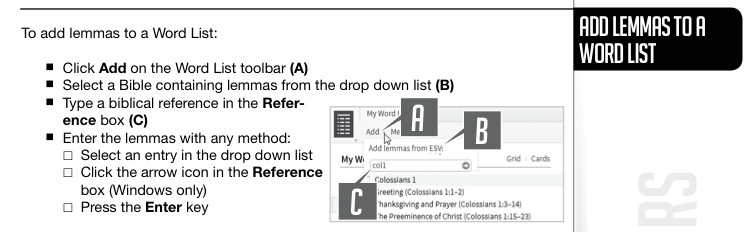
The instructions are clear and easy to follow. The consistent use of illustrations like the above make “What’s New?” a reference guide to keep near the computer. (The plastic spiral-bound construction of the book means it easily lays flat.) The screenshots are printed in black and white, but that does not detract from their clarity.
Even having spent significant time with Logos 5, I found details through this manual that I never would have thought to look for. For example, MP notes a new item in the “Information” panel called “Translated,” which displays various Bible translations of a given word in one place. The sections on the Bible Sense Lexicon (ch. 14) and Clause Searching (ch. 5) are especially good at explaining new features from the ground up, in a way that someone using Logos 5 for the first time could easily understand. MP has probably the best short explanation of the new Bible Sense Lexicon that I’ve seen–he calls it an “orchard with trees bearing branches,” a phrase he then unpacks in helpful detail.
I did find myself wanting a bit more from the section on the new “Sermon Starter Guide.” MP describes the basic headings found in that guide, but there is not a lot of information about how to work within the guide’s results. For example, it is clear from the manual how to generate the report and understand the headings it provides, but there is not mention of the fact that from a passage-based report, you can click on a theme to open an new theme-based report, or that you can click on “x” next to a heading to close that section altogether. Perhaps MP goes into this level of detail in the full Logos 5 manuals.
There is often mention of what Logos “can do for you,” or the assertion that “Logos is here to help,” and so on. This made me feel a few times like I was being sold to, which is unnecessary since anyone using this manual will already have Logos 5. This is a small distraction, through.
Here’s the Table of Contents, detailing what the 68-page manual covers:
1. Appearance and Tabs
2. Home Page
3. Library
4. Searching
5. Clause Searching
6. Documents Menu
7. Bibliography
8. Word List
9. Guides
10. Sermon Starter Guide
11. Topic Guide
12. Tools Menu
13. Bible Facts
14. Bible Sense Lexicon
15. Timeline
16. Visual Filters
17. Root Words
Even with Logos 5 under my belt for a few months, the “What’s New?” manual from MP Seminars has really deepened my understanding of the new features in that program. It’s a good guide for the transition from Logos 4 to 5.
Thanks to MP Seminars for the copy of the Logos 5 – What’s New? manual to review. You can find it available for purchase here.


 Words on the Word