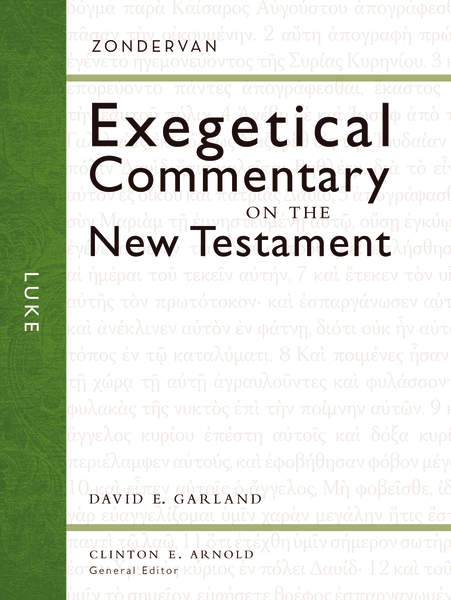
Luke (Zondervan ECNT), reviewed

The last few weeks I’ve been spending time with David Garland’s Luke volume in Zondervan’s Exegetical Commentary on the New Testament (ZECNT) series.

Garland’s commentary is more than 1,000 pages, but this should not be a surprise, since Luke is the longest Gospel. Like the rest of the ZECNT series, it is “designed for the pastor and Bible teacher.” Garland assumes a basic knowledge of Greek, but Greek is not required to understand his commentary. For each passage the commentary gives the broader literary context, the main idea (great for preachers!), an original translation of the Greek and its graphical layout, the structure, an outline, explanation, and “theology in application” section.

The graphical layout of each passage is a unique contribution that Garland’s Luke makes to Luke studies. Even though a narrative book like Luke is easier to follow than some of Paul’s detailed arguments, seeing main clauses in bold with subordinate clauses indented under them (plus how they relate back to the main clause) gives the reader a quick, visual grasp of the entire passage at hand. Garland does this well, too. Pages 50 and 62-63 of the commentary in this sample pdf give you a taste.

Luke has the full Greek text of Luke, verse by verse, and full English translation by Garland (passage by passage in the graphical layout, then again verse by verse next to the Greek). A value for me in using reference works is not having to pull five more reference works off the shelf to use the first reference work! This is about as portable as exegesis of Luke gets. Garland’s English translation is a bit wooden at times–just about every καὶ in the opening narrative of 1:5-25 receives the translation “and,” which it shouldn’t always. ὁ δὲ ἀποκριθεὶς εἶπεν in 10:27 becomes “He answered and said,” where just “He said,” would be preferred.

Garland’s intro is short, but covers what it needs to. He attributes authorship to Luke and holds to Luke-Acts unity, as many scholars do. (“[Luke] is writing not simply about the life of Jesus but what Jesus inaugurated that continued in the deeds of his followers (Acts 1:1-8)” (27).) He understands Luke-Acts as fitting into the genre of “Hellenistic historiography.” He treats Luke’s potential sources, date of writing, readers, location, purpose, and structural outline. There is an additional “theology of Luke” section at the back of the commentary that complements the introduction. It doesn’t cover all the theological themes in Luke (healing/exorcism, for example, is absent), but it doesn’t claim to, either.

Where Garland really shines in this commentary is in his treatment of the Greek words and phrases that comprise the Luke text. He attends to the lexical meaning of given words, how they function in context, and their use in other parts of Scripture. This is helpful especially for parts of Luke where the Greek vocabulary is more obscure or difficult.

Teachers and preachers especially will appreciate the “Theology in Application” section that concludes each passage. To the pastor wondering how to preach on something like Luke’s prologue, Garland writes:

The purpose of the gospel is not to give information but certainty that will change lives. Erudition about Jesus is not the same as insight into Jesus. The history of Jesus is not to be divorced from the proclamation about Jesus, as if the two were somehow incompatible. (58)

This comes after a detailed exegesis of the first four verses. As someone with preaching experience, I can say this combination of thorough attention to the Greek text with contemporary application is pure gold.

Inevitably no commentary can say everything about every word in the text, but there are parts of Luke that I thought deserved more attention. For example, in Luke 8:31 the demons known as Legion beg Jesus not to cast them into the Abyss (Greek ἄβυσσος). Garland just offers, “The Abyss is the place of punishment for evil spirits” (358). Although he infers that this verse shows the “eschatological dimension” to exorcisms, nothing more is given about ἄβυσσος. For a word that appears just once in the Gospels yet multiple times in the Old Testament and Apocrypha, more background on this term would have been useful to the reader. This could, of course, merely reflect a space limitation in the commentary.

On the other hand, Garland’s commentary on the Good Samaritan parable (“merciful” as Garland has it) leaves out just about nothing. To provide needed historical context to the passage, Garland draws on what Josephus said about priests, what Sirach said about helping those in need, and includes an excursus on the “adversarial history” of Jews and Samaritans. Garland compellingly concludes from the parable:

The original Jewish audience must enter the ditch and accept a Samaritan as a savior, helper, and healer. They must experience being touched by this unclean enemy who treats a wounded man as a compatriot. (446)

Garland seeks to prove right the series claim that “all who strive to understand and teach the New Testament will find these books beneficial,” and he succeeds in this. Preachers or students of Luke will want to supplement Garland’s work with other works on Luke (Bock’s two volume set remains the standard), but the graphical layout of each passage and the theology in application sections alone are enough to warrant careful consideration of this volume.

(I am grateful to Zondervan for the free review copy of this commentary, which was offered to me in exchange for an unbiased review. You can find the book on Amazon here.)

UPDATE: Enter to win a free book giveaway of Ephesians from this same series.

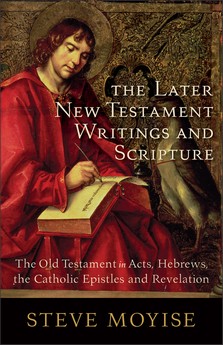
Magnificent Monograph Monday: The Later New Testament Writings and Scripture, Reviewed

Eisegesis. Not a label most evangelical Biblical interpreters want to wear. If exegesis is drawing the meaning out of a text–with a careful eye toward its original context and authorial intention–eisegesis is taking one’s own set of meanings and intentions into the text. Evangelical scholars aim to practice the former and avoid the latter, although of course everyone comes to any text with some presuppositions. (And new hermeneutics like reader response criticism may see this as a good thing anyway.)

My seminary teaches an exegetical method that majors on reading a text in its original context and understanding its original purpose. I’ve often thought that if New Testament writers submitted any of their works as exegesis papers, they’d fail because of the various “hermeneutical fallacies” they commit! It seems that New Testament writers freely appropriate or proof-text Old Testament passages for their own purposes, no matter the original context or intention of the passage at hand. They might even be accused of eisegesis, were they employing their methods today.

Baker Academic has just published the third volume of Steve Moyises’s de facto trilogy, in which he examines how Jesus, Paul, and the later New Testament writers use Scripture. He seeks to “give an account of” and “consider the use of Scripture” in the later NT writings. This is a “study” of “important engagements with Scripture.”

Just picking up the book before reading it was a pleasure–the layout is great, the paper quality is high, the font is clear and easy to read, and the cover design is appealing. Especially for a paperback, it’s an attractive volume to have on a bookshelf. (I note here that I received a free copy from Baker in exchange for an unbiased review.)

Moyise treats Acts, 1 Peter, Jude/2 Peter, James, Hebrews, Revelation, and includes a brief excursus on 1-3 John. He is thorough in the Scriptures he treats, which is especially aided by a UBS index in the back that serves as an index of all the quotations of the Old Testament in the above books. (There are full Scripture and author/subject indeces, too.)

The author groups the Scriptures thematically or by Old Testament book, rather than going verse by verse through each of the New Testament writings under consideration. In Acts, for example, he considers how the author Luke uses Old Testament Scripture to address themes like “Salvation for Jews and Gentiles,” “Christ’s death, resurrection, and exaltation,” “Judgement,” and so on. In 1 Peter Moyise has sections devoted to I Peter’s use of the Psalms, of Isaiah, etc. Moyise does this so as not to “miss the wood for the trees,” and he is successful. The reader, then, can conclude each portion of the book with a solid overview of how each NT writer uses the OT.

The text is accessible to a non-scholar or non-specialist in this field. For example, Moyise explains on p. 4:

[I]n some cases the New Testament authors appear to know a version of the text that differs from the majority of manuscripts that have come down to us. The discovery of the Dead Sea Scrolls (1948–) has shown that the biblical text existed in several forms in the first century and it is not always clear which form is being quoted.

He uses gray shaded boxes at various points to succinctly explain key concepts such as “typological interpretation” or to address things like 2 Peter’s use of the largely unknown 1 Enoch. The endnotes include more textual details and point the reader in the direction of the scholarly writings about each book. One does not need knowledge of the original language to read Moyise, but he does at times use transliteration of various Greek words if it helps his explanation.

The potential reader might be concerned that a book about intertextuality could end up as just a dry list of references. Moyise does thoroughly catalog the quoted OT passages, yet he draws conclusions from such use, as well:

Although James’s use of Scripture is not christological in a doctrinal sense, it bears comparison with Jesus’ own interpretation of the law, particularly his emphasis on seeing the law in the light of the twin commands to love God and neighbour. (63)

Moyise presents various interpretations in an even-handed, balanced way. I felt more than once like I was reading R.T. France, a favorite commentator of mine. He includes, too, the full text of many of the verses he cites, eliminating the need to flip back and forth through other reference works while reading this one. Jude and 2 Peter have a helpful table of comparisons where the two are lined up side-by-side, and this feature is present for other passages also.

There were a couple times where I thought Moyise might be guilty of the fallacy of post hoc ergo propter hoc (inferring causation just because one thing chronologically follows the other). In Revelation, for example (which he notes quotes no Scripture explicitly but is full of allusions), he speaks in terms of the “source” of (129, 137) or “inspiration behind” (130) John’s descriptions of his visions. My response to this was–just because John’s language has much in common with the Scriptures that came before him, do they therefore have to be his source? What if his source was, in fact, the vision he had, and he just used Scriptural language to express it?

Finally in the conclusion to his section on Revelation, Moyise addresses this very question. In fact, he is quite aware of questions like mine, and in the end treats it thoroughly and fairly, citing those who advocate a “scribal model” (where John is said to have basically just compiled Scriptures into a new presentation) and those who advocate a “rhetorical model” (where John uses OT language to express something new that he actually saw).

My question about whether or not NT writers are in some sense eisegetes is not an uncommon one. Students often ask: If we’re not supposed to handle Scripture that way, how can they? Though Moyise doesn’t necessarily set out to answer that question in this volume, he answers it beautifully:

The important point in all this is that the Scriptures did not exist in a vacuum. They were part of a living tradition where text and interpretation were transmitted together. (148)

In describing Revelation’s use of Daniel, for example, he says it is “not necessarily an ‘improper’ use of Scripture but hardly what Daniel had in mind” (140).

Moyise (87) quotes Susan E. Docherty from her book The Use of the Old Testament in Hebrews:

The author of Hebrews as much as any ancient Jewish exegete…regarded it as legitimate interpretation to seek out what scriptural texts imply as much as what they actually say, presumably believing that the new meaning he gave them was inherent in the original revelation, which he regarded as having endless depths of meaning and real contemporary relevance.

That Moyise’s trilogy of books on NT use of Scripture exists is a testament to the depth of Scripture. Moyise is a fantastic guide for exploring what can be confusing and difficult territory.

(Here’s the book at Amazon.)

Junia is Not Alone: Review of Scot McKnight

In Junia is Not Alone, Scot McKnight asks, “Why are we so obsessed with studying the ‘subordination’ of women to men but not a woman like Deborah, who subordinated men and enemies?” And, “Why is there so much silence in the church about the women in the Bible?”

Noting how few of his students (i.e., none) had heard of Junia and other women in the Bible, he dedicates his short ebook to “ending the church’s deafening silence on women in the Bible.”

Junia “appears innocently enough” in just one verse of the New Testament, Romans 16:7, “alongside her husband, Andronicus.” (See my Junia post here.) McNight goes on to say that Junia “had no idea she would someday be the subject of endless discussions,” although unfortunately his own discussion of her ends pretty quickly.

On the bright side, McKnight does what often goes undone in conversations about the apostle Junia–he explains what the term “apostle” means in Romans 16:7. He writes,

So, we conclude that there was a first-century relative of the apostle Paul named Junia; she entered into Christ before Paul did; and this Junia was an apostle. Which means (because this is what apostles did) she was in essence a Christ-experiencing, Christ-representing, church-establishing, probably miracle-working, missionizing woman who preached the gospel and taught the church.

Nice. Unfortunately, however, readers who are looking for anything else about Junia will be disappointed. Of course there is only the one Bible verse that mentions her, and no other first century documents where she is known to appear (although someone please correct me if I am wrong?). But there is a long history of interpretation and textual criticism around “Junia” and Romans 16:7, which I would have liked to see McKnight delve into a bit more. As it is he merely favorably summarizes the conclusions of Eldon J. Epp (the text does read “Junia,” not a male “Junias”; she was an actual apostle).

In addition to Junia, McKnight mentions other women in the Bible–Priscilla, Mary, Phoebe, Deborah, Miriam. Although his listing these women and briefly discussing their ministry is helpful, he says very little about each (Miriam: led Israel in song). Perhaps this is due to the nature of a deliberately short ebook, but I was left wanting more.

McKnight helpfully traces the history of the Greek New Testament editions, and how “Junia” became “Junias.” But his conclusion feels dramatic:

The editors of Greek New Testaments killed Junia. They killed her by silencing her into non-existence.

All I could think about after reading that line was Dan in Real Life, where one of Steve Carell’s teenage daughters (whose romantic relationship he is trying to end) storms off and says, “YOU!  ARE A MURDERER… OF LOVE!”  McKnight again: “They murdered that innocent woman by erasing her from the footnotes” (my italics). A bit much.

But I’ll give McKnight that even Bible translations can be “political” and motivated by other external factors. He says it better here: “Who says New Testament texts and translations are not political?” Some editors/translators think that a woman couldn’t hold the office of apostle, so they essentially tamper with the text… if he’s right that that has been a common motivation for reading “Junias” and not “Junia,” then I agree; it’s poor form. Actual textual evidence for “Junias” would be a good reason to read “Junias” in the text, but there is not much. All the same, the charge of murder seems harsh.

In the end McKnight asks about Junia, “Do you hear her voice?” But ultimately the God who calls, gifts, and equips women and men alike for ministry is the one whose voice we ought to be listening for. McKnight knows this, and I get his point, but I think his appeal could have been strengthened by calling the Church to hear and heed Junia’s example and to let her significant ministry as an “outstanding apostle” inspire us. Junia didn’t write anything (at least that we have today), so what “voice” are we to listen for, and how? It almost sounds like she is supposed to speak to me from the grave or via some warp in the space-time continuum.

I’d wager that’s not what McKnight is getting at, however. I think he simply wants the “silence” about women in the Church to end. Although the preponderance of Biblical heroes are male (for cultural but not theological reasons, in my opinion), there are some pretty significant ministry roles that women play in both testaments.

And my criticisms notwithstanding, I’m with McKnight–those women’s stories need to be told more often and more fully as preachers and teachers expound the whole Bible to their congregations. Where there is silence about how God has used and continues to use women to spread his Gospel, the silence should end. I just wish McKnight himself –as someone fully qualified to do so–had made more noise about Junia and the other women who join her in the pages of Scripture.

Best Commentaries

A few posts back I mentioned a great series that a blog called Reading Acts is doing, suggesting five good commentaries to own for each book of the New Testament.

There is also a site that I frequent, called Best Commentaries, that compiles and averages user reviews and ratings to rank the best commentaries on all the books of the Bible. The rankings are somewhat subjective and open to disagreement, but the site is quite helpful all the same. You can look up commentaries by book of the Bible or by commentary series. The site also notes the “academic level” of each commentary, so you know if Greek/Hebrew is required to understand it (“Technical”), if it’s ideal for sermon prep and heavy exegesis (“Pastoral”), or if it’s of a more “Devotional” nature.

(Of course, I think some commentaries fit into all three categories at once.)

Best Commentaries has served me multiple times already as a helpful guide. I highly recommend it.

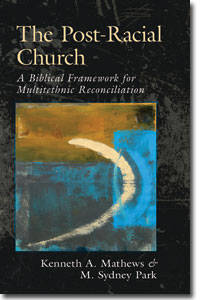
Magnificent Monograph Monday: Review of The Post-Racial Church

Kenneth A. Mathews (Old Testament) and M. Sydney Park (New Testament), professors at Beeson Divinity School, attempt in The Post-Racial Church to “better equip the church in answering why Christians claim that the gospel and the Christian church are the first and last best hope for peace in a racially diverse world” (25).

To help readers understand how churches can more faithfully reflect “the wonder of God’s human kaleidoscope,” they work their way through the arc of the Old and New Testaments to reveal God’s plan for reconciliation. Reconciliation, they believe, “can only be fully and finally achieved by a Savior who redeems and transforms the human state” (57). Their call to racial/ethnic unity in the church is an unabashedly Biblical program. They write, “Genuine unity must be predicated upon a commitment to the Lord God, not based on anything or anyone else. Otherwise, the unity is circumstantial, which means that it is superficial and fragile” (72-73). They ground their call for ethnic unity in the Church firmly in Scripture.

Mathews writes the introduction and chapters 1-4 on the Old Testament, addressing God’s design in creation, his covenant with Noah and then with Abram to bless all nations, as well as God’s heart and provision for the immigrant among the people of Israel. Park traces the New Testament development of the theme of the inclusion of all people in God’s covenant. She explores Jesus’ stories concerning reconciliation, as well as how Biblical characters like James, Peter, and Paul came to grips with a deeper understanding of God’s desire for trans-ethnic unity in the Church.  (Park’s interpretation and application of the Prodigal Son parable opened up new understandings of that story that I had never considered—despite having already heard and read it many times.)

The Post-Racial Church is excellent in the thoroughness with which it treats Biblical texts that have to do with multiethnic reconciliation (and reconciliation more generally). In this sense, it greatly succeeds in being what the book’s subtitle claims it will be: A Biblical Framework for Multiethnic Reconciliation. Even though the introductory chapter clarifies what the authors mean by various terms they use, the phrase “post-racial church” as such is not really explored in the book itself. “Kaleidoscopic Church” or “The Post-Racist Church” would have been more fitting titles for the book. (So if you, like me, express skepticism at a Church or any institution being “post-racial,” don’t let that stop you from checking out this book. The authors don’t actually advance that we be “color-blind” or “ignore race” as part of their thesis.)

On the one hand the book at times felt a bit over-dense (especially the first half). But on the other hand, other books I’ve read about multiethnic church-building or racial reconciliation often give what feels like too short a treatment of Biblical texts on the topic. Mathews’ and Park’s detailed exegesis was in the end refreshing in this sense, and makes a unique contribution to the genre of book into which The Post-Racial Church fits. I also appreciated that they drew on the original Hebrew and Greek to further illuminate the texts they expounded. This made their work even more compelling.

Each chapter concludes with “Thought Provoker” questions, a high point of the book. For example, one question (p. 171) asks,

If loving our neighbors is a critical factor in our discipleship, and if loving our neighbors self-sacrificially serves as the litmus test for our discipleship, does the test prove positive for you and your church?

One could easily use this book in a small group discussion to great effect.

The reader who takes the time to work carefully through the authors’ guided exegetical tour through the Scriptures will be greatly rewarded. If indeed, as Park claims, “the proper understanding of racial reconciliation is possible only in light of God’s saving activity throughout human history,” then those who desire to join God in drawing all people to himself will want to avail themselves to the solid Biblical exposition that the authors provide.

(Per FTC guidelines, I note that I received a complimentary copy of this book from Kregel in exchange for an unbiased review.)

Book Review: The Next Evangelicalism, by Soong-Chan Rah

Soong-Chan Rah writes, “As many lament the decline of Christianity in the United States in the early stages of the twenty-first century, very few have recognized that American Christianity may actually be growing, but in unexpected and surprising ways.”

In The Next Evangelicalism: Freeing the Church from Western Cultural Captivity, Rah posits that mainstream evangelicalism in the United States has been too monocultural in its worldview–“white” and “Western,” he says. It has been “taken captive” by individualism, consumerism and materialism, and racism. This captivity is pervasive, he writes, as seen in the megachurch movement, the emerging church movement (which Rah rightly argues pays too much attention to just white voices), and through cultural imperialism. Looking at Native American, African American, immigrant, and multicultural communities, Rah offers hopeful alternatives for evangelicalism’s future.

Every evangelical Christian should read this book. Rah has the courage to say hard things the church needs to hear. His excellent treatment of racism, especially, should be preached from the pulpits and studied in small groups.

However, there are at least two key points where I take issue with Rah.

First, a distraction is Rah’s equating “white” with “Western” as he discusses the church’s captivity. But these two are not always synonymous words, and sometimes when the author uses “white” he really means (or should mean) “Western” instead. Rah mentions T.D. Jakes as a megachurch pastor who is emblematic of the church’s captivity to (“white”) numerical pragmatism. But Jakes is “Western” and not “white.”  And there are non-white sectors of the Western church deserving of Rah’s critique (for example, Creflo Dollar and other “health and wealth gospel” African American pastors should be included in Rah’s critique of Western consumerism and materialism). Rah’s arguments would have more force (and been more accurate) if he simply had referred to “Western cultural captivity.”

Second, I struggled to accept some final remarks: “The shift in American evangelicalism is well under way. The white churches are in significant decline.” I will grant the first assertion. But as to the second, Rah does not define further what he means by “decline” and provides barely any evidence of it that I could see. In fact, if he means numerical decline, he is using a standard previously rejected in his book. (Church health ought to be measured not by buildings built or number of attendees alone, he notes, but by taking the spiritual pulse of the congregation.) Is a Church feeding the poor?  Welcoming visitors?  Caring for the sick? (Etc.?) If so, Rah would say, it is a healthy church. By this standard, the predominantly “white” church at which I recently served as youth minister, for example, is very healthy. Members of that church, and of many others I know that are like it, might read lines like this and ask, “What decline?”

Even so, I don’t want to overly fault Rah for those objections. As a reader I do not demand that Rah say everything perfectly before I accept the force and truth of his overarching claims. All in all, The Next Evangelicalism issues a clarion call to the church to end racism, embrace the growing ethnic diversity of the body of Christ, hear voices that have been overlooked and marginalized, and more accurately reflect the church the Bible calls us to be.

The “Preacher’s Trash Bin” (A Review of What Not to Say)

Here is some great preaching advice from my mother-in-law, a pastor: Never say from the pulpit that a certain idea came you to while you were in the shower.  Because who wants to think about their pastor in the shower?

Or as John C. Holbert and Alyce M. McKenzie put it, “Don’t tell stories that involve listeners picturing you naked. …So you received an insight into the cleansing power of God’s love in the shower on the mission trip as the cleansing and healing water cascaded over your body. Find another setting to tell about your epiphany.”

I set out to read What Not to Say: Avoiding the Common Mistakes That Can Sink Your Sermon, thinking that the book would be full of practical ideas like not sharing shower epiphanies as having taken place in the shower. Yet Holbert and McKenzie also write with theological depth and care as they coach preachers on what not to say and do in the pulpit.

Their chapters cover what not to say (and what to say): about God, about the Bible, at the sermon’s beginning, about the congregation, in the middle of the sermon, about yourself, in stories, and at the end of the sermon.

The goal of the book is “to give very direct advice out of the store of [the authors’] combined sixty years of preaching and over forty years of teaching others how to preach.”  They write, “It’s important in preaching to be as clear about what we are not saying as we are about what we are saying.” Here is where the theological depth of the authors comes to the fore, right in the first chapter: “First, affirming the sovereignty of God is not the same as insisting that everything that happens in my life and the world is directly the result of God’s actions.” The authors have a high view of God’s sovereignty, yet caution preachers against saying or implying, “Everything happens for a reason… and that reason is God.” Especially in a funeral sermon, for example, they say it’s theologically misguided for the preacher to say that God just “needed” the deceased’s voice to join the heavenly choir, or wanted “another flower for his heavenly bouquet.” God is sovereign, yes, preachers should affirm, but did he really cause a drunk driver to kill your daughter? No, the authors would say; free choice gone awry (i.e., stupidity) caused that. But preachers have to be careful that their words don’t somehow affirm that God’s sovereignty means He somehow took away that life. He may have allowed it; he didn’t ordain it.

Though the reader may not always find herself or himself in lock-step with the authors’ theology (I think the Bible is more of an “answer book” than they seem to indicate, and I respectfuly disagree with their interpretation of Romans 1, that Paul didn’t really understand the nuances of homosexuality), the reader will certainly appreciate their theological, Biblical, and homiletical care that grounds the eminently practical advice they give. The authors’ love of the Gospel, of the Church, and of preaching is on full display in these pages… and it inspired me as I read.

A few more highlights ought to convince anyone with an interest in preaching or public speaking to read this book:

  • The authors say the preacher should ask herself or himself this question honestly: “Do I habitually base my sermons on my favorite passages and avoid others I know little about or that may prove difficult?”
  • “Preachers throughout history have known that it is as important to exegete the congregation as it is to exegete the text. Jesus certainly did….”
  • “Sermons these days need to teach biblical and theological themes to often biblically illiterate listeners.”
  • “When we stir up people’s emotions without tying them to a biblical and theological message, what are they to do with their stirred-up emotions?”
  • Holbert and McKenzie want the preacher to ask: “Does the sermon tell the truth of the Gospel, not a domesticated version I assume the congregation would prefer to hear?”
  • On bad preaching habits (verbal filler, overused non-verbal gestures, etc.), they say: “Anything you do in the pulpit again and again will become over time the source of boredom and finally ridicule. When the youth sit in the balcony and count the number of times you say or do a certain thing, it is time to take stock of your preaching patterns.”
  • “Never make yourself the hero or heroine of your sermon” by using yourself as a positive example of how to apply a certain Scripture. “The sermon is not about us; it is about God.”
  • “Never use any of your children as sermon examples.” (Whether the reader finally agrees with this or not, the authors make a good case for it.)
  • Ask anyone for permission to talk about them in a story, even if that story shares something positive about them: “There are people in your church who would immediately transfer their membership if you thanked them publicly or singled them out in a positive way.”

It would be easy for me to go on about the helpful things I read in this book. I highly recommend it to all who preach or teach, in the Church or elsewhere.

The book is out now through Westminster John Knox Press.  (I am grateful to have received a digital galley of What Not to Say for review through Net Galley.)

I’ll give the authors the last word:

Preachers and teachers of preaching like to talk about the preacher’s toolbox. That is a positive metaphor. It signifies a repertoire of useful, effective sermonic strategies. There is also a preacher’s trash bin, a receptacle where we ought to put all the ineffective sermon strategies we don’t ever want to use again.

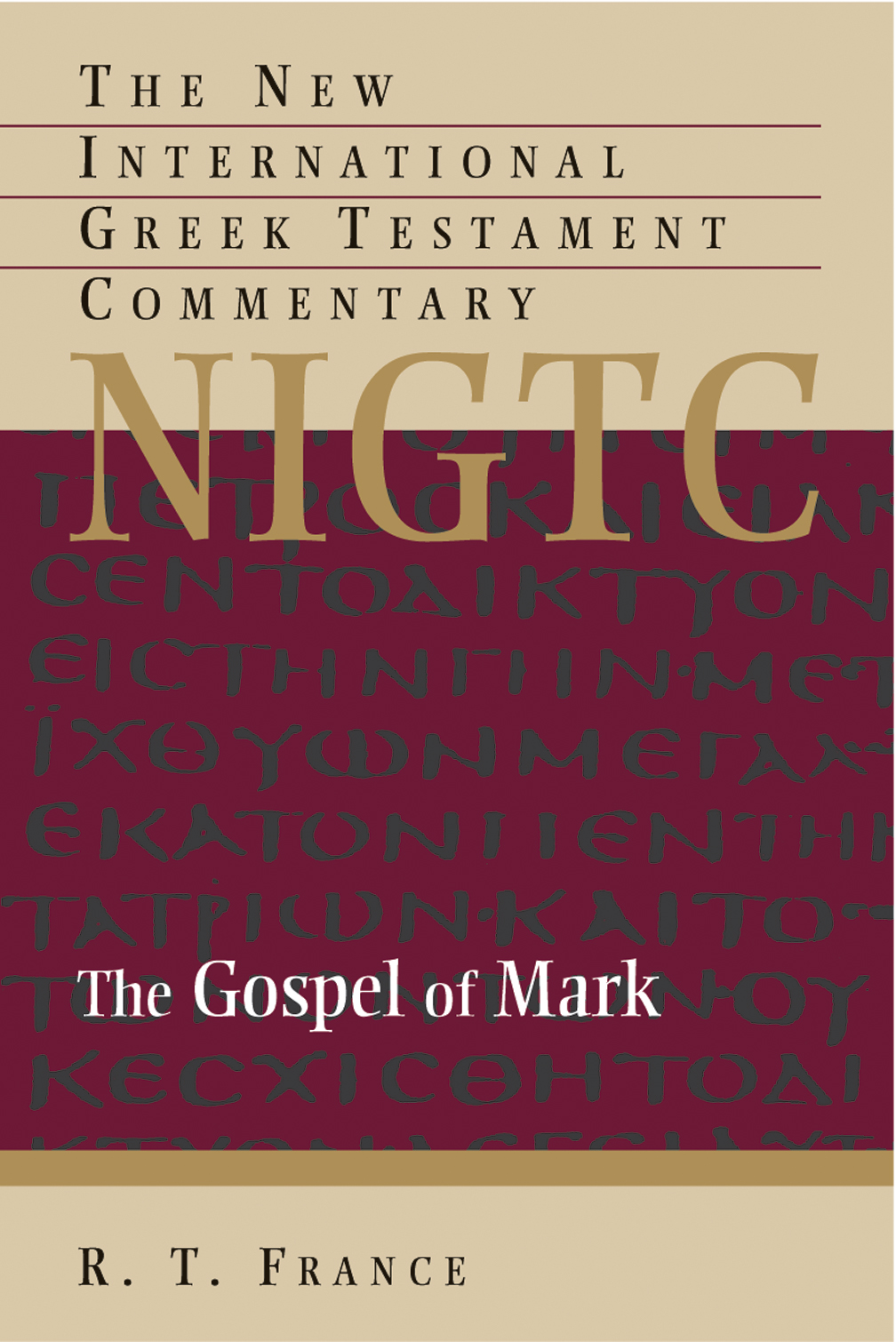
R.T. France on Mark

R.T. France’s commentary on Mark focuses on the Greek text, but I’d recommend it to anyone interested in carefully working through the Gospel of Mark, regardless of Greek knowledge. France takes the utmost care to interpret the text, providing much relevant background and comparison with other Gospels. Even as he is exegeting a single word or phrase from one verse, he always has the whole contour of the book in mind. While he does not formally have an application section as such, the conclusions he draws from the text are such that the careful reader could easily come up with applications from France’s insights.

France’s work is technical, yet easy enough to read, especially for a commentary. Beyond its superb quality as a technical/academic commentary, it has even gone so far as to more deeply inspire me in my own view of Jesus and his ministry. It’s well worth the money to purchase this book, and well worth the effort to work one’s way through it.

Sadly, France just passed away in February.  I was fortunate to be taking a class this past semester where this commentary was the primary textbook.

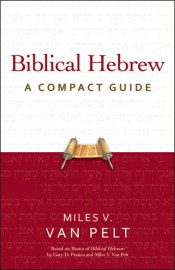
Review of Biblical Hebrew: A Compact Guide

At long last, a compact reference guide to Biblical Hebrew!  Not long ago Zondervan released Biblical Greek: A Compact Guide, a helpful and portable distillation of Mounce’s oft-used grammar. Many such little books already exist for easily reviewing Koine Greek: Dale Russell Bowne’s Paradigms and Principal Parts for the Greek New Testament, Paul Fullmer and Robert H. Smith’s Greek at a Glance, and even the back of Kubo’s Reader’s Lexicon has a good summary of Greek grammar with paradigm charts.

There seem to be more resources available to students of Biblical Greek than to students of Biblical Hebrew.  For example, while there is just one (excellent!) “Reader’s” Hebrew Bible (uncommon vocabulary is glossed at the bottom of the page), I am aware of at least three Reader’s Bibles that exist for the Greek New Testament.  So Van Pelt’s Compact Guide, based on his and Pratico’s Basics of Biblical Hebrew, is a welcome addition as far as this eager Hebrew student is concerned.

The book is not terribly dissimilar from Pratico/Van Pelt’s Charts of Biblical Hebrew, but unlike that work, A Compact Guide is more than just a collection of charts and paradigms.  Each section includes a distillation of what is in the grammar text, followed by paradigms and charts for quick reference.

Oddly enough, though, at times there seems to be more precision and detail in this little book than in the larger grammar.  Or perhaps it’s just more nuance that has come to articulation with the passage of time since the publishing of the grammar’s second edition.  For example, whereas the grammar lists three kinds of Hebrew prepositions (independent, Maqqef, and inseparable), the Compact Guide adds a fourth: compound prepositions, where “two different prepositions, or a preposition and a noun” (28) combine to make a new preposition.

The primary focus of the guide is morphology (how words are formed, including paradigm charts) and syntax (how words are used in sentences, i.e., grammar).  There is nothing in the work by way of vocabulary, save for a Hebrew-English mini-lexicon at the back of the book.  Unfortunately, at least in the digital galley version I viewed, there was no introduction or explanatory note as to what constituted inclusion on the lexicon.  By contrast, in Mounce’s Greek counterpart, his lexicon notes that it includes words that occur in the New Testament 10 times or more.

In addition to a thorough listing of paradigms (the 11-page section on pronominal suffixes is particularly helpful), the book is filled with examples from the Hebrew Bible (with English translation).  The Hebrew font used, while not as easy to read as that of the grammar, is readable enough.

The section on verbs is a particular strength of this work–in addition to examining all the forms and stems (both strong and weak), there are extensive listings of paradigms for easy review.

All in all, I give a hearty two thumbs up for this work–and express my gratitude that it is now on the scene for those who want to keep their Biblical Hebrew fresh!  For a beginner in Biblical Hebrew I would recommend the full-length grammar textbook, but for those with even a semester or two of Hebrew (and beyond), this small reference guide will be a valuable and inexpensive addition to their library.

The guide releases August 20, 2012, although you can preview some of it here now. (I received a digital galley for review through Net Galley.)

UPDATE: I review the hard copy, now released, here.