He crushes guns and diffuses bombs; he destroys weapons of destruction (Psalm 46 speaks into the mass school shooting)

gun

Psalm 46, a Psalm for tragedies and disasters, reads:

God is our refuge and strength,
an ever-present help in trouble.
Therefore we will not fear, though the earth give way
and the mountains fall into the heart of the sea,
though its waters roar and foam
and the mountains quake with their surging.

There is a river whose streams make glad the city of God,
the holy place where the Most High dwells.
God is within her, she will not fall;
God will help her at break of day.
Nations are in uproar, kingdoms fall;
he lifts his voice, the earth melts.

The Lord Almighty is with us;
the God of Jacob is our fortress.

Come and see what the Lord has done,
the desolations he has brought on the earth.
He makes wars cease
to the ends of the earth.
He breaks the bow and shatters the spear;
he burns the shields with fire.
He says, “Be still, and know that I am God;
I will be exalted among the nations,
I will be exalted in the earth.”

The Lord Almighty is with us;
the God of Jacob is our fortress.

The third part of this Psalm begins, “Come and see the works of the LORD, the desolations he has brought on the earth. He makes wars cease to the ends of the earth.” God is stronger than war—he can demolish even the strongest weapons of warfare. So in some kind of cosmic sense we don’t have to be afraid when there is violence.

“He breaks the bow and shatters the spear, he burns the shields with fire.” We might read this today as, “He crushes guns and diffuses bombs, he destroys human weapons of destruction.”

And then there is the main point of the Psalm, verse 10, followed by the refrain in verse 11 that appeared earlier in the Psalm: “Be still, and know that I am God; I will be exalted among the nations, I will be exalted in the earth. The LORD Almighty is with us; the God of Jacob is our fortress.”

Nature can appear to be in chaos, human actions can leave us scratching our heads, but neither the chaos of nature nor the chaos of human sinfulness can ultimately stand up to the power of God. He is exalted over the earth and over all people. He is a warrior God who declares war on war and causes all violence to end.

“The LORD Almighty,” a title for God from verse 11 and earlier in verse 7, is also sometimes translated “LORD of hosts,” or God of the angel armies. Based on these verses Martin Luther wrote, “LORD Sabaoth his name, from age to age the same, and he must win the battle.”

This Almighty warrior God is with us, present in chaos and suffering. He is the God of heavenly hosts of armies, yet he is the God of Jacob, too, a title that speaks of God’s personal relationship with his people.

He is a personal God that people can know. He invites us into an intimate relationship with him, especially when we are hurting, especially when things are going wrong.

The above is adapted from part of a sermon I preached a couple of summers ago on Psalm 46. I post in now in light of today’s awful news.

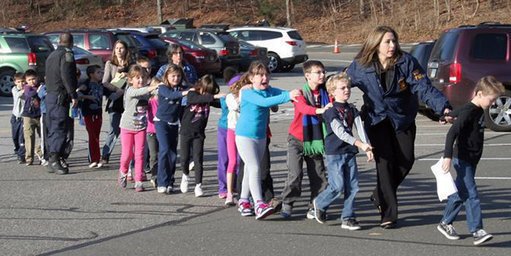
Jesus weeps, we weep

Shannon Hicks/Newtown Bee, via Associated Press

Jesus wept, and he weeps again today, with the horrible news of another school shooting in Newton, CT. From the New York Times:

A gunman killed 26 people, 20 of them children between the ages of 5 and 10, in a shooting on Friday morning at an elementary school in Newtown, Conn., about 65 miles northeast of New York City, the authorities said.

The gunman, who was believed to be in his 20s, walked into a classroom at Sandy Hook Elementary School where his mother was a teacher. He shot and killed her and then shot 20 students, most in the same classroom. He also shot five other adults, and then killed himself inside the school.

This evil deed is so heinous that even naming and describing it feels bad. May God have mercy on the souls of those poor children, and the grieving families they leave behind.

Christians have a rich Biblical tradition of lament that we can employ in times like this. This summer after the Colorado shooting, I posted this prayer, which was an aid to me in processing the grief, anger, and bewilderment I felt after hearing such awful news.

Prayer of Lament

O God, you are our help and strength,
our refuge in the time of trouble.
In you our ancestors trusted;
They trusted and you delivered them.
When we do not know how to pray as we ought,
your very Spirit intercedes for us
with sighs too deep for words.
We plead for the intercession now, Gracious One.

For desolation and destruction are in our streets,
and terror dances before us.
Our hearts faint; our knees tremble;
our bodies quake; all faces grow pale.
Our eyes are spent from weeping
and our stomachs churn.

How long, O Lord, how long
must we endure this devastation?
How long will destruction lay waste at noonday?
Why does violence flourish
while peace is taken prisoner?
Rouse yourself! Do not cast us off in times of trouble.
Come to our help;
redeem us for the sake of your steadfast love.

For you are a gracious God
abounding in steadfast love and faithfulness.

By the power of the cross,
through which you redeemed the world,
bring to an end hostility
and establish justice in the gate.
For you will gather together your people into that place
where mourning and crying and pain
will be no more,
and tears will be wiped from every eye.
Hasten the day, O God for our salvation.
Accomplish it quickly! Amen.

**From Let the Whole Church Say Amen! A Guide for Those Who Pray in Public, by Laurence Hull Stookey, pp 94-95 (Copyright 2001 by Abingdon Press). Reproduced by permission. Formatted print-friendly pdf of prayer here.

The Scriptures that the above prayer draws on are: Psalm 124:8, Psalm 37:39, Psalm 22:4, Romans 8:26, Isaiah 59:7, Job 41:22, Nahum 2:10, Lamentations 2:11, Isaiah 6:11, Psalm 91:6, Psalm 44:23, Psalm 44:26, Exodus 34:6, 1 Corinthians 1:17, Ephesians 2:14, Amos 5:15, Revelation 21:4, Isaiah 60:22.

Day of Prayer

Here’s part of a writeup I did on our Day of Prayer that took place last week:

In the evening we worshiped again as one in the chapel with a congregational expression of the Psalms through song. From a lone voice in the darkness expressing the cries of the Psalmist in Psalm 130, to voices in unison reading the Psalms of Ascent; from hymns to contemporary music to bluegrass; from a Taizé chorus to Gospel music led by the Gospel Choir, we raised our voices in prayer and praise together, using the words of the Psalms.

The whole post is here, at Notes Along the Way, the blog of Gordon College.

Rocks cry out on the Day of Prayer

What a great way spend a day this Tuesday! We had our annual Day of Prayer at Gordon College. (Here is the schedule of events for the day.)

As I wrote before, I’m struck by how the Day of Prayer is a microcosm of an important aspect the school’s life together: we are one and we are many. There are more than 40 denominations and Christian traditions represented at Gordon. On the Day of Prayer we prayed as one body—lived out in the morning and evening services in the chapel—and we prayed in diverse ways (for example, in the Orthodox tradition, through hymns, in the Catholic tradition, by reading Psalms together around a fire pit, in the dark, with artistic expressions, through dancers leading worship, a Gospel Choir, and more).

The picture above (via a Gordon student) is of a rock cairn that the students added to throughout the day. Students, faculty, and staff wrote prayers of gratitude and thanksgiving on a rock, which they then placed next to the entrance of the chapel. Watching the rocks pile up throughout the day, as praises going up to God, was a highlight for me. These rocks cry out!

See student response to Day of Prayer (with pictures) via the Twitter hashtag #GCDayofPrayer.

SEEK: Day of Prayer

Tomorrow (Tuesday) at Gordon College is the Day of Prayer. Here is the schedule for the day. We’ve been working hard in preparation for this day, and I’m excited now that it’s here at last.

Day of Prayer at Gordon is a dedicated day–no classes or regularly scheduled events–where we remind ourselves of who we are in Christ: a body of believers that can join together in prayer to give God praise and request his continued provision in our lives and in the world.

I’m struck by how the Day of Prayer is a microcosm of an important aspect the school’s life together: we are one and we are many. There are more than 40 denominations and Christian traditions represented at Gordon. On the Day of Prayer we pray as one body—lived out in the morning and evening services in the chapel—and we pray in diverse ways (for example, in the Orthodox tradition, through hymns, in the Catholic tradition, by reading Psalms together around a fire pit, in the dark, with artistic expressions, and so on).

Philosophers talk about the problem of “the one and the many.”  At Gordon, we get to experience the blessing in Christ of being one and many.

You can follow Day of Prayer via the Twitter hashtag #GCDayofPrayer. (Gordon College on Twitter is @GordonCollege.) Read the Day of Prayer press release here.

John Huss (c. 1372-1415), who said the Psalms as he burned at the stake

Though All Saints Day was yesterday, I want to highlight two more lesser-known saints today and tomorrow.

John Huss is nowhere near the household name (well… Christian household name) that Martin Luther or John Calvin is. But he tilled the ground for these and others.

Huss taught and pastored in Prague. Like the better-known reformers that would follow him, Huss criticized the established church of his day. He held that the Bible should be in the hands of the masses.  In his view, the only proper “head” of the Church was not any humanly established church government, but Jesus Christ. He advanced the Reformation idea of “Sola scriptura”—that the Bible alone should be the authority in issues pertaining to life and doctrine.

Christian History writes of his death this way:

In November 1414, the Council of Constance assembled, and Huss was urged by Holy Roman Emperor Sigismund to come and give an account of his doctrine. Because he was promised safe conduct, and because of the importance of the council (which promised significant church reforms), Huss went. When he arrived, however, he was immediately arrested, and he remained imprisoned for months. Instead of a hearing, Huss was eventually hauled before authorities in chains and asked merely to recant his views.

When he saw he wasn’t to be given a forum for explaining his ideas, let alone a fair hearing, he finally said, “I appeal to Jesus Christ, the only judge who is almighty and completely just. In his hands I plead my cause, not on the basis of false witnesses and erring councils, but on truth and justice.” He was taken to his cell, where many pleaded with him to recant. On July 6, 1415, he was taken to the cathedral, dressed in his priestly garments, then stripped of them one by one. He refused one last chance to recant at the stake, where he prayed, “Lord Jesus, it is for thee that I patiently endure this cruel death. I pray thee to have mercy on my enemies.” He was heard reciting the Psalms as the flames engulfed him.

Luther, who later would stumble on Huss’s writings, said, “I was overwhelmed with astonishment. I could not understand for what cause they had burnt so great a man, who explained the Scriptures with so much gravity and skill.”

(I remembered Moses the Black yesterday, Perpetua on Wednesday, and wrote about All Saints Day more generally the day before that.)

St. Moses the Black (4th century)

Happy All Saints Day!

Moses the Black was a 4th century African saint. He has some sweet aliases, too: Abba Moses the Robber and Moses the Strong. As in the image above (which is from here), he is also known as St. Moses the Ethiopian.

The Brotherhood of St. Moses the Black gives a short biography of the saint, which I have also seen (unsourced) elsewhere:

St. Moses the Black was a former gang leader, murderer, and thief in ancient Africa. However, he became a model of transformation. His is one of the most inspiring stories among the African saints.

Moses, an escaped slave, was the leader of a group of 75 robbers. He was a large and powerful man, who with his gang terrorized the entire region. Moses was transformed after he and his group attacked a monastery, intending to rob it. He was met by the abbot, whose peaceful and warm manner overwhelmed him. He immediately felt remorse for all his past sins, sincerely repented, and begged to remain at the monastery.

Moses was tortured by his past and for years was tempted to return to his old ways. One day, as he was confessing his sins to St. Macarius, it was reported that an angel appeared with a tablet full of his sins. As he confessed, the angel began wiping the tablet clean. The more he confessed, the more the angel was said to have wiped, until by the end it was completely clean. After meeting St. Macarius and St. Isidore, he completely left his old ways behind him and became a monk.

Later, St. Moses was ordained to the priesthood — a rare honor among the Desert Fathers– and founded a monastery of 75 monks, the same number as his former group of thieves. He was known for his wisdom, humility, love, and non-judgment of others. Once a brother had been caught in a particular sin, and the abbot asked St. Moses to come to the church and render judgment. He came reluctantly, carrying on his back a leaking bag of sand. When he arrived, the brothers asked him why he was carrying such a thing. He simply said, “This sand is my sins which are trailing out behind me, while I go to judge the sins of another.” At that reply, the brothers forgave the offender and returned to focusing on their own salvation rather than the sins of their brother.

In 405 A.D., at age 75, St. Moses suffered a martyr’s death when his monastery was attacked by a group of barbarians. He is remembered on the 28th of August. Today he is considered the patron saint of African Americans.

More on Moses the Black can be found here.

(I remembered Perpetua yesterday and wrote about All Saints Day more generally the day before that.)

The Martyrdom of Perpetua (d. 203)

Perpetua was a nursing mother who rejected her father’s pleadings to deny her Christian faith and make the requisite sacrifice to the Roman emperor. As the story goes, depicted above, she had to help guide the sword of her trembling executioner to her throat.

The book 131 Christians Everyone Should Know, by Mark Galli and Christian History magazine, recounts her story:

Her father immediately came to her in prison. He was a pagan, and he saw an easy way for Perpetua to save herself. He entreated her simply to deny she was a Christian.

“Father, do you see this vase here?” she replied. “Could it be called by any other name than what it is?”

“No,” he replied.

“Well, neither can I be called anything other than what I am, a Christian.”

In the next days, Perpetua was moved to a better part of the prison and allowed to breastfeed her child. With her hearing approaching, her father visited again, this time, pleading more passionately….

The day of the hearing arrived; Perpetua and her friends were marched before the governor, Hilarianus. Perpetua’s friends were questioned first, and each in turn admitted to being a Christian, and each in turn refused to make a sacrifice (an act of emperor worship). Then the governor turned to question Perpetua.

At that moment, her father, carrying Perpetua’s son in his arms, burst into the room. He grabbed Perpetua and pleaded, “Perform the sacrifice. Have pity on your baby!”

…When [Perpetua and her friends] entered the stadium, wild beasts and gladiators roamed the arena floor, and in the stands, crowds roared to see blood. They didn’t have to wait long.

Immediately a wild heifer charged the group. Perpetua was tossed into the air and onto her back. She sat up, adjusted her ripped tunic, and walked over to help Felicitas. Then a leopard was let loose, and it wasn’t long before the tunics of the Christians were stained with blood.

This was too deliberate for the impatient crowd, which began calling for death for the Christians. So Perpetua, Felicitas, and friends were lined up, and one by one, were slain by the sword.

The whole account can be found here.

It’s easy for me to “want to be in that number” when saints like Perpetua “go marching in,” but the courage and faithfulness she exhibited in the moments leading up to her martyrdom are qualities I can only pray to attain. The Wisdom of Solomon passage I quoted yesterday is apropos:

But the souls of the righteous are in the hand of God,
and no torment will ever touch them.

In the eyes of the foolish they seemed to have died,
and their departure was considered to be suffering,

and their going from us to be destruction,
but they are at peace.

As All Saints Day approaches tomorrow, I find myself moved and inspired by this committed follower of Jesus. Perpetua, though she was mercilessly separated from her husband, family, and precious little baby, is at peace.

“As sparks through the stubble, they will run about” (All Saints Day)

The Forerunners of Christ with Saints and Martyrs, by Fra Angelico (15th century)

November 1 is All Saints Day.  It’s a holiday in the church calendar of multiple Christian traditions: Catholic, Anglican, Lutheran, Methodist, and others. Halloween gets its name from All Saints Day.  All Saints Day used to be known as All Hallows Day, and Halloween was a contraction of All-Hallows-Even, or All Hallows Eve.

All Saints Day is meant to remember the saints, or fellow believers, who have gone on before us, walking in the way of Jesus.  The author of Hebrews writes, “We are surrounded by such a great cloud of witnesses.” We have the example of men and women who have walked with God, who have struggled with God, and who have triumphed in life with God.  As we look ahead to All Saints Day we can pause today to remember their example, and ask God to strengthen our faith, too.  We are part of that number.

Psalm 85:8 in the NIV says, “I will listen to what God the LORD will say; he promises peace to his people, his saints.”  Some 30 times Paul addresses congregations of believers as “saints.”  We who follow Jesus are rightfully called “saints.”  We are part of a narrative that is much bigger than ourselves, much bigger than any one community, and much bigger than this period in history.  We are a part of a timeless, worldwide communion of saints—the body of Christ.

Wisdom of Solomon (yes, it’s from the Septuagint!) puts it beautifully:

But the souls of the righteous are in the hand of God,
and no torment will ever touch them.

In the eyes of the foolish they seemed to have died,
and their departure was considered to be suffering,

and their going from us to be destruction,
but they are at peace.

For even if in the sight of human beings they were punished,
their hope is full of immortality,

and having been disciplined a little, they will be greatly benefited,
because God tested them and found them worthy of himself;

as gold in the furnace, he tested them,
and as a sacrificial whole burnt offering, he accepted them.

And in the time of their visitation they will shine out,
and as sparks through the stubble, they will run about.

They will judge nations and rule over peoples,
and the Lord will be king over them for ever.

Those who trust in him will understand truth,
and the faithful will remain with him in love,

because grace and mercy are upon his holy ones,
and he watches over his chosen ones.

–Wisdom of Solomon 3:1-9 (NETS)

In the coming days I’ll post about a series of lesser-known “saints” in the Church’s history, righteous ones whose “souls…are in the hand of God.”