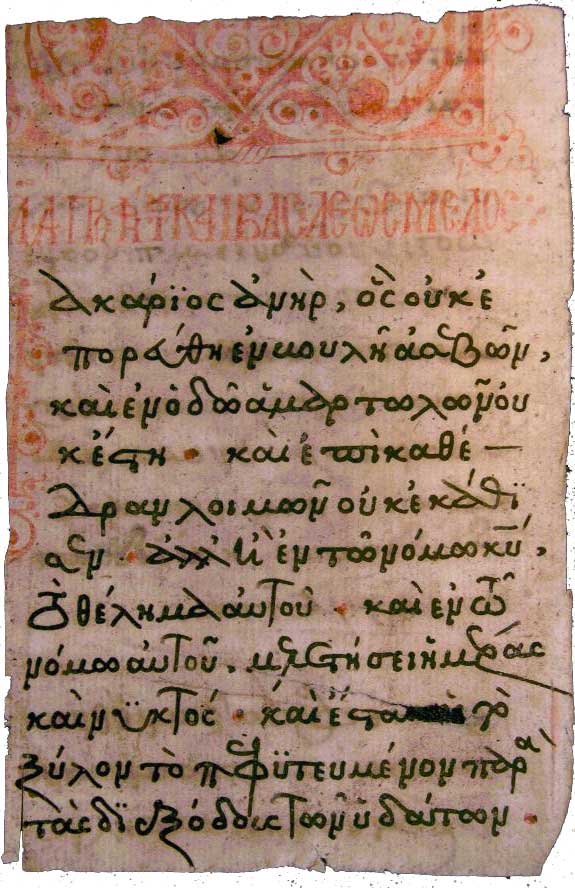
Resources for Septuagint Study

Yet another reason to love Sunday: it’s Septuagint Sunday at Words on the Word. (Settle down.) Here are some resources I’ve found helpful for the study of the Septuagint:

Resources Relating to the LXX. From the Codex biblical studies blog by Tyler Williams. This is up-to-date and probably the best place to start working your way through what’s out there in Septuagint land right now. Williams lists available English translations, introductions, Greek editions, language tools, topical studies, and electronic resources for the study of the Septuagint. He includes brief and helpful descriptions of each resource he links to. The page looks to have been last updated in 2009, but it’s still pretty current.

Rod Decker’s LXX Resources page. Decker is behind the ever-helpful Koine Greek Reader, which includes grammar review, vocabulary lists, and graded readings in the Greek of the New Testament, the Septuagint, the Apostolic Fathers, and a few early church creeds. His resources page has some very helpful Septuagint vocabulary lists. This one (PDF) has all words occurring more than 100 times in the Septuagint. And this one (PDF) has words that occur more than 100 times in the Septuagint but less than 25 times in the New Testament. The second list is ideal for those who know their NT Greek, but want to branch out into the much larger vocabulary pool of the Septuagint.

Septuagint Online. By Joel Kalvesmaki. He gives a great historical overview of the Septuagint, including clarifying some terminology (see here). And here is his link to other Septuagint resources.

The International Organization for Septuagint and Cognate Studies (IOSCS)The IOSCS is “a nonprofit, learned society formed to promote international research in and study of the Septuagint and related texts.” Yes, I’m a member, as of this last week (honey, sorry you had to hear about it on the blog, but it was only $15). The IOSCS puts out an annual journal, has published some Septuagint monographs, and even has a book-by-book commentary series on the Septuagint in the works.

Albert Pietersma’s page. Pietersma co-edited the New English Translation of the Septuagint (NETS, all online for free here). His page contains, among many other useful resources, a couple of .pdfs on various Psalms, where he does a verse-by-verse commentary that examines both the Greek and the Hebrew. He prints the Greek and the Hebrew before commenting on it, too, so it’s a great way to increase one’s language skills. This allows one to see the kinds of issues that Septuagint translators were working on.

You may also wish to bookmark this link, which gathers all my posts that have a “Septuagint” tag (including this one, previous ones, and future ones I post).

Prophetic Whiplash…God of Mercy or God of Wrath?

Reading the Biblical prophets (like Micah) can give the reader emotional whiplash. The prophets often alternated abruptly between communicating God’s good news and bad. So which one is it: does God graciously forgive his people’s sins, or does he harbor his anger against them in judgment?

The prophets didn’t feel a need to necessarily resolve this tension; both are true in some measure. But in the end the witness of the Hebrew Bible–very much confirmed in the New Testament–is summed up in Exodus 20:5-6 (AKJV):

Do not worship any idol, and do not serve them, for I am Yahweh your God, a zealous God. For the sins of parents I hold accountable their children, to the third and fourth generations of those who hate me. But I show covenant loyalty to thousands of generations of those who love me and who keep my commandments.

Insofar as the tension between God’s mercy and God’s anger finds resolution, the Bible indicates that mercy is the overriding attribute of God.

Micah’s bifid structure, alternating as it does between woe and weal, seems to resolve at the end in favor of God’s mercy to his unfaithful people. This is Septuagint Sunday at Words on the Word, so a bit of Greek is in order. (You don’t have to know Greek to follow here.)

Micah 1:1 is the book’s superscription (=title page, essentially) where Micah identifies himself as a messenger of Yahweh, who has received his word to give to his people. The very first prophetic utterance, in the next verse (AKJV, from the Greek), is,

Hear these words, people, and let the earth and all that is in it pay attention. The Lord will serve as a witness (εἰς μαρτύριον) against you, the Lord from his holy dwelling place.

What follows in chapter 1 is fairly damning lawsuit language that calls God’s people into a courtroom setting for their transgressions of God’s covenant… where, of course, they have no defense. The woe-weal or wrath-mercy alternation continues through the rest of the book, until Micah concludes in 7:18-20 with a hymn of praise to God (AKJV again, from Greek):

Who is a God like you, who forgives injustices and overlooks the sins of the remnant of his inheritance?

He does not retain his anger as a witness (εἰς μαρτύριον), for he is one who delights in mercy. He will turn and have compassion on us. He will sink our injustices and hurl all our sins into the depths of the sea.

You will give truth to Jacob and mercy to Abraham, just as you swore to our ancestors from ancient days.

Of special note is how εἰς μαρτύριον (“as a witness”) serves as bookends for the book. In the first few verses, God himself is a witness against his people that they have committed sin against him. But in the final verses, he chooses not to call himself (specifically, his anger) to the stand as a witness (εἰς μαρτύριον) against his people. Rather, he overlooks (ὑπερβαίνων) their sins, sinking them into the depths of the sea.

Quite a different use of εἰς μαρτύριον to close out the book! In his last verses, Micah echoes the Exodus passage, that God forgives our wrongdoings and shows mercy, even with all he has to call as a witness against us.

God’s wrath is real, and our sins deserve it, yet in the end he has chosen to have mercy on his people.

Bifid

The prophets in the Hebrew Bible knew how to throw down. They often ran the risk of death for their faithfulness in sharing God’s message with others. But that didn’t stop them.

One potentially confusing thing about the prophets is their frequent and sometimes abrupt transition between good news and bad news. Scholars refer to prophetical books like Micah as “bifid,” meaning that it has two primary kinds of prophecies: woe and weal. Woe prophecies are prophecies of bad things that will come to those who do injustice, who disobey God, who oppress the poor in their midst, etc. Weal prophecies are the comforting good news to God’s people: that though they are sinful and fall far short of God’s commands, yet he will have compassion and forgive.

The alternation between woe and weal in the prophets can be pretty unsettling to the reader, as I imagine it was to the people who first heard the prophecies. (“Oh, hey, cousin Asher… everything is cool! God’s going to forgive us. Wait… what’s he saying now? We’re going to perish in our transgressions?”)

Micah is a bifid book. One fairly common structural understanding of the book, which I first learned from my Hebrew professor, but have since seen elsewhere, has the book split up something like this:

1:1                Superscription (i.e., title) identifying Micah as a messenger of Yahweh

1:2-2:11       Punishment, part 1 (Woe):
Yahweh will punish Israel (the North) and Judah (the South) for their Idolatry

2:12-13        Restoration, part 1 (Weal):
Yahweh will gather the remnant of Israel like a flock

3:1-12           Punishment, part 2 (Woe):
Leaders, rulers, prophets, and priests are all corrupt, distorting justice.
Darkness will come over them and Jerusalem will be razed.

4:1-5:8          Restoration, part 2 (Weal):
Many nations will come to the mountain of Yahweh to worship the God of Jacob.
There will be peace.

5:9-7:6         Punishment, part 3 (Woe):
Yahweh will cut off idolatry from the land, destroying the unfaithful cities of Israel.

7:7-7:17      Restoration, part 3 (Weal):
The enemy will be trampled, the cities of Israel rebuilt.

7:18-7:20      Hymn of praise to God

There’s a particularly striking relationship between the first few and the last few verses of the book, that I think helps to resolve some of the tension that the reader experiences in the back-and-forth prophecies of Micah.

Reading through a short prophetical book like Micah with the above outline in hand can be a useful exercise in deepening one’s own understanding of Scripture and the character of God. Even as I’ve grown to deeply appreciate the book of Micah, I’ve found it quite challenging to work through.

I’ll post again in the future about how I think 1:1 and 7:18-20 work together to frame the book into a unified whole.

Micah and the Septuagint

A few semesters ago I had the privilege of taking a great class at Gordon-Conwell with Dr. Doug Stuart: Intermediate Hebrew Grammar (syllabus PDF).  Dr. Stuart is an excellent professor and scholar.  In that class we worked our way through the Hebrew text of Micah (which is quite a challenge!).  The class left a lasting impression on me, and kindled in me a love for the prophet Micah.  (It doesn’t hurt that I have a really great brother with that same name.)

Now I’m doing a “reading course” (directed study) with Dr. Al Padilla in the Greek Old Testament version of Micah (as well as I Maccabees 1-4).  The Greek in Micah is as difficult as the Hebrew (which it translates), but I’m having a great time working my way through the book again and trying to increase my Greek vocabulary.

Part of my course is to read a book I’ve wanted to read for a long time, Invitation to the Septuagint, by Dr. Karen Jobes (who teaches at Wheaton, where I did undergrad) and Moises Silva (who used to teach at Gordon-Conwell).  It’s a fantastic introduction–simple enough, yet still challenging.  The Greek Old Testament (“Septuagint”) translated the Hebrew Bible beginning in about the 3rd century B.C.  Thus it “was the primary theological and literary context within which the writers of the New Testament and most early Christians worked” (23).  Our English Bibles today translated the Old Testament from Hebrew, whereas New Testament writers quoted the Old Testament in Greek–which is why a NT quotation may differ from the OT when you go look it up in an English Bible.

I’m excited to read more of this book and continue my studies in Micah.  What is really fascinating to me is how Septuagint scholars have to know both Greek and Hebrew cold, since much of their work is trying to figure out what Hebrew the Greek before them translated.  I may never get to that level with my languages, but I’m going to at least make a little progress in the meantime.