Teaching a new worship song to a congregation

This morning I had the privilege of teaching our worshiping community this song:

Because I had guessed it would be new to the majority of our congregation, I decided to teach the song before we sang it all the way through. There are at least six things I like to try to do when teaching a new song:

1. Split it into pieces. I had the chorus for All the Earth Will Sing Your Praises on two Powerpoint slides. So I sang through the first half of the chorus (one PPT slide), stopped, and invited the congregation to sing that same part with me:

Then I repeated that same process for the second half of the chorus:
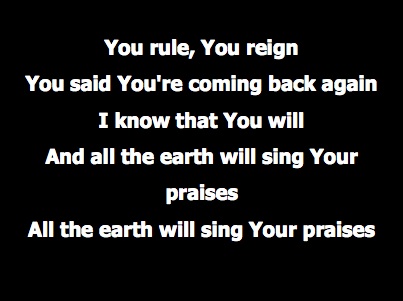
This way the congregation had heard the chorus once and sung it once.

2. Teach it not in order. This helps me and hopefully others remember that we’re actually working on learning the song. It also keeps us attentive to what part of the song we’re working on. We’ll piece it all together only once we’ve learned the component parts.

3. Highlight the lyrical content. If the tune is new, the lyrics likely are, too. At least they were in this case. So because this song speaks of Christ’s death, resurrection, and ascension, I took the opportunity to highlight that. I actually read some of the song lyrics before teaching it, and connected them to something my church says in our weekly worship: “Christ has died, Christ is risen, Christ will come again.” I mentioned that like 1 Corinthians 15 and Luke 24, this is one of the great summaries of our faith that can unite us across multiple denominations and Christian backgrounds.

4. Teach it with a conversational tone. I can’t think of any other way to teach a song than by actually talking with the congregation about it, what we’re doing, what we’re about to do, etc. I find a friendly, inviting, conversational tone works best. At least it feels right to me when I am teaching a song!

5. Affirm the congregation. Our worshiping community picked this song up so fast today (some knew it already, I think) that this was easy to do. I actually cut short the process of teaching the song so that we could begin from the beginning singing it all the way through. This was due to the fact that as I began teaching the verse (i.e., “I’ll sing so you can hear it”), I could already hear folks singing along. It would certainly not be out of place to sincerely say something like, “You all are good singers!” (Provided it’s true.)

6. Have them hear the song even before I teach it. For example, I had All the Earth will Sing Your Praises played over the speakers as they were leaving worship Monday, knowing we’d be learning it today. It’s a little thing, but it helps. Other options could have been playing it as the prelude today, emailing a Web link to the tune, etc.

The bottom line for me is: if we’re doing a song that I think will be new to most in the room, we highlight it as such and carve out time to work to learn it together. Then singing the new song from start to finish is not only easier, but feels like something we have worked at together in a way that draws us closer as we worship.

“Thinking Through the Benefits and Necessity of Liturgy”

Amanda MacInnis blogs wonderfully about the “benefits and necessity of liturgy.” On this Worship Leading Wednesday, I refer you to her. She has good things to say.

The money quote:

And so, even those who chafe at the thought of liturgy in Church, who balk at the use of liturgical texts on a weekly basis, are being profoundly shaped by the liturgy of being anti-liturgy.

Read the article in full here.

Creation… Fall… Redemption… Consummation. (Another one hour worship service from scratch)

On Sunday I led a group of student ministry leaders in worship for an hour. As in the time I described in this post, it was a one hour worship service from scratch. In other words, I was invited to plan and lead the hour of worship from start to finish. In my previous post I mentioned one way to give shape to what otherwise could be unstructured worship, using the A.C.T.S. acronym.

Here’s how I opted to structure the hour together with this same group this year. This is a version of the run sheet the worship musicians and I had before us.

Intro: Creation, Fall, Redemption, Consummation

  • What it is: way of understanding the whole sweep of the Bible (explain each part briefly)
  • Why it’s important: tells us God’s story—and our place in it.  Situate selves at start of new year.
  • We’ll weave between Scripture and Song and Prayer, standing and sitting, together and alone

Creation

Fall

Redemption

Consummation

  • Scripture: Revelation 21:1-5
  • And so our prayer, “Make all things new” is finally answered.
  • Moment of silence to reflect on “I am making all things new.”
  • Song (standing): Grace Like Rain

Conclusion: Close in prayer

A one hour worship service from scratch

Worship leaders from time to time may be called upon to plan a worship service start to finish, as I was this time last year. Here’s how I chose to give shape to an hour of worship with a group of student ministry leaders. This is one of many possible ways to go, but I did find that the sense of structure and movement helped us to feel like we had gotten somewhere by the end. Here is a version of the run sheet I used for myself.

Intro: Explanation of A.C.T.S. acronym

  • What it stands for: Adoration, Confession, Thanksgiving, Supplication
  • Why it’s important: keeps us focused on God….keeps us balanced in prayer life (not just “Me, me, me”)
  • It will frame our worship time together
  • We’ll weave between Scripture and Song and Prayer, standing and sitting, together and alone

Adoration

Confession

  • Prayer: (seated) Confession of Sin
    • Moment of Silence for individual confession
    • Confession from Book of Common Prayer
    • Assurance of Pardon from 1 John (read in unison)
  • Song: (standing or seated) (optional) I Love the Lord

Thanksgiving

  • Song: How Great Thou Art
  • Scripture: (seated) Lectio Divinia with Colossians 3:15-17
    • Explain Lectio Divina (Powerpoint slide with all four steps, one after the other)
    • NOTE: Four volunteer readers needed

Supplication

  • Prayer: (remain seated) How can we be praying for each other?  For our community?
  • (standing) Teach song: Today
  • Scripture: Joshua 24:14-15 with intro (give its context)
  • Song: Today

Conclusion: close in prayer

In the very near future I’m leading this same group in an hour of worship. I’m thinking through selecting songs, Scriptures, and prayers that follow the basic outline of salvation history: Creation, Fall, Redemption, Consummation. I’ll post the outline of that service on a future Worship Leading Wednesday.

Worship Leading Wednesday: You are what you worship

Some words of wisdom from Gary A. Parrett and S. Steve Kang:

That the formation of God’s people is a legitimate concern of our worship gatherings can be demonstrated by appeal to a number of biblical passages. First of all, worship itself is presented as intrinsically formative–for good or for ill. We read in several Old Testament passages, for example, that those who worship idols are doomed to become like the objects of their worship.

…That which is true in such profoundly negative and destructive ways, however, is also true in the positive. In other words, those who worship the living God will become like the object of their worship. Those who abide in the presence of the Lord, reflecting or contemplating his glory, are “transformed into his likeness with ever-increasing glory, which comes from the Lord, who is the Spirit” (2 Cor 3:18). Worshiping the God who is love, who is holy and righteous and true, we shall ourselves become more loving, holy righteous and true.

–from Teaching the Faith, Forming the Faithful: A Biblical Vision for Education in the Church, pp. 339-340

“Bringing our Pain to God” (Michael Card)

We’re afraid of other people’s pain. Like Job’s friends, we’re afraid when we don’t have answers. Job doesn’t get any answers for his sufferings, but he gets God.

–Michael Card, from this great article on Biblical lament in worship.

He’s got an album called The Hidden Face of God, which you can hear at Grooveshark for free (or click on the album image to the left). It kicks off with a great Gospel-flavored track called, “Come Lift Up Your Sorrows.”

“I Don’t Understand,” by Doran Stambaugh (song in response to the Aurora, Colarado shooting)

Doran Stambaugh, formerly of the Chicagoland band w a t e r w o r k s , has written a song, “I Don’t Understand,” as a response to the mass shooting at the Dark Knight screening a week and a half ago. This is a good lament.

Words on the Word Interview with Leslie C. Allen, Author of Liturgy of Grief

Not long ago I reviewed Leslie C. Allen’s Liturgy of Grief: A Pastoral Commentary on Lamentations. The book gently yet steadily coaches the reader in processing grief, expositing and drawing on the rich Biblical tradition of lament. I interviewed Dr. Allen this week.

You write, “Contemporary Western culture provides little space for grief.”  Why do you think this is?

A very good question. Perhaps, in reflection of a technologically advanced and relatively stable society, our culture expects comfort, convenience, and control, and won’t face up to anything contrary. Medication is assumed to be the answer to psychological as well as physical ills. So we feel embarrassed by grieving (and dying) people.

How can churches and worshiping communities better attend to the grieving processes of their community members? In addition to Lamentations and the rest of the rich Biblical tradition, are there other resources available to worship leaders and liturgists to better help them guide their communities through experiences of grief?

One example comes to mind. When I moved my home and started attending a new church some years ago, I found the associate minister’s morning prayer each Sunday was prayed on behalf of those present who were suffering in various ways. It was a different prayer each week, always wide reaching and beautifully crafted. I (and doubtless others) appreciatively felt she was praying for me, at a time when I needed prayer but found it difficult to pray.

You say, “‘Why?’ in the complaint psalms is never an intellectual request for information but a loaded rhetorical question that conveys emotional bewilderment and protest.”  Is there ever an appropriate time for the pastor/chaplain to address questions like “Why did this evil happen?” through a more deliberately theological-philosophical lens?  If so, how does the chaplain discern if and when it’s appropriate to go there?

C.S.Lewis’s The Problem of Pain evidently brought him no help as he penned A Grief Observed. Lamentations felt free to eventually tackle theological issues, using prophetic revelation as the guideline, whereas we and those we try to help are not living in the immediacy of such a situation when prophecy was being directly fulfilled. And Lamentations is able to give a variety of answers, perhaps in the hope that some at least would be found helpful. If a grieving person truly seeks an intellectual answer, one may tentatively broach some thoughts to be tried on for size. Otherwise, it is better considered when the emotional passion of grief does not intrude.

You mention the New Testament story (Mark 4:35-41) where Jesus’ disciples ask, “Teacher, don’t you care if we drown?”  Especially given Jesus’s reply (“Why are you so afraid? Do you still have no faith?”), how can we who worship God know when it’s appropriate to lament or complain in prayer and when it’s not?  This is the “how far is too far?” question with relation to lament and prayer!

If our prayers are to be real, we must pray from where we are, emotionally and in other ways. We miss a tone of voice in the written form of biblical revelation. I suspect Jesus’ reply was mainly meant as reassurance, rather than rebuke, like the examples of “Do not fear” in Isaiah 40:9; 41:13, 14; 43:1-2; 44:2, etc.

I happened to read Allen’s book just before the Colorado movie theater shootings. Reading it inspired me to find and pray two lament prayers in response (here and here). As a Professor of Old Testament and hospital chaplain, Allen in his book provides the reader with good space for grief and Biblically-inspired means to lament.  A Liturgy of Grief is available here.