Why do we call it GOOD Friday? Should we stop?

“I think Job’s friends should have gone to therapy school.” –my pre-teen


Christ Crucified, Diego Velázquez (17th cent.)

Around this time every year, I join my voice to the chorus of dressed-up church children everywhere, asking: “Wait, why do we call it GOOD Friday?”

My stock answer goes something like this: Even though Jesus died on Friday, he came back to life on Sunday, defeating sin and death, and giving the promise of new, resurrection life to all people! His death on Friday became good, even though it didn’t look so good at first.

And there are implications for us: what looks not-so-good at first, even suffering and death, can turn into good, especially when God is at work. In Genesis 50:20 Joseph says to his brothers: “You intended to harm me, but God intended it for good to accomplish what is now being done, the saving of many lives.” God brought wholeness out of harm, good out of evil. Joseph, without meaning to, foreshadows what would happen with Jesus on Easter weekend.

I still stand by this understanding of “Good” Friday. But I also worry about a human tendency to underestimate suffering, or to fetishize it. Theologian Christopher B. Hays says, “Indeed, there are times when suffering is simply evil, and must be resisted rather than embraced. The suggestion that other people’s suffering is redemptive is particularly dangerous; it risks making the observer complicit in the evil.”

Job’s friends wanted to find “other people’s suffering” (Job’s) redemptive, somehow. They wanted to see a cause-and-effect answer to why Job lost everything. Eliphaz, Bildad, and Zophar went to great lengths and used many, many words to try to find greater meaning in Job’s suffering. 

They must have really wanted to turn his Terrible, Horrible, No Good, Very Bad (Fri)Day into Easter Sunday. 

Maybe their pontifications weren’t for Job’s sake, but to ease their own theological cognitive dissonance.

After hearing one too many times that “Everything happens for a reason,” Job said: “I have heard many things like these before. What miserable comforters are you all!” (Job 16:2) 

Thou shalt neither minimize nor romanticize my suffering, in other words.

We can be like Job’s friends: downplaying suffering because we can’t handle how awful it is, or over-glorifying it because of the power of post-traumatic growth. Both are strong human impulses—in which I’m sure I’ve participated.

But even with Good Friday soon to give way to Resurrection Sunday, the horrors of crucifixion invite—even demand—that we take seriously pain and suffering and loss and trauma and torture and abuse.


The church traditions of The Stripping of the Altar and not-celebrating Eucharist on Good Friday are embodied ways of locating ourselves at the foot of the cross, as if in real time. 

If you’ve ever sat in a quiet and dark sanctuary with an eerily bare altar in Holy Week, you might have felt trapped in time. Or dislodged from your day-to-day travels through the space-time continuum. You might have even been able to inhabit a space where—even if only for a moment—you couldn’t conceive how it was going to all turn out.

I think we need such quiet moments. They help us avoid a triumphalism that skips past Good Friday and goes right to Easter, that skips death and goes right to life. So we linger at the cross a little longer, before we run to the tomb. We actually observe Good Friday.

But this Holy Week I’m wondering about going a step further. Even within Good Friday, what if I slowed down some aspects of the day itself?

I am asking: 

How might my participation in Good Friday change if I tarried a little longer with Jesus’s suffering, and with the suffering of the world borne on his shoulders? 

What would a Good Friday be like that didn’t hurry to ascribe greater cosmic significance to Jesus’s suffering, but just took it in, looking the crucified, tortured, abused Lord in the eyes? 

What if I tried to neither minimize Christ’s suffering (because I can’t handle the atrocity of it) nor romanticize Christ’s suffering (because I need suffering be redeemed)?

What if, this Good Friday, I put the meaning-making on hold and tried to just sit quietly with Jesus in his agony?

anImage_2.tiff

The above is cross-posted at Healing Pastors.

Confronting a Sex Offender in the Park After Church

We hadn’t been able to track him down until he unexpectedly showed up at worship one day.


Content warnings: child abuse, sexual abuse, evil, deception


Our church learned that an occasional attendee had repeatedly sexually abused a minor some decades ago.1 The one who shared was courageous to do so. The abuser had not confessed or taken accountability for his heinous behaviors.

Believing the report of the abuse, church leadership prayed and worked through a plan for talking to the offending man about what we had learned. Then we tried to find him—without success.

One Sunday, after a long absence from our church, he showed up at the public park where we were worshiping… mid-service. It was the first time I’d seen Ned Notrealname since learning of the abuse he perpetrated. I had to finish the sermon before I could talk to him.

I preached with one eye on the congregation and another eye on Ned. His presence that day was a surprise, but we were prepared for this moment.

After the service I approached him. With two church elders standing next to me, I told him we knew that he had sexually abused a minor, and that what he did is not okay. I called him to repentance.

Ned not only admitted it, he doubled down and said he was proud of what he did.

He was exulting in how he sexually abused a dearly loved child of God.

I’ve seen some things in 20+ years of ministry, but this was the most evil I’ve ever been face to face with.

Given Ned’s response, I told him he could not be present at our church. We were clear with him that what he did was awful. Here he was not only unrepentant, not only defending himself, but he was calling evil good. It was the actual worst.

Already agitated and combative, Ned looked poised to aggress. A member of the church offered to call the police. The police came and (kind of?) helped de-escalate the situation. Ned eventually left.

I planned to share with the congregation what happened. As a special announcement at the beginning of the next week’s service, I would be clear and open about what we’d learned about Ned and about how he responded to us. I wanted our people to know what was actually going on. And to know what kind of a church we would be when confronted with abuse in our midst.

That following Sunday, outside in the park again, I was in the middle of my planned, “You may have seen us talking last week after the service with Ned….” Before even my third sentence, a couple folks in the congregation motioned toward me to look behind them. There was Ned.

He was keeping a distance from us, and I hoped it would stay that way, but I was amplified through a speaker and he could have heard me. I cut the announcement short. I would have to put all this in a letter to the congregation.

So I did. Later that day I wrote:

Beloved Church,

This is a fuller version of the announcement I started to give in church today but chose to cut short because the person in question showed up, and I didn’t want another combative response from him. Note that the below has potentially triggering content around abuse. In the end I hope you receive it as a message of assurance.

If you were at the park in person last week, after church you saw or maybe even experienced a difficult interaction with Ned, who has a long on-and-off history with our church. I want you all to know what happened:

We heard a report earlier this year that Ned had repeatedly sexually abused a minor some decades ago. …

According to the plan we elders had set out, I was confronting Ned over his acts of abuse. I told him: we know about it, what he did is not okay, and I invited him to repentance. Instead he doubled down and said he was proud of what he did.

Any anger you may have seen toward Ned on Sunday wasn’t anger toward him for his mental condition, nor even for his being difficult to talk to, both in the past and again Sunday. Rather, we were angry at him for the acts of abuse he committed, and that he was now exulting in how he hurt a dearly loved child of God.

We do not see Ned as a safe person, and our church will be a physically safe environment, as best as we can make it. Consequently I told Ned that he may not be present at our church. If he does try to come around again, please do not engage him.

As I’ve spent time listening and praying through this, I want to share with you my heart for our church:

We will be a church that stands up for those who have been abused or harassed or hurt.

We will be a church that does our best to come alongside the wounded for their healing, and that calls oppressors to repentance.

We will be a church that–with God’s help–does the right thing in uncomfortable situations, especially where children and other vulnerable people are involved.

This difficult topic can open up past trauma for folks, especially if you have abuse in your past. If that is the case for you, please know that I am here and willing to listen. ___ is here and willing to listen, as well. Please don’t hesitate to reach out.

Empowered by the Holy Spirit, let’s keep on being a loving church and a place of safety, of hope, and of healing.

Yours in the strong and healing name of Jesus,

Pastor Abram

Let me repeat what I said in another post, where I expressed skepticism at any time a church leader is the hero (or just protagonist) in their own story:

Not that the above makes me heroic—trauma sensitivity is a bare minimum expectation we should have of the Church!

The above collective actions—and the supportive response of the congregation—encouraged me in my hope for the church. The interaction with Ned lit a fire under an already existing vision I had for the church. I wanted to be clear in communicating that vision again.

Even so, I believe that such a response is the bare minimum expectationany of us should have for how the Church responds to disclosures of sexual abuse.

And it grieves me that it seems to take so much to get churches to stop enabling abuse. Let alone respond to it in a way that centers the ones harmed and prioritizes everyone’s safety.

We ALL have work to do here.

May any of us with influence in the Church be found faithful before God in how we respond to abusers and care for the abused in our midst.

anImage_2.tiff

The above is cross-posted at Healing Pastors.

RESOURCES:

National Child Abuse Hotline  1-800-4-A-CHILD (1-800-422-4453)

GRACE (Godly Response to Abuse in the Christian Environment)


  1. I don’t say “occasional” or “some decades ago” to minimize the situation but to describe it. Abuse is abuse and people disclose (or don’t!) on their own timeline, and long-delayed disclosure of abuse is common. This is a documented and knowable phenomenon, one that I don’t understand why churches and pastors continue to overlook or deny. The church should be lovingly responsive to those who disclose abuse, no matter what—bare minimum, no excuses. I conclude the post this way too. ↩︎

I’m Writing at The Broken Road

A screenshot of The Broken Road Substack home page
still here


This blog has been quiet, but I am still writing.

I’ve been focusing especially on spiritual abuse in church settings—recognition, prevention, response, and healing. I’ve been privileged to join my friend Mindelynn in launching her Website and Substack, The Broken Road. There we seek to offer resources and connection to folks who have experienced harm, especially in church and religious settings.

Substack is new to me. It’s both a blog and an email newsletter subscription. The subscribe link gives you paid options, but for now everyone can access everything free.

Each post has something Mindelynn or I have written, followed by a collection of resources we are fans of. Here are the posts where I’ve written the lead article:

You Are Not Alone
Right, Just Not Right Enough (with wisdom from Flannery O’Connor)
Spiritual Abuse: It’s Not Fetch (with wisdom from Mean Girls)
What Grounds Definitions of Spiritual Abuse?

The Broken Road has new posts every Monday. In tomorrow’s post I’ll share some reflections on advocacy.


A New Testament Scholar Defines Spiritual Abuse


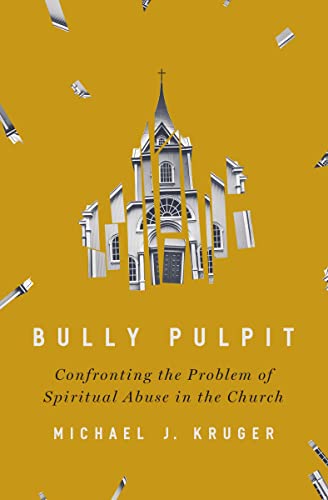
New Testament scholar Michael J. Kruger didn’t expect to write a book about spiritual abuse in the church, but—a couple of chapters in to his new book Bully Pulpit—I’m glad he did.

Kruger says:

I never expected to write a book on Christian leadership. And I certainly never expected to write this one. After all, my prior writing projects have been more on the academic side of the spectrum—mainly on early Christianity and the origins of the New Testament—and not on practical aspects of Christian ministry.

But what does any of us really know about what God might some day call us to? In lines that resonate with me, he goes on:

But sometimes God leads you down pathways you never imagined you would take. And sometimes you do things not because you want to but because they need to be done.

I know the feeling: I could only write each of these posts after firsthand and secondhand experience.

Bully Pulpit’s sub-title is: Confronting the Problem of Spiritual Abuse in the Church. Here’s Kruger’s definition of spiritual abuse:

Spiritual abuse is when a spiritual leader—such as a pastor, elder, or head of a Christian organization—wields his position of spiritual authority in such a way that he manipulates, domineers, bullies, and intimidates those under him as a means of maintaining his own power and control, even if he is convinced he is seeking biblical and kingdom-related goals.

Then he unpacks the definition:

  • “Spiritual abuse involves someone in a position of spiritual authority” (more on this below)
  • “Spiritual abuse involves sinful methods of controlling and domineering others” (i.e., the abuser is hypercritical, cruel, threatening, defensive, manipulative)
  • “Spiritual abusers seem to be building God’s kingdom (but are really building their own)”—this allows for an important intent vs. impact distinction

Kruger notes that defining spiritual abuse can be tricky, but that shouldn’t keep us from trying:

But sins that are more difficult to spot are still sins. Pride may be one of the worst sins, and yet it is remarkably difficult to prove in any given individual. Yet if such difficult-to-spot sins would disqualify a person from ministry (1 Tim. 3:3; Titus 1:7; 1 Peter 5:3; 2 Tim. 2:24), then the church is obligated to assess them even if the task of doing so requires more nuance and care. Can the church ignore these requirements merely because they are more subjective than others? One might argue that the pileup of churches wrecked by domineering leaders over the last decade shows that the church needs to do better in this area. We have ignored these requirements at our peril.

One element I especially appreciate in Kruger’s definition of spiritual abuse is that the abuser can be a person “in a position of [any] spiritual authority.” The abuser may not be in a positional of formal authority in the church, in other words. Their power may come from years of spiritual influence in a congregation. They may be a beloved church musician with informal authority but lots of power. They may be a long-serving elder or lay leader or popular Sunday school teacher who has waited out multiple pastors over the decades.

Kruger will come to focus, I think, on lead pastors or organization heads. This is as it should be, although I eagerly await someone’s book on spiritual abuse perpetuated from the so-called second chair–and the pew.

Either way, whoever spiritually abuses does so because they have spiritual power in a community, and they take drastic, hurtful measures to maintain it.

Jesus’s “Not so with you!” is a great refrain already in Kruger’s book. He will build to a positive vision of “creating a culture that resists spiritual abuse.”

For now, though, I’m grateful for his delineating what spiritual abuse is, since it offers shared, specific language for a practice that causes real and lasting harm.