Book Review: The Next Evangelicalism, by Soong-Chan Rah

Soong-Chan Rah writes, “As many lament the decline of Christianity in the United States in the early stages of the twenty-first century, very few have recognized that American Christianity may actually be growing, but in unexpected and surprising ways.”

In The Next Evangelicalism: Freeing the Church from Western Cultural Captivity, Rah posits that mainstream evangelicalism in the United States has been too monocultural in its worldview–“white” and “Western,” he says. It has been “taken captive” by individualism, consumerism and materialism, and racism. This captivity is pervasive, he writes, as seen in the megachurch movement, the emerging church movement (which Rah rightly argues pays too much attention to just white voices), and through cultural imperialism. Looking at Native American, African American, immigrant, and multicultural communities, Rah offers hopeful alternatives for evangelicalism’s future.

Every evangelical Christian should read this book. Rah has the courage to say hard things the church needs to hear. His excellent treatment of racism, especially, should be preached from the pulpits and studied in small groups.

However, there are at least two key points where I take issue with Rah.

First, a distraction is Rah’s equating “white” with “Western” as he discusses the church’s captivity. But these two are not always synonymous words, and sometimes when the author uses “white” he really means (or should mean) “Western” instead. Rah mentions T.D. Jakes as a megachurch pastor who is emblematic of the church’s captivity to (“white”) numerical pragmatism. But Jakes is “Western” and not “white.”  And there are non-white sectors of the Western church deserving of Rah’s critique (for example, Creflo Dollar and other “health and wealth gospel” African American pastors should be included in Rah’s critique of Western consumerism and materialism). Rah’s arguments would have more force (and been more accurate) if he simply had referred to “Western cultural captivity.”

Second, I struggled to accept some final remarks: “The shift in American evangelicalism is well under way. The white churches are in significant decline.” I will grant the first assertion. But as to the second, Rah does not define further what he means by “decline” and provides barely any evidence of it that I could see. In fact, if he means numerical decline, he is using a standard previously rejected in his book. (Church health ought to be measured not by buildings built or number of attendees alone, he notes, but by taking the spiritual pulse of the congregation.) Is a Church feeding the poor?  Welcoming visitors?  Caring for the sick? (Etc.?) If so, Rah would say, it is a healthy church. By this standard, the predominantly “white” church at which I recently served as youth minister, for example, is very healthy. Members of that church, and of many others I know that are like it, might read lines like this and ask, “What decline?”

Even so, I don’t want to overly fault Rah for those objections. As a reader I do not demand that Rah say everything perfectly before I accept the force and truth of his overarching claims. All in all, The Next Evangelicalism issues a clarion call to the church to end racism, embrace the growing ethnic diversity of the body of Christ, hear voices that have been overlooked and marginalized, and more accurately reflect the church the Bible calls us to be.

The “Preacher’s Trash Bin” (A Review of What Not to Say)

Here is some great preaching advice from my mother-in-law, a pastor: Never say from the pulpit that a certain idea came you to while you were in the shower.  Because who wants to think about their pastor in the shower?

Or as John C. Holbert and Alyce M. McKenzie put it, “Don’t tell stories that involve listeners picturing you naked. …So you received an insight into the cleansing power of God’s love in the shower on the mission trip as the cleansing and healing water cascaded over your body. Find another setting to tell about your epiphany.”

I set out to read What Not to Say: Avoiding the Common Mistakes That Can Sink Your Sermon, thinking that the book would be full of practical ideas like not sharing shower epiphanies as having taken place in the shower. Yet Holbert and McKenzie also write with theological depth and care as they coach preachers on what not to say and do in the pulpit.

Their chapters cover what not to say (and what to say): about God, about the Bible, at the sermon’s beginning, about the congregation, in the middle of the sermon, about yourself, in stories, and at the end of the sermon.

The goal of the book is “to give very direct advice out of the store of [the authors’] combined sixty years of preaching and over forty years of teaching others how to preach.”  They write, “It’s important in preaching to be as clear about what we are not saying as we are about what we are saying.” Here is where the theological depth of the authors comes to the fore, right in the first chapter: “First, affirming the sovereignty of God is not the same as insisting that everything that happens in my life and the world is directly the result of God’s actions.” The authors have a high view of God’s sovereignty, yet caution preachers against saying or implying, “Everything happens for a reason… and that reason is God.” Especially in a funeral sermon, for example, they say it’s theologically misguided for the preacher to say that God just “needed” the deceased’s voice to join the heavenly choir, or wanted “another flower for his heavenly bouquet.” God is sovereign, yes, preachers should affirm, but did he really cause a drunk driver to kill your daughter? No, the authors would say; free choice gone awry (i.e., stupidity) caused that. But preachers have to be careful that their words don’t somehow affirm that God’s sovereignty means He somehow took away that life. He may have allowed it; he didn’t ordain it.

Though the reader may not always find herself or himself in lock-step with the authors’ theology (I think the Bible is more of an “answer book” than they seem to indicate, and I respectfuly disagree with their interpretation of Romans 1, that Paul didn’t really understand the nuances of homosexuality), the reader will certainly appreciate their theological, Biblical, and homiletical care that grounds the eminently practical advice they give. The authors’ love of the Gospel, of the Church, and of preaching is on full display in these pages… and it inspired me as I read.

A few more highlights ought to convince anyone with an interest in preaching or public speaking to read this book:

  • The authors say the preacher should ask herself or himself this question honestly: “Do I habitually base my sermons on my favorite passages and avoid others I know little about or that may prove difficult?”
  • “Preachers throughout history have known that it is as important to exegete the congregation as it is to exegete the text. Jesus certainly did….”
  • “Sermons these days need to teach biblical and theological themes to often biblically illiterate listeners.”
  • “When we stir up people’s emotions without tying them to a biblical and theological message, what are they to do with their stirred-up emotions?”
  • Holbert and McKenzie want the preacher to ask: “Does the sermon tell the truth of the Gospel, not a domesticated version I assume the congregation would prefer to hear?”
  • On bad preaching habits (verbal filler, overused non-verbal gestures, etc.), they say: “Anything you do in the pulpit again and again will become over time the source of boredom and finally ridicule. When the youth sit in the balcony and count the number of times you say or do a certain thing, it is time to take stock of your preaching patterns.”
  • “Never make yourself the hero or heroine of your sermon” by using yourself as a positive example of how to apply a certain Scripture. “The sermon is not about us; it is about God.”
  • “Never use any of your children as sermon examples.” (Whether the reader finally agrees with this or not, the authors make a good case for it.)
  • Ask anyone for permission to talk about them in a story, even if that story shares something positive about them: “There are people in your church who would immediately transfer their membership if you thanked them publicly or singled them out in a positive way.”

It would be easy for me to go on about the helpful things I read in this book. I highly recommend it to all who preach or teach, in the Church or elsewhere.

The book is out now through Westminster John Knox Press.  (I am grateful to have received a digital galley of What Not to Say for review through Net Galley.)

I’ll give the authors the last word:

Preachers and teachers of preaching like to talk about the preacher’s toolbox. That is a positive metaphor. It signifies a repertoire of useful, effective sermonic strategies. There is also a preacher’s trash bin, a receptacle where we ought to put all the ineffective sermon strategies we don’t ever want to use again.

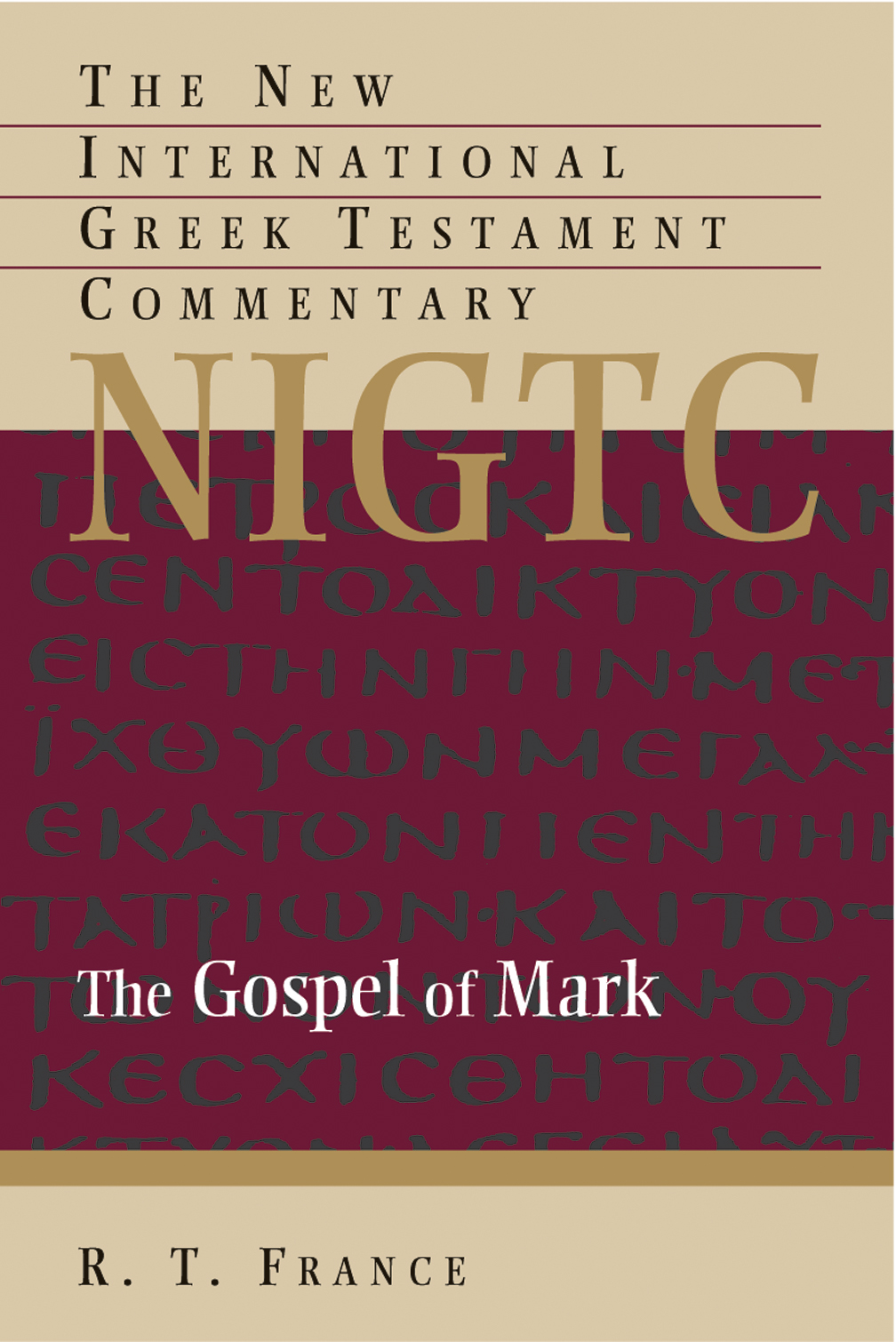
R.T. France on Mark

R.T. France’s commentary on Mark focuses on the Greek text, but I’d recommend it to anyone interested in carefully working through the Gospel of Mark, regardless of Greek knowledge. France takes the utmost care to interpret the text, providing much relevant background and comparison with other Gospels. Even as he is exegeting a single word or phrase from one verse, he always has the whole contour of the book in mind. While he does not formally have an application section as such, the conclusions he draws from the text are such that the careful reader could easily come up with applications from France’s insights.

France’s work is technical, yet easy enough to read, especially for a commentary. Beyond its superb quality as a technical/academic commentary, it has even gone so far as to more deeply inspire me in my own view of Jesus and his ministry. It’s well worth the money to purchase this book, and well worth the effort to work one’s way through it.

Sadly, France just passed away in February.  I was fortunate to be taking a class this past semester where this commentary was the primary textbook.

Review of Biblical Hebrew: A Compact Guide

At long last, a compact reference guide to Biblical Hebrew!  Not long ago Zondervan released Biblical Greek: A Compact Guide, a helpful and portable distillation of Mounce’s oft-used grammar. Many such little books already exist for easily reviewing Koine Greek: Dale Russell Bowne’s Paradigms and Principal Parts for the Greek New Testament, Paul Fullmer and Robert H. Smith’s Greek at a Glance, and even the back of Kubo’s Reader’s Lexicon has a good summary of Greek grammar with paradigm charts.

There seem to be more resources available to students of Biblical Greek than to students of Biblical Hebrew.  For example, while there is just one (excellent!) “Reader’s” Hebrew Bible (uncommon vocabulary is glossed at the bottom of the page), I am aware of at least three Reader’s Bibles that exist for the Greek New Testament.  So Van Pelt’s Compact Guide, based on his and Pratico’s Basics of Biblical Hebrew, is a welcome addition as far as this eager Hebrew student is concerned.

The book is not terribly dissimilar from Pratico/Van Pelt’s Charts of Biblical Hebrew, but unlike that work, A Compact Guide is more than just a collection of charts and paradigms.  Each section includes a distillation of what is in the grammar text, followed by paradigms and charts for quick reference.

Oddly enough, though, at times there seems to be more precision and detail in this little book than in the larger grammar.  Or perhaps it’s just more nuance that has come to articulation with the passage of time since the publishing of the grammar’s second edition.  For example, whereas the grammar lists three kinds of Hebrew prepositions (independent, Maqqef, and inseparable), the Compact Guide adds a fourth: compound prepositions, where “two different prepositions, or a preposition and a noun” (28) combine to make a new preposition.

The primary focus of the guide is morphology (how words are formed, including paradigm charts) and syntax (how words are used in sentences, i.e., grammar).  There is nothing in the work by way of vocabulary, save for a Hebrew-English mini-lexicon at the back of the book.  Unfortunately, at least in the digital galley version I viewed, there was no introduction or explanatory note as to what constituted inclusion on the lexicon.  By contrast, in Mounce’s Greek counterpart, his lexicon notes that it includes words that occur in the New Testament 10 times or more.

In addition to a thorough listing of paradigms (the 11-page section on pronominal suffixes is particularly helpful), the book is filled with examples from the Hebrew Bible (with English translation).  The Hebrew font used, while not as easy to read as that of the grammar, is readable enough.

The section on verbs is a particular strength of this work–in addition to examining all the forms and stems (both strong and weak), there are extensive listings of paradigms for easy review.

All in all, I give a hearty two thumbs up for this work–and express my gratitude that it is now on the scene for those who want to keep their Biblical Hebrew fresh!  For a beginner in Biblical Hebrew I would recommend the full-length grammar textbook, but for those with even a semester or two of Hebrew (and beyond), this small reference guide will be a valuable and inexpensive addition to their library.

The guide releases August 20, 2012, although you can preview some of it here now. (I received a digital galley for review through Net Galley.)

UPDATE: I review the hard copy, now released, here.