Some good advice here: before you preach a book of the Bible, try to live “inside” it first.
In line with the way one ought to prepare to preach any book of the Bible, the preacher needs to live inside a Gospel for a while before trying to preach any part of it. Reading it through at a single setting, several times, is a great way to begin; for those who have the training, working carefully through the text in Greek during preceding months will prove personally rewarding and homiletically enriching.
I’ve had a fascinating realization recently: almost all of Jesus’ first recorded words in Matthew and Luke were first spoken by somebody else. Jesus is highly prone to quotation early in his ministry.
This first stood out to me when reading through Matthew. After Jesus’ baptism and temptation, his first words of public proclamation (Matthew 4:17) are:
“Repent, for the kingdom of heaven has drawn near!”
John the Baptist had been saying the same thing (Matthew 3:2), verbatim, in his first recorded words in Matthew:
“Repent, for the kingdom of heaven has drawn near!”
The man Raymond Brown calls JBap
I’m sure that Jesus’/Matthew’s use of these same words from John are deliberate. Jesus and Matthew are showing that Jesus stands in the line of the prophetic, John-the-Baptist tradition. This is a tradition that fulfills what God has promised in the Old Testament. By chapter 4, the prophecy-fulfillment theme has already been prevalent in Matthew.
The very first words of Jesus that Matthew records are at Jesus’ baptism, where he tells a protesting John, “Let it be [this way] now, for this is proper, in order to fulfill all righteousness.”
But after that, the next three statements of Jesus in Matthew are quotations of Deuteronomy to fend off the devil in the temptation narrative. Then comes Matthew 4:17, where Jesus issues the same call to repentance that John has issued.
Luke is similar. After Luke 2:49 has Jesus telling his parents that he had to be in his Father’s house, Luke moves to his account of the temptation. Luke also includes three “It is written” statements by Jesus. Then he goes to his hometown synagogue in Nazareth and reads from Isaiah–yet more quoted words on the lips of Jesus.
What are we to make of this? Did Jesus not have anything original to say at the beginning of his ministry?
I think both of these Gospel writers and Jesus were keen to show that Jesus’ ministry was a continuation–better, a culmination–of the work and ministry that God had already initiated through Moses and the prophets. (Note: Mark and John look a bit different here.)
“God spoke long ago,” Hebrews begins, “in many instances and in many ways, to [our] fathers through the prophets, but in these last days he has spoken to us by [his] Son….”
At the baptism of Jesus in Matthew 3, God declared Jesus to be his Son. This Son carries on and brings to completion the work of salvation that God has already been effecting in the world. Matthew and Luke highlight Jesus’ use of Scripture early in his ministry to place him firmly at the center of God’s action in the world. The Sermon on the Mount of Matthew 5 and following will show even more in-depth interaction between Jesus and the Scriptures.
Jesus speaks God’s words, only now with an authority that exceeds the authority of all those who came before him. Jesus speaks other people’s words, but now with the authority of a Son, who was already present with God when the Word first inspired those words long ago.
“Have you ever been Baptized?” the preacher asked. “What’s that?” he murmured. “If I Baptize you,” the preacher said, “you’ll be able to go to the Kingdom of Christ. You’ll be washed in the river of suffering, son, and you’ll go by the deep river of life. Do you want that?” “Yes,” the child said, and thought, I won’t go back to the apartment then, I’ll go under the river. “You won’t be the same again,” the preacher said. “You’ll count.”
–Flannery O’Connor, “The River,” quoted in Richard Vinson’s Luke
When I preached through parts of Luke this past fall, one of my favorite commentaries to consult–and the one that always felt the freshest–was Richard Vinson’s Luke in the Smyth & Helwys Bible Commentary series. Here is how the series preface describes the series:
The Smyth & Helwys Bible Commentary is a visually stimulating and user-friendly series that is as close to multimedia in print as possible. Written by accomplished scholars with all students of Scripture in mind, the primary goal of the Smyth & Helwys Bible Commentary is to make available serious, credible biblical scholarship in an accessible and less intimidating format.
What stands out to me most about Luke is that it’s not only accessible but creative in its literary read of Scripture. Vinson knows Luke and its background well; he also knows modern history, culture, literature, and art in a way that allows him to explain the biblical text in a really fresh and engaging way. His primary audience is “pastors and other Bible teachers.”
The introduction is a concise 20-some pages, covering essentials like authorship, dating, sources, structure, and themes found in Luke. (This for me was the highlight of his introduction, as he discussed gospel sources, yet with his target audience in view–“So I will content myself with the occasional ‘if Q really exists’ and worry about more important issues.”)
There are times when reading the commentary is like reading a sermon–a good sermon. To take an example, the passage on Luke 18:1-8 (about prayer, the apathetic judge, and the persistent widow) begins like this:
The title of an article in the Chronicle of Higher Education caught my attention: “Study of Prayer’s Healing Power on Surgery Patients Finds No Effect.” The article described an experiment in having people pray, by name, for persons recovering from heart bypass surgery. [Does Prayer Work? sidebar] None of the pray-ers knew the pray-ees; some of the pray- ees knew they were being prayed for, while others were told only that it might be true for them. Would the prayers have a statistically measurable effect—would the persons prayed for suffer fewer complications than those who were not prayed for? In this test, under these conditions, not so much…. I find I have mixed reactions to the finding that prayer does not always bring the desired results: (a) surely that’s not news to anyone who prays regularly; (b) at least now I know that I’m not the only one, and that God isn’t singling out my prayers to ignore; (c) maybe the experiment proves that there is no God who can be controlled by specific human behaviors, even if the desired outcome is unobjectionable.
The study itself (detailed in a sidebar) is a little silly. But it’s a nice entry into the question that such texts raise: Will God answer my prayers? And if the outcomes I’m praying for don’t obtain, what is going on?
Art from the commentary
From there it moves into exposition of the passage. Exegesis in the commentary is passage-by-passage, rather than verse-by-verse. There’s not always a lot of technical detail, but I still felt like Vinson did justice to whatever passage was under consideration. He gives the Old Testament “job description” of the judge in the passage mentioned above, as well as the larger biblical context for the importance of widows. Comparisons to other Gospel accounts, as well as the occasional word studies for important words (with reference to Greek), make this as good a starting point as any.
And yet what commentary will also reference Flannery O’Connor, Hank Williams, and Wendell Berry’s Manifesto: The Mad Farmer Liberation Front? Vinson’s creativity and honesty as he seeks to make sense of a text are refreshing, and often set me at ease when facing the prospect of preaching on a challenging passage.
The commentary comes with a CD-ROM that has a pdf of the entire book, with Table of Contents and easy navigation (as pdfs go). You can keyword search it and make annotations. This is a step in the direction of my dream that one could own both print and digital with one purchase. And the print edition is quite nicely constructed, too–sewn binding and all (so it lays flat), which seems to be increasingly rare these days.
I had not heard of this series until recently, but for any book I preach out of (there are both OT and NT volumes), I’m going to try to get a hold of the corresponding Smyth & Helwys volume from here on out.
I am grateful to Smyth & Helwys for the gratis review copy of this commentary, which was sent to me for this review. You can find the book on Amazon here. The publisher’s product page is here. All the published volumes in the series are here.
Where gospel difference is seen as a problem or weakness that calls for elaborate harmonization procedures or critical unmasking, the root cause is a dissatisfaction with canonical pluralism as such and a determination to reduce it to singularity. But that is to overlook the hermeneutical significance of the canon itself, which strives to integrate the voice of the individual witness into an encompassing polyphony. As an ancient tradition suggests in word and image, this evangelical polyphony echoes the song of the four living creatures around the divine throne.
I’m reviewing Watson’s book for an upcoming Bible Study Magazine issue. Watson’s comfort with the co-existence of history and theology–as if one could be devoid of the other in the case of gospel reception–is refreshing.
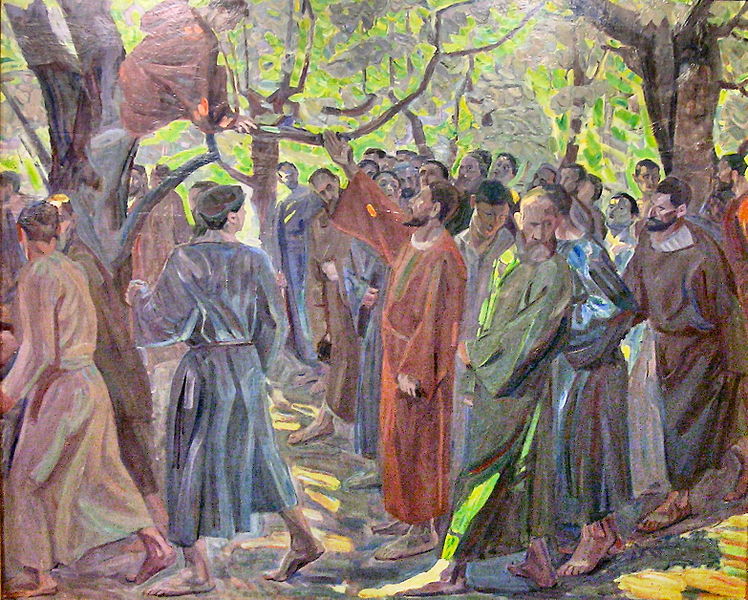
Even though Zacchaeus was “a wee little man”–he was not “wee” or “little” in terms of his financial standing.
Luke 19:1-2 Jesus entered Jericho and was passing through. A man was there by the name of Zacchaeus; he was a chief tax collector and was wealthy.
He was “a chief tax collector” and he “was wealthy.” Those two things are actually three strikes against Zacchaeus.
Strike one: He was a tax collector.
Tax collectors made out pretty well in Jesus’ day. They contracted with the Roman state to collect taxes from their fellow Jews. As long as the tax collectors paid the Romans a certain amount, they could charge whatever commission they wanted.
Strike two: He was a chief tax collector.
A chief tax collector oversaw other tax collectors. Zacchaeus had a prime position.
There was really little regulation here. This is sort of like pre-2008 subprime mortgage lending. Only it’s worse, because Zacchaeus as chief tax collector has a lot of other tax collectors doing the dirty work for him. And not only are they getting rich from people’s hard-earned cash, they’re even giving some of it to an imperial power–Rome. And who knows what non-kosher godlessness that money is going to!
Strike three: Zacchaeus was rich.
He was a tax collector, he was a chief tax collector, and he was rich. There’s nothing wrong with being rich, of course, but generally in Luke’s Gospel, the rich people Jesus meets have a hard time loving God on account of all their money.
Zacchaeus got rich off of other people’s money. Think: Ebenezer Scrooge.
As with the tax collector last week, the listeners expect this chief tax collector to be the antagonist.
So it’s no surprise in verse 3 when Zacchaeus can’t see Jesus. Sure, he’s short–probably not even 5 feet tall–but even if he were 6 feet tall, I’ll bet the crowd wouldn’t have made way for a guy like him.
Luke 19:3 He wanted to see who Jesus was, but being a short man he could not, because of the crowd.
Source: Adrienne Lavidor-Berman (Boston Globe)
These people are waiting to see Jesus! This is even more exciting than watching Big Papi and the Red Sox get on a duck boat! No way they’re going to make room for Zacchaeus.
The crowd blocks his line of sight. But Luke says he wanted to see Jesus. He seems to have these three strikes against him, but maybe this is a bit of character development here? Another translation says, “He wanted to see Jesus, who he was.”
He wants to figure out who Jesus is. He’s interested. He’s what church growth gurus in the 1980s and 90s referred to as “a seeker.”
The Motif of Urgency
Luke 19:4 So he ran ahead and climbed a sycamore-fig tree to see him, since Jesus was coming that way.
Zacchaeus runs ahead. He seems to be eager to see Jesus.
It wasn’t until I’d read this passage at least a dozen times and went for a long walk that I picked up on this motif of urgency.
The story picks up the pace at this point. Jesus is on his way to Jerusalem. He’s about to die. And rise again. He’s aware of what’s coming; his disciples are not, really.
But this is Jesus’ last face-to-face encounter till he gets to Jerusalem. So Luke as a writer is going to pack in as much as he can.
We’ve got lots of Luke’s themes here:
Wealth can keep you from God, or you can use it to worship him and serve others
Belief in God always leads to action and compassion for others
Jesus came to save the lost
God is a seeker, who goes after the ones he loves
In Luke this is a sort of final crescendo to close out this movement, before Jesus’ triumphal entry into Jerusalem, and then the events of Holy Week. All those themes are here, and Luke the storyteller notes that they are all important–urgently important.
verse 4: Zacchaeus runs ahead
verse 5: Jesus tells him to come down immediately…
verse 5 again: Jesus must stay at his house today
verse 6: Zacchaeus comes down at once
verse 8: Zacchaeus re-directs his giving and quits his cheating ways, and he metes out this retributive justice “here and now,” he says
“Today,” Jesus says in verse 9, “salvation has come to this house”
So keep that motif in mind as we work through the rest of the passage. Zacchaeus runs up the tree, and Jesus sees him.
Jesus Invites Himself Over
Luke 19:5b “Zacchaeus, come down immediately. I must stay at your house today.”
This culture valued hospitality, but there are still ways to do hospitality and ways not to do it. What you don’t do is invite yourself over to someone’s house. That’s still true today.
But Jesus has to–Jesus must–stay at his house. Forget the conventions of hospitality. Forget the conventions of not eating with unclean sinners. Forget that Zacchaeus was a traitor and that there were some in the crowd who just wanted Jesus to be Che Guevera and overthrow Rome.
How does Jesus know Zacchaeus’s name? Luke doesn’t tell us. Jesus other knew him through divine omniscience or through Zacchaeus’s reputation. But he’s got to get to Zacchaeus’s house.
Why? We’ll come to that in a bit.
Already we’re struck by Jesus’ offer of fellowship. His offer to fellowship with him is a standing offer, but as with Zacchaeus, it’s also an offer he wants us to take him up on right now. This very day. This very minute. Jesus wants to come to us, to enter the homes of our hearts and minds, and have communion with us.
God calls the ones he has made good. And when we go bad–as Zacchaeus did–he does not turn away from us, but continues to pursue us, and invite himself into our homes, our work, our daily routines, our lives.
Zacchaeus models a response to Jesus. He comes down with the same urgency Jesus had in calling him.
Luke 19:6 So he came down at once and welcomed him gladly.
He receives Jesus into his home as an esteemed guest. No delay. There’s not putting it off till another time. Zacchaeus comes down have fellowship with Jesus right now.
The people in the crowd don’t like this, of course.
Luke 19:7 All the people saw this and began to mutter, “He has gone to be the guest of a ‘sinner.’”
They grumble against Jesus. But haven’t they figured out by now that this is the sort of thing Jesus does? Have we learned that yet?
Zacchaeus’s Immediate Response
And then, more urgency:
Luke 19:8 But Zacchaeus stood up and said to the Lord, “Look, Lord! Here and now I give half of my possessions to the poor, and if I have cheated anybody out of anything, I will pay back four times the amount.”
Right now–on the spot, Zacchaeus pays it all back. Retributive justice, it’s called. He makes amends in a way that is appropriate to the crime. Redistribution of ill-gotten wealth was the only way for him to do this.
Saint Augustine once wrote of grace that it “is bestowed on us, not because we have done good works, but that we may be able to do them.”
This is another side of the coin when we consider last week’s tax collector and his uttered prayer. “God, have mercy on me, a sinner.” This prayer of faith made him right with God, Jesus said. Here, there is action, which always accompanies belief. Salvation has come, Jesus says, and that is evident because of what Zacchaeus is doing with his money.
He literally puts his money where his mouth is. His profession of faith is only truly complete as he acts on it. And he acts on it “here and now.”
He held his money loosely. He embodied that offertory prayer: “All things come from thee, O Lord, and of thine own have we given thee.”
Zacchaeus is going to lose a ton of money here–and think of all the logistics in making sure everyone gets repaid properly.
But no matter–he is eager to express his love toward God through his vocation and his giving.
Luke 19:9-10 Jesus said to him, “Today salvation has come to this house, because this man, too, is a son of Abraham. For the Son of Man came to seek and to save what was lost.”
Remember how Jesus said, “I must stay at your house today”? Or, as another translation puts it, “It is necessary” for Jesus to stay?
This is because Jesus’ fellowship with Zacchaeus was “mission-critical.” It was the core of Jesus’ mission to “seek and to save what was lost.” He’s doing that here. He has done that here. He sought Zacchaeus, and saved him– “Today salvation has come to this house.”
Zacchaeus did his part, of course–he climbed a tree, pledged to give back money he had extorted from people.
But Jesus is the ultimate initiator, I think. He could have passed by that tree… pretended not to see Zacchaeus.
The Prodigal Son Returns, Rembrandt
“The Son of Man [Jesus] came to seek and to save what was lost.”
The 1 sheep, lost and wandering away from the other 99. The 1 coin, lost on a dusty floor. The 1 son, lost in his youthful rebellion and waywardness. A despised chief tax collector. Prostitutes. People with diseases. Gentiles. You. Me. Jesus comes to seek and to get all of these.
Our Mission with Jesus
Jesus’ mission is “to seek and to save what was lost.”
This has now become the mission of the church, as the visible expression of Jesus’ body on earth.
Faith and action go hand in hand, as they did with Zacchaeus. For him, following Jesus necessarily entailed that he do all he could to bring about justice. The kingdom ethics of Jesus transformed the way he thought about his business relationships. It revolutionized the way he worked.
Zacchaeus responded to Jesus immediately. There was a sense of urgency in his desire to make things right before God.
And he responded to Jesus with joy.
May we be inspired by this unlikely hero. Zacchaeus allowed his whole life to be transformed by his encounter with Jesus, in the very moment of Christ’s coming to him. Salvation has come to our house today. Let’s receive him with joy.
The above is adapted from the sermon I preached this Sunday on Luke 19:1-10, covering the story of Zacchaeus’s encounter with Jesus. All Scripture quotations come from the NIV (1984). See my other sermons, if you desire, here.
“Lord Jesus Christ, Son of God, have mercy on me, a sinner!”
“Lord Jesus Christ, Son of God, have mercy on me, a sinner!”
“Lord Jesus Christ, Son of God, have mercy on me, a sinner!”
It’s a surprising source, but I have J.D. Salinger to thank for introducing me to the Jesus Prayer in his book Franny and Zooey.
“Lord Jesus Christ, Son of God, have mercy on me, a sinner!”
In a simplified form, that is the prayer of the tax collector in Jesus’ parable of the Pharisee and the tax collector (Luke 18:9-14): “God, have mercy on me, a sinner.” It has become known as the Jesus Prayer.
The tax collector is a model for prayer, though if this character in Jesus’ story were worshiping with us today, he’d never let us hold him up as an exemplar.
Two Guys Walk into the Temple to Pray….
Luke 18:9 To some who were confident of their own righteousness and looked down on everybody else, Jesus told this parable:
Note the phrases, “confident of their own righteousness” and, “looked down on everybody else.”
The Old Testament prophet Isaiah speaks of such people:
They say, “Keep to yourself!
Don’t get near me, for I am holier than you!”
These people are like smoke in my nostrils,
like a fire that keeps burning all day long. (Isa 65:5)
Luke 18:10 Two men went up to the temple to pray, one a Pharisee and the other a tax collector.
Of these two men, who do the listeners think is going to be the hero? The Pharisee. Just about everyone hated tax collectors.
Oh, this is going to be good, the self-righteous listeners must have thought. Jesus is about to validate us, as he should!
Jesus isn’t out to bash Pharisees with this parable. We have to be careful about this as we read the Gospels. In fact, as one commentator points out, “The Pharisees were admired by the common folk for their piety and devotion to the Mosaic Law. Our contemporary equation of Pharisaism with hypocrisy would not have been made by a first-century Jew.”
It’s the same kind of setup as you get in the Good Samaritan parable–the religious person ends up showing us what not to do, while the real sinner becomes the example.
God Is Lucky to Have Him
Luke 18:11 The Pharisee stood up and prayed about himself: “God, I thank you that I am not like other men—robbers, evildoers, adulterers—or even like this tax collector.
Some of the listeners in the audience are saying, “Amen! Good prayer! Jesus gets it!”
This Pharisee starts his prayer out in the right way–“God, I thank you,” a typical beginning to Jewish prayers.
But it never really was an actual thanking of God for who God is. It was a thanking of God for who the Pharisee was.
He’s at the temple praying, standing up. This is a posture that suggests he was praying for others to hear him.
Note that it says he “prayed about himself.” This is much more soliloquy than prayer. Dear God–but enough about you. Here’s who I am and what I bring to the table. He mentions God, prays to him, but God quickly becomes just a footnote in the prayer. He continuses:
Luke 18:12 “I fast twice a week and give a tenth of all I get.”
What a good, religious guy! No, really–he is living an exemplary life, in terms of spiritual practices.
And he might well be sincere in his fasting and tithing. His fasting twice a week was more than was required. Designating a tenth of everything to God is an Old Testament practice that many continue today when they consider financial giving to their churches.
But he’s missing the point.
The primary subject and actor in this prayer is… the one praying. Not the one he prays to.
He addresses his prayer to “God,” but after that, he thanks God for who he is not. He’s telling God what he’s doing for God, and he’s also making sure to remind God of how rotten these other people are. God, you’re lucky to have me!
This guy’s understanding of himself is interesting to me. He defines himself before God in two primary ways:
(a) who he is not (these other people) and
(b) what he has done.
The guy has identity issues. Can he only be secure in himself by putting others down? Or maybe he’s a little more sincere than that. Maybe he’s like the older brother in the Prodigal Son story–he does his duty, says his prayers, fasts, tithes… but the people around him are moral slackers. And he just can’t stand it.
He’s still missing the point. The despised tax collector, however, really does get it.
He Can’t Even Look at God
The Pharisee and the Tax Collector, by Gustave Doré (1832–1883)
Luke 18:13 But the tax collector stood at a distance. He would not even look up to heaven, but beat his breast and said, “God, have mercy on me, a sinner.”
With the Pharisee, the primary subject and actor in his prayer was… the one praying. The subject and primary actor in this prayer is God. “God, have mercy on me, a sinner.”
That’s it. It’s much shorter prayer than the Pharisee’s prayer.
Before he even prays, he beats his chest, a sign of lament. He did not stand where everyone could see him. The Message version says he was “slumped in the shadows.”
Clearly he was “supposed to” be the antagonist of the story. A tax collector was in collusion with the Roman occupiers. Assuming he was Jewish, he took money from his own people to pay a foreign power, often with a kickback for himself.
He knows he’s supposed to be the antagonist in the story–he knows his sin too well. He confesses his sin to God.
An Old Testament prayer goes: “O my God, I am too ashamed and embarrassed to lift my face to you, my God, for our iniquities have risen higher than our heads, and our guilt has mounted up to the heavens” (Ezra 9:6).
But God–and all the listeners to this story knew this–God is a God who forgives wrongdoings. He welcomes the wayward sinner home.
Jesus concludes:
Luke 18:14 “I tell you that this man, rather than the other, went home justified before God. For everyone who exalts himself will be humbled, and he who humbles himself will be exalted.”
Remember how the story started? “To some who were confident of their own righteousness and looked down on everybody else, Jesus told this parable.”
They were confident in their own righteousness, their own right standing, their peace with God. But, look, Jesus says, you don’t get that from yourself, so stop trying. If you hold yourself up as righteous, you’ll humbled. But if you are humble, you will be exalted–not a sort of fame or glory with other people, but if you are humble, you will be truly justified before God. You will have peace with God.
“God, have mercy on me, a sinner.”
Where We Fit in the Parable
One writer (quoting another for the first portion below) says that because we know the end of the story:
“We identify with the tax collector and feel silent gratitude that we are decent and humble rather than being self-righteous like that shameful Pharisee.” We can be like the Sunday school teacher who goes through the lesson and says at the end, “Now, children, let us bow our heads and thank God we are not like that Pharisee.”
And that’s one of our reactions reading this text, isn’t it?
Well, yeah, I’d never actually name people in my prayer and say, “God, thank you that I’m not like him or her or those people.” And maybe that’s true. Maybe we don’t explicitly pray prayers like that, certainly not out loud.
But we might think thoughts like that. This same loathing of others that the Pharisee brings to God… we may do this in more subtle ways.
We might smugly watch the people going for long walks on a Sunday morning while we drive to church. We might watch the way a parent scolds their child and think: well, I would never do anything like that. We might work hard in the office or even here at the church, and secretly resent those who don’t seem to be as productive as we are. Or we might just look at someone with pseudo-pity and say to ourselves, “I am sure glad I don’t have to be that person.”
“God, have mercy on me, a sinner.” This is the sort of attitude, the kind of prayer that brings us into fellowship with God.
This prayer, in various forms, has inspired people ever since the tax collector prayed it. Ironically enough–the prayer of this humble man has been exalted and used by many.
What Salinger’s Franny Knew About Prayer
J.D. Salinger first wrote Franny and Zooey in the late 1950s as two separate shorts in The New Yorker magazine. Franny is a college student who is becoming disillusioned with college–not with her studies, per se, but with other college students. She thinks they’re fake, shallow, and egotistical. Her boyfriend Lane isn’t much better.
He’s a name-dropper, a complainer. He boasts in his own achievements–his good grades and his upcoming paper he’s going to publish. He’s sort of like the Pharisee in the parable.
What Franny read
Franny is in the middle of an existential crisis. At the recommendation of a prof, she’s been reading The Way of a Pilgrim, a 19th century Russian story about a pilgrim who wants to know how to “pray without ceasing,” as one verse says. He finally finds a spiritual advisor who tells him to repeatedly pray a version of the tax collector’s prayer: “Lord Jesus Christ, Son of God, have mercy on me, a sinner.” The idea is to make this prayer move from the lips to the heart, so that, as Salinger puts it, the prayer “becomes an automatic function in the person, right along with the heartbeat.”
Franny has been experimenting with the prayer, and at the end of the story, she faints. When she comes to, with boyfriend Lane by her side, she is mouthing the words: “Lord Jesus Christ, Son of God, have mercy on me, a sinner.”
Various Christian traditions suggest praying the prayer repeatedly, as the Russian pilgrim did, and as Franny tried to do.
As one devotes 5, 15, then 30 minutes to praying this prayer, different words stand out each time. Jesus Christ is Lord. Jesus is the Son of God. I am a sinner. Mercy–Jesus has mercy on us, or shows us grace when we don’t deserve it. “Lord Jesus Christ, Son of God, have mercy on me, a sinner.”
Some recommend breathing in as you pray the first half of the prayer–inhale with “Lord Jesus Christ, Son of God,” then exhale as you pray the second half–”have mercy on me, a sinner.” You internalize this prayer, so that its words become as natural to you as breathing.
But humility is a tricky thing. Just as soon as we think we are humble, we are tempted to congratulate ourselves on our humility. Maybe not loudly, but quietly. So we cling to the message of this parable, summarized elsewhere in Scripture: “God opposes the proud, but gives grace to the humble.”
I wonder if Salinger’s character Franny knew that: even as she saw occasion to criticize shallowness and inauthenticity around her, she clung to the prayer of humility. It moved from her lips to her heart. It became not just a prayer, but a posture. It wasn’t a formula, but her very breath.
It is Christ’s mercy, his “unmerited favor,” as some have defined it, that sets us right with God. We remind ourselves of that mercy each time we confess our sins and call on God for his aid.
“Not to us, Lord, not to us, but to your name be the glory.” (Ps. 115:1)
The above is adapted from the sermon I preached today on Luke 18:9-14, covering the Parable of the Pharisee and the Tax Collector. All Scripture quotations come from the NIV (1984). See my other sermons, if you desire, here.
The following is adapted from the sermon I preached today on Luke 15:1-10, covering the Parable of the Lost Sheep and the Parable of the Lost Coin.
Luke 15:1 Now the tax collectors and “sinners” were all gathering around to hear [Jesus].
The tax collectors and “sinners” in Luke 15 were about as despised as you could get. Tax collectors were sometimes mentioned in the same sentence as prostitutes. Continue reading “Hound of Heaven on Our Trail”→
As Jesus and his disciples were on their way, he came to a village where a woman named Martha opened her home to him. She had a sister called Mary, who sat at the Lord’s feet listening to what he said. But Martha was distracted by all the preparations that had to be made. She came to him and asked, “Lord, don’t you care that my sister has left me to do the work by myself? Tell her to help me!”
“Martha, Martha,” the Lord answered, “you are worried and upset about many things, but only one thing is needed. Mary has chosen what is better, and it will not be taken away from her.”
–Luke 10:38-42 (NIV, 1984)
At the Rabbi’s Feet She (!) Sits
Martha gets off to a good start in this passage. She is showing hospitality to Jesus, by having him into her home. She “opened her home to him,” Luke says, using language of gracious hospitality.
She will call Jesus “Lord” later in the passage, so she clearly loves him.
She had a sister called Mary, who sat at the Lord’s feet listening to what he said.
Have you ever heard people talking about sitting at Jesus’ feet? Perhaps one of those evangelical phrases we hear from time to time, not really sure what it’s about.
That’s what Mary was doing: sitting there, listening.
This posture of sitting at someone’s feet is not the subservient posture we might think of today. Rather, this was how learners actively engaged with their teachers. A student would sit at the feet of his rabbi.
Yes, his rabbi. This is very unusual posture for a woman to take. There were some rabbis that had female students, but most did not. Women would instruct other women in the Torah. Mary was taking on a stereotypically male role here in becoming Jesus’ student.
And students sat in the dust at the feet of their rabbis, not only so they could learn, but so that they themselves could train to become rabbis, to teach others. Mary is taking in from Jesus how she, too, can preach the Gospel of Jesus and lead others to a saving knowledge of God.
N.T. Wright says, “People sat at a teacher’s feet in that world, not to gaze languidly with drooping eyelids, but in order to become teachers themselves. … Mary had crossed a boundary, entering into the man’s world of discipleship; Jesus had affirmed her right to be there….”
Last week we saw the Samaritan–one of the last people you’d expect–seeing and having compassion on a man in a ditch. He saw him, had compassion on him, and acted on that compassion. He did what was in his power to do. And he was one of the last people who would be expected to do that.
In this passage there is a woman–one of the last people one would have expected then, certainly the wrong gender, according to society, who takes the posture of a disciple, learning from a rabbi.
Jesus has little use, sometimes, for social conventions. He can and does work through them, certainly. But he’s just as likely to turn them on their heads, teaching instead the social conventions of the Kingdom of God.
Sibling Rivalry and Other Distractions
Christ in the House of Martha and Mary, by Johannes (Jan) Vermeer
But Martha was distracted by all the preparations that had to be made. She came to him and asked, “Lord, don’t you care that my sister has left me to do the work by myself? Tell her to help me!”
It’s interesting… Luke says that Mary was “listening to what he said.” “But Martha was distracted….”
Jesus was already talking. Why wasn’t Martha putting her work on hold to listen? Or at least, were there some preparations she could have done while still in earshot of him?
I’m sure many of us have been in that situation where we have guests coming over. We nervously look at our watch and see that we only have 10 minutes left to get the food in the oven, vacuum the living room, and maybe put on some deodorant or whatever, because we’ve been running around for the last hour or two. Maybe we exchange a few terse words with spouses or children to hurry up and help prepare….
And when the guests come, we may not be done with the preparations, but that’s okay. (It really is okay!) We can invite them to sit in the kitchen with us so we can finish dinner, but also talk to them. Or we put our preparations on hold at least to say hello, shake hands, give hugs, and so on.
Was Martha avoiding Jesus?
To be clear: the work itself was not bad. She was showing hospitality to Jesus by having him in. Earlier in Luke Jesus rails against a man named Simon who had invited him over but not been hospitable. In that story a woman “who had lived a sinful life” poured perfume on his feet and wiped them with her hair, crying all the while. Jesus said,
Do you see this woman? I came into your house. You did not give me any water for my feet, but she wet my feet with her tears and wiped them with her hair. You did not give me a kiss, but this woman, from the time I entered, has not stopped kissing my feet. You did not put oil on my head, but she has poured perfume on my feet. Therefore, I tell you, her many sins have been forgiven—for she loved much.
Jesus values hospitality. In fact, in Jesus’ culture, to complain to your host was a big no-no. You thanked your host profusely for going out of their way to greet you. But Jesus had called Simon out anyway.
So Martha is doing something that is generally good.
But her focus on the tasks of hospitality kept her from seeing the guest.
She was distracted–her attention was turned from where it should have been (the presence Jesus) to a lesser good (tasks done not in the presence of Jesus).
We get the picture of Martha barging in and interrupting–Jesus was talking to Mary, Mary was listening, and now Martha blurts out, “Lord, don’t you care that my sister has left me to do the work by myself? Tell her to help me!”
She puts the focus on herself. Actually, on her sister. “She’s not doing her chores.” (A common refrain of siblings everywhere.) “Tell her to help me.”
Another distraction-someone else’s relationship to Jesus–keeps Martha from thinking about her own relationship to Jesus.
Martha’s Baditude
Martha tells Jesus what to do! We begin to get the sense that throughout Jesus’ visit she has not been having a good attitude at all. We have a word for this in the K-J house: baditude. It’s a bad attitude. Martha is sporting a serious baditude.
A number of interpreters of this passage have pointed out the difference between Martha, who tells Jesus what he has to say, and Mary, who listens to what Jesus wants to say.
“Martha, Martha,” the Lord answered, “you are worried and upset about many things,
“Martha, Martha!” There is emotion in Jesus’ response, as he says her name twice. A firmness, it sounds like, but also compassion.
“You are worried and upset about many things.” Many things!
Maybe Martha is worried and upset about more than just Jesus’ arrival.
Maybe Martha has avoidance issues more generally.
Maybe she is afraid of being known well by others.
Maybe the baditude was just a front. Maybe she was scared of being loved deeply by someone else.
Maybe she thought she could somehow earn the love and approval of Jesus and his entourage by hosting them with the most elaborate spread.
Therefore I tell you, do not worry about your life, what you will eat or drink; or about your body, what you will wear. Is not life more than food, and the body more than clothes? Look at the birds of the air; they do not sow or reap or store away in barns, and yet your heavenly Father feeds them. Are you not much more valuable than they? Can any one of you by worrying add a single hour to your life?
Take my yoke upon you and learn from me, for I am gentle and humble in heart, and you will find rest for your souls. For my yoke is easy and my burden is light.
Cast all your anxiety on him because he cares for you.
David Garland, a Bible professor at Baylor, asks, “How is it that one can do everything right and still be wrong?”
Martha welcomed Jesus in v. 38, a sign of hospitality. She calls him Lord. She seems to truly love him. She just gets distracted. And stressed out. Frustrated with her sister for not joining her in her stress. And maybe she is even jealous of her sister’s relationship to Jesus?
You Only Really Need One Thing
but only one thing is needed. Mary has chosen what is better, and it will not be taken away from her.”
Martha has allowed the Good to distract her from the Better. Her priorities are not quite right. Her affections, her emotions, the way in which her heart is going… is mis-directed.
Prioritizing where our attention goes would be easy if we could choose between a bad thing and a good thing. But sometimes life gives us a choice between two goods. And one of those goods may be better than the other. Mary used wisdom and discernment in this passage to do that. Martha did not. She was too busy doing The Good to notice The Better that was right there in her living room.
Martha may do her work in silence, but it is a sham, a mask for rage. I like to think of her as saying nothing as she bangs around the house, trying to get Mary’s attention, or better yet, make her feel guilty for not helping out. …I recognize myself all too clearly in the scene; all the internal–infernal–distractions, the clatter-bang of daily routines and deadlines, that can make me unfit company for anyone.
When our work, when our lives become just a series of tasks, it’s exhausting. I identify with Martha here; I’d imagine that a number of us do. I want to make that decision that Mary makes. She’s not just passively sitting there, doing nothing, she has deliberately chosen to listen to Jesus. And, Jesus says, she has chosen “what is better.”
“Jesus is coming. Look busy,” the bumper sticker says.
And of course we can–and sometimes should be busy for Jesus. But we need to also ask how we can keep our work and our service and our ministry in its proper relation to listening to God.
When it comes down to it, Jesus says, “Only one thing is needed. Mary has chosen what is better, and it will not be taken away from her.”
One thing–Jesus. More specifically, sitting at Jesus’ feet and listening to him. That’s what we really need to do.
Inviting Jesus into the Kitchen
Brother Lawrence in the Kitchen
I don’t read this passage as telling all of us Marthas in the world that we can’t keep actively serving others. I don’t think Jesus is saying that we have to stop our work in the kitchen altogether.
But if we are doing our work with the same sort of “baditude” Martha has here, it’s either time to take a break and be with Jesus, or more deliberately invite Jesus into the work we are doing.
A number of sermons ago I suggested using sentence prayers throughout the days tasks to connect with God:
“Lord, I know that you are with me.”
“God, thank you.”
“Jesus, please help me.”
“Lord, help me love this person the same way you do.”
“God, I offer this work to you.”
Brother Lawrence was a 17th century monk who served as cook in his Carmelite order. He was described as having a “great aversion” to the kitchen, and yet, as one brother said of him,
[I]t was observed, that in the greatest hurry of business in the kitchen… He was never hasty nor loitering, but did each thing in its season, with an even uninterrupted composure and tranquillity of spirit.
“The time of business,” Lawrence said, “does not with me differ from the time of prayer; and in the noise and clutter of my kitchen, while several persons are at the same time calling for different things, I possess GOD in as great tranquillity as if I were upon my knees at the Blessed Sacrament.”
It’s especially tragic when we are doing ministry work, like the hospitality Martha was trying to show, and we forget the main reason we are serving… for Jesus.
Work without a connection to Jesus is just being busy.
But when we deliberately sit down with Jesus, or invite him into our work, listening to what he has to say… that can never be taken away from us.
The above is adapted from the sermon I preached today. All Scripture quotations come from the NIV (1984).
It’s kind of a funny name–Good Samaritan. It sounds redundant to us now, since “Samaritan” generally already has positive connotations: Samaritan’s Purse relief organization. Good Samaritan hospital. Church of the Good Samaritan. And so on.
But Jesus’ listeners would have heard “Good Samaritan” as an oxymoron. Samaritans were anything but good. They were a despised people–a product of God’s people intermarrying with another, idolatrous people. They weren’t faithful, many Jews thought. A Samaritan was the last person one would have expected to help another person.
How do we get to the parable?
How do we get to the “Parable of the Good Samaritan” in the first place?
Luke 10:25 On one occasion an expert in the law stood up to test Jesus. “Teacher,” he asked, “what must I do to inherit eternal life?”
An expert in the law, a lawyer, tests Jesus. As we soon see, he already has an answer to his own question in mind.
Luke 10:26 “What is written in the Law?” he replied. “How do you read it?”
Jesus answers his question. No, he doesn’t at all. He asks him another question. It’s that great trick of the trade when you’re teaching and you want to more fully engage someone… what do you think?
“Why does a Rabbi answer a question with a question?” the joke goes.
“Why shouldn’t a Rabbi answer a question with a question?”
Luke 10:27 [The expert in the law] answered: “ ‘Love the Lord your God with all your heart and with all your soul and with all your strength and with all your mind’; and, ‘Love your neighbor as yourself.’’”
Luke 10:28 “You have answered correctly,” Jesus replied. “Do this and you will live.”
These are two Great Commandments: Love God and Love Your Neighbor. Had the lawyer heard Jesus say something like this on another occasion? Perhaps. In Mark and Matthew, it is Jesus who gives these commandments as the most important ones in the law–on these hang all of God’s other commands. Love God, Love Your Neighbor–that frames, that grounds everything else.
“Do this and you will live,” Jesus says. Yes, law expert, you know the answer. Go do it.
And the parable will actually end this way, too, with Jesus saying, “Go and do likewise.” But…
Luke 10:29 But he wanted to justify himself, so he asked Jesus, “And who is my neighbor?”
“He wanted to justify himself.” Justify–to make right, to be declared righteous. He asks, “Who is my neighbor?” One commentator speculates that the question here is expecting a specific answer like, “Your parents, your friends, your cousins, etc.” so that he can then say, “I’ve loved them all” and be praised by Jesus in front of everyone.
“Who is my neighbor? Who all do I have to love, and who can I get by without loving? Who is my neighbor, and who is my non-neighbor?”
That’s what his question seems to imply. In a sense, he’s asking the bare minimum. Or at least some sort of clarification so he can know who will be inside his circle of love and who will be outside it.
So Jesus tells him a story. We’ve heard it.
The parable
Credit: Mark Jenkins (Sculpture)
Luke 10:30 In reply Jesus said: “A man was going down from Jerusalem to Jericho, when he fell into the hands of robbers. They stripped him of his clothes, beat him and went away, leaving him half dead.
That road was rocky, full of caves, about a 17-mile journey. There was a 3,000 foot elevation change on that journey. Thieves would hide out in those caves and mug people who travelled on the road. It was a lucrative business.
31 A priest happened to be going down the same road, and when he saw the man, he passed by on the other side.
A priest–a religious ruler. Part of society’s elite in those days. Coming from Jerusalem, he was probably doing his priestly duty. So he had just been in church!
(I wonder what Scripture readings he heard that day? I wonder what the teaching was?)
32 So too, a Levite, when he came to the place and saw him, passed by on the other side.
Levites assisted the priests–they were like the worship leaders, or the music leaders. Also coming from Jerusalem, maybe from worship there.
(I wonder what songs they led. I wonder what message they were seeking to reinforce in the service–have compassion? Love your neighbor as yourself?)
Then, what is supposed to be next is a person of Israel. There was a formula throughout the Old Testament of priests, Levites, and all the people of Israel.
This is shaping up so far to be an anti-clergy story. The person of Israel is supposed the be the hero–the so-called layperson. But instead–a Samaritan!
33 But a Samaritan, as he traveled, came where the man was; and when he saw him, he took pity on him. 34 He went to him and bandaged his wounds, pouring on oil and wine. Then he put the man on his own donkey, took him to an inn and took care of him. 35 The next day he took out two silver coins and gave them to the innkeeper. ‘Look after him,’ he said, ‘and when I return, I will reimburse you for any extra expense you may have.’
A man was mugged and beaten by a gang of thugs in the park. He was left for dead.
A theology student saw the man and had the instinct to help him, but she had just taken a pastoral care class, so said,
“We were just taught it is not good to try to rescue someone. We must resist the temptation, however sincere and religiously motivated, to naively wade in and try to be someone’s rescuer.” That’s a Savior complex. I’d better not help, she thought. So she passed by.
Then, in this re-telling of the parable, the chairperson of the local church association’s social justice committee came by. He saw the man. But he was overwhelmed with all the systemic, macro-level issues that could have produces a man lying in a ditch–the economy, social structures. “To help this man,” he said, “Is simply a Band-Aid, solving nothing.” He passed by, too.
Finally, the CEO of Texaco Oil, out riding around in his new BMW, saw the beaten man. His heart was moved with compassion. He picked him up, put him in the back of his car (on his clean, white upholstery), bandaged his wounds, and drove him to the local hospital, paying all his bills.
Who was the neighbor? Not, in this re-telling, the people you might have expected. And that’s one of Jesus’ main points here–if a Samaritan, someone this law-expert would least expect, can show compassion, anyone can.
“And When He Saw Him…”
Credit: Mark Jenkins (Sculpture)
Let’s go back to the original story. After the parable, Jesus asks another question:
Luke 10:36 “Which of these three do you think was a neighbor to the man who fell into the hands of robbers?”
The expert in the law might have wondered after the Priest and Levite passed the guy in the ditch–was he their neighbor? Gosh, maybe not…
But Jesus doesn’t spend a lot of time on the man in the ditch. We don’t know much about him. In this parable he is just, “a man.” Because for Jesus, the question is not, is he the neighbor, but will you be a neighbor to the one in need?
So he asks the law-expert: “Who was a good neighbor?”
The expert in the law can’t even bring himself to say the word “Samaritan,” so he says, “The one who had mercy on him.”
Jesus is saying–much more important than finding out who is your neighbor is being a neighbor. It’s the old adage: if you want to have a friend, be a friend.
Don’t think about other people’s status and worthiness. Be the loving neighbor we know we are called to be.
This passage ends with Jesus not so much saying–now I’ve explained the law to you and you know who is your neighbor, and how to inherit eternal life… he says, here’s a story of how someone you despise is a neighbor. And if he can do it, so can you. “Go and do likewise.” Go. Do. You know what to do. Go do it. Be a good neighbor. Be the neighbor you wish to see in the world.
And this is a good enough message, one that we know we all want to strive, by God’s grace, to listen to and put into practice.
But there’s just one more thing. A small but essential detail to this story.
Look one more time at the text. In verse 31:
31 A priest happened to be going down the same road, and when he saw the man, he passed by on the other side.
Going down the same road, and when he saw the man….he passed by….
32 So too, a Levite, when he came to the place and saw him, passed by on the other side.
33 But a Samaritan, as he traveled, came where the man was; and when he saw him, he took pity on him.
Each of these three people–the priest, the levite, and the Samaritan, came to where the man was, and they saw him. They saw him.
This verb that Luke uses–take pity, have compassion… the NRSV has it as “he was moved with pity.” This particular verb, when it is used in the New Testament, is mostly used of Jesus. He has compassion. And many of those times that compassion comes after Jesus has seen a crowd. Or Jesus has seen a person in need. Jesus sees them and has compassion, and then he acts.
In the same way, the Samaritan sees the man in the ditch and has compassion, and then he acts.
I was so struck this time around, as I studied this parable, at this one word–see. And Luke is a good writer–this is all on purpose. The Samaritan totally breaks up the pattern of the story:
sees–passes by
sees–passes by
sees–has compassion–does something
Credit: Mark Jenkins (Sculpture)
It’s the same sequence in the story of the Prodigal Son. The father sees his wayward son returning home, has compassion on him, and acts–he runs to him and sweeps him up in an ecstatic embrace.
The Samaritan’s compassion moves him to act. He takes care of this half-dead stranger. He bandages his wounds, pours on oil and wine for healing and soothing. Puts him on his donkey, takes him to an inn, takes care of him. Pays for him.
The priest, the Levite, the Samaritan–they all saw him. The difference was, what the Samaritan did with what he saw.
Seeing… and doing something
“Neighborliness comes in all shapes and sizes,” one author writes.
What needs do we see around us, situations or people that cry out for a neighbor? It may be a need in another country. It may be a need right here in the city or town in which you live.
Or there may be someone within a 25-foot radius of you that is in need of a good neighbor right now.
Or perhaps you can think of a person in need that you see during the week–whether physical need, emotional need, or social need.
Being a good neighbor starts with seeing. And acting on what we see, just as the Good Samaritan did.
Let’s not be like the theology student in the re-telling of the parable, or the chair of that committee–whose concerns were valid and legitimate (and I wholeheartedly believe Jesus calls us to effect change on the macro-level!)… but those concerns paralyzed them from doing the good they could have done in a specific situation.
May we see the needs of others, may we have compassion, and may we do what is in our power to act, and to help heal the wounds of the world around us.
The above is adapted from the sermon I preached this last Sunday. All Scripture quotations come from the NIV (1984).
I heard a good joke today. Good by my standards, anyway, which not all who know my humor will wholly trust.
Question: “What do John the Baptist and Kermit the Frog have in common?”
Answer: “Well, besides their affinity for water, they both share a middle name of the.”
That made me think again about my boy JBap. (Yes, that’s what Raymond Brown really calls him.) As Words on the Word inches closer to its one-year anniversary, I am reproducing below some reflections I shared last summer on John the Baptist, the wilderness, and restoration:
From the wilderness comes restoration.
The wilderness for Israel was all too often a place of dissension and lack of trust in God’s promises.
Exodus 17:7 says, “Moses called the name of the place Massah and Meribah, on account of the quarreling of the children of Israel, and on account of their testing Yahweh, which they did by saying, ‘Is Yahweh in the midst of us or not?'” Massah means testing and Meribah means strife or quarreling. “Whining” would not be an inappropriate translation for Meribah. Psalm 78 (go here and scroll down to 78) details the repeated lack of faith Israel had in their delivering God.
(Disclaimer: I am not claiming I would have done better or have done better in wilderness settings.)
In the Gospels, however, Jesus redeems and transforms the wilderness experience on behalf of the entire people of God. In the New Testament Jesus serves as a stand-in for the people of God, both in the wilderness and on the cross.
One of Mark’s first καὶ εὐθὺς statements (“and immediately”) has Jesus going into the wilderness to be tempted by Satan. But unlike the people of God in Exodus, Jesus did not sin when he was tempted to walk away from God and worship another. I once heard a preacher say that where Adam failed, where Israel failed, and where all humanity failed… Jesus succeeded on behalf of all people when he refused to listen to Satan in the wilderness.
The wilderness, isolated place that it is, connects with hope to the whole of salvation history. John the Baptist, the “voice of one crying in the wilderness,” hearkens back to Old Testament prophets that “prepare the way of the Lord.” John self-identifies as the prophet par excellence who prepares the way for Jesus. The wilderness may be lonely and despairing, but it is also the place to which Jesus comes.
As R.T. France writes, “The wilderness was a place of hope, of new beginnings…in the wilderness God’s people would again find their true destiny.”
From the wilderness comes restoration—even if it’s only the beginning of the process of restoration. Saint Mark’s first listeners/readers saw the wilderness motif immediately at the beginning of the Gospel (no birth narrative!), with John as prophet in the wilderness and with Jesus conquering Satan’s temptation in the wilderness. This alerted them that something significant was about to happen.
“Is God in our midst or not?”
I confess I’m too quick to ask that question with Israel when I find myself in a proverbial desert. But the desert wilderness is the exact place to which God saw fit to send John, preaching the good news of forgiveness and calling people to a baptism of repentance. The desert wilderness is the exact place to which God saw fit to drive Jesus, so that he could resist the devil’s temptations, beginning to win for us a victory we could never win for ourselves. God in Jesus restores what we have made “Massah” and “Meribah” by our lack of trust and rush to complain.
Next wilderness I come to, I’m going to try to ask myself… what restoration is on the other side of this?


















 Words on the Word