Betrayed


Who betrayed Jesus? People, institutions, and… God? Who has betrayed you? And how can the cross speak to your betrayal?

I was honored to be invited to preach at The 7 Last Words of Jesus Christ worship service at St. John Missionary Baptist Church in Roxbury, MA, hosted by the Black Ministerial Alliance Ten Point Coalition.

I preached on: “My God, My God, why have you forsaken me?” Recording above (with an awesome congregation of saints), transcript below.


Jesus was betrayed

Who betrayed Jesus?

Judas comes to mind.

Judas would move from a loving disciple and a safe person, to a treacherous informant. Judas would not protect Jesus but would turn him over. Judas betrayed Jesus.

Who betrayed Jesus?

Peter betrayed him, too.

Peter was even part of an inner circle of Peter, James, and John. Peter had VIP access to miracles and teachings. If anyone should defend Jesus, if anyone should show up for him, it’s Peter.

Yet when Jesus predicts his own death and resurrection, Peter rebukes him! Even before Holy Week Peter starts to deny Jesus: “Far be it from you, Lord!,” he says. “This shall never happen to you” (Matt. 16:22). That’s a betrayal of Jesus and his mission.

Peter’s betrayal of Jesus would go even deeper, when he denied Jesus—publicly and loudly—three more times during Holy Week.

More: when Jesus gets to the Garden of Gethsamene, he pleads with his disciples, “My soul is overwhelmed with sorrow to the point of death. Stay here and keep watch” (Mark 14:34). He just wanted his disciples to stay awake with him, to show some solidarity. 

He was “overwhelmed with sorrow to the point of death”—that’s the language of the traumatized, even before Jesus was arrested.

Jesus finds his crew sleeping. “Could you not keep watch for one hour?” (Matt. 26:40) he says. Betrayed by loved ones, yet again!

Surely Jesus’s family would stick with him.

Very early in Jesus’s adult ministry. Jesus appoints the 12, pulls them together, and then (Mark 3:21): “When his family heard about this, they went to take charge of him, for they said, ‘He is out of his mind.’”

His family—whom he relied on for safety and support and nurture for 30+ years—tried to seize him. And they called him crazy!

I get we might say, “Well, family is crazy.” But his family’s “intervention” was also a betrayal. They want to sideline Jesus, clip his wings, undermine his God-given mission.

Jesus Christ was betrayed at just about every turn—by one of his 12, by one of his 3, even by family.

That’s just at the personal level.

There’s still more to Who betrayed Jesus?

Jesus also experienced “institutional betrayal.”

I only learned that phrase recently: institutional betrayal. But as soon as I heard it I thought—oh, I know what that is!

There were institutions that were supposed to provide for and protect Jesus but didn’t, in the end.

Like: the temple. Like: the religious leadership, the chief priests and the elders and the Bible scholars of his day that he amazed at age 12 when he taught them.

Jesus was as observant and as close to God as you could get, and yet time and time again, he found himself betrayed by the religious institutions that were supposed to treat him with dignity. Many religious leaders handed him over, and parts of his religious community shouted “Crucify!”

And then, Jesus found himself betrayed by the political institutions of his day. The Roman Empire had the power to actually do something. Jesus deserved a fair trial. He deserved an advocate in Pontius Pilate, and instead he got, I wash my hands of him.

Jesus betrayed again, by a person, Pilate, and with the full weight of the institution of the Roman empire behind him.

The researcher Jennifer Freyd says institutional betrayal is a “fail[ure of institutions] to intervene,” on behalf of people who depend on those institutions.

Institutional betrayal is when ones appointed to protect and to serve instead neglect and betray.

And it’s so much worse when all these people—Judas, Peter, Jesus’s family—and these institutions—the Temple, Rome… they all have provided Jesus with support… until they withdraw it. They all loved him and nurtured him and respected his rights… until they betrayed those rights. They were all so trusted and trustworthy… until they weren’t.

So when Jesus cries out from the cross, “My God, My God, why have you forsaken me?” behind those words is the weight and pain and trauma of a lifetime of betrayals.

And now, even you, O LORD, are forsaking me? Et tu, Yahweh?

The personal betrayal was bad enough.

The institutional betrayal put Jesus up on this cross.

And now, Jesus asks, with the whole world listening: is there divine betrayal, too?

What happened to “I and the Father are one?” What happened to, “This is my Son, whom I love; with him I am well pleased”???

Whatever we make of the theology of it, Jesus’s prayer is a powerful portrayal of how a deeply traumatized person feels:

Abandoned.

Disoriented.

Fragmented.

Fractured.

Alienated.

A stranger to the world. A stranger to yourself.

“My God, My God, why have you forsaken me?”

You have been betrayed

Maybe, on some level, you can relate to this Jesus who knew so much betrayal. Maybe you have held in your body the overwhelming pain that betrayal trauma causes.

Like Jesus, do you know what it feels like to be betrayed by a friend or a family member? Have you been working with colleagues for a common cause, and you thought you were together, only to have them undermine what you had all agreed to?

Like Jesus, do you know what it feels like to be betrayed and exploited by the institutions that were supposed to be there for you? Have you brought your deep pain to the institution we call Church, only to get hurt even more? Have you been betrayed by a religious leader or political leader, when you turned to them for safety, and instead they tried to devour you?

And like Jesus, after all this betrayal you’ve felt, have you prayed—or wanted to pray—“My God, my God, why have you forsaken me?” Have you wondered if God—whom you trusted—had betrayed you?

However we wrestle with the theology of Jesus’s prayer, we know this: Jesus said it. Jesus prayed that prayer for all to hear: “My God, My God, why have you forsaken me?”

So Jesus knows that prayer when he hears it from you. 

Jesus knows what you feel like, when you’ve been betrayed: by people, by institutions, when you wonder if you’ve been betrayed by God.

When you ask Jesus to get you out of this “Godforsaken mess,” Jesus remembers the cross.

Resurrection, already on Good Friday

After Jesus prays, “My God, My God, why have you forsaken me?” he cries out again, he dies, and then…

“Behold! The curtain of the temple was torn in two from top to bottom. The earth shook, the rocks split and the tombs broke open. The bodies of many holy people who had died were raised to life.” (Matt. 27:51-52). 

“Raised to life”!

Jesus just died. We are just seconds away from betrayal trauma and torture overwhelming his faculties to the point of death, and we hear:

“The bodies of many holy people who had died were raised to life.”

Something with resurrection happened, not just Sunday at the tomb, but Friday at the cross. Something must have happened with that prayer—“My God, My God, why have you forsaken me?” Because already Jesus’s death was bringing wholeness, power, and resurrection.

The temple curtain ripped. The temple—that institution that had betrayed Jesus. A dividing curtain is ripped in half.

The ground shook and rocks split in two—this is a new, powerful world that only Jesus can bring. “Even the rocks will cry out” with life.

Those tombs—that included saints of old who were betrayed unto death—those tombs opened up. The dead were raised to life.

Being betrayed and feeling Godforsaken… violates even your ability to make meaning of life. Yet Jesus’s betrayal, Jesus’s trauma at the cross, Jesus’s cry of Godforsakenness… gives new meaning to all pain and suffering.

The cross means you have new life, right now, even when you are betrayed and feel like you’re dying. Even on your Good Friday, the cross means resurrection.

Bodies are already raised to life, even while Jesus is still on the cross.

The cross means that even when people and institutions betray you, God will, in fact, not betray you, because the dead—even the dead are raised! God will not forsake you. God will not leave you for dead.

God has brought you back to life, and God will bring you back to life as many times as you need,

so you can breathe again,

so you can walk again,

so you can live again,

so you can trust again.

There is resurrection even on Good Friday. “My God, My God, why have you forsaken me?”

And the answer comes—even before Easter! The answer to Jesus’s fourth word on the cross comes on Friday:

Here I am, tearing the curtain in two!

Here I am, shaking the earth. Here I am, splitting the rocks!

Here I am breaking open the tombs. Here I am, raising the dead to life!

Here I am, raising your bodies, your bodies that have known so much hurt and have held so much injury and have borne so much pain.

Here I am, raising your bodies that have been betrayed again and again and again.

Here I am raising your body to new life, right now, even on Good Friday.

anImage_2.tiff

The above is cross-posted at Healing Pastors.

Why do we call it GOOD Friday? Should we stop?

“I think Job’s friends should have gone to therapy school.” –my pre-teen


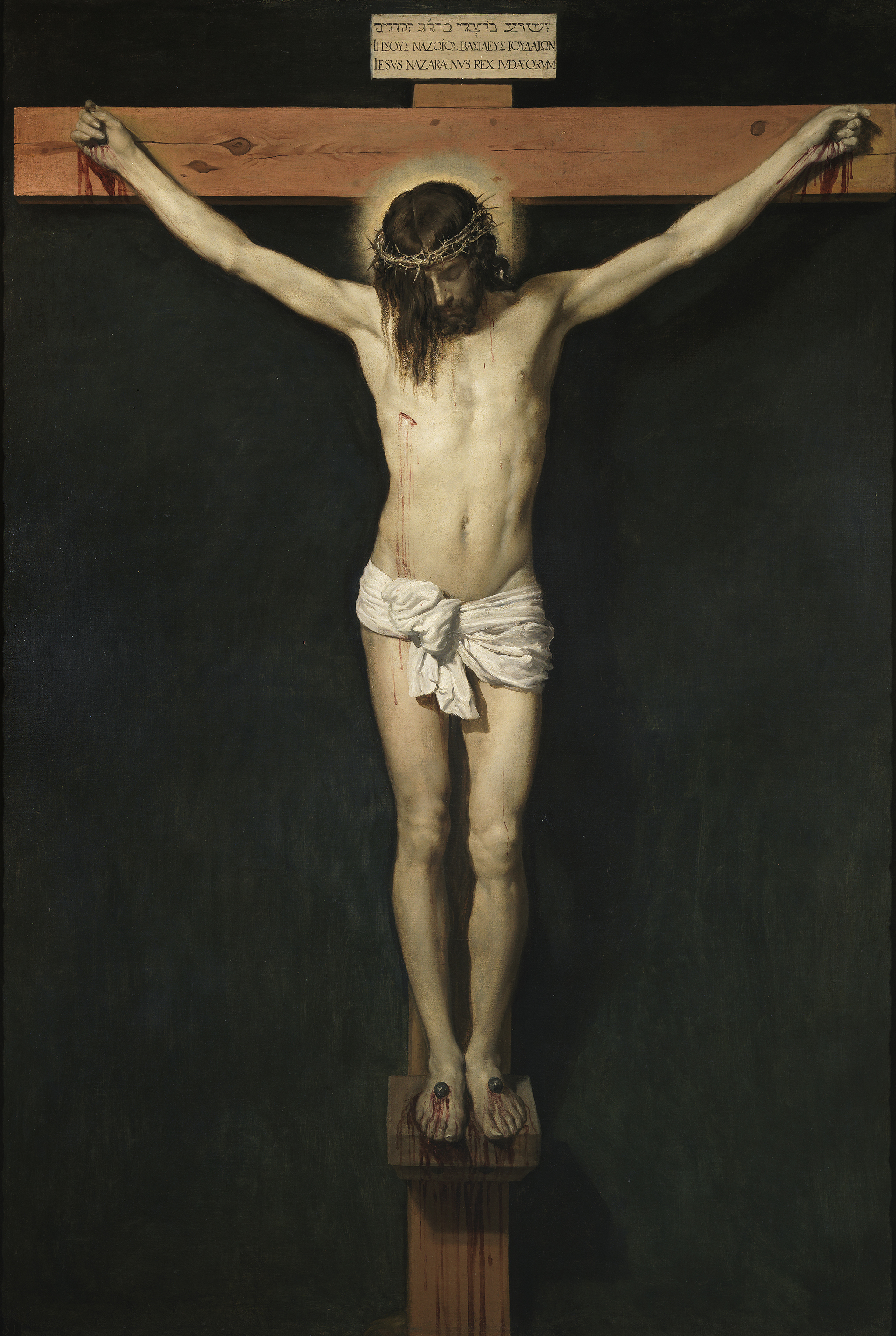
Christ Crucified, Diego Velázquez (17th cent.)

Around this time every year, I join my voice to the chorus of dressed-up church children everywhere, asking: “Wait, why do we call it GOOD Friday?”

My stock answer goes something like this: Even though Jesus died on Friday, he came back to life on Sunday, defeating sin and death, and giving the promise of new, resurrection life to all people! His death on Friday became good, even though it didn’t look so good at first.

And there are implications for us: what looks not-so-good at first, even suffering and death, can turn into good, especially when God is at work. In Genesis 50:20 Joseph says to his brothers: “You intended to harm me, but God intended it for good to accomplish what is now being done, the saving of many lives.” God brought wholeness out of harm, good out of evil. Joseph, without meaning to, foreshadows what would happen with Jesus on Easter weekend.

I still stand by this understanding of “Good” Friday. But I also worry about a human tendency to underestimate suffering, or to fetishize it. Theologian Christopher B. Hays says, “Indeed, there are times when suffering is simply evil, and must be resisted rather than embraced. The suggestion that other people’s suffering is redemptive is particularly dangerous; it risks making the observer complicit in the evil.”

Job’s friends wanted to find “other people’s suffering” (Job’s) redemptive, somehow. They wanted to see a cause-and-effect answer to why Job lost everything. Eliphaz, Bildad, and Zophar went to great lengths and used many, many words to try to find greater meaning in Job’s suffering. 

They must have really wanted to turn his Terrible, Horrible, No Good, Very Bad (Fri)Day into Easter Sunday. 

Maybe their pontifications weren’t for Job’s sake, but to ease their own theological cognitive dissonance.

After hearing one too many times that “Everything happens for a reason,” Job said: “I have heard many things like these before. What miserable comforters are you all!” (Job 16:2) 

Thou shalt neither minimize nor romanticize my suffering, in other words.

We can be like Job’s friends: downplaying suffering because we can’t handle how awful it is, or over-glorifying it because of the power of post-traumatic growth. Both are strong human impulses—in which I’m sure I’ve participated.

But even with Good Friday soon to give way to Resurrection Sunday, the horrors of crucifixion invite—even demand—that we take seriously pain and suffering and loss and trauma and torture and abuse.


The church traditions of The Stripping of the Altar and not-celebrating Eucharist on Good Friday are embodied ways of locating ourselves at the foot of the cross, as if in real time. 

If you’ve ever sat in a quiet and dark sanctuary with an eerily bare altar in Holy Week, you might have felt trapped in time. Or dislodged from your day-to-day travels through the space-time continuum. You might have even been able to inhabit a space where—even if only for a moment—you couldn’t conceive how it was going to all turn out.

I think we need such quiet moments. They help us avoid a triumphalism that skips past Good Friday and goes right to Easter, that skips death and goes right to life. So we linger at the cross a little longer, before we run to the tomb. We actually observe Good Friday.

But this Holy Week I’m wondering about going a step further. Even within Good Friday, what if I slowed down some aspects of the day itself?

I am asking: 

How might my participation in Good Friday change if I tarried a little longer with Jesus’s suffering, and with the suffering of the world borne on his shoulders? 

What would a Good Friday be like that didn’t hurry to ascribe greater cosmic significance to Jesus’s suffering, but just took it in, looking the crucified, tortured, abused Lord in the eyes? 

What if I tried to neither minimize Christ’s suffering (because I can’t handle the atrocity of it) nor romanticize Christ’s suffering (because I need suffering be redeemed)?

What if, this Good Friday, I put the meaning-making on hold and tried to just sit quietly with Jesus in his agony?

anImage_2.tiff

The above is cross-posted at Healing Pastors.
Jesus, Dead as a Doornail

Marley’s Ghost, by John Leech, Public domain, via Wikimedia Commons

After casting an unclean spirit out of a boy, Jesus takes his disciples away privately. Where does Jesus direct their attention after a triumphant encounter? Surprisingly, he points them to his own death:

And going out from there, they passed through Galilee, but Jesus did not want anyone to know, because he was teaching his disciples and saying to them, “The Son of Man is to be handed over into the hands of people, and they will kill him, and—despite being killed—after three days he will rise again.”
—Mark 9:31-32, my translation

The repetition of “kill” is fascinating. Here’s a wooden read of the Greek, where the verb for kill (ἀποκτείνω/apokteinō) is repeated:

…and they will kill (ἀποκτείνω/apokteinō) him, and—being killed (ἀποκτείνω/apokteinō)—he will rise again.

The first use of “kill” is an active indicative verb: “they will kill him.” Jesus is the object of that verb, the recipient of the action of killing.

The second use of “kill” is a passive participle, with Jesus the subject, translated something like: “and despite his being killed….” Here Jesus is grammatical subject, not object, because he is also the subject of the main indicative verb that the participle modifies: “he will rise again.”

I draw two conclusions from this:

First, Jesus has gone from passive recipient of a heinous action (“they will kill him”) to active agent that overcomes it (“despite being killed, he will…”). As my friend Mark used to say, “That’ll preach!” I think of the oft-used protest mantra, that I preached about the other week: “They tried to bury us; they didn’t know we were seeds.”

Second, Jesus is repetitive in saying, “they will kill him… and being killed he will….” I think Jesus is emphasizing his death on purpose.

Mark and Jesus don’t need to use “kill” (ἀποκτείνω/apokteinō) twice. In fact, in Mark 8:31, when Jesus predicts his death to his disciples, even a similar verbal formula uses “kill” just once. Perhaps because you can only kill a person once! Dead is dead.1

And yet in Mark 9, Jesus says “kill” twice. Maybe it’s because the disciples didn’t understand his impending death in Mark 8. So Jesus recapitulates the prediction here and adds some emphasis in hopes that they’ll get it this time in Mark 9.2 Maybe Jesus also wants to highlight the power of his resurrection—that he rose from the actual dead. He didn’t wake up from a merely “mostly dead” state:


In Charles Dickens’s A Christmas Carol it says, “Old Marley was as dead as a doornail.” Dickens could have just said “Old Marley was dead!” Dead is dead. You either are or you aren’t.

But since Ebenezer Scrooge will see the ghost of Marley, Dickens wants to emphasize that it really is a ghost, because Marley really is dead when the story begins.

I think Mark and Jesus are doing the same thing here: “they will kill me, and—even though I’ve really been killed, dead as a doornail—I will rise again.”

Mark sets the stage here for a powerful response of awe when Jesus does rise again—from full-on, actual death, over which Jesus has authority.


  1. Disclosure: I did not read through any commentaries before posting this, but I’m sure many commentators have seen the same thing. Fascinatingly, the NET Bible chooses NOT to translate the second “kill,” inexplicably chalking it up to “redundancy in the statement” in the Greek text.
  2. They don’t.

Jesus: “without credentials” and “dangerously antiestablishment”

I came across this powerful description of Jesus this morning:

Jesus, the poor layman turned prophet and teacher, the religious figure from rural Galilee without credentials, met his death in Jerusalem at least in part because of his clash with the rich aristocratic urban priesthood. To the latter, a poor layman from the Galilean countryside with disturbing doctrines and claims was marginal both in the sense of being dangerously antiestablishment and in the sense of lacking a power base in the capital. He could be easily brushed aside into the dust bin of death.

John P. Meier, A Marginal Jew: Rethinking the Historical Jesus, vol. 1: The Roots of the Problem and the Person, p. 9. Quoted in this awesome Richard Hays book. Emphasis mine.

Jesus Was Born, Infanticide Followed. Did That Inspire How He Loved Children?


Christ Blessing the Children
source: https://orthodoxgifts.com/christ-blessing-the-children-icon/


TW/CW: murder / infant death / child abuse


There is a Bible verse that always stops me in my tracks:

Herod was furious when he realized that the wise men had outwitted him. He sent soldiers to kill all the boys in and around Bethlehem who were two years old and under, based on the wise men’s report of the star’s first appearance.

—Matthew 2:16 (New Living Translation)

This is some of the most heinous evil the Bible reports. Can you imagine?

Herod couldn’t find Jesus, but he knew Jesus was in Bethlehem or nearby, and he knew Jesus was two years old or under. So Herod just took that whole group of people and had them killed. It’s an egregious abuse of power.

The Gospels record attempts on Jesus’s life once he is active in ministry, but it’s a miracle that Jesus even made it to adulthood. He emerged from an entire generation of babies that Herod ordered murdered.

The story of those babies and their families doesn’t stop with their murder. The parents had to live with the death of their children for the rest of their lives. All the birthdays, yearly feasts, and celebrations: gone. Two high school graduations—class of ’13 and class of ’14—cancelled, because no one was there to graduate. A murderous, abusive, vindictive tyrant stole those kids from their parents.

Jesus’s birth was surrounded by child abuse.

“O Little Town of Bethlehem, how still we see thee lie”? Nope. At least not for long. Herod was making that little town a cesspool of death and trauma. There’s no stillness in what Matthew goes on to describe, quoting the prophet Jeremiah:

“A cry was heard in Ramah—
weeping and great mourning.
Rachel weeps for her children,
refusing to be comforted,
for they are dead.”

Did Mary and Joseph and Jesus have survivor’s guilt? How awful must Mary and Joseph have felt about all this? And what was Jesus’s reaction when he realized the circumstances surrounding his birth? Surely this did not look like the salvation the angel had promised Jesus would bring—maybe even its opposite.

I’ve started wondering: all this killing of little babies… did this shape Jesus’s passion for ministering to children? Was it a deeply formative experience for how Jesus would live in the world?

More specifically, did the abuse and trauma Jesus learned about inspire him to especially love the abused and traumatized? Did the erasure of children and complete destruction of their rights lead him to become a champion of children?

Reading against such a backdrop, these words of Jesus strike me as even more poignant—and powerful:

“Let the little children come, and do not forbid them, for of such is the kingdom of heaven.”

“If anyone causes one of these little ones—those who believe in me—to stumble, it would be better for them to have a large millstone hung around their neck and to be drowned in the depths of the sea.”

“Truly I tell you, whoever does not receive the kingdom of God as a little child will never enter it.

And this powerful moment:

And he took them up in his arms, laid his hands on them, and blessed them.

I have to think Jesus carried all the death and grief and trauma that others experienced, not just at the cross, but from the very time he was born. When he looked at the children coming to him, did he remember all the children that would never have a chance to approach him? When he blessed the children, was it a deliberate undoing of the curse Herod had pronounced?

Miraculously, Jesus survived citywide infanticide. He lived through that systemic abuse. Now he would prioritize the well-being of children. He would make sure they could truly live.

Jesus Sleeps through a Storm While the Disciples are Dying


I’ve been enjoying teaching through the Gospel of Mark in an ongoing Webinar series called “Translation Notes.” We focus especially on the words and grammar of the Greek text, trying to answer questions that arise when translating to English.

A few weeks ago I taught a session on Mark 4:35-41, where Jesus exercises authority over the elements by calming a storm that had the disciples fearing for their lives—and already starting to drown.

Paying attention to Mark’s Greek helped me see two important parts of the narrative that could be easy to miss.

First, in Mark 4:37, when the “furious squall” (NIV) comes up, the waves are breaking into the boat where Jesus and his disciples are. Mark says, “the boat was already (ἤδη) filling up.”

This is an important detail, especially with ἤδη = already. The point at which the disciples call out to Jesus is not when they see storm clouds, or when they’re worried a storm might come, or even when they’re sure it is coming. The storm is already there, the waves are already breaking, and the boat is already getting swamped (so NRSV). Not just wet—drenched.

This means the disciples must have felt like they were seconds away from drowning. This isn’t a cute story or an object lesson for them: “Teacher, doesn’t it matter to you that we’re dying?”

Translations that give “we are about to die” or “don’t you care if we drown?” or “we’re going to drown” seem to soften the force of the present indicative verb Mark uses: we are dying. And don’t you care, Jesus?

I think this makes the story all the more relatable. We can cry out to Jesus not just in moments of feeling like we’re about to die, but in moments of actual dying.

A second important point in the narrative: before the disciples can utter this desperate prayer to Jesus, they find him sleeping. Mark narrates it like this:

καὶ αὐτὸς ἦν ἐν τῇ πρύμνῃ ἐπὶ τὸ προσκεφάλαιον καθεύδων.

= And he was in the stern, on a pillow, sleeping!

Major translations tend to change the Greek word order in translation, so that it reads, “But he was in the stern, sleeping on a pillow.”

But I think the word order as Mark has it is worth preserving in English, because Mark is heightening the drama:

And he… (okay, phew, Jesus is at least around!)

…was in the stern… (wait, what’s he doing in the back of the boat?)

…on a pillow… (at a time like this? He’d better not be sleeping!)

sleeping (!!!)

I struggled to find any English translation that translated it this way, but Eugene Peterson’s Message (supposedly a paraphrase—certainly more thought-for-thought than word-for-word) gives us, “Jesus was in the stern, head on a pillow, sleeping!”

It’s a short sentence, but I think Mark’s word order is deliberate—it’s like a slow-motion nightmare where the already-dying disciples find the worst possible outcome: the one who can save them is asleep.

Those two moments in the story—of actually beginning to die and of terror at Jesus’s being asleep—are worth inhabiting as readers today. Or maybe a better way to say it is that we already feel like we inhabit those moments, and we need to acknowledge it. Mark reminds us that we’re in good company: the company of the dying and terrified. And he invites us to cry out to Jesus, even in our dying, even when it looks like Jesus is fast asleep.

Why Didn’t Paul Use Parables?

As much as I have sought to meditate on the words of Jesus and the apostle Paul, one significant thought had never occurred to me:

“Interestingly, Jesus’s mode of parabolic discourse was generally not emulated in the early Christian tradition.”

That’s from Richard Hays, George Washington Ivey Professor Emeritus of New Testament at Duke Divinity School. It comes from an essay in his remarkable book Reading with the Grain of Scripture.

In other words, why didn’t Paul and James and Peter and John and Jude and Priscilla/Barnabas/Luke/Clement use parables?

Intent as they all were on imitating Jesus and carrying on his teaching, why did they not also imitate Jesus by carrying on his teaching method of using parables?

(As I’ve begun to reflect on this, I think James may come the closest to using parable-like discourse.)

As best as I can tell, it might just come down to this: the rest of the New Testament writers seemed to understand their calling and giftedness as teachers/writers differently.

Still, even if they’re not going to use parables themselves, why don’t Paul and the others at least reflect more on the parables of Jesus?

A Verse for Holy Week

Lent can help us recalibrate our anthropology:

καὶ γὰρ ὁ ἄνθρωπος τῆς εἰρήνης μου, ἐφ̓ ὃν ἤλπισα,
ὁ ἐσθίων ἄρτους μου, ἐμεγάλυνεν ἐπ̓ ἐμὲ πτερνισμόν·

Psalm 40:10 (LXX)

Indeed, the person at peace with me, in whom I hoped,
he who would eat of my bread, magnified trickery against me.

(NETS translation)

Jesus will apply this verse to Judas in John 13:18: The one who ate bread with me has turned his back on me.

And this was one of the 12! Even one of Jesus’s inner circle would turn his back on him. A sobering reminder of all that Jesus endured as we “journey toward the cross” this week.

“All shall be well”… Really??

This is the sermon I preached Sunday, with Luke 21:5-19 (read it here) as the Gospel lectionary text.

There are few things in life that we want to believe more than this:

All shall be well
And all shall be well
And all manner of thing shall be well.

Those lines come from Julian of Norwich in the 14th-century. It’s not her talking: it’s Jesus, as he has appeared to her in a vision.

Her vision is not cheap hope that crumbles at the first sign of pain or difficulty. It’s in the context of acknowledging the pain and sin in the world that Jesus says to Julian:

All shall be well
And all shall be well
And all manner of thing shall be well.

But do you know what her response was to these powerful words of comfort?

Ah, good Lord, how could all things be well, because of the great harm which has come through sin to your creatures?

“HOW could all things be well?”

The disciples were about to ask that question.

What about the disciples?

But first… they couldn’t help but admire this beautiful temple they worshiped in. They gawked at “the splendor of its stonework and memorial gifts,” Luke says (The Message).

The lectionary will circle back eventually to the story just before this passage—the poor widow with her two copper coins. She takes the standard of tithing 10% and multiplies that by 10, giving everything she has.

And somehow all the disciples want to talk about is who’s in the temple’s Platinum Donor’s Club. Hey, I know that guy! I talked to that family once! They’re a big deal around here!

They’re spiraling, and Jesus disrupts it: “As for these things that you see, the days will come when not one stone will be left upon another; all will be thrown down.”

It’s all going down, Jesus says, every… last… stone.

The disciples must get scared, because they snap out of their donor admiring, and ask, “Teacher, when will this be, and what will be the sign that this is about to take place?”

Jesus gives four:

ONE. Fake Jesuses. Verse 8: “Watch out that you are not deceived. For many will come in my name, claiming, ‘I am he,’ and, ‘The time is near.’ Do not follow them.”

TWO. Wars and revolutions. Verse 9: “When you hear of wars and revolutions, do not be frightened. These things must happen first, but the end will not come right away.”

THREE. Natural disasters. Verse 11: “There will be great earthquakes, famines and pestilences in various places, and fearful events and great signs from heaven.

The FOURTH sign is personal: being persecuted by others and betrayed by your own family. Verses 12, 16-17, “You will be betrayed even by parents and brothers, by relatives and friends; and they will put some of you to death. You will be hated by all because of my name.”

But then Jesus says, “… not a hair of your head will perish. By your endurance you will gain your souls” (18-19).

And, remarkably, Jesus says, “This will give you an opportunity to testify” (v. 13, NRSV). “This will result in your being witnesses to them” (NIV).

The disciples, apart from being scared, must have also been confused.

One commentary quite helpfully says, “The lack of chronological order in Jesus’ statements helps to discourage any attempts to work out in advance a timetable of events.”

The disciples couldn’t work out a timetable. They couldn’t know when their end was near; they could only know that God would be present with them no matter what happened and when.

What about us?

And that’s true for disciples of Jesus today, too.

Some scholars think this passage had both immediate fulfillment—the destruction of the temple, the persecution of the disciples, and a fulfillment that is yet to come—the so-called end times.

But just as the disciples couldn’t figure a timeline from Jesus’s words, neither can we. God doesn’t promise us we’ll know when the end is near. Elsewhere Jesus talks about the second coming as unexpected, so watch and wait for it. We’ll practice this watching and waiting in Advent.

So we hear this foretelling of wars and natural disasters, and we ask, “Surely it couldn’t get any worse than it is now? Surely this is it?”

It can get worse. Probably will.

It’s comical how many people have been so certain that the world would end on such-and-such a date.

And then, inevitably, when it doesn’t end, “Ah! I found an error in my calculations. It’ll be six months from now.”

This reality is perhaps best presented—and skewered—by the TV show Parks and Recreation. There’s a group in that show called “The Reasonabilists,” who are anything but what their name suggests. The Reasonabilists are an end-time cult that is waiting for Zorp the Surveyor to destroy the world.

Who is Zorp, you ask? A Parks & Rec fansite describes him as a “28-foot-tall lizard-god savior.” But the salvation he brought was a little different—he was to come to earth and melt everyone’s faces off with his “volcano mouth.”

Well, Zorp’s predicted time comes and goes, and the cult leader has to re-figure the numbers, only to stay up all night for the next time Zorp will come melt their faces off and thereby save the world.

Our temptation is more subtle… with every new war and every massive natural disaster, with every self-proclaimed Savior and persecution of Christians, we could begin to live in the same kind of fear the disciples surely feel.

But Jesus’s point is exactly the opposite.

No matter when such a time is, and no matter what it looks like, and now matter how bad it gets, the same God who accompanied the disciples—even to their deaths—promises to accompany us—even to our deaths.

Even in the scenario that verses 16 and 17 describe… even should your own family come to hate you, “Not a hair of your head will perish. By your endurance you will gain your souls.” They can take your body, but not your soul. No one can take God’s love away from you. So make up your minds, Jesus says, not to worry beforehand! (v. 14)

Paul picked up on this in Romans: “For I am convinced that neither death nor life, neither angels nor demons, neither the present nor the future, nor any powers, neither height nor depth, nor anything else in all creation, will be able to separate us from the love of God that is in Christ Jesus our Lord.”

————————-

Here’s a question to consider. You might give it some thought and prayer this week. When you walk into a difficult situation, what do you carry with you?

When you initiate a hard conversation, what do you have? When you face into a challenge you’d rather ignore, what resources do you have to face it? Maybe your family wouldn’t betray you to the death, but maybe you have to face some family dysfunction this Thanksgiving and Christmas.

What do you carry with you into all that?

However you answer that, we all have the promise of at least this resource: the words and wisdom of God. The words and wisdom of God.

Verse 15, spoken first to the disciples and surely extended to us in our time of need, has Jesus saying, “I will give you words and a wisdom that none of your opponents will be able to withstand or contradict.”

Those words, that wisdom… they come from the Holy Spirit, whom God has sent to dwell in the hearts of all who follow Jesus.

Well, indeed

I said that Julian of Norwich had replied to God, “Ah, good Lord, how could all things be well, because of the great harm which has come through sin to your creatures?”

That question feels right at home with this passage. It’s the kind of question the disciples would ask Jesus. It’s the kind of question WE want to ask Jesus when we hear something like this. Or when we just go about living our lives and watching the world around us. “How could all things be well,” O Lord?

Even after a vision of Jesus saying, “All shall be well,” that was what Julian asked—and a bunch of other questions like it.

And then, she got a response. She writes:

And so our good Lord answered to all the questions and doubts which I could raise, saying most comfortingly in this fashion: I will make all things well, I shall make all things well, I may make all things well and I can make all things well; and you will see that yourself, that all things will be well.

This is the same emphasis the Isaiah passage (65:17-18) gives us.

Behold, I will create / new heavens and a new earth. / The former things will not be remembered, / nor will they come to mind.

But be glad and rejoice forever / in what I will create, / for I will create Jerusalem to be a delight / and its people a joy.

I will create and all things shall be made new, God says. Not just because of some vague optimism that things just have to get better. “All shall be well” because our living and powerful God makes it so.

The 19th century poet Oscar Wilde is said to have taken Julian of Norwich’s lines—“All shall be well / And all shall be well / And all manner of thing shall be well”—he is said to have taken these lines and added to them:

And if it isn’t well, then it’s still not the end.