Changing Blood Into Wine

Check out these compelling lines from a 6th century Greek Orthodox hymnographer named St. Romanus the Melodist. He writes about Jesus’s first miracle of turning water into wine at Cana in Galilee:


    When Christ, as a sign of His power, clearly
        changed the water into wine
    All the crowd rejoiced, for they considered the
        taste marvelous.
    Now we all partake at the banquet in the
        church
    For Christ’s blood is changed into wine
    And we drink it with holy joy,
    Praising the great bridegroom,
    For he is the true bridegroom, the Son of
        Mary,
    The Word before all time who took the form
        of a servant,
    He who has in wisdom created all things.


Even Greater Things Than Jesus Did??

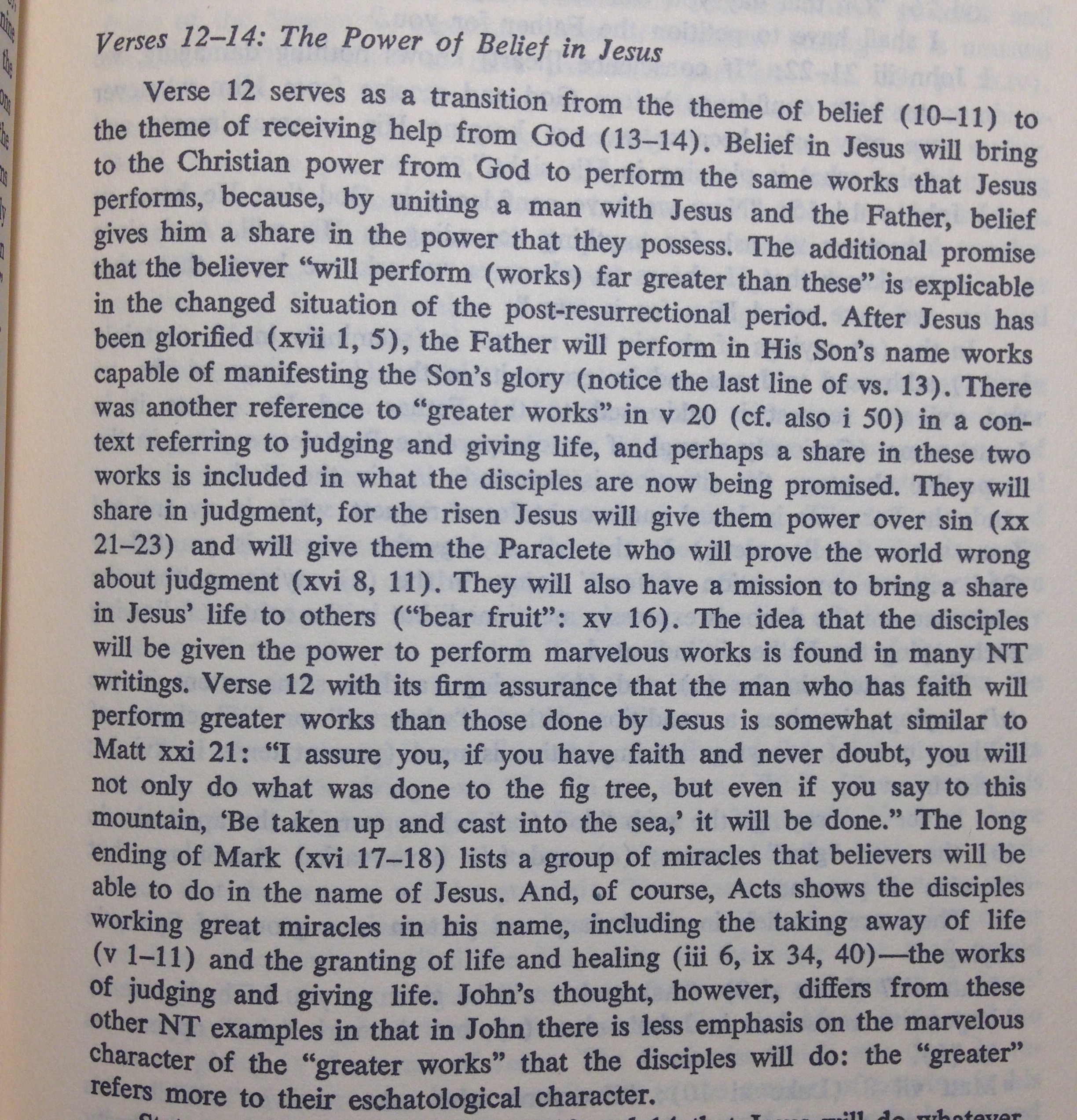
B 3Jesus says to his disciples in John, “I tell you the truth, anyone who has faith in me will do what I have been doing. He [or she] will do even greater things than these, because I am going to the Father.”

Of course our first reaction is to ask, “Greater than Jesus? How is that even possible?”

One possible meaning: Because I am going to the Father–because I am going to die and rise again–sin and death will be defeated and you will have even more power than you do now.

The Kingdom would be even more fully ushered in at the end of John. Is this what Jesus means?

This, at least, is what D.A. Carson suggests:

In short, the works that the disciples perform after the resurrection are greater than those done by Jesus before his death insofar as the former belong to an age of clarity and power introduced by Jesus’ sacrifice and exaltation. Both Jesus’ words and his deeds were somewhat veiled during the days of his flesh; even his closest followers, as the foregoing verses make clear, grasped only part of what he was saying. But Jesus is about to return to his Father, he is about to be glorified, and in the wake of his glorification his followers will know and make known all that Jesus is and does, and their every deed and word will belong to the new eschatological age that will then have dawned.

I think it could also be helpful to understand Jesus’ statement in light of the signs he has performed.

Jesus says the above in John 14, shortly after the conclusion of the “Book of Signs” portion of John–the first 12 chapters containing his “7 Signs.” John 13-21, then, constitute what scholars call the “Book of Glory.”

A sign, after all, is that which (while good in itself) points away from itself and to a greater, deeper, fuller reality. So if Jesus is referring to “greater things than these signs,” that is not so hard to grasp if we consider that signs always point to something greater anyway. One could read Jesus’ statement as a sort of tautology, where the “greater things” mean that somehow the deeper reality Jesus’ signs point to is more fully unearthed through the ministry of the disciples.

In other words, Jesus says to Philip, these signs are just a foretaste of the Kingdom of Heaven, and you and all the disciples after you are going to work and work and work together to keep bringing the Kingdom in.

When puzzling over John, I can think of no better place to turn than to Raymond E. Brown, to whom I give the last word. Note especially the final sentence of this paragraph.


Ray Brown on John 14.12

“There is No Rejoicing Without Wine”: Jesus’ First Miracle

One preacher says, “Weddings are accidents waiting to happen. Something almost always goes wrong at a service of holy matrimony.”

That doesn’t match my experience with weddings, but there is something quite wrong at the wedding in Cana, in Galilee (John 2:1-11): they’ve run out of wine.

So maybe there’s no better place for Jesus to show up, his first week of public ministry, than at a well-attended, days-long wedding.

Jesus turns water into wine—“the first of his miraculous signs,” John says.


The Seven Signs of Jesus in John


Jesus performed more than just seven signs, but John uses seven signs, or miracles, to organize the first part of his Gospel.

1. Jesus changes water into wine (John 2:1-11)
2. Jesus heals the official’s son (John 4:46-54)
3. Jesus heals the man at the pool of Bethesda 
(John 5:1-9)
4. Jesus feeds the 5,000 (John 6:1-13)
5. Jesus walks on water (John 6:16-21)
6. Jesus heals the man born blind (John 9:1-12)
7. Jesus raises Lazarus (John 11:1-44)

(via The New Testament in Antiquity, by Burge, Cohick, and Green)

What is a sign?

A translator’s handbook, intended especially for those who are taking to Bible into new languages for the first time, talks about it this way:

[A] “sign” is a means of revealing a greater reality to which the “sign” itself merely points. The Gospel of John speaks of seven “signs” of Jesus, and these are “signs,” not necessarily because they are miracles, but because they point to a truth beyond themselves, to a truth regarding God’s salvation.

Signs are good, even powerful, in and of themselves, but they point to a “greater reality.”

A sign is deeper than itself.

The signs of Jesus, in particular, are meant to tell us something about Jesus. The “signs” and wonders Jesus performs are witnesses to his glory. They’re each a vignette, a window into Christ’s revealing himself to anyone who would receive him.


Sign #1: Water Into Wine


Jesus, his mother, and his disciples have all gotten invitations to this wedding. It’s Jesus’ first week of public ministry, as John tells it, and it’s a huge event. It would not be unexpected for just about the whole town of Cana to be there. The local shops and businesses probably all put a “Closed for wedding” sign on their doors. Will be back in seven days. It was likely a week-long event.

But, even if not all weddings are “accidents waiting to happen,” this one was. The guests drank the wine down to the last drop.

It would be pointless (but fun) to speculate as to whether or not this was poor planning on the family’s part, or too much drinking on the guests’ part.

Either way, this family is about to go down in history as “the ones who ran out of wine at their wedding.” You sort of hope for them, at this point, that they don’t have any other kids to marry off, ‘cause no one’s coming.

Verse 3 says, “When the wine was gone, Jesus’ mother said to him, “They have no more wine.”

One early theologian said, “Perhaps his mother, as mothers do, incited him to perform a miracle, wishing that the greatness of her son would be revealed—and thinking that the lack of wine offered the right occasion for the miracle.”

The (1984) NIV gives us the reply: “Dear woman, why do you involve me?” Jesus replied. “My time has not yet come.”

There is a sense in which Jesus isn’t ready to fully reveal all his glory. But he whips into action. It’s a good way of honoring his mother.

Because… not only is the reputation of the family at stake, but the festive spirit of the wedding is in jeopardy. The Talmud, a text of Rabbinic Judaism from a couple centuries after this, bluntly says, “There is no rejoicing [without] wine.”

Jesus is on it. He performs the miracle, in kind of a subtle and smooth way. Maybe this is because his “time had not yet come,” as he said to mother Mary.

Jesus said to the servants, “Fill the jars with water”; so they filled them to the brim.

Then he told them, “Now draw some out and take it to the master of the banquet.”

They did so, and the master of the banquet tasted the water that had been turned into wine. He did not realize where it had come from, though the servants who had drawn the water knew. Then he called the bridegroom aside and said, “Everyone brings out the choice wine first and then the cheaper wine after the guests have had too much to drink; but you have saved the best till now.”

Just to be clear, we are talking about anywhere between 120 and 180 gallons of wine.

This doesn’t mean that a bunch of wedding guests are going to get toasted. If you think of a whole town of people celebrating for a week, a lot of wine is needed.

Here’s the town today that might have been 1st-century Cana:


Maybe Cana
Source: Accordance Bible Lands PhotoGuide


Imagine the effect of 180 gallons of wine!

This picture is probably 30 gallons or a little more:


Some Wine


So if my calculations are correct, here’s a visual on how much wine Jesus made:


More Wine


The result of this sign, besides a happy wedding, is in John 2:11:

This, the first of his miraculous signs, Jesus performed at Cana in Galilee.

He thus revealed his glory,
and his disciples put their faith in him.

Or, in another translation, “There Jesus showed how wonderful he was.”

It was looking back and thinking of moments like this that John could write in his Prologue, in chapter 1: “We have seen his glory, the glory of the one and only Son, who came from the Father, full of grace and truth.” We have seen how wonderful Jesus is.


What Does the Sign Show?


N.T. Wright says, “The whole point of the ‘signs’ is that they are moments when heaven and earth intersect with each other.”

From these signs of Jesus, we on earth learn more about ultimate, heavenly realities: who Jesus really is, what sorts of things God is capable of, what kind of intervention is possible in the problems of the world today.

Especially with this first sign, when Jesus is fresh on the scene, we get a portrait of who our Savior is.


—Jesus likes to have fun—

“Eat, drink, and be merry” is not just a mindset that the Bible shoots down. Jesus wants us to eat, drink, and be merry—so long as we’re not neglecting important things.

Jesus upset the religious elite of his day by all the feasting he and his disciples did. In Luke some angry leaders say to him,

John’s disciples, like the disciples of the Pharisees, frequently fast and pray, but your disciples eat and drink. Jesus said to them, “You cannot make wedding guests fast while the bridegroom is with them, can you? The days will come when the bridegroom will be taken away from them, and then they will fast in those days. (Luke 5:33-35)

As long as you’ve got me, Jesus says, party on.

And did you catch this nice touch from John: these jars, where the chemical miracle happened, were ones “used… for ceremonial washing.” There’s nothing wrong with religious ritual, per se—I quite like it myself. But these jars for ritual cleansing—Jesus turned them into party favors. That’s kind of like co-opting the baptismal font for a punch bowl.

This family made good choice in inviting Jesus to the wedding. Maybe he already had a reputation as a fun guy—someone you wanted to celebrate with.


—Jesus is generous—

This sign also shows Jesus to be generous. Under his command, the servants “filled [the jars with water] to the brim.” There’s no skimping with Jesus.

Next chapter Jesus will say, “For the one whom God has sent speaks the words of God, for God gives the Spirit without limit.”

God does not withhold his good gifts and his love from us. He wants us coming to him with open hands, even empty cups, so he can fill us with good things.

Also, just a geographical note here: we know the stories of Jesus, so we take it for granted, but Cana was 70 miles north of Jerusalem. This is pretty far outside the city of the religious power brokers.

But being a religious insider or expert, so to speak, has never been a requirement for receiving Christ’s love.

Jesus does not withhold his presence from the ones who have never known power, wealth, or the comfort of living in the mainstream of society. Jesus is generous.


—Jesus is accommodating—

Jesus is accommodating. He says his “time has not yet come,” but then he does the miracle. He seems to be flexible on timing. You’ll see in other places in John where Jesus says “his time has not yet come.”

We know the frustration of when God’s timetable or timing in the world does not match ours. But God is not impassable. God is not unaffected by our needs and desperation.

If God has a massive planner on his desk, with dates and times and places, it’s written in pencil. God can change the future. God can even accommodate our requests when he maybe otherwise wasn’t planning to. Jesus is accommodating.


How Shall We Respond?


Having seen this intersection of the heavenly and earthly, having caught a glimpse of a God who changes reality, a Jesus who is fun, and generous, and accommodating… how shall we respond?

John models a response for us in verse 11: “He thus revealed his glory, and his disciples put their faith in him.”

We can eat, drink, be merry, trusting that our God is a God of celebration… assured that he’s generous… and confident that he’s flexible to respond in real time to our needs and intercessions.

Look at Mary’s response in verse 5 to the servants: “Do whatever he tells you.”

I think we can safely assume, 30 years in, that she’s onto the whole divinity thing. She doesn’t know what he’s going to do or how, but she expects something, when she comes to him with a need: “They have no more wine.” Her words to the servants model an admirable submission to the Son of God: “Do whatever he tells you.”

Do the good you know to do. Act in love, in the ways that you see it within your reach to do. “Do whatever he tells you.”

John, by showing Mary and the disciples’ response to Jesus’ first sign, calls us, too, to submission and faith and trust in Christ.

I think another response this passage can call forth from us is just… relief.

Jesus isn’t boring or a killjoy. He liked to celebrate, to enjoy parties and good wine and food with others.

Jesus says of his mission, “I have come that you may have life, and have it abundantly.” Jesus wants disciples to live life to the fullest, and one implication of this is that we enjoy the good things on earth.

We read in the Psalms:

How precious is your steadfast love, O God!
All people may take refuge in the shadow of your wings.
They feast on the abundance of your house,
and you give them drink from the river of your delights.

Jesus wants us to enjoy the abundance of his creation. He is not stingy. He’s not inflexible.

This passage can offer us relief because it reminds us that prayers regarding needs do affect God. We can invite him into broken and unresolved places in our life.


An Even Greater Wedding Feast


The wedding at Cana, in fact, serves as a foreshadowing of a great heavenly banquet, where Jesus is the groom. And he invites everyone, not just in one whole town, but across many nations. It’s not just a weeklong wedding celebration, but an eternal one, with Jesus as host.

The prophets saw this day and were relieved. Amos rejoiced, “New wine will drip from the mountains and flow from all the hills.” Joel saw a day when “the mountains will drip with sweet wine, and the hills will flow with milk.” (And that milk—it accounts for those who don’t drink wine… so God’s got everyone covered.)

We, like Mary and the disciples, have seen the glory of Jesus. Witnesses to this and many other signs of Jesus, may we put our trust in him. May we hope in him. May we present our needs and lacks to him, asking for his help. May we place our confidence in him. And may we give ourselves over to him, and keep our hands open for the good things he has to give us.

Christmas in the Middle of Something

image


And there were shepherds living out in the fields nearby, keeping watch over their flocks at night. An angel of the Lord appeared to them, and the glory of the Lord shone around them, and they were terrified. But the angel said to them, “Do not be afraid. I bring you good news that will cause great joy for all the people. Today in the town of David a Savior has been born to you; he is the Messiah, the Lord. This will be a sign to you: You will find a baby wrapped in cloths and lying in a manger.”

Suddenly a great company of the heavenly host appeared with the angel, praising God and saying,“Glory to God in the highest heaven, and on earth peace to those on whom his favor rests.”

When the angels had left them and gone into heaven, the shepherds said to one another, “Let’s go to Bethlehem and see this thing that has happened, which the Lord has told us about.”

—Luke 2:8-15

Where were you the first time you remember hearing about Jesus? Or if you can’t remember a “first time,” what are some early memories you have of encounters with the God who came to earth? And just as important: how and where and in whom have you seen Jesus these last few weeks, days, and even hours?

The shepherds were just minding their own business, really. They were “keeping watch over their flocks at night.” That phrasing has become virtually poetic to us now, so tied is it to this beautiful story. It’s merely a preamble to the glory of the angels and of the Lord, a glory improbably made manifest in a “baby wrapped in cloths and lying in a manger.”

But this is also just like saying, “They were at work when God’s glory found them.” Or, “They were standing at the sink washing dishes when the Lord’s invitation came.” Or, “They were fixing a chain on a bicycle when Christ came to them.” Or, “They were practicing their caregiving role when they caught a sudden glimpse of God’s great love.”

No matter how well saturated we are with Scripture, no matter how solid our Christology, no matter how long we’ve been following Jesus, we simply do not know all the times and places where Christ is going to meet us. Chances are he will come to us while we’re in the middle of something else.

Encounters with the living God can be intense. But just as Luke is keen to point out Mary’s obedience to a seemingly bizarre call, he is eager to show us the willingness of the shepherds to drop their staffs (and leave their sheep momentarily unattended? or bring them along?) to “go… and see this thing that has happened,” which God told them about.

Christ has come to earth! He came in the form of a servant, taking on human likeness. Christ will come again! He will come in a glory that will surpass even that of the “great company of the heavenly host.” Christ comes to us! He comes and visits us each day in myriad ways, big and small, obvious and subtle, extraordinary and mundane.

Like these shepherds who were surely caught off guard by the interruption, may we have the willingness to see Christ whenever and however he comes to us. And may we hasten to the places where he is today, running to his feet, bowing down, and worshiping him.


The above is adapted from an Advent reflection I wrote as part of a devotional our church’s Deacons prepared for our congregation this Advent.

Advent: At Least It’s Not Lent!

If branding and marketing tag lines had been a thing when Advent found its way into the church calendar, the church of the late sixth century could have used: “Advent: At Least It’s Not Lent!”

It’s true—December just feels more exciting than February-March, and the four Sundays of Advent seem to get to the point more efficiently than what can seem like the 40-day slog of Lent. Besides, who’s ever heard of fasting from sweets in the weeks leading up to Christmas?

But both Advent and Lent share an important—if at times challenging—characteristic: they offer us church folk a chance to carve out deliberate spaces to look inward to our own spiritual state and outward to the person and work of Jesus.


advent wreath


We remind ourselves in Advent that we live in a waiting room of sorts. We have the fortunate lot in life to not have to wait for the coming of Jesus to earth—we know it happened and we still have the eyewitness accounts! But, ah… that second coming. No one knows when it will be. Even Jesus-on-earth said he didn’t know the hour.

So we wait. And wait. And wait. Each Advent that comes and goes is a poignant reminder that the kingdom is (still!) not yet fully present among us.

But that’s no reason to give up hope and stop waiting. On the contrary, we wait all the more eagerly. Luke 12 says:

Be dressed ready for service and keep your lamps burning, like servants waiting for their master to return from a wedding banquet, so that when he comes and knocks they can immediately open the door for him. It will be good for those servants whose master finds them watching when he comes. …You also must be ready, because the Son of Man will come at an hour when you do not expect him.

To our waiting we add watching and making ready.

The master has not yet returned, and our lamps too often dim when we forget to tend to them in the rush of other commitments. This Advent, may we keep our lamps brightly lit, persistent in our waiting, watching, and making ready for the coming of our King.


The above is adapted from an Advent reflection I wrote as part of a devotional our church’s Deacons prepared for our congregation this Advent.

Why I am a Pastor, in 10 Words


We hiked through the woods on a perfect fall day, our whole family and another family, whom we love spending time with.

My wife and I were talking about my potential as a small business owner. I told her how much I’d love being at the helm of a startup.

But what kind of startup to start?

I: What does the world need that it doesn’t have?

She: Jesus.

I: Exactly! That’s why I’m a pastor.

The startup can wait for me, at least for now.

4 Ways to Practice Sabbath Keeping

This Sunday I preached about Sabbath-keeping as a way of life. The below is the concluding, application-based portion of the message.


Keep Calm It's Sabbath Day


Let’s get specific for a minute, and talk about how a Sabbath way of life can make its way onto our calendars.


For an hour


You could think small, to begin with: one hour. Right, God didn’t say, “Remember a Sabbath hour and keep it holy,” but I think observing a Sabbath hour is very much in line with God’s intentions for our God-centered rest.

I’ve alluded a couple of times from the pulpit to my inordinate love for personal productivity literature and related apps. There’s a classic book called Getting Things Done by David Allen. His basic goal is to get his readers and clients to a point where they are not using their brains to keep track of commitments—get everything out of your head and into a trusted system you know you’ll keep coming back to. The end result of implementing such a system is that in any given moment, you know that you are doing what you should be doing. What you are saying yes to is what you should be saying yes to, and what you are saying no to is out of mind.

This may seem simplistic, but if you don’t have a dedicated hour like this each day or at least every other day, the alternative is that every hour available to you is an hour where you could be doing something… anything… 100 hundred different things. A Sabbath lifestyle, on the other hand, includes setting apart chunks of time where we put all work aside and rest. And we don’t feel guilty about it, because we are doing it deliberately, as a way to train our attentions on God.


A Daylong Sabbath


Another way that we can put Sabbath-ing into our schedules is through a weekly Sabbath day. Sunday is a good candidate here. It didn’t take the early church very long to move from the observance of Saturday as Sabbath to Sunday as Sabbath. One big reason for this was that Sunday was the day of resurrection, so it became the day the church gathered weekly for worship. To make their Sabbath about both leisure and Lordship, it shifted to Sunday.

Which day we take a Sabbath is less important than that we have one every week. And times when we can least afford to take a Sabbath are the times we most need to. So put it into your day planner or phone or wherever you keep your schedule—make it a daylong appointment: “Sabbath.” And if one of your primary vocations is parenting or caretaking, and those sweet loved ones of yours won’t let you observe a “day off,” talk to one of your church leaders and we’ll help you get childcare lined up!


Get Away


You could go even bigger with Sabbath-keeping: a day or half day every month where you go on retreat… not just taking a day off, but actually physically going somewhere else—to the beach, for a daylong hike in the woods, for an overnight camping trip.


Techno Sabbath


Finally—one more suggestion for a specific way to practice keeping a holy, God-focused Sabbath: one of our former church attenders shared with me his regular practice of a techno Sabbath. No, it’s not a day devoted to Electronic Dance Music (though that’s not a bad idea), but it’s a Sabbath from technology. I’d heard of these and always thought about taking one, but there was something about a conversation with him that made me feel like I finally had permission to unplug, to disconnect.

Of course, you can turn all your devices off for a short period of time—an hour, for the morning, during dinner and after it. But I’ve found a full 24-hour break each week from technology is both embarrassingly difficult and surprisingly life-giving. It serves the same purpose as fasting. Rather than reaching for a device that has a potentially life-changing notification on it, I try to offer those energies instead to God.

At first, there are feelings of withdrawal—no access to notifications that increase the rush of adrenaline and excitement when someone replies to that email you were so eager about, or when someone hearts your Instagram photo or retweets your witty observation about humanity. All that stuff just goes on… without you. At least for a day.

You could even try to have your techno Sabbath coincide with your weekly Sabbath.


Establish Your School Year Practices Now


As we begin a new school year, we have the opportunity to establish and re-establish practices of faithful living. Take some time this week, if you haven’t already, and think about what Sabbath-keeping this fall is going to look like for you. If you have other people with whom your schedule is interdependent, involve them in the conversation—sit down with your calendar and actually write in your Sabbath-keeping practices, so that they don’t get forgotten, or scheduled on top of.

I pray that God would give us the strength to be deliberate about making Sabbath observances central to how we go through our hours, days, and weeks. As we do so, may we find that prayer of Isaiah fulfilled: “O God, you will keep in perfect peace those whose minds are fixed on you; for in returning and rest we shall be saved; in quietness and trust shall be our strength.”

Is 2 Samuel 7 About Jesus?

I know–taken from the vantage point of Christian interpretation, it might seem a dumb question. So bear with me. Here is 2 Samuel 7:11b-16:

“Moreover the LORD declares to you that the LORD will make you a house. When your days are fulfilled and you lie down with your ancestors, I will raise up your offspring after you, who shall come forth from your body, and I will establish his kingdom. He shall build a house for my name, and I will establish the throne of his kingdom forever. I will be a father to him, and he shall be a son to me. When he commits iniquity, I will punish him with a rod such as mortals use, with blows inflicted by human beings.

This could all so easily be about Jesus, until you get to: “When he commits iniquity, I will punish him with a rod such as mortals use, with blows inflicted by human beings.”

Even if you want to say God somehow punished Jesus on the cross (uhh…), Christians don’t (generally) believe Jesus committed any iniquity.

So that part, at least, has to be about David’s literal next-of-kin descendant, Solomon.

Verses 15 and 16 go on:

But I will not take my steadfast love from him, as I took it from Saul, whom I put away from before you. Your house and your kingdom shall be made sure forever before me; your throne shall be established forever.

There are at least Messianic undertones to this whole passage, though. Surely God had more than just Solomon in mind when he spoke these words. He is, after all, promising a throne to David forever. Two other things:

1. The lectionary reading stops after v. 14a (!), so you don’t get the stuff about punishment. Is this to intentionally make it read more like it’s about Jesus?

2. The parallel passage in 1 Chronicles 17 also omits the iniquity part… does this mean the Chronicler was taking it to be a Messianic promise (only), too?

What say you, O readers? I’m still mulling this one over.

How Can the Ark of the LORD Ever Come to Me?


I. “How can the ark of the LORD ever come to me?”


David, now King over all Israel in 2 Samuel 6, asks a poignant question, “How can the ark of the LORD ever come to me?” (6:9) “How can the ark of the LORD ever come to me?”

The ark of the covenant was the adorned chest in the tabernacle that symbolized the presence of God. It went with and settled among God’s people wherever they wandered. It contained the two tablets with the 10 commandments, a jar of manna—representing God’s provision in the wilderness, and Aaron’s rod—a sign of the authority and sovereignty of God to make for himself a people of his own.

There’s a weightiness in David’s question: “How can the ark of the LORD ever come to me?” There’s a sincerity to it, a desire in David’s heart to truly commune with God. But there’s also fear and frustration. The verse before says, “Then David was angry because the LORD’s wrath had broken out against Uzzah…” (6:8).


II. A God of David’s Own Choosing?


We’re still in the part of 2 Samuel that narrates David’s rise to power, and his initial establishment of his kingdom. Most outlines of 2 Samuel have this chapter in the “successes” part of the David story. His moral failings and infidelity–to God and others–really start with the Bathsheba account.

There’s some truth to that. But already here, while David is still setting up shop as King, the complexity of his spiritual life begins to emerge. Sometimes he is inspiringly faithful, sometimes he’s not-so-faithful. No wonder so many have so deeply resonated with this historical character.


A. Faithful David


Let’s trace a portion of this narrative account to look at both David’s faithfulness to God, as well as ways in which he was already “prone to wander, prone to leave the God [he loved]”… just like we are. Let’s look first at the faithfulness of David.

1. David Practiced God’s Presence (5:10)

First, we saw last week that the key to David’s ability to lead, even before he was King, was his practice of the presence of God. 2 Samuel 5:10 says, “And he became more and more powerful, because the LORD God Almighty was with him.” David was rooted and grounded in the presence of God. Out of the assurance that God was with him, David led faithfully.

2. David Attributed His Success to God (5:12, 20)

Second, David attributed his success to God. 2 Samuel 5:12 says, “And David knew that the LORD had established him as king over Israel and had exalted his kingdom for the sake of his people Israel.” David knew that “every good and perfect gift comes from above,” as the New Testament says. And in verse 20, David says it is the LORD who has defeated his enemies.

He did not take credit for his own military success, or leadership effectiveness. He knew that it was God’s doing.

3. David “Inquired of the LORD” (5:19, 23)

A third way we see David’s faithfulness so far is in 2 Sam 5:19, 23. Both of these verses, before David makes a major decision, have the phrase, “[S]o David inquired of the LORD.” “[S]o David inquired of the LORD.”

Having sought the presence of God, having affirmed that his success was from God, he continued to regularly inquire of the LORD. And it doesn’t stretch the imagination too much to assume there are even other decisions and situations not described here where David inquired of the LORD some more.

4. David Got Rid of Philistine Idols (5:21)

Here is another sign of David’s obedience to God: chapter 5, verse 21 says, “The Philistines abandoned their idols there, and David and his men carried them off.” We have trouble with some of the militarism of the Old Testament, but perhaps it helps, at least a little, to realize that this was as much as anything, a sort of war of gods… a contest as to which god is really able to save a people.

Some of God’s people get in trouble in other passages for defeating an enemy, but then failing to destroy their idols. David does right here, and carries them off… completely removes them from the scene to physically show—there is no God but Yahweh. God is the best god out of all the gods, or, so-called gods. David removed the idols that others set up against the LORD God Almighty.

5. David Did What God Commanded (5:25)

And then, check out verse 25 of chapter 5: “So David did as the LORD commanded him, and he struck down the Philistines all the way from Gibeon to Gezer.” Again—we struggle with this “struck down” language, especially when we consider the value of every human life. But the Philistines are cast here as an oppressive people who want nothing more than to destroy a chosen people, worshiping gods who cannot save and who bring not life but death. David “did as the LORD commanded him” and went up against even Israel’s terrifying oppressors.

6. Praises Wholeheartedly; Leads Others in Same (6:5)

Finally, coming to our reading today, chapter 6, we see a portrait of a David as Spirit-filled worship leader. 2 Samuel 6:5 reads, ”David and the whole house of Israel were celebrating with all their might before the LORD, with songs and with harps, lyres, tambourines, sistrums [a kind of hand-held shaker] and cymbals.”

Israel celebrates the defeat of their oppressors, and especially rejoices in the presence of God, moving alongside them, symbolized by the ark of the covenant. They went all out in praising God.


B. Not-So-Faithful David


But a picture of a not-so-faithful David also starts to come into view in chapters 5 and 6.

1. David “Took” More Women (5:13)

2 Samuel 5:13 says, “After he left Hebron, David took more concubines and wives in Jerusalem, and more sons and daughters were born to him.”

Deuteronomy had already said rulers were not to multiply wives for themselves. And we know that David would eventually kill a man to cover up his adultery with the man’s wife, later on. This would lead to severe consequences for him and his family, and would prove a major breach of his relationship with God. One of David’s moral flaws is already visible.

2. David Did Not (Always) “Inquire of the LORD” (6:1)

Second, and you can see this in your outline, too: David did not always inquire of the LORD. You remember that in 2 Samuel 5:19 and 23, it said, “so David inquired of the LORD.”

As this new chapter, chapter 6 begins, the attentive listener or reader may notice that that little formula (“so David inquired of the LORD”) is not here. Like in those two instances, here David was gathering people for a major task—this time the moving of the ark. This time, however, he does not inquire of the LORD, at least as far as we can tell.

3. David Put the Ark on A New Cart (6:3-4)

A third instance of David’s being not-so-faithful comes in chapter 6, verses 3 and 4. Look at those verses:

They set the ark of God on a new cart and brought it from the house of Abinadab, which was on the hill. Uzzah and Ahio, sons of Abinadab, were guiding the new cart with the ark of God on it, and Ahio was walking in front of it.

What could be better than a sweet new ride for the sacred ark of the covenant? Well… a better question is: did the ark of God, the ark of the covenant need a new cart? No. It didn’t.

It had been in the house of Abinadab, after it had zapped some other irreverent Philistines who didn’t take it seriously. David didn’t inquire of the LORD before bringing the ark to Jerusalem, but moving the ark to Jerusalem itself seems to be okay. He’s bringing it to the city from which he will rule, as if to show that it is really God who is king.

However…the ark had rings and places for horizontal-running poles that were to be used to carry it. David, for whatever reason, is ignoring that instruction.

Had it been carried by its poles and not balanced on a cart, Uzzah probably wouldn’t have needed to reach for it, because it would have been more stable and likely wouldn’t have fallen in the first place.        (HT: this commentary)

Not only that, but Uzzah does not appear to have been a Levite. He was not from the clan that God had commanded to be the ones to oversee the ark. So he was the wrong guy, carrying the ark the wrong way, and then he was at the wrong place at the wrong time.

Maybe his intentions were good, but so holy is this ark, says God, which symbolizes my presence, that you are not supposed to even touch it. Uzzah’s demise all begins with David’s carelessness in overseeing the transportation of the ark in the first place. David and company were not taking God totally seriously.

As king, as spiritual leader of Israel, David is in an ultimate sense responsible for this whole debacle.

4. Wants the Ark (Presence) Only for its Blessing? (6:10-11)

This event leads to the fourth and probably the biggest way in which we see David as a deeply flawed hero. Look at verses 10 and 11:

He was not willing to take the ark of the LORD to be with him in the City of David. Instead, he took it aside to the house of Obed-edom the Gittite. The ark of the LORD remained in the house of Obed-edom the Gittite for three months, and the LORD blessed him and his entire household.

David now does not want anything to do with the ark, because he is afraid, but also because he is angry at God. He’s angry that Uzzah is struck down, but I wonder, too, if he’s angry that he got called out for trying to control God. One commentator says, “The ark would become central to Israel’s worship, but David needed to learn that it was not his to control.” He’s learned this lesson, but he’s learned it the hard way, so he sends the ark away.

Once it blesses the house to which it was banished, David wants it back after all!


III. A Fundamental Choice: 
Welcoming God’s Presence on God’s Own Terms


David, I think, realizes the folly of his ways. Now he dances in a priest’s robe, worshiping God with all his might. And verse 13 tells us that just six steps in to their Take 2 of moving the ark, they offer sacrifices to God. Now David seems to realize the utter care with which he must transport the sacred ark of the covenant, that symbol of God’s history and presence with Israel… a sign of God’s love and provision, but also his holiness that no human could ever attain to.

As I sit with this text and work with it and try to let it work on me, I keep hearing David’s haunting question in chapter 6, verse 9: “How can the ark of the LORD ever come to me?”

And I ask, “How can the presence of the LORD ever come to me?”

The answer, or at least the answer that this passage gives, is: on its own terms.  God comes to us as God comes to us, not how we wish God would come to us. God comes to us when God comes to us, now when we wish God would come to us. God comes to us, fully under his own control, not in manifestations that we can control or completely delineate, or fully understand. God will not be confined by the parameters we seek to impose.

Like David, we have a fundamental choice to make—it’s a choice which arrives many times a day, actually: will we welcome God’s presence on God’s own terms? Can the ark of the LORD, the presence of God, ever come to us? Will we welcome God’s presence when it appears as a challenge, as a rebuke, as a perplexing state of affairs over which God is somehow supposed to be superintending? Or, will we receive God when he shows mercy to the ones we wish would suffer the fate of Uzzah?

Tim Keller, a Gordon-Conwell grad and pastor in New York, says, “If your god never disagrees with you, you might just be worshiping an idealized version of yourself.”

It is precisely David’s initial comfort with accepting God on David’s terms that will lead to even more trouble. And who of us cannot point to a time when we had God wrong, or realized that—either intentionally or not—we were worshiping an idealized version of ourselves? Or following just a God of our own understanding or, worse, a God of our own choosing?

Yet even after David fouls this up, chapter 7, which we’ll read next week—is one of the most beautiful and important scenes in all of Scripture. God reiterates his covenant with David and promises him a throne that will last forever–being fulfilled at last in the Kingship of Jesus.

While it is gravely important that we seek through the power of the Holy Spirit to be faithful to God—while that is a most serious undertaking, we do not, we have not, we cannot, and we will not consistently get it right. We connect so well with David not because of his military exploits or womanizing or deceitful and murderous impulse (did I miss anything?), but we connect with him because we see in him a heart like ours… a heart which at its core may be very much trained on God, but is so “prone to wander,” prone to walk off, “prone to leave the God [we] love” that we sometimes wonder if we will ever be able to find our way back to him.

Good thing being at peace with God does not depend on our choosing God always, but on God’s having chosen us. Our salvation, the letter to Titus proclaims, is “not because of righteous things we had done, but because of [God our Savior’s] mercy.”

So even when we spend more time on the not-so-faithful side of the spectrum, it is not our actions or consistency in faithfulness that actually redeems us. It is God who chooses, God who saves, and God who has mercy. On that basis we are called his own dearly-loved children, just as God would promise to be like a father to David and his family for all time.

“How can the presence [of God] ever come to us?” Only on God’s own terms, terms which include holiness and a call to lifelong obedience… and terms which also include great mercy and never-ending love, and a relentless drive to continue to pursue us. God will yet make his home among us as sovereign LORD and King.

May God give us strength, courage, faithfulness, and the openness we need to welcome God’s own presence exactly as it comes to us.


The above is adapted from the sermon I preached today at church.