Lazarus: You Don’t Have to Wait, Because Jesus is Resurrection NOW

Do you notice how often John, in chapter 11 of his Gospel, defines Lazarus by his sickness?

“Sick” or “sickness” appears five times in the first six verses.

v. 1: “ a man named Lazarus was sick
v. 2: “Mary, whose brother Lazarus now lay sick
v. 3: “Lord, the one you love is sick.”
v. 4: “This sickness will not end in death.”
v. 6: “he heard that Lazarus was sick

Add to that: he was from Bethany, a town meaning “house of the the poor” or sick. “Sick” is the main description of Lazarus.

Lazarus: Brother, Beloved

Who else was he? Lazarus was brother to Mary and Martha.

These were sisters John’s audience knew well enough that John could just identify Mary by a single story: “the same one who poured perfume on the Lord and wiped his feet with her hair.”

It was “this Mary, whose brother Lazarus now lay sick.”

Lazarus was a brother. And Lazarus was a beloved. Verse 3 says, “So the sisters sent word to Jesus, “Lord, the one you love is sick.””

Some say the so-called “disciples Jesus loved” is not John but Lazarus… this verse would be evidence for that view. Lazarus was a brother and beloved friend.

Lazarus: DEAD

As the account progresses, Lazarus becomes defined by his being dead. “He’s that guy who died.”

v. 11: “Our friend Lazarus has fallen asleep
v. 13: “Jesus had been speaking of his death
v. 14: “Lazarus is dead
v. 16: “Let us… die with him
v. 17: “Lazarus had already been in the tomb for four days”
v. 19: “the loss of their brother”
v. 21: “If you had been here, my brother would not have died
v. 37: “Could not he who opened the eyes of the blind man have kept this man from dying?”
v. 38: “’But, Lord,’” said Martha, the sister of the dead man”

Even in verse 44 after Jesus has said, “Lazarus, come out,” John doesn’t say: And Lazarus came out… he says, “The dead man came out, his hands and feet wrapped with stops of linen, and a cloth around his face.”

John primarily describes Lazarus as either sick or dead.

And he heightens the pathos of the narrative by noting he is a brother and a loved one.

Lazarus: Locus of God’s Glory

But there’s one more thing that John says about Lazarus—he is the site of the revelation of God’s glory. He is the locus of God’s Son being glorified.

The miracle sets the stage for the rest of the book of John.

It’s the 7th of the 7 Signs of Jesus in John. We’ve seen Jesus turn water into wine, perform three healings, feed the multitudes, walk on water, and now he’s about to raise a man from the dead.

This paves the way for Jesus’ own resurrection from the dead, which John will narrate at the end of the Gospel.

Look at verse 4: “When he heard this, Jesus said, ‘This sickness will not end in death. No, it is for God’s glory so that God’s Son may be glorified through it.’”

Lazarus is the one through whom Jesus reveals himself to be the resurrection and the life. Lazarus’s death is an occasion for Jesus to show everyone more about himself, leading up to his own resurrection.

Remember that—I’ll come back to that in a bit: Lazarus is the one through whom Jesus reveals himself to be the resurrection and the life.


The Story of Lazarus


So that’s Lazarus, as John tells it: Sick… a brother… a beloved friend… then dead… but ultimately the locus of Jesus’ revelation and God’s glory.

The Setup

Jesus gets news of Lazarus’s sickness, and even though John’s about to describe Lazarus as “the dead man,” Jesus says, “This sickness will NOT end in death.”

But Jesus stays put for two days.

And he hears about it from Mary and Martha. Both sisters, independently of each other, say, “Lord, if you had been here, my brother would not have died!”

God, if you had intervened—and you could have—this man I love would have been healed. Or maybe he wouldn’t have even gotten sick in the first place.

Theodicy: Jesus Mourns with Us

This chapter actually makes an enduring contribution to Christian theodicy, or the practice of trying to justify how an all-powerful God could stop evil but doesn’t.

John doesn’t address the question directly, but he does show a Jesus who comes alongside his loved ones in adversity, and mourns with them.

John 11:35 is the shortest verse in the Bible, and the best one to start with if you want to up your Scripture memory game. It just says, “Jesus wept.” “Jesus wept.”

It’s not the only time in the New Testament that someone cries, but John uses a word for weeping that is only used here in the New Testament. A richer translation is: “Jesus burst into tears.”

He mourns when death seems to have gotten dominion—Jesus is even angry at the injustice of it all. We Christians don’t need to fear death, but it’s awful to lose a friend, a family member, a loved one.

Jesus mourns—bursts into tears, even—right along with us.

The Jewish co-mourners—the ones who were comforting Mary and Martha—are taken aback and say, “See how he loved him!”

Jesus’s weeping was motivated by love.

So that’s a nice sidebar in this story, I think—it doesn’t solve the problem of evil, not at all. But Jesus’s response does remind us that where there is suffering, where there is death, where the unfair and unthinkable happen… in those places, Jesus weeps with us, because he is a loving, compassionate, and empathetic God.

The Sign

And then the sign comes—verse 43, Jesus says in a loud voice: “Lazarus, come out!”

We don’t even get a response from Lazarus—he walks out like a mummy, all his death clothes still wrapped around him.

And then, you kind of feel bad for the guy…. After Lazarus is resurrected, in chapter 12 the religious leaders would make a decision about him. They decide not only do they want to kill Jesus, they want to kill Lazarus, too! Even after this awesome miracle, he might be dead again soon.

Jesus is like, “Come on! I just… got him out of there.”


Jesus is Resurrection NOW


The Crux of the Passage

As I’ve read and re-read this passage, as I’ve studied and puzzled over it… I keep coming back to verses 21-27.

They are the crux of the passage.

“Lord,” Martha said to Jesus, “if you had been here, my brother would not have died. But I know that even now God will give you whatever you ask.”

Jesus said to her, “Your brother will rise again.”

Martha answered, “I know he will rise again in the resurrection at the last day.”

Jesus said to her, “I am the resurrection and the life. He who believes in me will live, even though he dies; and whoever lives and believes in me will never die. Do you believe this?”

“Yes, Lord,” she told him, “I believe that you are the Christ, the Son of God, who was to come into the world.”

There’s a cosmic interplay in their conversation between present and future, between resurrection later and resurrection now.

Martha says, “I know Lazarus will rise again in the resurrection at the last day.”

This is common Jewish teaching. The Pharisees believed in a resurrection. The Sadducees didn’t—that’s why they’re so sad, you see. Martha’s response is not unexpected.

Especially since Jesus in John 6 said, about a million times, “I will raise them up at the last day.” Anyone who comes to me, who eats this bread of life (that is me, Jesus), will never die, will live forever, and I will raise them up at the last day.

Martha is tracking with the best of Jesus’ students here.

Resurrection at the last day is not only standard Jewish teaching—it is standard Christian teaching. We affirm that we will experience the joy of resurrection, in body and soul, at some future day we call “the last day.”

At Funerals and during Easter are the two times we’re most aware of the promise of resurrection.

Jesus doesn’t argue with Martha, about raising people up at the last day. There’s nothing for him to correct in her future eschatology. Hope in a future resurrection is kind of the anchor for our faith.

But Jesus pushes a step further and says, “I am—RIGHT NOW—the resurrection and the life. Whoever believes in me will live, even though they die, and whoever lives and believes in me will never die.”

“I am—not just tomorrow, not just in the last day, but right now, present tense, in this very moment—I am the resurrection and the life.”

Immediately after saying so, Jesus gives a manifestation—a pretty literal one—as to what it means that Jesus is the resurrection right now for those who believe. He raises Lazarus from the dead.

By a supernatural sign Jesus shows that the power of the resurrection is not just for tomorrow or some later date, but for this day.
 

We are Lazarus


I suspect John wants us to use Lazarus as a sort of mirror, a character in whom we find ourselves.

Lazarus was sick. We get sick. We have physical ailments.

And if we allegorize a bit, we have mental lapses, emotional breakdowns, and plenty of imperfections. We see lack of health in ourselves.

Also like Lazarus, we were dead.

“As for you,” Ephesians says, “You were dead in your transgressions and sins…. All of us also lived among them at one time, gratifying the cravings of our flesh and following its desires and thoughts. Like the rest, we were by nature deserving of wrath.” Before coming to know Jesus, we were as good as tomb-dwellers.

Lazarus is also the one Jesus loves. His beloved. John himself, in one of his short church letters, will call his recipients beloved. We are loved by Jesus, just like his friend Lazarus.

We’re like Lazarus in his sickness… like Lazarus in his death… and like Lazarus in resurrection.

That Ephesians passage continues:

But because of his great love for us, God, who is rich in mercy, made us alive with Christ even when we were dead in transgressions—it is by grace you have been saved.

Even now we are raised to new life in Christ, remade in him from sickness to health, and from death to life.

Resurrection People

Scripture is rife with passages that suggest resurrection isn’t just for later, but for right now, for those who are people of God.

Paul says in Philippians 3, “I want to know Christ and the power of his resurrection.”

Romans 8:4 says:

Therefore we have been buried with him by baptism into death, so that, just as Christ was raised from the dead by the glory of the Father, so we too might walk in newness of life.” (Right now!)

Had we been protesting the lack of resurrection in our lives, we might have shown up to a rally, chanting, “What do we want? Resurrection! When do we want it? Now!”

Later in Romans 8, we hear:

And if the Spirit of him who raised Jesus from the dead is living in you, he who raised Christ from the dead will also give life to your mortal bodies because of his Spirit who lives in you.


Resurrection Now


In Living the Resurrection Eugene Peterson (whose Message translation inspired the title of this post) observes that the ones who witnessed Christ’s resurrection were afterwards “walking the same old roads over the same old ground they had grown up on and talked and worked on, with the same old people they had grown up with.” He says:

Now it was becoming clear to them… that the resurrection also had to do with them and the ongoing circumstances of their lives. … They were beginning to get the sense that Jesus’ resurrection had everything to do with their ordinary lives. They needed practice in this reorientation, and they plunged into ordinariness—the old familiar workplace of sea and the fishing boat.

Because Jesus is the resurrection and the life, right now, we live in the light of the resurrection… right now. We already walk and live and work in a new reality—we don’t have to wait for it.

How do we receive such a gift? If we are to be resurrection people right now, how do we practice living out that identity?

Answering this question will actually be a churchwide focus in Lent.

Lent might feel more like crucifixion than resurrection for you. But we have already been raised to new life, just like Lazarus. And there are methods of engagement we can employ to put ourselves in a position to receive God’s grace, God’s new life.

In Lent our congregation will be trying out a series of weeklong habits—“spiritual disciplines” is the familiar name for them. Each Sunday I’ll preach about one practice Christians throughout the centuries have used to open up to God, to receive Jesus as resurrection and life… and then we’ll practice on our own that week.

And as we re-gather Sunday after Sunday in Lent, we’ll do it at this same communion table. At the table we receive a taste of that new life, and a reminder that the resurrected life is ours to receive and live, every day.

We don’t have to be defined—as Lazarus was—by our sickness, by our imperfections, by our falling short.

We don’t have to be identified—as Lazarus was—as being dead… in our case, dead in our transgressions and stupid sins. We are no longer cut off in darkness from the land of the living.

We are, like Lazarus, identified as God’s dearly loved children. Jesus, the resurrection and the life, calls us to put our full trust and faith in him.

And through his resurrection power, he calls us (right now!) into newness of life.


The above is adapted from a sermon I preached last Sunday, the last in a series on the Seven Signs of Jesus in John.


New Story of God Bible Commentary Volumes: Genesis and Romans

SGBC GenesisScot McKnight set the bar high with his Sermon on the Mount volume in The Story of God Bible Commentary series.

Now there are two more volumes: Genesis, by Tremper Longman III, and Romans, by Michael F. Bird.

As Tremper Longman III describes in the video below, The Story of God Bible Commentary has three primary focuses:

  1. Listening to the Story
  2. Interpreting the Story
  3. Living the Story


You can read my review of McKnight’s Sermon on the Mount volume here. Also published so far have been Lynn H. Cohick’s Philippians and John Byron’s 1 and 2 Thessalonians. You can find the series landing page here.

Book Notice: Ruth (Zondervan Exegetical Commentary on the OT)

Ruth ZECOT


Just a short post today to alert you to a new commentary on the book of Ruth: Daniel I. Block’s volume in the Zondervan Exegetical Commentary on the Old Testament. Ruth is just the third published volume in the series, formerly called Hearing the Message of Scripture. Block is the General Editor of the series.

I reviewed Block’s Obadiah here. And Kevin J. Youngblood’s Jonah volume is probably the best commentary I’ve worked through on Jonah. (And there is no shortage of Jonah commentaries!)

You can learn more about the Ruth volume here. I’ll write about it again in due course.

Changing Blood Into Wine

Check out these compelling lines from a 6th century Greek Orthodox hymnographer named St. Romanus the Melodist. He writes about Jesus’s first miracle of turning water into wine at Cana in Galilee:


    When Christ, as a sign of His power, clearly
        changed the water into wine
    All the crowd rejoiced, for they considered the
        taste marvelous.
    Now we all partake at the banquet in the
        church
    For Christ’s blood is changed into wine
    And we drink it with holy joy,
    Praising the great bridegroom,
    For he is the true bridegroom, the Son of
        Mary,
    The Word before all time who took the form
        of a servant,
    He who has in wisdom created all things.


Even Greater Things Than Jesus Did??

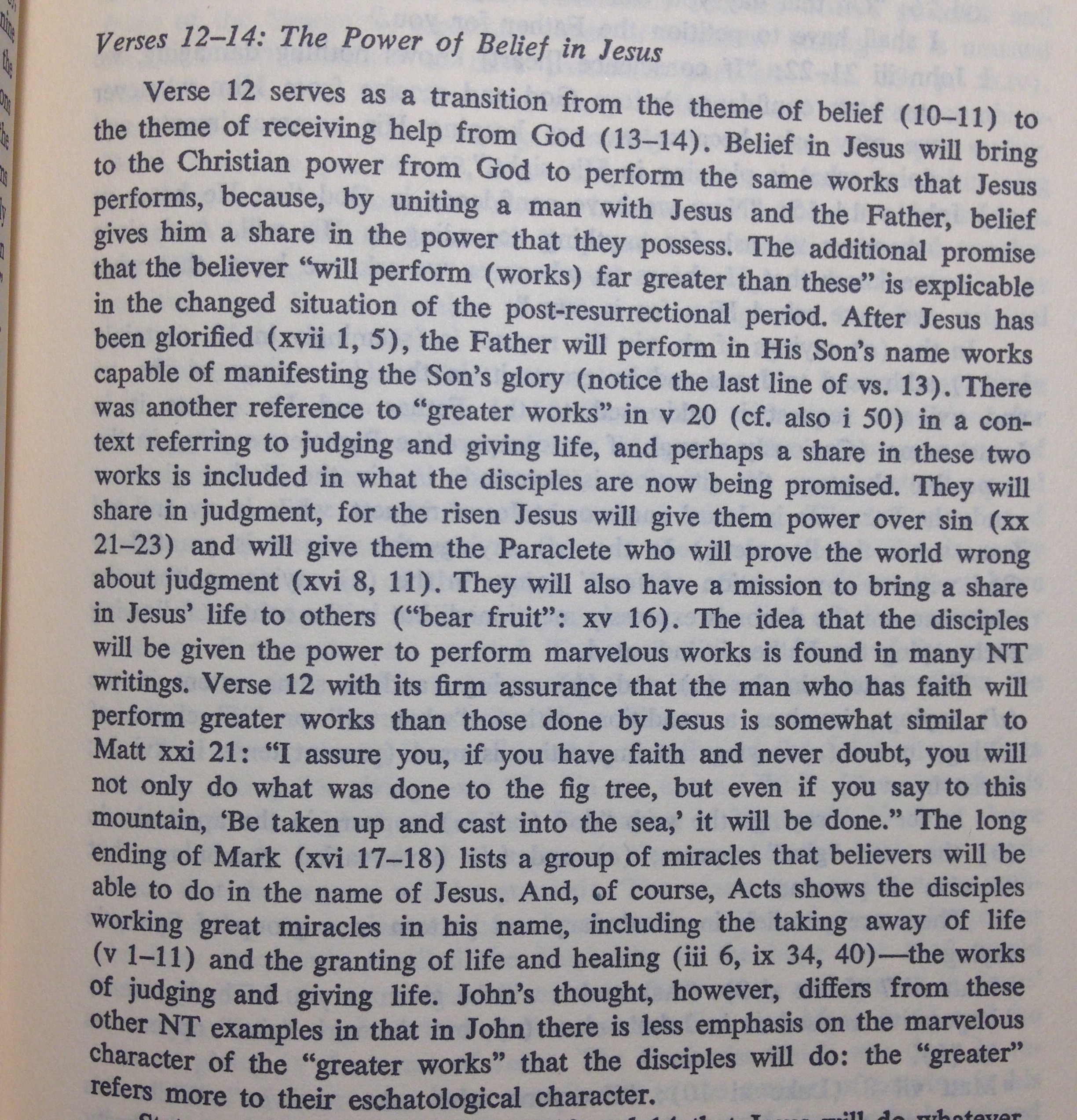
B 3Jesus says to his disciples in John, “I tell you the truth, anyone who has faith in me will do what I have been doing. He [or she] will do even greater things than these, because I am going to the Father.”

Of course our first reaction is to ask, “Greater than Jesus? How is that even possible?”

One possible meaning: Because I am going to the Father–because I am going to die and rise again–sin and death will be defeated and you will have even more power than you do now.

The Kingdom would be even more fully ushered in at the end of John. Is this what Jesus means?

This, at least, is what D.A. Carson suggests:

In short, the works that the disciples perform after the resurrection are greater than those done by Jesus before his death insofar as the former belong to an age of clarity and power introduced by Jesus’ sacrifice and exaltation. Both Jesus’ words and his deeds were somewhat veiled during the days of his flesh; even his closest followers, as the foregoing verses make clear, grasped only part of what he was saying. But Jesus is about to return to his Father, he is about to be glorified, and in the wake of his glorification his followers will know and make known all that Jesus is and does, and their every deed and word will belong to the new eschatological age that will then have dawned.

I think it could also be helpful to understand Jesus’ statement in light of the signs he has performed.

Jesus says the above in John 14, shortly after the conclusion of the “Book of Signs” portion of John–the first 12 chapters containing his “7 Signs.” John 13-21, then, constitute what scholars call the “Book of Glory.”

A sign, after all, is that which (while good in itself) points away from itself and to a greater, deeper, fuller reality. So if Jesus is referring to “greater things than these signs,” that is not so hard to grasp if we consider that signs always point to something greater anyway. One could read Jesus’ statement as a sort of tautology, where the “greater things” mean that somehow the deeper reality Jesus’ signs point to is more fully unearthed through the ministry of the disciples.

In other words, Jesus says to Philip, these signs are just a foretaste of the Kingdom of Heaven, and you and all the disciples after you are going to work and work and work together to keep bringing the Kingdom in.

When puzzling over John, I can think of no better place to turn than to Raymond E. Brown, to whom I give the last word. Note especially the final sentence of this paragraph.


Ray Brown on John 14.12

“There is No Rejoicing Without Wine”: Jesus’ First Miracle

One preacher says, “Weddings are accidents waiting to happen. Something almost always goes wrong at a service of holy matrimony.”

That doesn’t match my experience with weddings, but there is something quite wrong at the wedding in Cana, in Galilee (John 2:1-11): they’ve run out of wine.

So maybe there’s no better place for Jesus to show up, his first week of public ministry, than at a well-attended, days-long wedding.

Jesus turns water into wine—“the first of his miraculous signs,” John says.


The Seven Signs of Jesus in John


Jesus performed more than just seven signs, but John uses seven signs, or miracles, to organize the first part of his Gospel.

1. Jesus changes water into wine (John 2:1-11)
2. Jesus heals the official’s son (John 4:46-54)
3. Jesus heals the man at the pool of Bethesda 
(John 5:1-9)
4. Jesus feeds the 5,000 (John 6:1-13)
5. Jesus walks on water (John 6:16-21)
6. Jesus heals the man born blind (John 9:1-12)
7. Jesus raises Lazarus (John 11:1-44)

(via The New Testament in Antiquity, by Burge, Cohick, and Green)

What is a sign?

A translator’s handbook, intended especially for those who are taking to Bible into new languages for the first time, talks about it this way:

[A] “sign” is a means of revealing a greater reality to which the “sign” itself merely points. The Gospel of John speaks of seven “signs” of Jesus, and these are “signs,” not necessarily because they are miracles, but because they point to a truth beyond themselves, to a truth regarding God’s salvation.

Signs are good, even powerful, in and of themselves, but they point to a “greater reality.”

A sign is deeper than itself.

The signs of Jesus, in particular, are meant to tell us something about Jesus. The “signs” and wonders Jesus performs are witnesses to his glory. They’re each a vignette, a window into Christ’s revealing himself to anyone who would receive him.


Sign #1: Water Into Wine


Jesus, his mother, and his disciples have all gotten invitations to this wedding. It’s Jesus’ first week of public ministry, as John tells it, and it’s a huge event. It would not be unexpected for just about the whole town of Cana to be there. The local shops and businesses probably all put a “Closed for wedding” sign on their doors. Will be back in seven days. It was likely a week-long event.

But, even if not all weddings are “accidents waiting to happen,” this one was. The guests drank the wine down to the last drop.

It would be pointless (but fun) to speculate as to whether or not this was poor planning on the family’s part, or too much drinking on the guests’ part.

Either way, this family is about to go down in history as “the ones who ran out of wine at their wedding.” You sort of hope for them, at this point, that they don’t have any other kids to marry off, ‘cause no one’s coming.

Verse 3 says, “When the wine was gone, Jesus’ mother said to him, “They have no more wine.”

One early theologian said, “Perhaps his mother, as mothers do, incited him to perform a miracle, wishing that the greatness of her son would be revealed—and thinking that the lack of wine offered the right occasion for the miracle.”

The (1984) NIV gives us the reply: “Dear woman, why do you involve me?” Jesus replied. “My time has not yet come.”

There is a sense in which Jesus isn’t ready to fully reveal all his glory. But he whips into action. It’s a good way of honoring his mother.

Because… not only is the reputation of the family at stake, but the festive spirit of the wedding is in jeopardy. The Talmud, a text of Rabbinic Judaism from a couple centuries after this, bluntly says, “There is no rejoicing [without] wine.”

Jesus is on it. He performs the miracle, in kind of a subtle and smooth way. Maybe this is because his “time had not yet come,” as he said to mother Mary.

Jesus said to the servants, “Fill the jars with water”; so they filled them to the brim.

Then he told them, “Now draw some out and take it to the master of the banquet.”

They did so, and the master of the banquet tasted the water that had been turned into wine. He did not realize where it had come from, though the servants who had drawn the water knew. Then he called the bridegroom aside and said, “Everyone brings out the choice wine first and then the cheaper wine after the guests have had too much to drink; but you have saved the best till now.”

Just to be clear, we are talking about anywhere between 120 and 180 gallons of wine.

This doesn’t mean that a bunch of wedding guests are going to get toasted. If you think of a whole town of people celebrating for a week, a lot of wine is needed.

Here’s the town today that might have been 1st-century Cana:


Maybe Cana
Source: Accordance Bible Lands PhotoGuide


Imagine the effect of 180 gallons of wine!

This picture is probably 30 gallons or a little more:


Some Wine


So if my calculations are correct, here’s a visual on how much wine Jesus made:


More Wine


The result of this sign, besides a happy wedding, is in John 2:11:

This, the first of his miraculous signs, Jesus performed at Cana in Galilee.

He thus revealed his glory,
and his disciples put their faith in him.

Or, in another translation, “There Jesus showed how wonderful he was.”

It was looking back and thinking of moments like this that John could write in his Prologue, in chapter 1: “We have seen his glory, the glory of the one and only Son, who came from the Father, full of grace and truth.” We have seen how wonderful Jesus is.


What Does the Sign Show?


N.T. Wright says, “The whole point of the ‘signs’ is that they are moments when heaven and earth intersect with each other.”

From these signs of Jesus, we on earth learn more about ultimate, heavenly realities: who Jesus really is, what sorts of things God is capable of, what kind of intervention is possible in the problems of the world today.

Especially with this first sign, when Jesus is fresh on the scene, we get a portrait of who our Savior is.


—Jesus likes to have fun—

“Eat, drink, and be merry” is not just a mindset that the Bible shoots down. Jesus wants us to eat, drink, and be merry—so long as we’re not neglecting important things.

Jesus upset the religious elite of his day by all the feasting he and his disciples did. In Luke some angry leaders say to him,

John’s disciples, like the disciples of the Pharisees, frequently fast and pray, but your disciples eat and drink. Jesus said to them, “You cannot make wedding guests fast while the bridegroom is with them, can you? The days will come when the bridegroom will be taken away from them, and then they will fast in those days. (Luke 5:33-35)

As long as you’ve got me, Jesus says, party on.

And did you catch this nice touch from John: these jars, where the chemical miracle happened, were ones “used… for ceremonial washing.” There’s nothing wrong with religious ritual, per se—I quite like it myself. But these jars for ritual cleansing—Jesus turned them into party favors. That’s kind of like co-opting the baptismal font for a punch bowl.

This family made good choice in inviting Jesus to the wedding. Maybe he already had a reputation as a fun guy—someone you wanted to celebrate with.


—Jesus is generous—

This sign also shows Jesus to be generous. Under his command, the servants “filled [the jars with water] to the brim.” There’s no skimping with Jesus.

Next chapter Jesus will say, “For the one whom God has sent speaks the words of God, for God gives the Spirit without limit.”

God does not withhold his good gifts and his love from us. He wants us coming to him with open hands, even empty cups, so he can fill us with good things.

Also, just a geographical note here: we know the stories of Jesus, so we take it for granted, but Cana was 70 miles north of Jerusalem. This is pretty far outside the city of the religious power brokers.

But being a religious insider or expert, so to speak, has never been a requirement for receiving Christ’s love.

Jesus does not withhold his presence from the ones who have never known power, wealth, or the comfort of living in the mainstream of society. Jesus is generous.


—Jesus is accommodating—

Jesus is accommodating. He says his “time has not yet come,” but then he does the miracle. He seems to be flexible on timing. You’ll see in other places in John where Jesus says “his time has not yet come.”

We know the frustration of when God’s timetable or timing in the world does not match ours. But God is not impassable. God is not unaffected by our needs and desperation.

If God has a massive planner on his desk, with dates and times and places, it’s written in pencil. God can change the future. God can even accommodate our requests when he maybe otherwise wasn’t planning to. Jesus is accommodating.


How Shall We Respond?


Having seen this intersection of the heavenly and earthly, having caught a glimpse of a God who changes reality, a Jesus who is fun, and generous, and accommodating… how shall we respond?

John models a response for us in verse 11: “He thus revealed his glory, and his disciples put their faith in him.”

We can eat, drink, be merry, trusting that our God is a God of celebration… assured that he’s generous… and confident that he’s flexible to respond in real time to our needs and intercessions.

Look at Mary’s response in verse 5 to the servants: “Do whatever he tells you.”

I think we can safely assume, 30 years in, that she’s onto the whole divinity thing. She doesn’t know what he’s going to do or how, but she expects something, when she comes to him with a need: “They have no more wine.” Her words to the servants model an admirable submission to the Son of God: “Do whatever he tells you.”

Do the good you know to do. Act in love, in the ways that you see it within your reach to do. “Do whatever he tells you.”

John, by showing Mary and the disciples’ response to Jesus’ first sign, calls us, too, to submission and faith and trust in Christ.

I think another response this passage can call forth from us is just… relief.

Jesus isn’t boring or a killjoy. He liked to celebrate, to enjoy parties and good wine and food with others.

Jesus says of his mission, “I have come that you may have life, and have it abundantly.” Jesus wants disciples to live life to the fullest, and one implication of this is that we enjoy the good things on earth.

We read in the Psalms:

How precious is your steadfast love, O God!
All people may take refuge in the shadow of your wings.
They feast on the abundance of your house,
and you give them drink from the river of your delights.

Jesus wants us to enjoy the abundance of his creation. He is not stingy. He’s not inflexible.

This passage can offer us relief because it reminds us that prayers regarding needs do affect God. We can invite him into broken and unresolved places in our life.


An Even Greater Wedding Feast


The wedding at Cana, in fact, serves as a foreshadowing of a great heavenly banquet, where Jesus is the groom. And he invites everyone, not just in one whole town, but across many nations. It’s not just a weeklong wedding celebration, but an eternal one, with Jesus as host.

The prophets saw this day and were relieved. Amos rejoiced, “New wine will drip from the mountains and flow from all the hills.” Joel saw a day when “the mountains will drip with sweet wine, and the hills will flow with milk.” (And that milk—it accounts for those who don’t drink wine… so God’s got everyone covered.)

We, like Mary and the disciples, have seen the glory of Jesus. Witnesses to this and many other signs of Jesus, may we put our trust in him. May we hope in him. May we present our needs and lacks to him, asking for his help. May we place our confidence in him. And may we give ourselves over to him, and keep our hands open for the good things he has to give us.

Free JPS Exodus Commentary via Logos

JPS Torah Exodus


This month’s free book of the month from Logos Bible Software is the brilliant Nahum Sarna’s JPS Torah Commentary. It’s worth much more than $0.00, but you can get it for that price here. I reviewed the commentary here.

Logos is also offering the JPS Jonah Commentary (I covered it here) for $1.99–an excellent deal.

Christmas in the Middle of Something

image


And there were shepherds living out in the fields nearby, keeping watch over their flocks at night. An angel of the Lord appeared to them, and the glory of the Lord shone around them, and they were terrified. But the angel said to them, “Do not be afraid. I bring you good news that will cause great joy for all the people. Today in the town of David a Savior has been born to you; he is the Messiah, the Lord. This will be a sign to you: You will find a baby wrapped in cloths and lying in a manger.”

Suddenly a great company of the heavenly host appeared with the angel, praising God and saying,“Glory to God in the highest heaven, and on earth peace to those on whom his favor rests.”

When the angels had left them and gone into heaven, the shepherds said to one another, “Let’s go to Bethlehem and see this thing that has happened, which the Lord has told us about.”

—Luke 2:8-15

Where were you the first time you remember hearing about Jesus? Or if you can’t remember a “first time,” what are some early memories you have of encounters with the God who came to earth? And just as important: how and where and in whom have you seen Jesus these last few weeks, days, and even hours?

The shepherds were just minding their own business, really. They were “keeping watch over their flocks at night.” That phrasing has become virtually poetic to us now, so tied is it to this beautiful story. It’s merely a preamble to the glory of the angels and of the Lord, a glory improbably made manifest in a “baby wrapped in cloths and lying in a manger.”

But this is also just like saying, “They were at work when God’s glory found them.” Or, “They were standing at the sink washing dishes when the Lord’s invitation came.” Or, “They were fixing a chain on a bicycle when Christ came to them.” Or, “They were practicing their caregiving role when they caught a sudden glimpse of God’s great love.”

No matter how well saturated we are with Scripture, no matter how solid our Christology, no matter how long we’ve been following Jesus, we simply do not know all the times and places where Christ is going to meet us. Chances are he will come to us while we’re in the middle of something else.

Encounters with the living God can be intense. But just as Luke is keen to point out Mary’s obedience to a seemingly bizarre call, he is eager to show us the willingness of the shepherds to drop their staffs (and leave their sheep momentarily unattended? or bring them along?) to “go… and see this thing that has happened,” which God told them about.

Christ has come to earth! He came in the form of a servant, taking on human likeness. Christ will come again! He will come in a glory that will surpass even that of the “great company of the heavenly host.” Christ comes to us! He comes and visits us each day in myriad ways, big and small, obvious and subtle, extraordinary and mundane.

Like these shepherds who were surely caught off guard by the interruption, may we have the willingness to see Christ whenever and however he comes to us. And may we hasten to the places where he is today, running to his feet, bowing down, and worshiping him.


The above is adapted from an Advent reflection I wrote as part of a devotional our church’s Deacons prepared for our congregation this Advent.

Advent: At Least It’s Not Lent!

If branding and marketing tag lines had been a thing when Advent found its way into the church calendar, the church of the late sixth century could have used: “Advent: At Least It’s Not Lent!”

It’s true—December just feels more exciting than February-March, and the four Sundays of Advent seem to get to the point more efficiently than what can seem like the 40-day slog of Lent. Besides, who’s ever heard of fasting from sweets in the weeks leading up to Christmas?

But both Advent and Lent share an important—if at times challenging—characteristic: they offer us church folk a chance to carve out deliberate spaces to look inward to our own spiritual state and outward to the person and work of Jesus.


advent wreath


We remind ourselves in Advent that we live in a waiting room of sorts. We have the fortunate lot in life to not have to wait for the coming of Jesus to earth—we know it happened and we still have the eyewitness accounts! But, ah… that second coming. No one knows when it will be. Even Jesus-on-earth said he didn’t know the hour.

So we wait. And wait. And wait. Each Advent that comes and goes is a poignant reminder that the kingdom is (still!) not yet fully present among us.

But that’s no reason to give up hope and stop waiting. On the contrary, we wait all the more eagerly. Luke 12 says:

Be dressed ready for service and keep your lamps burning, like servants waiting for their master to return from a wedding banquet, so that when he comes and knocks they can immediately open the door for him. It will be good for those servants whose master finds them watching when he comes. …You also must be ready, because the Son of Man will come at an hour when you do not expect him.

To our waiting we add watching and making ready.

The master has not yet returned, and our lamps too often dim when we forget to tend to them in the rush of other commitments. This Advent, may we keep our lamps brightly lit, persistent in our waiting, watching, and making ready for the coming of our King.


The above is adapted from an Advent reflection I wrote as part of a devotional our church’s Deacons prepared for our congregation this Advent.