What are the Best New Testament Commentaries?

NT Commentary Survey

D.A. Carson’s 2013 update to his New Testament Commentary Survey puts the book into its seventh edition. Having come six years since the last edition, the new edition is substantially revised and updated to include just about every significant commentary on every book of the New Testament. The Survey rarely misses a volume.

Carson goes book-by-book through the New Testament and suggests what he thinks are the best-written commentaries and why. He also offers introductory notes and principles for selecting commentaries and series, as well as 14 pages on New Testament introductions and theologies to consider. The number of books that Carson surveys is impressive.

I found Carson’s survey to be much more detailed and up-to-date than its Old Testament counterpart. He makes mention, for example, of the brand new Teach the Text commentary series. And he seems to have already examined the relevant ZECNT volumes that had been released before this survey went to press. So anyone using this book can be assured that not much ground is left uncovered.

Of course, it’s impossible in 175 pages or so to get detailed analysis of each commentary. For the most part, Carson is able, in just a couple of sentences, to give the reader a really good idea of what each commentary does well, and whether or not to consider adding it to one’s library. One always knows what top two or three commentaries Carson would suggest on a given book of the New Testament (and why).

There are times where Carson’s evaluations are left unexplained, or when he fails to evaluate a commentary in accordance with its own purposes. For instance, he criticizes a New Testament introduction on “Intertextual Development of the NT Writings” for focusing “so narrowly on intertextual connections that other axes are unhelpfully ignored.” Or a socio-rhetorical commentary on Matthew is faulted for not including enough “penetrating comment on structure, grammar, and sometimes theology.” The discerning reader can overlook this and not be deterred by it.

Carson’s writing style is engaging, enjoyable, and downright funny at times. Of his own commentary on John, he writes, “Carson’s work is rather more difficult for me to assess.” He pulls no punches in his critiques. A reviewer could multiply examples, but here are just a few quotations:

  • “…despite the superfluity of cutesy remarks that are in constant danger of distorting the picture of who Jesus is…”
  • “…his grasp of Greek is mechanical, amateurish, and without respect for the fluidity of the Greek in the Hellenistic period.”
  • “…the result is a disappointing monument to misplaced energy.”
  • “…his reconstruction of the church situation is so quirky that it cannot be recommended except to readers who are devoted to quirkiness.”

I was surprised that a short guide like this would contain such strongly expressed opinions, but the more I read on, the more useful I found them to be–even as I realized that some of Carson’s assessments are subjective and need to be weighed. (He too blithely, in my opinion, dismisses reader-response criticism.) He is an excellent writer and somehow manages throughout the book to avoid many reviewers’ clichés, which is no small accomplishment when covering this many commentaries!

Carson is (refreshingly) not at all reluctant to call out unacknowledged borrowing, which occurs in commentaries more often than one would hope.

Carson’s goal is:

to provide theological students and ministers with a handy survey of the resources, especially commentaries, that are available in English to facilitate understanding of the NT.

In this Carson has succeeded, even in entertaining fashion. If the reader is willing to overlook the few critiques mentioned above (as I largely have been), she or he will find this a good desk-side companion to help wade through the world of myriad commentaries.

Thanks to Baker Academic for the review copy of NT Commentary Survey. You can find it here (Baker Academic) and here (Amazon/affiliate link).

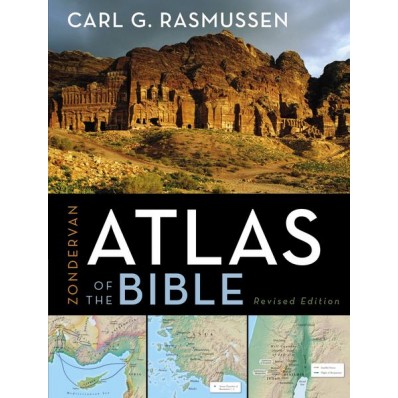
Zondervan Atlas of the Bible

Zondervan Atlas

Carl G. Rasmussen has recently released a Revised Edition of Zondervan Atlas of the Bible. Below I offer a description of its contents with some evaluative remarks.

What’s in the Atlas

After the Preface and Introduction the atlas consists of a Geographical Section and a Historical Section, followed by Appendices.

The Geographical Section is first, because:

This atlas has been written in the belief that once one has a basic understanding of the geography of the Middle East, one has a much better chance of coming to grips with the flow of historical events that occurred there.

After “Introduction to the Middle East as a Whole” there are these sub-sections:

  1. The Geography of Israel and Jordan (the longest section, covering “the Five Zones,” weather, routes, and individual regions)
  2. The Geography of Egypt
  3. The Geography of Syria and Lebanon
  4. The Geography of Mesopotamia

The Historical Section covers the Bible’s history in canonical order, from the pre-patriarchal period to the churches in Revelation. It concludes with a special section on Jerusalem (“Of all the cities in the Bible, this is the most prominent one: it is mentioned 667 times in the Old Testament and 139 times in the New”) and an essay:  “The Disciplines of Historical Geography.” I appreciated being able to compare the layout of Jerusalem in the Old Testament, during the time of Nehemiah, and in the New Testament.

Rasmussen covers even the so-called intertestamental period, with sections on the Greeks (4th century B.C. onward), the Maccabees, and the Hasmonean dynasty.

The Appendices are also impressive. What really makes this atlas user-friendly is the 31-page Geographical Dictionary and Index. Any place name in the atlas (whether it has appeared on a map or in the descriptive text) is in the dictionary/index. There are also identifications with modern places, so one finds out, for example, that the biblical Bethany is the current-day El-Azariya. More specifically, here is the entry for Bethany at the back of the atlas:

Bethany (near Jerusalem)—Village on road to Jericho (Mark 11:1; Luke 19:29) less than 2 mi. from Jerusalem (John 11:18). Mary, Martha, and Lazarus lived there (John 11) and it seems that Jesus spent the evenings of the week before his crucifixion there. Mentioned 11 times in NT.–El-Azariya (174131), 1.5 mi. E of Jerusalem, on E side of Mount of Olives. 212, 214, 217, 251, 252

There’s quite a lot of text in the atlas, too. (It’s far more than just maps and photos.) In the section covering Jesus’ life, for example, Rasmussen offers an almost narrative overview of the locations of Jesus’ ministry, interspersed with graphics.

The Graphics

As with other Zondervan books along similar lines, there are striking full-color images and well-drawn maps throughout the book. Photographs like this will have to suffice until I can visit the lands described in this book:

Full-color photograph from the Atlas
Full-color photograph from the atlas

The atlas contains both two-dimensional and three-dimensional maps:

One of many maps from the Atlas

Between the maps, photographs, and timelines throughout the book, you can easily get your bearings in any era or biblical passage of study.

Evaluation

I’ve not been able to take full advantage of all that the atlas has to offer–there is a lot here–but it is my current go-to atlas. I look forward to making further use of it. Perhaps the proof is in the pudding: even though I was given a gratis copy for review by Zondervan, I purchased an electronic version of it in Accordance Bible software so I could have access to it there, too (I rarely purchase a book in two formats). Accordance’s production of the module, from what I’ve seen so far, enhances what is already an excellent book, with the added advantages of hyperlinks and advanced searching capabilities.

My two points of critique are fairly minor ones. First, the timelines throughout the book are easy enough to follow, but they are stylized in such a way that they feel a bit cluttered. You can see examples using the Search Inside feature on Amazon here (affiliate link). Second, the font is narrow and looks crammed on a page, especially pages that have a good amount of text. The flip-side to this is that in a book that is still fairly portable (just under 300 pages), you’re getting a lot of great information, but it’s not always easy to read for long stretches of time.
Any serious reader, no matter their level of prior knowledge of biblical geography and history, could make profitable use of the atlas. It’s not highly technical or scholarly, though students and professors should still consider it, especially in a classroom or Sunday school setting.

You can view a sample pdf of the atlas (including a detailed Table of Contents) here. Its product page at Zondervan is here. Accordance has it on sale for the rest of today (Monday) here.

Septuagint Studies Soirée #7: Mostly Just Links Edition

LXX decal

Welcome to the Septuagint Studies Soirée #7, covering February in the Septuagintablogosphere.

There is now a Septuagint podcast. Check it out here.

Via Jim West: There will be a Historical and Theological Lexicon of the Septuagint (HTLS), which you can read more about here and here. You can even read a sample article (pdf)!

Do you want to contribute to a Septuagint Dictionary? Then check this one out.

This is a review of the Joshua volume of the Septuagint Commentary Series (Brill).

Here’s Lawrence Shiffman on Isaiah and the Greek Septuagint.

Brian Davidson posted a rockin’ interview with the editors of the Lexham English Septuagint.

It’s the International Septuaginta Summer School 2014. It sounds incredible, and it’s on Greek Isaiah. If you have a benefactor, go (and then introduce him or her to me, and I’ll meet you there).

Into prizes? Submit an LXX paper here for a prize of $350.

UPDATE 3/3/14: Wayne Coppins writes about Dietrich-Alex Koch’s analysis of Paul’s use of the Septuagint.

Finally, here and here you can find more interaction with T. Michael Law’s When God Spoke Greek.

Did I miss anything? Feel free to leave more February 2014 LXX links of interest in the comments.

New OT Commentary Series: Hearing the Message of Scripture

HMS Obadiah by BlockZondervan has just published the first two volumes of a new Old Testament commentary series, Hearing the Message of Scripture. Here’s part of a brief description of its approach:

[W]hen dealing with specific texts, the authors of the commentaries in this series are concerned with three principal questions:

  1. What are the principal theological points the biblical writers are making?
  2. How do biblical writers make those points?
  3. What significance does the message of the present text have for understanding the message of the biblical book within which it is embedded and the message of the Scriptures as a whole?

The achievement of these goals requires careful attention to the way ideas are expressed in the OT, including the selection and arrangement of materials and the syntactical shaping of the text.

Zondervan introduces the series more fully here, with a listing of contributors here. Or, if you prefer a video introduction, here is Series Editor Daniel I. Block on the series:

You can see PDF samples from Obadiah (by Daniel I. Block) here and from Jonah (by Kevin J. Youngblood) here. Zondervan’s book pages for each title are here and here. I’ve read half of the Obadiah volume so far and will post a review shortly.

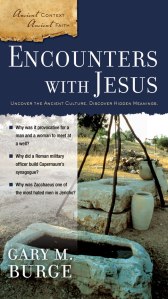
Where Cultural Anthropology, Geography, History, and Praise All Meet

Encounters with JesusI learned my very first bit of Hebrew–the Sh’ma–from Gary Burge at Wheaton. His knowledge of cultural backgrounds of the Bible–and ability to communicate about it–is impressive. In Encounters with Jesus he explores the connections between “the ancient landscape,” encounters people in the first century had with Jesus, and how that can draw us into a deeper faith in Jesus today.

The short book consists of six chapters:

  1. Encountering Jesus
  2. The Woman with the Hemorrhage (from Matthew 9:18 – 26 and Mark 5:21 – 43)
  3. Zacchaeus of Jericho (from Luke 19:1 – 10)
  4. The Centurion of Capernaum (from Luke 7:1 – 10)
  5. A Woman in Samaria (from John 4:4 – 26)
  6. A Greek Woman in Tyre (from Matthew 15:21 – 28 and Mark 7:24 – 30)

In the series preface Burge writes:

We have forgotten that we read the Bible as foreigners, as visitors who have traveled not only to a new geography but a new century. We are literary tourists who are deeply in need of a guide.

The goal of this series is to be such a guide….

Burge asks, “Have you ever wondered what it would be like to encounter Jesus personally?” In chapter 1 he sketches a picture of a teacher who “took time for people who generally assumed that they were invisible.” And yet as accustomed as we are to thinking of Jesus as present with the poor, the sick, the outcast, and the powerless, Burge notes that Jesus does not deliberately avoid the powerful, either. Case in point: the centurion in Capernaum (chapter 4).

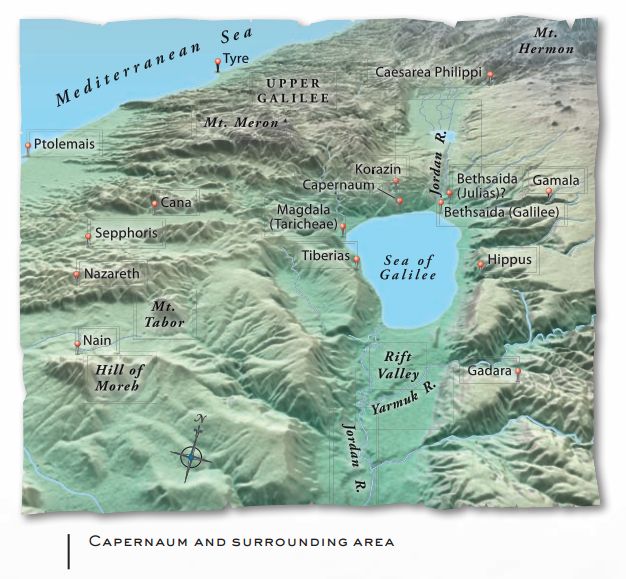
A map from the book
A map from the book

You can read the story of the centurion’s encounter with Jesus and find much to appreciate and marvel at already. But as Burge unpacked what was behind that encounter, the improbability of such an interaction became increasingly clear. That chapter begins with important geographical information on Capernaum, and then notes that it was Jesus’ home, as well as the site of the Sermon on the Mount and the Feeding of the 5,000. (No wonder, Burge notes, that Jesus says woe to Capernaum in Matthew 11, when they won’t believe.)

Capernaum was an economically strategic trade center, and so the Roman occupiers had made a home there–hence the presence of the centurion. Burge explains the organization of the Roman army, a “highly disciplined, professional fighting force.” An easy-to-understand diagram shows the division of the army into legions, cohorts, and centuries (which consisted of one centurion overseeing 80 men).

It is against this backdrop that Burge then tells the story of Jesus’ encounter with the centurion, a man who “understands that Jesus is similarly empowered by God in a way that others are not.” Jesus takes “social risks” in responding to him. Burge similarly unpacks the four more encounters with Jesus in the Gospels.

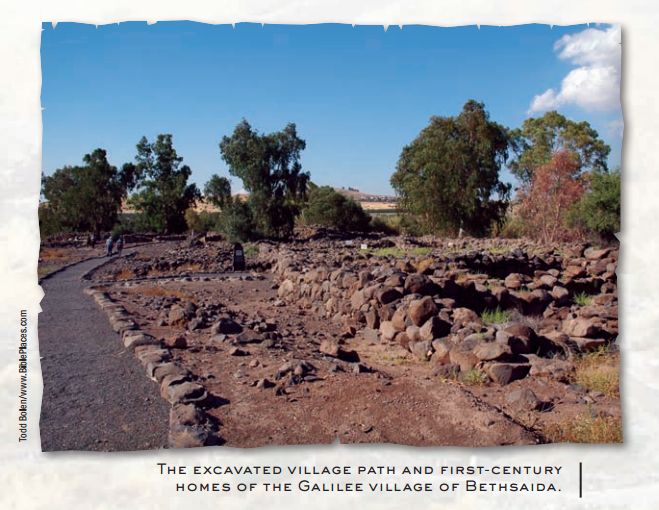
Like the other books in the Ancient Context, Ancient Faith series, Encounters with Jesus is printed on thick, glossy paper (which you can still easily mark in pencil) and is full of high-quality, color photographs and maps. Both the selection and placement of the visuals is perfect. (This truly is the guidebook the author seeks to produce.) Here’s one photograph from the book:

A photograph from the book

There are endnotes at the back of the book, but as with another book in the series, there is no Subject or Place Names or Scripture index, which I experienced as a lack. That’s about the extent of what I found to critique, though.

Encounters with Jesus is something I love: a book of biblical studies that also draws the reader into the presence and praise of God. I began reading it because I wanted to learn more about the cultural and historical background of some of the Gospel stories, but by the time I had finished the first chapter, I moved to reading it deliberately as part of my personal devotions.

I highly recommend Encounters with Jesus. As I read I had a better sense of what was happening in the Gospel stories Burge recounts, and–more important–I found myself growing in admiration and awe of Jesus.

Thanks to Zondervan for the review copy. Encounters with Jesus is on Amazon here. Its product page is at Zondervan’s site here. A sample pdf is here.

Happy International Septuagint Day!

International Septuagint Day

Happy International Septuagint Day! 

Read some Septuagint today, if you can, in Greek or English. Here’s why I think you need the Septuagint. And here are some more “rarely cited reasons” why the LXX is important, given by James Aitken and noted on Jim West’s blog.

goettingen septuagintOne good monograph to read on the Septuagint is First Bible of the Church. And if you want to get in-depth with the critical edition of the LXX, I have offered reviews of the Göttingen Septuagint in Logos and Accordance softwares. And, perhaps as important, I suggest how one might actually make sense of that critical edition, noted here and here, with an ever-elusive third part of the primer still to come.

But right now, I’m going to go play outside in the snow with my kids. Happy LXX Day!

How Jesus Used the Bible

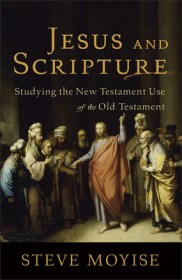
Jesus and Scripure by MoyiseI still wonder what language(s) Jesus spoke. I know, I know. Easy: Aramaic…right? And possibly also Hebrew when he quotes Scripture?

I’m becoming increasingly open to the idea, however, that Jesus–at least on occasion–taught in Greek. At any rate, it is true that the Gospel writers that quote Jesus do so in Greek. There is also the fascinating question of what text form(s) Jesus used when he quoted Scripture, which he did frequently.

Last week I finished reading Steve Moyise’s Jesus and Scripture: Studying the New Testament Use of the Old Testament. It’s part of his de facto trilogy by Baker Academic on the New Testament’s use of the Old Testament. (I reviewed the other two volumes here and here.)

How Moyise Approaches Jesus’ Use of Scripture

As Moyise sees it, the task of studying Jesus’ use of Scripture is two-fold:

First, we must study what each Gospel writer has to say about Jesus’ use of Scripture and seek to determine his method and purpose.

To do this, Moyise briefly (yet substantively) surveys how each Gospel writer presents Jesus’ use of Scripture. For each of Mark, Matthew, and Luke, Moyise analyzes Jesus’ quotations of “the law,” “the prophets,” and “the writings.” For John he treats “the four explicit quotations” and scriptural allusions.

Moyise goes on:

Second, if we are to understand Jesus’ use of Scripture we must engage in historical criticism to decide what Jesus must have said to give rise to the various accounts we find in the Gospels.

To this end Moyise looks at three categories of scholars:

  1. Those with “minimalist views” on Jesus and history: Geza Vermes, John Dominic Crossan, and Marcus Borg. They more or less “do not regard Mark as an accurate record of what Jesus said and did, which has implications for the accuracy of Matthew and Luke.”
  2. Those with “moderate views”: James Dunn and Tom (N.T.) Wright. The moderate view “accepts that real events lie behind the Gospel stories but believes that they have been embellished as each Gospel writer adapts the tradition to meet his readers’ needs.”
  3. Those with “maximalist views”: Charles Kimball and Richard (R.T.) France.” Jesus must have said all of the sayings and … each Gospel has been selective in what it records. …its strategy for dealing with differences between the Gospels is to seek harmony.”

Moyise lays out the issues in the synoptic Gospels and John clearly and succinctly. He raises as many questions as he answers, but this is a good thing. Reading Jesus and Scripture made we want to delve deeper into the topic at hand.

An Evaluation

While the volume is accessible, it does not oversimplify complexities where they exist. For example, after saying that Jesus’ Aramaic sayings “were translated into Greek, including his quotations from Scripture,” Moyise highlights the existence already of a Greek translation of the Hebrew Bible (the LXX). He goes on:

The important question this raises is whether, when the translators recognized that Jesus was quoting Scripture, they translated his words for themselves or availed themselves of the translation already in circulation.

Gray shaded boxes throughout the book offer concise information about topics such as: “The text of the LXX known to Matthew,” “Hillel’s seven exegetical rules,” “Critical editions of Q,” and more.

Especially helpful for further study is Appendix 1: “Index of Jesus’ quotations in the Gospels,” which is listed in Old Testament book order. The select bibliography is short but a good starting point, too.

Of the three “views” he describes, Moyise writes about helping “readers decide for themselves which reconstruction they find the most convincing.” He excels here–phrases like “many scholars believe” are coupled with a fair spelling out of others’ views of Jesus and what he said. His even-handedness helps readers get the lay of the land in Jesus studies.

Phrases like “what Jesus actually said” got to be a bit tiresome to me after a while. Perhaps my maximalism shows through here, but I’m just not sure how productive or advisable a quest it is to try to ascertain what Jesus really said. (And if we did, wouldn’t we have to go back to retroverted Aramaic?) This is in part due to Moyise’s own “moderate views,” but he certainly does not push for them over France’s “maximalist views,” for example, which he describes charitably and even favorably. The reader can decide for herself or himself.

Jesus and Scripture would be perfect for a seminary course on the Gospels, or on the NT use of the OT. An advanced undergrad course would also do well to adopt this book. I’d also recommend it to a serious Bible reader–no biblical languages are needed here, and I found that even with my own knowledge gaps in historical Jesus studies, Moyise explained everything I needed to know.

Though this survey is short (less than 150 pages), Moyise gives plenty of sample passages and insights that have challenged me. I know this is a book I will come back to and want to read again in the future.

Thank you to Baker Academic for providing me with a review copy of the book. See its product page at Baker here. You can find it on Amazon here.

Septuagint Studies Soirée #6, and this Saturday

It’s a day late (I blame the groundhog), but not a dollar short: Here’s the blogosphere’s only Septuagint Studies Soirée… this one is #6.

Some Important Dates

Add it to your iCal
Add it to your iCal

First things first: This Saturday (February 8) is International Septuagint Day. Read some Septuagint that day, if you can, in Greek or English. Why not read Tobit? Here’s why I think you need the Septuagint.

Looking back, Jim West celebrates Mogens Müller’s January 25 birthday, he (the latter) of First Bible of the Church renown.

Coming up, James Aitken (via FB) notes the following:

THE GRINFIELD LECTURES ON THE SEPTUAGINT 2013-14, University of Oxford

NICHOLAS DE LANGE
Emeritus Professor of Hebrew and Jewish Studies, Cambridge

‘Japheth in the Tents of Shem: Greek Bible translations in Medieval Judaism’

(First series)
Hilary Term 2014 (6th Week)

Monday 24 Feb.: ‘New light on an old question’
Venue: Examination Schools at 5.00 pm
Members of the public are welcome to attend

Tuesday 25 Feb.: ‘Aquila fragments from the Genizah’
Venue: Seminar in Jewish Studies in the Greco- Roman Period, Oriental Institute, 2.30 – 4.00 pm

Thursday 27 Feb.: ‘The Successors of Aquila’
Venue: Ioannou Centre, 5.00pm – 6.00 pm

And T. Michael Law notes an upcoming symposium on Isaiah and the Beginnings of Christian Theology.

God is Still Speaking (Greek)

TML book

Didn’t get enough reviews of T. Michael Law’s When God Spoke Greek? Mosissimus Mose announces a review of the book in dialogic form. The first part is here, featuring Aaron White, W. Edward Glenny, and Christopher Fresch. They promise more dialogue in the future.

Law’s book made Michael F. Bird’s Top 5 for 2013.

More LXX Love on the Blogs

Suzanne at BLT has been writing about childshippe. I haven’t been able to fully digest it all, but given the preponderance of the word “son”/υἱός in the New Testament, I want to spend more time thinking through why so many translations opt for “son” when both male and female “children” seem to be in view. She writes more here and here.

Jim promises a review of de Gruyter’s Die Göttinger Septuaginta. And check out the Dust blog for a post called, “How much we take for granted, the publishing process and the Septuagint,” here.

Also, it wasn’t updated in January, but I just found out about what looks like a good LXX-related blog.

Did I miss anything? Feel free to leave more January 2014 LXX links of interest in the comments. And Happy (almost) International Septuagint Day!

One Way to Improve Your Biblical Hebrew Is…

…to beef up your knowledge of vocabulary in the Hebrew Bible. But reading through the detailed instructions on building the tabernacle (Exodus 26 and following) can feel like too much of a vocab stretch. It seems like every other word is a rare one. Using an alphabetically organized lexicon for such passages really slows down the reading. Also, readers who have a way to gauge how common a word is can decide if they should know it or not.

Back in Print

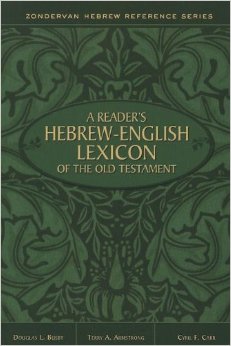
Readers Hebrew English LexiconA resource that has been out of print for some time is now back and available in a (cheaper) paperback edition. Zondervan’s Reader’s Hebrew-English Lexicon of the Old Testament offers verse-by-verse glosses (short translation equivalents) for rarely occurring words in the Hebrew Bible. The glosses are based on the Brown/Driver/Briggs (BDB) lexicon, with the context of each verse also taken into account. Organized in canonical order and covering the whole Old Testament, the lexicon lists each word that occurs 50 times or less in the Old Testament. Next to the word is the gloss and how many times that word appears in (a) a given book and (b) the whole Hebrew Bible. Each entry also has the page number in BDB, if you want to consult that additional work for a longer definition of a word. For verbs, the number of occurrences of that particular stem is also noted.

The lexicon follows the order of books that the Hebrew Bible does (i.e., the ordering differs from English Bibles). Only numbers and proper nouns are not included. The lexicon clocks in at 720 pages. It’s not as portable as when this single work was split into four volumes, but those are as hard to find as the four-volumes-in-one hardback had been. A Reader’s Hebrew-English Lexicon is intended to be a sort of counterpart to Kubo’s Greek lexicon by Zondervan. Here’s what it looks like:

HebrewI often struggle to remember Hebrew words that occur between 50 and 100 times in the OT, so the additional appendix is especially useful–it has Hebrew words that occur more than 50 times. There is also an Aramaic appendix.

How I Use It, Why I Like It

I’ve used this reader’s lexicon in tandem with Zondervan’s nicely laid out  “reader’s” edition of the Hebrew Bible. Though that Bible already footnotes rarely occurring words, the frequency counts in this lexicon help me know if it’s a word I should have known (e.g., one that occurs 45 times) or one I shouldn’t be surprised to not know (e.g., one that occurs three times).

The glosses are sufficient for rapid reading of the text. And the frequency counts add a nice orienting element not found in the reader’s Bible.

This edition is a reprint, so nothing has been re-formatted or changed in terms of the font. The font, while not always crisp on every page, is readable, both in Hebrew and English.

Yes, there are good Bible software options for reading the text, but I still like to read through the Hebrew Bible in print, and this reader’s lexicon makes for a convenient and trustworthy guide. For bettering one’s Hebrew vocabulary and reading, I heartily recommend it.

Thanks to Zondervan for the review copy of the lexicon. Its product page is here. It’s here on Amazon.