Sunday School That Really Excels, Reviewed

Any undertaking by the body of Christ for the cause of Christ should be done with excellence. Our Lord and Savior deserves the very best from his redeemed people. Therefore, the church of Jesus Christ ought to excel.

So writes Allan Taylor, the Minister of Education at First Baptist Church in Woodstock, GA, in the Foreword to Sunday School That Really Excels: Real Life Examples of Churches with Healthy Sunday Schools.

Both Prescriptive and Descriptive

The book is both prescriptive and descriptive. It aims to (prescriptively) suggest how a church’s Sunday School can excel by (descriptively) offering case studies and anecdotes from churches.

The book begins with the chapter, “The State of Sunday School Today,” in which editor and author Steve R. Parr interviews Dr. Thom Rainer. Thankfully there is an early and concise definition of “Sunday school” offered in that chapter: it “consists of Bible study groups for all ages that ordinarily meet on Sunday mornings in conjunction with a worship experience either before or aftewards.”

Rainer notes three key features that successful Sunday school programs should have:

  1. The lead pastor’s support.
  2. “A strong core of lay leaders” that receive solid training.
  3. A sense of Sunday school as “a hero of the church.”

Following the helpful wisdom of Rainer, the next 14 chapters note some specific settings and ways in which Sunday school programs should and do excel. These range from Sunday school that “Excels in the Middle of Nowhere” to Sunday school that “Excels on the Heels of a Crisis,” and more. Contributors generally reinforce Rainer’s assessment of what is needed for a robust Sunday school.

Sun School that Really ExelsThe last two chapters offer a few more short case studies and some general concluding principles for how to help move a Sunday school program forward.

Initial Observations

The case studies come predominantly (but not exclusively) from Baptist churches in the South. So ministers in other traditions may need to do some cultural adaptation in seeking to implement some of what’s recommended here. The more than dozen contributors are all male, and almost all “white.” (Southern) Baptist Sunday School That Really Excels, As Told By Mostly White Males would have been a more accurate title. (No snark intended–I had just expected more diversity of background and perspective.)

All the same, there are plenty of inspiring stories and recommendations for building healthy Sunday schools. Whether it’s the call to make sure a church has clarified the purpose of their Sunday school, or specific suggestions as to how to teach with various learning styles in mind (Ken Coley’s chapter 15–probably the best chapter), anyone reading this book will find herself or himself making a running to-do list as they read. (This is what I did.) The anecdotes from various churches were at times inspiring.

Some Lacks and Disagreements

There wasn’t much about Sunday school for young children or youth, something I had hoped this book would include. And there is what I consider to be some unsound (maybe even dangerous?) missions advice in one chapter about a Sunday school program’s effort to reach out to families at a local trailer park: “They need to see the church as a place where we will help you even if you hate us for doing it.” Good intentions, for sure, but probably bad advice as so-called development efforts go.

And I found it hard to believe that some of the evangelism efforts described would actually have positive long-term results. One contributor (whose chapter seems not to relate much to Sunday school, per se) suggests “Accountability Evangelism,” practiced by a pastor who “planned to reach the lost friends of his members” by asking “everyone to invite a neighbor to the new building and get their friend to promise attendance by filling out a ‘Yes’ card. Their signature and ‘Yes’ indicated they would be present.”

That’s: get the potential visitor (not the church member) to fill out a “Yes” card.

No doubt–God can and does choose to bless efforts of every stripe, even misguided ones. And I want to be reluctant to criticize another Christian’s evangelism efforts, but the approach described above, which also refers to said neighbors as “prospects,” just strikes me as odd, off-putting, and counter-productive.

While Sunday School That Really Excels does describe “growth” in terms of spiritual depth, the underlying assumption seems to be that healthy and excelling Sunday schools are growing numerically–and exponentially is even better. I won’t engage that presupposition at length here, but it passes as a critically unexamined axiom in this book that I don’t think is always true. I.e., “bigger” is not always and necessarily “better.”

Finally, I was surprised that none of the contributors addressed theories of culture change. To help a languishing Sunday school to excel could require a re-orientation and re-creation of the culture surrounding Sunday school. Programmatic fixes may not be enough. I’d have liked to see part of the book address how pastors and ministry leaders can help a church to navigate the change process itself, keeping systems and culture in mind.

Conclusion

So I found some things lacking and a lot to disagree with here, some of which I thought was unsound in a prescriptive sense, even if it had worked in a church in a descriptive sense.

But there were some helpful ideas and reminders to me of things I as a pastor can be contributing in my own church’s setting, as we seek to have a healthy and thriving Sunday school program. For that I’m grateful, even if on the balance I might not recommend the book as a great read for someone seeking to help a Sunday school truly excel.

If you want to see more, there is a pdf excerpt here, including Table of Contents, list of contributors, introduction, and chapter 1.

Thanks to Kregel for the review copy, offered with no expectation as to the content of this review. Find the book on Amazon here (affiliate link), or through Kregel here.

Geffrey B. Kelly’s Reading Bonhoeffer

I’m a sucker for biblical and theological studies with an unapologetically doxological posture. So it was with excitement that I read John W. Matthews’s concluding sentence in his foreword to Geffrey B. Kelly’s Reading Bonhoeffer: A Guide to His Spiritual Classics and Selected Writings on Peace. Matthews writes:

I believe both the author and the subject [Bonhoeffer] would be disappointed if this book did not somehow draw you, the readers, closer to Jesus Christ and to your neighbor.

Kelly’s short yet substantive book does very much that. His first encounter with Bonhoeffer is intertwined with a beautiful story of his own re-awakening to Jesus. He says in the Preface:

Through Bonhoeffer’s inspirational words Jesus’ Sermon on the Mount seemed to be addressed to me personally for the first time. I was hooked.

Reading Bonhoeffer has four major sections:

  1. Dietrich Bonhoeffer: A Biographical Sketch
  2. On Reading Bonhoeffer’s Spiritual Classic, Discipleship
  3. Life Together: Bonhoeffer on Christian Community
  4. Selected Writings on Peace: An Ecumenical Conference and Two Sermons

The Preface, after describing Kelly’s transformative first read of Discipleship, offers some helpful background information and resources for Bonhoeffer studies. Kelly mentions, for example, his involvement with the International Bonhoeffer Society, English Language Section. He writes about the International Bonhoeffer Congress. And he discusses the genesis of the Dietrich Bonhoeffer Works series (English translation), published by Fortress Press.

1. A Riveting Biographical Sketch

Kelly’s “Biographical Sketch” is longer than Renate Bethge’s short work, and (obviously) a much quicker read than Eberhard Bethge’s monumental biography. 28 pages follow Bonhoeffer through his life, writings, and ministry.

Reading BonhoefferThere are a few things that stand out about Kelly’s short biography. For one, though it’s scant on details of Bonhoeffer’s early life (to be expected, given its length), the overview is thorough and really orients the reader well to Bonhoeffer. Kelly has a knack for succinctly summarizing Bonhoeffer’s writings in understandable language–even Bonhoeffer’s challenging Sanctorum Communio!

Second, Kelly’s biography is itself a gripping narrative. There is real movement as he progress through the various pastoral and academic positions Bonhoeffer held, from Berlin to London, from the seminary at Finkenwalde to the church struggle, Bonhoeffer’s arrest, and his imprisonment. I found myself wanting more dates in places (e.g., “Once back in Berlin…”–when?), but perhaps this omission was deliberate to keep the narrative moving. I was not able to put the book down until I had finished the page-turner of a biography.

Third, Kelly describes many of Bonhoeffer’s key terms and concepts, both in this first section and throughout Reading Bonhoeffer. Even a reader with little or no Bonhoeffer background will walk away from the biographical sketch with confidence to read any of Bonhoeffer’s writing.

Fourth, Kelly is clearly in awe of his subject, and rightly so. This, in turn, allows the reader to be inspired by Bonhoeffer. Kelly includes a treasure trove of Bonhoeffer quotations, some familiar, and some more off-the-beaten path. To wit:

I was quite pleased with myself. Then the Bible, and in particular the Sermon on the Mount, freed me from that. Since then everything has changed…. It was a great liberation. It became clear to me that the life of a servant of Jesus Christ must belong to the church, and step by step it became plainer to me how far that must go.

2. Kelly on Bonhoeffer’s Discipleship

Kelly served as co-editor, with John D. Godsey, of Discipleship, volume 4 in the (English) Dietrich Bonhoeffer Works series (DBWE). This second section of Reading Bonhoeffer offers more than 60 pages of commentary on that well-loved Bonhoeffer book, known also as The Cost of Discipleship.

After a brief “history of the text” Kelly proceeds section-by-section through Discipleship. In short, according to Kelly,

Discipleship is a book in which Bonhoeffer uses Jesus’ own words as recorded in the gospels and the exhortations of the apostle Paul to confront readers with the uncushioned challenges to all their inaccurate ideas, falsified by Nazi propaganda, of what it means to be a follower of Jesus Christ.

DBWE DiscipleshipReaders of Discipleship will of course already know that much of the book exposits Jesus’ Sermon on the Mount, but Kelly’s unique contribution as a commentator here is in highlighting the historical context that makes Bonhoeffer’s writing even more remarkable. Not only does Kelly note a particular Nazi evil to which Bonhoeffer may have been alluding, he also points ahead in Bonhoeffer’s life to instances where he would live out the call of his own writings.

As Kelly was co-editor of the DBWE volume, to read his chapter-by-chapter commentary on Bonhoeffer’s Discipleship is to have a guided tour by a leading expert, complete with summary statements and key quotes from that book. It’s well-footnoted with reference to the page numbers in the DBWE edition, so following up in Bonhoeffer’s text is easy. It’s an essential companion.

3. Kelly on Bonhoeffer’s Life Together

The first Bonhoeffer book to be published in the DBWE series was Life Together, which appears as volume 5, bound together with Prayerbook of the Bible. Kelly served as editor of that volume, which includes an introduction and critical apparatus (i.e., lots of informative and orienting footnotes).

DBWE Life TogetherAs with the previous section of Reading Bonhoeffer, Kelly’s commentary on Life Together, although significantly briefer in its section-by-section analysis, serves as a really useful reader’s guide. Its introductory section in this book is thorough, drawing on Kelly’s introduction in the DBWE edition. This sets up the reader well to better understand Bonhoeffer’s important work on community life in the Church.

Kelly, for example, points to “Bonhoeffer’s distinction between being with and being for the others in community.” He traces Bonhoeffer’s interest in building a community, going back even to socio-theological themes in Sanctorum Communio, Bonhoeffer’s first doctoral dissertation. Kelly summarizes and comments on each of the five sections of Life Together in turn: Community, The Day Together, The Day Alone, Service, and Confession and the Lord’s Supper.

4. Peace Writings

Kelly notes the tension that many students and readers of Bonhoeffer experience when they realize a conspirator against Hitler was a peace activist. After tracing the development of Bonhoeffer’s concern for peace, via an overview of his friendship with pacificst Jean Lasserre, Kelly looks at “three texts in which Bonhoeffer reveals himself as an uncompromising advocate for peace on the troubled earth where Nazism ruled with tactics of fear, violence, and the promise of a return to German military glory.” These include a 1932 conference lecture in Switzerland (with excerpts), a 1932 sermon (also with excerpts), and Bonhoeffer’s address to the Ecumenical Council of Christian Churches at Fanø, Denmark in 1934.

Together these orations display Bonhoeffer’s boldness and even impatience at times with inaction around him. In the address in Denmark, for instance, Bonhoeffer says,

Why do we fear the fury of the world powers? Why don’t we take the power from them and give it back to Christ? We can still do it today. The Ecumenical Council is in session; it can send out to all believers this radical call to peace.

Kelly helps Bonhoeffer’s call to peace come alive for the reader many decades later.

Concluding Remarks

There is little to critique in Kelly’s book. However, I was distracted by a number of sentences that were long (multiple modifying prepositional phrases) and comma-less. For example:

[Bonhoeffer] recognizes the danger posted by abandonment of Christ’s vision for the world and the manner in which even basically good people can succumb to the temptations to fall into the compromises in morality for which worldly attitudes are particularly prone, business and government plaudits given to acts of avarice and violence serving as prime examples of why it is necessary to be single-minded in following Christ.

A re-read of every such sentence showed that it was generally clear enough. But additional punctuation or shorter sentences would have helped. If there are future printings of this fine book, perhaps this and a few other minor editorial oversights could be re-visited.

Woven throughout Reading Bonhoeffer are “the twin aspects of Bonhoeffer’s spiritual legacy: scholarly expertise and pastoral care.” Kelly himself writes as one in the academy whose own pastoral sensitivity and concern is fully on display. I can only imagine how engaging and inspiring a Bonhoeffer course with him must be.

Reading Bonhoeffer would be a stimulating read for pastors, theologians, seminary students, and Christians who are intent to more faithfully follow Jesus in both individual and community contexts. The discussion questions at the end of each section will facilitate this book’s use in a small group, Sunday school, or classroom setting.

Kelly writes about Bonhoeffer, yes, but Bonhoeffer points so often and so clearly to Jesus, that a good commentary on Bonhoeffer (which this book is) will do the same. I am grateful for this short, hearty work that Kelly has written, and hope that more DBWE volumes receive similar treatment in the future.

By the way–I’m also grateful to Wipf and Stock Publishers for the review copy. They’ve provided a 40% off coupon code to readers of this blog, good toward the purchase of Reading Bonhoeffer or anything else on Wipf and Stock’s site. Simply use the code LETTERS at checkout. It’s good through the end of May.

How to Teach a New Worship Song to a Congregation

The below is a re-post from September 2012. I’m posting it again because it strikes me that summer could be a good time to try something new in your church services, including learning new songs together. Here are some suggestions for teaching a new worship song to a congregation or other group of people.

This morning I had the privilege of teaching our worshiping community this song:

Because I had guessed it would be new to the majority of our congregation, I decided to teach the song before we sang it all the way through. There are at least six things I like to try to do when teaching a new song:

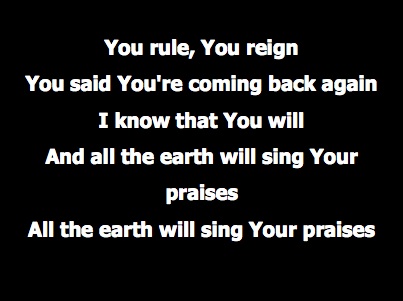
1. Split it into pieces. I had the chorus for All the Earth Will Sing Your Praises on two Powerpoint slides. So I sang through the first half of the chorus (one PPT slide), stopped, and invited the congregation to sing that same part with me:

Then I repeated that same process for the second half of the chorus:

This way the congregation had heard the chorus once and sung it once.

2. Teach it not in order. This helps me and hopefully others remember that we’re actually working on learning the song. It also keeps us attentive to what part of the song we’re working on. We’ll piece it all together only once we’ve learned the component parts.

3. Highlight the lyrical content. If the tune is new, the lyrics likely are, too. At least they were in this case. So because this song speaks of Christ’s death, resurrection, and ascension, I took the opportunity to highlight that. I actually read some of the song lyrics before teaching it, and connected them to something my church says in our weekly worship: “Christ has died, Christ is risen, Christ will come again.” I mentioned that like 1 Corinthians 15 and Luke 24, this is one of the great summaries of our faith that can unite us across multiple denominations and Christian backgrounds.

4. Teach it with a conversational tone. I can’t think of any other way to teach a song than by actually talking with the congregation about it, what we’re doing, what we’re about to do, etc. I find a friendly, inviting, conversational tone works best. At least it feels right to me when I am teaching a song!

5. Affirm the congregation. Our worshiping community picked this song up so fast today (some knew it already, I think) that this was easy to do. I actually cut short the process of teaching the song so that we could begin from the beginning singing it all the way through. This was due to the fact that as I began teaching the verse (i.e., “I’ll sing so you can hear it”), I could already hear folks singing along. It would certainly not be out of place to sincerely say something like, “You all are good singers!” (Provided it’s true.)

6. Have them hear the song even before I teach it. For example, I had All the Earth will Sing Your Praises played over the speakers as they were leaving worship Monday, knowing we’d be learning it today (Wednesday). It’s a little thing, but it helps. Other options could have been playing it as the prelude today, emailing everyone a Web link to the tune, etc.

The bottom line for me is: if we’re doing a song that I think will be new to most in the room, we highlight it as such and carve out time to work to learn it together. Then singing the new song from start to finish is not only easier, but feels like something we have worked at together in a way that draws us closer as we worship.

“The Biblical Picture is Not of What Someone Receives from the Church….”

Bock BECNT Acts

Here are some words of wisdom from Darrell L. Bock, writing about Acts 2:42-47, on which I’ll be preaching tomorrow:

The biblical picture is not of what someone receives from the church, although one does receive a great deal, but of what one gives and how one contributes to it. The portrait of the early church in Acts shows that community and the welfare of the group were a priority. …[T]he believers’ preaching was matched by their community, making a powerful testimony for their mission. When the early church said that God cared, the care they gave their own demonstrated this.

O Lord or Oh, Lord?

CommaWhen I was a college worship director for a couple of years, I put together and helped edit a lot of lyrics on PowerPoint. One recurring question I had was: Is it O Lord or Oh, Lord?

By default I found myself using the first, though I was never really sure why (I thought it looked better).

According to this articleO Lord is correct, when addressing a petition, prayer, or other saying to God.

One thing I’m still stuck on, though–if is proper for use with vocatives, why is there not also a comma after it?

It’s Still Easter

Via Jeff Miller at www.splendoroftruth.com
Image Source: Jeff Miller at splendoroftruth.com

You may be done with Easter Sunday services and Easter egg hunts. You may have put away your fancy new Easter dress and your bunny decorations. But Easter isn’t over, at least not for millions of Christians throughout history and throughout the world today.

Mark D. Roberts introduces the idea of Easter as a season with the above words, part of a post here that is worth reading in its entirety.

In the church calendar the Easter season begins on Easter Sunday and goes to Pentecost Sunday. That gives, Roberts points out, seven weeks of Sunday worship to sing Easter hymns and focus more intently on the resurrection of Jesus. He writes:

I was ready to experiment with all of this, though I must confess it felt rather strange to sing “Christ the Lord is Risen Today” a couple of weeks after Easter Sunday. (“Christ the Lord is Risen Two Weeks Ago” wouldn’t work either.) Moreover, the word “Eastertide” sounded strange to me, like some remnant of days gone by. Nevertheless, I did my best to be a good sport. Slowly, over the years, I’ve grown to appreciate celebrating Easter for more than just a single Sunday.

Especially for churches and Christians that observe 40 days of lent Lent (which, let’s be honest, can feel loooong), marking and celebrating the even longer 50 days of Eastertide is important. Roberts recommends some practical ways to engage in and celebrate the risen life of Jesus. Check it out here.

Bonhoeffer: Pastor, Pacifist, Nazi Resister (MOVIE)

Bonhoeffer Movie

My wife recently checked out a Bonhoeffer DVD for me, which we started watching the other night. We’re halfway through, and it’s already quite moving. First Run Features put it out, called Bonhoeffer: Pastor, Pacifist, Nazi Resister (pictured above).

Here is the film synopsis:

The German theologian Dietrich Bonhoeffer was one of the first, and strongest, voices of resistance to Adolf Hitler. An acclaimed preacher, pacifist and author, Bonhoeffer came to the famed Abyssinian Baptist Church in Harlem on a teaching fellowship. When Bonhoeffer returned to Germany in 1932 he had a new awareness of racial prejudice and challenged Christian churches to stand with the Jews in their moment of need. Bonhoeffer eventually joined the unsuccessful plots to assassinate Hitler and was executed three weeks before the end of the war.

Here’s part of the movie, “Bonhoeffer Speaks Out Against Hitler”:

You can find the DVD here (affiliate link) or, most likely, at your local library. With how much Bonhoeffer I’ve been reading lately, it’s been nice to watch a filmic representation of his life–although further study of his life and struggle against Nazism is not for the faint of heart.

This is the fourth post in “Tuesdays in Lent with Bonhoeffer.” See the first one (on forgiveness) here. The second post covers Bonhoeffer’s early life, here. Some brilliance from 19-year-old Dietrich is noted here.

Excerpts from a Catechism by Bonhoeffer

DBW 11In 1932 Dietrich Bonhoeffer co-wrote a draft for a catechism called, “As You Believe, So You Receive.” The catechism is “for students in a confirmation class and yet is intended not only for them.” Bonhoeffer and his co-writing friend Franz Hildebrandt wrote it as a Lutheran catechism, but almost all of it is ecumenically appropriate.

Here are a few excerpts:

What is the gospel?

This is the message of God’s salvation that has appeared to us in Jesus Christ and has been conveyed to us through his Spirit. This is the message of the kingdom of God that is contested in the world and intended for God’s righteous. This is the message of God’s will, which speaks today and decides over life and death.

How does Jesus of Nazareth help me today?

To know about Jesus does not yet mean to believe in him. Merely considering him to be true is, of course, lifeless. Faith depends not on lifeless letters but rather on the living Lord who stands commandingly before us, above all doubt about the Bible and its stories.

Why is actually Jesus the Lord?

He is the answer to every human question. He is the salvation in all the sufferings of the world. He is the victory over all our sins. In him, you have God himself in his power and the human being in complete powerlessness.

Does the church, then, act according to the will of Christ?

The church knows today more than ever how little it obeys the Sermon on the Mount. Yet the greater the discord in the world becomes, the more Christ wants to have proclaimed the peace of God that reigns in his kingdom. The church still continues daily in prayer for the return of its divine Lord, and he lays his hand upon it, until he leads the church to its fulfillment.

What do we know of eternal life?

Whether we want it or not—as truly as God lives—our life has come under God’s judgment and has been sustained by God’s hand. Not flesh and blood, but rather spirit, soul, and body are to rise up from the dead. We know not when the hour will come, but the church looks forward with all creation to a new earth and a new heaven.

The catechism is short–barely 10 pages in volume 11 of Dietrich Bonhoeffer Works. (This particular catechism is also included in The Bonhoeffer Reader.) But even in its brevity there is much to take in, and the “carefully focused reading” that the introduction to the catechism calls for is greatly rewarded.

How Great Thou Art (Guitar Chord Charts for Hymns)

Hymnal

Last Wednesday I posted a chord chart for Praise to the Lord, the Almighty. Here (pdf) is a chord chart I have used for the classic hymn, How Great Thou Art. It’s quite simple–just three chords throughout. More chords could be added, so the chart could also serve as a jumping off point.

Praise to the Lord, the Almighty (Guitar Chord Charts for Hymns)

Hymnal

Praise to the Lord, the Almighty has always been one of my favorite hymns. Here (pdf) is a chord chart I put together for the hymn, in case you’ve been Googling “Praise to the Lord, the Almighty guitar chord charts” and haven’t found anything yet. Not all hymnals have chords, so hopefully this can be of help to some worship leaders.