Teaching a new worship song to a congregation

This morning I had the privilege of teaching our worshiping community this song:

Because I had guessed it would be new to the majority of our congregation, I decided to teach the song before we sang it all the way through. There are at least six things I like to try to do when teaching a new song:

1. Split it into pieces. I had the chorus for All the Earth Will Sing Your Praises on two Powerpoint slides. So I sang through the first half of the chorus (one PPT slide), stopped, and invited the congregation to sing that same part with me:

Then I repeated that same process for the second half of the chorus:
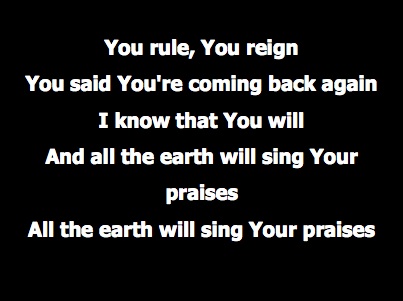
This way the congregation had heard the chorus once and sung it once.

2. Teach it not in order. This helps me and hopefully others remember that we’re actually working on learning the song. It also keeps us attentive to what part of the song we’re working on. We’ll piece it all together only once we’ve learned the component parts.

3. Highlight the lyrical content. If the tune is new, the lyrics likely are, too. At least they were in this case. So because this song speaks of Christ’s death, resurrection, and ascension, I took the opportunity to highlight that. I actually read some of the song lyrics before teaching it, and connected them to something my church says in our weekly worship: “Christ has died, Christ is risen, Christ will come again.” I mentioned that like 1 Corinthians 15 and Luke 24, this is one of the great summaries of our faith that can unite us across multiple denominations and Christian backgrounds.

4. Teach it with a conversational tone. I can’t think of any other way to teach a song than by actually talking with the congregation about it, what we’re doing, what we’re about to do, etc. I find a friendly, inviting, conversational tone works best. At least it feels right to me when I am teaching a song!

5. Affirm the congregation. Our worshiping community picked this song up so fast today (some knew it already, I think) that this was easy to do. I actually cut short the process of teaching the song so that we could begin from the beginning singing it all the way through. This was due to the fact that as I began teaching the verse (i.e., “I’ll sing so you can hear it”), I could already hear folks singing along. It would certainly not be out of place to sincerely say something like, “You all are good singers!” (Provided it’s true.)

6. Have them hear the song even before I teach it. For example, I had All the Earth will Sing Your Praises played over the speakers as they were leaving worship Monday, knowing we’d be learning it today. It’s a little thing, but it helps. Other options could have been playing it as the prelude today, emailing a Web link to the tune, etc.

The bottom line for me is: if we’re doing a song that I think will be new to most in the room, we highlight it as such and carve out time to work to learn it together. Then singing the new song from start to finish is not only easier, but feels like something we have worked at together in a way that draws us closer as we worship.

“Thinking Through the Benefits and Necessity of Liturgy”

Amanda MacInnis blogs wonderfully about the “benefits and necessity of liturgy.” On this Worship Leading Wednesday, I refer you to her. She has good things to say.

The money quote:

And so, even those who chafe at the thought of liturgy in Church, who balk at the use of liturgical texts on a weekly basis, are being profoundly shaped by the liturgy of being anti-liturgy.

Read the article in full here.

Creation… Fall… Redemption… Consummation. (Another one hour worship service from scratch)

On Sunday I led a group of student ministry leaders in worship for an hour. As in the time I described in this post, it was a one hour worship service from scratch. In other words, I was invited to plan and lead the hour of worship from start to finish. In my previous post I mentioned one way to give shape to what otherwise could be unstructured worship, using the A.C.T.S. acronym.

Here’s how I opted to structure the hour together with this same group this year. This is a version of the run sheet the worship musicians and I had before us.

Intro: Creation, Fall, Redemption, Consummation

  • What it is: way of understanding the whole sweep of the Bible (explain each part briefly)
  • Why it’s important: tells us God’s story—and our place in it.  Situate selves at start of new year.
  • We’ll weave between Scripture and Song and Prayer, standing and sitting, together and alone

Creation

Fall

Redemption

Consummation

  • Scripture: Revelation 21:1-5
  • And so our prayer, “Make all things new” is finally answered.
  • Moment of silence to reflect on “I am making all things new.”
  • Song (standing): Grace Like Rain

Conclusion: Close in prayer

A one hour worship service from scratch

Worship leaders from time to time may be called upon to plan a worship service start to finish, as I was this time last year. Here’s how I chose to give shape to an hour of worship with a group of student ministry leaders. This is one of many possible ways to go, but I did find that the sense of structure and movement helped us to feel like we had gotten somewhere by the end. Here is a version of the run sheet I used for myself.

Intro: Explanation of A.C.T.S. acronym

  • What it stands for: Adoration, Confession, Thanksgiving, Supplication
  • Why it’s important: keeps us focused on God….keeps us balanced in prayer life (not just “Me, me, me”)
  • It will frame our worship time together
  • We’ll weave between Scripture and Song and Prayer, standing and sitting, together and alone

Adoration

Confession

  • Prayer: (seated) Confession of Sin
    • Moment of Silence for individual confession
    • Confession from Book of Common Prayer
    • Assurance of Pardon from 1 John (read in unison)
  • Song: (standing or seated) (optional) I Love the Lord

Thanksgiving

  • Song: How Great Thou Art
  • Scripture: (seated) Lectio Divinia with Colossians 3:15-17
    • Explain Lectio Divina (Powerpoint slide with all four steps, one after the other)
    • NOTE: Four volunteer readers needed

Supplication

  • Prayer: (remain seated) How can we be praying for each other?  For our community?
  • (standing) Teach song: Today
  • Scripture: Joshua 24:14-15 with intro (give its context)
  • Song: Today

Conclusion: close in prayer

In the very near future I’m leading this same group in an hour of worship. I’m thinking through selecting songs, Scriptures, and prayers that follow the basic outline of salvation history: Creation, Fall, Redemption, Consummation. I’ll post the outline of that service on a future Worship Leading Wednesday.

Worship Leading Wednesday: You are what you worship

Some words of wisdom from Gary A. Parrett and S. Steve Kang:

That the formation of God’s people is a legitimate concern of our worship gatherings can be demonstrated by appeal to a number of biblical passages. First of all, worship itself is presented as intrinsically formative–for good or for ill. We read in several Old Testament passages, for example, that those who worship idols are doomed to become like the objects of their worship.

…That which is true in such profoundly negative and destructive ways, however, is also true in the positive. In other words, those who worship the living God will become like the object of their worship. Those who abide in the presence of the Lord, reflecting or contemplating his glory, are “transformed into his likeness with ever-increasing glory, which comes from the Lord, who is the Spirit” (2 Cor 3:18). Worshiping the God who is love, who is holy and righteous and true, we shall ourselves become more loving, holy righteous and true.

–from Teaching the Faith, Forming the Faithful: A Biblical Vision for Education in the Church, pp. 339-340

“Bringing our Pain to God” (Michael Card)

We’re afraid of other people’s pain. Like Job’s friends, we’re afraid when we don’t have answers. Job doesn’t get any answers for his sufferings, but he gets God.

–Michael Card, from this great article on Biblical lament in worship.

He’s got an album called The Hidden Face of God, which you can hear at Grooveshark for free (or click on the album image to the left). It kicks off with a great Gospel-flavored track called, “Come Lift Up Your Sorrows.”

Prayer in the liturgy: Is it worth it?

Today’s post comes from Timothy Dean Roth, author of The Week That Changed the World: The Complete Easter Story (amzn). There are few people whose words inspire, challenge, and fill me with a sense of God’s presence more than Tim’s. His book has been an excellent aid to my experience of Holy Week these last two years. He’s given me some of my best sermon ideas. Etc., etc. He’s a great dialogue partner and friend. As Words on the Word addresses themes of worship and liturgy on Wednesdays, Tim asks today: “Prayer in the liturgy: Is it worth it?”

If you go to a Church that has a time when a lector reads prayers and the congregation responds after each one-sentence prayer, “Lord, hear our prayer,” you may wonder sometimes whether the Lord really does hear our prayer, especially if you were spacing out and can’t even remember what the prayer was. The answer is that God does indeed hear these prayers, and he responds to them.

Here’s why. These prayers are themselves written by liturgists in a spirit of prayer in response to the needs of the times we live in. The Holy Spirit himself prompts liturgists who are attuned to his voice to write down these prayers. I have never heard a prayer read to the congregation that could be considered outside God’s will (and hopefully you haven’t either), and we know that God favorably answers prayers that are in accordance with his will. We also know that God the Father answers the prayers of the righteous, just like he answered the prayers of his own Son, though only if prayed in a spirit of steadfast faith and without doubt, which is the hard part.

Fortunately for those of us with weak faith, there are some crazy people out there who do believe that when we pray outlandish things like, “That you may increase peace in the Middle East” or, “That you may help all politicians recognize the value of life,” these things are actually going to happen. God hears these people, even if we can’t quite figure out how. What if a suicide bomber changes his mind the day before blowing up a mosque because enough people like the one right next to you sincerely said, “Lord, hear our prayer”? We can’t know how these prayers are answered, but they are. God’s word promises us that. Every little prayer counts, every little prayer brings a little more good into the world and a little less evil, and even the tiniest difference in the chaotic, unpredictable daily stock market fluctuations of good versus evil is worth the effort.

God is going to answer these prayers with or without your participation, so why not participate, why not fully abandon yourself to these prayers? Through these prayers, he’s inviting every one of us, from greatest to least, to join the battle, to actively participate in his work of transforming this world.

Ever tried to play guitar with a credit card? (as a pick?)

I have. (It was an old credit card.) Expired credit cards and insurance cards have a good thickness to them. Perfect for a gritty, hard plastic-on-steel sound.

But they’re a little unwieldy. Not quite pick-shaped. So check this out–guitar players can use this “pick punch” on Amazon to make their own guitar picks out of just about anything. A bit pricey, but an interesting novelty item nonetheless.

One-Stop Site for Worship Planning


In January I had the privilege of taking two college students with me to join with a gathering of worship leaders from many backgrounds at the Calvin Symposium on Worship. I’m still making use of the things I learned while there.

The Calvin Institute of Christian Worship has a fantastic Website. It’s a good place to spend some time, and on this Worship Leading Wednesday at WotW, I heartily recommend it. One of their resources that I’ve found most helpful as a worship planner is their “Plan Worship” space. Here you can, in their words:

The CICW also provide links to help in the crafting of music, prayers, and art for worship services.