Geffrey B. Kelly’s Reading Bonhoeffer

I’m a sucker for biblical and theological studies with an unapologetically doxological posture. So it was with excitement that I read John W. Matthews’s concluding sentence in his foreword to Geffrey B. Kelly’s Reading Bonhoeffer: A Guide to His Spiritual Classics and Selected Writings on Peace. Matthews writes:

I believe both the author and the subject [Bonhoeffer] would be disappointed if this book did not somehow draw you, the readers, closer to Jesus Christ and to your neighbor.

Kelly’s short yet substantive book does very much that. His first encounter with Bonhoeffer is intertwined with a beautiful story of his own re-awakening to Jesus. He says in the Preface:

Through Bonhoeffer’s inspirational words Jesus’ Sermon on the Mount seemed to be addressed to me personally for the first time. I was hooked.

Reading Bonhoeffer has four major sections:

  1. Dietrich Bonhoeffer: A Biographical Sketch
  2. On Reading Bonhoeffer’s Spiritual Classic, Discipleship
  3. Life Together: Bonhoeffer on Christian Community
  4. Selected Writings on Peace: An Ecumenical Conference and Two Sermons

The Preface, after describing Kelly’s transformative first read of Discipleship, offers some helpful background information and resources for Bonhoeffer studies. Kelly mentions, for example, his involvement with the International Bonhoeffer Society, English Language Section. He writes about the International Bonhoeffer Congress. And he discusses the genesis of the Dietrich Bonhoeffer Works series (English translation), published by Fortress Press.

1. A Riveting Biographical Sketch

Kelly’s “Biographical Sketch” is longer than Renate Bethge’s short work, and (obviously) a much quicker read than Eberhard Bethge’s monumental biography. 28 pages follow Bonhoeffer through his life, writings, and ministry.

Reading BonhoefferThere are a few things that stand out about Kelly’s short biography. For one, though it’s scant on details of Bonhoeffer’s early life (to be expected, given its length), the overview is thorough and really orients the reader well to Bonhoeffer. Kelly has a knack for succinctly summarizing Bonhoeffer’s writings in understandable language–even Bonhoeffer’s challenging Sanctorum Communio!

Second, Kelly’s biography is itself a gripping narrative. There is real movement as he progress through the various pastoral and academic positions Bonhoeffer held, from Berlin to London, from the seminary at Finkenwalde to the church struggle, Bonhoeffer’s arrest, and his imprisonment. I found myself wanting more dates in places (e.g., “Once back in Berlin…”–when?), but perhaps this omission was deliberate to keep the narrative moving. I was not able to put the book down until I had finished the page-turner of a biography.

Third, Kelly describes many of Bonhoeffer’s key terms and concepts, both in this first section and throughout Reading Bonhoeffer. Even a reader with little or no Bonhoeffer background will walk away from the biographical sketch with confidence to read any of Bonhoeffer’s writing.

Fourth, Kelly is clearly in awe of his subject, and rightly so. This, in turn, allows the reader to be inspired by Bonhoeffer. Kelly includes a treasure trove of Bonhoeffer quotations, some familiar, and some more off-the-beaten path. To wit:

I was quite pleased with myself. Then the Bible, and in particular the Sermon on the Mount, freed me from that. Since then everything has changed…. It was a great liberation. It became clear to me that the life of a servant of Jesus Christ must belong to the church, and step by step it became plainer to me how far that must go.

2. Kelly on Bonhoeffer’s Discipleship

Kelly served as co-editor, with John D. Godsey, of Discipleship, volume 4 in the (English) Dietrich Bonhoeffer Works series (DBWE). This second section of Reading Bonhoeffer offers more than 60 pages of commentary on that well-loved Bonhoeffer book, known also as The Cost of Discipleship.

After a brief “history of the text” Kelly proceeds section-by-section through Discipleship. In short, according to Kelly,

Discipleship is a book in which Bonhoeffer uses Jesus’ own words as recorded in the gospels and the exhortations of the apostle Paul to confront readers with the uncushioned challenges to all their inaccurate ideas, falsified by Nazi propaganda, of what it means to be a follower of Jesus Christ.

DBWE DiscipleshipReaders of Discipleship will of course already know that much of the book exposits Jesus’ Sermon on the Mount, but Kelly’s unique contribution as a commentator here is in highlighting the historical context that makes Bonhoeffer’s writing even more remarkable. Not only does Kelly note a particular Nazi evil to which Bonhoeffer may have been alluding, he also points ahead in Bonhoeffer’s life to instances where he would live out the call of his own writings.

As Kelly was co-editor of the DBWE volume, to read his chapter-by-chapter commentary on Bonhoeffer’s Discipleship is to have a guided tour by a leading expert, complete with summary statements and key quotes from that book. It’s well-footnoted with reference to the page numbers in the DBWE edition, so following up in Bonhoeffer’s text is easy. It’s an essential companion.

3. Kelly on Bonhoeffer’s Life Together

The first Bonhoeffer book to be published in the DBWE series was Life Together, which appears as volume 5, bound together with Prayerbook of the Bible. Kelly served as editor of that volume, which includes an introduction and critical apparatus (i.e., lots of informative and orienting footnotes).

DBWE Life TogetherAs with the previous section of Reading Bonhoeffer, Kelly’s commentary on Life Together, although significantly briefer in its section-by-section analysis, serves as a really useful reader’s guide. Its introductory section in this book is thorough, drawing on Kelly’s introduction in the DBWE edition. This sets up the reader well to better understand Bonhoeffer’s important work on community life in the Church.

Kelly, for example, points to “Bonhoeffer’s distinction between being with and being for the others in community.” He traces Bonhoeffer’s interest in building a community, going back even to socio-theological themes in Sanctorum Communio, Bonhoeffer’s first doctoral dissertation. Kelly summarizes and comments on each of the five sections of Life Together in turn: Community, The Day Together, The Day Alone, Service, and Confession and the Lord’s Supper.

4. Peace Writings

Kelly notes the tension that many students and readers of Bonhoeffer experience when they realize a conspirator against Hitler was a peace activist. After tracing the development of Bonhoeffer’s concern for peace, via an overview of his friendship with pacificst Jean Lasserre, Kelly looks at “three texts in which Bonhoeffer reveals himself as an uncompromising advocate for peace on the troubled earth where Nazism ruled with tactics of fear, violence, and the promise of a return to German military glory.” These include a 1932 conference lecture in Switzerland (with excerpts), a 1932 sermon (also with excerpts), and Bonhoeffer’s address to the Ecumenical Council of Christian Churches at Fanø, Denmark in 1934.

Together these orations display Bonhoeffer’s boldness and even impatience at times with inaction around him. In the address in Denmark, for instance, Bonhoeffer says,

Why do we fear the fury of the world powers? Why don’t we take the power from them and give it back to Christ? We can still do it today. The Ecumenical Council is in session; it can send out to all believers this radical call to peace.

Kelly helps Bonhoeffer’s call to peace come alive for the reader many decades later.

Concluding Remarks

There is little to critique in Kelly’s book. However, I was distracted by a number of sentences that were long (multiple modifying prepositional phrases) and comma-less. For example:

[Bonhoeffer] recognizes the danger posted by abandonment of Christ’s vision for the world and the manner in which even basically good people can succumb to the temptations to fall into the compromises in morality for which worldly attitudes are particularly prone, business and government plaudits given to acts of avarice and violence serving as prime examples of why it is necessary to be single-minded in following Christ.

A re-read of every such sentence showed that it was generally clear enough. But additional punctuation or shorter sentences would have helped. If there are future printings of this fine book, perhaps this and a few other minor editorial oversights could be re-visited.

Woven throughout Reading Bonhoeffer are “the twin aspects of Bonhoeffer’s spiritual legacy: scholarly expertise and pastoral care.” Kelly himself writes as one in the academy whose own pastoral sensitivity and concern is fully on display. I can only imagine how engaging and inspiring a Bonhoeffer course with him must be.

Reading Bonhoeffer would be a stimulating read for pastors, theologians, seminary students, and Christians who are intent to more faithfully follow Jesus in both individual and community contexts. The discussion questions at the end of each section will facilitate this book’s use in a small group, Sunday school, or classroom setting.

Kelly writes about Bonhoeffer, yes, but Bonhoeffer points so often and so clearly to Jesus, that a good commentary on Bonhoeffer (which this book is) will do the same. I am grateful for this short, hearty work that Kelly has written, and hope that more DBWE volumes receive similar treatment in the future.

By the way–I’m also grateful to Wipf and Stock Publishers for the review copy. They’ve provided a 40% off coupon code to readers of this blog, good toward the purchase of Reading Bonhoeffer or anything else on Wipf and Stock’s site. Simply use the code LETTERS at checkout. It’s good through the end of May.

Becoming a Living Martyr

The below is adapted from the sermon I preached on Acts 7:54-60 today. You can read that text here.

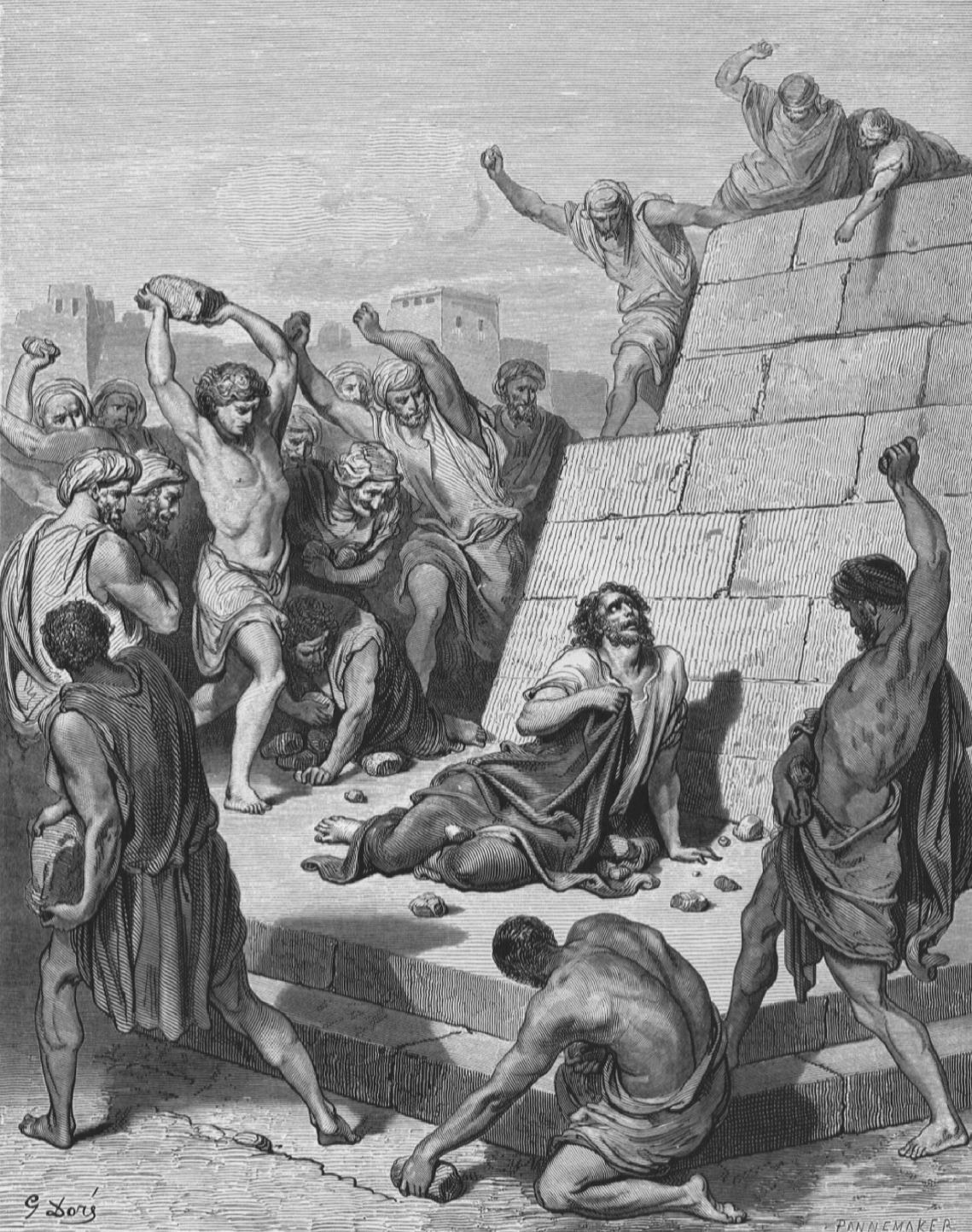
The Stoning of Stephen

As the mob closes in, Stephen is distracted, beautifully distracted, by a vision of Jesus. “Look,” he says, “I see the heavens opened and the Son of Man standing at the right hand of God!” Usually when we hear about Jesus at the right hand of God, he’s seated, as on a throne. But it’s as if Jesus stands up to receive his servant Stephen, to welcome him into an unmediated experience of God’s love and presence, for all eternity.

The Stoning of Stephen, Gustave Doré (1832–1883)

His angry listeners thought they were hearing blasphemy, and so covered their ears. This Jesus who died was to them a heretic, rightly crucified under God’s curse for claiming to be something he was not. And Stephen says he sees this Jesus standing next to the one God! So bad was this blasphemy that they had to rush him out of the city of Jerusalem. The holy city should not be subject to such absurdities.

Verse 59 says that as he was being stoned, “Stephen prayed, ‘Lord Jesus, receive my spirit.’”

This should sound familiar to us. Luke, who wrote the book of Acts, also records Jesus saying on the cross, “Lord, into your hands I commit my spirit.”

“Then [Stephen] knelt down,” Luke writes, “and cried out in a loud voice, ‘Lord, do not hold this sin against them.’”

More familiar words. Luke also records Jesus saying, “Father, forgive them, for they do not know what they are doing.”

Stephen is remarkably like Jesus in his death. He is able to ask for forgiveness for those who are unjustly killing him.

Stephen makes death by stoning look easy. Luke says in the NIV that he “fell asleep”…. It was actual death, obviously. But so smooth, so easy, so forgiving and loving, so peaceful was the way in which Stephen faced his execution, that he simply “fell asleep.” And he entered into God’s presence.

“The Blood of the Martyrs…”

An early church theologian named Tertullian famously said, “The blood of the martyrs is the seed of the church.”

Even on that day of Stephen’s death, there might have been a small seed planted in Paul’s heart, as he collected coats from the crowd.

Stephen was the first Christian martyr after Jesus’ death and resurrection. Before Stephen there was John the Baptist. After Stephen there were James, Peter, and a host of other apostles and church leaders. A number of means were used for martyring someone. Some of them quick and sudden, others slow and painful.

“The blood of the martyrs is the seed of the church,” because we marvel at the courage of our sisters and brothers in Christ who stand for Jesus, come what may. Books of the lives of martyrs have long been popular among Christians, for use in private devotion and in public worship, to inspire, encourage, and exhort the body of believers to persevere in their faith.

I’ve been reading about one such martyr lately.

Catholic Archbishop Óscar Romero made it a hallmark of his ministry to stand with the poor, the marginalized, those who were on the other side of power. Romero, in what would be his final recorded sermon, gave a litany of the recent deaths of peasants and students in his El Salvador, even naming some by name, so that unjust violence and oppression would not go unnoticed. These victims have names, he insisted. Amazingly, his sermon concluded with an appeal to “the National Guard, the police, and the military” who were responsible for the killing. He said,

I implore you, I beg you, I order you in the name of God: stop the repression.

As he was preparing the Mass in a service of worship the next day, he lifted the chalice high, and was shot in the chest, falling at the feet of the crucifix.

“May God have mercy on the assassins,” he said, echoing Jesus and Stephen. Like Stephen, he committed himself into the hands of his Lord Jesus.

Martyrs Today

Most of us will never stare a martyr’s death in the face, but today, throughout the world, Christians do. Some of their stories are known, many others are unknown.

Sadly, we don’t have to look very hard for martyrs in 2014. Just this last week in Sudan, a 27-year-old woman, Meriam Yahia Ibrahim, received a death sentence for not recanting her Christian faith in favor of Islam. She has a 20-month-old son and is 8 months pregnant.

But the Islamist courts and government that have handed down her sentence cannot destroy her faith in Jesus, or even the Church of Jesus, to which she belongs, with us.

Like Stephen, she has committed himself into the hands of her Lord Jesus.

A Christian’s death because of his or her following Jesus continues to inspire the Church to grow.

A hip-hop artist in El Salvador, 30 years after Romero’s death, reflected on the former Archbishop’s ubiquitous cultural presence in that country. “What [Romero’s] killer did,” he said, “was to keep three generations thinking about him.”

How did they do it?

How did these men and women face death so calmly? So peacefully? How did Stephen and Romero both ask, with their last breaths, for God to forgive the ones who turned them into innocent victims?

I’m convinced that by the time a Christian martyr is confronted with death, she has already died a thousand deaths, by living for God.

In the moment that a disciple of Jesus looks the end of life in the face, he has already died to himself, many times over, by accepting Scripture’s call to follow Jesus.

When Jesus says, “take up your cross and follow me,” he says, do it daily. Take up your cross in life, in your everyday life. Not just in death, but in life.

Which is a funny thing to say, if you think about it. We’ve got a rather sanitized view of the cross. It’s a thing we might wear around our necks, or a centerpiece in some church sanctuaries. But it’s a symbol of death. For Jesus, it was a means of martyrdom.

A Call to Be Living Martyrs

The call to “take up our cross daily,” then, is a call to martyrdom, maybe in death, for some… but for sure it’s a call to be living martyrs. We who follow Jesus have a call to die to ourselves, each day.

Two years before his death, Archbishop Romero paraphrased Jesus a bit, though I think he captures his meaning well. He said,

“Let those who would follow me deny themselves”…repress in themselves the outbursts of pride, kill in their hearts the outbursts of greed, of avarice, of conceit, of arrogance. Let them kill it in their hearts. This is what must be killed, this is the violence that must be done, so that out of it a new person may arise, the only one who can build a new civilization: a civilization of love.

Stephen, when he came to the day of his stoning, was already dead to himself. He was already fully alive in Christ, living for God alone. His whole being was consumed with imitating Jesus.

At his dying he said the same things Jesus said in his death, “Father forgive them.” “Into your hands I commit my spirit.” And so, mind-boggling as his final prayers are, they are not anything you wouldn’t have already expected, if you knew him.

Those kinds of prayers were already part of his daily life. Prayers like,

Father, forgive those who do wrong to me. Jesus, have mercy on those who mistreat me, who misunderstand me, who fail to give me the benefit of the doubt, who take advantage of me. Please forgive them.

And, prayers like,

Jesus, into your hands I commit this day; I give you my work. I devote my time to you. I lift up my children and my family to you—they are truly yours and not mine, so I commit all of us into your care.

Stephen fixed his eyes on Jesus as the crowd started to pick up heavy stones. But this sort of “looking up,” this sort of steady gaze on the person of Jesus, was already an ongoing posture in Stephen’s life.

We must die to our carnal desires that make an empty yet compelling promise of life. We must live instead to the will of Jesus.

We must die to the values of this world, a society that tells us that newer is better, that less is worse, that power over others is something to be procured and preserved. We must live instead to the values of the kingdom of God, where the pure in heart see God, where we are satisfied not with buying or getting more stuff, but where we are satisfied in God when we hunger and thirst for righteousness.

We must die to arrogance and greed, and live instead to humility and generosity.

We must die—as we are able—to our impatience with others who insist on taking our time and attention, when we’d rather keep to ourselves.

We must die to our desire for revenge, and live instead to show mercy to even the merciless who don’t deserve it.

We must die to any impulse we may have toward violence, and live instead to make peace.

We must die to ourselves, and live to Jesus, losing our lives for his sake.

Like Stephen, we must commit ourselves every day into the hands of our Lord Jesus.

“Beautiful is the moment,” Romero said, “Beautiful is the moment in which we understand that we are no more than an instrument of God; we live only as long as God wants us to live; we can only do as much as God makes us able to do….”

Into your hands, Lord Jesus, do we commit our spirits.

Into your hands, Lord Jesus, do we commit our lives.

Into your hands, Lord Jesus, do we commit our desires and dreams.

Into your hands, Lord Jesus, do we commit our whole selves.

How to Teach a New Worship Song to a Congregation

The below is a re-post from September 2012. I’m posting it again because it strikes me that summer could be a good time to try something new in your church services, including learning new songs together. Here are some suggestions for teaching a new worship song to a congregation or other group of people.

This morning I had the privilege of teaching our worshiping community this song:

Because I had guessed it would be new to the majority of our congregation, I decided to teach the song before we sang it all the way through. There are at least six things I like to try to do when teaching a new song:

1. Split it into pieces. I had the chorus for All the Earth Will Sing Your Praises on two Powerpoint slides. So I sang through the first half of the chorus (one PPT slide), stopped, and invited the congregation to sing that same part with me:

Then I repeated that same process for the second half of the chorus:

This way the congregation had heard the chorus once and sung it once.

2. Teach it not in order. This helps me and hopefully others remember that we’re actually working on learning the song. It also keeps us attentive to what part of the song we’re working on. We’ll piece it all together only once we’ve learned the component parts.

3. Highlight the lyrical content. If the tune is new, the lyrics likely are, too. At least they were in this case. So because this song speaks of Christ’s death, resurrection, and ascension, I took the opportunity to highlight that. I actually read some of the song lyrics before teaching it, and connected them to something my church says in our weekly worship: “Christ has died, Christ is risen, Christ will come again.” I mentioned that like 1 Corinthians 15 and Luke 24, this is one of the great summaries of our faith that can unite us across multiple denominations and Christian backgrounds.

4. Teach it with a conversational tone. I can’t think of any other way to teach a song than by actually talking with the congregation about it, what we’re doing, what we’re about to do, etc. I find a friendly, inviting, conversational tone works best. At least it feels right to me when I am teaching a song!

5. Affirm the congregation. Our worshiping community picked this song up so fast today (some knew it already, I think) that this was easy to do. I actually cut short the process of teaching the song so that we could begin from the beginning singing it all the way through. This was due to the fact that as I began teaching the verse (i.e., “I’ll sing so you can hear it”), I could already hear folks singing along. It would certainly not be out of place to sincerely say something like, “You all are good singers!” (Provided it’s true.)

6. Have them hear the song even before I teach it. For example, I had All the Earth will Sing Your Praises played over the speakers as they were leaving worship Monday, knowing we’d be learning it today (Wednesday). It’s a little thing, but it helps. Other options could have been playing it as the prelude today, emailing everyone a Web link to the tune, etc.

The bottom line for me is: if we’re doing a song that I think will be new to most in the room, we highlight it as such and carve out time to work to learn it together. Then singing the new song from start to finish is not only easier, but feels like something we have worked at together in a way that draws us closer as we worship.

Portrait of a Thriving Church

As my wife and I continue to raise our three young children, we try to think about the values we want to instill in them. It’s not just about how we want them to behave, although we let them know that, too, but we have a certain ethos we are trying to cultivate in the family. We find ourselves saying things like, “That’s how we act in this family,” or, “This is not how we talk to each other in this family.”

What about our other family—our church family? How do we act? How do we treat each other? What sorts of things should we do? What are the values of this family?

The lectionary reading (Acts 2:42-47) provides some serious inspiration, some robust answers to that question. It gives a portrait of a thriving community of Christians.

The Four Things They Did

Acts 2:42    They devoted themselves to the apostles’ teaching and to the fellowship, to the breaking of bread and to prayer.  43 Everyone was filled with awe, and many wonders and miraculous signs were done by the apostles.

There are four repeated activities listed in verse 42, that the earliest church was practicing together regularly. These are all things that they devoted themselves to… they gave themselves wholly to these things.

1. The Apostles’ Teaching

The first thing to which the early church devoted themselves was the apostles’ teaching.

The Apostles Preach the Gospel, Gustave Doré (1832–1883)

Earlier in this same chapter, Acts 2, Peter, one of the apostles, addresses a crowd who is amazed at the outpouring of the Holy Spirit on this early community of believers.

He speaks of the life of Jesus, his death, and his resurrection. As one summary formulation of the Christian faith says, “Christ has died. Christ is risen. Christ will come again.” The apostles did us the great favor of writing down their teachings and the teachings of our Lord… so that we, too, can devote ourselves to the apostles’ teaching, just as the early church did.

At our own church we “devote [ourselves] to the apostles’ teaching” any time we gather to hear God’s Word read and proclaimed, when we study our way together through a book, or in a small group setting. We do that when we remind ourselves of the truths contained in Scripture, how the teachings of the Bible make available to us a fuller life than we could have ever dreamed of.

A thriving church devotes itself to the apostles’ teaching, to their words preserved for us now through the Scriptures.

2. The Fellowship

Second, they devoted themselves to “the fellowship.”

This term “fellowship,” that the author Luke uses, was also used in his day to describe the sort of close relationship that exists in a healthy and intimate marriage.

We can think about some of the marks of a good marriage: spending unhurried time together, taking a slow walk to just talk, sitting down for a meal and conversation, learning what makes the other person tick, trying to understand how to speak their love language. Happy marriages are not devoid of conflict, but have at least some established patterns for dealing with conflict when it inevitably arises. They’ll stop and carve out the time to work together on building the relationship.

My college roommate and I had so many post-conflict, relationship-clarifying talks our first year living together, that we often talked about how ready we were both going to be for marriage… how lucky two women were going to be to find such well-formed, emotionally mature men such as ourselves, who knew how to work through disagreements and differing life perspectives.

One kind of fellowship

The analogy breaks down, obviously, and I’m not suggesting we think of ourselves as married to this church, per se. But there is something to be said for a repeatedly investing yourself in a close fellowship with others. It takes effort. And, you may have heard it said, sometimes to have a friend, you need to be a friend. Fellowship doesn’t just happen by all showing up in the same place together each week.

One writer puts it this way:

There are churches that view themselves as friendly and welcoming, but within which a visitor will not be drawn into conversation—where even members can suffer silently, unknown and unloved. Devotion to fellowship means nurturing the habits of hospitality—and it takes work: It takes courage to notice a newcomer, helping him or her find the coatrack or a classroom. It takes initiative to invite someone to lunch or a cup of coffee after worship…. It takes creativity to start a regular gathering where a small group can begin to know and care for each other.

A thriving church devotes itself to the creative, proactive work of building fellowship. Members of such a church make efforts to intentionally cultivate relationships.

3. The Breaking of Bread

Third, this early, thriving church devoted themselves to “the breaking of the bread.”

Alister McGrath writes about the passing of his aunt, barely 80 years old when she died. As he and some others were cleaning out her house, they found an old photograph of a young-looking man, someone his aunt had been in love with, but the relationship had come to an unexpected and premature end. His aunt was never married—this young man she had loved, and him alone.

Why did she keep the photograph, so many years after the relationship ended?

McGrath writes,

As she aged, she knew that she would have difficulty believing that, at one point in her life, someone had once cared for her and regarded her as his everything. It could all have seemed a dream, an illusion, something she had invented in her old age to console her in her declining years — except for the photo. The photo reminded her that she really had loved someone once and was loved in return. It was her sole link to a world in which she had been valued.

In the same way, McGrath goes on,

Communion bread and wine, like that photograph, reassure us that something that seems too good to be true—something that we might even be suspected of having invented—really did happen.

Jesus, you will remember from last week’s reading, was made known to two disciples on the Road to Emmaus, in the breaking of the bread.

Breaking bread together is a way we remember and reinforce the content of the apostles’ teaching: “Christ has died. Christ is risen. Christ will come again.” When we break bread and drink from the cup together, we remind ourselves that something “really did happen.”

4. Prayer

Fourth, this early, thriving church devoted themselves to “prayer.”

praying handsHere, too, devotion and initiative are needed. It takes dedication to remember to pray not just here, not just today, but throughout the week for each other. And it also takes devotion to have the guts to share something vulnerable, to ask others for prayer for specific things we are in the middle of. But as we do, we find ourselves growing together into a closer fellowship of Christians.

A thriving church devotes itself to prayer.

One More Thing They Did

And there’s at least one more thing this early church did, that still stands out as an example to us. That is in verses 44 and 45.

44 All the believers were together and had everything in common.  45 Selling their possessions and goods, they gave to anyone as he had need.

This passage and these verses in particular have inspired many an intentional community to actually move in and live together as disciples. Churches are a little bit different, in our context, but part of a deliberate devotion to fellowship is making sure we care for our own, especially when they are in need.

One other translation says that “they sold from time to time,” implying that this was not just a one-time event, but an ongoing solution that the church offered to the financial challenges its members faced.

With Determination, With Glad and Sincere Hearts

Luke twice mentions the devotion that the church had in working together to build a healthy and faithful community. In verse 42, “they devoted themselves….” In verse 46, “Every day they continued to meet together.”

It was continually, with perseverance, over and over, time and time again, that the church persisted in coming together. They worked at it, and they didn’t stop working at it.

But lest we think it was all work and no fun, Luke also says, “They broke bread in their homes and ate together with glad and sincere hearts.” They were truly happy to be together. They thoroughly enjoyed each other’s company.

Come, Devote Yourself to the Church….

“It is not good to be alone,” we hear, very early in the Bible.

Loneliness is a sort of pre-existing human condition, and the church is its best antidote.

Do you feel flat, dull, or stale in your walk with God? Come, devote yourself to church, and have your faith renewed by worshiping with others who want to love and know the same God you do.

Are you listless, directionless, or looking for wise counsel as to how to live? Come, devote yourself to the teaching of the apostles, and we as a church will dwell on God’s Word together.

Do you feel despondent as you eat another quiet meal alone? Come, devote yourself to the fellowship of the church, where we spend time in meaningful conversation with each other, often with food and drink in hand.

Have you forgotten who you are, and who Christ is? Do you need to remember again just how much Jesus loves you, precious child that you are? Come, devote yourself to the breaking of the bread, and know Jesus—and taste his love—in the physical reminders of his body and blood, given for us.

Are you facing a scenario that is far beyond your capability, that has you throwing up your hands in surrender? Or have you experienced a recent joy, the excitement of which is so great you have to tell somebody else? Lean on others who will mourn with you, who will rejoice with you, and who will pray with you and on your behalf. Come, devote yourself to prayer, and find renewal and strengthening from the prayers of others.

God, Who Makes it Grow

The last verse in our passage says, “And the Lord added to their number daily those who were being saved.” Ultimately it was God who grew that young church.

mulberry treeWhether it’s numerically or in other ways—spiritual depth, strength of fellowship, vulnerability of relationships—it is God who adds to the health and vitality of a fellowship of believers. We are planters, though, and we can dig out a small hole in the dirt and drop in a few seeds. We can cultivate what we’ve planted by watering it and protecting it from pesky garden predators—those forces that would prohibit growth together. We can nurture this organic, living body we call our church through our perseverance, our continual commitment to be together, and with glad and sincere hearts.

Come, let us devote ourselves to the work of nurturing this church: through learning the Scriptures, through fellowship, through the breaking of the bread, through prayer, and through sharing with each other when we are in need…. And as we work, let’s watch God move among us and make us grow.

The above is adapted from the sermon I preached on Acts 2:42-47 today. All Scripture quotations come from the NIV (1984) or TNIV. See my other sermons, if you desire, here.

O Lord or Oh, Lord?

CommaWhen I was a college worship director for a couple of years, I put together and helped edit a lot of lyrics on PowerPoint. One recurring question I had was: Is it O Lord or Oh, Lord?

By default I found myself using the first, though I was never really sure why (I thought it looked better).

According to this articleO Lord is correct, when addressing a petition, prayer, or other saying to God.

One thing I’m still stuck on, though–if is proper for use with vocatives, why is there not also a comma after it?

Do Not Our Hearts Burn Within Us?

Supper at Emmaus, by Dr. He Qi, 2001

N.T. Wright compares the two disciples on the road to Emmaus to people who have gotten up early to watch the sunrise, but were looking westward, rather than eastward.

They were like people on a hillside, watching eagerly for the sunrise. …Disoriented, they are facing the wrong way. The expected moment comes and goes, and nothing happens. Then they become aware that, though the sky they are scanning remains dark, light seems to be shining anyway. With a strange excitement they turn around, to see the sun shining in full strength in the very place they least expected it.

The day Luke describes in Luke 24:13 is the day of Jesus’ resurrection, although it was decidedly not Easter to these two travelers. This is why Wright says “they least expected it.”

The women had seen the empty tomb, and these two disciples knew that, but they hadn’t pieced it all together yet. To them, Jesus was still dead. So they have this road trip now to talk about the death of Jesus, the denial of Peter, the betrayal of Judas, the crowds shouting, “Crucify!”, the weeping of the disciples at the cross, and the shock and shattered dreams of the community of Jesus’ followers.

One of the questions Luke is posing to his listeners and readers is: will we, when Jesus shows up, have eyes to see him?

The Road to Emmaus Was Covered With Tears

Jesus chastises the two, as only a loving and trusted teacher can do, for not understanding, for not knowing who he was.

But, in one sense, we don’t really want to blame these two disciples. To be fair, they were utterly devastated. “[T]hey crucified him,” they said, “but we had hoped that he was the one who was going to redeem Israel.”

When our eyes are cloudy with tears, when we’re sinking beneath the weight of death and tragedy and incomprehensible outcomes… do we recognize Jesus?

They must have felt like that speech from Macbeth that I had to memorize in high school:

Out, out, brief candle!
Life’s but a walking shadow, a poor player
That struts and frets his hour upon the stage
And then is heard no more. It is a tale
Told by an idiot, full of sound and fury
Signifying nothing.

Good Friday and the days following were just an idiot’s tale, not a compelling narrative of an entire nation’s redemption. It all meant nothing.

Jesus and the Disciples on the Road to Emmaus, by Gustave Doré (1832–1883)
Jesus and the Disciples on the Road to Emmaus, Gustave Doré (1832–1883)

We don’t know for sure where Emmaus is–people who like to study these things have made two or three suggestions. It was within walking distance from Jerusalem, at least.

But I think we do know what Emmaus was. It was an escape. It was another town, it was not-Jerusalem, which was just too painful a place for these two disciples to be. It was a pre-emptive break from the regular weekday schedule that surely awaited the disciples on Monday morning. Those routines would have been unbearable with Jesus gone. So at least if they could go somewhere where the buildings and mountains and water wouldn’t remind them of him, maybe their sorrows could be numbed a little bit.

They were done. It was over. The road to Emmaus was a road of confusion, frustration, and tears.

Jesus Shows Up

Then Jesus shows up. They don’t know it’s Jesus. It’s another fellow traveler, and it would not have been weird at all for them to walk together, even if they hadn’t met.

“They were kept from recognizing him,” Luke says, a curious phrase. Was it their own sadness that kept them from seeing? Was it lack of faith? Did they think, “Hey this guy does look a little like Jesus, but no way it’s him”? Did God somehow keep them from seeing, so this scene could play out?

When he asks what they’re talking about, they can hardly bring themselves to re-live the tragedy. Cleopas does his best and, surprised that anyone wouldn’t have heard the front-page news, he goes on and tells about the criminal’s death his supposed Savior died.

[W]hat is more, it is the third day since all this took place. In addition, some of our women amazed us. They went to the tomb early this morning but didn’t find his body. They came and told us that they had seen a vision of angels, who said he was alive. Then some of our companions went to the tomb and found it just as the women had said, but him they did not see.

They knew this was the “third day,” when something was supposed to happen. And they knew the tomb was empty. And they knew the women were excited and had seen angels at Jesus’ tomb. But they hadn’t yet seen Jesus alive, outside of the tomb.

Jesus rebukes them for not knowing how it was supposed to all go down, a gentle (or maybe not-so-gentle) reminder to us to pay attention to what God is doing in the world… to pay attention to who Jesus is. No matter what led these two followers to go to Emmaus, there were some mysterious things afoot in Jerusalem, and they didn’t bother to stick around to see how it would play out. Maybe this is why Jesus calls them “foolish” and “slow of heart.”

Jesus then goes through the Scriptures (“Moses and all the Prophets,” or the whole Old Testament) and shows how it all points to him.

They Recognized Him

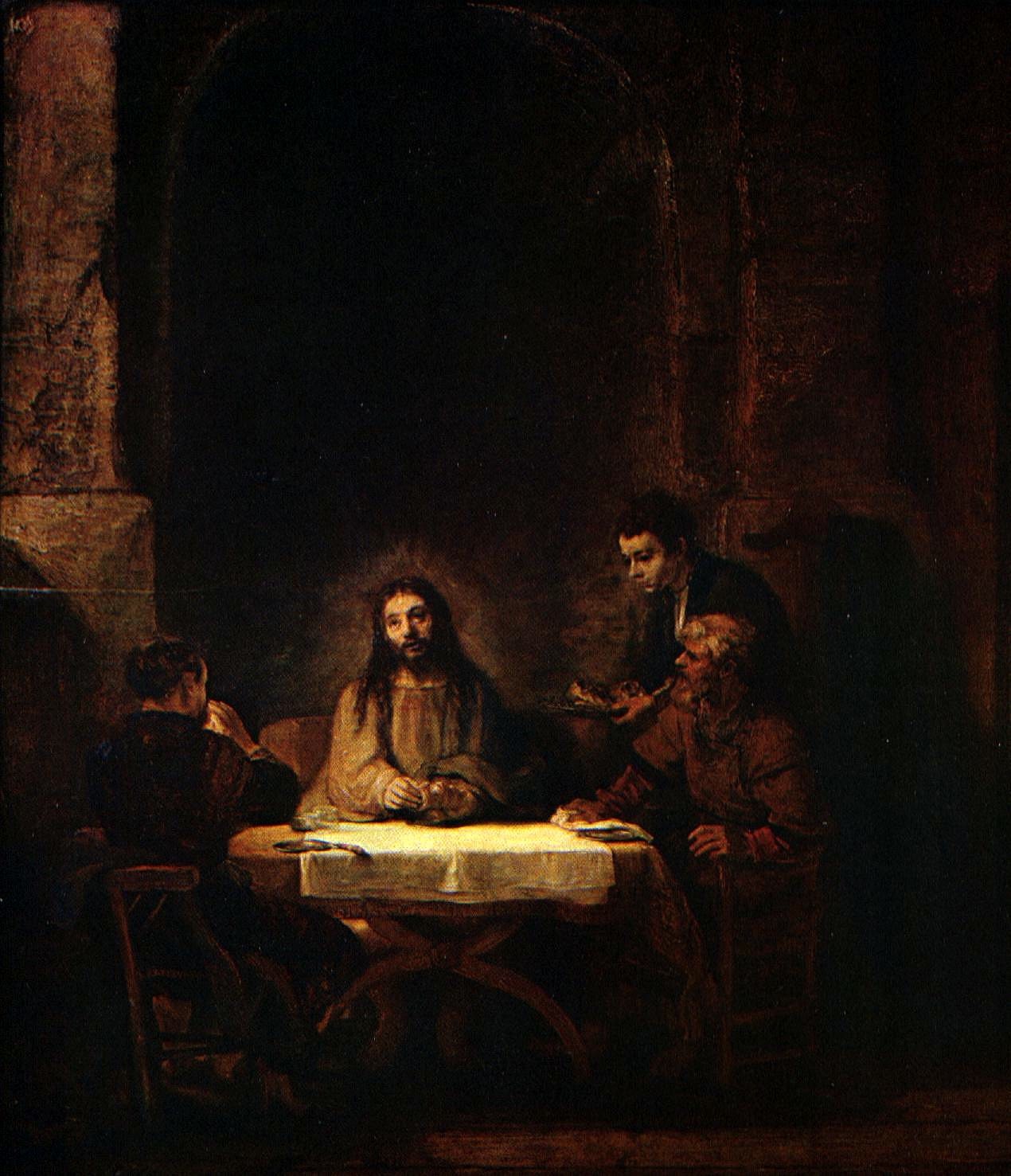
They get to Emmaus, so they get ready to stay the night there. Middle Eastern hospitality requires that they ask Jesus to join them, so he’s not out walking by himself. They sit down to eat. If the guided tour of the Hebrew Bible by one of its co-authors wasn’t enough, the two disciples now at last recognize Jesus, as he breaks the bread. Jesus goes quickly from table guest to host at a meal that would forever transform these two:

When he was at the table with them, he took bread, gave thanks, broke it and began to give it to them. Then their eyes were opened and they recognized him, and he disappeared from their sight. They asked each other, “Were not our hearts burning within us while he talked with us on the road and opened the Scriptures to us?”

The Disciples Recognize Jesus at Emmaus,  Rembrandt (1606–1669)
The Disciples Recognize Jesus at Emmaus,
Rembrandt (1606–1669)

Now they know Jesus, in the breaking of the bread. Perhaps they recall the feeding of the 5,000, or the Last Supper that they had probably heard about from the other disciples who were there. On both of those occasions, Jesus took bread, gave thanks, broke it, and distributed it.

So they go back to Jerusalem, where all the commotion is, and make their contribution to the unfolding events of the first Easter:

They got up and returned at once to Jerusalem. There they found the Eleven and those with them, assembled together and saying, “It is true! The Lord has risen and has appeared to Simon.” Then the two told what had happened on the way, and how Jesus was recognized by them when he broke the bread.

Jesus appears to them through the reading of Scripture and through fellowship at a table.

Time and time again the early church and the church throughout the ages would gather to hear the Word of God proclaimed and the sacrament of communion celebrated, and in so doing the church would continue to recognize its risen Lord.

Hearts Burning Within Us

During an Easter hymn two weeks ago, I was filled with awe at just how transforming the resurrection is for those who believe in it.

I began to think, “What if we remembered more often, both when we’re together and when we’re apart–what if we remembered more often that we worship a risen Jesus, and Christ’s resurrection completely transforms how we see the world? The victorious life over death of the resurrected Jesus is foundational to our identity.” We worship a Lord who could not be shut up in a tomb. Therefore, we, too, are resurrection people, disciples who have been forever changed by Christ’s victory over death.

Do not our hearts burn within us when we gather to hear God’s word, and when we break bread at Christ’s table? And do not our hearts burn within us, as we see Jesus in each other, at brunch or meals in each other’s homes, at coffee, through small group prayer, and notes of encouragement? Do not our hearts burn within us when we realize we’re not alone on the road, but have each other for traveling companions?

Do not our hearts burn within us when we truly recognize Jesus through an encounter with him?

And this encounter with Jesus is just as likely to take place on our defeated path to Emmaus… in those moments where we walk away from our hopes and dreams and visions of the future that are now traded in for just the hope of making it to lunchtime….

We see Jesus on our roads and sidewalks, because he comes and finds us there. We weren’t even looking for him. We didn’t even recognize him, and he came–the resurrected Lord, giving us his broken body and blood for our new life–he came and enlivened our hearts, rekindled our passion, made us excited about something again. Jesus gave us renewed purpose and vision. Jesus offered us hope when we were grasping at straws.

Do not our hearts burn within us?

And so we, who have seen this risen Lord, say with the two Emmaus-bound disciples and the others:

“It is true! The Lord has risen!”

This becomes a foundational truth about our identity, our make-up as believers in Jesus.

We are a people who have seen the risen Lord.

“It is true! The Lord has risen!”

We may invite him in as a guest to our gatherings, as those two road-walkers in our passage did. But we quickly find Jesus himself to be host, the one who invited us into fellowship with him in the first place. And do not our hearts burn within us as we hear his invitation to come to his table?

“It is true! The Lord has risen!”

Come, see Jesus now. The table of fellowship is set. Recognize him as he opens his table to us who journey along the road. And let your heart beat a little bit faster as you encounter the risen Jesus there.

The above is adapted from the sermon I preached on Luke 24:13-35 today. All Scripture quotations come from the NIV (1984) or TNIV. See my other sermons, if you desire, here. The image at the beginning of the post is used and covered under the Creative Commons Attribution Noncommercial ShareAlike 3.0 License.

It’s Still Easter

Via Jeff Miller at www.splendoroftruth.com
Image Source: Jeff Miller at splendoroftruth.com

You may be done with Easter Sunday services and Easter egg hunts. You may have put away your fancy new Easter dress and your bunny decorations. But Easter isn’t over, at least not for millions of Christians throughout history and throughout the world today.

Mark D. Roberts introduces the idea of Easter as a season with the above words, part of a post here that is worth reading in its entirety.

In the church calendar the Easter season begins on Easter Sunday and goes to Pentecost Sunday. That gives, Roberts points out, seven weeks of Sunday worship to sing Easter hymns and focus more intently on the resurrection of Jesus. He writes:

I was ready to experiment with all of this, though I must confess it felt rather strange to sing “Christ the Lord is Risen Today” a couple of weeks after Easter Sunday. (“Christ the Lord is Risen Two Weeks Ago” wouldn’t work either.) Moreover, the word “Eastertide” sounded strange to me, like some remnant of days gone by. Nevertheless, I did my best to be a good sport. Slowly, over the years, I’ve grown to appreciate celebrating Easter for more than just a single Sunday.

Especially for churches and Christians that observe 40 days of lent Lent (which, let’s be honest, can feel loooong), marking and celebrating the even longer 50 days of Eastertide is important. Roberts recommends some practical ways to engage in and celebrate the risen life of Jesus. Check it out here.

Death Has Been Swallowed Up in Victory

The resurrection

You don’t go to a tomb to rejoice. You don’t go to a graveyard, shortly after someone has been buried there, to celebrate.

And so, Matthew writes, “After the Sabbath, at dawn on the first day of the week, Mary Magdalene and the other Mary went to look at the tomb.”

They have come to pay their respects and to remember their now deceased teacher. They have come to mourn–expecting to find comfort, perhaps, in being together, but not expecting much more than that.

Then an angel pushes away the stone covering the tomb–we can think of the tomb as a sort of underground walk-in closet. And the guards are so scared, they shake and are petrified.

“Do not be afraid!” the angel has to say to the unsuspecting women. “Jesus is not here–he is risen!” Come, look, the angel says, “see the place where he lay.” “Go quickly and tell his disciples–He has risen from the dead!”

As they hurry off, their fast-beating hearts a jumble of joy and fear, they see Jesus. “Greetings,” he says, nonchalantly. (“Hey, what’s up?”)

They kneel down, grasp his feet, and worship him.

They had gone to his tomb to weep.
Instead, they went away laughing and rejoicing.

They had come early that morning to encounter the stark reality of death.
Instead, they found the glorious miracle of new life.

They had come to process an immense and unthinkable loss.
Instead, they met a living Jesus, the triumphant victor over death.

These women, and then, in turn, all of Jesus’ disciples from that day forward, would never see death the same way again.

Death Swallowed Up in Victory: Paul’s Reminder

Some years later Paul would remind his church of the “gospel,” the good news of Jesus.

The good news, he says, is “that Christ died for our sins according to the Scriptures, that he was buried, that he was raised on the third day according to the Scriptures….”

By this “gospel,” the good news of Jesus’ death and coming back from life to show himself again to his followers–by this “gospel,” Paul says, you are saved. You are delivered.

Where your life had been a prison,
you are freed.

Where you had once seen darkness,
now you see light.

Though you had come to a tomb, ready to mourn because of the end of things,
now you rejoice at a new beginning and fresh possibilities.

Where it had once been a long, hard, cold, relentless winter,
the spring of new life is finally here.

Because Jesus was raised on the third day, we will never see death the same way again.

“Death has been swallowed up in victory.” Paul speaks of a day when that will come true, when death itself is finally and forever dead.

But the way Paul is talking–it’s so certain a fate for death, for it to be completely vanquished and drowned in new life… it’s so certain that he’s saying it’s true, in a sense, right now.

Through the resurrection of Jesus, death and evil have already been defeated.

“Where, O death, is your victory?
Where, O death, is your sting?”

Christ’s resurrection proved that, when God is at work, “dead” isn’t really “dead.”

Feeling Defeated by Death

And yet, such an idea was the farthest thing from the minds of the disciples that weekend.

How long Good Friday to Easter Sunday must have felt that year!

When you lose a friend, a brother, a spouse, a parent, a child, someone you love… the day of your dear one’s death is painful. Agonizing. Unthinkable. Whether unexpected or expected, there’s always a quality of “this is not how it should be” when a loved one dies. So much still could have been… should have been.

Then there’s something about the second day that hurts even more. Maybe the initial shock is gone (though probably not really), and reality sets in a bit more. This death wasn’t a bad dream you woke up from. You’re still here, and your good friend, your valued family member is really gone.

I bet that second day–Saturday–was even more difficult for the disciples than the Friday when they watched Jesus die a criminal’s death.

Jesus was not just any loved one…he was, to his followers, a teacher and friend and humble servant, but he was also supposed to be their deliverer, their shepherd, their light, their life… NOT someone who just goes dying on them.

Was he not who they thought he was?

Was their promised deliverance, their offer of hope and a new life, just a farce?

Was Jesus just one among many other teachers claiming to be divine, but in reality, mortal like everyone else?

Jimmy Chitwood HoosiersOne of my favorite movies, and arguably the greatest sports movie of all time, is the movie Hoosiers. It’s based on the true story of a high school basketball team in rural Indiana who in 1954 won the state championship, beating much bigger and more established schools along the way.

And even though I know how it ends, I still watch it, probably at least once a year. “Did they win again?” I’ve often been asked after watching it for the umpteenth time.

It’s a little easier to watch through the suspense and nail-biting overtime games when I know the outcome. But for the characters in the movie, of course, the players and fans that the actors played, there was no guarantee of a good ending.

It’s hard for us to get at just what those women, characters in the story, must have been feeling as they went to the tomb. We know how this story ends. We know what (or, rather, who) is waiting for them at the tomb.

But they felt firmly wrapped in the grip of death, of disappointment, of shattered dreams, of hopes delayed or even demolished. Perhaps their trust had been severely misplaced, after all.

They’re blindsided when they see the angel, the empty tomb, and then… Jesus. That’s why Matthew says they are both filled with joy and scared out of their minds.

It’s not that they had weak faith, but Jesus was dead! Not just mostly dead, but dead dead.

Jesus had cheated death before by slipping through hostile crowds and, for all we know, dodging stones thrown his way, but this was not supposed to happen, or so his mourning disciples thought.

The Last Scene Was a Victory

Resurrection 2But a tomb was not the last scene in this story.

The apostle Peter would later preach to a crowd in Acts, “But God released him from the horrors of death and raised him back to life, for death could not keep him in its grip.”

Death did not have dominion, mastery, or the power of intimidation over Jesus. Once Jesus got a hold of death, it would never be the same.

Through his miraculous coming-back-to-life, Jesus showed that even death cannot stop him. Through Jesus’ resurrection, Paul says, “Death [was] swallowed up in victory.” As one preacher wryly (but accurately) said, “Jesus beat the hell out of sin and death.”

And so “dead” for Jesus didn’t really mean “dead.” It wasn’t the end. There was life on the other side of it.

We who follow the risen Jesus, then, do not need to be afraid. Though death is maybe one of the scariest, or most painful things that many of us can think of, the Christian’s death does not actually end in death. We, too, have been raised with Christ.

As one Christian martyr put it:

The fact that Jesus Christ died is more important than the fact that I will die. And the fact that Jesus Christ was raised from the dead is the sole ground of my hope that I, too, will be raised on the day of judgment. Our salvation is ‘from outside ourselves.’ I find salvation not in my life story, but only in the story of Jesus Christ. Only those who allow themselves to be found in Jesus Christ — in the incarnation, cross, and resurrection — are with God and God with them.

“Death has been swallowed up in” the victory of the life of Christ, a life in which we are invited to participate, a life which we can receive by believing in the risen Lord. As we see the living Jesus and hear his invitation to life, how else can we respond but to do what the two Marys did, and throw ourselves at him and praise him?

Death is cause for lament and mourning–you don’t go to a tomb to rejoice–yet just as death no longer has dominion over Jesus, it no longer shall have dominion over us.

Jesus’ resurrection means that death is no longer our intimidator, master, or schoolyard bully.

Evil loses, and death is dead.

Paul taunts death in the Corinthians passage, “Whatcha got, death? I’m alive with the resurrected Christ–how you like me now?”

Paul had to remind his church of the powerlessness of death, just like we need to remind ourselves, because it so often looks like death and sin and evil and inhumanity reign supreme in the world around us. Death and evil are still talking a big game.

But that’s all it is–it’s just talk.

Sin is no longer the undefeatable foe it might have once seemed to be. Evil is not inevitable. Death is not really the end.

We do not have to be afraid.

Through the victory of the resurrected Christ, the lifeless are made alive. Darkness becomes light.

Mourning turns to rejoicing.

Winter turns to spring.

The impossible becomes possible.

Dormant dreams can spring back to life again.

Good outcomes can result from bad things happening.

Because of Jesus’ decisive victory over the powers of evil and death,
even what looks like a cold and empty tomb
contains within it a glimmer of hope,
and the promise of new life.

The above is the sermon I preached on Easter Day 2014.

A Personal Reflection on Dietrich Bonhoeffer: What I’ve Found This Lent


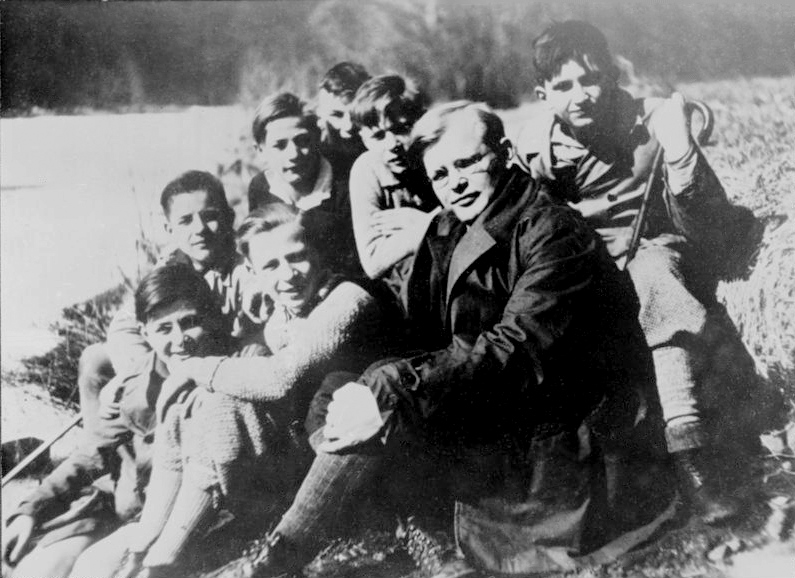
Bonhoeffer with Confirmands, 1932

I knew when I was preaching through the Sermon on the Mount recently that I would make good use of Dietrich Bonhoeffer’s Cost of Discipleship. I had no idea that a single question I asked would lead me–in my quest for an “answer”–so far into the life and writings of Bonhoeffer.

Of War and Peace: Which Bonhoeffer? (Revisited)

Russia invaded Ukraine in early March, just days after the Revised Common Lectionary reading was Matthew 5:38-48, which reads in part:

You have heard that it was said, ‘Eye for eye, and tooth for tooth.’ But I tell you, do not resist an evil person. If anyone slaps you on the right cheek, turn to them the other cheek also.

You have heard that it was said, ‘Love your neighbor and hate your enemy.’ But I tell you, love your enemies and pray for those who persecute you, that you may be children of your Father in heaven.

I wondered: does “turn the other cheek” apply just on an interpersonal level, or at a state level? I turned to Bonhoeffer, who rejected a privatized read of Jesus’ words. In 1937’s Discipleship he wrote:

The overcoming of others now occurs by allowing their evil to run its course. The evil does not find what it is seeking, namely, resistance and, therewith, new evil which will inflame it even more. Evil will become powerless when it finds no opposing object, no resistance, but, instead, is willingly borne and suffered….

Should Ukrainians (or other oppressed peoples) just let themselves be invaded (or oppressed)? I struggled with Bonhoeffer’s words:

There is no thinkable deed in which evil is so large and strong that it would require a different response from a Christian. The more terrible the evil, the more willing the disciple should be to suffer. Evil persons must be delivered to the hands of Jesus. Not I but Jesus must deal with them.

And yet in 1945 he was hanged for his involvement in a conspiracy to kill Hitler. This was not the “no opposing object” and “no resistance” that Bonhoeffer had talked about in Discipleship.

But maybe Bonhoeffer differentiated between evil done to him and evil done to others? Should the Christian be willing “to suffer” in the former instance but willing to act and resist on behalf of another in the latter instance?

As I asked these questions a month and a half ago, I found my own response to Matthew 5 and “turn the other cheek” to be more tension-filled than I would have liked.

Is There a Resolution to the Tension in Bonhoeffer? 

I had been hoping that further study of Bonhoeffer would help me to find some writing where he would essentially repudiate his non-violence stance in Discipleship, saying instead something like, “But when others are oppressed, take up force to eliminate evil, if necessary.”

Bonhoeffer never said any such thing. In fact, on July 21, 1944, the day after a bomb intended for Hitler failed to kill him, Bonhoeffer wrote from prison (about that 1937 book) to his good friend and biographer-to-be Eberhard Bethge:

Today I clearly see the dangers of that book, though I still stand by it.

He still stood by it. Did he mean he also stood by the line from that book, “Not I but Jesus must deal with them”? Was not his involvement in an effort to bomb Hitler a way of trying to deal with him? (Note: I’m not sure I fault Bonhoeffer either way.)

After a Lenten discipline of reading Bonhoeffer (and sections of his biographies) slowly and meditatively, I’m no closer to a resolution of such tensions than I was when I first discovered them. If anything, I’ve been encouraged to see other readers of Bonhoeffer wrestling with the same sorts of questions. This question of whether a ready-to-use-violence Bonhoeffer is consistent with the turn-the-other-cheek Bonhoeffer is, in fact, a fruitful question in Bonhoeffer studies.

What I’ve Found Instead

Tension in Bonhoeffer notwithstanding (and I’m actually coming to appreciate it), I’ve been deeply moved at nearly every turn as I’ve delved more deeply into the life and writings of an activist pastor.

I’ve found:

  • An inspired and passionate preacher, not afraid to tell the truth about life and about Jesus
  • A brilliant writer, already evident at age 19 and age 21
  • An eloquent catechist and Christian educator
  • A brave and gutsy man, who valued the life of others more than his own
  • A gifted poet with incisive awareness of the human condition

His preaching has encouraged mine. His deliberateness in pastoral care and visiting congregants has inspired me. I used one of his catechisms for our church membership class (his writing in that context was met with appreciation by all of us). His courage has bolstered mine, even if I don’t face the sort of trials that he did.

And, best of all, he has pointed away from himself and to the cross of Christ, so that my appreciation for Bonhoeffer doesn’t finally center on Bonhoeffer himself. Rather, through the writings of Dietrich Bonhoeffer–no doubt inhabited again by the Holy Spirit–I have come to see and know and love Jesus more deeply.

As Bonhoeffer says of the early disciples, listening to Jesus on the mountainside:

They have only him. Yes, and with him they have nothing in the world, nothing at all, but everything, everything with God.