5 Years Later… A Review of The Innocence Mission’s New Album

Hello I Feel the Same album cover


The last Innocence Mission release was 2010’s My Room in the Trees. I’ve been a big fan of the band since I inquired about my youth minister’s copy of Glow on top of the youth group boombox in the mid-90s. My Room in the Trees, however, stood out to me as one of their best. It featured the amazing “God is Love”:

God is love, and love will never fail me

God is love, and love will never fail me

If I’m driving there today

And I really am this afraid

God is love, and love will never fail me.

I’ve quoted it from the pulpit before and have sung it to myself not a few times.

I listened to that song and album in the midst of some dear friends moving out of our triple-decker community house (“Some birds I know are moving on this weekend”). I needed to hear “God is Love,” because we were in the midst of a major transition: our second child was soon to be born.

Without recounting the entire birth story here, I can simply say that his safe arrival left us in tears–more than the “usual” baby-being-born kind of tears. Some last-minute delivery challenges gave us quite a scare–but then there was baby #2, safely being cuddled by his mom and me. It may seem a small thing to The Innocence Mission to sing, “Stay calm… stay calm,” but that line from North American Field Song carried me through some shared moments of difficulty. I still think that is the best song they’ve ever recorded, and one of the very few songs I would ever consider calling “perfect.”


* * * * * * *


This Friday The Innocence Mission releases Hello I Feel the Same, their first album since My Room in the Trees.

If you are still, 20 years later, longing for the killer drums of 1995’s “That Was Another Country” (my second favorite track of theirs), or the opening track to 1991’s Umbrella, you will be left waiting again till next time. (Every new Innocence Mission I harbor a secret hope that Karen and Don Peris will ply their trade with a rocking band behind them. I’m long-suffering.) Mr. Peris does, however, lay down a sweet drum groove on “Barcelona,” the album’s fourth track. It’s like a fresh-water version of recent Mark Kozelek. The drums make another cameo before the album ends.

The first two tracks are classic Innocence Mission, with just a touch of drums and subtle bass harmonica (!) coming in a minute or so into the second song. Don Peris’s high-register guitar arpeggios and pleasingly breathy background vocals complement Karen Paris’s good-as-they’ve-ever-sounded vocals.

Track 3, “Washington Field Trip,” is this album’s “North American Field Song”–at least as I listen to it. Here is the band, only “wanting to be helpful in this life,” helping–whether they mean to or not–by laying down a devastatingly beautiful song with actually perfect piano tone. Never was a three-note melody in a chorus so haunting. The Perises, again, get into soul territory:

I do not want fear to hold me

I don’t want to be kept from loving at all

The longest song on the album is 3:43. Four songs don’t even reach the three-minute mark. You want all of these songs to keep going, but therein lies the duo’s approach and artistry.

Highlights include “Blue and Yellow” (what The Truman Show might have sounded like had Karen and Don Peris scored the movie) as well as the moving (and highly singable) tribute, “Fred Rogers,” which calls to mind Lancaster, PA (and, now that I think about it, maybe also heaven):

And you know I hate to drive

Maybe I’ll see you at the station

“The Color Green” features viola and violin and closes the album in a wonderfully fitting way–ascending piano with gorgeous melody in the right hand, joined by all manner of longing-inducing string parts.

And darn it if the song doesn’t resolve to the tonic at the end! One hopes The Innocence Mission will not make their listeners wait five more years to hear what’s next.

Hello I Feel the Same is another excellent effort from some beautiful makers of art and music.


Thanks to The Innocence Mission’s publicity team for early access to the album for the review. I’m sure it’s available on Amazon and iTunes, but why not support the band more directly? Check out the album at their Bandcamp page here.

Review of Audiosharp AS1130 Earbuds


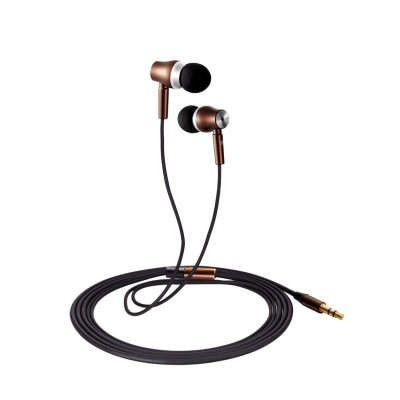
Earbuds 2
Image via Audiosharp


After I ran a 5K my sweet three-year old picked off one of my earbud covers and left it who-knows-where. So I’ve been in search of a good replacement. Audiosharp’s AS1130 earbuds (currently on sale for $25 at Amazon) have been an exceptional choice for every-day headphones.

Here are the specs from Audiosharp:


  • Perfect design: Solid all-metal construction even down to the plugs, Three size soft silicone ear buds provide a super comfortable, secure fit and One Compact rugged case for safe storage are included.
  • Accurately reproduce clear natural vocals: High intensity listening experience with crisp, clear sound and deep powerful bass, Ultra-fast,accurate speaker design delivers the full details of today’s digital music with extreme clarity and deep bass.
  • Awesome noise reduction: Sealed in-ear design reduces external noise for a better music experience. the voice is still clear over the din of the store so you can enjoy uninterrupted music on the go.
  • High Performance: High Quality Tangle Free Cable.Micro-strand wire and flux tube for clear audio with reduced interference.Innovative, cable design is ultra-flexible and tangle free.
  • Audiosharp Features: Audiosharp is the most professional headset seller, Our products are designed by high-end designers and rigorous professional inspection. All Audiosharp products come with a 1-year warranty.

Most surprising was the packaging in which the earbuds arrived. It’s impressive, if excessive:


Image via Audiosharp


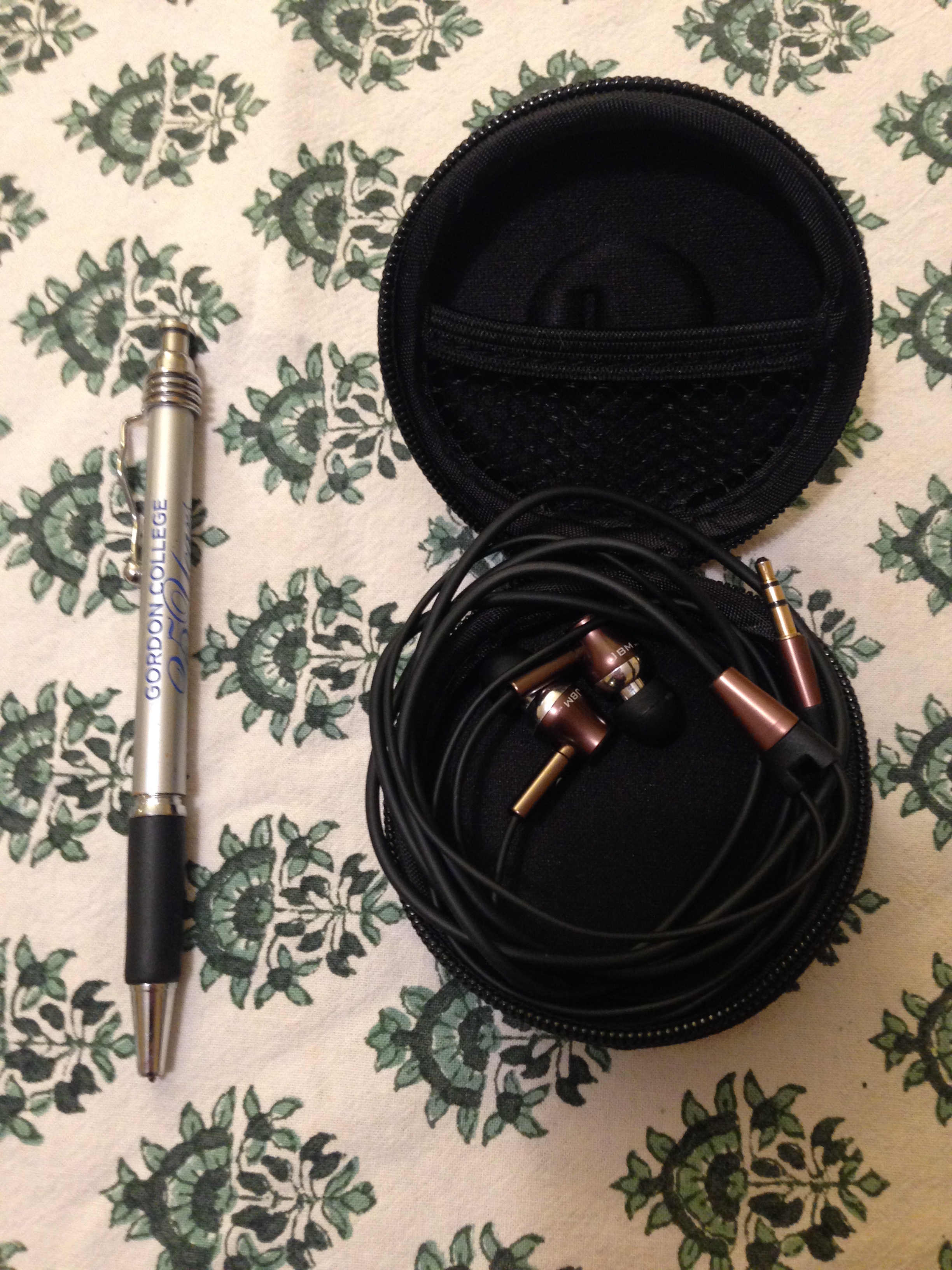
The carrying case is especially cool–and useful! It’s easy to wrap the earbuds up and store them in their protective cover:


Earbuds in case


The construction is high-grade, and these appear to be earbuds that will last a long time. The all-metal design looks cool, too:


Earbuds


Cable


As for the sound, the quality greatly exceeds what I expected for an under-$30 set of earbuds. Bass is fully present (but not overly so), and highs and mids are clear. It’s definitely an upgrade from the standard issue Apple set.

Having the earbuds in really does silence outside noise, too. They’re not noise-cancelling (nor do they claim to be), but noise-reducing, for sure.

They stay in my ears well even when I’ve got them outside on a run–a non-negotiable for me with a set of earbuds, and a feature which seems to be missing in most kinds that I’ve tried.

If you’re looking for greater sound quality than what you get with a $5 pair of earbuds, but for something that won’t break the bank and will last you a long time, Audiosharp’s AS1130 earbuds are an excellent option.


Thanks to Audiosharp for the review sample, given to me for purposes of review but with no expectation as to the content of this post. Find the earbuds here.

The Story on Gender and the NIV (1984), TNIV, and NIV (2011)

I keep coming back to the NIV translation of the Bible. The (now discontinued) TNIV and the 2011 NIV (which supersedes the TNIV) are constant companions in my Bible reading and sermon preparation.

Bruce Waltke anticipates that the NIV will be “ever more precise and always in the language of the people” as it continues to evolve. 50 years ago the Committee on Bible Translation (CBT) convened.


CBT (image via Zondervan)


The first three speakers in the following video–Doug Moo, Karen Jobes, and Mark Strauss–are all ones whose works I’ve consulted (literally) in the last two days!


There is an utterly fascinating history of how the translation has changed over the years. I am particularly interested in the discussion about how gender works in translation. I’m with Bruce Waltke on this one:

If you use “man” and part of your constituency is hearing it as male, and it wasn’t intended to be male, that’s bad translation.

So get this:

For the coming [1990s] edition, the CBT decided that where the Greek or Hebrew clearly referred to all people—male and female—the translation would have to find accurate contemporary English language to make this clear.

But before the CBT could release the update, a Christian magazine learned what the CBT was planning and published an article condemning the shift in language, initiating a firestorm of controversy.

Some Christians were unhappy about what the CBT was planning. They accused the CBT of a “feminist” agenda when, in reality, the only agenda CBT had was to accurately reflect the meaning of Scripture in modern English. But the heat of the controversy made it hard for people to understand what was really going on.

The issue became so heated that the International Bible Society (now Biblica) decided that it was not in the best interest of the translation to continue and chose not to publish the revisions. In the United States, Zondervan would keep printing the 1984 edition of the NIV.

Finally, in 2005, the TNIV was born. But the publisher wanted to unify the now two separate editions, paving the way for the 2011 NIV.

Read the whole history here–it’s not a quick read, but it’s quite interesting. And it’s also sad how parts of the Christian community pushed against what would be not just a gender-inclusive, but a more gender-accurate translation.

There are tons of NIV Bibles available, many of which are detailed here. I’ve had a chance to compare a number of the Bibles, so feel free to ask in the comments if you want to hear more… or share your own thoughts on the NIV translation.


It seems I’m blogging fairly regularly about Zondervan and its products. They have been gracious to provide copies of various products for my review purposes.

Alpha: The NATO Alphabet for Kids (and Their Parents)

image


With Isabelle Arsenault’s Alpha, I finally have a tool to keep the NATO phonetic alphabet in my head. That’s more useful to me than you might think, not least of which is because I really do have to spell both my first and last name quite often when talking to various phone reps. (A… B as in Bravo… R… A… M as in Mike.)

It’s first and foremost a children’s book–though also a good visual aid for learning what is also known as the International Radiotelephony Spelling Alphabet.

The book’s cover is actually a fine way to judge its contents in this case: It is the clever illustration–a paper airplane–for Delta.


image


The next spread, Echo, has a child at school throwing such an airplane at the child sitting in front of him.

Each letter of the alphabet receives a two-page spread: the word at left and an illustration at right. Some illustrations you might have guessed–like the couple dancing the Foxtrot. Others are more subtle and creative–like Hotel, which is the Monopoly hotel piece. Romeo and Juliet share a ghostly motif that ties the two images together, separated they are by some pages (and… uh… other impediments).

The letter under consideration has its own color, so that with even younger children you could focus just on A, B, C, D, and so on. Of course, my eight-year-old can appreciate that this section of his Dangerous Book for Boys now has some visual reminders to help him with his NATO alphabet.

There’s no storyline to follow, of course. But it’s been an interesting (and visually pleasing) read for each of my three kids, from three up to eight years old.

The sewn binding and high-quality paper will find approval with parents who want a book that will withstand a few throws across the room. (From the kids, not the parents.)

Alpha is a smart, nice-looking, and useful take on the classic children’s abecedarian.

Find Alpha at Amazon here, or at Candlewick Press’s page here. See Isabelle Arsenault’s page (with lots of images) here.


Thanks to Candlewick Press for the review copy, given with no expectation as to the content of the review.

T Muraoka’s Biblical Aramaic Reader (2015)

Muraoka Aramaic


Any time you see a T. Muraoka volume that retails at under $30, it’s worth paying attention to.

Peeters has released the short but sure-to-be excellent volume, A Biblical Aramaic Reader: With an Outline Grammar.

Here’s the publisher’s description:

This reader is for anyone very eager to read the story of Daniel in the lions’ den and many other fascinating stories in their original language, Aramaic.

A brief outline of Biblical Aramaic grammar is followed by a verse-by-verse grammatical commentary on the Aramaic chapters in the books of Daniel and Ezra. Both the outline grammar and the grammatical commentary presuppose basic knowledge of the grammar and vocabulary of Biblical Hebrew. Constant references are made in the commentary to relevant sections of the outline grammar. The commentary is written in a user-friendly, not overtly technical language. Some grammatical exercises with keys and paradigms conclude the Reader. Also suitable for self-study.

At just under 100 pages, it looks great. Find it on Amazon here.

Baron Fig’s Confidant Notebook, Reviewed

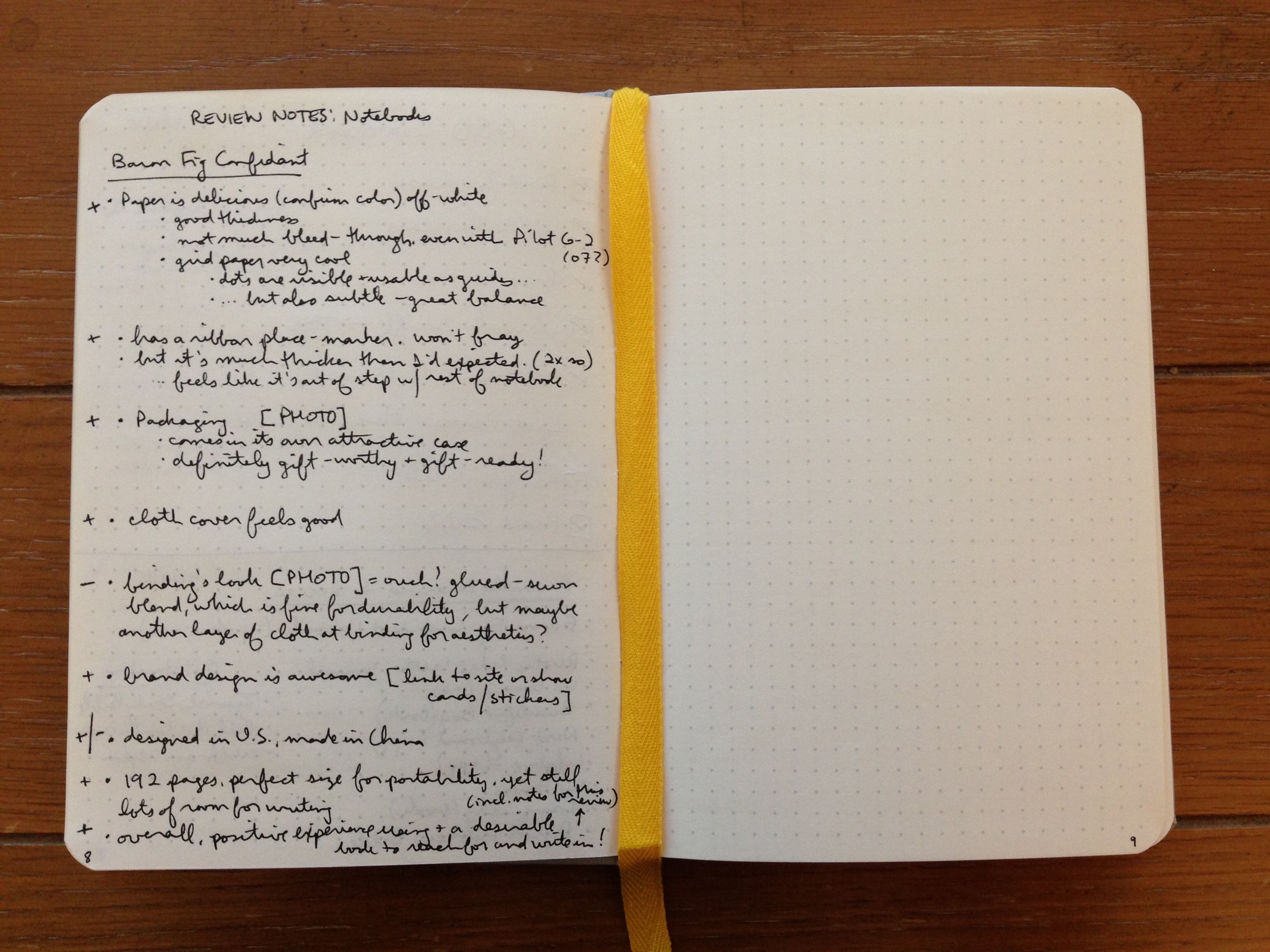
The first thing I noticed about Baron Fig’s Confidant notebook is that the paper is a delicious off-white. The paper’s thickness is perfect: there’s not very much writing bleed-through at all, even when using a Pilot G2 07 gel pen. That’s probably my first desideratum in a notebook, and Baron Fig nails it here.

The Confidant comes with blank paper, ruled paper, or dot grid paper, which is what I reviewed for review. The grey dots are visible and usable as guides for diagramming or sketching or writing… but they’re also subtle enough to stay out of your way. A great balance here.


Confidant Page Up Close


The Confidant lays flat, just as Baron Fig claims, though sometimes a bit of pushing down on the pages is required for them to stay flat. But this will happen naturally as you’re writing or sketching anyway. The binding itself lays flat as you’d hope. As you can see:


Baron Fig Confidant with writing
You guessed it: I started this blog post in my Confidant notebook


The acid-free paper means the book is built to last. And the dimensions just feel perfect to me: 5.4 by 7.7 inches. It’s 192 pages, with 12 pages at the back of the journal which are perforated. In other words, it’s enough space to keep you supplied for a while, but not so much that you’ve got a bulky journal to carry around. The portability is right on.

The cloth cover looks and feels good. The binding is sewn (yes!), which is, of course, one reason it lays flat so well.

I was not as impressed with the aesthetic of the binding: I thought it could have used maybe a thicker piece of cloth to cover up the binding construction that is so easily visible? I might just be missing that the look is intentional, but it didn’t appeal to me.


Binding


But let me step back for a moment. The packaging is top-notch. The notebook comes in its own attractive case, so that it’s gift-ready:


Confidant Gift Box


And as design goes, these folks are impressive. (See their Website here, for example.) Here’s a little clip from the insert that comes inside the box with the journal:


Confidant Design


The Confidant notebook comes with a ribbon for marking your place. I greatly appreciated this. It is about twice the thickness of most other ribbon markers, though, so it felt to me like it was out of step with the rest of the notebook. I have gotten used to this over time.

*******

Overall, the critiques above notwithstanding, I’ve had a positive experience using the Confidant, which gives me a notebook I really do want to reach for and write in! It goes with me in my satchel just about everywhere I go now.

You can learn more about the Confidant here and order it here.

Bonus paragraph: Baron Fig also makes the pocket-sized Apprentice notebook, which I think is an A+ in its class. It fits perfectly into even small pockets and isn’t a nuisance there. I’ve been carrying one of those around, too, so I don’t have to whip out a device every time I want to write down an action item I’ve committed to. The 3.5″ by 5″ little guy comes in a three-pack. More info on the Apprentice notebook is here; you can order here.


Many thanks to the awesome people at Baron Fig for the notebooks for review! Check them out here.

Children’s Book Review: The Little Snowplow

The Little Snowplow


We need the little snowplow in our neighborhood. Last winter we saw more than 100 inches of snow pile up. The kids loved it, and we parents sort of did, but it made getting around a challenge. And it got old fast.

Enter the little snowplow:

On the Mighty Mountain Road Crew, the trucks came in one size: BIG.

That is, until a new snowplow joined the crew.

“You’re such a little snowplow,” the big trucks said.
“Leave the heavy lifting to us.”
And off they roared.

My five-year-old was enraptured at this point. And what young child wouldn’t identify with the little guy in the story? Each night he does his “reps” (raising and lowering his plow ten times). He pulls blocks of concrete. “Just in case.” Had he been training for 2015 in Massachusetts, he would have been oh-so-glad for all the hours he put in.

Then a blizzard hits–more than the little snowplow can handle, and the plow driver has to call for backup. In the end, against the odds, the little snowplow turns out to be a real hero, with his place secured among the Mighty Mountain Road Crew.

Most grown-ups will see the story coming–the motifs are familiar ones. One thinks of the setting and improbability of Katy and the Big Snow, with echoes of The Little Engine That Could, and a scene reminiscent of Little Blue Truck. The story ends with the little snowplow ready to bed down, though the “He could hardly wait for sleep” ending felt a little less satisfying than expected.

Still, The Little Snowplow is engaging. It’s an important idea that one can succeed even though small or dismissed by others. The message of the book is a good one, and the story moves along nicely. My three kids are all fans of the book.

The Little Snowplow is Lora Koehler’s first children’s picture book. Jake Parker illustrates the story. And the illustrations are great. They’re colorful, clear, and absorbing. They really make the book. There are enough of them, too, that a non-reader can easily enough make his or her way through the story. (See a few more illustrations here.)

I don’t even want to think about winter coming soon, but I’m sure we’ll continue to reach for this book when the snow comes–and we are reading it now, even with potential blizzards months away.

Find The Little Snowplow at Amazon here, or at Candlewick Press’s page here.


Thanks to Candlewick Press for the review copy, given with no expectation as to the content of the review.

Review of WaterField’s External Keyboard Slip Case

Logitech makes an amazingly good external keyboard, the K811, which I reviewed here. At the time I noted:

It would be nice if the keyboard came with a carrying case or simple sleeve, though–you’ll have to figure that one out on your own.

And, boy, did I figure it out! Turns out a San Francisco manufacturer named WaterField makes just such a product: the Keyboard Slip Case. Here’s their description:

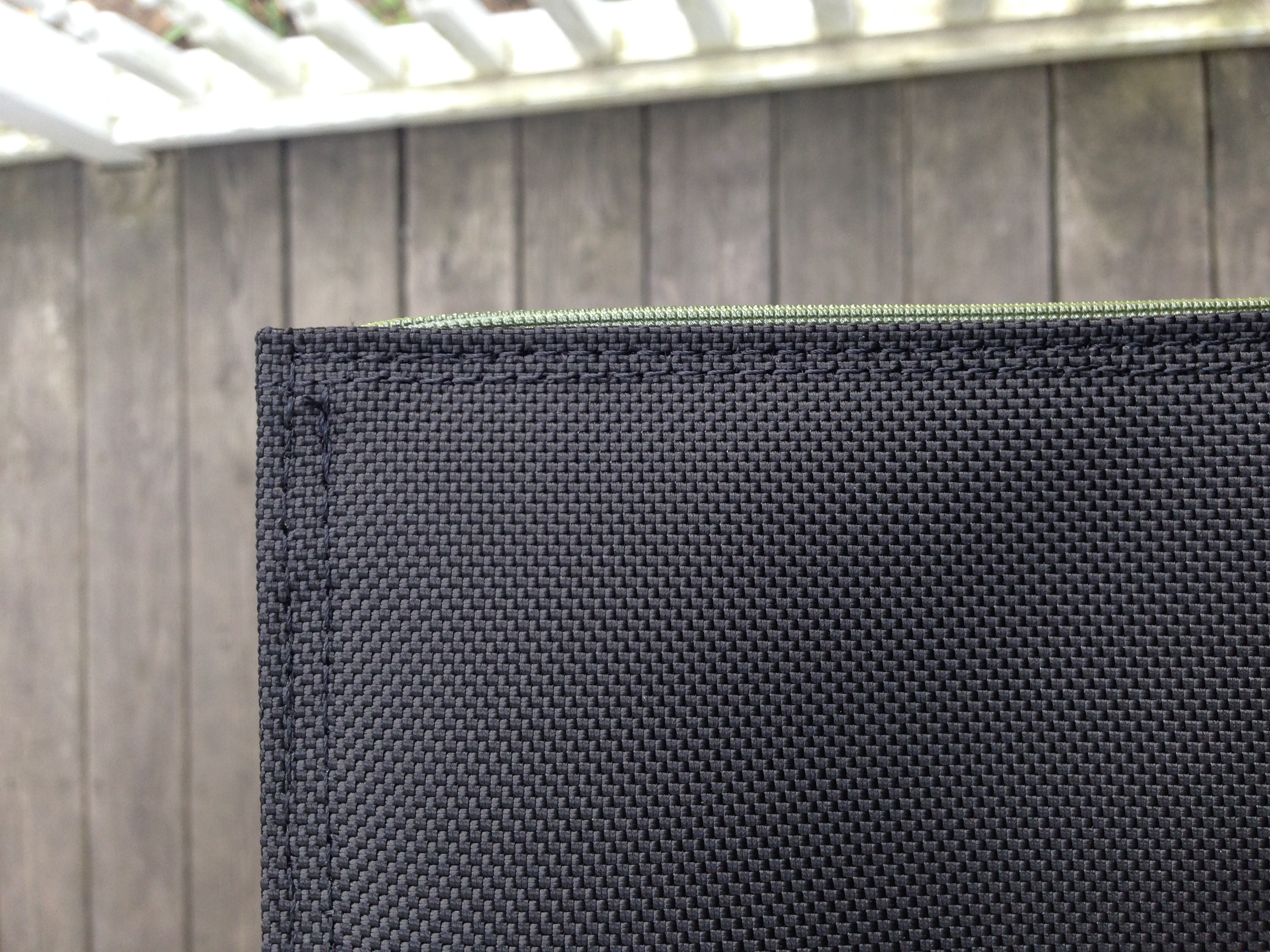
Thin is in. The Keyboard Slip Case offers gentle protection in a slim ballistic nylon case with a lightly padded liner. A piping trimmed edge lets you choose to add a splash of bold color, or to stay under the radar with subdued tones. Pack it up and off you go.

I can at last not worry about whether my keyboard keys will pop off inside my messenger bag, and my neighbors and friends can now avoid the unseemly sight of my walking around with an external keyboard in my hand. (I mean, not literally just walking around with it. But going from point A to point B.)

The dimensions are 12″ x 6″ and 3 ounces, perfect for the Apple wireless keyboard and my Logitech model.

To remind you, here’s what the K811 looks like:


Image via Logitech
Image via Logitech


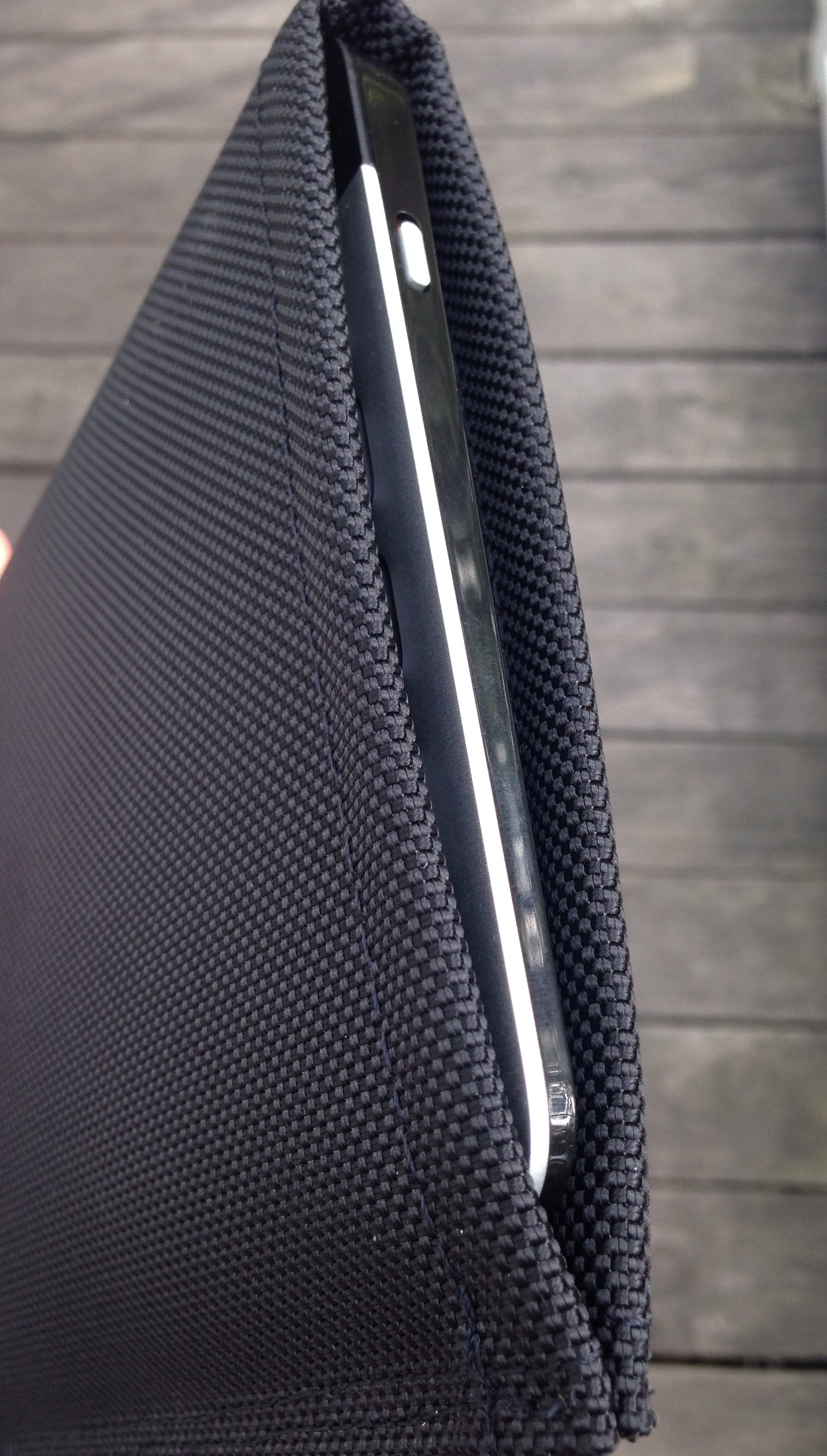
And now, in its case:


Keyboard in Sleeve


Pretty awesome, yeah? I know–I’m too excited about a piece of gear, but I use my K811 a lot, and am glad to protect it well.

The inside is protective yet soft:


Soft Inside


It’s made in San Francisco, so you’re buying a made-in-the-U.S.A. product with WaterField.

There’s even a nice little piece of trim that gives it a slight pop:


Trim


Here it is next to an iPad:


With iPad Air 2


The slip case is well constructed, and looks like it perfectly blends being lightweight with protecting your keyboard.

The keyboard fits snugly, so the lack of a closure is no loss. I’d initially wondered about this, but it’s not a problem. And it’s still easy to slide the keyboard in and out. (But if you’re worried, you can get this model.)

My only critique is that the nylon exterior is a little slippery. When carrying around an iPad and notebook and keyboard-in-its-case today, I felt the iPad slip against the keyboard case. So be aware of that so you don’t drop something!

Otherwise, the K811 has found its perfect match. Or as I put it in a six-word review on WaterField’s site:

Just what my external keyboard needed.

WaterField makes a lot of other really cool-looking gear, which you can learn more about here. Find the Keyboard Slip Case here.


Thanks to WaterField for the product review sample, given to me for purposes of review, but with no expectations or influence on the review’s content.