Do Not Our Hearts Burn Within Us?

Supper at Emmaus, by Dr. He Qi, 2001

N.T. Wright compares the two disciples on the road to Emmaus to people who have gotten up early to watch the sunrise, but were looking westward, rather than eastward.

They were like people on a hillside, watching eagerly for the sunrise. …Disoriented, they are facing the wrong way. The expected moment comes and goes, and nothing happens. Then they become aware that, though the sky they are scanning remains dark, light seems to be shining anyway. With a strange excitement they turn around, to see the sun shining in full strength in the very place they least expected it.

The day Luke describes in Luke 24:13 is the day of Jesus’ resurrection, although it was decidedly not Easter to these two travelers. This is why Wright says “they least expected it.”

The women had seen the empty tomb, and these two disciples knew that, but they hadn’t pieced it all together yet. To them, Jesus was still dead. So they have this road trip now to talk about the death of Jesus, the denial of Peter, the betrayal of Judas, the crowds shouting, “Crucify!”, the weeping of the disciples at the cross, and the shock and shattered dreams of the community of Jesus’ followers.

One of the questions Luke is posing to his listeners and readers is: will we, when Jesus shows up, have eyes to see him?

The Road to Emmaus Was Covered With Tears

Jesus chastises the two, as only a loving and trusted teacher can do, for not understanding, for not knowing who he was.

But, in one sense, we don’t really want to blame these two disciples. To be fair, they were utterly devastated. “[T]hey crucified him,” they said, “but we had hoped that he was the one who was going to redeem Israel.”

When our eyes are cloudy with tears, when we’re sinking beneath the weight of death and tragedy and incomprehensible outcomes… do we recognize Jesus?

They must have felt like that speech from Macbeth that I had to memorize in high school:

Out, out, brief candle!
Life’s but a walking shadow, a poor player
That struts and frets his hour upon the stage
And then is heard no more. It is a tale
Told by an idiot, full of sound and fury
Signifying nothing.

Good Friday and the days following were just an idiot’s tale, not a compelling narrative of an entire nation’s redemption. It all meant nothing.

Jesus and the Disciples on the Road to Emmaus, by Gustave Doré (1832–1883)
Jesus and the Disciples on the Road to Emmaus, Gustave Doré (1832–1883)

We don’t know for sure where Emmaus is–people who like to study these things have made two or three suggestions. It was within walking distance from Jerusalem, at least.

But I think we do know what Emmaus was. It was an escape. It was another town, it was not-Jerusalem, which was just too painful a place for these two disciples to be. It was a pre-emptive break from the regular weekday schedule that surely awaited the disciples on Monday morning. Those routines would have been unbearable with Jesus gone. So at least if they could go somewhere where the buildings and mountains and water wouldn’t remind them of him, maybe their sorrows could be numbed a little bit.

They were done. It was over. The road to Emmaus was a road of confusion, frustration, and tears.

Jesus Shows Up

Then Jesus shows up. They don’t know it’s Jesus. It’s another fellow traveler, and it would not have been weird at all for them to walk together, even if they hadn’t met.

“They were kept from recognizing him,” Luke says, a curious phrase. Was it their own sadness that kept them from seeing? Was it lack of faith? Did they think, “Hey this guy does look a little like Jesus, but no way it’s him”? Did God somehow keep them from seeing, so this scene could play out?

When he asks what they’re talking about, they can hardly bring themselves to re-live the tragedy. Cleopas does his best and, surprised that anyone wouldn’t have heard the front-page news, he goes on and tells about the criminal’s death his supposed Savior died.

[W]hat is more, it is the third day since all this took place. In addition, some of our women amazed us. They went to the tomb early this morning but didn’t find his body. They came and told us that they had seen a vision of angels, who said he was alive. Then some of our companions went to the tomb and found it just as the women had said, but him they did not see.

They knew this was the “third day,” when something was supposed to happen. And they knew the tomb was empty. And they knew the women were excited and had seen angels at Jesus’ tomb. But they hadn’t yet seen Jesus alive, outside of the tomb.

Jesus rebukes them for not knowing how it was supposed to all go down, a gentle (or maybe not-so-gentle) reminder to us to pay attention to what God is doing in the world… to pay attention to who Jesus is. No matter what led these two followers to go to Emmaus, there were some mysterious things afoot in Jerusalem, and they didn’t bother to stick around to see how it would play out. Maybe this is why Jesus calls them “foolish” and “slow of heart.”

Jesus then goes through the Scriptures (“Moses and all the Prophets,” or the whole Old Testament) and shows how it all points to him.

They Recognized Him

They get to Emmaus, so they get ready to stay the night there. Middle Eastern hospitality requires that they ask Jesus to join them, so he’s not out walking by himself. They sit down to eat. If the guided tour of the Hebrew Bible by one of its co-authors wasn’t enough, the two disciples now at last recognize Jesus, as he breaks the bread. Jesus goes quickly from table guest to host at a meal that would forever transform these two:

When he was at the table with them, he took bread, gave thanks, broke it and began to give it to them. Then their eyes were opened and they recognized him, and he disappeared from their sight. They asked each other, “Were not our hearts burning within us while he talked with us on the road and opened the Scriptures to us?”
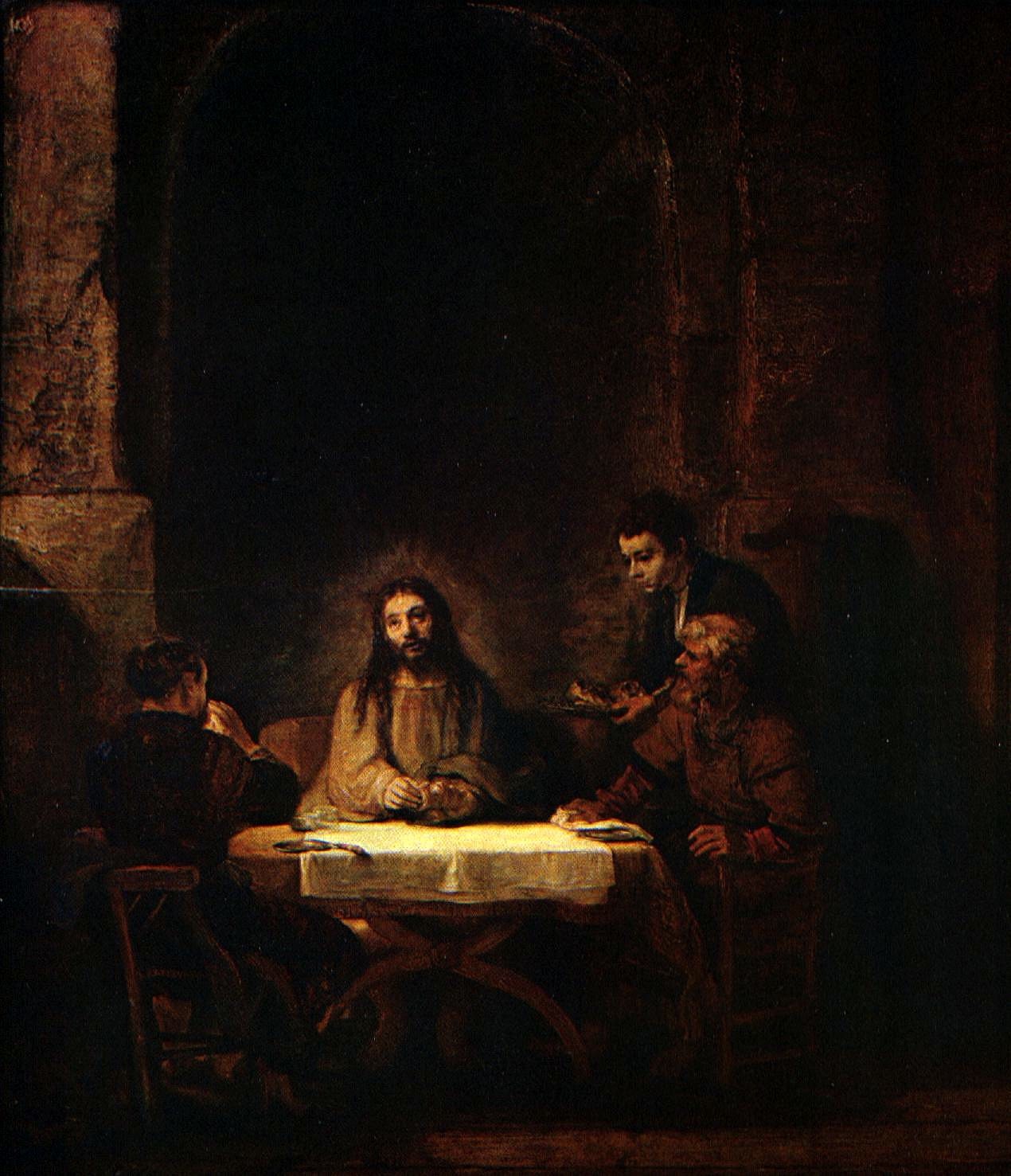
The Disciples Recognize Jesus at Emmaus,  Rembrandt (1606–1669)
The Disciples Recognize Jesus at Emmaus,
Rembrandt (1606–1669)

Now they know Jesus, in the breaking of the bread. Perhaps they recall the feeding of the 5,000, or the Last Supper that they had probably heard about from the other disciples who were there. On both of those occasions, Jesus took bread, gave thanks, broke it, and distributed it.

So they go back to Jerusalem, where all the commotion is, and make their contribution to the unfolding events of the first Easter:

They got up and returned at once to Jerusalem. There they found the Eleven and those with them, assembled together and saying, “It is true! The Lord has risen and has appeared to Simon.” Then the two told what had happened on the way, and how Jesus was recognized by them when he broke the bread.

Jesus appears to them through the reading of Scripture and through fellowship at a table.

Time and time again the early church and the church throughout the ages would gather to hear the Word of God proclaimed and the sacrament of communion celebrated, and in so doing the church would continue to recognize its risen Lord.

Hearts Burning Within Us

During an Easter hymn two weeks ago, I was filled with awe at just how transforming the resurrection is for those who believe in it.

I began to think, “What if we remembered more often, both when we’re together and when we’re apart–what if we remembered more often that we worship a risen Jesus, and Christ’s resurrection completely transforms how we see the world? The victorious life over death of the resurrected Jesus is foundational to our identity.” We worship a Lord who could not be shut up in a tomb. Therefore, we, too, are resurrection people, disciples who have been forever changed by Christ’s victory over death.

Do not our hearts burn within us when we gather to hear God’s word, and when we break bread at Christ’s table? And do not our hearts burn within us, as we see Jesus in each other, at brunch or meals in each other’s homes, at coffee, through small group prayer, and notes of encouragement? Do not our hearts burn within us when we realize we’re not alone on the road, but have each other for traveling companions?

Do not our hearts burn within us when we truly recognize Jesus through an encounter with him?

And this encounter with Jesus is just as likely to take place on our defeated path to Emmaus… in those moments where we walk away from our hopes and dreams and visions of the future that are now traded in for just the hope of making it to lunchtime….

We see Jesus on our roads and sidewalks, because he comes and finds us there. We weren’t even looking for him. We didn’t even recognize him, and he came–the resurrected Lord, giving us his broken body and blood for our new life–he came and enlivened our hearts, rekindled our passion, made us excited about something again. Jesus gave us renewed purpose and vision. Jesus offered us hope when we were grasping at straws.

Do not our hearts burn within us?

And so we, who have seen this risen Lord, say with the two Emmaus-bound disciples and the others:

“It is true! The Lord has risen!”

This becomes a foundational truth about our identity, our make-up as believers in Jesus.

We are a people who have seen the risen Lord.

“It is true! The Lord has risen!”

We may invite him in as a guest to our gatherings, as those two road-walkers in our passage did. But we quickly find Jesus himself to be host, the one who invited us into fellowship with him in the first place. And do not our hearts burn within us as we hear his invitation to come to his table?

“It is true! The Lord has risen!”

Come, see Jesus now. The table of fellowship is set. Recognize him as he opens his table to us who journey along the road. And let your heart beat a little bit faster as you encounter the risen Jesus there.

The above is adapted from the sermon I preached on Luke 24:13-35 today. All Scripture quotations come from the NIV (1984) or TNIV. See my other sermons, if you desire, here. The image at the beginning of the post is used and covered under the Creative Commons Attribution Noncommercial ShareAlike 3.0 License.

First Ice Cream and Lyle the Crocodile

Ice Cream

Yesterday was a momentous occasion: the first all-family ice cream outing of the summer. (Shhh… it’s summer in my mind.) We did the almost-impossible-to-beat triumvirate of

ice cream

park

used bookstore

At the used bookstore, we got a hardcover edition of four Lyle the Crocodile books bound together (sewn binding, mind you!) for a mere $5.

Tonight we read the first one:

Lyle the Crocodile

In The House on East 88th Street, Mr. Primm, Mrs. Primm, and their son Joshua move into a new house, only to find a crocodile in the bathtub. They’re even more shocked when–as they’re trying to figure out how to get rid of it–it saunters down the stairs and starts doing tricks for them.

It’s a funny and well-written book. We’re looking forward to reading the rest. Highly recommended #kidlit!

Logos Free Book of the Month for May

Screenshot 2014-05-01 21.12.34This month’s free book in Logos Bible Software is 300 Quotations for Preachers from the Puritans. It is free as a stand-alone, and also part of a larger series I reviewed about a year ago, 1,500 Quotations for Preachers.

Here’s the link to the free 300 quotations book. Richard Baxter, John Bunyan, Jonathan Edwards, John Owen, and a number of others are included.

There is also a short commentary on James (from Logos’s Pastorum Series) available for $0.99, here.

A Six-Year-Old’s Review of The LEGO Movie Official Handbook and Junior Novel

Lego Movie HandbookHaving seen and thoroughly enjoyed The LEGO Movie, my six-year-old son has been reading a couple of related books: The LEGO Movie: The Official Movie Handbook and The Lego Movie: Junior Novel.

The Movie Handbook packs a lot in, both text and full-color illustrations, especially for the price.

In the words of my six-year-old, “It’s really good. If someone had never seen it, I’d say that the best pages ever are ‘Where are My Pants?’ This is an episode of a TV show in Bricksburg in The LEGO Movie.”

[Dad’s editorial note: it’s more tame than it sounds, and one of the funnier parts of the movie, which is quite clever throughout.]

Lego Movie Junior NovelHere are some of the characters in the books, as told by my six-year-old:

  • Emmet: A construction worker. He is always scared of the bad guys. He falls out of a tower that, like, goes past heaven.
  • Lord Business: A bad guy. Someone who tries to defeat the good guys. He tries to wreck the Piece of Resistance.
  • Batman: A superhero. He turns Bad Cop’s car into a baby carriage in the book (i.e., in the Junior Novel).
  • Bad Cop: A bad police. Someone who helps Lord Business.
  • Wyldstyle: A superhero. She asks Emmet if he’s “the Special.” Her hair has a ponytail on the side.
  • P. UniKitty (i.e., Princess UniKitty): She’s really cute. She says, “Any idea is a good idea, except the not happy ones!”

Here’s a look inside the Movie Handbook:

Wyldstyle

The Junior Novel is more than 100 pages of text at a level that seemed to be just right for a six-year-old. Its opening lines are as silly as the rest of the book and the movie:

Bright red lava flowed from the volcano that marked the entrance to the hidden temple. Inside, a mighty weapon called the Kragle was nestled in a glowing sarcophagus.

Here is a shot of the Table of Contents from the Movie Handbook:

Lego Movie Handbook TOC

The books tie in well with the movie, yet still leave a lot on the screen. The Movie Handbook also comes with a fold-out poster, which is now taped to the ceiling above my son’s top bunk bed.

Thanks to Scholastic for the review copies, given with no expectation as to the content of the review. Find The Lego Movie: The Official Movie Handbook here at Amazon (affiliate link) or here at Scholastic’s site. The Junior Novel is here at Amazon (affiliate link) and here at Scholastic’s site.

Dietrich Bonhoeffer Works (16 Volumes) for $100

Bonhoeffer in Olive Tree

For just a few more days, Dietrich Bonhoeffer Works (DBW) (16 volumes) are $100 in Olive Tree Bible software. I have not seen DBW in Olive Tree, but have reviewed the app here. Their iOS and desktop apps are free, so if you like Bonhoeffer and have the cash, this is probably the best price for his complete works in English that one will ever find.

(Except for checking the books out from your local theological library, which is even cheaper!)

UPDATE: It would appear this sale has ended, a couple days before the date Olive Tree had given me via FB. Despite the miscommunication, the folks at Olive Tree have let me know the set may go on sale again in the future. To your library!

New UBS5 Greek New Testament, Next Month

UBS5


Fall 2014 UPDATE: The UBS5 is out. Go here for a chance to win one of two free copies.

******

On the heels of the release of the NA28 Greek New Testament, the UBS4 is giving way to a revised UBS5. Find the book’s product page here. Just as I reviewed the NA28 (plus LXX), I hope to post more in the future about the UBS5 edition, which is geared more toward translators than academics, per se.

Here’s a sample pdf of the first few chapters of Mark, posted by Hendrickson.

The most noticeable change right off the bat is that the italicized font of the UBS4 has been replaced with something I find much more readable and aesthetically pleasing:

UBS5 text

Other than punctuation and paragraph divisions, the text is the same as that of the NA28, with the differences between the two coming in the critical apparatus.

UBS5 is slated to release in May.

It’s Still Easter

Via Jeff Miller at www.splendoroftruth.com
Image Source: Jeff Miller at splendoroftruth.com

You may be done with Easter Sunday services and Easter egg hunts. You may have put away your fancy new Easter dress and your bunny decorations. But Easter isn’t over, at least not for millions of Christians throughout history and throughout the world today.

Mark D. Roberts introduces the idea of Easter as a season with the above words, part of a post here that is worth reading in its entirety.

In the church calendar the Easter season begins on Easter Sunday and goes to Pentecost Sunday. That gives, Roberts points out, seven weeks of Sunday worship to sing Easter hymns and focus more intently on the resurrection of Jesus. He writes:

I was ready to experiment with all of this, though I must confess it felt rather strange to sing “Christ the Lord is Risen Today” a couple of weeks after Easter Sunday. (“Christ the Lord is Risen Two Weeks Ago” wouldn’t work either.) Moreover, the word “Eastertide” sounded strange to me, like some remnant of days gone by. Nevertheless, I did my best to be a good sport. Slowly, over the years, I’ve grown to appreciate celebrating Easter for more than just a single Sunday.

Especially for churches and Christians that observe 40 days of lent Lent (which, let’s be honest, can feel loooong), marking and celebrating the even longer 50 days of Eastertide is important. Roberts recommends some practical ways to engage in and celebrate the risen life of Jesus. Check it out here.

Death Has Been Swallowed Up in Victory

The resurrection

You don’t go to a tomb to rejoice. You don’t go to a graveyard, shortly after someone has been buried there, to celebrate.

And so, Matthew writes, “After the Sabbath, at dawn on the first day of the week, Mary Magdalene and the other Mary went to look at the tomb.”

They have come to pay their respects and to remember their now deceased teacher. They have come to mourn–expecting to find comfort, perhaps, in being together, but not expecting much more than that.

Then an angel pushes away the stone covering the tomb–we can think of the tomb as a sort of underground walk-in closet. And the guards are so scared, they shake and are petrified.

“Do not be afraid!” the angel has to say to the unsuspecting women. “Jesus is not here–he is risen!” Come, look, the angel says, “see the place where he lay.” “Go quickly and tell his disciples–He has risen from the dead!”

As they hurry off, their fast-beating hearts a jumble of joy and fear, they see Jesus. “Greetings,” he says, nonchalantly. (“Hey, what’s up?”)

They kneel down, grasp his feet, and worship him.

They had gone to his tomb to weep.
Instead, they went away laughing and rejoicing.

They had come early that morning to encounter the stark reality of death.
Instead, they found the glorious miracle of new life.

They had come to process an immense and unthinkable loss.
Instead, they met a living Jesus, the triumphant victor over death.

These women, and then, in turn, all of Jesus’ disciples from that day forward, would never see death the same way again.

Death Swallowed Up in Victory: Paul’s Reminder

Some years later Paul would remind his church of the “gospel,” the good news of Jesus.

The good news, he says, is “that Christ died for our sins according to the Scriptures, that he was buried, that he was raised on the third day according to the Scriptures….”

By this “gospel,” the good news of Jesus’ death and coming back from life to show himself again to his followers–by this “gospel,” Paul says, you are saved. You are delivered.

Where your life had been a prison,
you are freed.

Where you had once seen darkness,
now you see light.

Though you had come to a tomb, ready to mourn because of the end of things,
now you rejoice at a new beginning and fresh possibilities.

Where it had once been a long, hard, cold, relentless winter,
the spring of new life is finally here.

Because Jesus was raised on the third day, we will never see death the same way again.

“Death has been swallowed up in victory.” Paul speaks of a day when that will come true, when death itself is finally and forever dead.

But the way Paul is talking–it’s so certain a fate for death, for it to be completely vanquished and drowned in new life… it’s so certain that he’s saying it’s true, in a sense, right now.

Through the resurrection of Jesus, death and evil have already been defeated.

“Where, O death, is your victory?
Where, O death, is your sting?”

Christ’s resurrection proved that, when God is at work, “dead” isn’t really “dead.”

Feeling Defeated by Death

And yet, such an idea was the farthest thing from the minds of the disciples that weekend.

How long Good Friday to Easter Sunday must have felt that year!

When you lose a friend, a brother, a spouse, a parent, a child, someone you love… the day of your dear one’s death is painful. Agonizing. Unthinkable. Whether unexpected or expected, there’s always a quality of “this is not how it should be” when a loved one dies. So much still could have been… should have been.

Then there’s something about the second day that hurts even more. Maybe the initial shock is gone (though probably not really), and reality sets in a bit more. This death wasn’t a bad dream you woke up from. You’re still here, and your good friend, your valued family member is really gone.

I bet that second day–Saturday–was even more difficult for the disciples than the Friday when they watched Jesus die a criminal’s death.

Jesus was not just any loved one…he was, to his followers, a teacher and friend and humble servant, but he was also supposed to be their deliverer, their shepherd, their light, their life… NOT someone who just goes dying on them.

Was he not who they thought he was?

Was their promised deliverance, their offer of hope and a new life, just a farce?

Was Jesus just one among many other teachers claiming to be divine, but in reality, mortal like everyone else?

Jimmy Chitwood HoosiersOne of my favorite movies, and arguably the greatest sports movie of all time, is the movie Hoosiers. It’s based on the true story of a high school basketball team in rural Indiana who in 1954 won the state championship, beating much bigger and more established schools along the way.

And even though I know how it ends, I still watch it, probably at least once a year. “Did they win again?” I’ve often been asked after watching it for the umpteenth time.

It’s a little easier to watch through the suspense and nail-biting overtime games when I know the outcome. But for the characters in the movie, of course, the players and fans that the actors played, there was no guarantee of a good ending.

It’s hard for us to get at just what those women, characters in the story, must have been feeling as they went to the tomb. We know how this story ends. We know what (or, rather, who) is waiting for them at the tomb.

But they felt firmly wrapped in the grip of death, of disappointment, of shattered dreams, of hopes delayed or even demolished. Perhaps their trust had been severely misplaced, after all.

They’re blindsided when they see the angel, the empty tomb, and then… Jesus. That’s why Matthew says they are both filled with joy and scared out of their minds.

It’s not that they had weak faith, but Jesus was dead! Not just mostly dead, but dead dead.

Jesus had cheated death before by slipping through hostile crowds and, for all we know, dodging stones thrown his way, but this was not supposed to happen, or so his mourning disciples thought.

The Last Scene Was a Victory

Resurrection 2But a tomb was not the last scene in this story.

The apostle Peter would later preach to a crowd in Acts, “But God released him from the horrors of death and raised him back to life, for death could not keep him in its grip.”

Death did not have dominion, mastery, or the power of intimidation over Jesus. Once Jesus got a hold of death, it would never be the same.

Through his miraculous coming-back-to-life, Jesus showed that even death cannot stop him. Through Jesus’ resurrection, Paul says, “Death [was] swallowed up in victory.” As one preacher wryly (but accurately) said, “Jesus beat the hell out of sin and death.”

And so “dead” for Jesus didn’t really mean “dead.” It wasn’t the end. There was life on the other side of it.

We who follow the risen Jesus, then, do not need to be afraid. Though death is maybe one of the scariest, or most painful things that many of us can think of, the Christian’s death does not actually end in death. We, too, have been raised with Christ.

As one Christian martyr put it:

The fact that Jesus Christ died is more important than the fact that I will die. And the fact that Jesus Christ was raised from the dead is the sole ground of my hope that I, too, will be raised on the day of judgment. Our salvation is ‘from outside ourselves.’ I find salvation not in my life story, but only in the story of Jesus Christ. Only those who allow themselves to be found in Jesus Christ — in the incarnation, cross, and resurrection — are with God and God with them.

“Death has been swallowed up in” the victory of the life of Christ, a life in which we are invited to participate, a life which we can receive by believing in the risen Lord. As we see the living Jesus and hear his invitation to life, how else can we respond but to do what the two Marys did, and throw ourselves at him and praise him?

Death is cause for lament and mourning–you don’t go to a tomb to rejoice–yet just as death no longer has dominion over Jesus, it no longer shall have dominion over us.

Jesus’ resurrection means that death is no longer our intimidator, master, or schoolyard bully.

Evil loses, and death is dead.

Paul taunts death in the Corinthians passage, “Whatcha got, death? I’m alive with the resurrected Christ–how you like me now?”

Paul had to remind his church of the powerlessness of death, just like we need to remind ourselves, because it so often looks like death and sin and evil and inhumanity reign supreme in the world around us. Death and evil are still talking a big game.

But that’s all it is–it’s just talk.

Sin is no longer the undefeatable foe it might have once seemed to be. Evil is not inevitable. Death is not really the end.

We do not have to be afraid.

Through the victory of the resurrected Christ, the lifeless are made alive. Darkness becomes light.

Mourning turns to rejoicing.

Winter turns to spring.

The impossible becomes possible.

Dormant dreams can spring back to life again.

Good outcomes can result from bad things happening.

Because of Jesus’ decisive victory over the powers of evil and death,
even what looks like a cold and empty tomb
contains within it a glimmer of hope,
and the promise of new life.

The above is the sermon I preached on Easter Day 2014.

A Personal Reflection on Dietrich Bonhoeffer: What I’ve Found This Lent


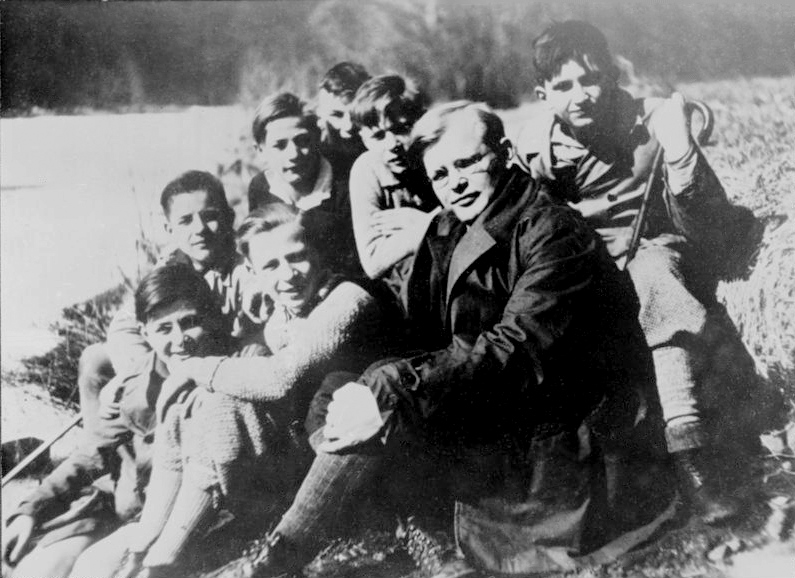
Bonhoeffer with Confirmands, 1932

I knew when I was preaching through the Sermon on the Mount recently that I would make good use of Dietrich Bonhoeffer’s Cost of Discipleship. I had no idea that a single question I asked would lead me–in my quest for an “answer”–so far into the life and writings of Bonhoeffer.

Of War and Peace: Which Bonhoeffer? (Revisited)

Russia invaded Ukraine in early March, just days after the Revised Common Lectionary reading was Matthew 5:38-48, which reads in part:

You have heard that it was said, ‘Eye for eye, and tooth for tooth.’ But I tell you, do not resist an evil person. If anyone slaps you on the right cheek, turn to them the other cheek also.

You have heard that it was said, ‘Love your neighbor and hate your enemy.’ But I tell you, love your enemies and pray for those who persecute you, that you may be children of your Father in heaven.

I wondered: does “turn the other cheek” apply just on an interpersonal level, or at a state level? I turned to Bonhoeffer, who rejected a privatized read of Jesus’ words. In 1937’s Discipleship he wrote:

The overcoming of others now occurs by allowing their evil to run its course. The evil does not find what it is seeking, namely, resistance and, therewith, new evil which will inflame it even more. Evil will become powerless when it finds no opposing object, no resistance, but, instead, is willingly borne and suffered….

Should Ukrainians (or other oppressed peoples) just let themselves be invaded (or oppressed)? I struggled with Bonhoeffer’s words:

There is no thinkable deed in which evil is so large and strong that it would require a different response from a Christian. The more terrible the evil, the more willing the disciple should be to suffer. Evil persons must be delivered to the hands of Jesus. Not I but Jesus must deal with them.

And yet in 1945 he was hanged for his involvement in a conspiracy to kill Hitler. This was not the “no opposing object” and “no resistance” that Bonhoeffer had talked about in Discipleship.

But maybe Bonhoeffer differentiated between evil done to him and evil done to others? Should the Christian be willing “to suffer” in the former instance but willing to act and resist on behalf of another in the latter instance?

As I asked these questions a month and a half ago, I found my own response to Matthew 5 and “turn the other cheek” to be more tension-filled than I would have liked.

Is There a Resolution to the Tension in Bonhoeffer? 

I had been hoping that further study of Bonhoeffer would help me to find some writing where he would essentially repudiate his non-violence stance in Discipleship, saying instead something like, “But when others are oppressed, take up force to eliminate evil, if necessary.”

Bonhoeffer never said any such thing. In fact, on July 21, 1944, the day after a bomb intended for Hitler failed to kill him, Bonhoeffer wrote from prison (about that 1937 book) to his good friend and biographer-to-be Eberhard Bethge:

Today I clearly see the dangers of that book, though I still stand by it.

He still stood by it. Did he mean he also stood by the line from that book, “Not I but Jesus must deal with them”? Was not his involvement in an effort to bomb Hitler a way of trying to deal with him? (Note: I’m not sure I fault Bonhoeffer either way.)

After a Lenten discipline of reading Bonhoeffer (and sections of his biographies) slowly and meditatively, I’m no closer to a resolution of such tensions than I was when I first discovered them. If anything, I’ve been encouraged to see other readers of Bonhoeffer wrestling with the same sorts of questions. This question of whether a ready-to-use-violence Bonhoeffer is consistent with the turn-the-other-cheek Bonhoeffer is, in fact, a fruitful question in Bonhoeffer studies.

What I’ve Found Instead

Tension in Bonhoeffer notwithstanding (and I’m actually coming to appreciate it), I’ve been deeply moved at nearly every turn as I’ve delved more deeply into the life and writings of an activist pastor.

I’ve found:

  • An inspired and passionate preacher, not afraid to tell the truth about life and about Jesus
  • A brilliant writer, already evident at age 19 and age 21
  • An eloquent catechist and Christian educator
  • A brave and gutsy man, who valued the life of others more than his own
  • A gifted poet with incisive awareness of the human condition

His preaching has encouraged mine. His deliberateness in pastoral care and visiting congregants has inspired me. I used one of his catechisms for our church membership class (his writing in that context was met with appreciation by all of us). His courage has bolstered mine, even if I don’t face the sort of trials that he did.

And, best of all, he has pointed away from himself and to the cross of Christ, so that my appreciation for Bonhoeffer doesn’t finally center on Bonhoeffer himself. Rather, through the writings of Dietrich Bonhoeffer–no doubt inhabited again by the Holy Spirit–I have come to see and know and love Jesus more deeply.

As Bonhoeffer says of the early disciples, listening to Jesus on the mountainside:

They have only him. Yes, and with him they have nothing in the world, nothing at all, but everything, everything with God.