Galileans at Pentecost

"Pentecost," by Jan Joest van Kalkar (1505 – 1508)
“Pentecost,” by Jan Joest van Kalkar (1505 – 1508)


Pentecosts reminds us that God pours out the Holy Spirit on any and all persons who would receive… and he uses unexpected persons as his conduits!

The use of “Galileans” to help usher in the era of the Spirit is also a sort of breaking of barriers. It shows that when God chooses to do something marvelous, he does not necessarily wait till a person high in earthly esteem comes along. He does use such people, of course, as we see with God’s using Paul. But he is not limited to them.

The key to usefulness is the fullness of the Spirit, and the Spirit can bring life to anyone he chooses, provided that he or she is open to this enlivening.

(Ajith Fernando, Acts: The NIV Application Commentary)

Image above via Global Christian Worship.

After Luke and Acts: Part 3 of Luke’s Trilogy

As I’ve been working on the Book of Acts for my last few sermons, Acts has been working right back on me. I’m still thinking about my encounter with the Ethiopian eunuch. This last week, as the lectionary moved from Acts 8 and Acts 10 back to Acts 1 (for the Sunday after Ascension Day), I found myself thinking in terms of Acts 1:8 as a prequel for what had been happening so far.

Just before he ascends, Jesus tells the disciples to wait for the promised gift of the Holy Spirit.

He says:

But you will receive power when the Holy Spirit comes on you; and you will be my witnesses in Jerusalem, and in all Judea and Samaria, and to the ends of the earth.

They had wanted to know when the kingdom would be restored, but Jesus points them to a different when: the when of the Holy Spirit.

One implication of Jesus’ response, I think, is that we don’t have to know when or have life’s tensions resolved to be a witness right now to what we have seen in Jesus.

We don’t have to understand all the ins and outs of the kingdom of God–we may even think of its consummation as being a loooong ways away–to be able to make a contribution to it today, through the power of the Holy Spirit.

There’s an African proverb that says, “That which is good is never finished.”

The Book of Acts is like this. It’s not finished. If Acts 1 serves as a prequel for the whole narrative, Acts’s sequel is being written by men, women, boys, and girls who make up the church today.

The Story Luke TellsJusto Gonzalez comes at this another way in his excellent new book,The Story Luke Tells: Luke’s Unique Witness to the Gospel (Eerdmans, 2015).

He points out that Luke’s story in Luke-Acts doesn’t really end: “Paul has suffered countless vicissitudes. He has been shipwrecked. He has finally made it to Rome. He is awaiting trial before Caesar. And then—nothing!”

(This helps explain why after a recent read-through of Acts, I was at a loss to remember what happened to Paul at the end!)

Gonzalez goes on:

In telling his story and leaving it unfinished, Luke is inviting his readers to be part of it, to join the throng. ….But since the story is unfinished, it is more appropriate to conclude it with “RSVP,” like an invitation that awaits a response. This is what Luke demand from us: not satisfied curiosity about the past, but a response here and now. RSVP!

Pretty amazing, isn’t it?

We are the sequel to the two-part combo of Luke and Acts–the threequel, if you like. The story of the church in the world now becomes the third part in Luke’s trilogy. Luke-Acts-Us.

The NIV’s 50th Anniversary

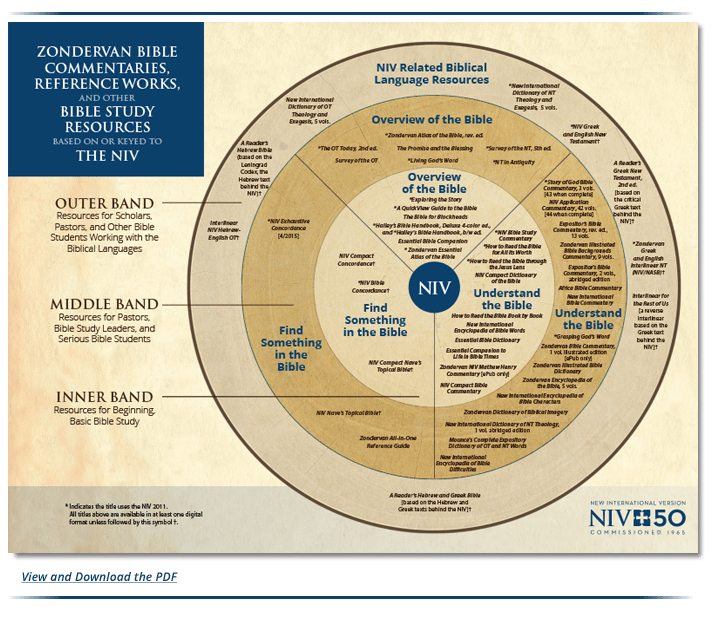
NIV Wheel Graphic


Whether it was for summer camp or Bible quizzing, I grew up memorizing the (1984) New International Version. And, yes, I’m still quite fond of the unfortunately discontinued TNIV. Now Zondervan no longer publishes the 1984 NIV, nor the TNIV–instead, the 2011 update to the NIV is the current version.

You might not realize that the NIV is 50 years old this year. Here’s a recent press release:

In 1965, the Committee on Bible Translation took on the most massive translation project of modern times: to prepare a contemporary English translation of the Bible from the best available original manuscripts. Since its release in 1978, the NIV has become the world’s most read and most trusted modern-English Bible translation with over 450 million copies distributed worldwide. Upon the 1978 release of the NIV, readers were ecstatic that they could finally understand the Word of God in contemporary language.

This anniversary got onto my radar screen when I came across the new NIV 50th anniversary app. What I didn’t know till the other day is that the NIV Study Bible is the best-selling study Bible in the last 30 years.

Here’s a video with some recognizable names discussing the work of the Committee on Bible Translation, who produced the NIV:


You can read more about the NIV here.


Disclosure of Material Connection: A Zondervan rep approached me with an invitation/encouragement to post about the NIV, and offered to send an NIV Study Bible. I plan to post about that in due course, too, once I receive it. While I do appreciate the 2011 NIV over the 1984 NIV in a number of ways, said “Material Connection” has not diminished the place in my heart that the TNIV will always have.

My Encounter with the Ethiopian Eunuch

Preaching so specifically about the Ethiopian eunuch the other week felt risky for at least two reasons:

  1. The eunuch in Acts 8:26-40 reads as a category-defying character, with a sort of in-between sex/gender identity and a home that was the unknown “ends of the earth” described in Acts 1:8.
  2. What even was a eunuch?

DeFranza EerdmansI found a great deal of help in understanding the eunuch and his identity from a just-published book from Eerdmans: Megan DeFranza’s Sex Difference in Christian Theology: Male, Female, and Intersex in the Image of God.

As the book treats sex difference widely, it examines the oft-misunderstood (or unknown!) category of intersex, with eunuchs providing a sort of historical case study in chapter 2. Did you know that Jesus spoke approvingly of eunuchs, and described three kinds?

The chapter was an immense boost to my appreciation of all the uncertainties that could have been at play as Philip encountered the eunuch, part of a group of people that DeFranza cites a 4th century poet as calling “exiles from the society of the human race, belonging to neither one sex nor the other.” They’re male, but not fully, at least not in the expected sense. And there were prohibitions in the Torah like this one in Deuteronomy 23:

 No one who has been emasculated by crushing or cutting may enter the assembly of the LORD.

Yet, as DeFranza and others have suggested, already in the broad sweep of Scripture, there seemed to be hope for eunuchs. Moving from the books of the Law to the prophets, Isaiah, just a few chapters after what the eunuch was reading in his chariot, there is:

To the eunuchs who keep my Sabbaths, who choose what pleases me and hold fast to my covenant—to them I will give within my temple and its walls a memorial and a name better than sons and daughters; I will give them an everlasting name that will not be cut off…. (Isa. 56:3ff)

But if he may not “enter the assembly of the LORD,” maybe he couldn’t be baptized, either?

Josephus, a first century historian, was no exchanger of pleasantries with eunuchs. He wrote:

Let those that have made themselves eunuchs be had in detestation; and do you avoid any conversation with them who have deprived themselves of their manhood, and of that fruit of generation which God has given to men for the increase of their kind….  (Antiquities 4:290)

It seems that the eunuch—a man probably used to giving orders and approval to decisions on the home front—in this poignant moment is asking Philip for his approval. Having heard the good news of Jesus as Philip explains the Scriptures to him, the eunuch wants to know, “Am I allowed in?” Am I excluded or included? Can I be baptized into Jesus?”

Philip had no problem baptizing him into the fellowship of Jesus. Philip surely knew of God’s promise through Isaiah to give the eunuch “a name better than sons and daughters” (which they could not have!). Philip surely had surmised that this man who had traveled from Ethiopia to Jerusalem–a great cost and sacrifice of time… and could he even get in at the temple?–was committed to worshiping God with his whole life. Philip had experienced the Holy Spirit’s presence in Jerusalem and all Judea and (just verses before) in Samaria… and now he must have thought, “Here are the very ends of the earth–the blurring and transcending of many categories–coming right here to this odd deserted road I’ve just been called to!”

Yes, the eunuch had to be baptized.


The chapter on eunuchs is as far as I’ve gotten in Megan’s book. (And if I’ve gone astray anywhere in the above, it’s my doing, not hers.) But I’ve found myself transformed by this vicarious encounter with the Ethiopian eunuch in Acts 8. As I told my congregation, I come back to this passage again, now asking these questions:

Where have I drawn my own borders? How open to re-examination am I in how I think about others and their place in the kingdom of heaven? How can I learn from the eunuch and allow that would-be outcast to change my heart? What do the people Jesus calls brother and sister really look like? Will I allow “the uncategorized” or marginalized or ignored ones to instruct me and lead me into deeper appreciation for the wideness of God’s mercy?

I don’t expect Megan to answer all these questions for me, but hers is a very important book, timed perfectly for this moment in the life of the church and society at large. I’m excited to read the rest of it, as my own encounter with God’s grace shown to the eunuch continues to work on my heart and mind.


Find Dr. DeFranza’s book here at Amazon. The publisher’s book page is here. Megan writes compellingly about the book’s coming into being here.

Read Matthew and Mark in Six Languages at Once

Matthew and Mark Polyglot


Much as I am grateful to be able to see the text of the Bible in multiple languages at one time on a computer, sometimes you just want to curl up with a good, printed edition of a 6-language polyglot.

Fredrick J. Long and T. Michael W. Halcomb have begun such a series, with the recent publishing of Matthew and Mark in Hebrew, Latin, Greek, English, German, and French. It’s obvious that an English-speaking Bible reader would want access to biblical texts in Greek and Hebrew and Latin. German and French, as major research languages for biblical and theological studies, complete the languages of this almost-500-page polyglot.

It’s a pretty sweet work, and an awesome way to practice multiple languages at once. Here’s what it looks like:


GlossaHouse Polyglot Matthew


The layout of the polyglot is clean and easy to follow. It would not be all that difficult to read through all of Matthew and/or Mark in a single language, if one so desired. The fonts are quite legible, although the Hebrew font for Mark differs from the Hebrew font for Matthew. (Also, the vowels are not properly centered under the Hebrew consonants in Mark. This doesn’t make reading it impossible, but I found it distracting.)

There is no critical apparatus, but this is no problem–Long and Halcomb intend simply to provide multiple texts for reading. (Text-critical notes on six languages would make this volume unwieldy, indeed!) The versions used are largely ones in the public domain. The Greek text, for example, is the Robinson-Pierpont Byzantine edition. I have a Greek reader’s Bible I used to use with this same edition. At first I worried that I wasn’t using the academic version of the NA28, but after using that reader’s Bible for a few weeks, I realized it really didn’t matter, if the goal was just to get better at reading Greek. So, too, here: not having the NA28 text included is no loss.

The English translation in Matthew is an authors’ revision of the 1901 American Standard Version (ASV). In Mark the authors use their own translation. They aim to be “fairly literal” in translating the Greek, I’ve never really agreed with such translations’ taking the Greek’s historical present, for example, and keeping it in the present tense in English.

For example, Mark 10:35 begins, “And they come near to him…,” which follows a Greek present participle, but then the two verses later in English has “they said to them” (my emphasis). Though this translates a Greek aorist in the expected way, I would have smoothed out the tenses for the purposes of readability in English translation–even while seeking to be close to the Greek text. Even somewhat literal translations of Greek ought to put its historical present into English past tense, in my opinion. But this perhaps just amounts to a difference in translation philosophy. And a benefit of the authors’ translating Mark this way is you can easily tell, if your Greek parsing is rusty, which Greek verbs are present and which are aorist, since Greek historical present is rendered as present in English.

Those concerns aside, this modern-day “Hexapla” is hard to beat as a way of learning (and keeping active) multiple languages at once. A resource like this would be essential for someone preparing for a Ph.D. program in biblical studies or theology. Pastors, such as yours truly, who want to keep their Greek and Hebrew alive can do so with just this single book.

GlossaHouse offers a wide selection of creative resources for language learning and retention. Check out their site here to see the Hexapla and more.


Thanks to the good folks at GlossaHouse for the review copy! Find it here on Amazon.

How to Use Accordance to Write Sermons

Accordance Live Online Training


Accordance Bible Software has just posted the video recording of a recent webinar I taught, Sermon Preparation in Action with Accordance. Here‘s the one-page handout so you can see what I cover in the just-over one hour presentation. Live webinars are coming up, and include a Q and A time not shown in the video below. (The next one is May 21–sign up or learn more here.)

Here’s the video, with Accordance’s description below. (If you’re reading this blog post via email, you may need to go to the original post to watch the video.)


In this previously recorded webinar, pastor Abram Kielsmeier-Jones demonstrates how he uses Accordance for sermon preparation. Anyone who preaches or teaches the Bible regularly will benefit from watching Abram’s presentation. Originally recorded on April 27, 2015.


Accordance has quite a few other online trainings coming up. Check them all out.

Kierkegaard: “Christ Enters Through Closed Doors”


Søren Kierkegaard, in an 1837 journal, wrote this about the so-called “doubting Thomas” post-resurrection Gospel account:

If Christ is to come in order to dwell in me, that has to transpire in accordance with the heading of the gospel for the day in the calendar: “Christ enters through closed doors.”

Bonhoeffer’s Last Words, Before He Was Hanged (70 Years Ago Today)

Source: German Federal Archive

Dietrich Bonhoeffer was hanged in the Nazi concentration camp of Flossenbürg on April 9, 1945, just two weeks before the U.S. military came to liberate it.

John W. de Gruchy describes the lead-up to that day in his Editor’s Introduction to Letters and Papers from Prison (Dietrich Bonhoeffer Works, volume 8):

On October 8 [of 1944], Bonhoeffer was taken to the cellar of the Gestapo prison on Prinz-Albrecht-Straße, where he stayed until February 7, 1945. From then on, all correspondence came to an end, and contact between Bonhoeffer and the family and [Eberhard] Bethge was broken. From there Bonhoeffer was taken first to Buchenwald and then, via the village of Schönberg in Bavaria, to the Flossenbürg concentration camp, where he arrived on April 8. That evening he was tried by a hastily rigged court and condemned to death. Early the next morning Bonhoeffer was executed along with several other coconspirators.

He was hanged April 9. His family would not learn about it for several months.

The July before he had written to his trusted friend (and later biographer) Eberhard Bethge, one day after the failed assassination attempt on Hitler’s life. He wrote:

How should one become arrogant over successes or shaken by one’s failures when one shares in God’s suffering in the life of this world? You understand what I mean even when I put it so briefly. I am grateful that I have been allowed this insight, and I know that it is only on the path that I have finally taken that I was able to learn this. So I am thinking gratefully and with peace of mind about past as well as present things. …

May God lead us kindly through these times, but above all, may God lead us to himself.

His final recorded words before his hanging are especially appropriate in these days that follow Easter Sunday:

This is the end–for me the beginning of life.


This post is adapted from a post I wrote around this time last year, as part of the “Tuesdays in Lent with Bonhoeffer” I was doing. See other gathered posts here.

With Him in Death, With Him in Life

S 1


When I saw the Whoopie Pie truck in the drop-off lane of a local workout facility, I was reminded that life is full of oxymorons. Or at least things that go together that seem to be contradictory. (Chocolate and cream-filled power up for the elliptical? Yes, please!)

Jesus once said:

Whoever wants to be my disciple must deny themselves and take up their cross and follow me. For whoever wants to save their life will lose it, but whoever loses their life for me and for the gospel will save it.”

There’s another oxymoron for you—or at least it sure sounds like one. The disciples thought it was. “Lose your life to save it? If you lose your life, you’re dead.”

Jesus applied that idea to himself. Before he could rise again from the dead, he had to… well… die first. That you would have to die before you could come back from death is logical enough. But that Jesus even could come back once he was in the irreversible state of death sounded as oxymoronic to the disciples as a dessert delivery driver stopping by the morning Zoomba class.

Peter “knew better.” After his teacher’s death-to-life crazy-talk, Peter pulled Jesus aside and started to “rebuke him.” Jesus rebuked him right back, “Get behind me, Satan! You do not have in mind the concerns of God, but merely human concerns.”

Shortly after that episode with Peter, Jesus said again to his disciples, “‘The Son of Man is going to be betrayed into human hands, and they will kill him, and three days after being killed, he will rise again.’”

Once again, the Gospel of Mark tells us, “They did not understand what he was saying,” but this time they “were afraid to ask him.”


I-Thou: Why Jesus’ Death Was So Devastating


Peter and the others thought that death could only be the career-ending move that it has been, is, and will be for every other human being. It’s not something you come back from.

The idea of resurrection supersedes rationality and, generally, so-called empirical evidence.

And underneath Peter’s blockheaded attempt to tell Jesus who he really was and what he should do, there was a real love. Peter would confess Jesus as “the Messiah, the Son of the living God.”

The disciples didn’t understand Jesus’ teaching of, “I must die and you must die so that we together may truly live.” And even if they could grasp it intellectually, Jesus’ disciples were a group of men and women who had left home, jobs, ways of life to follow someone they believed was going to save them, guide them, and just be with them.

Someone you love that much is the last person you want to even think about dying, let alone hear that person repeatedly referring to their death and saying it has to happen. So there was, I’m sure, an emotional resistance on the disciples’ part to hearing Jesus talk about his own death.

The Jewish theologian Martin Buber offers some insight into why the death of a loved one is so difficult. In his I and Thou, Buber writes that the identity of the individual is constituted not just in isolation, but in relationship to others:

If Thou is said, the I of the combination I-Thou is said along with it.
The primary word I-Thou can only be spoken with the whole being.
There is no I taken in itself, but only the I of the primary word I-Thou.

The disciples’ sense of self was fully interdependent with their sense of who Jesus was. They knew, at least at some level, that they lived and died with him. When they heard Jesus talk about his own death, whether they kept living or not, they knew that a part of themselves would die with him.

It was that knowledge—that gut sense of their intertwined identity—that would lead Peter to say just before the crucifixion, “Even if I have to die with you, I will never disown you.”

Jesus’ death was devastating to his followers. Their sense of self and of the world would never be the same. How could they ever hope again? How could they ever trust? How could they dig out of the hole they now found themselves in?

In the Gospel John’s resurrection account, the stone is gone, but the disciples still don’t understand about Jesus’ dying-then-living. Even with the tombstone rolled away, it was all Mary Magdalene could do to stand “outside the tomb crying… [weeping].”


But There’s More Beneath the Surface


It seems like every time I walk back to our house from the church, I find something new in the driveway or yard. As the snow continues its slow, steady melt, we keep discovering things we forgot we lost. A whiffle ball bat. The pink plastic shovel that caused so much discord back when the kids were fighting over who would use it. Or that hand towel I was reaching for to wipe snotty noses in between shoveling piles of snow off the van several times a week.

I asked our Deacons if they, too, were able to testify to the signs of life emerging from underneath the snow, shooting up from the ground. And they were—let me show you.

 

B 1


B 3


S 2


S 3


There’s always more beneath the surface. Life is so rich and the universe so mysterious and wonderful that what you see on first glance isn’t all that’s there.

The workings of God exceed what we can comprehend. We may think or live as if he’s limited by natural laws. Yet the One who wrote those laws, who put them into place, can re-order the universe as he sees fit.

The one who breathed and still breathes life into creation does not find death to be an obstacle to his purposes.

What seems to be the end is not the end. What the disciples thought was the Last Supper they would ever have with Jesus was, in fact, the first communion meal, an observance that would be repeated countless times by Christians everywhere. That bread—in its brokenness‚ representing death—would be the very source of life to followers of Jesus throughout the ages. One early church father called the communion bread, “medicine of immortality” and “an antidote to prevent us from dying.”


I-Thou, Redux: With Him in Death, With Him in Life


Jesus’ death was heart-wrenching to his disciples. This is because, for them, participation in Jesus’ suffering and death was not a spiritual discipline, or a spiritual state to try to attain—it was their natural reaction to an immense loss. They died with him, as the fire in their hearts went out.

But if they died with Jesus that awful Friday we dare to call “Good,” they came right back life with him, at his resurrection.

“I have seen the Lord!” Mary Magdalene proclaimed. When Jesus came—in person—to the fear-struck, mourning disciples, John says they “were overjoyed when they saw the Lord.”

The disciples were buried with Christ, and they rose again with him to new life. Jesus breathed on them, gave them the Holy Spirit, and the book of Acts happened. The church spread at an amazing rate. Christ’s followers could not contain the joy of new life.

We who call ourselves disciples today also have participated in the death of Jesus. We take part with Jesus in his suffering any time we are compassionately attuned to the unjust treatment and oppression of others. We associate ourselves with Christ’s crucifixion again today when we receive the elements of communion. We join with the first disciples when we observe Holy Week, or practice austerity during Lent, and when we affirm that we, too, were there when they crucified our Lord.

One well-known disciple, Paul, would say, “Is not the cup of thanksgiving for which we give thanks a participation in the blood of Christ? And is not the bread that we break a participation in the body of Christ?”

We participate in Jesus’ death when we accept that it was a sacrifice made on our behalf, offered to bring us into communion with God. From the cross came life–our life, springing forth from the cold, dead ground.

Elsewhere Paul would write, “We were therefore buried with him through baptism into death in order that, just as Christ was raised from the dead through the glory of the Father, we too may live a new life. For if we have been united with him in a death like his, we will certainly also be united with him in a resurrection like his.”

If we have died with Christ, then we live with Christ. We have participated in his death, so we participate in his resurrection.


Conclusion: The Stone Has Been Rolled Away


The stone has been rolled away. Jesus did not stay in the land of the dead, but rose to the land of the living. When death gets the last word in the lives of the ones we love, we know that life actually has a rejoinder. Dead isn’t dead forever.

This is why the Psalmist, perhaps in anticipation of the coming Messiah, could say, “I will not die but live, and will proclaim what the Lord has done.”

So, like those beautiful buds and flowers that improbably spring forth from under an impossible mound of snow, come on out of the hole you’ve dug into the ground. The stone has been rolled away–Jesus himself has done this! There’s no more need to hibernate or hide out.

Jesus, thought to have breathed his last, springs forth from the grave, finds the disciples he so loves, and breathes his own new life on them, so that they can share with him in the resurrected life. The darkness of the tomb is now illuminated by the light of Christ. The somber purple of Lent has give way to the bright white of Easter.

Jesus is risen from the dead! Death is so last season. Resurrection is the new black.

Apparent endings can become starting points, seedbeds, for unexpected beginnings. We now have access to new life in Christ.

The world is lit up with the light of the resurrection of Jesus. Jesus died and lived through it. He took us with him from cross to grave to glory.

We who have died with Christ, who “were there” when they crucified our Lord, now share in the abundant, new life he gives us, through his resurrection from the dead. Thanks be to God!

A Tale of Two Eucharists

The Last Supper


I just got home from our congregation’s Maundy Thursday service of communion. We came forward, knelt down, and partook of the bread and the cup–the body broken, the blood poured out for us. The altar has now been stripped and the cross covered with black cloth.

Our church’s practice is to celebrate communion on the first Sunday of the month. This Easter, then, will be a Communion Sunday for us.

As we do not have communion every Sunday, the idea of two Eucharists in such close proximity–one on the betrayal-and-death side of the story, the other on the resurrection side–has been fascinating to me.

Below is an adaptation of a short message I wrote to our congregation last night.


I’m writing to invite you again to our Maundy Thursday communion service of worship tomorrow night at the church.

And Sunday is Easter Day, Resurrection Sunday, the most glorious day of the calendar year.

As it turns out, because April 5 is the first Sunday of the month, it is also a Communion Sunday for us.

This offers as a unique lens through which to experience this last half of Holy Week and Easter. We might even think of it as A Tale of Two Eucharists.


The First Eucharist

On Thursday Jesus broke bread and gave thanks (this latter verb is the underlying meaning of the Greek-based Eucharist). But even as he was filled with gratitude for his Father’s love, surrounded by the ones who loved him most, he knew there was a betrayer at the table.

In a more cosmic sense, the next day—Good Friday—he would be betrayed by all of the ones he came to save. Not I!, we protest with the disciples at the table. But we, too, “were there when they crucified our Lord.” We have been complicit.


The Second Eucharist

Yet Jesus forgives us of that complicity. Every other Eucharist that has taken place since that first Thursday Eucharist has been on the other side of Resurrection. Our moral failings, stubborn hearts, and forgetfulness in doing good have now all been put to death. We rise to new life with Christ, given a second (and a third, and a fourth…) chance to embody Jesus to a world that is as broken today as it was when our Savior was crucified.

Easter reminds us that the crucifixion was not the closing chapter the disciples thought it was. Rather, it was a preface (a “cold open,” as TV shows call it) to the real story of why Jesus came—to defeat sin and suffering and death through his resurrection, and to invite us into the resurrected life with him.

Just as we participate with Jesus in his death and suffering–Maundy Thursday’s bread of betrayal–we also participate with him in his glorious victory over darkness–Easter morning’s bread of new life.