HALOT has been the scholarly standard in Hebrew lexicons, but might that change?
The mammoth 8-volume Dictionary of Classical Hebrew (DCH) is another major lexical source for readers of biblical Hebrew to consult. What is unique about the DCH is that lexicons like HALOT and Brown-Driver-Briggs (BDB) cover solely the Hebrew found in the Hebrew Bible. DCH, by contrast, covers a wider corpus–“from the earliest times to 200 CE,” it says. According to its product page:
It is the first dictionary of the classical Hebrew language to cover not only the biblical texts but also Ben Sira, the Dead Sea Scrolls and the Hebrew inscriptions. It is the first dictionary to analyse the exact sense of every occurrence of every word, to follow every Hebrew word or phrase with an English equivalent, to print a frequency table of occurrences of each word, and to provide an English-Hebrew index.
Not least among its features is its addition of more than 3500 new words to the stock of the Hebrew lexicon, together with an extraordinarily rich bibliography surveying special lexicographical studies over the last century.

The 8-volume set in print is high-priced, as one would expect. It is much more affordable (as “affordable” goes, in these contexts) in Accordance, which is currently the only Bible software to carry it. The concise version seems to be financially within the reach of many students and pastors.
What is remarkable about the concise version of the dictionary is: “All the words in the full Dictionary of Classical Hebrew are to be found in the CDCH.” Of course, there are less instances of a given word’s occurrence listed, but that every word of the 8-volume set is treated in its 500-some-page younger sister is impressive.
The publisher notes:
The CDCH thus contains not only the c. 8400 Hebrew words found in the standard dictionaries, but also a further 3340+ words (540 from the Dead Sea Scrolls, 680 from other ancient Hebrew literature, and 2120+ proposed words for the Hebrew Bible not previously recognized by dictionaries).
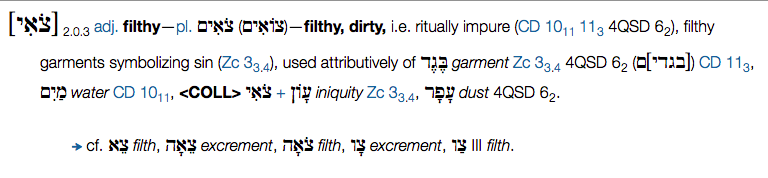
By way of comparison, here is an entry for the same (rarely occurring) word in the concise and full dictionaries, respectively:

I use the Concise DCH for regular Hebrew reading in Accordance, but have just recently been really getting to know it as a lexicon. (UPDATE: see another post here on word frequency statistics in the lexicon.) The print version of The Concise DCH is here; in Accordance it is here. The full 8-volume set from Sheffield Phoenix Press is here, found also here at Accordance.