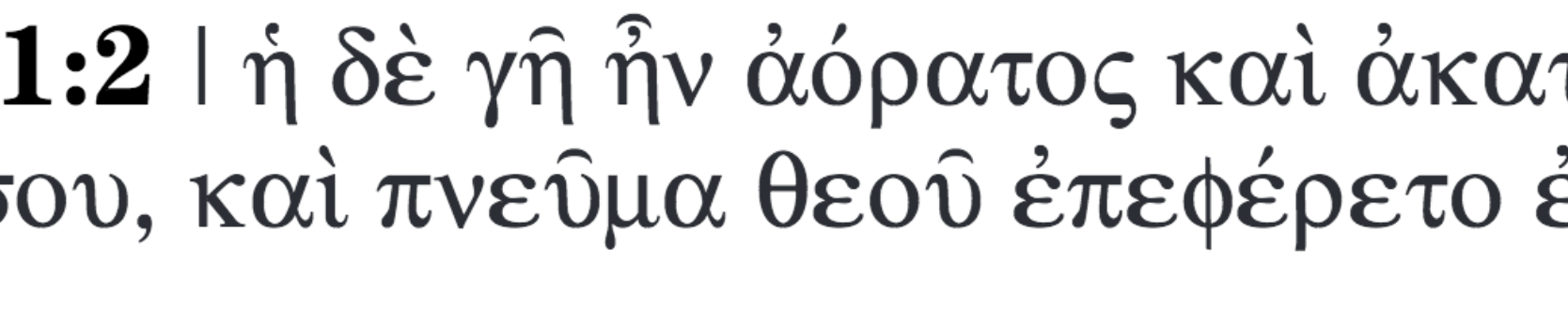
February 8: Happy International Septuagint Day!

International Septuagint Day


Today is February 8, which can only mean one thing: International Septuagint Day. Happy LXX Day! Take some time to read part of the Septuagint today, in Greek or English.

Here are few more links to explore:

A Review of Discovering the Septuagint: A Guided Reader (Jobes)

Discovering the LXX


At long last Karen Jobes’s Discovering the Septuagint: A Guided Reader, has been published by Kregel Academic. The TL;DR version of my review is: while the resource has a few noticeable flaws (easily fixable for a second edition), its addition to the world of Greek reading and Septuagint studies is long overdue.

Below is a longer review of the book, in what I hope will be easy-to-scan Q & A format.


What books of the LXX are covered?

There are ten, intended to “give readers a taste of different genres, an experience of distinctive Septuagintal elements, and a sampling of texts later used by writers of the New Testament” (9). Discovering the Septuagint treats nearly 700 verses from:

  1. Genesis (80 verses)
  2. Exodus (79 verses)
  3. Exodus 20:1–21 // Deuteronomy 5:6–21 (10 Commandments)
  4. Ruth (85 verses)
  5. Additions to Greek Esther (73 verses)
  6. Psalms (67 verses)
  7. Hosea (56 verses)
  8. Jonah (48 verses)
  9. Malachi (55 verses)
  10. Isaiah (81 verses)


For whom is this book?

Jobes says it “contains everything needed for any reader with three semesters of koine Greek to succeed in expanding their horizons to the Septuagint” (8). I think this assessment is right, as I found the book easy to understand (though I’ve had more than three semesters of Greek).


How is the book structured?

Each LXX book has a short introduction. Then there is the passage, verse by verse, with the Greek text re-printed in full. Under each verse are word-by-word and phrase-by-phrase comments on the vocabulary, usage, syntax, translation from Hebrew (the book is strong here), and so on. Following each passage is the NETS (English translation). The end of the book has a three-page, 33-term glossary and a two-page “Index of New Testament LXX Citations” for the books included in the reader.


What does a sample entry look like?

Here’s Jonah 4:6:

jobes-on-jonah-lxx


What’s commendable about Discovering the Septuagint?

It shouldn’t go without saying that the very existence of this resource is a boon to Greek readers. There is Conybeare and Stock, as well as some passages in Decker’s Koine Greek Reader, but readers of the Septuagint have far fewer resources than readers of the Greek New Testament.

The margins are plenty wide for students to jot down their own parsings, translations, and notes.

Notes on the verses are often answers to questions I’ve had as I’ve read the Greek text. In this sense the reader is a great guide. For example, here is a comment from Genesis 1:4:

ἀνὰ μέσον . . . ἀνὰ μέσον | Idiomatic prep phrase, “between.” This is a Hebraism, so there is no need to translate the second of the pair as NETS does.

And another helpful nugget from Genesis 1:11:

κατὰ γένος | Prep + neut sg acc (3rd dec) noun, γένος, kind. Remember the nom and acc forms are identical in this paradigm. Agrees with and modifies σπέρμα.

Whether or not a fourth semester Greek student should remember that nominative and accusative forms are identical in the third declension is another issue. That the reader reminds me as much is welcomed.


What is lacking?

The glued binding doesn’t do justice to a book like this, but that seems to be the way many publishers have gone recently, even with reference works in biblical studies.

Parts of the book feel under-edited or rushed to print:

  • a few typos (missing periods, etc.)
  • referring to the Rahlfs-Hanhart text as a “critical edition of the Septuagint” (9), which is technically true, but potentially misleading, as “semi-critical” is better (text criticism is not a real concern of the book)
  • a peppering of vague statements like this one on “the image of God” in Genesis 1:26: “See a commentary or study Bible” (31)
  • the typesetting on the epsilon just seems off to me. I’ve tried to convince myself it’s just me, but I haven’t since been able to unsee what just looks like a flattened ε or a backwards three, rather than an actual Greek letter:


    screenshot-2016-10-31-22-06-57


    By contrast, look at the letter in this screenshot, taken from Accordance Bible Software:


    screenshot-2016-10-31-22-08-42


    The layout and Greek font are nice otherwise! (Though a couple times in the typesetting of the book, a letter from another language intrudes mid-word.)

  • Introductory issues are quite sparse–whether in the introduction to the Greek of the Septuagint itself (just two pages) or in the introductions to books. I would have liked it if the contributing writers had offered more for each book–even three or four pages would have gone further than the one or two that are here.

This last point deserves just a couple more lines. A number of the introductions adapt or “abstract” their text from the NETS book introductions, which readers could easily enough have found on their own. In some ways the book introductions read just like exam study guides you might have made yourself for a grad-level class on the Septuagint. That may be, in fact, how they started! (Jobes is chief overseer of the book, with many contributors.) This does not make the introductions not valuable, but it will probably leave readers wishing for more detail.

All in all, Discovering the Septuagint is worth owning. The number of times I’ve gotten grammatical or morphological help from the comments far outweighs any of the volume’s weaknesses. And there is a lot of Greek help to be had here. I’ll be making repeated use of this book by Jobes and company, and am glad it’s finally on the market.

Discovering the Septuagint is available from Amazon, as well as from Kregel.


Thanks to Kregel for sending the review copy, provided to me so I could write about the book, but with no expectation as to the content of my review.

Let the Church be a Thermostat, not a Thermometer

mlk-in-jail


Tomorrow our church’s adult Sunday school class will discuss white privilege and Martin Luther King’s compelling “Letter from a Birmingham Jail.” I think I’ve marked up at least 50% of the words in his moving piece of writing. Here’s one section that stood out:

There was a time when the church was very powerful–in the time when the early Christians rejoiced at being deemed worthy to suffer for what they believed. In those days the church was not merely a thermometer that recorded the ideas and principles of popular opinion; it was a thermostat that transformed the mores of society.

King continues:

But the judgment of God is upon the church as never before. If today’s church does not recapture the sacrificial spirit of the early church, it will lose its authenticity, forfeit the loyalty of millions, and be dismissed as an irrelevant social club with no meaning for the twentieth century. Every day I meet young people whose disappointment with the church has turned into outright disgust.

Perhaps I have once again been too optimistic. Is organized religion too inextricably bound to the status quo to save our nation and the world?

Reading and preaching through the Old Testament lectionary (prophets!) has been reminding me of the dual proclamation of the prophets: both God’s hope (which I prefer to think about and preach on) and God’s judgment on those who practice injustice and sin (not as easy to talk about; no less true). Rev. Dr. King was a prophet in the tradition of Joel, Amos, Isaiah, Jeremiah, and all the rest. Of course the church today is not immune from God’s judgment for too easily capitulating to a non-Christlike status quo.

Also intriguing is the idea, as Joel has it in tomorrow’s reading, that all believers have not only the Holy Spirit, but also the charge of prophesying and proclaiming the truth of the God who judges with justice, in whom we can put our hope. All of God’s people are called to the prophetic office!

It’s Prohibitively Expensive, But…

Brill LXX


…the Brill Septuagint Commentary Series is nearing availability on Logos Bible Software.

Here is how Brill describes its series:

This multi-volume series fills a significant gap in biblical studies by providing a literary commentary on the Greek text of the Septuagint. The Septuagint is widely recognized as one of the most important interpretations of the Old Testament and one of the most important sources for New Testament study. Whereas there has been much attention devoted to the two testaments, with numerous commentary series having been written, the Septuagint has been virtually neglected as a set of primary texts used by Jewish and Christian religious communities in the Greco-Roman world.

All 13 published titles will be released in late July through Logos, now available for the steep pre-order price of $1,773.99. It’s a good time to consult your local theological library. All the same, I’m encouraged to see the expanding availability of electronic resources for Septuagint studies.

Find out more here.

A Three-Volume, Multi-Thousand Page Commentary for Psalms Study

Engagement with the Psalms—reading them, owning them, singing them, praying them, and taking cues from them—is vital for robust worship and spiritual formation in the church. If they truly are “a Bible in miniature,” as Luther has said, they offer the opportunity for the church to grow in its spiritual and emotional maturity.


Descriptive, Prescriptive


The writers of the Psalms give language to the whole range of emotions: from gratitude to fear, from joy to lamentation, from petition to thanksgiving, from intimate, private prayers to national, corporate prayers. In this way they are eminently descriptive of the human experience.

The Psalms also prescriptively guide the reader into various postures of prayer, so that the one praying does not only ever approach God with petitions, or only ever with complaint, and so on. The cognitive and affective come together in the Psalms in sometimes unexpected ways. Psalms of lament, for example, often begin with a loud “Why?” (stressing the affective) yet end with a determined profession of faith like, “But I will trust in you still….” In this way they stress the use of cognitive powers in prayer—external life evidence notwithstanding!

The Psalms express (descriptively) and call forth (prescriptively) a whole spectrum of human experience in relationship to God. They teach us to bring our whole selves to God in worship.


Preaching the Psalms


But how to preach them? One will need to take into account intercultural realities. Understanding the role of a shepherd in ancient society will certainly help with Psalm 23. And soul-searching is required.


Psalms of Summer


A good set of commentaries helps, too. I preached some Psalms a couple summers ago, and found these two options quite helpful.

Just completed, too, is Allen P. Ross’s three-volume, multi-thousand page commentary on the Psalms, published by Kregel Academic.


Ross’s Commentary, in Three Volumes


Ross Psalms Vol. 1


Volume 1 has more than 150 pages of introductory material, covering:

  • “Value of the Psalms” (Ross says, “It is impossible to express adequately the value of the Book of Psalms to the household of faith”)
  • “Text and Ancient Versions of the Psalms”
  • “History of the Interpretation of the Psalms”
  • “Interpreting Biblical Poetry”
  • “Literary Forms and Functions in the Psalms” (the best starting place, I thought)
  • “Psalms in Worship”
  • “Theology of the Psalms”
  • “Exposition of the Psalms”

I haven’t seen the just-released third volume, but Kregel was kind to send me the first two volumes for review. In what follows I interact with those books. Volume 1 covers Psalms 1-41; Volume 2 treats Psalms 42-89.


The Commentary Layout (Psalm 42 as Case Study)


Even in the Table of Contents you can get a sense of where Ross will go with a given Psalm, as each Psalm listed includes summary titles. Psalm 1 is “The Life That Is Blessed.” Psalm 23: “The Faithful Provisions of the LORD.” Psalm 46: “The Powerful Presence of God.” Psalm 51: “The Necessity of Full Forgiveness.”

Introduction to the Psalm

Then there follows Ross’s introduction to the Psalm. He provides his own translation from Hebrew with extensive notes, analyzing the text and textual variants. Psalm 42:2, for example, he translates:

My soul thirsts for God, for the living God.

When shall I come and appear before God?

His footnote offers a point of interest: “This first ‘God’ is not in the Greek version; it simply reads ‘for the living God.’” He often has the Septuagint in view, which I especially appreciate. On Psalm 42:9, for example (“I say to God, my rock…”), he notes:

The Greek interprets the image with ἀντιλήμπτωρ μου εἶ, “you are my supporter/helper.”

Not that every footnote “will preach,” but they don’t need to—Ross offers a wealth of insight that will help preacher, student, and professor better understand the text as it has come down to us.

Still with each Psalm’s introductory material, the “Composition and Context” session sets the Psalm in its biblical-literary context and explores background information (where available). Regarding Psalm 42, Ross says:

And Psalm 42 is unique in supplying details of the location. The psalmist is apparently separated from the formal place of worship in Jerusalem by some distance, finding himself in the mountainous regions of the sources of the Jordan. There is no explanation of why he was there; and there is no information about who the psalmist was.

Ross Psalms Vol. 2Reading the commentary, one trusts that were there such information, Ross would have unearthed and presented it!

Then there is a summary “Exegetical Analysis,” followed by an outline of the Psalm. Anyone looking to get their bearings quickly with a Psalm will find this one of the most helpful sections. Here is Ross again, with his summary of Psalm 42:

Yearning in his soul for restoration to communion with the living God in Zion and lamenting the fact that his adversaries have prevented him, the psalmist encourages himself as he petitions the LORD to vindicate him and lead him back to the temple where he will find spiritual fulfillment and joy.

Commentary in Expository Form

After each Psalm’s generous introduction, Ross presents the commentary proper (“Commentary in Expository Form”). It’s as detailed as one would expect and hope. Here he is, for example, on Psalm 42:3-4 (“They must endure the taunts of unbelievers”):

In the meantime, the psalmist must endure the taunts of his enemies—enemies of his faith. In this he is an archetype of believers down through the ages who are taunted for their faith. This has caused him tremendous grief, so much so that he says his tears have been his food night and day (see Pss. 80:5 and 102:9; Job 3:24). The line has several figures: “tear” (collective for “tears”) represents his sorrow (a metonymy of effect); “food” compares his sorrow with his daily portion (a metaphor); and “day and night” means all the time (a merism). The cause of his sorrow is their challenging question: “when they say to me continually, ‘Where is your God’?” (see Pss. 74:10 and 115:2). The unbelieving world does not understand the faith and is unsympathetic to believers. “Where is your God?” is a rhetorical question, meaning your God does not exist and will not deliver you—it is foolish to believe. For someone who is as devout as the psalmist, this is a painful taunt.

This blend of careful attention to the text and reverent devotion to the God who breathed it is typical of the Ross’s rich comments.

Message and Application

Though Ross already offers theological interpretation in the commentary proper, the Message and Application section is one any reader will appreciate. He often reads (in a good way) through a New Testament and Christological lens, as with Psalms 42-43:

But in the New Testament the greatest longing of those who are spiritual is to be in the heavenly sanctuary with the Lord, for that will be the great and lasting vindication of the faith. Paul said he would rather be at home with the Lord—but whether there or here, he would try to please the Lord (2 Cor. 5:8–9). And Paul certainly knew what it meant to be persecuted for his faith. But the marvelous part of the desire to be in the heavenly sanctuary is that the Lord Jesus Christ desires that we be there with him, to see his glory (John 14:3; 17:24). Throughout the history of the faith believers have desired to go to the sanctuary to see the LORD (see Ps. 63); in Christ Jesus that desire will be fulfilled gloriously.

Those looking for a dispassionate commentary or for one that does not find Jesus in the Hebrew Bible will be better served looking elsewhere. To my mind, this dynamic is one of the great strengths of these volumes.

Toward the end of a Psalm, then, Ross boils it down to an italicized expositional message. This is one of the (many) highlights of the commentary, as it pulls everything together from Ross’s careful exegesis into the world of the listener. Here is how he puts Psalm 23:

The righteous desire to be in the presence of the Lord where they will feed on his Word, find spiritual restoration, be guided into righteousness, be reminded of his protective presence, receive provisions from his bounty, and be joyfully welcomed by him.

Where to Get It


Here is where to find these fine books:

Volume 1: Amazon / Kregel

Volume 2: Amazon / Kregel

Volume 3: Amazon / Kregel


Thanks to Kregel for the review copies of both books, given to me for the purposes of reviewing them, but with no expectation as to the content of this post.

Structure of Ephesians 2:1-10: The Center Is Not What I First Thought

In the past when I’ve preached on Ephesians 2:1-10, I’ve gone straight for the gold of Ephesians 2:8-10:

For it is by grace you have been saved, through faith—and this not from yourselves, it is the gift of God—not by works, so that no one can boast. For we are God’s workmanship, created in Christ Jesus to do good works, which God prepared in advance for us to do.

The first seven verses have just felt like an opening band that–while good–wasn’t necessarily what I had come to see.

I see the passage differently now, having spent a good deal of time trying to understand Paul’s flow.

Here’s the passage from the 1984 NIV, followed by the passage in Greek:

Eph 2:1       As for you, you were dead in your transgressions and sins, 2 in which you used to live when you followed the ways of this world and of the ruler of the kingdom of the air, the spirit who is now at work in those who are disobedient. 3 All of us also lived among them at one time, gratifying the cravings of our sinful nature and following its desires and thoughts. Like the rest, we were by nature objects of wrath. 4 But because of his great love for us, God, who is rich in mercy, 5 made us alive with Christ even when we were dead in transgressions—it is by grace you have been saved. 6 And God raised us up with Christ and seated us with him in the heavenly realms in Christ Jesus, 7 in order that in the coming ages he might show the incomparable riches of his grace, expressed in his kindness to us in Christ Jesus. 8 For it is by grace you have been saved, through faith—and this not from yourselves, it is the gift of God— 9 not by works, so that no one can boast. 10 For we are God’s workmanship, created in Christ Jesus to do good works, which God prepared in advance for us to do.

Eph 2:1     Καὶ ὑμᾶς ὄντας νεκροὺς τοῖς παραπτώμασιν καὶ ταῖς ἁμαρτίαις ὑμῶν, 2 ἐν αἷς ποτε περιεπατήσατε κατὰ τὸν αἰῶνα τοῦ κόσμου τούτου, κατὰ τὸν ἄρχοντα τῆς ἐξουσίας τοῦ ἀέρος, τοῦ πνεύματος τοῦ νῦν ἐνεργοῦντος ἐν τοῖς υἱοῖς τῆς ἀπειθείας· 3 ἐν οἷς καὶ ἡμεῖς πάντες ἀνεστράφημέν ποτε ἐν ταῖς ἐπιθυμίαις τῆς σαρκὸς ἡμῶν ποιοῦντες τὰ θελήματα τῆς σαρκὸς καὶ τῶν διανοιῶν, καὶ ἤμεθα τέκνα φύσει ὀργῆς ὡς καὶ οἱ λοιποί· 4 ὁ δὲ θεὸς πλούσιος ὢν ἐν ἐλέει, διὰ τὴν πολλὴν ἀγάπην αὐτοῦ ἣν ἠγάπησεν ἡμᾶς, 5 καὶ ὄντας ἡμᾶς νεκροὺς τοῖς παραπτώμασιν συνεζωοποίησεν τῷ Χριστῷ, _ χάριτί ἐστε σεσῳσμένοι _ 6 καὶ συνήγειρεν καὶ συνεκάθισεν ἐν τοῖς ἐπουρανίοις ἐν Χριστῷ Ἰησοῦ, 7 ἵνα ἐνδείξηται ἐν τοῖς αἰῶσιν τοῖς ἐπερχομένοις τὸ ὑπερβάλλον πλοῦτος τῆς χάριτος αὐτοῦ ἐν χρηστότητι ἐφ᾿ ἡμᾶς ἐν Χριστῷ Ἰησοῦ. 8 Τῇ γὰρ χάριτί ἐστε σεσῳσμένοι διὰ πίστεως· καὶ τοῦτο οὐκ ἐξ ὑμῶν, θεοῦ τὸ δῶρον· 9 οὐκ ἐξ ἔργων, ἵνα μή τις καυχήσηται. 10 αὐτοῦ γάρ ἐσμεν ποίημα, κτισθέντες ἐν Χριστῷ Ἰησοῦ ἐπὶ ἔργοις ἀγαθοῖς οἷς προητοίμασεν ὁ θεὸς, ἵνα ἐν αὐτοῖς περιπατήσωμεν.

Assuming 2:1 is the beginning of a new sentence (Καὶ ὑμᾶς ὄντας νεκροὺς τοῖς παραπτώμασιν καὶ ταῖς ἁμαρτίαις ὑμῶν), there is not a clear indicative verb in a non-subordinate clause really anywhere in sight, at least not until an indicative verb of ἤμεθα (“we were”) in 2:3 (και ἤμεθα τέκνα φύσει ὀργῆς ὡς καὶ οἱ λοιποί). (Though I confess I’m not sure why this is preceded by καὶ if it’s not a participle.)

So 2:3’s ἤμεθα is the first indicative verb in the whole passage not in a subordinate clause. 2:1 (“You, being dead…”=participle) leads to 2:3b’s “we were children of wrath” (and notice Paul’s subtle shift in 2:3a from “you” as sinner to “we” as sinners). This wrath is the outcome one would anticipate.

Then there is a construction with a participle in 2:4a, similar to how the chapter began: ὁ δὲ θεὸς πλούσιος ὢν ἐν ἐλέει–“God, being rich in mercy”=participle. This is a grammatical (and theological) balance to “you, being dead.”

Paul is about to expand on this nice contrast, but first he interrupts with this recapitulation in Ephesians 2:5a: καὶ ὄντας ἡμᾶς νεκροὺς  τοῖς παραπτώμασιν (and you, being dead in transgressions). It is nearly identical wording to how the passage started, forming an inclusio with 2:1. (Just in case we missed it the first time, that we were dead in sin!)

Now there is the continuation of θεὸς ὢν–completed with a main verb to grammatically match but theologically and narratively replace the “we were children of wrath.” It is the high point of the passage, the phrase that holds the whole passage together. It has the three main verbs the listener/reader will have been waiting for since the participle of 2:1.

συνεζωοποίησεν τῷ Χριστῷ

God made us alive in Christ!

Then the rest of the passage is the unfolding (2:6 gives two more main verbs: he raised us and seated us with Christ) and purpose (2:7) and reiteration with implications (2:8-9) of συνεζωοποίησεν τῷ Χριστῷ.

I take 2:10 and its ἐν Χριστῷ Ἰησοῦ, then, to be the “application” section of this passage.

Interestingly enough, read this way, the ever-popular 2:8-9 are not the main point of the passage, at least not on their own. They need to be understood in light of God’s specific actions of making us alive in Christ (συνεζωοποίησεν τῷ Χριστῷ), raising us (συνήγειρεν) and seating us in the heavenly realms in Christ (συνεκάθισεν ἐν τοῖς ἐπουρανίοις ἐν Χριστῷ Ἰησοῦ).

The technical commentaries confirm this way of reading the passage, namely, that the structural and grammatical center is 2:5-6, describing the three-fold action of God in making us alive, raising us, and seating us.

It’s a nuance, to be sure, and it doesn’t take away from the power of 2:8-10. But it does mean my preaching focus tomorrow will be on the three-fold action of God, and how we understand that as his saving grace, to be received by faith.

Discovering the Septuagint: A Guided Reader (Jobes) Is Now Available

Discovering the LXX


For Greek reading I’ve been so knee-deep in Ephesians that I haven’t been much in the Septuagint of late. That will change with the release of Karen Jobes’s Discovering the Septuagint: A Guided Reader, just published by Kregel Academic. I have known about this for a long time, so am happy to see it released into the wild! I think a lot of folks will benefit from it, especially those ready to freshen things up or go a step deeper in Greek learning.

While it’s available for pre-order from Amazon, it’s shipping now from Kregel, so what are you waiting for?

Guess What? Ephesians 1:15-23 is Also One Sentence in Greek: Trying a Mind Map

Just when I thought my sermon preparation was moving away from loooong Pauline sentences, Ephesians 1:15-23 offers another–a single sentence stretches across those nine verses. (See here on Ephesians 1:3-14 as one sentence and where I started my exegesis.)

This week I thought I’d see if I could wed my need to visually outline the text with my deep appreciation for mind mapping.

The result was that I got a significant step closer to understanding the focus of Paul’s prayer for Ephesian Christians. This is in rough form (and will be revised still), but here’s how I used the app MindNode to lay out the passage (click/tap to enlarge):


AKJ Mind Map Sentence Flow


It’s coming together!

At Last: Muraoka’s Syntax of Septuagint Greek

Muraoka Syntax of LXX Greek


At last, an up-to-date, full-on Septuagint grammar: Muraoka’s Syntax of Septuagint Greek.

I mean, just take a look at the Table of Contents! Thank you, T. Muraoka, for writing it.

It is undoubtedly worth every penny, though it does cost many pennies, as you might expect.

Here’s what the publisher says about it:

This is the first ever comprehensive analysis of the morphosyntax and syntax of Septuagint Greek. The work is based on the most up-to-date editions of the Septuagint. The so-called Antiochene version of Samuel, Kings, and Chronicles as well as Judges has been studied. Though this is a synchronic grammar, and though not systematic, comparison with Classical Greek, the Greek of contemporary literature of the Hellenistic-Roman period, papyri and epigraphical data, and New Testament Greek has often been undertaken. Even when analysing translated documents of the Septuagint, the perspective is basically that of its readers. However, attempts were made to determine in what ways and to what extent the structure of the Semitic source languages may have influenced the selection of this or that particular construction by translators. At many places it is demonstrated and illustrated how an analysis of the morphosyntax and syntax can illuminate our general interpretation of the Septuagint text.

Here it is at Peeters Publishers. Here‘s the Amazon page.