Brand New from Carta: The Illustrated Josephus (The Jewish War)

Josephus Carta


Josephus–affectionately dubbed Brosephus in my household–now comes to you, via Carta Jerusalem, with full-color illustrations. I’m still coming back to these three new titles, but in the meantime, here’s a bit of info about Carta’s Illustrated The Jewish War by Josephus.

The publisher describes it thus:

A modern reading of Josephus’ ancient text, profusely illustrated, and placed against its geographical historical background.

• 40 maps illustrating the events recorded by Josephus referenced to the latest scholarly research (The Carta Bible Atlas, The Sacred Bridge: Carta’s Atlas of the Biblical World, and more);

• 175 illustrations of sites, archaeological finds, landscapes, artifacts, and artist’s renditions;

• Easy name search for: Persons (red); Places (blue); References (green).

The Sacred Bridge, as I suggested in probably the longest review I’ve written on this site, is pure gold. R. Steven Notley, a co-author of The Sacred Bridge, has written the introduction for this new volume. It is not very long, but Notley does not need many words to orient readers well to the subject at hand.

Make sure to check out the sample pages here.

The translation is William Whiston’s. The illustrations, maps, and other images (not to mention the color coding that makes even a small-font, tour de force like The Sacred Bridge readable) look to be a nice enhancement to Josephus’s text.

I’ve not seen more than the sample pages, but a possible desideratum could be additional study notes, or footnoted annotations throughout the text to keep the reader oriented to The Jewish War. The images appear to serve that purpose in at least some measure, and promise to make for yet another beautiful book from Carta.

Through the end of June the discount code 30-off will get you 30% off the hardcover volume (retails at $60). The book is to be published in early June. You can find it here.

Ephesians 1:3-14 is One Sentence in Greek: Where to Start

Ephesians 1:3-14 is a single sentence in Greek. It has more than 200 words. How does a preacher even begin!

Well, to start, I isolated the indicative verbs, which is as simple as typing

[VERB Indicative]

into the search entry bar in Accordance software. I wanted to start there because I thought indicative verbs (as opposed to the participles) would be the best place to begin breaking down the flow of Paul’s argument.

Then I cross-highlighted the verbs in an English translation in parallel (though I had done my own translation, too) so I could see them in both languages. The result was this (click/tap to enlarge):


Ephesians 1.1-14 Indicative Verbs


From there, you guessed it, a three-point outline emerged, which shaped my sermon on this beautiful passage. I found that the indicative verbs themselves coalesce pretty nicely into three main points.

I’m preaching on the passage tomorrow–great stuff, and much more to share, but just this simple search (with, of course, instantaneous results) has been essential in guiding my exegesis and preparation.

The Holy Spirit Is for Ordinary Time

At my church we’ve spent the Easter season looking for and finding signs of Christ’s resurrection power all around us.

We see the power of the risen Jesus through mundane interactions in our worlds, just as the risen Jesus appeared on the shore to the disciples and ate breakfast with them.

We find rhythms of resurrection—death and rebirth—in creation.

We see signs of it in our daily lives: our work, family life, and friendships.

We find the power of the resurrection at work within us when we Christians show love to each other—both in word and action.

And we experience the power of the resurrection of Jesus when we affirm with his disciple John, “Perfect love drives out fear.”

I’ve grown these last couple months in my appreciation of how Christ’s resurrection is still shaping everything today.

So I sort of don’t want the Easter season to end. It feels like a little bit of a letdown. I’ll still be on the lookout for signs of the resurrection—I’ll still try to “practice resurrection,” as Wendell Berry wisely tells us to do. But we’re moving now into that long period in the church calendar creatively called, “Ordinary Time.”

I was doing some long-range preaching planning the other day with a week-by-week calendar in front of me. This coming Sunday is the First Sunday after Pentecost. And then, not surprisingly, it will be the Second Sunday after Pentecost. And then the Third, and Fourth, and Fifth, and 13th, and 19th, and 23rd Sunday after Pentecost… all the way up to the 27th Sunday after Pentecost on November 20. Then it’s Advent.

Those “after Pentecost” Sundays for us are “Ordinary Time.”

But moving from what has been a meaningful Easter season for me into this 27-week long “Ordinary Time,” I feel a little like the disciples must’ve felt on Pentecost Sunday: “What now?” “Where do we go from here?”

We need the Holy Spirit for the “ordinary” days ahead. Jesus unleashes the power and energy and life and breath that is the Holy Spirit, so that the disciples can have the Holy Spirit now that Easter has come and gone.


* * * * * *


If I could live through any period of history, it would be those post-resurrection days with the disciples and Jesus. They had lost him to death once, and now he’s gone from them again through his ascension to heaven.

But he doesn’t leave them stranded. He gives to the Church and to every believer the Holy Spirit for all our days to come. The Holy Spirit is for ordinary time.

A number of years ago, when Newsweek was still a print magazine, the editors asked Garrison Keillor what five books were most important to him. #1 on his list was “The Acts of the Apostles.” His one-sentence summary of it was: “The flames lit on their little heads and bravely and dangerously went they onward.” (HT)

And that’s how we go: onward, into differently structured summer days and adjusted schedules. We go onward, even into Ordinary Time, into seasons of waiting and tedium and unmet expectations—we go forward anyway because the promised Holy Spirit has come.

When we love with the love of Jesus, we go “dangerously” but willingly into places of darkness and loneliness and despair, ready to share God’s Spirit far beyond our gathered Sunday morning assemblies. Through the Holy Spirit’s power we can declare with the prophet Joel and the apostle Peter that God’s Holy Spirit is for all people, and that “everyone who calls on the name of the Lord will be saved.”

The Holy Spirit, having come in power at Pentecost, has filled each of us—all of us—to speak words of praise and comfort and love. And we can move with those first disciples from praying, “Come, Holy Spirit,” to now praying, “Thank you, Jesus, for giving us your Holy Spirit. Come afresh to me.”

And we can know that the Holy Spirit is a promise, a guarantee of Jesus Christ himself, given to us now. The Holy Spirit is for Ordinary Time!


The above is adapted from my Pentecost Sunday sermon to my congregation yesterday.

A Greek Word for the Twitter Age: σπερμολογος (spermologos)

Here’s a fun Greek word: σπερμολογος (spermologos). It appears only one time in the Greek New Testament, and nowhere in the Septuagint. Here it is in its context, Acts 17:18:

τινες δε και των Επικουρειων και Στοικων φιλοσοφων συνεβαλλον αυτω, και τινες ελεγον· τι αν θελοι ο σπερμολογος ουτος λεγειν; οι δε· ξενων δαιμονιων δοκει καταγγελευς ειναι, οτι τον Ιησουν και την αναστασιν ευηγγελιζετο.

A group of Epicurean and Stoic philosophers began to debate with [Paul]. Some of them asked, “What is this babbler trying to say?” Others remarked, “He seems to be advocating foreign gods.” They said this because Paul was preaching the good news about Jesus and the resurrection.

The NIV 2011 (above), NRSV, and KJV all translate σπερμολογος (spermologos) as “babbler.” HCSB has “pseduo-intellectual.” NASB has “idle babbler.” NET has “foolish babbler.” Not to be outdone, the Message offers, “What an airhead!”

Context determines meaning, which makes a word like this tricky, since it has no other uses in the Bible. The LSJ lexicon notes its use in, among other classic works, the play Birds by Aristophanes, where it refers to birds picking up seeds. In the 1st century B.C. history of Dionysius of Halicarnassus, σπερμολογος  describes a “frivolous” person. For the noun form LSJ offers, “one who picks up and retails scraps of knowledge, an idle babbler, gossip.”

BDAG has this: “in pejorative imagery of persons whose communication lacks sophistication and seems to pick up scraps of information here and there.” I also like its gloss of “scrapmonger”! In the part of the entry that covers the Acts verse, it says, “Engl. synonyms include ‘gossip’, ‘babbler’, ‘chatterer’; but these terms miss the imagery of unsystematic gathering.

Also helpful is Louw-Nida’s Greek-English Lexicon of the New Testament Based on Semantic Domains:

one who acquires bits and pieces of relatively extraneous information and proceeds to pass them on with pretense and show.

And then this gem, from the same source:

The term σπερμολογος is semantically complex in that it combines two quite distinct phases of activity: (1) the acquiring of information and (2) the passing on of such information. Because of the complex semantic structure of σπερμολογος, it may be best in some languages to render it as ‘one who learns lots of trivial things and wants to tell everyone about his knowledge,’ but in most languages there is a perfectly appropriate idiom for ‘a pseudo-intellectual who insists on spouting off.’

The implications for an easy-to-access information age are obvious–how much of the Internet is gathering information like seed and passing it on, without stopping to research and truly evaluate it?

We could pontificate, but back to Acts–this is what some Athenian philosophers called Paul: a σπερμολογος. The parenthetical statement in Acts 17:21, however, makes this the height of irony:

Αθηναιοι δε παντες και οι επιδημουντες ξενοι εις ουδεν ετερον ηυκαιρουν η λεγειν τι η ακουειν τι καινοτερον.

(All the Athenians and the foreigners who lived there spent their time doing nothing but talking about and listening to the latest ideas.)

Did you catch it? Louw-Nida says a σπερμολογος engages in “two quite distinct phases of activity: (1) the acquiring of information and (2) the passing on of such information.” Acts 17:21 says the Athenians themselves (who leveled the σπερμολογος charge against Paul) spent all their time in two phases of activity: talking (#2 above) and listening (#1) to “the latest ideas.”

Moral of the story: check yourself before you call someone a σπερμολογος.

“Can there be any day but this?” George Herbert’s “Easter”

As we are still in the Easter season, here is George Herbert’s “Easter,” quoted in N.T. Wright’s Resurrection and the Son of God.

I got me flowers to straw thy way;
I got me boughs off many a tree:
But thou wast up by break of day,
And brought’st thy sweets along with thee.

The Sunne arising in the East,
Though he give light, and th’East perfume;
If they should offer to contest
With thy arising, they presume.

Can there be any day but this,
Though many sunnes to shine endeavour?
We count three hundred, but we misse:
There is but one, and that one ever.

Bonhoeffer’s Last Words, Before He Was Hanged (71 Years Ago Today)


Source: German Federal Archive


Dietrich Bonhoeffer was hanged in the Nazi concentration camp of Flossenbürg on April 9, 1945, just two weeks before the U.S. military came to liberate it.

John W. de Gruchy describes the lead-up to that day in his Editor’s Introduction to Letters and Papers from Prison (Dietrich Bonhoeffer Works, volume 8):

On October 8 [of 1944], Bonhoeffer was taken to the cellar of the Gestapo prison on Prinz-Albrecht-Straße, where he stayed until February 7, 1945. From then on, all correspondence came to an end, and contact between Bonhoeffer and the family and [Eberhard] Bethge was broken. From there Bonhoeffer was taken first to Buchenwald and then, via the village of Schönberg in Bavaria, to the Flossenbürg concentration camp, where he arrived on April 8. That evening he was tried by a hastily rigged court and condemned to death. Early the next morning Bonhoeffer was executed along with several other coconspirators.

He was hanged April 9. His family would not learn about it for several months.

The July before he had written to his trusted friend (and later biographer) Eberhard Bethge, one day after the failed assassination attempt on Hitler’s life. He wrote:

How should one become arrogant over successes or shaken by one’s failures when one shares in God’s suffering in the life of this world? You understand what I mean even when I put it so briefly. I am grateful that I have been allowed this insight, and I know that it is only on the path that I have finally taken that I was able to learn this. So I am thinking gratefully and with peace of mind about past as well as present things. …

May God lead us kindly through these times, but above all, may God lead us to himself.

His final recorded words before his hanging are especially appropriate in these days that follow Easter Sunday:

This is the end–for me the beginning of life.


This post is adapted from a post I wrote around this time two years ago, as part of the “Tuesdays in Lent with Bonhoeffer” I was doing. See other gathered posts here.

New Commentary Series: T&T Clark International Theological Commentary

Joel ITC


Users of technical and original language-oriented commentaries are familiar with the International Critical Commentary series. The publisher of ICC has just announced the new International Theological Commentary series.

The publisher’s description of the series is as follows:

The T&T Clark International Theological Commentary (ITC) offers a verse by verse interpretation of the Bible that addresses its theological subject matter, gleaning the best from both the classical and modern commentary traditions and showing the doctrinal development of Scriptural truths.

A companion series to the long-running International Critical Commentary (ICC) the ITC bears all the same hallmarks of scholarly rigour and excellence. The two series will be published alongside each other with the ITC’s focus being on the theological significance of biblical texts.

The series editors are Michael Allen and Scott R. Swain, both of Reformed Theological Seminary. The books sport a high price tag, like the ICC counterpart–the just-published Joel volume is $94 in hardback. (A bit cheaper on Kindle.) You may wish to ask your local library to get these volumes so you can check them out.

Learn more about the series here.

“He Is Risen!” Delirious Tale or New Reality?

There was a family with twin boys. They looked exactly alike, but everything else about them was different. One liked rap; the other listened to country music. One always thought it was too warm in the house; the other thought it was too cold. And so on. One brother was a hope-filled optimist, while the other was a convinced pessimist.

Their dad wanted to try an experiment with them. So one Christmas Eve, while the kids were asleep, he filled the room of his pessimist son with every single item on his wish list: toys, games, books, gadgets.

The room of his optimist son, on the other hand, he filled with horse manure.

Christmas morning came, and the Dad went to the pessimist’s room. That son was surrounded with his new presents, weeping.

“Why are you crying?” said the dad.

The son replied, “My friends will get jealous of me; I’ll have to share; there’s all these instructions to read before I can play with the toys; the batteries are going to run out…”, etc.

Down the hall the father saw his other son–the optimist–singing and dancing around in the pile of manure.

“Why are you so happy?” the dad asked.

The optimistic son said, “Because… there’s got to be a pony in here somewhere!”


Setting the Stage: The Tomb


The disciples on Easter morning lived in a pessimists’ world, and for good reason, as we’ll see. They had no hope of finding a pony among the manure. Their hope, they thought, lay dead in the ground, sealed behind a heavy stone.

Luke tells us some female disciples went to the tomb, “taking the spices that they had prepared.” They were going to embalm the body. Not in the hopes of resuscitating it—nobody thought that was possible. But because they wanted to show honor to the dead.

But they get there, and—no body. Luke 24:4 says “they were perplexed about this.”

And wouldn’t you be, too?

This is not necessarily a sign of hope to them, that the body is gone. It’s cause for despair.

Their beloved teacher, their companion and friend, the one who was going to redeem them from their constrained existence under Roman rule—this one was dead. What’s worse, they can’t mourn him properly now. They’re losing access to their chance at closure. This is not shaping up to be a good death.

Fact is, it’s not shaping up to be a death at all.

The angels ask, “Why do you look for the living among the dead?” (“The living,” they must’ve responded?)

“He is not here, but has risen!”

Spinning as their heads were, verse 8 represents at least a minor miracle: “They remembered his words.” It all clicks. Jesus is alive! They believe it.

And they run and tell the disciples and a bunch of others.


Unbelieving Disciples: Idle Tale


And don’t you just love how true-to-life the Gospels are?

The eleven apostles and the others—a formidable group of men and women from whom the Church would spring–they didn’t believe their own friends! Verse 11 says, “But these words seemed to them an idle tale, and they did not believe them.”

“An idle tale.” Silliness. The ravings of madmen, or, in this case, madwomen. The narrator Luke was a doctor, his word for “idle tale” is rooted in medical language–it has to do with delirium. The women were assumed to be delirious.


Bad start for the Church

This is a bad start for the church–resurrection is THE core belief of Christianity. The apostle Paul would soon write, “If Christ has not been raised [from the dead], our preaching is useless and so is your faith.” (1 Cor 15:14)

Useless. The faith of these disciples the women are preaching to is useless. If the story had stopped here, you and I would not even be gathered for worship this morning! If you don’t have the resurrection of Jesus, you don’t stand a fighting chance against the world!

This is a real struggle of people of faith: they thought they were hearing idle tales.

They might have appreciated the narrative arc of the women’s story. They might have said, “This will make for some great literature to be studied in future English courses.” (Or, uh, Aramaic and Greek classes.) They maybe even saw the book sales potential–finally we’ve got something that can bump Homer off the best-sellers’ list!

But still, this is just a story we’re hearing, they thought. Fiction–not factual truth.


Justified, though?

One reason they didn’t believe the women is because of some bad cultural mores that discounted a woman’s witness. They weren’t seen as credible sources.

But if we can’t forgive the disciples their outdated sexism, let’s cut them some slack, for some other reasons. Before Jesus would undo death, his death had undone everything for the disciples. Every word Jesus had spoken to them? Felt like an empty promise. This coming Kingdom of God? Gone, nailed to the cross with him.

Besides that, one of these women, Mary Magdalene, had been demon-possessed. And not just sort of demon-possessed. She was severely demon-possessed. Luke told his readers earlier that she had “seven demons cast out.”

The disciples thought she was delirious, and must’ve wondered–did she now have a relapse, with Jesus dead? Is she a conduit for demons again?

Make no mistake–the disciples believed in resurrection, even before they saw Jesus. But the story of Lazarus notwithstanding, they seem to have reverted back to their default religious belief. Resurrection would happen in their mind… but at the last day. In the end times. And THIS was not yet the last day.


How we are like them

The story of the resurrection did not ring true in the disciples’ ears. To their mind there was no power to it.

There is a danger that you and I would hear the resurrection story as they did, as an idle tale. We are susceptible to the same disbelief the disciples had, when it comes to Jesus’ rising from the dead. Many today take this account as fiction.

Or worse, we might accept the truthfulness of Luke 24, but then unwittingly dismiss the resurrection story as an irrelevant tale. We may celebrate the resurrection historically, as a past event, without the realization that it still means everything for us today. We would be without true hope if we acknowledged that it happened, but then failed to live like ones who have ourselves received the gift of resurrection power, of new life.


Peter: Sprint to the Tomb


Peter fares a little better than the others. He actually takes the women’s story seriously, and so runs to the tomb, in Luke 24:12: “But Peter got up and ran to the tomb; stooping and looking in, he saw the linen cloths by themselves; then he went home, amazed at what had happened.”

He gets there and sees the tomb:
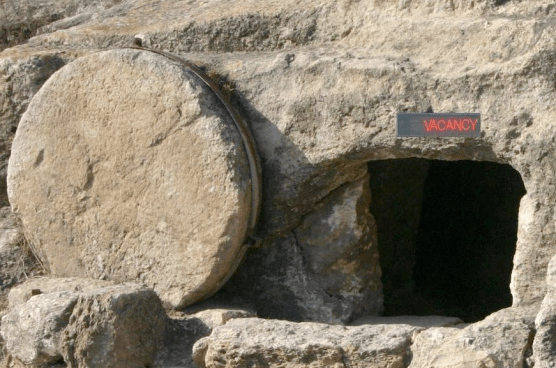
 

Tomb Vacancy


But Peter goes home. He doesn’t, oh, say, go back to the disciples and confirm the account of the women. That’s because, even though he’s amazed, he’s still not sure what everything means. His amazement does not seem to translate into full acceptance of faith. It’s more like being perplexed, bewildered. He is astounded, yes, but this going home feels like a shrug of the shoulders.

We can identify with Peter. How many times have we sprinted towards the cross, only to get there and turn around and go back home, to our old ways? How often have we run towards the empty tomb, eager to meet our risen Lord… only to walk away as if nothing ever happened?

It’s like the one in James who looks in a mirror and then goes away and forget what he looks like. Peter’s response calls to mind the seed that was sewn, and grew up fast… but then could not grow once it encountered the thorns and weeds of this life.

Living in the light of the resurrection is more marathon than sprint. Eagerness is good, yes, but so is stick-to-itiveness.


The Women


We come to Jesus much as the women came to the tomb that morning. We come to him with no hope in the world, apart from what we trust he can give us. Maybe you’re coming this morning and wondering if the resurrection really is all that relevant to what you’re going to have for lunch in a little while, or what your working day tomorrow looks like. Maybe you are having trouble connecting the glory of this morning to the mundane week that awaits you. Perhaps you are looking for somewhere trustworthy to place your belief… someone Good you can hold onto.

Mary Magdalene and the others, desperate and forlorn, manage somehow to offer a model response to the resurrection.

The male disciples–even Peter, the so-called “rock”–are Luke’s version of the TV show “What Not to Wear.” Dismissing the resurrection as an idle tale? Not the response I’m looking for, says Luke. Sprinting toward the empty tomb, only to go away shrugging your shoulders in bewilderment? Nope.

Instead, Luke traces an inspiring movement of faith by Mary Magdalene, Joanna, and Mary the mother of James.


They looked for the living, albeit among the dead

The angel asks, “Why do you look for the living among the dead?”

The women didn’t realize they were looking for the living, but they were looking for Jesus all the same! They thought they were going to find a dead Jesus, but at least they were seeking all the Jesus they had left!

Especially in those moments when Jesus seems distant, disconnected–or, worse, dead to us–approaching what we have of him may be all we can do. Still do it, Luke suggests.


They bowed in worship

In response to the angel, the women “bowed their faces to the ground” in worship. This humble posture of Doxology shows their openness to letting God reveal himself however he will reveal himself. At this point they’ve let go of the fabrication that we know better than God.


They remembered his words

From their posture of worship, Mary and the women could remember what Jesus said. Verse 8 says, “Then they remembered his words.”

Remembering is not just something you happen to do or don’t. Sure, if we don’t go grocery shopping with a good list, the pack of coffee filters will slip our mind. But this remembering the women do–it’s more than a fleeting thought that happened to come to them. They’re training their focus back to inhabit the world they had known with Jesus. They’re calling his words to mind… dwelling on them, and believing them. They remember their first love. You do that, too, Luke seems to tell us.


What the Resurrection Means


This week has brought us a steady stream of reminders that life sometimes seems like nonsense. An airport attack in Brussels. Another one in Iraq. Yet another videotaped example of institutionalized racial profiling.

It would be easy to rush to the tombs of these innocent men and women and see only bewilderment and death.

Closer to home we have our own enigmatic interactions and happenings that push the limits of our capacity to hope in God.

But because of the resurrection, where our lives once looked like this…


Egg Down


…they now look like this:


Many Eggs


Jesus’ defeat of death is real. The resurrection is far-reaching in its implications. Jesus’ rising from the dead calls us to a new way of living. Those women’s lives really started that day.

Because of Jesus’ resurrection, failure can become opportunity. Because of Jesus’ defeat of death, every ending has in it the seeds of a new beginning. Because of the presence in our lives of the resurrected Christ, where we have forgotten, we can again choose to remember. Because the stone was rolled away, our stony hearts can give way to compassion. Because Jesus did not remain among the realm of the dead, mourners can know that–if not now–then SOME DAY they will rejoice. Because of Christ’s victory over the grave, when others intend to keep us down, God can bring us back up again, rising with him.

That optimistic twin brother was right–where there’s manure, there’s got to be a pony somewhere. But not because we are optimistic people by nature. There are plenty of things to be pessimistic about, and with good reason. But the power of Christ’s resurrection opens us up to a new reality. It’s more than a new perspective on life. It’s new life altogether!

We can overcome evil with good. We can stare down death and know that it’s not the end. Even when we’re confronted with evil, we can be assured that the power of the rolled away stone is stronger than the power of the tomb. We can follow these wonderful women, and be first responders at scenes of tragedy, sharing the good news of God’s love in Christ.

If the resurrection of Jesus is real–if it transformed the world then–it is still transforming the world now. If Mary Magdalene and her friends could go from wailing tears to evangelistic zeal, there is hope for you in your despairing moments. If Jesus rose from the dead–and, friends, he did–he rises again out of the rubble of the world. Jesus even rises in our hearts, and empowers us to choose life with Him.

Alleluia! Christ is risen!
The Lord is risen indeed! Alleluia!

Alleluia! Christ is risen!
The Lord is risen indeed! Alleluia!

Holy Saturday? More like “Awful Saturday”

(Adapted from the archives)

Many Western Christians have an idea of what to do on Good Friday and Easter. On Good Friday we call to mind our sins, the last words of Jesus on the cross, the shock and despair his followers experienced… and we try to imagine his suffering, entering into that as best as we are able.

And then Easter is the party of all parties, when we declare the defeat of death: “Jesus Christ is no longer dead!”

Alleluia! Christ is risen!
The Lord is risen indeed! Alleluia!

But what about Saturday? The disciples didn’t have an “Easter” to look forward to. Jesus was done for, as far as they knew. He was really dead. When he did appear to the apostles, they were terrified and thought they were looking at a ghost. They weren’t even hopeful for resurrection–it hadn’t crossed their mind as an option.

So what some Orthodox call “Bright Saturday” was anything but bright for Jesus’ first followers. It was horrible. Awful Saturday, they thought they would have to call it for years to come. They felt as empty as the tomb was about to be. It was a Sabbath day, too, so they didn’t have any work to distract them. They were quiet. Or maybe they wailed loudly.

Maybe the second day–Saturday, and he was still gone!–was even more difficult for the disciples than Friday.

There’s a liminal quality to Saturday in Holy Week: it’s an often unnoticed, unmarked day that is situated between death (Good Friday) and life (Resurrection Sunday). How should I feel? Sad? Penitential? Happy? Pre-happy? Expectant? However I want? All or none of the above?

Many Episcopal churches have a full Easter Vigil service on Saturday night, but just this simple offering for a Holy Saturday liturgy. We “await with him” and “rise with him” in that service’s Collect. This calls to mind Psalm 30:5, which says, “Weeping may stay for the night, but rejoicing comes in the morning.” Our Holy/Bright/Liminal Saturday is a short day, since we know of Resurrection Sunday’s shouts of acclamation and loud Alleluias.

But Saturday for the disciples was not liminal. It was not thought of as perched between death and life. That day and those men and women felt firmly ensconced in the grips of death. There was no “other side” to look forward to, as far as they knew–at least not until the end of time. The closing anthem in the short Book of Common Prayer liturgy above begins, “In the midst of life we are in death….”


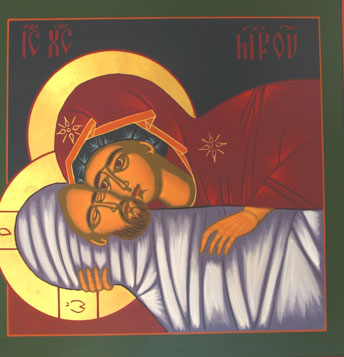
Jesus and Mary


“We are in death.” Death Saturday. Awful Saturday.

Jesus’ followers had no clue what–or Who–was just around the corner….

Practicing Solitude Anywhere, in a Matter of Seconds

The practice of solitude suffers from some misconceptions.

An old misconception of the habit, which tempts our belief from time to time, is that solitude is primarily the domain of those who live in the desert or among cloisters and in monks’ cells.

We do have some impressive models from such traditions. There was St. Anthony of Egypt, who withdrew to the desert and lived as a hermit until he died at 105 years old. Hardly a week passed where he didn’t have some visitor coming to seek his wisdom.

Or maybe the word “solitude” conjures up a more recent spiritual practitioner, someone closer to home, like Thomas Merton, who wrote from a Trappist monastery in Kentucky.

We might also conceive of solitude as a luxury available only to folks with few external commitments.

But, as with all spiritual disciplines, practicing solitude is for everybody.

I’ve been having my inner world re-arranged again this Lent by Richard Foster’s Celebration of Discipline. He knows plenty about how often misunderstood the spiritual disciplines are. So on the very first page of his book, he says, “God intends the Disciplines of the spiritual life to be for ordinary human beings: people who have jobs, who care for children, who wash dishes and mow lawns.”

Solitude is for everybody.

It’s not to be confused with loneliness.

In loneliness there is a constant wish that things would be other than they are. There is a deep, unsatisfied craving–even a sad yearning, a missing of what is not there. Loneliness includes anxiety. It feels like being forgotten or passed by. Loneliness seems more often beyond our control, whereas solitude is a choice.

Solitude and loneliness are not the same.

Neither is solitude merely time alone… any more than holy Sabbath-keeping is just lack of working.

There are plenty of ways to not work and still disregard a holy Sabbath that we consecrate to God. And there are many ways to be alone but not really alone with God. We can be alone and not even really alone with ourselves. Our first impulse when solo might be to distract ourselves with some noise or input.


Sanctified Time


Solitude is not just time alone; it’s sanctified time alone. It’s dedicated and God-focused aloneness.

The Psalmist prays to God, “My times are in your hands” (31:15). Solitude is sanctified time, willingly placed in God’s hands. It is our attention, given over to God for the purposes of God, not the purposes of the self.

Many Christians through the years have suggested one reason God doesn’t “speak” to us today is that we’re too absorbed in other noise to be attuned to God’s voice in the first place.

Solitude, then, is being by yourself, but in such a way that you are clutter-free enough to hear yourself, and to be open to the voice of God.

I share here about solitude, using the same units we use to measure time: seconds, minutes, hours, days.


Seconds


It is possible, yes, to put even the seconds of our lives into God’s hands. We can give the tick of the seconds hand to God in such a way that even something like a quarter of a minute can be sanctified for God’s work in us.

All of the spiritual disciplines have both internal and external components to them. When we think about the seconds of our days, a soul-searching question to ask is: What do I default to doing when I have a short break? What do I reach for when I’m waiting half a minute for someone to arrive at a meeting? Even when I get to the coffee shop and there are only two folks in front of me, where does my mind go? When my kid finally stops running around because he or she has to go potty, what am I doing with the short break–interrupted as it soon will be by a request for help?

All of those instances are enough time to pray, for example, the Jesus Prayer: “Lord Jesus Christ, Son of God, have mercy on me, a sinner.”

I don’t mean we have to be deliberate about every single second of the day. That would be exhausting. And it’s good to just zone out sometimes. But especially if you’re struggling with where to find opportunities for solitude, those otherwise lost moments–those scattered seconds–are the place to begin. We all have these already-existing spaces–however small they are–that we don’t have to create. We just have to see them and be ready to use them as mini-retreats.

Thinking in terms of seconds an unexpected place to start on solitude. But this spiritual practice in particular, I think, is one where quality of time is at least as important as quantity of time.

If we don’t know how to sanctify the seconds of our lives for our communion with God–however brief it may be–if we can’t do that, we’re likely struggle when we carve out longer periods of time to reflect and pray by ourselves.

I was a professional house painter for a year. I wanted to paint fast (and well) like my boss. He cut in the best lines (with no painter’s tape!), and quickly.

But, of course, in my first weeks painting, I was only fast. As a result, I had to learn how to use a razor blade to take excess oil-based paint off window panes.

My boss referred me to Walter, the best painter in the city who occasionally worked with us. Walter trained me. He said: start with quality first. Get it right before you get it fast. Speed will follow good technique.

I slowed down. I got better at painting clean lines. My boss noticed my decrease in speed—how long it took me to do a window or baseboard—but he was patient. By the end the of year, I was painting windows and baseboards with no painter’s tape, almost as fast as my boss.

Solitude is like this, too: start with quality of time spent alone, then build quantity from there. Work on your solitude mindset technique, so to speak, in the seconds of the day.

And if you already regularly practice solitude with much greater quantity than seconds, pay attention to the seconds hand. God is just as present there as he is in your hour-long devotional time.


Minutes


Then there the minutes of our lives. They add up quickly, those minutes we need to get ready for the day, to do our hair, to take a shower, to wind down before we go to sleep. We spend minutes at a time in line at the grocery store. Minutes in the car (sometimes many minutes) stuck in traffic.

Like seconds, these minutes are already-existing moments we don’t have to create–they’re either built-in or beyond our control. And they’re a great place to practice solitude–opening ourselves up, in moments of aloneness, to God.

The other day I had to make what would be a 90-minute commute for a school meeting I was hoping would have just been an email.

Before leaving, I probably spent as much time complaining to my wife about the meeting as I would later spend stuck in traffic on the highway.

And I spent way too much psychological energy trying to figure out how I could redeem the 3 hours I knew I would be in the car. Audiobooks? Phone calls? Bass-heavy, hip hop music playlists?

To my surprise, when I got into the car to head out, I felt a fairly strong sense that I should just spend that time praying. Some of that praying ended up being confession for the non-prayer-like thoughts I had about the drivers around me. But as frustrated I was at all that time in the car, through God’s mercy, I was able to receive that solitude–such as it was–as a gift.


Hours


Our lives are made up of seconds and minutes… and also of hours. This moves us into territory where we need to carve out time and space for solitude. These hours exist–we all have the same amount of them each day. But a little more effort is required.

We’ve got to anticipate our first morning commitment and set the alarm for 15 or 30 or 45 minutes before that. Or look at what time our last commitment of the day will be and schedule time with ourselves and God at night, before we go to bed.

As we learn to practice solitude in the seconds and minutes of our days, time alone with God that is measured by the half hour and hour will become especially precious.

We heard the Gospels of Jesus–a man with relational demands on his time if ever there was one!–“But Jesus often withdrew to lonely places and prayed.” Often–on a regular basis. Even while the sick and needy were trying to track him down and keep him from solitude. He withdrew–a proactive move to seek substantial alone time with God.


Days


Then, as the quality of our sanctified time in God’s hands increases, we’ll probably not be content with just seconds and minutes and even hours–we’ll start to consider whether we can spend periods of solitude that span half-days and full days.

Something like an overnight retreat or day trip to a local retreat center requires extra coordination, but it’s just as doable as planning a vacation.


As a Way of Life and Orientation of the Heart


As we weave in and out of seconds, minutes, hours, and days, the question we want to answer is: How we can live in an integrated way so that our heart’s orientation can be one of inward solitude and focus on God? Even with crowds and sounds and external demands around us each day, how can we devote our attention in a given moment to singular communion with God?

Solitude is a way of life and, overall, an orientation of the heart, whether we are alone or with others.

There is much that keeps us from practicing solitude. They are internal and external: external noise, internal noise, fear, an impulse of self-preservation, feelings of incompetence in the spiritual life, and guilt.

Especially the barrier of guilt can keep us from solitude. We may have a sense of shame or having fallen woefully short when it comes to practices like God-focused solitude. Both our past and present lack of success induce enough guilt to keep us from entering into God’s presence during important moments of our day.

But, friends, every day we have 86,400 new seconds to call God’s goodness to mind and pray. Each day affords us 1,440 more minutes to say to God, “My time is in your hands.” This time—this very second—is in your hands.

We don’t get to choose the use of all of these seconds and minutes and 24 hours. The sheer amount of inputs competing for our attention will always tempt us to pass off God-focused solitude as the purview of advanced spiritual masters. But if you miss the three-minute opportunity you just had to re-center on God, don’t beat yourself up. Just offer God the next little pocket of time you have–when you’re waiting for someone or in between commitments.

God’s promise to us through Isaiah is: “You will keep in perfect peace those whose minds are steadfast, because they trust in you.”

Let us trust in God—let us trust God with our seconds, minutes, days, hours… and with focused hearts. May we fix our minds on Jesus through moments of solitude—moments both short and long. May God meet us there, and keep us in perfect peace.