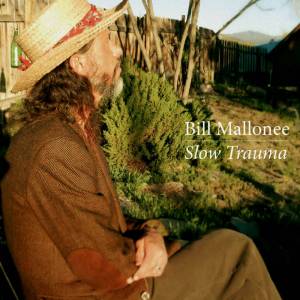
Bill Mallonee’s Slow Trauma

The 1:06 opening track, “One & the Same,” serves as a Prelude to Bill Mallonee’s most recent album–Slow Trauma–asking:

What you hold onto and what you let go of
and what you should give away
What’s gonna save you and what makes you smile?
Sometimes, they are one and the same

Then the full band kicks in with a sweet folksy rock groove in “Only Time Will Tell.” (“Where it’s all going? Only time will tell.”) And by full band, I mean: Bill Mallonee on vocals, guitars, bass, and drums. This is something like his 74th album (!), and I only learned an album or two ago that drums are his first instrument.

Before I say any more about this top-notch record, here’s Mr. Mallonee from an essay he wrote that serves as liner notes:

Death. Cessation.
A component of my interior world.
I feel like I’ve been staring it down in one form or another all of my life.
I’ve been “institutional material” once or twice.
It has certainly shaped my melancholy temperament and driven my art in noticeable ways.

I know some movements across the spectrum of human history have glorified it, romanticized it, even reveled in it…
Death. What’s to revel in?
Me? I don’t see it that way. At all.
I think it’s more like an aberration.
A blasphemy.
God, damn it. (That’s a prayer. Not an expletive.)

The third track, “Waiting for the Stone to be Rolled Away” has a great groove, too. It’s a resurrection song, written “from the parking lot of the Holy Spirit Assembly.” Mr. Mallonee takes the listener “down these sad, back streets of doubt to a new and brighter day / waiting for the stone to be rolled away.” (He does it with a killer harmony part, too.)

Slow TraumaIn this third track begins a trend that Mr. Mallonee thankfully repeats throughout the album: just when you get fully into the groove and expect the song to end, he goes another minute with some instrumental rocking out. I love this album for that. He takes his time with the songs. He comes to say what he needs to say, then lets the music do the rest of the talking, helping the listener mull it all over.

Even the album’s less remarkable songs (there are only two I would even begin to consider fast-forwarding on Listen #47) are only so because the others are so good.

“WPA/When I Get to Where They’re Taking Us,” the fifth track, has a really punchy lead guitar line that will stay with you for days. Mr. Mallonee is as gifted a guitarist as he is a songwriter.

Track six, “Ironclad,” is another highlight, closing with a melodic guitar riff you wouldn’t think possible on someone’s 70th (give or take a few) album! (How does he still do it? No idea, but I’m glad he does.)

The closing number, “That Last Hill,” is my favorite song on the album and one of his more poignant tracks in his massive catalogue:

will my highbeams flood the plain?
will the gatekeeper know my name
will there be someone to claim me for his own?

Even though that song is nearly five minutes, I could have listened to it for ten more. Throughout the album Mr. Mallonee offers beauty and a sure hand to help the listener think through difficult themes of death, life, loss, living, and giving.

The last words belong to the liner note essay:

“He Is Risen,” goes the Easter liturgy.
And you & I, the stumbling, wayward congregation of the spiritually poor, blind, sin-sick and lame respond:
“He Is Risen, Indeed!”
I’m there.

After hearing this record the listener will want to heed Mr. Mallonee’s call:

Do your part, in your corner and among your friends, to kick at the darkness and at death itself.

Slow Trauma is available here.


Thanks to Bill Mallonee for the opportunity to review this excellent record. It got me through my last handful of hour-long commutes to seminary last spring! He’s got a new record already in the works, which you can see here.

Psalm Songs: The Best New Worship Music You Might Not Have Heard Yet

I wrote about the Psalms as descriptive and prescriptive not long ago:

The writers of the Psalms give language to the whole range of emotions: from gratitude to fear, from joy to lamentation, from petition to thanksgiving, from intimate, private prayers to national, corporate prayers. In this way they are eminently descriptive of the human experience.

The Psalms also prescriptively guide the reader into various postures of prayer, so that the one praying does not only ever approach God with petitions, or only ever with complaint, and so on. The cognitive and affective come together in the Psalms in sometimes unexpected ways. Psalms of lament, for example, often begin with a loud “Why?” (stressing the affective) yet end with a determined profession of faith like, “But I will trust in you still….” In this way they stress the use of cognitive powers in prayer—external life evidence notwithstanding!

The Psalms express (descriptively) and call forth (prescriptively) a whole spectrum of human experience in relationship to God. They teach us to bring our whole selves to God in worship.

There comes a point in biblical studies when one has to say, I guess we’ll never know. That’s especially true with possible musical settings of Israel’s Psalms (careful efforts notwithstanding). So when it comes to music today for the Psalms, the Church (and before that, the synagogue) has had to make the way by walking.


*    *    *    *    *


A few months ago I received an email from Adam Wright, a church worship leader in Alabama and primary force behind The Corner Room. He introduced me to his band’s Psalm Songs, Volume 1. I’ve heard Scripture set to music in ways that were helpful and edifying, as well as ways that were… well… not. I was getting ready to reply with what I usually need to say, which is that I’m behind on existing reviews and need to take a pass on writing about this record. But then I listened and found myself spending at least a half hour at his site. Months later the record is still on regular rotation at our house and during my sermon preparation sessions and in our car.


Adam Wright (image via The Corner Room)


Each of the album’s ten tracks sets a Psalm to full-band music. Adam writes, “As the Psalms are diverse in their character and intent, so is the musical character of this collection – rock, folk, bluegrass and modern worship are genres you’ll hear on this first volume.” Not only that, the kinds of Psalms represented are wonderfully diverse. The album covers a broad range: from the Psalm of Ascent (121) to the pastoral Psalm (23) to the lament Psalm (42)–and that’s just the first three tracks!

Adam’s voice on the record is perfect. It’s smooth but not overly saccharine, strong but not abrasive, and his soaring tenor has me singing in my falsetto just to try to keep pace. He calls to mind Chris Thiele, not just in terms of vocal timbre, but also in his ability to effortlessly cover different styles of music. If Adam will forgive my mild Hoosiers obsession, I can say that he’s as good a songwriter, musician, and band leader as Jimmy Chitwood is a ball player.


Jimmy Chitwood Hoosiers
Psalm Songs: Like This Guy’s Shooting Set to Music


The musicianship on Psalm Songs is as good as it gets. The band is tight and the instrument parts all fit together well–from mandolin to guitar to fiddle to bass and drums. The multi-part harmonies so characteristic of bluegrass will have you singing along as soon as you know the song.


*    *    *    *    *


psalm songs vol 1_itunes imageThe album takes the Psalms verbatim from the English Standard Version. The ESV is not my all-time favorite translation–I will probably always take issue with the generic Hebrew or Greek word for human being translated as “man.” But that version is more fluildy poetic than I expected for the Psalms. Rare is the moment on the album when the words feel shoehorned into the music–the settings do the Psalms great justice.

Psalm 23 has been set to music so many times, one might wonder how it could be done well again. But the second track is poignant and uplifting all at once. It’s got a moving video, too:


The other two videos at this page are pretty awesome, too.

One of Adam’s driving motivations, by the way, is to help people memorize Scripture via these musical settings. I’ve found the music helpful to that end, for sure.

I could go on about how much I like this record (and my three kids are big fans, too, especially of the opening Psalm 121). But go listen for a few minutes and I suspect you’ll have the same reaction I did, that this is an album you’ll not only want to own, but will also want to get a few copies of so you can give away to others.

Check out The Corner Room’s site here. You can also get Psalm Songs on iTunes (link) and Amazon (link).


I received Psalm Songs, Volume 1 free for the purposes of review–I’ve already given away my hard copy but am happily still listening to an electronic copy.

Bill Mallonee’s Lands & Peoples: Review and Ruminations

Bill Mallonee is a man of many albums–some 80 by the last count.

His 2015 album Lands & Peoples begins with a folksy steel-string guitar and upright bass, lifted up to the stratosphere by ambient loops in the background.

Then, before you know it, it’s all about that bass and Mr. Mallonee’s tried and true vocals:

Somewhere between a border town and outside Santa Fe
Where the moonlight casts her heavy sigh and sent me on my way
You learn to trust the compass stars woven in her hair
And you learn to read the poetry hanging in the thin air

This has to be autobiographical. How else could a songwriter produce so many meaningful lyrics, album after album after album? He finds them “hanging in the thin air”–the secret revealed.

Why, then, is Mr. Mallonee still “a drifter”? The music industry embraced him at one time, especially through the commercial success he experienced with Vigilantes of Love. (Yes, I even remember hearing them on the radio!) Mr. Mallonee, however, still has friends in earthy places:

Should you become a drifter, the Good Earth is your friend
And you learn to read her language till the bitter end

His vulnerability on the first song is what his listeners have come to expect and love about his music:

There was a Rosary on the rearview; this time it went unsaid
But, if Love gets the last word, maybe, I’ll be “ok.”

After the opening confessional, Lands & Peoples moves into the grooving “Hide Me in the Darkness,” a song where the upbeat tempo and its closing lines are a mismatch:

Just look on the bright side…just tend to your homestead
Just look on the dark side…plow’s broke and the horses are dead

But this is Bill Mallonee, gosh darnit, so the juxtaposition is surely intentional. It does not go unnoticed by the careful listener.

I think my favorite track on the album is “Steering Wheel is a Prayer Wheel,” which calls to mind everything I loved about Winnowing, his previous full-length album. And have I mentioned how much I like the drumming on this album, at its best on this fourth track? Who does it, you ask? You guessed it–Mr. Mallonee himself, the same one who sings/prays:

There’s only so much you can freight on your heart’s shaky scaffold
And the steering wheel is a prayer wheel on the open road

Mallonee-Lands and PeoplesOne of Mr. Mallonee’s enduring gifts is being able to turn on a dime from a heart-wrenching tune like “String of Days” to the gratitude-laced “Sangre de Christos.” The former is an addict’s lament, bemoaning the “losing streaks” that go “on for miles.” But he follows it with a prayer of appreciation uttered “under the blue skies.”

For Mr. Mallonee, it seems, life is all of one piece–ups and downs, joys and sorrows, laments and thanksgivings. All of it is as “poetry hanging in the thin air,” and he continues to pull it out, jot it down, and sing it like he means it–because he does. I love that about him.

I found myself having a hard time hanging in there with the second half of the album, but even so, there are more gems:

There’s a story that I’m writing
Would you help me hold the pen?
On every page you will shine just like a star
And if that deck is stacked?
We’ll just laugh and leave the table
And leave the dealer all alone there in the dark

And then “Hope the Kids Make it Out” came on, the second to last track. Ah, those interlocking guitars! The pulsing bass, the perfectly toned drums… the rock and roll. That’s one of my favorite Bill Mallonee songs in the last decade.

I still have a preference for Winnowing, perhaps in part because I randomly stumbled on it late one Friday night, not having kept abreast of Mr. Mallonee’s catalogue for some time. I stayed up and listened to the whole thing all the way through, a moment of being-ministered-to that I needed then. So perhaps it’s unfair to compare this newer full-length to that work of genius, but so it goes.

One way or the other, Lands & Peoples is pretty easily a top 10 Bill Mallonee record, through and through. (About how many artists can you say their album is one of their best 10… and it be a compliment?) That he covers so much territory–drums, vocals, guitars, bass, etc.–makes it all the richer a listen, musically and lyrically.

You can learn more about the album, read the lyrics, and listen and download here.


My sincerest thanks to the musical powers that be, who gave me the album to download for review, but with no expectation as to the content of my write-up.

New Teen Daze Music! New Teen Daze Music! New…

Teen Daze Célébrer

I’d never heard of Teen Daze before last August. His/their Morning World was one of my favorite new releases in a very long time.

Today I received an email that there is more Teen Daze music. I’m listening to each of these mini-releases, song by song. The feel of the lead single “Célébrer” is pretty different from Morning World, even different from his other more synth-heavy stuff. But it’s pretty sweet.

Here–I’ll just quote a chunk of the email/press release, since it hyperlinks to all the songs. Enjoy!

After releasing last year’s full length, Morning World, Teen Daze has announced that 2016 will see the release of several new, dance-oriented singles.  The first, Célébrer, is already available to stream and download.  Along with the single, you can dive into the first episode of Célébrer Radio, a new, hour long mix series, featuring 60 mins of upbeat dance music.

In other new release news, Teen Daze has contributed a new song to the latest alaya. compilation.  The serene, spacious track, Narrow Road, Too Deep, was created in several different countries and was inspired by “cyclonic weather in Northern Australia, the great new age artist Laraaji, and humid days exploring the labyrinth of Hatsudai, a neighbourhood in Tokyo.”

On top of all of this, there have been two new Teen Daze remixes that have dropped in the last two months.  Check out the dreamy rework of Japanese Wallpaper’s beautiful song, Forces, and the dance floor-ready edit of Drake’s Hotline Bling.

Mediac: This Is The Most Serene Republic in 2015


IMG_0137


The first half-minute of ambience that opens Mediac took me right back to the first time I listened to The Most Serene Republic’s fantastic debut Underwater Cinematographer. I have my sister-in-law to continue to thank for introducing me to that still-ahead-of-its-time album.


Unique Toronto, Unique Toronto


TMSR always has been and still is a band very much their own. Are there 4 members? 8? 126? It doesn’t really matter, because they all (there are actually 6) play in sync with each other, even while contributing unique lines you might not otherwise think could be combined in a single song.

That’s part of the band’s unique genius. Sometimes you’re experiencing the music as one unified groove, as in the poppy “I Haven’t Seen You Around,” Mediac’s second track, or as in “Ontario Morning,” the album’s first single. Other times you hear the instruments more disparately and have to work harder to take a song in, as in “Brain Etiquette,” the album’s second-to-last song.

TMSR is not afraid to challenge their listeners, a trait I admire in a band. What other rock sextet do you know of that routinely incorporates brass and strings as if it were second nature? Well, okay, maybe a lot do, but not this creatively. “Failure of Anger,” the sixth track, makes you wonder why you haven’t heard more banjo and electric guitar fuzz in the same song before this.

But back to the beginning for a minute.


TMSR Through the Years


Underwater Cinematographer came in 2005. And on a blog that has long since disappeared from the Internet, Phages was my 2006 Album of the Year… even though it was an EP. That’s how good these guys are. Their live show matched the energy and quality of their recordings. They were probably my favorite band of the mid-oughts, or whatever we finally ended up deciding to call that decade. Their second full-length, Population (2007), was my favorite outdoor running companion for many months.

I sort of lost touch with the band at that point, and they actually have been on hiatus themselves for the last five years. Well, they’ve worked the last four years on Mediac, but I don’t know who knew that until now.


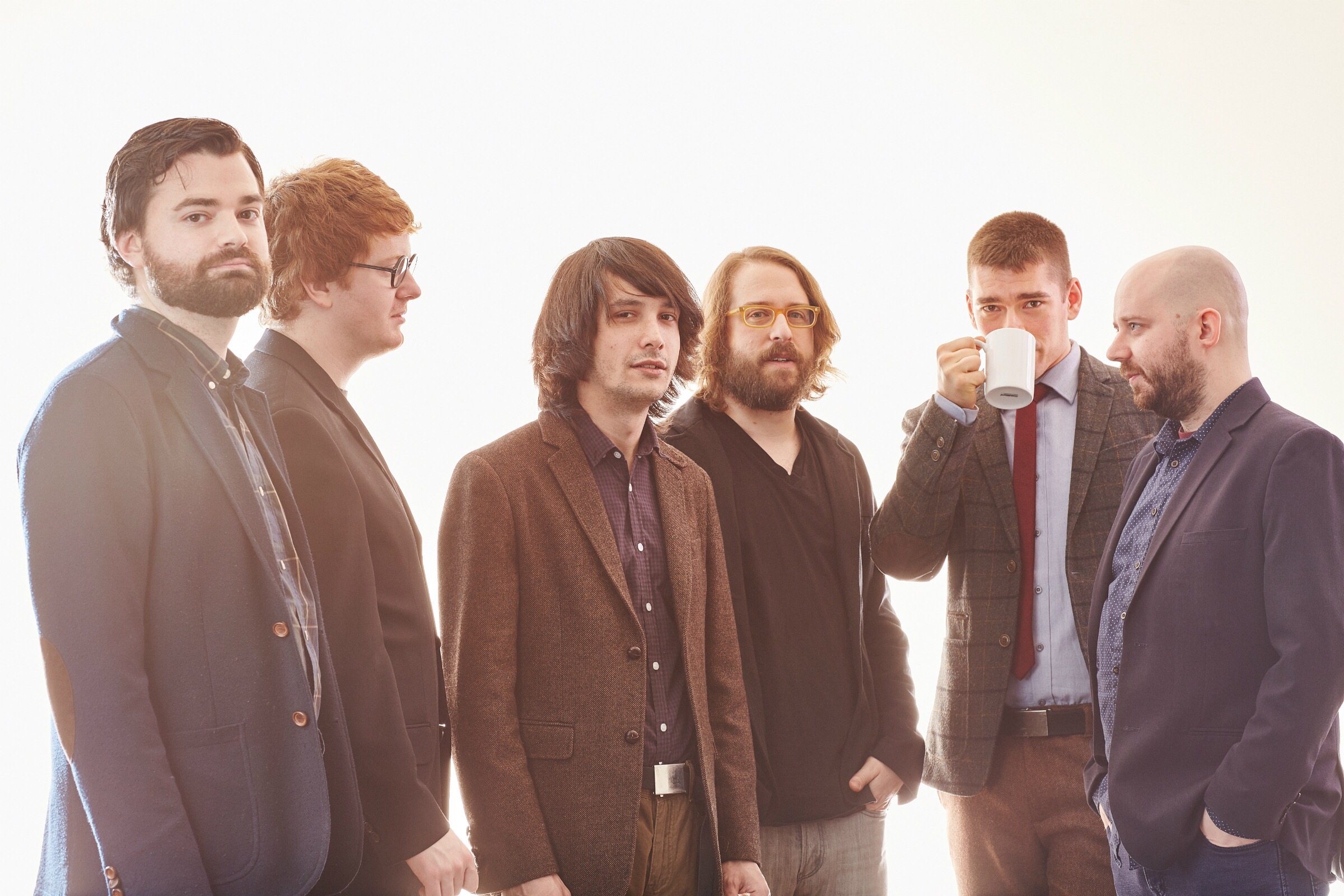
PR Photo of Some Cool-Looking Dudes


Word Association


Ready for some album reviewer’s word association?

Creativity? They’ve still got it.

Quality production? Check. (Brought to you by Ryan Lenssen from the band and David Newfield, who has overseen Broken Social Scene, Super Furry Animals, and Los Campesinos!).

Memorable hooks? Done, throughout.

Lush, interweaving guitars? Yes, even if it’s not a priority as such.

Thought-provoking, critical-of-the-mainstream lyrics? Uh, yeah. In “Capitalist Waltz” (which, awesomely, is not a waltz) Adrian Jewett snarkily sings, “I’ll advertise for you,” an impulse we reviewers have to face cautiously, much as we may love the bands we write about.

In that spirit, some lyrics hit me as a little obtuse:

To fill the day with an effigy of you,

while Earth’s cigarette is freshly lit

in the modern times, the modern times.

(Et tu, Facebook? he Tweeted.)

That same song is still catchy, though:

A montage of you turning around, turning around, turning around

And, okay, I’ll admit–if I’m understanding the song right, referring to Facebook (and/or Instagram) as “Earth’s cigarette” is actually right on the money.


Concluding Evaluation and Where to Get Mediac


I’m thrilled these guys are back in action with another full-length. Their first few records showed real progression, while each being winners in their own right. Medaic is a little harder for me to know how to place in the TMSR corpus, all of which I’ve listened to. It has some real bright moments, though I didn’t initially experience it as being as cohesive or as innovative as previous efforts.

That said, if you have never listened to TMSR, they exude talent, passion, conviction, and RAWK on any album they put their hands to.

And even as I wrap up this review, some weeks after starting to listen to Mediac, it’s growing on me with each listen. I find more hooks, melodies, motifs, and layers to latch onto each time.

You probably will, too, so definitely untangle those headphones in your jeans pocket, download the album, and queue up your iPod. The Most Serene Republic is back.

Mediac releases today, November 13. You can find it on Amazon here, iTunes here, or at the band’s site here.


Thanks to the fine folks doing PR for TMSR, who provided me with an advance copy of the album so I could review it.

Dealer, by Foxing

Dealer by Foxing 


I have seen a lot of Tweets about Foxing in the last year, so when I learned they had a new album releasing, I was eager to listen and write about it. The five-piece from St. Louis put out a very good first record, The Albatross, in 2013. On Friday, Triple Crown Records, home to Caspian, released Foxing’s follow-up, Dealer.

Dealer begins with “Weave,” a gorgeous track that builds and builds and builds… until at last clean guitars give way to (just enough!) distortion. The high register of vocalist Conor Murphy calls to mind that of Copeland’s Aaron Marsh, though maybe is a little grittier. “Weave” is the easily the best song on the album and one of the best rock tracks of 2015.

On “The Magdalene,” Murphy sings, “I’m going down… with the rosary,” part of the ongoing post-Catholic sentiment the album expresses. To be clear: I don’t want to minimize someone’s actually painful experience, which the lyrics and music throughout the record seek to express in a heartfelt way. But it’s hard not to hear this and other such lyrics as anti-Catholic, which felt to me a little bit of a tired trope as I listened through.

The third track’s piano and opening lyric—“We danced naked outside of your bathroom”—marks a significant departure from the first two songs and feels like a loss of built-up momentum. What emo kid can’t empathize with the chorus’s “Future love, don’t fall apart”? But the lush and largely upbeat feel of the first tracks gives way to a more morose tone for the middle section of the album. “Night Channels” does end with a nice full-band groove, but tracks 3 through 7 (supple string arrangements of track 6, “Winding Cloth,” notwithstanding) required more patience than expected for at least this listener to engage and keep listening.

The eighth track, “Glass Coughs,” finds the band picking things back up again, especially by the end of the track. On “Eiffel” (the following song) the drums let loose shortly after the two-minute mark, making me want more of that Foxing on future recordings.


Concluding Thoughts and Where to Get It


I don’t think Dealer is an album that will be on steady repeat for me from here on out. But Dealer is getting rave reviews already, even though it just released Friday. And Foxing’s fans are of the die-hard variety. That’s a credit to the band.

For me, I loved the first two tracks and then found the album had a hard time fully re-capturing my interest after the start of the third track. But I’m open to the possibility I’m just missing something, and am willing to give it another chance.

Either way, Foxing is early in their music-making career and has a lot of people excited about what they’re doing. (And I hear their live shows bring an intense energy to the crowd.) So it’s at least worth a listen or two for you to see what you think.

Check out Dealer on Amazon here, or here at iTunes.


Thank you to the kind folks at Brixton/Triple Crown for early access to the album for review!

The Rain for Roots CD Winners Are…

image


The forthcoming Rain for Roots Advent album is phenomenal. Read more about it here.

Today I’m posting with the results of the giveaway contest my review post included. I’m pleased to congratulate the two winners, Ruth Ohlman and Elisabeth Kvernen! Nice one!

(I will be in touch with both of you via email to make sure the CD gets sent to the right place.)

In case you’re curious… I didn’t count duplicate comments, but did count one entry for a comment and one additional entry for a comment that said a person shared on Facebook or Twitter. There were 59 entries total. I used a random number generator to pick.


image


Thanks to all who commented! There were a lot of really meaningful reflections on Advent that folks shared, and I only wish I could more fully engaged with each of them, but I read them all and loved it. Rain for Roots has some pretty great fans.

And thanks again to the good folks at Rain for Roots for sponsoring the giveaway and–more importantly–for writing, recording, producing, and releasing this fabulous record for a season of waiting.

A Guided Listen Through Caspian’s Dust and Disquiet

Dust and Disquiet Cover


Caspian’s Dust and Disquiet releases Friday. At the time of writing, you can stream the whole album via the New York Times here. Or you can just take my word for it and buy it for yourself now (iTunes/Amazon/band), and listen as you read through this track-by-track review.


1. Separation No. 2 (3:09)


The album fades in with a gorgeous opening track. Is that a saxophone? I wondered on my first few listens through. Then felt embarrassed to learn my brass knowledge is not what it should be. It’s Jon Green on the trumpet. With effects. On top of a lovely guitar. Beverly, Mass. never knew so sweet a sound.

After the three tracks Caspian previewed to introduce the album’s release, I was not expecting the soft, gentle sound of “Separation No. 2.” The lush tones, layers, guitar swells… everything is in sync. It’s one of the more evocative album intros I can remember hearing. Strings, brass, acoustic and electric guitars… YES.

The track is a mere 3:09, so leaves something to be desired. But you realize it’s the first of a pair, really. It’s the call to the response of the second track.


2. Ríoseco (7:52)


I could listen to this Caspian all day. The drums finally enter the record, about half a minute in. One wonders, too, if the bass’s album entrance only at 1:01 is deliberate–a sort of silence to honor the life and now absence of late bassist Chris Friedrich. (Also, now that you’re thinking about that, look again at the album cover.)

By 1:51 everyone is in and in lockstep. Guitars, bass, drums, effects strings–you get the feeling the band is just doing their thing for themselves, and you’re lucky enough to get to listen in.

“Ríoseco” is a really moving track. This is post-rock (or whatever) at its best… with pedal steel. No, it’s not country; it’s just awesome. I hope the band will be complimented and not bothered by the comparison with this track to (the best of) early-2000-era Mogwai.


3. Arcs of Command (8:49)


Caspian, you know, has a propensity to pull in ex-emo kids like me with the interlocking, layered, warm guitar parts, and then double their volume and quadruple the distortion. “Arcs of Command” begins more aggressively. Now that Caspian has got you all teary-eyed, they’re ready to rock those tears right off your face.

And dang it if they’re not going to do it in 5/4 time! Until they decide, that is, to turn the track into a blistering waltz. And that’s not the last time in the song they’ll change time signatures.

Especially after the first two tracks, the listener may well ask: What is this, a metal record? Caspian asks a lot of their listeners in this song, most of whom will be thrilled to oblige.

 
4. Echo and Abyss (5:45)
 

Where can you go after the heavy “Arcs of Command”? To another heavy song, of course, the build-up in which barely takes any time at all.

The (heavily processed) vocals cry out, as from an abyss, “Speak to me! Speak to me!”

 
5. Run Dry (4:36)
 

“Run Dry” is the albums “Whaaa…?” moment. The acoustic guitar with clearly audible vocals (“We are wide awake now….”) evoke Bruce Cockburn more than anything in Caspian’s back catalog.

Have we heard Calvin Joss sing before? After hearing him partway through Dust and Disquiet, we who love this instrumental band might still want more of his vocals in future records and/or side projects.

 
6. Equal Night (1:57)
 

A short two minutes serve as a sort of coda to the previous track. “Equal Night” brings the first part of the album (at least as I interpret it) to a close and prepares the listener for the second half.

 
7. Sad Heart of Mine (4:27)
 

The opening arpeggios call to mind the start of the record. If this were a cassette tape, it would be the perfect first track to Side B. This time, though, there’s a bit more of a joyful feel, or at least a post-catharsis mood, having worked through the first six tracks.

All of which is (deliberately?) ironic, given the track’s title.

 
8. Darkfield (6:36)
 

Don’t get me wrong–this is a fine song, and Caspian rarely if ever puts out what fans would consider a dud, but I found this track to be not as remarkable as the others. I was actually relieved for a bit of a break, in that sense, because there are still 13 minutes to go.

Take my assessment with a grain of salt, though–I’m a sucker for their quieter stuff. If you like the heavier, industrial sounds Caspian sometimes reaches for, you’ll likely love the track.

 
9. Aeternum Vale (2:08)
 

Another interlude, this one featuring some nylon-string guitar. It’s good in its own right, but seems needful preparation for the album’s long and (you guessed it) epic closing track.

 
10. Dust and Disquiet (11:26)
 

The album’s title track is classic Caspian. There are lots of dynamic shifts, builds, swells, memorable melodies, grooves, and tremolo picking. Lesser bands might give up on such a song and split it into multiple tracks. Not these guys.

And, no, 11 minutes is not too long for this track. It’s the exact length it needs to be to do what Caspian wants it to do.

The riff they finally end on will stay in your mind (and maybe even your heart, dare I say) long after the album ends.


* * * * * * *


The fall is here, and you need good music in your life. I’m grateful to Caspian for making such a thoughtful, emotive, meaningful, and well-executed album. I’ve already listened to it a dozen times, and even introduced my seven-year-old and five-year-old to it. (They’re fans now.) I will listen many more times to this record.

Check it out for yourself now (iTunes/Amazon/band). The album releases Friday, September 25.


——


Thanks to the good folks of Stunt Company for the album download for review. And many thanks to Caspian for making this record!

Review of Teen Daze’s Morning World: Do Yourself a Favor and Listen to This Amazing Album. Right Now.


It’s already August, so I’ll just call it now: Teen Daze’s Morning World is 2015’s Album of the Year.

Two weeks ago I had never heard of Teen Daze, impoverished soul that I was. The lush, arpeggiated riff that opens the album on “Valley of Gardens” drew me immediately in.

Then Jamison, genius behind Teen Daze, sweetly sings:

I went down
To see what the pond had collected.
A valley of gardens
Muted the sound of the hills.
And the rain had ended
I can smell the leaving of winter.
Blue and green, now:
I feel them in every sentence.

…which is a good thing, because there aren’t that many sentences on this record. Jamison doesn’t need many lyrics, though, because (a) the ones he uses are plenty evocative and (b) the music is expressive, creative, intricately layered, and speaks for itself.

After my first listen or two, I described Teen Daze’s sound as if The Lassie Foundation were covering Badly Drawn Boy songs, with some mid-1990s James Iha (Smashing Pumpkins) sprinkled in. The drums are perfect, the riffs are unforgettable, and the production (John Vanderslice, mastered by Bob Weston) is outstanding.

But then on about my fourth listen through, I noticed the strings. Oh, those strings. They really make the album. Cello and rock and roll were made for each other. And these parts are perfectly orchestrated.

Morning World somehow has a way of evoking so many bands I’ve loved over the last couple decades, yet with its own unique sound.

The title track, “Morning World,” is what my college roommate might have called “the perfect pop song.” Its 4:15 duration could easily be 10 minutes, and you wouldn’t mind. Jamison asks in his falsetto:

Should I, drift back
Drift back, into a dream.
Into a dream?

The album pulls the listener into this dream—no, not the dream of the 90s, but visions of the Garden of Eden (“finally a place of endless wonder”). If Teen Daze is suggesting Morning World could have been the Garden’s soundtrack, it’s hard to argue.

But despite the promise that “We can live forever,” and the desire to “believe that this is forever,” mid-album (and the lyrics only allude to it, allowing the music to do the work) the listener realizes something has gone wrong in the Garden. The rest of the record comes to grips with what it means when “forever” actually has an end.

Morning World—released today—is actually a fairly significant departure from Teen Daze’s previous work. I went back and listened to three previous albums, and there’s barely a live drum set or unprocessed guitar part to be found. That older, ambient, synth-heavy stuff is awesome in its own right (and still has a place here), but the new sound serves Teen Daze’s music well.

Also—Teen Daze took just 10 days to make this album. Yes, 10 days—6 for recording and 4 for mixing. There are a few times when this shows–a couple muffled guitar notes here and there–but that comes across and mostly endearing and just adds to the album’s charm. You’d otherwise never know this genius record took less than two weeks to bring to completion.

Get this album as soon as you can, put on a pair of headphones, turn off your device notifications, and enjoy what is easily the best album of the year. Find it here (iTunes) and here (Amazon).

——

Thanks to the good folks of Force Field PR for the album download for review.