Words on the Word Interview with Leslie C. Allen, Author of Liturgy of Grief

Not long ago I reviewed Leslie C. Allen’s Liturgy of Grief: A Pastoral Commentary on Lamentations. The book gently yet steadily coaches the reader in processing grief, expositing and drawing on the rich Biblical tradition of lament. I interviewed Dr. Allen this week.

You write, “Contemporary Western culture provides little space for grief.”  Why do you think this is?

A very good question. Perhaps, in reflection of a technologically advanced and relatively stable society, our culture expects comfort, convenience, and control, and won’t face up to anything contrary. Medication is assumed to be the answer to psychological as well as physical ills. So we feel embarrassed by grieving (and dying) people.

How can churches and worshiping communities better attend to the grieving processes of their community members? In addition to Lamentations and the rest of the rich Biblical tradition, are there other resources available to worship leaders and liturgists to better help them guide their communities through experiences of grief?

One example comes to mind. When I moved my home and started attending a new church some years ago, I found the associate minister’s morning prayer each Sunday was prayed on behalf of those present who were suffering in various ways. It was a different prayer each week, always wide reaching and beautifully crafted. I (and doubtless others) appreciatively felt she was praying for me, at a time when I needed prayer but found it difficult to pray.

You say, “‘Why?’ in the complaint psalms is never an intellectual request for information but a loaded rhetorical question that conveys emotional bewilderment and protest.”  Is there ever an appropriate time for the pastor/chaplain to address questions like “Why did this evil happen?” through a more deliberately theological-philosophical lens?  If so, how does the chaplain discern if and when it’s appropriate to go there?

C.S.Lewis’s The Problem of Pain evidently brought him no help as he penned A Grief Observed. Lamentations felt free to eventually tackle theological issues, using prophetic revelation as the guideline, whereas we and those we try to help are not living in the immediacy of such a situation when prophecy was being directly fulfilled. And Lamentations is able to give a variety of answers, perhaps in the hope that some at least would be found helpful. If a grieving person truly seeks an intellectual answer, one may tentatively broach some thoughts to be tried on for size. Otherwise, it is better considered when the emotional passion of grief does not intrude.

You mention the New Testament story (Mark 4:35-41) where Jesus’ disciples ask, “Teacher, don’t you care if we drown?”  Especially given Jesus’s reply (“Why are you so afraid? Do you still have no faith?”), how can we who worship God know when it’s appropriate to lament or complain in prayer and when it’s not?  This is the “how far is too far?” question with relation to lament and prayer!

If our prayers are to be real, we must pray from where we are, emotionally and in other ways. We miss a tone of voice in the written form of biblical revelation. I suspect Jesus’ reply was mainly meant as reassurance, rather than rebuke, like the examples of “Do not fear” in Isaiah 40:9; 41:13, 14; 43:1-2; 44:2, etc.

I happened to read Allen’s book just before the Colorado movie theater shootings. Reading it inspired me to find and pray two lament prayers in response (here and here). As a Professor of Old Testament and hospital chaplain, Allen in his book provides the reader with good space for grief and Biblically-inspired means to lament.  A Liturgy of Grief is available here.

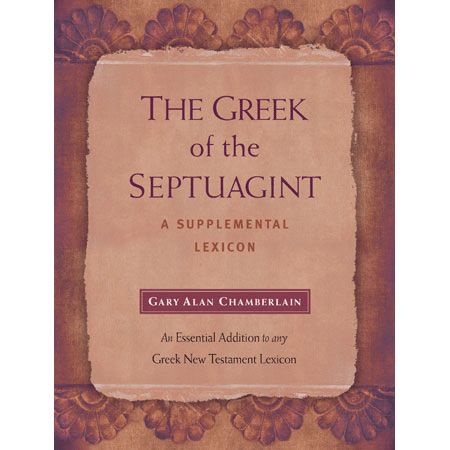
Review of The Greek of the Septuagint: Supplemental Lexicon

This, then, is the single dominant characteristic of the LXX vocabulary: it is normal, idiomatic Greek. I base my construal of it on this hypothesis whenever I can.

–Gary Alan Chamberlain in The Greek of the Septuagint: A Supplemental Lexicon

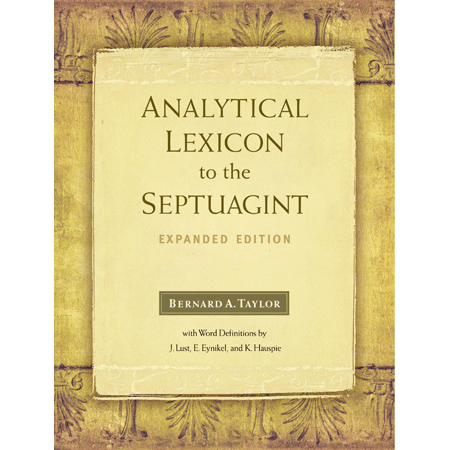
Not long ago I noted that “the challenging nature of Septuagint vocabulary is … one reason why even students of New Testament Greek stay away from the Septuagint. How can one make her or his way through the Septuagint in Greek in a way that is not entirely frustrating?” To begin, you could read about why you need the Septuagint here, and some helpful resources here to get started. Also, I recently reviewed Bernard A. Taylor’s Analytical Lexicon to the Septuagint: Expanded Edition, a one-stop reference work to guide readers through the LXX.

I have now had the occasion (and privilege) to spend some time with The Greek of the Septuagint: A Supplemental Lexicon, by Gary Alan Chamberlain. (Thanks to Hendrickson for the review copy, provided in exchange for an unbiased review.)

Chamberlain intends his lexicon to be a supplemental one, an addition to any Greek New Testament lexicon. (He has BDAG specifically in view.) The vocabulary of the Septuagint is more expansive and potentially different enough from New Testament vocabulary that a lexicon like this is warranted. Many Greek students, especially Biblical studies ones, come to the LXX after first studying the New Testament. So if they already own BDAG or some other New Testament lexicon, the potential need for something like this to “fill in the gaps” could make sense.

The Greek of the Septuagint contains lexicon entries for 5,000 LXX words not in the NT, as well as 1,000 words with LXX-specific uses that a NT lexicon would not carry. For the latter, Chamberlain simply adds to the BDAG numbering system, so that the entry for καθίστημί, for example, begins, “3.b. seek to establish, declare.” Words that the lexicon does fully treat have morphological information (e.g., principal parts for verbs) and citations of word usage in the LXX and beyond.

There is “no treatment of the most common words” in the LXX, so not just a cursory knowledge but a solid grasp of Greek vocabulary would be needed to use this lexicon on its own. I.e., a first- or second-year Greek student really would have to use this as the “supplemental” lexicon it intends to be. “Throughout this work,” Chamberlain notes, “I have assumed that the user has sufficient command of ancient Greek to cope with articular infinitives, genitive absolutes, and the varied means of expressing volition and command. The thousand or so most common LXX words should convey relatively few difficulties.” This work won’t serve the Greek initiate, in other words, but Chamberlain does not intend for his work to be “elementary.”

One might ask, Why not just purchase a full-on Septuagint lexicon? Here is where Chamberlain makes the “distinctive contribution…to LXX studies” that he aims to make.

The dense 19-page introduction explains several classifications of LXX words, and is complemented by an exceedingly useful set of word lists in the appendices. (Hendrickson has the intro in pdf here.) Chamberlain includes word lists and discussion of:

  1. Precise parallels between the LXX and extrabiblical texts. This is where he asserts that LXX vocab is “normal, idiomatic Greek.” He accounts for what others have claimed are examples to the contrary (e.g., “Semitisms”) with the following categories.
  2. Transliterations of the Hebrew into Greek.
  3. Hapax Legomena–Greek words that occur once in the LXX and nowhere else in ancient Greek literature, as well as words that occur multiple times in the LXX but nowhere else (he notes all this and all these categories throughout the lexicon in the appropriate entries, a sample pdf of which is here).
  4. Greek words that occur first in the LXX.
  5. Words with no parallel in other ancient Greek sources.
  6. Stereotypical translations (“calques,” where “translators faced severe challenges in rendering a few common Hebrew terms for which no equivalent was possible within the framework of Greek language”).
  7. Mistranslations (where “LXX translators misconstrued the meaning of their sources’ words, through a confusion of roots or a misunderstanding of meaning of the source”).
  8. Textual variants (more than 200 instances, including his suggested emendations, helpfully organized in canonical order).
  9. More complicated words “involving multiple factors” (“We are simply trying to explain how a Greek word was placed in a context that does not make good sense if we read it as a Greek sentence”).

Having read the descriptions of each of these categories and looked through the corresponding word lists, this reader is convinced that The Greek of the Septuagint offers something that neither BDAG nor any other LXX lexicon on the market (of which I’m aware) currently does. Even without the actual lexicon entries, the word lists and explanations are an invaluable contribution to LXX studies. (The lexical entries themselves are appropriately concise yet substantive.)

His Appendix II is the place to start when looking up a word. It shows (through the use of bold, italics, and regular font) if a word is in this lexicon but not BDAG; if it is in BDAG and supplemented here; or if the word is sufficiently covered in BDAG and therefore not in Chamberlain’s lexicon. Appendix III has a neat listing of LXX book titles in English and Greek, as well as a table that shows the differing versification between the two.

The Greek and English fonts are clear and easy to read (the Hebrew font is a bit small).

I found The Greek of the Septuagint to be a lexicon one has to work at. In other words, it’s not like Taylor’s lexicon, which one could easily pick up and use right away off the shelf. Carefully reading the 4-page preface and 19-page introduction is pretty much required to be able to make use of Chamberlain’s work. But that’s true of BDAG, too, and sort of the point of a preface and introduction in the first place. So that’s not at all a strike against this lexicon. In fact, the user who is willing to put in the work will find great reward in a deepened understanding of the LXX and its vocabulary.

Chamberlain concludes his introduction in this inspiring way:

For many years I have been reflecting upon and experimenting with the question of what the faithful reading of Scripture is in relation to life lived very much “in the world.” Both the method and the goal of preparing this lexicon have been the reading of the LXX text itself (alongside the Hebrew Bible, the Greek NT, and not infrequently the Vulgate) with the prayerful attention the Benedictines call lectio divina. I have made constant and grateful use of the astonishing resources of biblical and classical scholarship, with an embarrassed and hopeless inability to be in any sense in command of those resources. I want simply to apprehend the text, and beyond that to engage the living reality of which the text intends to speak.

Chamberlain’s lexicon is available here.

“How do I get more out of my Bible reading?”

“How do I get more out of my Bible reading? What was going on during the gap between the Old and New Testaments? How do all the books of the Bible fit together as a whole?”

It is the aim of Understanding the Picture of the Bible: A Guide to Reading the Bible Well to answer those questions and put “clear, readable Bible study aids at your fingertips.” (All quotes from back cover and also found here.) Here I review the book for another installment of Magnificent Monograph Mondays.

The book begins with “An Overview of the Bible’s Storyline,” then continues with three parts, one for the Old Testament (subdivided into OT Theology, Pentateuch, Historical Books, Poetry/Wisdom Literature, and Prophets), one for New Testament background (intertestamental history and literature), and one for the New Testament (NT Theology, Gospels/Acts, Epistles, and Revelation). Each author gives a thorough yet concise overview of the section of the Bible he (all authors are male) treats. Each also discusses themes within a given section of the Bible and how they connect with the larger Biblical narrative.

What first stands out in Understanding the Big Picture of the Bible is that almost every author has a knack for simply explaining important concepts and terms. The summary overviews of sections of the Bible provide the reader with a firm foundation for better understanding the purpose and scope of that section. For example, Paul House’s excellent chapter on the prophetic books has an excursus on “pronouns in the prophets.” He begins: “As prepositions are to the letters of Paul, so pronouns are to the oracles of the prophets: crucial for meaning, but often puzzling” (72). In the five following pages he does much for the reader to make prophetic pronouns (and how they often shift person and gender) easier to understand. Other highlights are Gordon Wenham’s chapter on the Pentateuch and Dennis Johnson’s essay on Revelation.

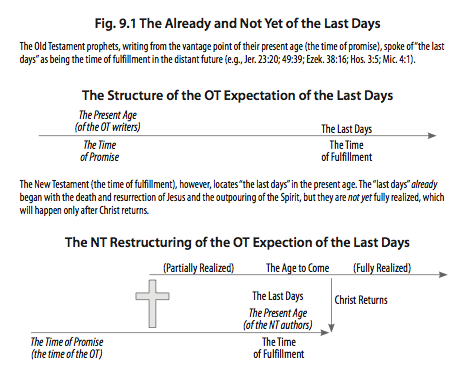
Timelines and charts throughout are a great feature. In addition to timelines in the back of the book covering all of Biblical history (including intertestamental times), there are charts throughout the book that aid the reader. Thomas Schreiner lists all the Epistles, their authors, dates, place of writing, and recipients. Johnson uses nine separate figures to visually (and clearly) display the differences in how Christians interpret Revelation. And House has a table that lines up the prophets with the kings during whose time they prophesied. (A couple of similarly simple and clear maps could be a great addition to future editions of this book.) Here’s an example (taken from a pdf sample of the book):

And then there’s the middle section, part two of Understanding the Big Picture of the Bible. That section alone makes this book worth more than its purchase price. It contains the following:

  • “The Time between the Testaments,” by J. Julius Scott Jr.
  • “The Roman Empire and the Greco-Roman World at the Time of the New Testament,” by David Chapman
  • “Jewish Groups at the Time of the New Testament,” by John Delhousaye

Take just this short quotation from Chapman as an example:

Amid this history, Jesus Christ launched his ministry in a Galilee governed by a Roman client king, a Judea under Roman procurators, and a Judaism tinged with Hellenism. After his crucifixion by the Romans and his resurrection, his gospel was carried by the apostles directly into the heart of Greek culture and Roman power. (94)

Having this background in mind when approaching the New Testament will greatly advance the efforts of any Bible reader. Most Bible overview guides that I’ve seen go right from Old Testament to New Testament. But what about all that time in between? I’ve written more here about why that time period is essential to NT understanding. This book really gets that, and covers that period well. Someone with no knowledge of NT background would find this section easy to follow, and even a budding scholar would appreciate the clarity of the historical overview.

While it’s hard to discern what is the work of the editors (this book has three: Wayne Grudem, C. John Collins, and Schreiner) and what is the work of the writers, this book could have benefitted from a little more careful editorial oversight. There are a few little typos scattered throughout the book (tehillah instead of tefillah for Hebrew prayer, e.g.). I found the use of the sex-specific “man” to refer to all of humanity–even when not quoting the ESV–distracting (although this may not bother other readers).

But there is a bigger editorial oversight. While the book excellently helps the reader to better understand the “big picture” of the Bible, it never directly answers the question it seeks to answer of “How do I get more out of my Bible reading?” The authors present all the necessary information to better understand the background (context) and foreground (content) of the Bible, yes. But understanding context and content is only necessary and not sufficient for “reading the Bible well.” I wish the editors would have made sure the book gave more attention to how one can read the Bible, for example, devotionally… or for transformation rather than just the receiving of information. In other words, I wanted this book, based on its title, to answer: How can I grow closer to God as I read the Bible? How can I allow the Bible to convict me of my sin? What about the importance of reading Scripture in community and corporate worship? David Reimer’s essay gets closest to this when he says, “[T]he art and craft of the Bible’s poems offers an invitation to read slowly, to have one’s vision broadened, once’s perception deepened… to see literary reflection in the service of worship and godly living” (54). I wanted to hear more about this. The key question for me is: Is overview knowledge of the Bible’s context and content sufficient to read the Bible well? Necessary, yes. Sufficient, no.

However, even if the book doesn’t execute its aim listed in the subtitle, it is still a valuable work to have in hand while reading through the Bible. Its unique contribution to works of this kind is in the middle section. I’d imagine this book sitting well on someone’s shelf next to his/her Bible and notebook. (It has on mine these last few weeks!) It would benefit a serious Bible reader to read, say, Darrell Bock’s essay on the Gospels and Acts before reading those Biblical books through.

Thank you to Crossway who provided me with a review copy of this book in exchange for an unbiased review. You can find Understanding the Bible Picture of the Bible at Amazon here.

Hipster Septuagintalist

The Septuagint has become cool–or at least a bit hip.

–Ben Wright in “The Septuagint and Its Modern Translators,” from Die Septuaginta—Texte, Kontexte, Lebenswelten

(quoted in Wolfgang Kraus’s excellent review of the New English Translation of the Septuagint)

I’m not sure that a Septuagintalist (yet another word you can use when you study the Septuagint!) is necessarily the best judge of what’s cool or hip… but I’m going to concur with Wright. As yet another LXX post on Words on the Word is attesting (Happy Septuagint Sunday!), the Translation of the Seventy is at least becoming very hip with me. Also, with this guy:

Good Grief (a review of A Liturgy of Grief)

There is a Yiddish proverb that calls tears the soap of the soul. The release, rather than the bottling up, of inarticulate emotion is a valuable first aid to be applied over and over again to the raw wounds of grief.

A Liturgy of Grief, p. 2

My boss and I have recently lamented together the lack of good lament liturgies for the Church. Worshiping communities seem to be good at celebration and constant in intercession–maybe even at times confession–but lament? We’re too scared or too complacent to adopt that difficult posture. We may think that even if we wanted to lament, we don’t have the words with which to do it. “Contemporary Western culture,” Leslie C. Allen says in his Liturgy of Grief, “provides little space for grief.”

And yet we do have resources, scripts to help us unbottle the anguish and woe we inevitably experience. Allen, whose book is aptly subtitled A Pastoral Commentary on Lamentations, writes, “The book of Lamentations is best understood as the script of a liturgy intended as a therapeutic ritual.”

A Liturgy of Grief is a unique kind of commentary. Though Allen has written technical commentaries and contributed to commentary sets (a few are here), this book is a monograph, a singular contribution to Lamentations commentaries. Baker Academic publishes it, but it is not so academic or technical so as to exclude readers who have only a passing familiarity with Lamentations or the Old Testament.

The book includes the full English text of Lamentations, in Allen’s own translation. Though he often references the Hebrew he translates, he rarely lists the Hebrew words themselves. Language and translation buffs, however, will be happy to see nine pages of translation notes in an appendix. (This language buff appreciated that Allen saved his longest translation note for the single English word “but” in the last verse of Lamentations.)

Allen has written lengthy technical commentaries, yet this is not that, nor is it intended to be. However, Allen does not neglect to thoroughly elucidate the text. He understands the five chapters of Lamentations as “five poems,” each with their own distinctive theme and contribution to the larger book. The climax of the book comes in the fifth poem. Here the grieving community, having heard the model prayers of a pastoral mentor/liturgist (Allen calls him “the reporter”), at last can pray to God in their grief.

Allen weaves together narratives past and present, from the 6th century B.C. to today, in order to guide the reader section-by-section through the book of Lamentations. In addition to being Senior Professor of Old Testament at Fuller Theological Seminary, he is a hospital chaplain. Nicholas Wolterstorff comments in the foreword, “[Allen] brings to his commentary an understanding of grief that was already deeply informed both by the contemporary literature on grief, all of which he seems to have read, and by his own activities as a hospital chaplain.” In reference to the repeated expressions of grief in the first poem (chapter 1 of Lamentations), Allen writes:

For those who grieve, but not for their regular hearers, the old story is ever new, always filling their consciousness and needing to be told once more, as intensely as it was the first time. Patience is the prime virtue that empathy requires.

Any preacher, liturgist, or worship leader will appreciate Allen’s commentary. He gives attention to the approach and words of “the reporter”/liturgist in Lamentations, drawing important conclusions that can guide today’s liturgist in helping a community deal with grief:

In this [third] poem a wounded healer offers his knowledge of God’s ways and his experience of them in a context of suffering. At beginning and end he ministers out of his own suffering and presents himself as an object lesson. A fellow sufferer, he points the congregation forward to a new wholeness that both he and they yearn to attain. In turn, we readers who are wounded have the potential to be wounded healers.

A Liturgy of Grief is a special book and a gift to the Church, both its leaders and its members. Contrary to lament-free churches or a Western culture which knows not how to grieve, Allen opens up a space for readers to recall and feel their hurt and the hurt of others. The commentary is “pastoral,” just as it promises, with Allen a pastor to any who will receive the ministry he has to offer through this book. “When believers find themselves in such a fearfully dark valley,” Allen concludes, “the biblical tradition is there, providing challenging words for souls in pain to use.” In addition to Lamentations, Allen evokes the biblical traditions of Isaiah, Jeremiah, Joel, and makes reference to numerous lament Psalms.

Allen illuminates all these “challenging words” of Scripture beautifully. His final chapter perfectly matches the surprising ending of Lamentations. (No spoilers here, but I will say that all I could write in the margins was, “This is real, true, holy.”) I finally realized hours after finishing the book that, all along, Allen as author plays the same role to reader as “the reporter”/liturgist in Lamentations did to his 6th century B.C. worshiping community:

He mentors members of the community by giving expression to the grief he and they have in common, turning incoherent feelings into words and explaining the experiences they have all been through. …He is also interpreter of their loss…. and finally involves them in a creative response of their own that they are ready to make in the final poem…

…that of prayer to God. As a result, A Liturgy of Grief serves as its own sort of book of Lamentations for the 21st century, with Allen “giving expression to the grief” of his readers, interpreting their loss and–finally–guiding them into a response of prayer.

I offer my thanks to Baker Academic for providing me with a free review copy in exchange for an unbiased review. A Liturgy of Grief is available at Amazon.

UPDATE: I interview the author here.

BibleWorks and the Septuagint

I recently blogged on why you need the Septuagint. And here are some great resources to begin and further pursue Septuagint study.

One indispensable resource for Septuagint study that I use almost daily is the computer program BibleWorks. I have not yet made the upgrade from version 8 to version 9, but much if not all of what I have to say here will still be applicable to users of version 9 (and 7, for that matter).

Here is what my BibleWorks looks like for 1 Maccabees (click or open in a new tab to view larger):

The following features help me navigate my way through the Septuagint:

  • A nice, big Browse Window (middle column in the top window) so that I can see the whole Greek verse easily at once, with English translations below. Both the LXA (Brenton’s Septuagint with Apocrypha, in English) and the NRS (NRSV, which includes the Apocrypha) are part of BibleWorks.
  • A stand-alone Word Analysis Window (bottom right of the screen) so I can better use my other columns. I set the default lexicon to LEH (Lust/Eynikel/Hauspie’s Greek-English Lexicon of the Septuagint, Revised Edition).
    Not only is this a fantastic Septuagint-specific lexicon; it also includes word frequency counts. What I particularly like about this is that I can use the Stats window (in the Analysis Window, the right column in the top window) to find out how many times a word appears in the whole Greek Bible (LXX+New Testament). Then using the LEH frequency counts, I can get a quick number on how many times a word is used in the LXX and the NT. This is helpful if I see an LXX word that occurs 200+ times, have never heard of it, and then see it only appears 10 times in the NT.
  • The Resource Summary Window (bottom left of the screen). Here I can access Conybeare’s Grammar of Septuagint Greek, which comes with BibleWorks and is hyperlinked both by part of speech and Scripture index. Another nice feature is that I can pull up BibleWorks paradigms quickly for a given part of speech–a helpful grammatical refresher! The IVP Dictionary of Jesus and the Gospels in that window is an add-on from WordSearch, but their IVP Dictionary package has a bunch of great Septuagint articles.
  • Note: There is no punctuation in the BibleWorks Septuagint text. This is not a display error; it’s just how it is. There are accents and breathing marks, though. And, the way I see it, even if Rahlfs in print has punctuation, the original manuscripts did not, so no huge loss.
  • I hesitate to write too much more about the Analysis window (right column in the top window), because BibleWorks 9 has significantly changed (=improved) the layout. In fact, there are now four columns, as seen here. However, for anyone using 8 or less, the above configuration allows you to work with the LXX profitably. For BibleWorks 9, I’m sure you could use the above layout as is (BW9 lets you use just three columns if you want, I believe) or make whatever modifications you wanted in BW9.

1 Maccabees has no existing Hebrew text. The scholars I’ve read on it all think that the Greek of 1 Maccabees has the flavor of translation Greek, and so translated a Hebrew original. But we don’t have it. (BibleWorks is powerful, but not quite that powerful!)

How I use the LXX when there is a corresponding Hebrew text (e.g., when I’m reading Micah) looks a little different. For example, in addition to the above, I’ll have the Hebrew text and English translation displayed. BibleWorks has the amazing Tov-Polak Parallel Hebrew/LXX Database, too, that comes with the base package.

BibleWorks allows me to read through the Septuagint in Greek with English translations displayed underneath. (I can also hide them–that’s what my “No Eng.” tab is in the left column of the top window.) It gives me instant word analysis (its parsing and then word definition and frequency count through LEH). I get grammatical helps from Conybeare and BibleWorks paradigms. I can search on a word to see how it’s used throughout the Septuagint and/or New Testament (note the highlighted word above). And with the IVP add-ons, I get historical background, too.

Using BibleWorks is a fabulous way to read through the Septuagint. I feel very blessed to have access to such a tool as this.

And I know there is much more BibleWorks can do. Fellow BibleWorks users and lovers of the Septuagint, how do you use BibleWorks for LXX success?

Septuagint Sunday is a regular feature of Words on the Word. All my LXX posts are here. The full contents of BibleWorks (now in version 9) are listed here. You can buy the program here or here.

All you need is your Septuagint and this (LXX+ALS=Septuagint Success)

I wrote a few days ago about why you need the Septuagint. I noted:

For students of Greek, the LXX is a good way to challenge oneself in Greek beyond the New Testament. There is a fuller and deeper vocabulary in the Septuagint that helps Greek students grow in their knowledge of the language.

While this is true, the challenging nature of Septuagint vocabulary is also one reason why even students of New Testament Greek stay away from the Septuagint. How can one make her or his way through the Septuagint in Greek in a way that is not entirely frustrating?

I’ve listed some helpful Septuagint resources here, including vocabulary helps. But what if someone just wants to read through the Septuagint in Greek, unencumbered by multiple resources at hand? One thing I value is not having to use four or five additional reference works to understand the first reference work.

Enter Bernard A. Taylor’s Analytical Lexicon to the Septuagint: Expanded Edition (Hendrickson, 2009).

Taylor lists every single word found in Rahlfs Septuagint, the standard LXX text, as it appears (inflected) in the text. Each word then has full parsing information and the basic word meaning taken from Lust, Eynikel, and Hauspie’s Greek-English Lexicon of the Septuagint [GELS].

This means that the user of this expanded edition (ALS, hereafter) does not need an additional lexicon at hand to get basic word meanings. To be sure, Taylor notes:

The abridged GELS entries in this volume include only the basic word definitions, not the contextual meanings found in the subsequent paragraphs of many of that work’s entries. The word definitions included are glosses, or translation equivalents, rather than [full] descriptions of each word’s meaning.

If you’re looking to read the Septuagint and do word studies, you’ll need an additional resource. But if you need only the basic meaning (what most people want who are reading straight through), Taylor’s lexicon covers all your needs. (And he certainly doesn’t claim that the glosses in his ALS are anything more than that, glosses.) You get full parsing information, which then refers you to the lexical form of the word, which then has the basic word meaning from GELS. Especially helpful is the inclusion of proper nouns, so that there is really no word in the LXX that is left untouched by this lexicon.

ALS is intuitive, well-laid out, and easy to use. The Greek font is clear and big enough to read easily. The lexical forms of words (i.e., where the basic word definitions are) are in bold for easy reference. The book is not very heavy (two pounds), so it travels well. More than 20 pages of introductory material clearly and concisely explain the features of the lexicon, abbreviations, suggestions for use, and overview notes on various parts of speech, transliterations, and so on. The introductory materials are instructive and easy to read, yet ALS presents its information so well that its user can easily put it to work right away.

It’s tempting to debate the merits of a work like this in print, when all that Taylor offers (and more) can be had in electronic Bible programs like BibleWorks. However, to do that would not be to review this lexicon in its own right. Of course an electronic database (that can parse and provide lexical meanings of words) is faster to use, but a print copy is easier on the eyes, you don’t have to wait for it to boot up, etc. That’s all beside the point, though. The important thing about Taylor’s expanded edition is that it has morphological and lexical analysis, so it functions as an all-in-one supplement to guide the reader through the Greek of the Septuagint.

Analytical Lexicon to the Septuagint: Expanded Edition is now on my bookshelf right next to my Rahlfs Septuagint. It’s hard to imagine a more useful Septuagint resource than Taylor’s.

I thank Hendrickson Publishers for the review copy of this book, which was provided to me free of charge in exchange for an unbiased review. Taylor’s lexicon is available here.
Leaving it all on the field

I took a Septuagint test today. It was about Micah generally, the passage where Micah and Isaiah have basically the same text, the verse in Matthew that quotes Micah, and a verse in Joel that on first glance seems to say the opposite of a verse in Micah. I was asked to explain these things and do a bunch of translating.

This is how I felt before, during and after the test:

Yes, I’m a nerd, but the Septuagint really is awesome. I hope in future posts (perhaps on Septuagint Sundays) to share more about what I’ve been learning in my Septuagint directed study.

Magnificent Monograph Monday: The Later New Testament Writings and Scripture, Reviewed

Eisegesis. Not a label most evangelical Biblical interpreters want to wear. If exegesis is drawing the meaning out of a text–with a careful eye toward its original context and authorial intention–eisegesis is taking one’s own set of meanings and intentions into the text. Evangelical scholars aim to practice the former and avoid the latter, although of course everyone comes to any text with some presuppositions. (And new hermeneutics like reader response criticism may see this as a good thing anyway.)

My seminary teaches an exegetical method that majors on reading a text in its original context and understanding its original purpose. I’ve often thought that if New Testament writers submitted any of their works as exegesis papers, they’d fail because of the various “hermeneutical fallacies” they commit! It seems that New Testament writers freely appropriate or proof-text Old Testament passages for their own purposes, no matter the original context or intention of the passage at hand. They might even be accused of eisegesis, were they employing their methods today.

Baker Academic has just published the third volume of Steve Moyises’s de facto trilogy, in which he examines how Jesus, Paul, and the later New Testament writers use Scripture. He seeks to “give an account of” and “consider the use of Scripture” in the later NT writings. This is a “study” of “important engagements with Scripture.”

Just picking up the book before reading it was a pleasure–the layout is great, the paper quality is high, the font is clear and easy to read, and the cover design is appealing. Especially for a paperback, it’s an attractive volume to have on a bookshelf. (I note here that I received a free copy from Baker in exchange for an unbiased review.)

Moyise treats Acts, 1 Peter, Jude/2 Peter, James, Hebrews, Revelation, and includes a brief excursus on 1-3 John. He is thorough in the Scriptures he treats, which is especially aided by a UBS index in the back that serves as an index of all the quotations of the Old Testament in the above books. (There are full Scripture and author/subject indeces, too.)

The author groups the Scriptures thematically or by Old Testament book, rather than going verse by verse through each of the New Testament writings under consideration. In Acts, for example, he considers how the author Luke uses Old Testament Scripture to address themes like “Salvation for Jews and Gentiles,” “Christ’s death, resurrection, and exaltation,” “Judgement,” and so on. In 1 Peter Moyise has sections devoted to I Peter’s use of the Psalms, of Isaiah, etc. Moyise does this so as not to “miss the wood for the trees,” and he is successful. The reader, then, can conclude each portion of the book with a solid overview of how each NT writer uses the OT.

The text is accessible to a non-scholar or non-specialist in this field. For example, Moyise explains on p. 4:

[I]n some cases the New Testament authors appear to know a version of the text that differs from the majority of manuscripts that have come down to us. The discovery of the Dead Sea Scrolls (1948–) has shown that the biblical text existed in several forms in the first century and it is not always clear which form is being quoted.

He uses gray shaded boxes at various points to succinctly explain key concepts such as “typological interpretation” or to address things like 2 Peter’s use of the largely unknown 1 Enoch. The endnotes include more textual details and point the reader in the direction of the scholarly writings about each book. One does not need knowledge of the original language to read Moyise, but he does at times use transliteration of various Greek words if it helps his explanation.

The potential reader might be concerned that a book about intertextuality could end up as just a dry list of references. Moyise does thoroughly catalog the quoted OT passages, yet he draws conclusions from such use, as well:

Although James’s use of Scripture is not christological in a doctrinal sense, it bears comparison with Jesus’ own interpretation of the law, particularly his emphasis on seeing the law in the light of the twin commands to love God and neighbour. (63)

Moyise presents various interpretations in an even-handed, balanced way. I felt more than once like I was reading R.T. France, a favorite commentator of mine. He includes, too, the full text of many of the verses he cites, eliminating the need to flip back and forth through other reference works while reading this one. Jude and 2 Peter have a helpful table of comparisons where the two are lined up side-by-side, and this feature is present for other passages also.

There were a couple times where I thought Moyise might be guilty of the fallacy of post hoc ergo propter hoc (inferring causation just because one thing chronologically follows the other). In Revelation, for example (which he notes quotes no Scripture explicitly but is full of allusions), he speaks in terms of the “source” of (129, 137) or “inspiration behind” (130) John’s descriptions of his visions. My response to this was–just because John’s language has much in common with the Scriptures that came before him, do they therefore have to be his source? What if his source was, in fact, the vision he had, and he just used Scriptural language to express it?

Finally in the conclusion to his section on Revelation, Moyise addresses this very question. In fact, he is quite aware of questions like mine, and in the end treats it thoroughly and fairly, citing those who advocate a “scribal model” (where John is said to have basically just compiled Scriptures into a new presentation) and those who advocate a “rhetorical model” (where John uses OT language to express something new that he actually saw).

My question about whether or not NT writers are in some sense eisegetes is not an uncommon one. Students often ask: If we’re not supposed to handle Scripture that way, how can they? Though Moyise doesn’t necessarily set out to answer that question in this volume, he answers it beautifully:

The important point in all this is that the Scriptures did not exist in a vacuum. They were part of a living tradition where text and interpretation were transmitted together. (148)

In describing Revelation’s use of Daniel, for example, he says it is “not necessarily an ‘improper’ use of Scripture but hardly what Daniel had in mind” (140).

Moyise (87) quotes Susan E. Docherty from her book The Use of the Old Testament in Hebrews:

The author of Hebrews as much as any ancient Jewish exegete…regarded it as legitimate interpretation to seek out what scriptural texts imply as much as what they actually say, presumably believing that the new meaning he gave them was inherent in the original revelation, which he regarded as having endless depths of meaning and real contemporary relevance.

That Moyise’s trilogy of books on NT use of Scripture exists is a testament to the depth of Scripture. Moyise is a fantastic guide for exploring what can be confusing and difficult territory.

(Here’s the book at Amazon.)