Calendars 5: A Better Calendar App for iPhone and iPad

Calendars 5At first I scoffed a bit at the idea of another calendar app for iOS. What’s wrong with Apple’s native “Calendar” app?

Well, it’s a fine app, and it gets the job done. You can sync your schedule across multiple devices–it’s how my family keeps our days and weeks organized. I add an event and it populates in any other place that my wife or I would check it.

Its interface feels a little less streamlined or smooth than one would like, but a calendar app is a calendar app, right?

Well, yes, for the most part. But Readdle’s Calendars 5 app is even better than the Calendar app that comes pre-installed on every iPhone and iPad. Look at this:


IMG_2039
Calendars 5 in iPhone


(Independence? We celebrate it twice around here.)

If I had a lot more events on June 28, I would simply swipe right gently to reveal them, while the whole rest of the screen/week would stay in place. This is the Week view, the one I use most often. There are also Tasks, List, Day, and Month views. You can easily tap (or just drag and drop) your way into creating new items or making schedule changes.

What is the Tasks view, you ask? It’s anything in your Reminders app! So from your calendar app (without switching to another app), you can see your tasks. (Integrated work flow is the only way to really get stuff done effectively, I think.)

You can even see on June 28 above: Calendars 5 combines appointments and tasks into each day, so you can easily keep track of everywhere you have to be and everything you have to do.

Once you set up sync (also very easy), anything that you change in Calendars 5 also updates in your iCal/Calendar app (and vice versa), and any task you add here updates in your Reminders app (and vice versa). This means you can say, “Siri, remind me tomorrow to…,” and if you it synced, the reminder shows up in your calendar view right in Calendars 5.

It never occurred to me that I’d have less mental clutter by using a single mechanism (app) to track appointments and tasks. Maybe I sound overly ebullient, but… this is a really sweet app. You should get it if you can.

Thanks to the folks at Readdle for the gratis download codes for the review, given with no expectation as to what I’d write. Though now that I’ve used Calendars 5, I’d pay for it if I had to. It’s been that helpful to me–and it looks really good, too.

You can get Calendars 5 here. $6.99 may feel like a lot for an app, but you get it on both iPad and iPhone (and they sync), so if you rock both devices, it’s like two-for-the-price-of-one.

Calendars 5 is also part of Readdle’s Ultimate Productivity Bundle, which includes PDF Expert 5 (I like that app, too–see my video review here). The Bundle comes with the elegant Scanner Pro and Printer Pro, that lets you print wirelessly from your iOS devices. See the discounted Bundle in action here, and check out purchase information here.

Through the Psalms? 2 Books to Help

Before the mid-50 degree winds blow Psalms of Summer too far back into my homiletical consciousness, I want to highlight two Psalms commentaries I used every week this summer.

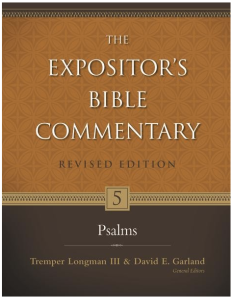
They are Willem A. VanGemeren’s Psalms (Expositor’s Bible Commentary, Revised edition) and Gerald H. Wilson’s Psalms Volume 1 (NIV Application Commentary), both from Zondervan.


1. Revised EBC


Psalms Revised EBC

In the EBC set’s previous edition, Psalms was only available in a larger volume that also contained Proverbs, Ecclesiastes, and Song of Solomon. Now, with some expansions and revisions, it is its own 1,000-page volume.

VanGemeren’s introduction is detailed, offering the kind of thorough but not verbose overview anyone reading or preaching on the Psalms would want. Among other issues, he writes about Psalm types, the formation of the Psalter, theology in the Psalms, and literary/poetic devices–in addition to parallelism, he lists and describes 16 devices.

The typical pattern is for each Psalm to begin with an Overview (covering its themes, structure, authorship, and so on). Then follow “Commentary” and “Notes” for each passage. The Commentary section is verse-by-verse exposition; the Notes include more detailed technical insights, especially delving into the Hebrew text. 22 “Reflections” throughout the commentary offer additional explanation of important themes.

To take just one look inside the commentary, Psalm 13:5-6 in the NIV (1984) reads:

But I trust in your unfailing love;
my heart rejoices in your salvation.

I will sing to the LORD,
for he has been good to me.

Of these verses VanGemeren says:

Though he has experienced deep despair, the psalmist does not give up. His feet did not slip. He held on to the promise of God’s covenant love: “your unfailing love” (hesed). He is not overwhelmed by his troubles, but in his depression he says, “But I trust.” The emphatic “But I” (v.5) is a surprising response from the heart of a depressed person. Because life may be so bitter for some, it is only by God’s grace that the heart of faith may groan, “but I.”


2. NIVAC


Psalms Vol 1 NIVACAs with the Revised EBC volume, the introduction to Psalms Volume 1 in the NIV Application Commentary series (NIVAC) covers good ground: authorship, historical use of Psalms (in temple worship, as well as the move “from public performance to private piety”), poetic conventions, Hebrew poetry specifically (parallelism, use of refrains, acrostics), Psalm headings, and types of Psalms.

Wilson–after an informative historical survey of attempts to categorize Psalms–highlights three “main” Psalm types: Praise, Lament, and Thanksgiving. He also notes other types, like royal Psalms and wisdom Psalms. The introduction spans more than 60 pages and (thankfully) exceeds what one might expect to find in an “application commentary.”

The NIVAC series has as its primary goal “to help you with the difficult but vital task of bringing an ancient message into a modern context.” It employs three sections for each Psalm to (quite successfully) accomplish the aim:

  1. Original Meaning: “the meaning of the biblical text in its original context.”
  2. Bridging Contexts: “to help you discern what is timeless in the timely pages of the Bible–and what is not,” i.e., what applies only particularly to a context and not universally.
  3. Contemporary Significance: the application section, including suggestions for the preacher or teacher or reader of the passage.

The text of each Psalm is printed in full before its commentary, which I appreciated. This first volume covers Psalms 1-72 (Books I and II of the Psalter). The author is as adept in the text’s Original Meaning as he is in Bridging Contexts or discussing its Contemporary Significance. Wilson won’t write your sermon for you, but he gives the preacher or teacher plenty to chew on, both for herself and for her congregation. Especially illuminating in the application section is Wilson’s Christological read of many Psalms.

Here are just two examples of the kind of edifying insights that fill Wilson’s NIVAC volume:

1. He notes the walk…stand…sit progression of Psalm 1, and does so with a nice turn of phrase:

The order of these verbs may indicate a gradual descent into evil, in which one first walks alongside, then stops, and ultimately takes up permanent residence in the company of the wicked.

2. When Sons of Korah in Psalm 46 call the congregation to a counterintuitive praise session, they do so in the midst not just of some tragic events befalling God’s people—it’s the complete disintegration of all of life that is the dominant metaphor in these verses. Wilson says that when the Psalm speaks of mountains falling into the sea, this “amounts to a moment of uncreation.”


Praying with Many, Many Others


Wilson puts it well:

Thus, whenever you read the psalms, when you sing them or pray them, you are praying, singing, and reading alongside a huge crowd of faithful witnesses throughout the ages. The words you speak have been spoken thousands–even millions–of times before: in Hebrew, Greek, Latin, English, and a myriad of other languages. As you read or sing or pray, off to your right stand Moses and Miriam, in front of you David and Solomon kneel down, to your left are Jesus, Peter and Paul, Priscilla and Aquila, while from behind come the voices of Jerome, St. Augustine, Theresa of Avila, Luther, Calvin, and more–so many more!


Thanks to Zondervan for review copies of each of the above, given to me with no expectation as to the content or trajectory of my review. Find the Revised EBC volume here (Amazon) or here (Zondervan). The NIVAC Psalms volume is here (Amazon) or here (Zondervan). 

A First-Year Textbook that Gets You Reading Hebrew A.S.A.P.

First Hebrew Primer“But when do we get to start reading Hebrew?”

The question was a near-refrain in my first semester of Hebrew class at seminary. After months of memorizing verbal paradigm charts and individual vocabulary words, I wondered he same thing.

I don’t mind a memorization-based or paradigm-based model for second language acquisition. I did fairly well in first learning Hebrew from the Pratico and Van Pelt Basics of Biblical Hebrew (see here and here).

But as I noted in my Pratico/Van Pelt reviews:

Some people disagree that paradigm memorization outside the context of a text or conversation is ideal pedagogy for language learning. … Even dead or ancient languages should be taught as “living languages,” proponents say. So some Hebrew textbooks encourage instead a text-based inductive approach.


Getting to Read Hebrew A.S.A.P.


The First Hebrew Primer (Third Edition, EKS Publishing) takes more of a reading-based inductive approach:

The goal of the Primer is to teach students to read and understand Biblical Hebrew as quickly as possible; therefore, the lessons emphasize recognition and translation – not memorization.

It succeeds well in this aim. Indeed, as soon as chapter 10 (out of 30), the student will be excited to begin her or his guided reading of Ruth:

Congratulations! You have learned enough Hebrew to begin reading the Bible—revised for your reading level. We have chosen Ruth because it is short, simple, and beautiful. In the beginning, the Hebrew text will be simplified, but as we progress, the text will approach the original. Before we finish the Book of Ruth, you will be reading the actual biblical text.

As soon as the Primer teaches the alphabet, it offers a host of a exercises for out-loud reading practice. The “Tall Tales” (folk tales) readings give students yet another chance to put into a reading context what they have learned. All the expected charts for nouns and verbs, vocabulary lists (with occurrence of 200x or more in the Hebrew Bible), and exercise sets are present throughout the book. But I especially appreciated its emphasis on reading early.


Updates to the Third Edition


What’s different in the Third Edition? Primarily, there is more grammatical detail offered.

This revised third edition introduces several new terms and clarifies grammatical points, but will look the same to long-time Primer readers. The key change we have made is the inclusion of new explanatory endnotes. Many readers have expressed a desire to deepen their knowledge of Biblical Hebrew, but have unanimously endorsed the clear, uncomplicated tone of the Primer. We have responded by adding these optional supplementary notes. Students may read the notes to enrich their understanding of Hebrew grammar or concentrate solely on the main text. Either way, the Primer provides a sound foundation for more advanced studies in the Hebrew Bible.

One gets the feeling that in the absence of those clarifying notes, some of the grammatical concepts are oversimplified. So the additional nuances expressed in the endnotes are imperative for laying a good foundation for later Hebrew learning. EKS Publishing uses its own name for some grammatical terms (“Word Pair” instead of “construct chain” and “regular infinitive” instead of “infinitive construct”).

I can see this being something a student would need to re-learn if she or her goes further in learning Hebrew grammar; I’m not sure the level of simplification here is always helpful or necessary. (And the lack of an index makes it difficult to trace discussion throughout the book of a given concept.) All the same, page 368 provides a “Guide to Grammatical Terms” with a table of “Our Name” and the “Traditional Name” for key concepts.


The Primer for Kids?


Hebrew Learning


Though the book is for “adult beginners,” my six-year-old son, whose Hebrew-learning adventures I have chronicled here, took an interest in The First Hebrew Primer once he saw it on the shelf. Chapter 3 (“The Sheva, Odd Vowels, and the Dagesh”) was particularly helpful, as the sheva had been giving him trouble. The Primer explains how to pronounce the sheva depending on where in a word it is:

  • Sheva at the beginning of a word: “always pronounced with a short, slurred sound”
  • Sheva at the end of a word: “always a silent vowel, and it is not pronounced at all”
  • Sheva in the middle of a word: “When a sheva appears alone in the middle of a word, it usually falls at the end of a syllable and is not pronounced.” (An endnote at this point offers additional illuminating detail.)

My son did astutely ask, “How do I correct myself if I get something wrong?” So I’ve gone through the Primer with him, rather than letting him use the Primer much on his own (even though he can read just fine). There is a companion audio CD available, which has to be purchased separately; self-guided learners will need it to be able to take full advantage of the oral exercises in the Primer.


Concluding Evaluation


The Hebrew font in The First Hebrew Primer is clear and easy to read. The exercises strike a nice balance between appropriateness for each lesson and being challenging. For example, in chapter 7 (“The Perfect Tense”), there is this:

EKS First Hebrew Primer

If you prefer an interactive, digital edition, Accordance Bible Software has a Primer package available for purchase here. The Accordance edition includes the primer, the answer key (otherwise a separate purchase), and more than an hour’s worth of accompanying audio. In other words, Accordance puts everything needed in one integrated and easy-to-use place.

Would I use The First Hebrew Primer as a textbook for a first-year Hebrew student? Definitely–despite the occasional lack of nuance in the grammatical explanations, its emphasis on oral practice, its engaging exercises, its inclusions of basic paradigms, and especially its introduction of reading early on make it a solid option for a first-year Hebrew text. As an added bonus, there are plenty of English to Hebrew exercises (and even an English-Hebrew Glossary), which will go a long way to help the student solidify Hebrew comprehension.


Thanks to EKS Publishing for the review copy of the Primer and answer key, offered for the purposes of this review, but with no expectation as to my review’s content. The publisher’s book page is here (answer key here). It’s also on Amazon (affiliate link) here (answer key here).

A First Look Inside Bonhoeffer Works, Volume 17 (VIDEO)

DBWE17

After nearly 20 years the Dietrich Bonhoeffer Works (English edition) is complete.

Yesterday I received the concluding Volume 17, Index and Supplementary Materials. Take a look inside–this is a fittingly well-done volume to complete the set. (Make sure you click the gear icon to watch in HD.)


I describe the volume more in detail here.

To learn more about Fortress Press’s giveaway of the entire 17-volume Bonhoeffer Works, go here.

This Just Went to the Top of My Reading Stack

Bonhoeffer as Youth Worker


For months I’ve been waiting for this book to come out. Today I received it in the mail. As it weds two of my loves in life–youth ministry and Bonhoeffer–it’s going straight to the top of my reading stack.

About Bonhoeffer as Youth Worker:

The youth ministry focus of Dietrich Bonhoeffer’s life is often forgotten or overlooked, even though he did much work with young people and wrote a number of papers, sermons, and addresses about or for the youth of the church. However, youth ministry expert Andrew Root explains that this focus is central to Bonhoeffer’s story and thought. Root presents Bonhoeffer as the forefather and model of the growing theological turn in youth ministry. By linking contemporary youth workers with this epic theologian, the author shows the depth of youth ministry work and underscores its importance in the church. He also shows how Bonhoeffer’s life and thought impact present-day youth ministry practice.

With appreciation to Baker Academic. I’ll post a review here this fall. Check out the Table of Contents and first chapter here. You can also pre-order the print book on Amazon or the Kindle edition.


Video Review of PDF Expert 5 on iOS8

PDF Expert 5 icon Having a good way to keep track of and annotate PDFs across multiple devices is important to me. PDF Expert 5 makes it easy, with a quick, high-powered, and intuitive app. It works great in iOS 8 already. The book I use in the video review below is a good one in its own right. It’s called Learning from Life: Turning Life’s Lessons into Leadership Experience, by Marian N. Ruderman and Patricia J. Ohlott. You can find it at the Center for Creative Leadership here or here, as part of CCL’s Ideas into Action Guidebook series. Here’s PDF Expert 5 on an iPhone (make sure you use the settings gear in the embedded video to watch in HD; you can also view full screen):  


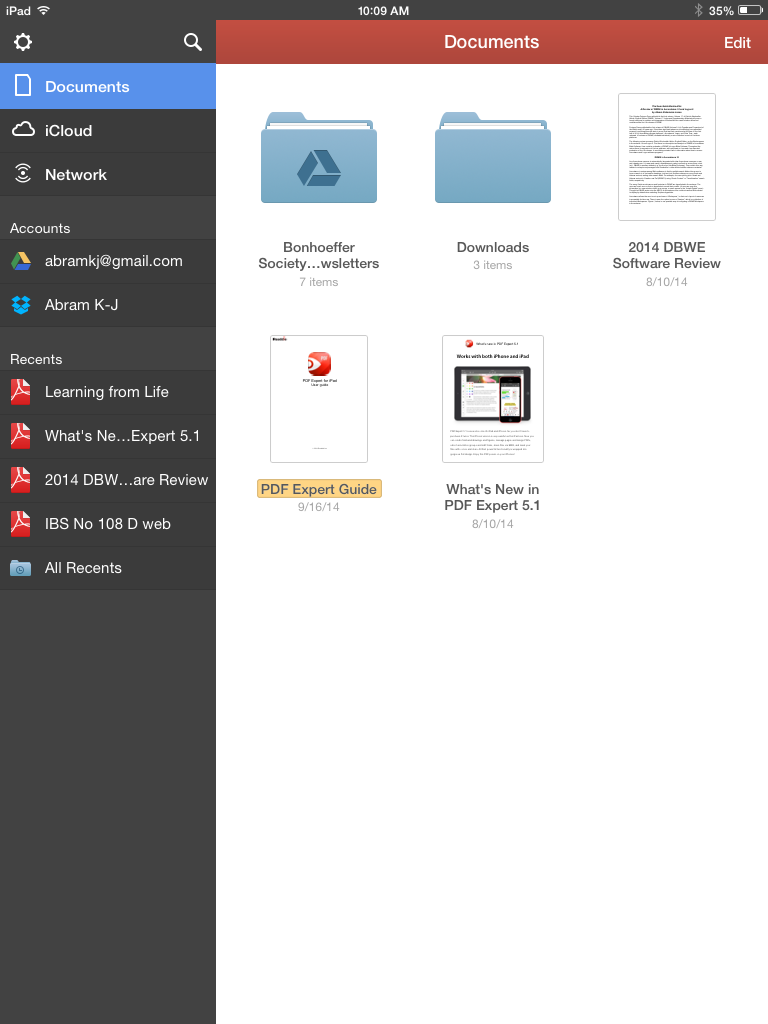
Here are a couple of shots of what it looks like on an iPad.  


Documents Screen  


Especially useful on iPad is the ability to have multiple documents open at once as tabs:  


Reading Screen  


Thanks to the folks at Readdle for the chance to review! Learn more about PDF Expert here. (P.S. I made the video above using the handy Reflector app. Reflector mirrors your iOS device to a computer, from which you can record your screen.)

351 Words on 4 Mac Apps I’ve Been Using Every Day

Here are 4 Mac apps I use every day:

OmniFocus1. OmniFocus

This is turning into Organize-Me Central. I figured out today how to install extensions in Firefox and Chrome on OSX, so that I can save any Web article I want to read later as an action step in Omni Focus. It syncs seamlessly across Mac, iPad, and iPhone, too. There’s a bit of a learning curve to it, but I’ve made the decision to try to run all of my tasks, appointments, and notes through OmniFocus.

I even figured out, using their Clip-o-Tron 3001, how to turn Mac Mail messages into tasks with a keyboard shortcut. (Email inboxes are not a good place to keep tasks, you realize.)

OmniFocus 2 for iPad just came out, and works very well so far with iOS 8. Check out their site here.

TextExpander_icon2. TextExpander

TextExpander does something simple but sweet: it allows you to type text abbreviations that automatically expand into something larger. There are some preset “Snippets,” as well as the option to create your own. For example, “ddate” will insert the current date into any document. I’ve even got “.autoreply” set to convert to this text (I’m using TextExpander for the below):

Thanks for writing. I’m out of the office and away from email Tuesday. I’ll get back to you as soon as possible after that.

Thanks,

Abram K-J

It’s also available on iPhone and iPad, and you can sync your Snippets across devices. Pretty awesome. Read more about it here.

accordance 10 lamp3. Accordance

I’ve written a lot about Accordance, including a six-part review of Accordance 10. It’s my go-to Bible software on Mac.

Accordance is on Windows now, too, and has an iOS app for iPad and iPhone. Find Accordance on the Web here.

Scrivener Logo4. Scrivener

What a word processing program! (But, also, so much more). Writers love this app, and I can see why. I recorded my initial impressions of Scrivener here (where I used it to write a paper). It’s my primary organizing tool each week for sermon writing.

Check out Scrivener here. No iOS apps… yet.

Soon I’ll post about some handy iOS apps I’ve been using.

Scot McKnight’s Sermon on the Mount Commentary, Reviewed

SGBC SMount


My mild obsession with the writings of Dietrich Bonhoeffer can be traced back to a question I asked myself and the congregation with whom I worship in early March: How can Ukraine love its Russian occupiers? And what would Bonhoeffer suggest?

The questions came from my wrestling through Matthew 5:38-48, which I find the be the most difficult passage in the Sermon on the Mount. I concluded, in part,

What seems a fairly straightforward statement, “Love your enemy,” is difficult. What does it mean to love enemies? In what spheres must that take place, and how should it happen, especially in the presence of an inordinately powerful evil? How categorical is Jesus in his forbidding of force? Was he speaking to disciples, or to disciples and states?

You can see how I landed (at least in a sense) at the end of this post.


Enter Scot McKnight


Scot McKnight’s Sermon on the Mount (The Story of God Bible Commentary, Zondervan, 2013) helped me wrestle through the difficult question of just what it means to “turn the other cheek.” While some interpreters (such as Luther) have sought to distinguish between private (interpersonal) and public (political) applications of this text, McKnight responds: “Utter nonsense.” Instead:

One of the main thrusts of the ethic of Jesus is the radicalization of an ethic so that we live consistently, from the so-called “private” to the “public” spheres. There is for Jesus no distinction between a secular life and spiritual life: we are always to follow him. His ethic is an Ethic from Beyond. But others, in words not so wrongheaded as Luther’s, have continued Luther’s personal vs. public or spiritual vs. secular distinction when it comes to ethics.

Jesus, McKnight persuasively argues, was not distinguishing between how the disciples should live in their private lives (whatever that would have meant) as opposed to in public. “The question every reader of the Sermon must ask,” McKnight goes on, is:

Does that world begin now, or does it begin now in private but not in public, or does it begin now for his followers in both private and to the degree possible in the public realm as well?


A New Commentary Series: SGBC


The Story of God Bible Commentary is a new series, with McKnight’s volume and Lynn Cohick’s Philippians volume being the first two published. As the name implies, the series is concerned to interpret and apply Scripture with an eye to how each passage relates to the larger biblical story:

We want to explain each passage of the Bible in light of the Bible’s grand Story. The Bible’s grand Story, of course, connects this series to the classic expression regula fidei, the “rule of faith,” which was the Bible’s story coming to fulfillment in Jesus as the Messiah, Lord, and Savior of all.

There are three primary sections in each passage:

1. Listen to the Story. With the assumption that “the most important posture of the Christian before the Bible is to listen,” the SGBC series begins with the full text of the passage under consideration (using the 2011 New International Version). The section also includes an introduction to the passage.

2. Explain the Story. From historical background to cultural context, from theological explanation to individual word studies, here is where SGBC unpacks “a sound and living reading of the text in light of the Story of God in the Bible.”

3. Live the Story. This is the “digging deeper” into “our world” section. The commentary series is not geared for an academic audience, which allows authors to spend more time imagining 21st century applications of a passage to life. This is especially helpful for preachers and anyone wanting to know how to live out a passage they are studying.


“Better People” or “Better Liars”?


McKnight wastes no time in convicting the reader, much as the Sermon on the Mount itself does. Just before the introduction he quotes Bonhoeffer, who says of the Sermon:

Its validity depends on its being obeyed.

And here’s Dean Smith, via McKnight:

The Sermon on the Mount has a strange way of making us better people or better liars.

(Ouch! But so true.)

McKnight agrees that the incongruence “between Jesus’ vision and our life bothers many of us.” Various interpretive attempts, he suggest, have made Jesus say what he did not really say. By contrast:

There is something vital—and this is a central theme in this commentary—in letting the demand of Jesus, expressed over and over in the Sermon as imperatives or commands, stand in its rhetorical ruggedness.

Jesus intended the Sermon on the Mount as “the claim of Jesus upon our whole being.”

So you can’t just read this commentary in a detached way or use it for dry or “objective” research (as if there were such a thing!). Throughout the commentary McKnight helps the reader hear Jesus’ demanding (yet life-giving) message in resounding terms.


McKnight on Jesus and Ethics


The commentary’s introduction has a substantive (and surprisingly helpful) section called, “The Sermon and Moral Theory,” where McKnight compares “Jesus’ moral vision” to other moral theories, whether Aristotle’s virtue ethics, Kant’s categorical imperative (deontology), or Bentham and Mill’s utilitarianism.

McKnight presents Jesus’ ethics through the conjoining lenses of:

  • “Ethics from Above”—Jesus speaks as God
  • “Ethics from Beyond”—”kingdom ethics” that seek to bring “God’s future to bear on the present”
  • “Ethics from Below”—based on human “inductive observation”
  • An ethical theory that is “messianic, ecclesial, pneumatic”—in Jesus’ “messianic vocation,” he believes that “an ethic can only be lived out in community (the kingdom manifestation in the church) and through the power of the Spirit now at work.”

The introduction offers no structural outline of the Sermon on the Mount. There is just a paragraph about its structure, saying that the matter is “incapable of any kind of firm resolution.” So the omission of an outline seems deliberate, but at least something preliminary would have helped–even a Table of Contents that shows the pericope divisions/commentary chapters at a glance, which this volume lacks.


The Commentary Proper


McKnight breaks the Sermon into 23 chapters in his commentary proper (chapter 1 treats both the very first and very last verses of the Sermon on the Mount together). Each chapter prints the full biblical text (it’s nice to have everything in one place), then proceeds with the sections noted above: Listen to the Story, Explain the Story, Live the Story. His experience in teaching and ministry is obvious throughout the book, which is a refreshing balance of deep exegesis, lucid prose, and convicting application.

To look briefly at just one passage, Matthew 7:12 says:

So in everything, do to others what you would have them do to you, for this sums up the Law and the Prophets.

McKnight writes:

Of the many ways to describe or articulate the Torah, two are pertinent in our text: one can either multiply laws so as to cover all possible situations, or one can reduce the law to its essence.

The verse, which he sets in biblical and rabbinical context, “summarizes the essence of the Sermon” (emphasis in original). And it has much to say to how we ought to live now:

But the Golden Rule is of direct value in relationships in churches. It takes but a moment’s thought to think it through: How do I want to treat others? How would I want to be treated?

*****

This is a fantastic commentary. It’s smart, well-researched, deep, engaging, challenging, and–perhaps best of all–like the Sermon it addresses, issues a clear call to righteous living according to God’s will.


Thanks to Zondervan Academic for the review copy, offered for the purposes of an unbiased review. Find it at Zondervan here or Amazon here.

The Westminster Dictionary of Theological Terms, Reviewed

Westminster Dictionary of Theological Terms


The Westminster Dictionary of Theological Terms (Westminster John Knox Press, 2014) is a succinct compendium of key theological words and concepts.

One obvious advantage to the book is its portability. It’s less than 400 pages and easy to carry around in a satchel… though since receiving it, I’ve kept it on my desk with a few other works I reference a lot.

What sorts of “theological terms” does this dictionary cover? The publisher’s product page notes:

This second edition of The Westminster Dictionary of Theological Terms provides a comprehensive guide to nearly 7,000 theological terms—1,000 more terms than the first edition. McKim’s succinct definitions cover a broad range of theological studies and related disciplines: contemporary theologies, biblical studies, church history, ethics, feminist theology, global theologies, hermeneutics, liberation theology, liturgy, ministry, philosophy, philosophy of religion, postcolonial theology, social sciences, spiritually, worship, and Protestant, Reformed, and Roman Catholic theologies.

There is also a short annotated bibliography, list of works consulted, and set of abbreviations at the back of the book. The “Major Topics and Distinctive Terms and Concepts” section at the beginning gives the reader a framework of overarching topics into which the dictionary’s terms will fit. (E.g., “Bible,” “theology,” “worship,” “ethics and moral theology,” and so on.)

McKim himself has overseen much larger dictionaries. An initial point of skepticism for me was whether a theological dictionary this small and short could still be substantive. Definitions are somewhere in the 15-75 word range, depending on the term.

Yet as a quick-reference guide, it does well. Consider McKim’s definition of feminist criticism:

A critical approach to reading the Bible that focuses on the political, social, and economic rights of women. Diverse goals and methods are employed, with a common recognition that all texts are gendered. This implies not only that they reflect sexual differences between males and females, but also that they involve power. Feminist criticism seeks to make clear culturally based presuppositions found in texts.

Here’s another example, the entry for “agrapha,” a term one finds shortly after delving into studies of the Gospels:

(Gr. “unwritten sayings”) Sayings attributed to Jesus that circulated as traditions during the period of the early church. Also those sayings attributed to Jesus found outside the canonical Gospels.

The reader will also find terms like “Griesbach hypothesis,” “haggadah,” “Muratorian Canon,” perspectivalism,” “cuneiform,” “body-soul dualism,” “Trisagion,” “interiority,” “rechte Lehre” (German for “right teaching on doctrine”), and many more.

McKim’s goal was to provide a “wider, synthetic work that gives short, identifying definitions over a more comprehensive range of theological disciplines,” as opposed to something more “specialized” and “extensive.” The beginning theological students that McKim seeks to reach will find such a dictionary an especially useful entry point into the large and growing world of biblical and theological studies. McKim seeks to be more “broad” than “deep”; in this he succeeds, but the definitions are still plenty substantive to be useful to students at various stages.

The annotated bibliography is just five pages and glosses over important works (e.g., the commentaries section lists Anchor but omits Hermeneia). It does include a good page on Web-based resources for theological studies. The abbreviations include a couple pages of textual criticism abbreviations (including Latin), which will save the new reader of the Hebrew Bible from having to look most terms up elsewhere.

One feature I felt to be missing was a lengthier set of introductory essays on the nature and methods of theological study. I’m assuming Dr. McKim didn’t include this because it might exceed the intended scope of the work, but perhaps future editions could include–as many dictionaries do–at least two or three introductory essays to further orient the reader to theological study.

I’ve had the dictionary at my desk all summer, and each time I’ve looked up a word or phrase, I’ve found what I was looking for (with the exception of dereliction or “cry of dereliction”).

Especially for its price and accessibility, The Westminster Dictionary of Theological Terms is an excellent starting point for seminary students or for pastors who want to stay up-to-date on theological terminology.

Many thanks to WJK Press for the review copy, given to me with no expectation as to the content of my review. You can find the dictionary here on Amazon (affiliate link), or here at WJK Press.

Bonhoeffer’s Life Together: A Review

A scroll through some of my recent Facebook statuses shows the quotability of Bonhoeffer’s Life Together and its impact on me:

And:

Also, this one:

And, just for fun, here’s some Bonhoeffer from a letter quoted in Eberhard Bethge’s biography of him:

Bonhoeffer’s Life Together is substantial evidence that this servant of God saw himself as belonging to the church. The short, powerful book is both a gift and a challenge to any Christian who will take the time to study it.

I have just finished reading it through all the way for the first time. Though it’s true that there is a focus on how one can be a faithful member of a Christian community, the application to the Christian-as-individual is rich, as well.
 

How Life Together is Structured

 
There are five main sections of Life Together:

  1. Community
  2. The Day Together
  3. The Day Alone
  4. Service
  5. Confession and the Lord’s Supper

Bonhoeffer was, in fact, writing with his own seminary community in mind (see “Benefits of the DBWE Critical Edition,” below), but he also intended with Life Together something more universal:

We are not dealing with a concern of some private circles but with a mission entrusted to the church. Because of this, we are not searching for more or less haphazard individual solutions to a problem. This is, rather, a responsibility to be undertaken by the church as a whole.

Throughout each of the sections, the focus of the book is “life together under the Word” (my emphasis, but also an ongoing emphasis of Bonhoeffer). An editor’s footnote explains that “life together” can also be translated from German as “common life.”

Christians in community are a sort of sacrament to each other, a theme throughout Life Together:

The prisoner, the sick person, the Christian living in the diaspora recognizes in the nearness of a fellow Christian a physical sign of the gracious presence of the triune God. In their loneliness, both the visitor and the one visited recognize in each other the Christ who is present in the body.

Through prayer and worship together, intentional solitude, service to each other, hearing confession of sins and–ultimately–through participation in the Lord’s Supper, the purpose and aim of Christian communities is “to encounter one another as bringers of the message of salvation.”
 

Bonhoeffer’s Dialectic of Solitude and Community

 
Throughout the book Bonhoeffer explores the dialectic between living in community (“The Day Together”) and the individual’s time alone (“The Day Alone”). He suggests that the ones who will do best living in community are those who already do well alone. Those who cannot already live at peace with themselves will not do well in community:

Those who take refuge in community while fleeing from themselves are misusing it to indulge in empty talk and distraction, no matter how spiritual this idle talk and distraction may appear.

On the other hand, “the reverse is also true.” Discipleship is best when not received, experienced, and lived just as a solitary endeavor. Bonhoeffer says, “Whoever cannot stand being in community should beware of being alone” (emphasis in original).

Both solitude and the company of others, then, are needed:

We recognize, then, that only as we stand within the community can we be alone, and only those who are alone can live in the community. … It is not as if the one preceded the other; rather both begin at the same time, namely, with the call of Jesus Christ.

Bonhoeffer’s characteristic and refreshing forthrightness brings the point to a head:

Those who want community without solitude [Alleinsein] plunge into the void of words and feelings, and those who seek solitude without community perish in the bottomless pit of vanity, self-infatuation, and despair.

Whoever cannot be alone should beware of community. Whoever cannot stand being in community should beware of being alone.


Benefits of the DBWE Critical Edition

 
Bonhoeffer Life TogetherLife Together is Volume 5 of Fortress Press’s Dietrich Bonhoeffer Works (English Edition); it’s also the first one published (1995) in the series.

In addition to its being a new translation from Bonhoeffer’s German, there is an Editor’s Introduction to the English Edition, Editors’ Afterword to the German Edition [abridged], and an extensive (though not distractingly so) set of footnotes as part of an explanatory critical apparatus.

Though one could certainly read Life Together in its own right, editor Geffrey B. Kelly’s introduction is a great set-up. From the very beginning he highlights the fascinating history of the book:

It was because [the Gestapo] had shut down the preachers’ seminary at Finkenwalde that Dietrich Bonhoeffer was finally persuaded to compose his thoughts on the nature and sustaining structures of Christian community, based on the “life together” that he and his seminarians had sustained both at the seminary and in the Brothers’ House at Finkenwalde. … With the closing of the seminary at Finkenwalde and the dispersal of the seminarians, however, Bonhoeffer felt compelled not only to record for posterity the daily regimen and its rationale, but also to voice his conviction that the worldwide church itself needed to promote a sense of community like this if it was to have new life breathed into it.

Kelly brings to light more about the historical situation leading to Life Together (including the Finkenwalde seminary), as well as ties it in with some of Bonhoeffer’s earlier writing that undergirds the book. Kelly notes that Life Together is ultimately a highly Christocentric work. Indeed, Bonhoeffer writes:

Christian community means community through Jesus Christ and in Jesus Christ. There is no Christian community that is more than this, and none that is less than this. Whether it be a brief, single encounter or the daily community of many years, Christian community is solely this. We belong to one another only through and in Jesus Christ.

The critical footnotes are excellent and seem to be placed at just the right spots. They include biblical references, historical background, explanations of German-to-English translations, and descriptions, where needed, of the larger body of Bonhoeffer’s thought that informs a given passage.

For those wanting to read Life Together, there’s a nice bonus with the Fortress Press DBWE edition: it includes also Bonhoeffer’s Prayerbook of the Bible: An Introduction to the Psalms. Given his emphasis already in Life Together on the importance of the Psalms for the prayer life of the community (“The Psalter is the great school of prayer”), its inclusion in this volume is perfectly fitting. The text itself is just above 20 pages, with the addition of an English editor’s introduction and German editors’ afterword.
 

One More Bonhoeffer Quote,
and How to Get the Book

 
The last word of this review goes to Bonhoeffer. Here it is:

The fact that Jesus Christ died is more important than the fact that I will die. And the fact that Jesus Christ was raised from the dead is the sole ground of my hope that I, too, will be raised on the day of judgment. Our salvation is “from outside ourselves” (extra nos). I find salvation not in my life story, but only in the story of Jesus Christ. Only those who allow themselves to be found in Jesus Christ—in the incarnation, cross, and resurrection—are with God and God with them.

If you don’t already own Life Together, you should. If you do own it in an old paperback edition, you should get the Fortress Press Dietrich Bonhoeffer Works edition, if possible, whether through purchase or library check-out.

If you really want to go in depth, Geffrey B. Kelly (lead English editor of DBWE 5) wrote Reading Bonhoeffer, which includes a reading companion to Life Together.

Many thanks to Fortress Press for the review copy, given to me with no expectation as to the content of my review. You can find Life Together and Prayerbook of the Bible here on Amazon (affiliate link), or here at Fortress Press.