The (Leather) Gospel, According to John

I’ve had hit-or-miss success in 2016 with Bible memorization. It’s entirely possible I’m being too hard on myself, but I also know I struggle to consistently work at the parts of the Bible I’m trying to memorize this year.

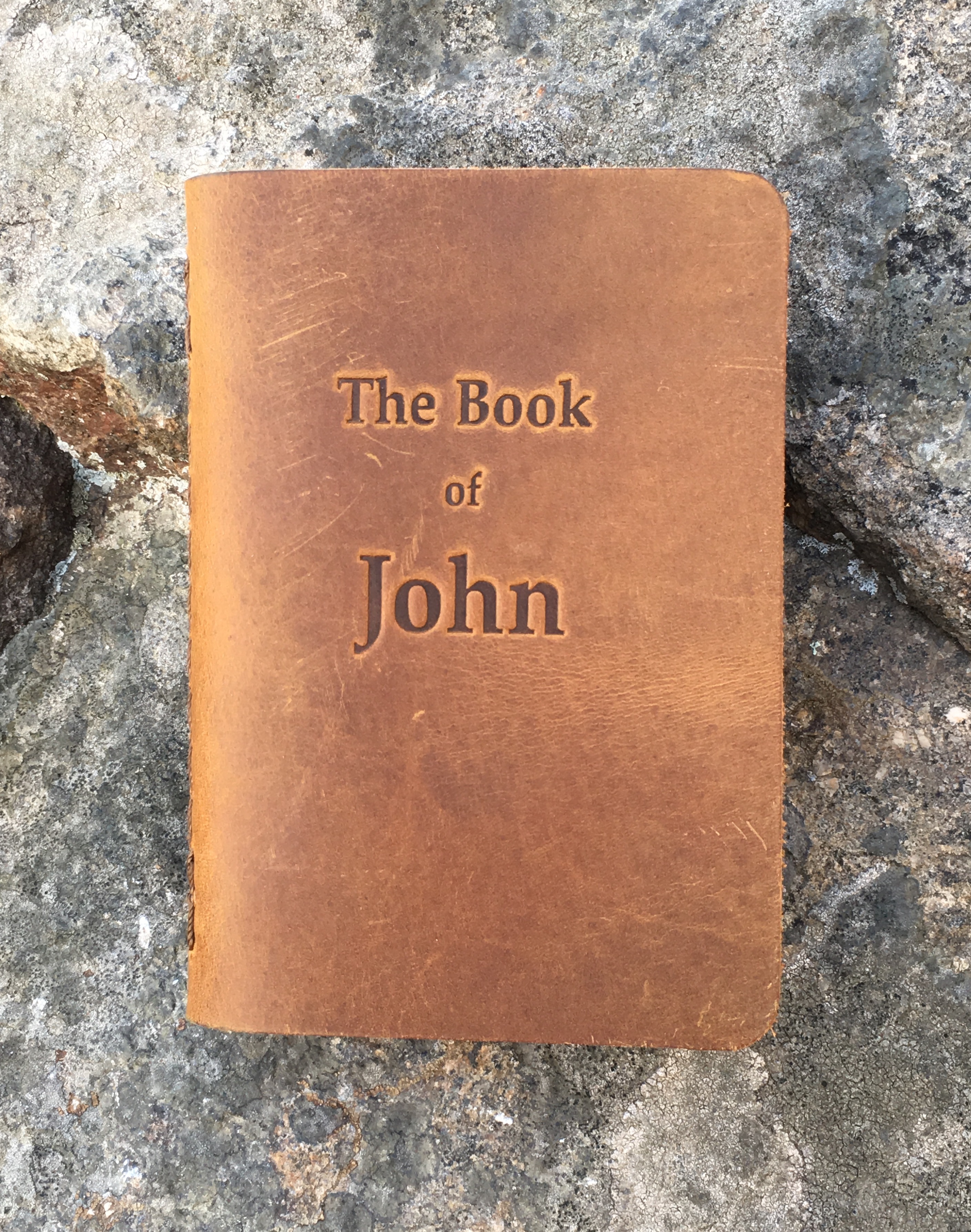
A tool won’t necessarily make me a better memorizer, but thinking it could help, I sprang for the Saddleback Leather Gospel of John Bible portion. You readers of this blog know I like good leather. You know I like pocket notebooks. And of course I like pocket notebooks with leather covers. So why not have a portable Scripture portion covered in leather?

This has actually been a desideratum of mine for some time, so I was really excited to see that Saddleback Leather has just released a set of three books of the Bible (John, Proverbs, and Revelation), each stitched into a leather cover. These are not inserts that can be exchanged–they are permanently stitched to their covers.

Lemme show you.


0_Two Balms
Lip Balm, Life Balm


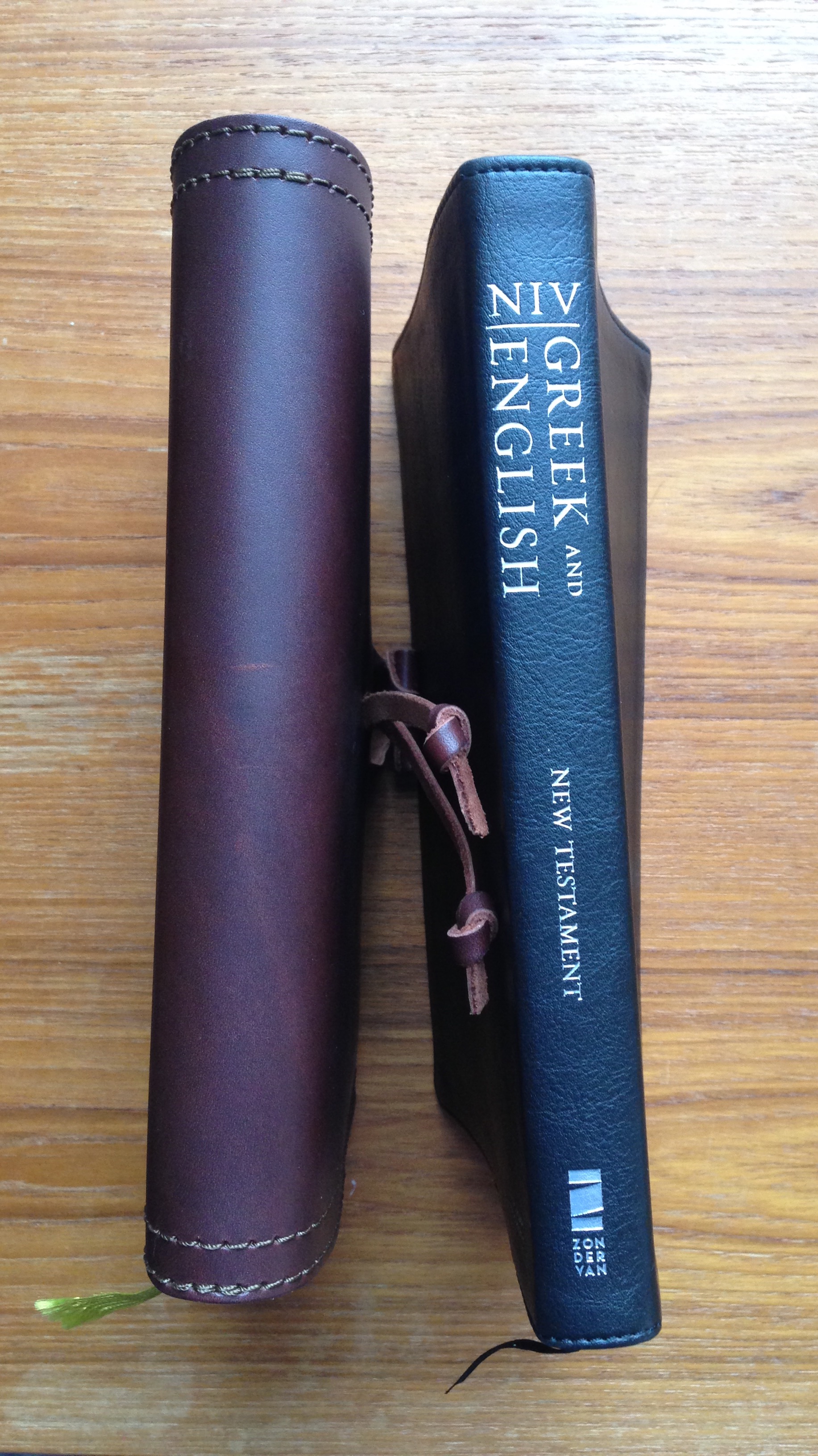
The book is passport size (think 3.5″ x 5″ Baron Fig Apprentice rather than 3.5″ x 5.5″ Field Notes or Word. Notebooks). This means it’s a great front pocket fit.


1_Pocket View


Here it is, front and back:


Words of the Word on the Rock
Words of the Word on a Rock


3_Back on Rock
Rock on, You Rock on the Rock


Here’s a look at how the uber-tough paper is stitched into the leather:


4_Inside Stitching


5_Outside Stitching


That paper, by the way, is “YUPO synthetic paper: 100% recyclable, waterproof, tree-free, durable, and easily wipes clean.”


7_Inside Stitching Up Close


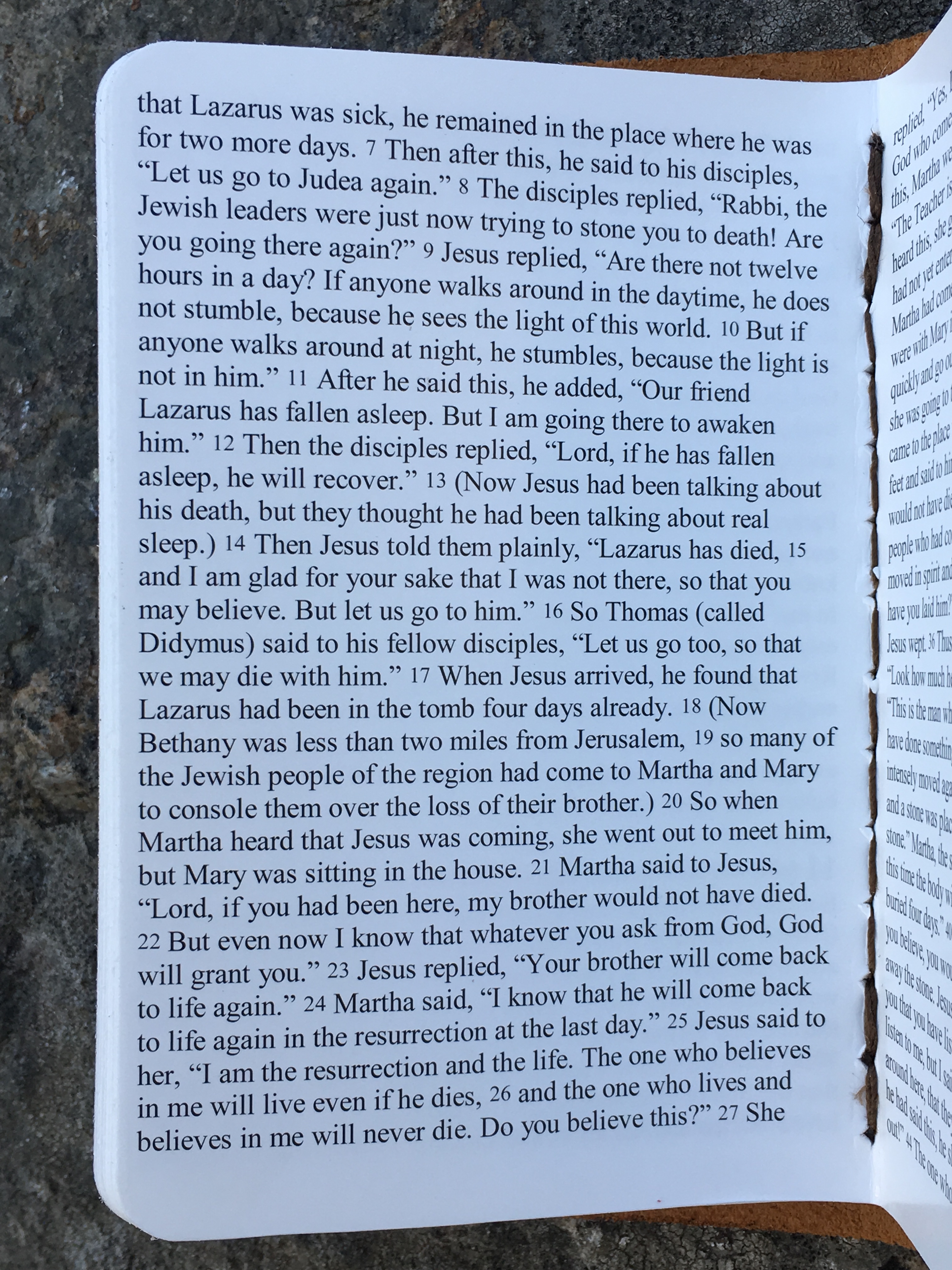
Bible production is notoriously challenging, and I’m quite sure this piece was no exception. A bummer is that there is virtually no margin to the pages. The font is small, but the lack of white space is the larger issue:
 

8_Full Page Text


This especially becomes a problem as some pages don’t lay 100% flat:


Crammed margins
Crammed margins


The leather is full grain and wonderful, as with all of Saddleback’s stuff. It smells good, of course. It will last forever. The paper looks just as tough, too. I don’t quite feel like trying to rip it to see if it’s truly tear-free, but it’s the kind of paper you could take on a camping trip and not have to worry.

Surprisingly, given the excellent workmanship on Saddleback products, the leather stitching was a little crooked, even though it’s machine-stitched:

 

6_Outside Stitching Up Close


6a_Stitching Not Straight


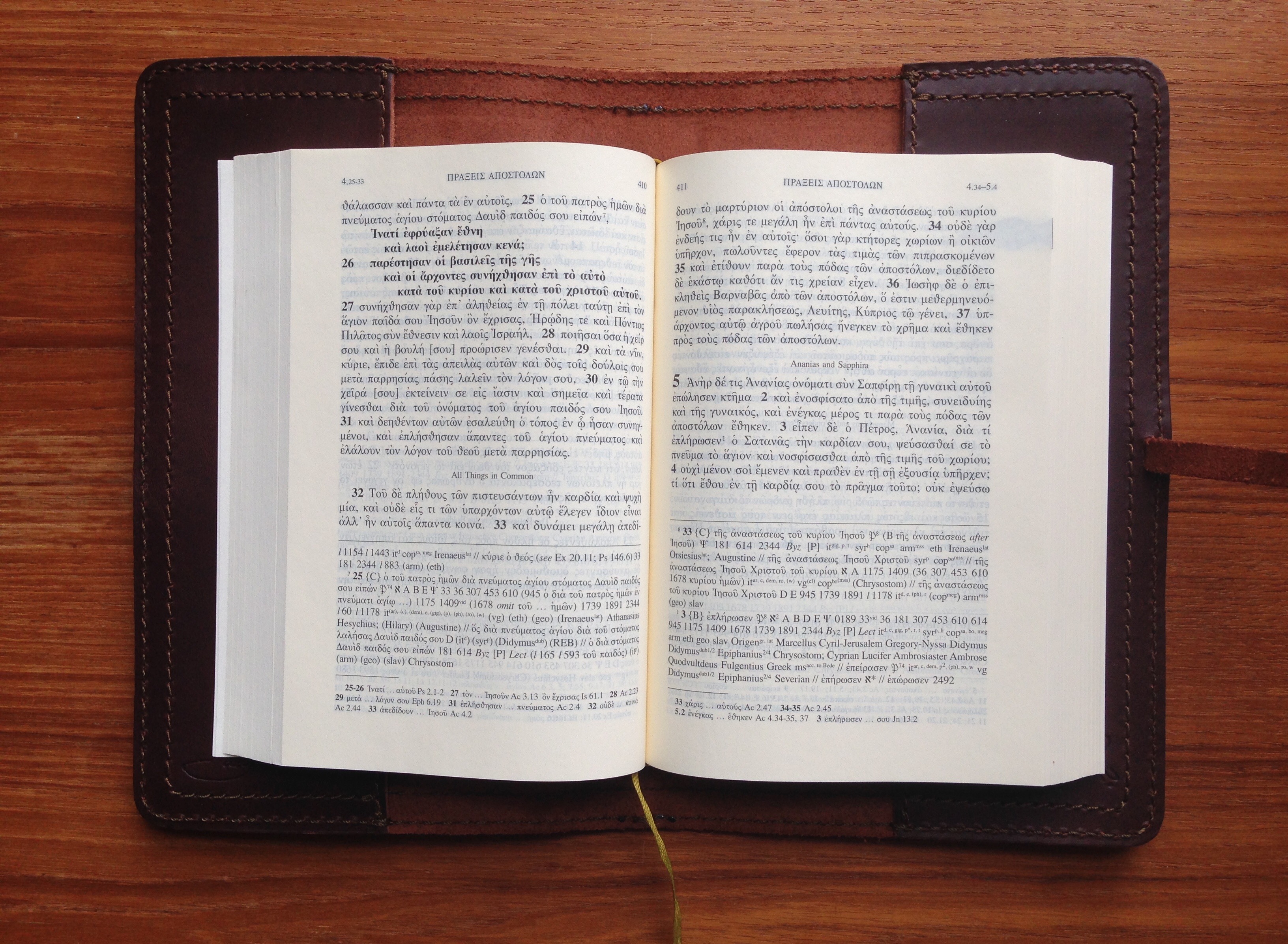
The insides are the NET Bible, which I appreciate as a translation for its rich footnotes. Those are not included here, which is inevitable, since the font is already small to get John to fit in.

There are 30 pages (15 sheets), including–oddly–five blank pages at the end, which means that one less sheet could have been used. (Maybe these are for notes?)

Back to why I got this thing–to memorize. The NET Bible does not lend itself well to memorization. Consider John 1:1-5 in the 1984 NIV:

In the beginning was the Word, and the Word was with God, and the Word was God. He was with God in the beginning.

Through him all things were made; without him nothing was made that has been made. In him was life, and that life was the light of men. The light shines in the darkness, but the darkness has not understood it.

Here it is in the NET Bible:

In the beginning was the Word, and the Word was with God, and the Word was fully God. The Word was with God in the beginning. All things were created by him, and apart from him not one thing was created that has been created. In him was life, and the life was the light of mankind. And the light shines on in the darkness, but the darkness has not mastered it.

I dislike the translation of the generic Greek ανθρωπος as “man” in the 1984 NIV. “Humanity” or “humankind” is better in 2016–even the NET footnote cedes this option, but the text alone just gives you “mankind.” And though the footnote in fuller NET editions explains “the Word was fully God” well, NET has other such turns of phrase that make the version less than ideal for memorization.

There are also no paragraphs in this text. This means the 71-verse John 6 is a single paragraph in the Saddleback Leather Gospel of John. There is a single blank line between chapters, but especially with those five blank pages at the end, could not paragraph separations for greater readability have been employed?

One more minor production quibble: the cover text (“The Book of John”) is ever so slightly left of center, and the branding on the back is a little off-center. These are not really noticeable (like the stitching is), and maybe it’s just that I’ve come to expect near perfection from Saddleback!

I still, however, think it is absolutely awesome that Saddleback is making these things, so even though the NET Bible here isn’t quite the pocket-sized, leather-covered panacea I was seeking for Bible memorization (I know: I have issues), I would still buy this again, even if only to support the effort and have it to keep with me.

I imagine the production of these little books will only improve in time–if you’re going to get one, maybe give it a couple months and see if the next few production runs iron out the quality and layout issues.

(Personally, I’d love to see an easier-to-memorize version available in the future, too, like the NIV or NRSV.)

Saddleback’s site is here, with many wonderful leather things. You can also check out my review of their pen/sunglasses case as well as their leather Bible Cover.

Here is the Gospel of John via Saddleback, as well as a larger set of three books of the Bible, similarly bound.


This was not a review sample–I paid for it, but was fortunate to have received a handsome discount code (as a newsletter subscriber) for the item.

Systems Thinking 101: How Your Church Family Works (Steinke)

Steinke_Healthy CongregationsA “system” is a process with its distinct yet interrelated parts. Interlocking systems (nervous, skeletal, respiratory) make up the one human body. The human body is itself a sort of system of systems.

The Bible uses systems imagery when it describes the body in Romans 12: “For just as each of us has one body with many members, and these members do not all have the same function, so in Christ we, though many, form one body, and each member belongs to all the others.” In a healthy body, all the systems do their part and work together as one toward balance and health. As Peter L. Steinke says in Healthy Congregations: A Systems Approach, “Health is a continuous process, the ongoing interplay a of multiple forces and conditions.” One thinks of the biblical notion of shalom, where health, wholeness, peace, and justice are all present.

Systems thinking offers what Steinke calls “a way of thinking about life as all of a piece… and how the relationships between the parts produce something new.” The key is not just the individual parts, but the interrelatedness of the parts and the dynamics they produce and reinforce together.

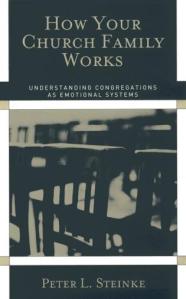
In How Your Church Family Works: Understanding Congregations as Emotional Systems, precursor to Healthy Congregations, Steinke suggests that the church is “an emotional unit” and that “the same emotional processes experienced in the family operate in the church” (xvi). Just like the hand cannot say to the foot, “I don’t need you!”, the budget-setting process of the church cannot say to the strategic planning process, “I don’t need you!”

Similarly, anxiety in one part of the system or church affects what is happening in another part of the system or church, as when a parishioner loses a loved one and directs the anger outward at a church leader or other member. (Steinke later refers to this as shifting the burden.) Systems crave homeostasis, and sometimes anxiety in the system causes its members to pursue survival in less than healthy ways.


 *   *   *   *   *   *


In How Your Church Family Works Steinke aims to

conceptualize emotional processes so that we can recognize them and, ultimately, let them serve rather than corrupt the purpose of our bonding together–“for the sake of ministry, for building up the body of Christ” (Ephesians 4:13), that “every tongue confess that Jesus Christ is Lord, to the glory of God the Father” (Philippians 2:11).

There are two main parts to the How Your Church Family Works. First there is “Conceptualizing Emotional Processes.” Here Steinke talks about systems and their “emotional processes” (“anxiety and reactivity,” “stability and change,” and so on). Second is “The Congregation as an Emotional System,” which uses anecdotes to show the theory of the book’s first half in action.


The Whole, Not (Just) Parts


How Your Church Family Works is one of the most insightful books I’ve read in a long time. My first exposure to systems thinking a decade ago (through Peter Senge’s book The Fifth Discipline) permanently altered how I make sense of relationship dynamics, especially in an organizational setting. The idea of systems thinking is generative for creativity and problem solving. “Instead of seeing isolated, unrelated parts, we look at the whole” (3). But it’s far easier in pastoral ministry to fixate on isolated parts, or to fail to see an interaction as situated within a larger system. I have personally experienced what Steinke says, that systems thinking “deepens our understanding of life” (4).

 

Anxiety and Its Targets


Steinke_How Your Church Family WorksI loved Steinke’s section on anxiety. He remarks, “The most vulnerable or responsible people in the relationship network are the usual targets” (15) when anxiety hits. This would explain why pastors (and other organizational leaders) serve as lightning rods when the people’s anxiety is high. It’s not that anxiety itself is bad, Steinke says. It can provoke positive change (16), but only if it’s regulated. Otherwise, “what is stimulus becomes restraint” (16). In part this is because of the automatic reactive processes from the 15% of our brain’s functioning that is rooted in the brain stem (“survival processes”) and limbic system (“emotional response”) (17).

I’ve been in the Church long enough to no longer expect that a Christian community should magically be conflict-free. Neither do I expect that conflict is always handled in a healthy way. Steinke brilliantly notes just what is going on when anxiety is high in the body of believers: “Threatened, any of us may dispense with our Christian convictions and values. Anxiety is no respecter of belief systems” (21). Indeed, since the stakes are higher in Christian communities (centered as we are around the deepest truths of life), unchecked reactions to anxiety may ripple throughout the system with even more impact.


Difficult? Do It


So how should church leaders respond to anxiety? Here was one of my favorite takeaways from the book for my own ministry. Leaders ignore anxiety in systems at their own peril. (People-pleasing pastors will especially be attempted to just keep the peace.) Steinke cautions:

But “benign neglect” only reinforces malignant processes. Moreover, ignoring is as reactive as placating or attacking. VICIOUS CIRCLES CAN ONLY BE DISABLED THROUGH EXPOSURE. They are enabled by secrecy and avoidance. (27, all caps are original to Steinke)

Exposure is difficult, but a Christian calling. One thinks of the warnings in the New Testament about deeds of darkness and bringing them into the light. I was fortified by Steinke’s quotation of Rainer Maria Rilke: “That something is difficult must be one more reason for us to do it” (43). Difficult ministry-related conversations get easier the more experience I have, but a part of me would would rather just keep the peace. However, to apply Steinke’s insight, that risks perpetuating anxiety and reactivity in a system, in a way that is less than helpful. The better thing is to seek (in humility, love, and confidence) to expose and address those parts of a system that seem to be exacerbating problems. (Realizing, too, that I myself am part of the system and capable of contributing for good or for ill.)


Case Studies


The book’s second half provides ample case studies to help the reader better understand the concepts. Steinke breaks down one church’s dysfunction into a series of triangulations, which he diagrams for clarity (84-5). Earlier in the book he describes a church he consulted with, where he encouraged them to redefine problems they’d articulated “without focusing solely on a person or issue as presented in the original problem” (57).

His “Presenting Problem” vs. “Redefined Problem” chart is a model for how to reframe conflict. His ten group reflection questions that follow are virtually alone worth the price of the book. Here are two highlights: “What would it take to have a pastor stay here ten years, twenty years?” (59) and, “How would you be willing to invest yourself in the process of creating the image you defined above?” (60) I photographed these ten questions and saved them to my Evernote, so I can access them for future work in church evaluation.

I’ll be mulling over these systems thinking concepts for years to come. Both of these books by Steinke are worth reading a.s.a.p.


Where to Find out More


How Your Church Family Works: Understanding Congregations as Emotional Systems: Amazon / Publisher’s page

Healthy Congregations: A Systems Approach: Amazon / Publisher’s page


Thanks to Rowman & Littlefield for the review copies of both books, given to me for review purposes but with no expectation as to the content or nature of my evaluation.

The Challenge of Preaching: John Stott, Abridged

The Challenge of Preaching is an abridged and updated version of John Stott’s Between Two Worlds. The book is clear in its aim:

This book sets out to encourage preachers by reminding them of the importance of their calling; to exhort them to spend time in careful and prayerful sermon preparation; and to remind them of the personal qualities that must characterize every faithful preacher of God’s word. (x)

It easily succeeds in this goal. I found myself bolstered in my sense of calling as a preacher. And the abridgment is compelling in its description of how the preacher should prepare (a) sermons and (b) himself or herself.

The book gets better as it progresses. I bristled at the first chapter where I thought there was both an overemphasis on the word in Christian communities, as well as only vague criticisms of the culture at large.


Words: The Church’s One Foundation?


Challenge of PreachingOf course I agree with Stott that “God chose to use words to reveal himself to humanity” (1), but I’m not sure we can rightly conclude that this is “the truth” which “Christianity is based on” (1). One might alternatively suggest a truth like, “God is love,” or the truth of John 3:16 as a more robust foundation than that of the written and spoken word as “the foundation on which all Christian preaching rests” (14). What I thought was an undue overemphasis on the word shows up elsewhere. The church, for example, is “the creation of God by his word” (21). That’s true as it goes, but leaves a lot out.

Even how the word/Word is interpreted is narrowly construed: “Everything in the rest of the text must relate in some way to the main issue” (55). And again, “Every text has an overriding thrust” (58). It’s difficult to think of biblical passages that support the notion that a biblical passage must have one overriding thrust. Why think this? I was left unconvinced by an assumed claim that I hear often repeated in some evangelical preaching traditions.

I agree with Stott on the primacy of the biblical text in preaching preparation: “We have to be ready to pray and think ourselves deep into the text, until we become its humble and obedient servant” (59). But herein, I think, lies the rub: while I desire to willingly submit to Scripture, isn’t it better to say that we are first humble and obedient servants of the Lord who stands behind Scripture, who breathed it into being, and who breathes life into us even now so we can understand and follow his words? This may seem a subtle nuance—and Stott is clear in emphasizing the role of the Holy Spirit in the process—but I think one has to be careful not to give too much weight to the written and spoken word. We don’t want to unwittingly fossilize it.


Challenges to Preaching


The first chapter is “Challenges to Preaching.” Here Stott mentions “Hostility to Authority” (2), “The Electronic Age” (5), and “The Church’s Loss of Confidence in the Gospel” (9). The criticisms are unfortunately broad and sweeping: “People have also become emotionally insensitive” (6). Which people? What constitutes “insensitive”? What is the basis for the assessment? Each of the challenges suffers from vagueness like this (“We must trust God, not our computers…” (8)). A better model for cultural criticisms is the depth and winsomeness so readily on display in David J. Lose’s Preaching at the Crossroads. I think this may just be a fault, however, of the book’s being abridged. The longer version includes more studies and citations to support the criticisms Stott makes.

Similarly, the second chapter (“Theological Foundations for Preaching”) includes assessments of the pastorate that wasn’t convinced were warranted. Bemoaning “today’s pastors” (which ones? in which denominations? according to which studies?) who don’t take the New Testament seriously (measured how?), Stott writes, “Instead, sadly, many pastors are more involved in administration” (25). Don’t get me wrong: I’ve read Acts 6, and I would love to spend 20 hours a week in sermon preparation, but I really do believe God has entrusted administrative aspects of church leadership to me (with others), whether it’s helping the leadership work toward a mission-driven budget, helping to organize Sunday school classes, etc. I appreciate Stott’s views, but I found them at times to be unmerited hermeneutical leaps.

(It’s worth pausing here to say: disagreements and frustrations with the first part of this book aside, if I could one day be half of half the pastor John Stott was, I would rejoice greatly.)


Metaphors for Preachers, and a Non-Neutral Pulpit


From the beginning of chapter 3 (“Preaching as Bridge-building”) and throughout the rest of the book, I found myself nodding in agreement and with conviction. Stott’s six metaphors the Bible uses to describe preachers is a compelling and really helpful way to frame the role of the preacher: heralds, farmers, stewards, shepherds, ambassadors, and workers. “In all of these New Testament images,” he says, “the preacher is a servant under someone else’s authority, the communicator of someone else’s word” (31). May God forgive me those moments when I take this truth for granted—it is at the heart of my preaching philosophy, and why I continue to get up into the pulpit Sunday after Sunday, seeking to communicate God’s love with God’s people. Seeing these specific ways to understand my role encourages me to continue to seek to be faithful in my calling.

Along these lines I found myself convicted by Stott’s line, “The pulpit cannot be neutral” (39) when it comes to social issues. Amen! He offers a set of examples that could make folks on all sides of the political spectrum (including centrists) squirm a little: “We also need to address issues of injustice, poverty, hunger, illiteracy and disease; the pollution of the environment; failure to conserve natural resources; abortion, mercy-killing or euthanasia and capital punishment; inhumane technocracy, bureaucracy and unemployment…” (38-39). A good word, indeed.

He adds a wise caution only a seasoned leader can: “We need wisdom not to go beyond what is written in Scripture and to speak carefully where Scripture is not clear” (39). May God give us preachers wisdom to know the difference!


Study and Character


Chapter 4 suggests some (realistic) habits of study in sermon preparation. The 5th chapter goes more in depth, including this great question for preachers to ask: “What response does the Holy Spirit want to this text?” (55) He calls for both study and prayer in equal measure (57). His suggestions (even in this abridged version) are specific, practical, and ones that a preacher could implement this week. I was especially intrigued by his suggestions that the preacher write the body of the sermon out, then the conclusion, and (only) then the introduction! (65) He reasons, “Only after doing this, will we be sufficiently clear about what we are introducing” (66). I’m in the habit of writing the introduction first, once I have my outline. I plan to try Stott’s proposed order first chance I get.

The final two chapters focus on the character of the preacher (chapter 6, “Sincerity and Earnestness” and chapter 7, “Courage and Humility”). The first appendix is an abbreviated (though still fairly robust) overview of the history of preaching. I thought it was wise to make this an appendix, though it serves as the first chapter in the longer Between Two Worlds.


Conclusion and Where to Get It


In the end, even if I didn’t agree with all of Stott’s approach, I found this book refreshing and inspiring. He quotes Spurgeon, who said to his students, “Our preaching must not be articulate snoring” (82). Stott’s passion for Scripture and wisdom in preaching are clear. Reading even this abridged version of his classic book serves as yet another reminder of a life well lived, and a ministry faithfully carried out. We preachers are fortunate to be able to access Stott’s hard-earned wisdom.
You can find the book at Amazon here. The publisher’s page is here.


Thanks to Eerdmans for thinking to send me a copy of the book.

The Near-Perfect Driftwood Leather Field Notes Cover (Popov Leather)

Now that your Field Notes: Sweet Tooth Edition have arrived (and they do not disappoint!), what are you going to put them in? Your pocket, of course. But unless you’re wearing chaps, you can’t put your notebook into your pocket and into leather at the same time.

Well, actually you can. And there’s hardly a better way to do it than with Popov Leather’s perfectly constructed and reasonably priced Leather Field Notes Cover. Popov has a wide array of leather covers (here). In this post I review the Driftwood leather cover with pockets ($49). You can protect your pocket notebooks, make them smell good, have pockets in your pockets, and avoid chaps–all with one piece of gear.

The packaging, if I may quote Kendrick Lamar, is A1:


0_In Wrapping


It looks great out of the wrapper–there’s even a personalization option:


1_Front Cover


The only lack I could perceive in this top-notch piece of EDC gear is a place to easily keep a pen. (And maybe, too, a way to keep the notebook shut, but it stays flat and closed on its own just fine.)

I made a slight modification to mine so I could have a pen with it at all times:


2_Fron Cover w Pen and Band


Inside on the left are two card slots for credit cards, cash, business cards, driver’s license, and so on:


3_Left Inside Pocket


When you order, you can select the color of thread–the blue pops, but not too much. It looks great.

And if you haven’t gathered already from the images above, the stitching is flawless (and done by hand):


5_Stitching Close-up


6_Stitching Close-up 2


7_Stitching Close-up 3


It was from the Popov Leather site, in fact, that I learned the mechanics of why hand-stitching lasts longer than machine-stitching.

You can easily fit two 3.5″ x 5.5″ notebooks:


4_Two Notebooks


Already the leather is softening and getting a distinctive look. What kind of leather, you ask? Horween’s Chromexcel, of course. And have I mentioned how detailed the Popov Leather site is? Lots of makers are using Horween, but why? Popov tells you.

I’ve got two use cases for this notebook cover that have worked really well.

Setup the First: Into the left slot goes the notebook I use for weekly meal menus and handwritten recipes or food prep notes. The right slot holds the notebook I use for shopping lists. (I know… that’s getting a little specialized on the Field Notes.) But then I can keep grocery store receipts in the card pockets and have everything in one place, which helps not just with long-range menu planning, but also budget tracking.

Setup the Second: Daily note-taking with more catch-all pocket notebooks. Card pockets for little notes and other scraps of paper.

So this one is a winner. A Popov Tweet suggests a pen loop may be in the works for future editions, but Field Notes covers with loops are the rarer breed anyway. Bonus: you get a free Field Notes notebook inserted into the cover.

The look, feel, smell, and craftsmanship of the Driftwood Leather Field Notes Cover are about as good as it gets. Check it out here.


Thanks to Popov Leather for sending the Driftwood cover for the purposes of the review. Their kindness in sending the sample did not keep me from an honest and objective assessment in my review. I also cross-posted this review at the new Words on the Goods.

The Preacher’s Formidable Task, and One Way to Tackle It

Reading for PreachingI almost always read non-fiction when I sit down with a book. What drives this is, in part, my insatiable (and sometimes over-active) desire to learn something new about the world. But of course it is untrue that only non-fiction can teach. The best poets and storytellers can offer as true insight into human nature as the best psychology text.

It is this former group of writers that Cornelius Plantinga, Jr. wants preachers to read, in his Reading for Preaching: The Preacher in Conversation with Storytellers, Biographers, Poets, and Journalists (Eerdmans, 2013). After all, preachers have a formidable task each weekend, which Plantinga articulates with not one ounce of exaggeration:

Where else in life does a person have to stand weekly before a mixed audience and speak to them engagingly on the mightiest topics known to humankind–God, life, death, sin, grace, love, hatred, hope, despair, and the passion and resurrection of Jesus Christ? Who is even close to being adequate for this challenge? (xi)

Plantinga immediately engaged me in this way. He both reassured me as a preacher and convinced me from the beginning of Reading for Preaching that I ought to have my nose in fiction more often–and to add biographies to my non-fiction reading. The Holy Spirit “sows truth promiscuously” (ix, via Calvin), so we who presume to be preachers do well to read widely and “get wisdom” on all of life. From here we can employ our insights to more effectively shape our language–just like poets do, saying “a lot in a few words” (xii)–since language is the preacher’s “first tool” (x).

Based on lectures and workshops around the same themes, Reading for Preaching divides into six short and highly readable chapters:

  1. Introduction to the Conversation
  2. Attentive Illustrations
  3. Tuning the Preacher’s Ear
  4. Whatever You Get, Get Wisdom
  5. Wisdom on the Variousness of Life
  6. Wisdom on Sin and Grace


What Preaching Is, What Reading Is


Preaching for Plantinga is “the presentation of God’s Word at a particular time to particular people by someone the church authorizes to do it” (1). The preacher’s job is to “not just repeat a text, but also to outfit it for the hearing of a congregation.” (Sometimes more challenging than it sounds.) In order to do this, Plantinga suggests that preachers “get into the interrogative mood and stay there a while” (vii-ix). He calls on them to ask about biblical texts “everything you can think of, including about the tone of voice of the speakers in the text” (102).

And he gives copious examples of how to both ask questions of biblical texts and use wisdom found from non-biblical texts to do it. One of the book’s great strengths is its use of stories, characters, and motifs from works like Grapes of Wrath, Les Miserables, Tolstoy short stories, a biography of Lyndon B. Johnson, and much more. In every case Plantinga shows the reader (a) how wisdom may be found in the text and hand and (b) how to apply it from the pulpit.

This doesn’t mean Plantinga wants preachers to read fiction just for the sake of finding good illustrations. That would cheat both literature and preacher. But the preacher can find wisdom everywhere, if she or he is looking for it. Plantinga shows how even a conversation with a long-winded neighbor helped one attentive preacher understand humanity more fully. To that end the book concludes with a few words on having a good system for storing and retrieving illustrations. Many future sermon illustrations will come up in unexpected moments and need to be filed and saved for later.

It is out of his own wealth of illustrations that Plantinga has drawn–he says as much. Especially in later chapters I had the feeling of reading illustration upon illustration, but this is offset by the masterful way in which Plantinga links complicated fictional characters, for example, to abiding truths about life in Christ. He shows more than he tells. He is a gifted illustrator and writer, which makes the book a joy to read.

The book would have been greatly enhanced by a Scripture and especially Subject Index, since there are so many illustrations I will want to return to.

Plantinga offers some good cautions, too. The goal of a sermon should be doxological, helping train the congregation’s eyes on Jesus. Overly poetic sermons with the goal of being “pretty” won’t do.


Needing to See the Risen Lord


Sunday morning comes without fail, each week–“right about the same time, too,” as one of my minister friends says. Again, here is Plantinga on the preacher’s challenge and call (and invitation!):

A preacher needs to be a sage to speak responsibly from the pulpit week by week. She has to have something worth listening to on some of the mightiest subjects in the world, including how the universe looks to a Christian, who human beings are, the human predicament, God’s gracious address to the predicament in Jesus Christ, the resulting prognosis for our world, and, along the way, much else. Fortunately she has our community’s book to draw from, which is wonderful except that she now has to bridge from Scripture, which is a multiplex ancient literature, to her own particular context and engage an audience there that is certain to be mixed in some formidable ways. (107)

Phew!

The preacher has to be a little crazy to tackle all this. Or else, like the Apostle Paul, she needs to have seen the risen Lord. In either case, once embarked, the preacher will need to get wisdom with all deliberate speed. (107)

Plantinga cautions: “Naïve preaching is a kind of malpractice” (102). Reading widely–and paying attention to life!–is a good antidote for this. So is prayer and that encounter with “the risen Lord.” Sometimes sermons really do write themselves. And–reading aside–it’s for one primary reason, at least that I can figure: if the Holy Spirit that raised Jesus from the dead is the same Holy Spirit that Jesus breathed onto the disciples and gives to us… does not that same Holy Spirit breath through us, and even speak through us preachers?

All I can say is Thanks be to God!, because I could never be (and would never dare to even try) a preacher if that were not true. Plantinga, I think, would agree.


Where to Get It


Here is the book trailer:


Read more about the book at the publisher’s product page. You can get it in print (publisher // Amazon) or electronic editions (Kindle // Logos).


Thanks to Eerdmans for the review copy. You can find the book’s product page here. It is on Amazon here.

Preaching at the Crossroads (of Postmodernism, Secularism, and Pluralism)

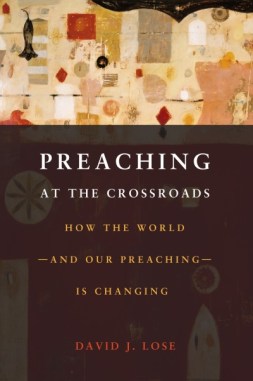
Preaching at CrossroadsDavid J. Lose, in his Preaching at the Crossroads (Fortress Press, 2013), helps preachers respond to three significant cultural trends: postmodernism, secularism, and pluralism. Postmodernism, according to Lose, asks an epistemological question: “How do we know for certain whether anything is true?” Competing metanarratives mean that the Christian story has become one among many.

A second related trend, secularism, is “marked first and foremost by a loss of transcendence.” Long says, “[I]f postmodernity challenges us to explore the possibility for claiming the Christian story is true, secularism demands to know how Christianity is relevant.” Faith is still important to people, to be sure, but it “no longer plays as meaningful a role as it did for our parents in helping us navigate our day-to-day lives in a secular world.”

Third, Lose addresses pluralism, noting that we are more than ever “faced with a plethora of religious and spiritual options,” many of which are just a click, tap, or scroll away from us. He notes one estimate that on a daily basis everyone is “subjected to more new information than a person in the Middle Ages was in his or her entire lifetime.” Even so-called digital natives “yearn for the sense of stability that tradition lends.” But when seeking wisdom or making decisions, “even those that are rife with ethical consequences, we are far more likely to consult our iPhone than the teaching of our denomination or even our pastor.”


*   *   *   *   *


Postmodernism, secularism, and pluralism are not problems to be fixed, per se. Or if they are, Lose focuses more on how the preacher can envision them as opportunities to reimagine preaching, rather than as challenges for which preachers need to seek a new panacea. Sure, preachers could reach for better use of multimedia or development of new homiletical techniques. But the cultural shifts in front of us, Lose argues, require more than just tinkering from the pulpit. They call for a paradigm shift:

The choice is before us. We are at a crossroads—one where not only the outcome is unclear, but also the primary challenge and perhaps even the alternatives. We can either continue adapting and refining established techniques or be willing to call into question our fundamental practices by leaning into and listening carefully to the world in front of us.

Lose is as engaging a writer as I imagine he must be a preacher. He sweeps the reader up in a compelling childhood narrative at the book’s beginning. He speaks as one who knows and loves the culture around him, but who is not afraid of it. He writes as one who loves preachers and is faithful to the Gospel, but is not afraid to freshly envision creative contextualizations. I can’t remember the last thing I read that got me this excited about preaching in the 21st century—even while the cultural challenges Lose presents were not lost on me.

Much of Lose’s analysis was sobering to me as a pastor. It’s not that I haven’t observed postmodernism, secularism, and pluralism having an effect on the congregation (myself included). And I knew that the days of pastor-as-assumed-authority were gone. But to read (again) that the pastor is no longer the assumed spiritual authority was an important reminder (even if I find this cultural trend short-sighted). Mileage varies, of course–how congregants view the pastor differs according perhaps to generations and a number of other factors. And we preachers do speak to the authority that is really found in the Word of God (and not in ourselves). But preachers, if Lose is right, will have to be ready to work from the pulpit to gain a hearing with a congregation listening to a million other voices and Tweets in a given week.


*   *   *   *   *


Preaching at the Crossroads is short (124 pages) but inspiring. It has already given me action steps and sermon illustrations that I’ve started in on—and this was true even before I had finished the book! He quotes from a W.H. Auden Christmas poem, which, it turns out, provided the perfect perspective for me to preach about resurrection on the Second Sunday of Easter. He recommends asking congregants this difficult but brilliant question (which I plan to do): “What biblical stories provide you with comfort or courage when you are struggling with a problem at home or work?” And he reminds preachers of our rightful place, and how we can pray: “Our job is to testify; it is up to God to make that testimony potent.”

The whole book is great, but chapter 4 (“Preaching the Grandeur of God in the Everyday”) was a real highlight and gift to me. He calls for preachers to help congregants connect their Sunday church-going worlds to their Monday morning work-going worlds. He wants preachers to go to parishioners’ workplaces and ask them things like “where they see God in this place.” But, he wisely offers, “be prepared to help with an answer, as we have not trained our people to look for God anywhere outside of church.”

Lose is convicting throughout his book, but never without also encouraging the preacher and giving her or him practical ways forward. Especially good is Lose’s focus on how preachers can equip the congregation for the work of ministry, where ministry is much more than just what happens on Sunday morning. He paints an inspiring picture:

Over time… your congregation may grow from being a place where the word is preached more fully into a community of the word where all the members take some responsibility for sharing the news of God’s ongoing work to love, bless, and save the world.

In the end, Lose draws on the Internet’s shift to “Web 2.0” (more interactive, socially networked, and user-focused) as a metaphor to envision the sermon as the locus of not passive but “active identity construction.” His closing suggestion is:

If we can imagine making a leap similar to that made by users and programmers who left the static world of Web 1.0 to inhabit the more dynamic and interactive world of Web 2.0, we might be able to offer the sermon as, indeed, a “transport mechanism, the ether through which interactivity [between God’s word and God’s people] happens.”

I don’t read many books twice, but I’ll be back for more of this one.

Find Preaching at the Crossroads on Amazon here, and check out the publisher’s product page here, which includes link to some .pdf samples.


Thanks to the book’s publicist for a review copy, sent to me so I could review it, but with no expectation as the the review’s content.

Honing in on Your CQ (Cultural Intelligence)

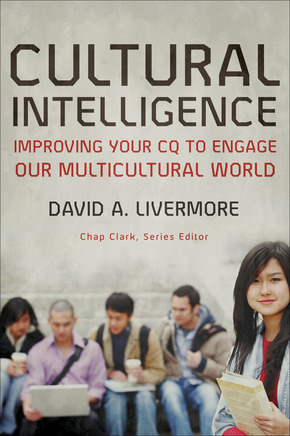
CQDavid Livermore’s goal in Cultural Intelligence is to effect cross-cultural transformation, rather than just impart information (12). Across the barriers of difference and “the barrage of cultures around us” (11), we still “have so much in common” (11). As we navigate the tensions of sameness and difference, Livermore notes, “These points of difference are where we find both our greatest challenges and our greatest discoveries” (11). Yet Livermore wants more than just cultural awareness. He says, “We must actually become more multicultural people so that we might better express love cross-culturally” (12).

Undergirding all levels of cultural intelligence is Livermore’s call to love, coupled with a robust theology of the Incarnation. I appreciated this theological and practical grounding. He writes, “The language of God is Jesus. The incarnation is the ultimate form of contextualization, the fullest embodiment of cultural intelligence” (33). As a result, Livermore warns those who think the Gospel can only be expressed in “one right way” (34). Jesus himself was a culturally situated figure, and yet a liminal one. The Gospels show Jesus’ interaction with 1st Century Palestine’s institutions and structures, where sometimes he embraced and other times he protested against the cultural values and practices of his day. Even if some readers will find his theological exposition familiar territory, it is nonetheless compelling.

CQ (cultural intelligence quotient) goes beyond educating ourselves about culture—even if it must start there. CQ “measures the ability to effectively reach across the chasm of cultural difference in ways that are loving and respectful” (13). An important step toward a fuller expression of love across lines of difference is growth in self-awareness. One must not only learn about other cultural mores and traditions, but one must know one’s own cultural heritage, and how that shapes one’s identity.

Livermore divides Cultural Intelligence into four basic types, which constitute the major sections of the book. First, there is Knowledge CQ, which pertains to a basic “level of understanding about culture and culture’s role in shaping behavior and social interactions” (48). This is CQ at the level of cognitive awareness. There are several important kinds of awareness: my awareness of my culture, my awareness of your culture, and my awareness of your perception of my culture (49). Livermore provides some practical metrics to help readers measure their Knowledge CQ: fluency in other languages, awareness of how other cultures resolve conflict, knowledge of cultural differences in how Christianity is expressed, lack of projecting our values onto others’ cultures, and so on (58, 61). Especially helpful is Livermore’s division of culture into three domains: socioethnic culture, organizational culture, and generational culture (93). His description of these domains addresses what would otherwise have been a concern of mine: that “culture” is not just a racial-ethnic phenomenon. I’ve worked at churches where the socioethnic culture and even generational culture were similar, but the organizational culture (“shared personality”) between the two was vastly different. Ministry methodologies and initiatives that worked in one church simply would not fly in the other.

Second, there is Interpretive CQ, which is metacognitive, since it relates to thinking about how one thinks. Interpretive CQ is essentially applied Knowledge CQ. If Knowledge CQ is basic exegesis, Interpretive CQ is hermeneutics. A key virtue here is that of empathy: “noticing what’s apparent about another person and trying to tune into her or his thoughts, emotions, and feelings” (158). Livermore connects Knowledge CQ and Interpretive CQ together into “cultural strategic thinking.”

Third, Livermore outlines Perseverance CQ, which is “our level of interest, drive, and motivation to adapt cross-culturally” (213). Anyone who has sought to form deliberate partnerships (or even just close friendships) across cultural lines is aware of the potential for discomfort, miscommunication, misunderstanding, and frustration, especially as intimacy builds. Perseverance CQ is the desire to push through these feelings for the sake of expressing love across the cultural gaps the author describes. Livermore offers an important set of questions and considerations:

What fuels our motivation? Why are we reaching into a new cultural context in the first place? We have to honestly face the motives behind our service, travel, and work. And we have to bear in mind that we are the Other to billions of other people. (225)

To push back, one may find oneself in cross-cultural relationships without deliberately engaging in service, travel, and work. They may exist “at home,” so to speak. Even so, the questions are worth asking. And the emphasis of othering the self that pops up throughout Cultural Intelligence is a needed (if difficult) perspective.

Finally, there is Behavioral CQ. This is the on-the-ground evidence that we love the Other. Livermore describes it as “the extent to which we appropriately change our verbal and nonverbal actions when we interact cross-culturally” (233). True CQ leads to action. We will not be able to “accomplish flawless cross-cultural behavior” (240), but we can become more faithful in “reflect[ing] Jesus to the Other through culturally intelligent communication” (241).

Cultural Intelligence concludes with a practical “What now?” chapter with “Twenty-four Ways to Advance Your CQ” (242). Then follows a CQ self-assessment, which is a brilliant inclusion. I first took the CQ self-assessment six years ago. I was surprised then to have tested so high (“excellent”) in the last two modes of CQ: Perseverance and Behavioral. Re-taking the test in 2016 I oddly dipped in Perseverance and Behavioral CQ, but went up in my “Cultural Strategic Thinking” (Knowledge and Interpretive CQ).

I wonder whether this is because my cross-cultural awareness has grown over the years, while my comfort with my own culture (and my being content with that comfort, to some degree) has led me to make cross-cultural stretching less of a priority. It’s not that I don’t interact with people from different cultures on a regular basis (whether socioethnic, organizational, or generational cultures); it’s just that given the choice I might default to monocultural settings, since they are “easier” (in some senses) to navigate. This is especially true when it comes to workplace and organizational culture. This may be sin I need to repent of—or just a reflection of my plate being over-full already, and the fact that my focus is strained until I graduate from seminary! I found the assessment to be somewhat limited, with its forced choices.

Readers will likely note at the beginning of Livermore’s book that the tasks the author sets out could be more difficult for “white” people who think of themselves as people who “have no ethnicity.” The outdated (but still present!) “Ethnic Foods” aisle is instructive here. “Ethnic” is understood all too often in opposition to “non-ethnic,” or “regular,” which then becomes culturally normative. The insidious danger is when this move happens subconsciously. Everyone has ethnicity, and all foods (and churches) are “ethnic.” The question is rather, “Of which ethnicity?” Livermore’s book reads, in some senses, as being geared toward such a person. However, even those who have done more extensive reflection on their own ethnic and cultural identity can benefit from his work.

Cultural Intelligence is an excellent primer for anyone seeking to enhance their cross-cultural fluency. Livermore is patient with the reader, but not overly so—he’s not afraid to challenge where needed. His truth-telling and practical step-by-step explanations combine to have a powerful impact. Anyone who gets lost in the various interdisciplinary concerns of the book will have a handy Glossary to refer to. Church leaders, Christians, and concerned citizens alike should carve out the time to not just read but also work through the concepts of the book—maybe even with someone with whom they have cultural differences.

You can find the book here at Amazon or here at the publisher’s page. Go here to read a .pdf sample.

Saddleback’s Leather Bible Cover: The One You’ve Been Waiting For (If It Fits)

Finding classy and well-made Bible covers is surprisingly difficult, even on Amazon. Christian Book Distributors fares a little better. But you still have to wade through some, uh, options.


But what if she wants the eagle cover?


NFL Bible Cover
One way to solve the long sermon vs. game-starting-at-1 rivalry


Like a roaring... leopard?
Like a roaring… leopard?


Plain canvas would be just fine. Full grain leather? Even better.


Front


That’s the Leather Bible Cover from Saddleback Leather Company. No, not that Saddleback. This one.

Saddleback’s cover comes in four color options: Tobacco, Dark Coffee Brown, Black, and Chestnut (pictured above).

Here are a few more images, to introduce you:


Back


Open Empty


The Bible slides right in:


Inside Left


Bible Open


That’s the UBS5 Greek New Testament, which, as you can see, is a little short for the cover, but otherwise is a great fit.

A closer look reveals consummate stitching:


Stitching Close-up


Back Right Close-up


The closure mechanism is easy to get used to, and even allows you to slide a pencil or pen inside:


Closure Close-up


The Chestnut color is deep and rich. The leather is sturdy! So much so when it first arrived that I didn’t believe it would soften over time, but it has. It lays flat with no issue, as a result. You just have to make sure you handle the Bible cover (and enclosed Bible) rather than build a shrine to it on your shelf-of-leather. (Uh, no, I don’t have one of those.)

It looks, feels, and smells delicious. No complaints at all on the appearance, construction, design, and feel of the thing. Top-notch.

Let’s talk about fit.

A dictum of reviewing is that you review a book (or piece of gear) on its own merits, in accordance with its aim. It would be unfair, for example, to lambast a print book for not being as keyword searchable as its electronic counterpart. Print never claims to give you search results with a single click. (Not YET.)

So, to be fair, the cover’s product page says:

Buy this cover AND THEN go buy a Bible to fit

And it gives you the dimensions of the (opened) cover: 12 ½” W x 9 ½” H.

However, I think it’s fair to ask: how many people buy a leather Bible cover before buying a Bible? Usually you realize that a certain Bible has become your mainstay: through 52-week sermon series on Romans (chapters 1 and 2), through holidays and family reunions, through major life events, through years of semi-failed reading plans… and then you go get a cover worthy of the Bible.

Saddleback currently offers just this size, so you’re limited in your options. This cover is nowhere near big enough to work for the kind of Bible many folks would want to put into a leather cover: a Study Bible.

However, user reviews indicate this beautiful cover is good for slimline Bibles (ESV, NIV, NKJV). And the product page is clear along these lines, so you just have to be sure you know what you’re getting.

The Greek New Testament above is the best fit I found among my Bibles. I was disappointed that my not-that-big Greek-English New Testament didn’t fit:


Bible too big
Bible too big


Before I laid eyes on the cover, I had dreams of my Septuagint fitting in, but…


No Fit_LXX
Nope


Even the portable paperback edition of N.T. Wright’s Kingdom translation didn’t go in:


No Fit_NTW


I got really excited that my since-discontinued TNIV Bible (which I’m pretty sure is “slimline”) would be the last Bible I’d put in the cover:


No Fit_TNIV1


But it was not to be:


No Fit_TNIV2


In fact, this was a real downside to the cover–this Bible and a small hardbound notebook both got bent in my efforts to wedge them in. I didn’t push too hard, but you really have to be sure your Bible is small enough for this thing to work. Again–the product page is clear here, but one might wish not to have so many misses in matching beloved Bible to beautiful cover.

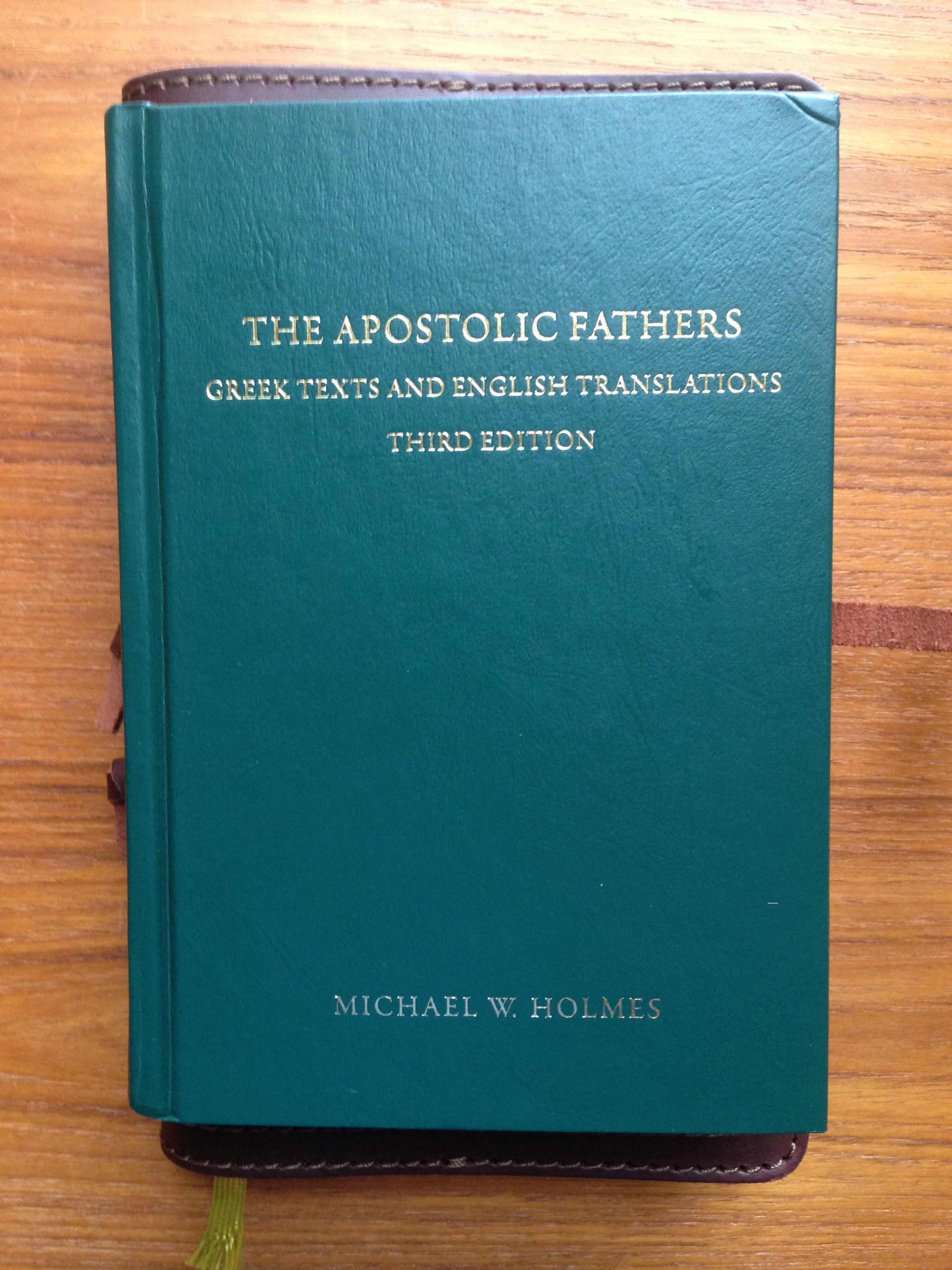
This Greek-English edition of the Apostolic Fathers is a nice fit:


Fit_Fathers


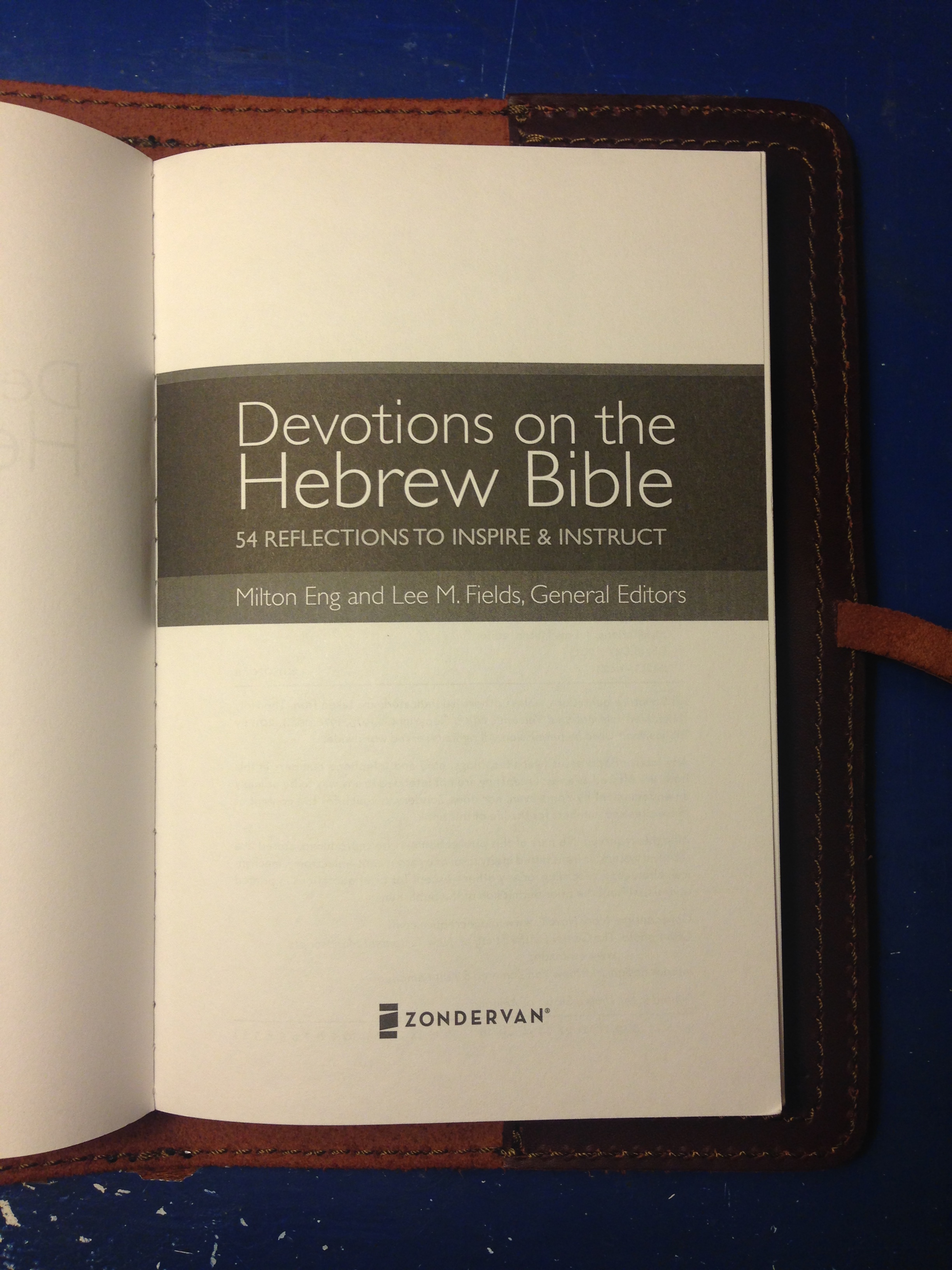
And don’t forget about books! That’s actually another good option, if maybe a little superfluous:


Fit_Devotions on HB


I wish I had more to contribute to what needs to be a running list somewhere on the Saddleback Website of “Bibles that fit this cover.” My Greek New Testament has a happy home now–and smells really good. I hope Saddleback will consider expanding its sizing options.

In the meantime, if the fit is right, it’s hard to imagine a nicer cover. Saddleback uses the best leather, and their workmanship is excellent. People who buy from them tend to buy more than one item over the course of a lifetime.

Saddleback’s site is here, with a ton of products that will make you want to “go leather or go home” (I hope I’m not giving anyone any Bible cover phrasing ideas). You can also check out my review of their pen/sunglasses case. The Leather Bible Cover (reasonable retail price of $49) is here.


Many thanks to the awesome people at Saddleback Leather for sending the Bible cover review! I’m really grateful they sent it, and I would have been embarrassed had anybody seen me rip into the UPS package the way I did when it arrived… though that did not influence the objectivity of the review.

Work as “Partnership with God”: The Gospel-Centered Life at Work

Gospel Centered Life at Work PG


The Gospel-Centered Life at Work is “about the spiritual dynamics of work and life and how God uses our work in the lifelong process of making us more like Christ.” Robert W. Alexander says, “This study is a tool to help you build a bridge from your personal faith to your work. It will help you see how Jesus’s work for you applies to the work you do every day” (1). Through a combination of biblical study, good theology, practical application, and hands-on exercises, Alexander’s book is capable of helping any Christian living out faith at work.

What is work? Alexander says, “Work from a biblical point of view is whatever activity a believer pursues in the sight of God, for the glory of God, to the benefit of others” (3). The “vocation or calling of those who live by faith” is that “even the simplest tasks we perform by faith become acts of worship reflecting God’s character and ways” (8). Work is, ultimately, “a partnership with God” (10).

Having lain the foundation of work as partnership with God, Alexander addresses God’s work as Creator, Provider, and Redeemer. We, too, as participants in this work, create, provide, and redeem (10). Alexander is at his best in offering specific examples of each of these kinds of work. A biochemist, for example, is a provider because she or he says, “I help in harvesting and/or restoring of natural resources” (11). The book’s first exercise inspiringly calls for the reader to “jot down how your work reflects aspects of God’s work” (12).

If “vocation” is an imposing word or concept, Alexander helps demystify it. “Work” for Christians moves from being “a daily grind” to the locus of God’s work and presence, that space where we live out our faith (14). Vocation is discipleship, in other words, and the workplace is one of a few “chief laboratories of the gospel” (65).

Our jobs (whether inside the home or outside it) turn a mirror on our hearts, motivations, and idols (lesson 2). We are flawed and so either pretend or perform at work, if we’re not careful (lesson 3). But in our partnership with God (Creator, Provider, and Redeemer), the Gospel calls us to several roles: image-bearers (lesson 4), imitators (lesson 5), bond-servants (lesson 6), stewards (lesson 7), ambassadors (lesson 8), and messengers (lesson 9).

Alexander offers guidance and asks questions to help the reader think through each of these roles, which build on each other. For example, of image-bearing he asks, “How can Jesus’s work and presence in your life affect your own fears, expectations, desires, and goals?” (41) With this in mind the worker is more confident in his or her identity as image-bearer of God.

Gospel Centered Life at Work LGBoth the Leader’s Guide (pictured and hyperlinked at left) and the Participant’s Guide (pictured and hyperlinked up top) have a “Big Idea” introducing the lesson. The Leader’s Guide adds a “Lesson Overview” for small groups (complete with times!) and “Bible Conversation,” a guided tour (with ready-made questions) through relevant biblical passages that ground the topic at hand. One would hardly need to do much more supplemental preparation to lead a group through the material.

A few minor points in the book gave me pause. Alexander speaks of “housewives” (in 2016!) without mentioning “househusbands,” or the “stay-at-home mom” without considering the stay-at-home dad. And he inadvertently uses the Greek word diakonos in describing stewards. (The intended Greek word is oikonomos, which has to do with managing the economy of a house.) There are also a few points that feel Christian jargon-heavy.

But the spiritual meatiness of the book, coupled with practical questions and exercises, far outweigh any drawbacks. To take just one more example, Alexander offers a two-columned assessment a Christian can make of his or her day, including both a “To-Do” list and a “Done-For” list, which focuses on “the ways God worked through others to serve you as his beloved child” (66). I found this reassuring and motivating.

The final lesson on Sabbath-keeping is the best one in the book, alone making it worth the price of purchase, or the time it takes to go get it at the library. While the book is well-suited for individual use, Alexander has done small groups and small group leaders a service in writing his articles, exercises, and study guide.


Thanks to the kind folks at New Growth Press for the review copies. Check out the book’s product pages here and here, or find them at Amazon here and here.


Review: UE Boom 2 Bluetooth Speaker

Ultimate Ears (owned by Logitech) makes a great-sounding, sleek-lookin’ Bluetooth speaker: the UE Boom 2, now in its second generation.


The Look


The cylindrical shape and design are very cool:


2_Standing Up Volume Buttons


The speaker is meant to be used standing up, but you can also lay it on its side without it rolling away:


3_On Side


The UE Boom 2 comes in a box that looks like one of those little bank deposit tubes from days gone by:


1_In the Box


Those volume buttons are HUGE, especially compared to the smaller power on/off and Bluetooth buttons. But it’s a good look. Besides that, you can control the sound just from the volume buttons on the side of your connected device. (Pressing both speaker buttons at the same time will have the speaker tell you what percentage of battery life remains.)


The Sound


The Boom 2 has great sound, even with flat EQ. The bass is nice and clear. At a price point of just under $200, you’d expect decent sound, and this speaker does not disappoint in that regard. I didn’t measure decibels, but it can fill a whole floor of a house with music, despite its being barely taller than seven inches. Podcasts and NPR both sound great on the Boom.

The battery lasts for ages (officially rated at 15 hours), and the speaker turns itself off after a period of inactivity–which you know because a cool, little drum riff sound indicates that the speaker is powering down. Nice touch!

One down side is that the speaker won’t play when the battery is depleted, even when it’s plugged in and first charging. I found this counter-intuitive and frustrating–in other words, if you use the battery long enough, you won’t be able to listen and charge at the same time, at least not right away.

It seems also to be a design flaw that the charger port is on the bottom of the speaker. The cord protrudes such that you have to flip the speaker upside-down to keep it upright when it’s charging. This doesn’t, from what I could tell, affect the sound, however. Once you do charge it, it’s back to full power in just a couple hours.


The Use


The UE Boom 2 is waterproof (not just water-resistant). UE claims it “can be immersed in water up to 1m for up to 30 minutes.” I was not about to try this, but I do regularly–with no worries–have the speaker playing on the window sill just above the kitchen sink, while I do dishes. You don’t want to shower with this thing, but you probably could and be okay! (Disclaimer: Words on the Word is in no way responsible if you try and it goes badly for you.)
 

Bluetooth

Initial pairing between speaker and Bluetooth-enabled device (phone, tablet, computer) is a breeze.


4_Connecting via Bluetooth


The tech specs for the Boom 2 say the mobile range (for maintaining the Bluetooth connection between speaker and device) is 100 feet. That was not even close to my experience–even on one floor of a house with no shut doors, at 50 feet I would occasionally notice the stream starting to cut out.

If you forget your phone is connected to the speakers and you walk out of range, there is an auto-stop feature so that you don’t lose your place in the album you’re listening too. I found this really handy.

The Bluetooth connection gets a little dicier if you’ve connected more than two devices to the speaker (i.e., ever). For the most part, though, the Bluetooth pairing process works well.


App

There is an accompanying UE Boom app–it’s simple, but it greatly enhances the user experience.

You can see a speaker battery life icon on your phone, right next to your phone battery percentage indicator.

And you can use the app to power off (and on!) the speaker. This wowed me. The app also has EQ settings you can adjust.


Battery life indicator, and other options via the app


You can use this bad boy as a speaker phone, though trying to use Siri or place phone calls in conjunction with the speaker is pretty frustrating, unless you happen to be right next to the speaker.

Perhaps the coolest feature is that you can “Double Up” to link two UE Boom speakers to each other via Bluetooth.


6_Double Up


This is beyond cool, and I set it up (with little effort required) the second I figured out you could do it–I listened in (loud) surround sound.


7_Boom 1 and 2


Where to Get It


The UE Boom 2 is maybe a little pricey, and it’s not without its downsides, but all in all you get your dollar’s worth. Especially impressive are the Boom’s high portability, accompanying app, general ease of use, and good sound quality.

You can find the UE Boom 2 at Amazon, or at the Ultimate Ears site.


Thanks to the good folks at UE/Logitech for sending me the Boom 2 (and, previously, Boom 1) for the purposes of the review. Their kindness in sending the samples did not, as you can probably tell, keep me from honest and objective assessment in my review.