BibleWorks in the pew? (Not quite, but the next best thing)

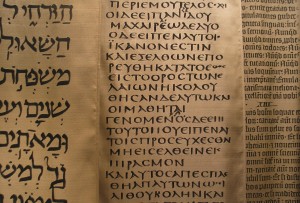
[GEEK ALERT] In an effort to integrate my learning of Biblical languages with church attendance and participation, I can be spotted at my church carrying this and this around. If I had an extra hand, I’d bring this, too. At first I feared it would look pretentious–it still may–but my motives are just to use my Greek and Hebrew in the context of corporate worship, while Scripture is being read aloud (in English, in my church’s case). So I follow along the Scripture readings, as best I can, in the original languages.

By Gerard Whyman (http://www.gerardwhyman.co.uk/)

To take it a step further, some time ago on the BibleWorks forums there was a user-initiated discussion about whether it is appropriate to have a laptop with BibleWorks open in the middle of a church service.

While I personally find the idea of a pew-sitter with a laptop tacky, I do understand the sentiment behind wanting to look at the Bible in the original languages while it’s being read and exposited in church. Hence my solution of having a print Bible with me. That’s not quite as out of place as a laptop would be.

So having my Greek and Hebrew Bibles with me is the next best thing to having BibleWorks open during church. However, there are two other next best things that do involve BibleWorks. First, there is a free user-created module that has the Revised Common Lectionary, linked to texts in BibleWorks. I rarely have time to use it on Sunday morning as we rush out the door, but I have at times been able to look ahead to the texts we’d be reading in church that week and use BibleWorks to work my way through them. The RCL module is really nifty. More about it here.

Today I found myself with the unexpected blessing of some time to play around with BibleWorks a bit. (I just received BibleWorks 9 in exchange for an unbiased review, which I will be offering in parts in coming weeks. Consider this a prologue of sorts.) Using the Report Generator, I was able to create a “Reader’s” version of Jeremiah 23:1-6, the Old Testament reading in church from the RCL this morning. Here’s the screen shot of how to get there, which also shows how I have my BibleWorks set up for Septuagint study. (Click on image for larger, or open it in a new tab.)

Once there, I set the Report Generator in the following way:

Then I clicked on “Build Report” and got a report with the text of Jeremiah 23:1-6 in Greek, followed by the listing of all words used in that passage, with frequency counts, followed by lexicon entries. After some manual organizing, I ended up with the below. Resources like this exist for the Hebrew Bible and the Greek New Testament (what I take to church with me), but there is not as of yet a “Reader’s” Septuagint.

Fellow language-lovers… what do you think? And do you take your languages with you to church? If so, how?

Jeremiah 23:1-6 (Rahlfs Septuagint)

–with footnoted vocabulary (glosses) for words that appear less than 200 times in entire Greek Bible (LXX+NT together). Glosses from here: print / BibleWorks module.

1 Ὦ[1] οἱ ποιμένες[2] οἱ διασκορπίζοντες[3] καὶ ἀπολλύοντες τὰ πρόβατα τῆς νομῆς[4] μου.
2 διὰ τοῦτο τάδε λέγει κύριος ἐπὶ τοὺς ποιμαίνοντας[5] τὸν λαόν μου Ὑμεῖς διεσκορπίσατε[6] τὰ πρόβατά μου καὶ ἐξώσατε[7] αὐτὰ καὶ οὐκ ἐπεσκέψασθε[8] αὐτά, ἰδοὺ ἐγὼ ἐκδικῶ[9] ἐφ’ ὑμᾶς κατὰ τὰ πονηρὰ ἐπιτηδεύματα[10] ὑμῶν·
3 καὶ ἐγὼ εἰσδέξομαι[11] τοὺς καταλοίπους[12] τοῦ λαοῦ μου ἀπὸ πάσης τῆς γῆς, οὗ ἐξῶσα[13] αὐτοὺς ἐκεῖ, καὶ καταστήσω αὐτοὺς εἰς τὴν νομὴν[14] αὐτῶν, καὶ αὐξηθήσονται[15] καὶ πληθυνθήσονται·
4 καὶ ἀναστήσω αὐτοῖς ποιμένας[16], οἳ ποιμανοῦσιν[17] αὐτούς, καὶ οὐ φοβηθήσονται ἔτι οὐδὲ πτοηθήσονται[18], λέγει κύριος.
5 Ἰδοὺ ἡμέραι ἔρχονται, λέγει κύριος, καὶ ἀναστήσω τῷ Δαυιδ ἀνατολὴν δικαίαν, καὶ βασιλεύσει βασιλεὺς καὶ συνήσει[19] καὶ ποιήσει κρίμα καὶ δικαιοσύνην ἐπὶ τῆς γῆς.
6 ἐν ταῖς ἡμέραις αὐτοῦ σωθήσεται Ιουδας, καὶ Ισραηλ κατασκηνώσει[20] πεποιθώς, καὶ τοῦτο τὸ ὄνομα αὐτοῦ, ὃ καλέσει αὐτὸν κύριος Ιωσεδεκ[21].


[1] ὦ (109) woe (to)
[2] ποιμήν (99) shepherd
[3] διασκορπίζω (64) scatter
[4] νομή (39) pasture
[5] ποιμαίνω (65) shepherd
[6] διασκορπίζω (64) scatter
[7] ἐξωθέω (31)  force out
[8] ἐπισκέπτομαι (181) visit
[9] ἐκδικέω (97) exact vengeance
[10] ἐπιτήδευμα (58) practice, way of living
[11] εἰσδέχομαι (20) gather
[12] κατάλοιπος (98) remnant
[13] ἐξωθέω (31)  force out
[14] νομή (39) pasture
[15] αὐξάνω (63) grow
[16] ποιμήν (99) shepherd
[17] ποιμαίνω (65) shepherd
[18] πτοέω (39) tremble
[19] συνίημι (144) have understanding
[20] κατασκηνόω (70) dwell, settle
[21] Ιωσεδεκ (18) proper noun (name)

Hipster Septuagintalist

The Septuagint has become cool–or at least a bit hip.

–Ben Wright in “The Septuagint and Its Modern Translators,” from Die Septuaginta—Texte, Kontexte, Lebenswelten

(quoted in Wolfgang Kraus’s excellent review of the New English Translation of the Septuagint)

I’m not sure that a Septuagintalist (yet another word you can use when you study the Septuagint!) is necessarily the best judge of what’s cool or hip… but I’m going to concur with Wright. As yet another LXX post on Words on the Word is attesting (Happy Septuagint Sunday!), the Translation of the Seventy is at least becoming very hip with me. Also, with this guy:

BibleWorks and the Septuagint

I recently blogged on why you need the Septuagint. And here are some great resources to begin and further pursue Septuagint study.

One indispensable resource for Septuagint study that I use almost daily is the computer program BibleWorks. I have not yet made the upgrade from version 8 to version 9, but much if not all of what I have to say here will still be applicable to users of version 9 (and 7, for that matter).

Here is what my BibleWorks looks like for 1 Maccabees (click or open in a new tab to view larger):

The following features help me navigate my way through the Septuagint:

  • A nice, big Browse Window (middle column in the top window) so that I can see the whole Greek verse easily at once, with English translations below. Both the LXA (Brenton’s Septuagint with Apocrypha, in English) and the NRS (NRSV, which includes the Apocrypha) are part of BibleWorks.
  • A stand-alone Word Analysis Window (bottom right of the screen) so I can better use my other columns. I set the default lexicon to LEH (Lust/Eynikel/Hauspie’s Greek-English Lexicon of the Septuagint, Revised Edition).
    Not only is this a fantastic Septuagint-specific lexicon; it also includes word frequency counts. What I particularly like about this is that I can use the Stats window (in the Analysis Window, the right column in the top window) to find out how many times a word appears in the whole Greek Bible (LXX+New Testament). Then using the LEH frequency counts, I can get a quick number on how many times a word is used in the LXX and the NT. This is helpful if I see an LXX word that occurs 200+ times, have never heard of it, and then see it only appears 10 times in the NT.
  • The Resource Summary Window (bottom left of the screen). Here I can access Conybeare’s Grammar of Septuagint Greek, which comes with BibleWorks and is hyperlinked both by part of speech and Scripture index. Another nice feature is that I can pull up BibleWorks paradigms quickly for a given part of speech–a helpful grammatical refresher! The IVP Dictionary of Jesus and the Gospels in that window is an add-on from WordSearch, but their IVP Dictionary package has a bunch of great Septuagint articles.
  • Note: There is no punctuation in the BibleWorks Septuagint text. This is not a display error; it’s just how it is. There are accents and breathing marks, though. And, the way I see it, even if Rahlfs in print has punctuation, the original manuscripts did not, so no huge loss.
  • I hesitate to write too much more about the Analysis window (right column in the top window), because BibleWorks 9 has significantly changed (=improved) the layout. In fact, there are now four columns, as seen here. However, for anyone using 8 or less, the above configuration allows you to work with the LXX profitably. For BibleWorks 9, I’m sure you could use the above layout as is (BW9 lets you use just three columns if you want, I believe) or make whatever modifications you wanted in BW9.

1 Maccabees has no existing Hebrew text. The scholars I’ve read on it all think that the Greek of 1 Maccabees has the flavor of translation Greek, and so translated a Hebrew original. But we don’t have it. (BibleWorks is powerful, but not quite that powerful!)

How I use the LXX when there is a corresponding Hebrew text (e.g., when I’m reading Micah) looks a little different. For example, in addition to the above, I’ll have the Hebrew text and English translation displayed. BibleWorks has the amazing Tov-Polak Parallel Hebrew/LXX Database, too, that comes with the base package.

BibleWorks allows me to read through the Septuagint in Greek with English translations displayed underneath. (I can also hide them–that’s what my “No Eng.” tab is in the left column of the top window.) It gives me instant word analysis (its parsing and then word definition and frequency count through LEH). I get grammatical helps from Conybeare and BibleWorks paradigms. I can search on a word to see how it’s used throughout the Septuagint and/or New Testament (note the highlighted word above). And with the IVP add-ons, I get historical background, too.

Using BibleWorks is a fabulous way to read through the Septuagint. I feel very blessed to have access to such a tool as this.

And I know there is much more BibleWorks can do. Fellow BibleWorks users and lovers of the Septuagint, how do you use BibleWorks for LXX success?

Septuagint Sunday is a regular feature of Words on the Word. All my LXX posts are here. The full contents of BibleWorks (now in version 9) are listed here. You can buy the program here or here.

All you need is your Septuagint and this (LXX+ALS=Septuagint Success)

I wrote a few days ago about why you need the Septuagint. I noted:

For students of Greek, the LXX is a good way to challenge oneself in Greek beyond the New Testament. There is a fuller and deeper vocabulary in the Septuagint that helps Greek students grow in their knowledge of the language.

While this is true, the challenging nature of Septuagint vocabulary is also one reason why even students of New Testament Greek stay away from the Septuagint. How can one make her or his way through the Septuagint in Greek in a way that is not entirely frustrating?

I’ve listed some helpful Septuagint resources here, including vocabulary helps. But what if someone just wants to read through the Septuagint in Greek, unencumbered by multiple resources at hand? One thing I value is not having to use four or five additional reference works to understand the first reference work.

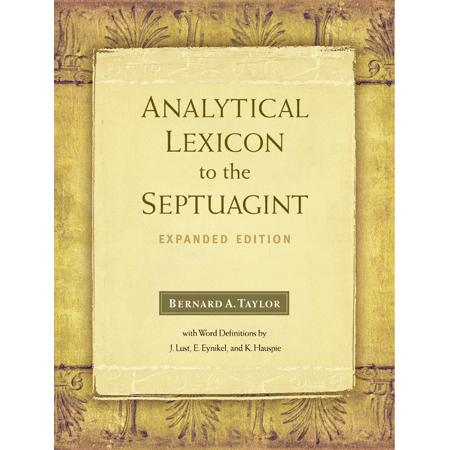
Enter Bernard A. Taylor’s Analytical Lexicon to the Septuagint: Expanded Edition (Hendrickson, 2009).

Taylor lists every single word found in Rahlfs Septuagint, the standard LXX text, as it appears (inflected) in the text. Each word then has full parsing information and the basic word meaning taken from Lust, Eynikel, and Hauspie’s Greek-English Lexicon of the Septuagint [GELS].

This means that the user of this expanded edition (ALS, hereafter) does not need an additional lexicon at hand to get basic word meanings. To be sure, Taylor notes:

The abridged GELS entries in this volume include only the basic word definitions, not the contextual meanings found in the subsequent paragraphs of many of that work’s entries. The word definitions included are glosses, or translation equivalents, rather than [full] descriptions of each word’s meaning.

If you’re looking to read the Septuagint and do word studies, you’ll need an additional resource. But if you need only the basic meaning (what most people want who are reading straight through), Taylor’s lexicon covers all your needs. (And he certainly doesn’t claim that the glosses in his ALS are anything more than that, glosses.) You get full parsing information, which then refers you to the lexical form of the word, which then has the basic word meaning from GELS. Especially helpful is the inclusion of proper nouns, so that there is really no word in the LXX that is left untouched by this lexicon.

ALS is intuitive, well-laid out, and easy to use. The Greek font is clear and big enough to read easily. The lexical forms of words (i.e., where the basic word definitions are) are in bold for easy reference. The book is not very heavy (two pounds), so it travels well. More than 20 pages of introductory material clearly and concisely explain the features of the lexicon, abbreviations, suggestions for use, and overview notes on various parts of speech, transliterations, and so on. The introductory materials are instructive and easy to read, yet ALS presents its information so well that its user can easily put it to work right away.

It’s tempting to debate the merits of a work like this in print, when all that Taylor offers (and more) can be had in electronic Bible programs like BibleWorks. However, to do that would not be to review this lexicon in its own right. Of course an electronic database (that can parse and provide lexical meanings of words) is faster to use, but a print copy is easier on the eyes, you don’t have to wait for it to boot up, etc. That’s all beside the point, though. The important thing about Taylor’s expanded edition is that it has morphological and lexical analysis, so it functions as an all-in-one supplement to guide the reader through the Greek of the Septuagint.

Analytical Lexicon to the Septuagint: Expanded Edition is now on my bookshelf right next to my Rahlfs Septuagint. It’s hard to imagine a more useful Septuagint resource than Taylor’s.

I thank Hendrickson Publishers for the review copy of this book, which was provided to me free of charge in exchange for an unbiased review. Taylor’s lexicon is available here.

Why you need the Septuagint

I recently had somebody ask me, in so many words, why the Septuagint?  Why bother with the Greek Septuagint when we have the Old Testament in Hebrew, in which it was first written? English translations of the Bible in most churches use the Hebrew text as a base, anyway.

Before giving my top 10 reasons why, here are a couple ways to access the Septuagint (often abbreviated LXX after the tradition of the 70(+2) who were said to have translated it). This site has the whole Septuagint in Greek with an English translation. And here‘s a good, up-to-date English translation of the whole thing. (For hard copies, the standard Greek text is the Rahlfs Septuagint, and a recent English translation is the NETS.)

Here are 10 good reasons to pay attention to the Septuagint:

10. It helps us read Scripture in new, fresh ways.

9. You get to use fun words like Septuagint, intertextuality, and urtext.

8. It’s the Bible the New Testament writers used and quoted. (See here for more about this.)

7. For students of Greek, the LXX is a good way to challenge oneself in Greek beyond the New Testament. There is a fuller and deeper vocabulary in the Septuagint that helps Greek students grow in their knowledge of the language.

6. The Septuagint was translated from a set of Hebrew texts that are centuries earlier than the Hebrew text underlying most English Old Testaments. This helps us get closer to the “original” text.

5. There are books that, while additional to the Protestant canon, still shed light on life. (I’m looking at you, Wisdom of Solomon!)

4. The Odes. This is a collection of texts appended to the end of the Psalms. It compiles some beautiful prayers found in the Old Testament (and apocryphal books). A few of these are in the Book of Common Prayer’s Morning Prayer canticles.

3. It connects us to the broad sweep of history in the Church. This was not only the Bible of the New Testament writers; it was the Bible of the Greek-speaking early church.

2. Books like 1 Maccabees, especially, fill out the intertestamental gap between Malachi and Matthew. I’ve been working my way through 1 Maccabees lately, and it’s really helping me better understand Jewish expectation of a conquering Messiah who would expel oppressive Roman rule.

1. Jesus used it. I’m intrigued by this, and want to explore it more. [UPDATE: This is a complex issue, especially since Jesus spoke Aramaic and knew and used the Hebrew Bible. I am reading this now.] But it does seem to me that his use of the Septuagint constitutes at least an implicit endorsement of it. If it was good enough for Jesus….
        [UPDATE 2: Perhaps it’s more accurate to say that the Gospel writers quote Jesus sometimes using a Septuagint text that differs from the Hebrew/proto-Masoretic Text. Many say this means only that the Gospel writers–not Jesus himself–used the Septuagint. Did Jesus himself not “use” the Septuagint, then? I will research this more and blog about it at a future date.]

Leaving it all on the field

I took a Septuagint test today. It was about Micah generally, the passage where Micah and Isaiah have basically the same text, the verse in Matthew that quotes Micah, and a verse in Joel that on first glance seems to say the opposite of a verse in Micah. I was asked to explain these things and do a bunch of translating.

This is how I felt before, during and after the test:

Yes, I’m a nerd, but the Septuagint really is awesome. I hope in future posts (perhaps on Septuagint Sundays) to share more about what I’ve been learning in my Septuagint directed study.

Magnificent Monograph Monday: The Later New Testament Writings and Scripture, Reviewed

Eisegesis. Not a label most evangelical Biblical interpreters want to wear. If exegesis is drawing the meaning out of a text–with a careful eye toward its original context and authorial intention–eisegesis is taking one’s own set of meanings and intentions into the text. Evangelical scholars aim to practice the former and avoid the latter, although of course everyone comes to any text with some presuppositions. (And new hermeneutics like reader response criticism may see this as a good thing anyway.)

My seminary teaches an exegetical method that majors on reading a text in its original context and understanding its original purpose. I’ve often thought that if New Testament writers submitted any of their works as exegesis papers, they’d fail because of the various “hermeneutical fallacies” they commit! It seems that New Testament writers freely appropriate or proof-text Old Testament passages for their own purposes, no matter the original context or intention of the passage at hand. They might even be accused of eisegesis, were they employing their methods today.

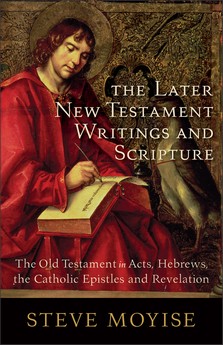
Baker Academic has just published the third volume of Steve Moyises’s de facto trilogy, in which he examines how Jesus, Paul, and the later New Testament writers use Scripture. He seeks to “give an account of” and “consider the use of Scripture” in the later NT writings. This is a “study” of “important engagements with Scripture.”

Just picking up the book before reading it was a pleasure–the layout is great, the paper quality is high, the font is clear and easy to read, and the cover design is appealing. Especially for a paperback, it’s an attractive volume to have on a bookshelf. (I note here that I received a free copy from Baker in exchange for an unbiased review.)

Moyise treats Acts, 1 Peter, Jude/2 Peter, James, Hebrews, Revelation, and includes a brief excursus on 1-3 John. He is thorough in the Scriptures he treats, which is especially aided by a UBS index in the back that serves as an index of all the quotations of the Old Testament in the above books. (There are full Scripture and author/subject indeces, too.)

The author groups the Scriptures thematically or by Old Testament book, rather than going verse by verse through each of the New Testament writings under consideration. In Acts, for example, he considers how the author Luke uses Old Testament Scripture to address themes like “Salvation for Jews and Gentiles,” “Christ’s death, resurrection, and exaltation,” “Judgement,” and so on. In 1 Peter Moyise has sections devoted to I Peter’s use of the Psalms, of Isaiah, etc. Moyise does this so as not to “miss the wood for the trees,” and he is successful. The reader, then, can conclude each portion of the book with a solid overview of how each NT writer uses the OT.

The text is accessible to a non-scholar or non-specialist in this field. For example, Moyise explains on p. 4:

[I]n some cases the New Testament authors appear to know a version of the text that differs from the majority of manuscripts that have come down to us. The discovery of the Dead Sea Scrolls (1948–) has shown that the biblical text existed in several forms in the first century and it is not always clear which form is being quoted.

He uses gray shaded boxes at various points to succinctly explain key concepts such as “typological interpretation” or to address things like 2 Peter’s use of the largely unknown 1 Enoch. The endnotes include more textual details and point the reader in the direction of the scholarly writings about each book. One does not need knowledge of the original language to read Moyise, but he does at times use transliteration of various Greek words if it helps his explanation.

The potential reader might be concerned that a book about intertextuality could end up as just a dry list of references. Moyise does thoroughly catalog the quoted OT passages, yet he draws conclusions from such use, as well:

Although James’s use of Scripture is not christological in a doctrinal sense, it bears comparison with Jesus’ own interpretation of the law, particularly his emphasis on seeing the law in the light of the twin commands to love God and neighbour. (63)

Moyise presents various interpretations in an even-handed, balanced way. I felt more than once like I was reading R.T. France, a favorite commentator of mine. He includes, too, the full text of many of the verses he cites, eliminating the need to flip back and forth through other reference works while reading this one. Jude and 2 Peter have a helpful table of comparisons where the two are lined up side-by-side, and this feature is present for other passages also.

There were a couple times where I thought Moyise might be guilty of the fallacy of post hoc ergo propter hoc (inferring causation just because one thing chronologically follows the other). In Revelation, for example (which he notes quotes no Scripture explicitly but is full of allusions), he speaks in terms of the “source” of (129, 137) or “inspiration behind” (130) John’s descriptions of his visions. My response to this was–just because John’s language has much in common with the Scriptures that came before him, do they therefore have to be his source? What if his source was, in fact, the vision he had, and he just used Scriptural language to express it?

Finally in the conclusion to his section on Revelation, Moyise addresses this very question. In fact, he is quite aware of questions like mine, and in the end treats it thoroughly and fairly, citing those who advocate a “scribal model” (where John is said to have basically just compiled Scriptures into a new presentation) and those who advocate a “rhetorical model” (where John uses OT language to express something new that he actually saw).

My question about whether or not NT writers are in some sense eisegetes is not an uncommon one. Students often ask: If we’re not supposed to handle Scripture that way, how can they? Though Moyise doesn’t necessarily set out to answer that question in this volume, he answers it beautifully:

The important point in all this is that the Scriptures did not exist in a vacuum. They were part of a living tradition where text and interpretation were transmitted together. (148)

In describing Revelation’s use of Daniel, for example, he says it is “not necessarily an ‘improper’ use of Scripture but hardly what Daniel had in mind” (140).

Moyise (87) quotes Susan E. Docherty from her book The Use of the Old Testament in Hebrews:

The author of Hebrews as much as any ancient Jewish exegete…regarded it as legitimate interpretation to seek out what scriptural texts imply as much as what they actually say, presumably believing that the new meaning he gave them was inherent in the original revelation, which he regarded as having endless depths of meaning and real contemporary relevance.

That Moyise’s trilogy of books on NT use of Scripture exists is a testament to the depth of Scripture. Moyise is a fantastic guide for exploring what can be confusing and difficult territory.

(Here’s the book at Amazon.)

Resources for Septuagint Study

Yet another reason to love Sunday: it’s Septuagint Sunday at Words on the Word. (Settle down.) Here are some resources I’ve found helpful for the study of the Septuagint:

Resources Relating to the LXX. From the Codex biblical studies blog by Tyler Williams. This is up-to-date and probably the best place to start working your way through what’s out there in Septuagint land right now. Williams lists available English translations, introductions, Greek editions, language tools, topical studies, and electronic resources for the study of the Septuagint. He includes brief and helpful descriptions of each resource he links to. The page looks to have been last updated in 2009, but it’s still pretty current.

Rod Decker’s LXX Resources page. Decker is behind the ever-helpful Koine Greek Reader, which includes grammar review, vocabulary lists, and graded readings in the Greek of the New Testament, the Septuagint, the Apostolic Fathers, and a few early church creeds. His resources page has some very helpful Septuagint vocabulary lists. This one (PDF) has all words occurring more than 100 times in the Septuagint. And this one (PDF) has words that occur more than 100 times in the Septuagint but less than 25 times in the New Testament. The second list is ideal for those who know their NT Greek, but want to branch out into the much larger vocabulary pool of the Septuagint.

Septuagint Online. By Joel Kalvesmaki. He gives a great historical overview of the Septuagint, including clarifying some terminology (see here). And here is his link to other Septuagint resources.

The International Organization for Septuagint and Cognate Studies (IOSCS)The IOSCS is “a nonprofit, learned society formed to promote international research in and study of the Septuagint and related texts.” Yes, I’m a member, as of this last week (honey, sorry you had to hear about it on the blog, but it was only $15). The IOSCS puts out an annual journal, has published some Septuagint monographs, and even has a book-by-book commentary series on the Septuagint in the works.

Albert Pietersma’s page. Pietersma co-edited the New English Translation of the Septuagint (NETS, all online for free here). His page contains, among many other useful resources, a couple of .pdfs on various Psalms, where he does a verse-by-verse commentary that examines both the Greek and the Hebrew. He prints the Greek and the Hebrew before commenting on it, too, so it’s a great way to increase one’s language skills. This allows one to see the kinds of issues that Septuagint translators were working on.

You may also wish to bookmark this link, which gathers all my posts that have a “Septuagint” tag (including this one, previous ones, and future ones I post).

Prophetic Whiplash…God of Mercy or God of Wrath?

Reading the Biblical prophets (like Micah) can give the reader emotional whiplash. The prophets often alternated abruptly between communicating God’s good news and bad. So which one is it: does God graciously forgive his people’s sins, or does he harbor his anger against them in judgment?

The prophets didn’t feel a need to necessarily resolve this tension; both are true in some measure. But in the end the witness of the Hebrew Bible–very much confirmed in the New Testament–is summed up in Exodus 20:5-6 (AKJV):

Do not worship any idol, and do not serve them, for I am Yahweh your God, a zealous God. For the sins of parents I hold accountable their children, to the third and fourth generations of those who hate me. But I show covenant loyalty to thousands of generations of those who love me and who keep my commandments.

Insofar as the tension between God’s mercy and God’s anger finds resolution, the Bible indicates that mercy is the overriding attribute of God.

Micah’s bifid structure, alternating as it does between woe and weal, seems to resolve at the end in favor of God’s mercy to his unfaithful people. This is Septuagint Sunday at Words on the Word, so a bit of Greek is in order. (You don’t have to know Greek to follow here.)

Micah 1:1 is the book’s superscription (=title page, essentially) where Micah identifies himself as a messenger of Yahweh, who has received his word to give to his people. The very first prophetic utterance, in the next verse (AKJV, from the Greek), is,

Hear these words, people, and let the earth and all that is in it pay attention. The Lord will serve as a witness (εἰς μαρτύριον) against you, the Lord from his holy dwelling place.

What follows in chapter 1 is fairly damning lawsuit language that calls God’s people into a courtroom setting for their transgressions of God’s covenant… where, of course, they have no defense. The woe-weal or wrath-mercy alternation continues through the rest of the book, until Micah concludes in 7:18-20 with a hymn of praise to God (AKJV again, from Greek):

Who is a God like you, who forgives injustices and overlooks the sins of the remnant of his inheritance?

He does not retain his anger as a witness (εἰς μαρτύριον), for he is one who delights in mercy. He will turn and have compassion on us. He will sink our injustices and hurl all our sins into the depths of the sea.

You will give truth to Jacob and mercy to Abraham, just as you swore to our ancestors from ancient days.

Of special note is how εἰς μαρτύριον (“as a witness”) serves as bookends for the book. In the first few verses, God himself is a witness against his people that they have committed sin against him. But in the final verses, he chooses not to call himself (specifically, his anger) to the stand as a witness (εἰς μαρτύριον) against his people. Rather, he overlooks (ὑπερβαίνων) their sins, sinking them into the depths of the sea.

Quite a different use of εἰς μαρτύριον to close out the book! In his last verses, Micah echoes the Exodus passage, that God forgives our wrongdoings and shows mercy, even with all he has to call as a witness against us.

God’s wrath is real, and our sins deserve it, yet in the end he has chosen to have mercy on his people.