New President for Princeton Seminary

Princeton Seminary has just announced a new President, Reverend Dr. M. Craig Barnes:

The Board of Trustees of Princeton Theological Seminary is pleased to announce the unanimous election of the Reverend Dr. M. Craig Barnes as its seventh president, and as professor of pastoral ministry.  Barnes, a 1981 Master of Divinity graduate of Princeton, has also served as a trustee of the Seminary. Dr. Barnes currently serves as the Robert Meneilly Professor of Pastoral Ministry and Leadership at Pittsburgh Theological Seminary and pastor of the 1,100-member Shadyside Presbyterian Church in Pittsburgh.

Here is the announcement in full.

“Worship that Welcomes”

Furthermore, what are we teaching our congregations about worship music? If it is always the same thing over and over again; isn’t this unfair to them? We say things like, “we are multi-generational,” “we are racially diverse,” “we are multi-ethnic.” We say, “we are global Christians” (of course what we probably mean is that we sent a mission team to the Caribbean this summer) and the list goes on and on. Yet, our setlists never change.

David M. Edwards raises some interesting questions (and explores answers) in his post, “Worship that Welcomes.” I don’t agree with everything here, but the issues he brings up are good ones for worship leaders to consider. The full article is here.

frameworks (How to Navigate the New Testament): a review

Why the book frameworks? Author Eric Larson says,

frameworks, quite simply, is a book about Bible navigation and context, material that’s designed to build your confidence in your ability to negotiate the text and understand it. Think of it as a guidebook, a Bible companion, written for anyone who would like to have a personal biblical tour guide. This book can be used for self-study, in small group discussions or in classrooms to set the context for Bible reading and to lead you through it.

The emphasis in the book is on presentation and memorability. Larson uses rich and beautiful imagery (and “lots of refreshing white space”) to create a book that has a good home on a coffee/display table. Yet he doesn’t neglect solid content around each biblical book, either.

The introduction is short and sweet and covers essential territory like who the writers were, literary divisions of the book, and an especially helpful 7-part “Navigating Jesus’ Ministry” section with simple maps and narrative highlights. After an introduction to the New Testament in general, each book of the New Testament has these 10 sections: introduction, theme, purpose, outline, verses to note in that book (the best part of frameworks, I thought), navigation (a page of things to look for when reading a book-well done), unique things about that book, recap, questions, and a verse to apply right now.

There is a sample pdf of the table of contents and introduction here.

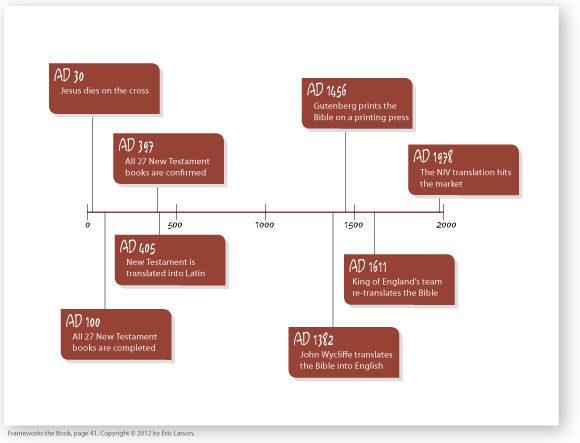
Charts, tables, photographs and other graphics are a strong point of this book. Some are as simple as this historical timeline, which is visually appealing:
Or take this visual outline of the book of Luke, from p. 92 of the book (and posted on the author’s blog):

(The spelling error in ascension is corrected in the book.)

This book will answer many questions people had about the New Testament but were afraid to ask–one of its intended purposes. For example, in Larson’s introduction to the Gospels (“Biographies of Christ”), he writes about the “four living creatures” that many have understood to represent the Gospels. (Lion, Ox, Man, Eagle.)

I’ve always seen Mark associated with the lion, but Larson has the lion with Matthew, the ox with Mark, the man with Luke, and the eagle with John. He notes that this is the order of the four living creatures in Revelation 4:6-7. But the order as it appears in Ezekiel 1:1-14 is what I’ve seen more typically, where it’s human, lion, ox, and eagle. I understand that Christian tradition varies here a bit.

This is not a huge deal, but it is indicative of a larger trend in the book–nuance seems to be prioritized at times less highly then presentation. Larson’s laudable goal is to engage “anyone who would like to have a personal biblical tour guide.” It’s about “navigation and context,” but readers will still want to look elsewhere for greater detail and clarification on some matters.

As far as a New Testament framework goes, Larson’s 4-1-9-4-8-1 scheme did not immediately strike me as easily memorable. He divides the NT this way:

  • 4 biographies of Christ
  • 1 history book (Acts)
  • 9 letters of Paul to the churches
  • 4 letters of Paul to people
  • 8 general letters
  • 1 book of prophecy (Revelation)

This is less memorable than the 4-1-21-1! chant I’ve used with young people. (See the pdf of it here, from Center for Youth Studies.) Larson’s 4-1-9-4-8-1 does have the advantage of dividing up the 21 letters/epistles into their types/authors, but as much as I wanted to latch on to 4-1-9-4-8-1, I never quite did. This is not too say it’s a bad thing to use; it is to say a reader might not pick it up as easily as some other NT “frameworks.”

One other critique I offer is that, although I appreciate the approach of using visual imagery and stories and examples rooted in culture to try to connect the ancient text to today, sometimes the connections feel a bit stretched. For example, the photograph accompanying the “history” title page (for the book of Acts) is an unfinished attic with a sawhorse in it and a window with light coming through. It’s a beautiful image. But what’s it trying to evoke? The upper room? The light as the Holy Spirit? Okay, but why the sawhorse? Other such images left me curious as to why they were selected, or how they were meant to visually reinforce the author’s text.

Similarly, while the story about Anne Sullivan and Helen Keller to begin the book of James is itself inspirational, its application to James and his audience sure felt reach-y. That James’s “self-indulged spiritual children” were “behaving badly and desperately need a spanking” is an odd way, indeed, to describe things! James would have never “spanked” his listeners. I know the author doesn’t mean that literally, but that image was distracting. I often found myself reacting this way in the introductions to each of the books.

Everything after a book’s introduction is generally solid–and creative. In Mark, for example, Larson has a selection of verses from that Gospel that he has the reader “read…without stopping to take a breath.” He puts in bold words like “at once,” “quickly,” and “immediately” (a favorite of Mark’s). Then he concludes, “If you feel out of breath, congratulations. Mark has succeeded in brining you into his fast moving narrative.” I thought this was a great way to draw the reader into the fast-paced action movie that Mark often feels like.

I like the approach to this New Testament introduction; it’s creative and will reach a larger audience then some less visually-oriented books on the same subject. The short descriptions of each book are generally solid, but the occasional lack of nuance and informal tone distracted me at times as I worked my way through the book. (In other words, as with any book, this one should be read critically.)

Yet I do think Larson’s efforts will guide the reader into deeper engagement with the biblical text. His emphasis on what to look for in a book, pulling out and quoting specific verses, and his constant admonition to “Read It!” are refreshing. He even gives an estimate for how long it takes to read through a book at a casual pace, which is an enormous aid to anyone who will commit to sitting down and doing reading through God’s Word.

I received a free copy of frameworks for review purposes. Thank you to the author and publicist for the chance to review it.

A wife for Jesus?

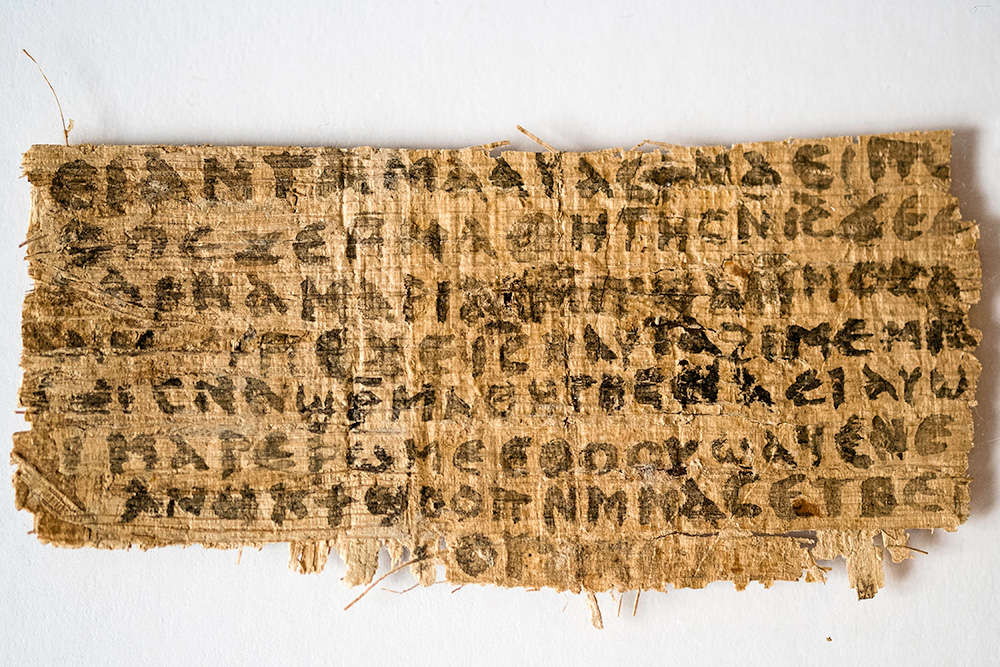
Front of papyrus fragment, Karen L. King, 2012

Did Jesus have a wife? Does it matter?

In the last two days I’ve seen about 50 Facebook status updates from friends and groups I follow, each with their own take on the “Gospel of Jesus’s Wife” papyrus that Harvard Professor Karen L. King recently announced. (Nerdy grammatical excursus: King has titled the papyrus with Jesus’s, but I follow Strunk and White and prefer Jesus’.)

The Harvard Divinity School press release is here. It begins,

Four words on a previously unknown papyrus fragment provide the first evidence that some early Christians believed Jesus had been married, Harvard Professor Karen King told the 10th International Congress of Coptic Studies today.

The papyrus has been dated to the 4th century and is written in Coptic, the alphabet of which has overlap with the Greek alphabet. King has postulated, in fact, that the Coptic in this little fragment may have translated a Greek original.

The key quote from the papyrus is translated, “Jesus said to them, ‘My wife….'” It then gets cut off. Go here for a full translation, as well as helpful Q&A with Professor King.

It seems to me there are two primary questions on folks’ minds right now. First, is this thing real or a fake? Second, did Jesus have a wife, or could he have?

In pursuit of these questions, I spoke with two Professors of Biblical Studies at Gordon College, a top Christian liberal arts school, located just north of Boston. Was Jesus married?

“Is there anything in the Gospels that would give us a hint he was married? I don’t think so,” noted Professor Marvin R. Wilson. “If he was married, how come he says to his beloved disciple at the cross, ‘Take my mother,’ not ‘Take my wife’?”

The significant woman in Jesus’ life, for whom he is looking out in his final hours, is his mother Mary, not a wife.

All the same, Wilson said, “It’s a good question. One who had no marriage would certainly have been the exception. We have an exception in Jeremiah, but that was a divinely commanded celibacy.”

Wilson noted, however, that the assertion that Jesus had a wife is still an argument from silence. “Certainly he had a wonderful ministry with women. We know the 4th century was a time of theological clarification (Council of Nicea) as well as turbulence. This Coptic text may have represented a small sect of aberrant Christians that had broken away from the larger–yet still emerging–traditional community.”

Is there much at stake in the question of whether or not Jesus had a wife?

“Certainly I don’t think any key issues of the Christian faith are at stake here. If Jesus had a self-imposed celibacy because of the work he was called to accomplish, that would make him unusual, but not unique.”

Professor Steven Hunt noted, “There’s so much we don’t know about it yet. It’s apparently a very small fragment.”

Regarding the authenticity of the papyrus, he added, “I’m perfectly willing to go with [Professor King] and say that it’s an authentic fragment of some document that’s now lost, but it’s probably speaking more to the nature of debates in the 3rd and 4th century about sex and marriage… it’s almost certainly not giving us accurate information about the historical Jesus.”

More interesting than the fragment itself, Hunt noted, is the question, “Would Christians be troubled to find out Jesus was married? The fact that many would, may really be quite suggestive, especially if their reaction was rooted in a negative attitude toward bodily existence in general and sexuality in particular.

“So, while there’s no good historical evidence that he was [married], from my perspective,” Hunt said, “it’s not really theologically problematic to suggest that he could have been. Since the Bible affirms the essential goodness of marriage and sexuality, what would be the problem with that?”

And God planted a garden…

[R]econciliation has too often been discussed in Christian circles as if it took place in a vacuum, as if only people and not trees, rivers, mountains and farms are swept up in God’s redemptive drama. Our aim, then, is to point our attention back to the land, to say what a faithful life on it might look like, and to show that the land–indeed, the entire cosmos–is inextricably bound up in God’s salvation through Jesus Christ (see Col 1:20).

–Fred Bahnson & Norman Wirzba in Making Peace with the Land

The newest offering from IVP Books’ Resources for Reconciliation series is Making Peace with the Land: God’s Call to Reconcile with CreationThe Resources for Reconciliation series pairs a practitioner with an academician, who then together address the theology and practice of reconciliation in a given sphere of life. The first book in the series, Reconciling All Things, profoundly influenced my development of a Biblical theology of justice and reconciliation.

Practitioner Fred Bahnson is an agriculturalist and writer (and excellent theologian); academician Norman Wirzba is a theology professor at Duke Divinity School (and grounded practitioner). Making Peace with the Land makes the Biblical case that “redemption is cosmic,” and so extends to the whole created order, not just humanity. God wants all creatures (“human and nonhuman”) to be “reconciled with each other and with God.” In other words, our Biblical theology of reconciliation is anemic if it does not extend to a loving stewardship of the whole of God’s creation. The authors warn against “ecological amnesia.”

Our “ecological amnesia” is at its core a theological issue. God is God of the soil, a gardener who loves the soil and brings forth life through it (as noted in Genesis). But we have worked against the land in developing systems and structures for farming that draw heavily on “our own agricultural scheme” and “monocultures of annual crops.” Instead we need to “look to nature as a model for how to practice agriculture,” engaging in what Bahnson calls regenerative agriculture, founded on the truth that “the ecosystems in which we find ourselves–created by God and deemed ‘very good’–are far more adept at growing things than we are.” The profile in chapter 6 of the work of ECHO (Educational Concerns for Hunger Organization) both astounded and inspired me. (Check out ECHO here.)

Bahnson and Wirzba are compelling: “Surely it is a contradiction to profess belief in the Creator while showing disregard or disdain for the works of the Creator’s hands.” After reading a lengthy description of how Chicken McNuggets are made, I was about ready to become a vegetarian. Regardless of how the phrase “animal rights” makes you feel, animal torture is not possibly justifiable by those who have been called to co-steward the creation with God.

At times I desired more exegetical nuance when the authors dealt with Scripture. For example, though the prologue is convincing enough that we ought to view God as gardener, to accept that God’s gardening work is “the most fundamental and indispensable expression of the divine love that creates, sustains, and reconciles the world” is difficult for me to… well… reconcile with the expression of divine love on the cross. In the end, it’s all of the above. That said, Bahnson’s note on the acacia tree in Isaiah 41:18-19 as a nitrogen-fixing tree and thus “divine agroforestry advice” was awesome. And the authors do affirm elsewhere that reconciliation begins with the person and work of Jesus–it is in Jesus that all things hold together, as they point out from Colossians 1.

Many of us practice “a sort of gnostic disdain for manual labor, soil husbandry, caring for physical places and living within our ecological limits.” If I make enough money to simply buy food, I don’t need to get close to that food except to pick it up at the store (or restaurant!). Then I eat it and keep going with my work, however disconnected I may be from the source of that food. However,

Reconciliation with the land means learning to see the land as part of God’s redemptive plan and acknowledge God’s ongoing presence there. That will require putting ourselves in proximity to the land and staying there long enough to be changed.

After reading this book, I’m unsettled. I’m a lot farther from “the land” than I perhaps should be. I’m not sure what to do with that. And my theology of reconciliation has often not been robust enough. But I’ve been thinking more about my food, its sources, and my connection to God’s land now that I’ve read Making Peace with the Land. I’m not suggesting that we engage carbon offsets as a solution. (Slight detour: does this not look eerily like indulgences?)

But if I’m unsettled, I’m also inspired. What if I allowed my having been reconciled with Christ to inform a ministry of reconciliation not limited to other people? What if we followed Wirzba’s advice to allow our weekly “Eucharistic eating” to “not only transform the eating we do with people,” but to also transform “the entire act of eating, which means [changing] the way we go about growing, harvesting, processing, distributing, preparing and then sharing the food we daily eat”?

That would be an abundant life.

Thank you to IVP for the free review copy, in exchange for an unbiased review, and–as it turns out–a re-examined life. Find more about Making Peace with the Land here (IVP) or here (Amazon). Highly recommended.

Prayer in the liturgy: Is it worth it?

Today’s post comes from Timothy Dean Roth, author of The Week That Changed the World: The Complete Easter Story (amzn). There are few people whose words inspire, challenge, and fill me with a sense of God’s presence more than Tim’s. His book has been an excellent aid to my experience of Holy Week these last two years. He’s given me some of my best sermon ideas. Etc., etc. He’s a great dialogue partner and friend. As Words on the Word addresses themes of worship and liturgy on Wednesdays, Tim asks today: “Prayer in the liturgy: Is it worth it?”

If you go to a Church that has a time when a lector reads prayers and the congregation responds after each one-sentence prayer, “Lord, hear our prayer,” you may wonder sometimes whether the Lord really does hear our prayer, especially if you were spacing out and can’t even remember what the prayer was. The answer is that God does indeed hear these prayers, and he responds to them.

Here’s why. These prayers are themselves written by liturgists in a spirit of prayer in response to the needs of the times we live in. The Holy Spirit himself prompts liturgists who are attuned to his voice to write down these prayers. I have never heard a prayer read to the congregation that could be considered outside God’s will (and hopefully you haven’t either), and we know that God favorably answers prayers that are in accordance with his will. We also know that God the Father answers the prayers of the righteous, just like he answered the prayers of his own Son, though only if prayed in a spirit of steadfast faith and without doubt, which is the hard part.

Fortunately for those of us with weak faith, there are some crazy people out there who do believe that when we pray outlandish things like, “That you may increase peace in the Middle East” or, “That you may help all politicians recognize the value of life,” these things are actually going to happen. God hears these people, even if we can’t quite figure out how. What if a suicide bomber changes his mind the day before blowing up a mosque because enough people like the one right next to you sincerely said, “Lord, hear our prayer”? We can’t know how these prayers are answered, but they are. God’s word promises us that. Every little prayer counts, every little prayer brings a little more good into the world and a little less evil, and even the tiniest difference in the chaotic, unpredictable daily stock market fluctuations of good versus evil is worth the effort.

God is going to answer these prayers with or without your participation, so why not participate, why not fully abandon yourself to these prayers? Through these prayers, he’s inviting every one of us, from greatest to least, to join the battle, to actively participate in his work of transforming this world.