I’m Speaking at Open Boston in February on Student Worship Leaders

open ymIn a couple of weeks I’ll be one of a group of speakers at a youth ministry event called Open Boston. It’s February 2 and takes place at Gordon College.

From Open’s What to Expect page:

The content of sessions is firmly focused on ideas, concepts, and best practices for developing a youth ministry for your context. Expect presentations that cover issues around working with high school students, middle school students, and every combination of adolescents in your community.

The general idea behind Open is that we believe that the best ideas in youth ministry are “out there” being tried–right now–by youth workers just like you. But most other events don’t give those voices an opportunity to share what they’re learning.

Open is exactly the opposite. We exist to celebrate innovation, discover new ministry ideas, and hopefully inspire the collective us, the tribe of youth ministry, to dream about reaching students in new ways.

The session I’m leading is called “Raising Up Shouts of Praise: Developing Student Worship Leaders.” Here’s the writeup:

Worship through song is key to a community’s sense of connection to God and each other. God deserves our praise, and God delights in the praise of his people. What role can and should your young people have in leading worship? How can you recruit youth to lead worship, and train them to do it faithfully and effectively?

In “Raising Up Shouts of Praise,” Abram Kielsmeier-Jones will share some lessons he’s learned in developing student worship leaders: from big picture methodology concerns (like how to select a team; Biblical principles in which to train them) to nuts and bolts (like how to coach worship leaders in what to say between songs, how to help them find and teach new music). Abram especially looks forward to hearing others’ lessons learned that he might take back with him to his own worship leading context.

I’m really looking forward to being a part of this, both as speaker and attendee. Click here to read more about The Youth Cartel (not an actual cartel), who is helping to organize the event. Open Seattle happened in October; Open Paris is coming up in the spring. You can go to the Open Boston site to find out more.

How shall we sing hymns?

John WesleyJohn Wesley (1703-1791) was an Anglican minister and theologian. His ministry (and that of his brother Charles Wesley) led to the creation of the Methodist Church, as well as other traditions that have their roots in Wesley: the Wesleyan holiness movement, Pentecostalism, and the Charismatic movement.

Wesley issued seven “Rules for Singing” in 1761. Here are some excerpts:

Sing all. See that you join with the congregation as frequently as you can. …If it is a cross to you, take it up and you will find a blessing.

Sing…with a good courage. Beware of singing as if you were half dead, or half asleep; but lift up your voice with strength…. (AKJ: This is particular pertinent for those services that take place in the morning hours.)

Sing in time. Whatever time is sung, be sure to keep with it. Do not run before, not stay behind it; but attend closely to the leading voices, and move therewith as exactly as you can;

And take care you sing not too slow. This drawling way naturally steals on all who are lazy; and it is high time to drive it out from among us, and sing all our tunes just as quick as we did at first.

WesleyHymn tempo can be largely a subjective decision–some like it fast, some like it slow. But might singing “all our tunes just as quick” encourage more hearty singing? It seems Wesley thought so.

Regarding the call to “attend closely to the leading voices,” I find it particularly helpful when worshiping congregations have vocal leaders for hymns, especially if members of the congregation are not familiar with a given hymn. This may sound self-evident, but the majority of my hymn-singing experience has been in churches where the organist leads the hymn just from the organ. This works fine in a congregation that knows hymns and sings them well, but I’m not convinced it’s always the  best approach to leading congregational hymns in worship.

Here’s my favorite part of Wesley’s rules:

Above all, sing spiritually. Have an eye to God in every word you sing. …[S]ee that your heart is not carried away with the sound, but offered to God continually.

I don’t think having “your heart… carried away with the sound” is mutually exclusive with offering it “to God continually,” but I love Wesley’s call to “have an eye to God in every word you sing.” We sing hymns best when we make them prayers to God, affirmations of our faith, even heartfelt confessions.

The rules in their entirety are here.

Advent Wreath! Advent Wreath! Advent Wreath!

advent wreath

“Advent Wreath! Advent Wreath! Advent Wreath!”

This is the mantra my 2-year-old son repeats as soon as bedtime routines begin–and sometimes before that.

Each night since the beginning of Advent, our family has observed Advent together by praying, reading a Bible passage, lighting a candle, and singing a verse and the chorus of “O Come, O Come, Emmanuel.” There is perhaps nothing more heart-warming than hearing our two young boys sincerely belt out, “REJOICE! REJOICE!” each night around the Advent wreath. This will be a family tradition for years to come.

We made the wreath together as a family at our church before Advent. We use it to mark the time as we eagerly anticipate the celebration on Christmas of Christ’s first coming to earth, even as we await and long for his second coming. The waiting and yearning themes of Advent have been particularly appropriate given that we have yet again recently seen the evil we humans are capable of.

For those of you who plan worship services, or like to think deeply about them, the Calvin Institute of Christian Worship has a helpful Advent and Christmas Resource Guide. A reflection from that site says:

In Advent we hear the prophecies of the Messiah’s coming as addressed to us—people who wait for the second coming. In Advent we heighten our anticipation for the ultimate fulfillment of all Old Testament promises, when the wolf will lie down with the lamb, death will be swallowed up, and every tear will be wiped away.

There is something for me to learn from my two-year-old’s persistence as we gather each night. The anticipation with which he comes to our time of prayer (often clapping his hands) is what I want to offer God in this time of waiting.

Jesus weeps, we weep

Shannon Hicks/Newtown Bee, via Associated Press

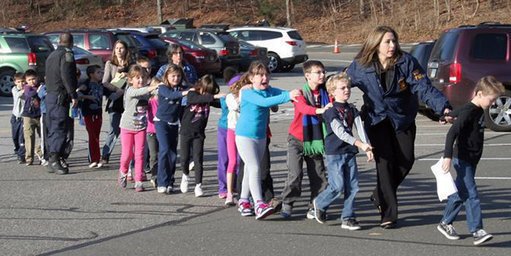
Jesus wept, and he weeps again today, with the horrible news of another school shooting in Newton, CT. From the New York Times:

A gunman killed 26 people, 20 of them children between the ages of 5 and 10, in a shooting on Friday morning at an elementary school in Newtown, Conn., about 65 miles northeast of New York City, the authorities said.

The gunman, who was believed to be in his 20s, walked into a classroom at Sandy Hook Elementary School where his mother was a teacher. He shot and killed her and then shot 20 students, most in the same classroom. He also shot five other adults, and then killed himself inside the school.

This evil deed is so heinous that even naming and describing it feels bad. May God have mercy on the souls of those poor children, and the grieving families they leave behind.

Christians have a rich Biblical tradition of lament that we can employ in times like this. This summer after the Colorado shooting, I posted this prayer, which was an aid to me in processing the grief, anger, and bewilderment I felt after hearing such awful news.

Prayer of Lament

O God, you are our help and strength,
our refuge in the time of trouble.
In you our ancestors trusted;
They trusted and you delivered them.
When we do not know how to pray as we ought,
your very Spirit intercedes for us
with sighs too deep for words.
We plead for the intercession now, Gracious One.

For desolation and destruction are in our streets,
and terror dances before us.
Our hearts faint; our knees tremble;
our bodies quake; all faces grow pale.
Our eyes are spent from weeping
and our stomachs churn.

How long, O Lord, how long
must we endure this devastation?
How long will destruction lay waste at noonday?
Why does violence flourish
while peace is taken prisoner?
Rouse yourself! Do not cast us off in times of trouble.
Come to our help;
redeem us for the sake of your steadfast love.

For you are a gracious God
abounding in steadfast love and faithfulness.

By the power of the cross,
through which you redeemed the world,
bring to an end hostility
and establish justice in the gate.
For you will gather together your people into that place
where mourning and crying and pain
will be no more,
and tears will be wiped from every eye.
Hasten the day, O God for our salvation.
Accomplish it quickly! Amen.

**From Let the Whole Church Say Amen! A Guide for Those Who Pray in Public, by Laurence Hull Stookey, pp 94-95 (Copyright 2001 by Abingdon Press). Reproduced by permission. Formatted print-friendly pdf of prayer here.

The Scriptures that the above prayer draws on are: Psalm 124:8, Psalm 37:39, Psalm 22:4, Romans 8:26, Isaiah 59:7, Job 41:22, Nahum 2:10, Lamentations 2:11, Isaiah 6:11, Psalm 91:6, Psalm 44:23, Psalm 44:26, Exodus 34:6, 1 Corinthians 1:17, Ephesians 2:14, Amos 5:15, Revelation 21:4, Isaiah 60:22.

Day of Prayer

Here’s part of a writeup I did on our Day of Prayer that took place last week:

In the evening we worshiped again as one in the chapel with a congregational expression of the Psalms through song. From a lone voice in the darkness expressing the cries of the Psalmist in Psalm 130, to voices in unison reading the Psalms of Ascent; from hymns to contemporary music to bluegrass; from a Taizé chorus to Gospel music led by the Gospel Choir, we raised our voices in prayer and praise together, using the words of the Psalms.

The whole post is here, at Notes Along the Way, the blog of Gordon College.

Rocks cry out on the Day of Prayer

What a great way spend a day this Tuesday! We had our annual Day of Prayer at Gordon College. (Here is the schedule of events for the day.)

As I wrote before, I’m struck by how the Day of Prayer is a microcosm of an important aspect the school’s life together: we are one and we are many. There are more than 40 denominations and Christian traditions represented at Gordon. On the Day of Prayer we prayed as one body—lived out in the morning and evening services in the chapel—and we prayed in diverse ways (for example, in the Orthodox tradition, through hymns, in the Catholic tradition, by reading Psalms together around a fire pit, in the dark, with artistic expressions, through dancers leading worship, a Gospel Choir, and more).

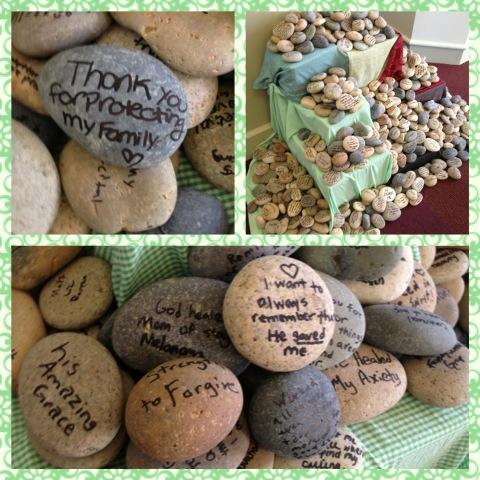
The picture above (via a Gordon student) is of a rock cairn that the students added to throughout the day. Students, faculty, and staff wrote prayers of gratitude and thanksgiving on a rock, which they then placed next to the entrance of the chapel. Watching the rocks pile up throughout the day, as praises going up to God, was a highlight for me. These rocks cry out!

See student response to Day of Prayer (with pictures) via the Twitter hashtag #GCDayofPrayer.

SEEK: Day of Prayer

Tomorrow (Tuesday) at Gordon College is the Day of Prayer. Here is the schedule for the day. We’ve been working hard in preparation for this day, and I’m excited now that it’s here at last.

Day of Prayer at Gordon is a dedicated day–no classes or regularly scheduled events–where we remind ourselves of who we are in Christ: a body of believers that can join together in prayer to give God praise and request his continued provision in our lives and in the world.

I’m struck by how the Day of Prayer is a microcosm of an important aspect the school’s life together: we are one and we are many. There are more than 40 denominations and Christian traditions represented at Gordon. On the Day of Prayer we pray as one body—lived out in the morning and evening services in the chapel—and we pray in diverse ways (for example, in the Orthodox tradition, through hymns, in the Catholic tradition, by reading Psalms together around a fire pit, in the dark, with artistic expressions, and so on).

Philosophers talk about the problem of “the one and the many.”  At Gordon, we get to experience the blessing in Christ of being one and many.

You can follow Day of Prayer via the Twitter hashtag #GCDayofPrayer. (Gordon College on Twitter is @GordonCollege.) Read the Day of Prayer press release here.

John Huss (c. 1372-1415), who said the Psalms as he burned at the stake

Though All Saints Day was yesterday, I want to highlight two more lesser-known saints today and tomorrow.

John Huss is nowhere near the household name (well… Christian household name) that Martin Luther or John Calvin is. But he tilled the ground for these and others.

Huss taught and pastored in Prague. Like the better-known reformers that would follow him, Huss criticized the established church of his day. He held that the Bible should be in the hands of the masses.  In his view, the only proper “head” of the Church was not any humanly established church government, but Jesus Christ. He advanced the Reformation idea of “Sola scriptura”—that the Bible alone should be the authority in issues pertaining to life and doctrine.

Christian History writes of his death this way:

In November 1414, the Council of Constance assembled, and Huss was urged by Holy Roman Emperor Sigismund to come and give an account of his doctrine. Because he was promised safe conduct, and because of the importance of the council (which promised significant church reforms), Huss went. When he arrived, however, he was immediately arrested, and he remained imprisoned for months. Instead of a hearing, Huss was eventually hauled before authorities in chains and asked merely to recant his views.

When he saw he wasn’t to be given a forum for explaining his ideas, let alone a fair hearing, he finally said, “I appeal to Jesus Christ, the only judge who is almighty and completely just. In his hands I plead my cause, not on the basis of false witnesses and erring councils, but on truth and justice.” He was taken to his cell, where many pleaded with him to recant. On July 6, 1415, he was taken to the cathedral, dressed in his priestly garments, then stripped of them one by one. He refused one last chance to recant at the stake, where he prayed, “Lord Jesus, it is for thee that I patiently endure this cruel death. I pray thee to have mercy on my enemies.” He was heard reciting the Psalms as the flames engulfed him.

Luther, who later would stumble on Huss’s writings, said, “I was overwhelmed with astonishment. I could not understand for what cause they had burnt so great a man, who explained the Scriptures with so much gravity and skill.”

(I remembered Moses the Black yesterday, Perpetua on Wednesday, and wrote about All Saints Day more generally the day before that.)