Five tips for talking to your kids about sex

Friend and fellow blogger Jennifer has posted some great ideas for how to talk to your kids about sex. (I was asking a similar question here after my four-year-old unexpectedly asked me how did I “fertilize the egg.”)

She says:

Use correct words to identify body parts and functions. While talking about your son’s ding-dong or your daughter’s who-ha may seem cute when they are babies, it does little to help them understand what these parts are or what they do.  It adds an unnecessary element of mystery and is confusing.

Read her top five here.

“How do I get more out of my Bible reading?”

“How do I get more out of my Bible reading? What was going on during the gap between the Old and New Testaments? How do all the books of the Bible fit together as a whole?”

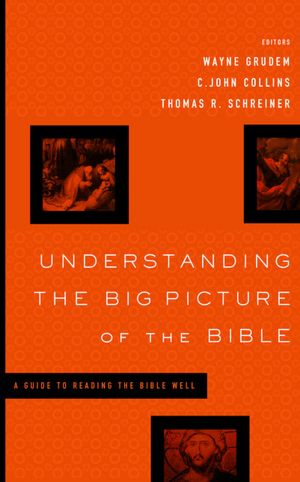
It is the aim of Understanding the Picture of the Bible: A Guide to Reading the Bible Well to answer those questions and put “clear, readable Bible study aids at your fingertips.” (All quotes from back cover and also found here.) Here I review the book for another installment of Magnificent Monograph Mondays.

The book begins with “An Overview of the Bible’s Storyline,” then continues with three parts, one for the Old Testament (subdivided into OT Theology, Pentateuch, Historical Books, Poetry/Wisdom Literature, and Prophets), one for New Testament background (intertestamental history and literature), and one for the New Testament (NT Theology, Gospels/Acts, Epistles, and Revelation). Each author gives a thorough yet concise overview of the section of the Bible he (all authors are male) treats. Each also discusses themes within a given section of the Bible and how they connect with the larger Biblical narrative.

What first stands out in Understanding the Big Picture of the Bible is that almost every author has a knack for simply explaining important concepts and terms. The summary overviews of sections of the Bible provide the reader with a firm foundation for better understanding the purpose and scope of that section. For example, Paul House’s excellent chapter on the prophetic books has an excursus on “pronouns in the prophets.” He begins: “As prepositions are to the letters of Paul, so pronouns are to the oracles of the prophets: crucial for meaning, but often puzzling” (72). In the five following pages he does much for the reader to make prophetic pronouns (and how they often shift person and gender) easier to understand. Other highlights are Gordon Wenham’s chapter on the Pentateuch and Dennis Johnson’s essay on Revelation.

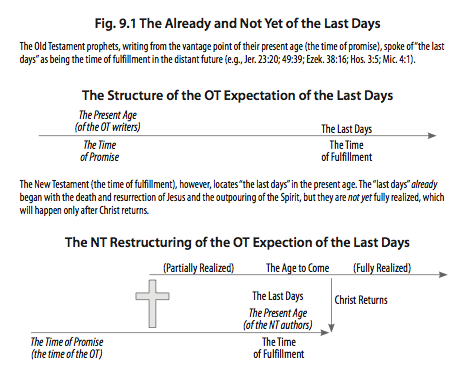
Timelines and charts throughout are a great feature. In addition to timelines in the back of the book covering all of Biblical history (including intertestamental times), there are charts throughout the book that aid the reader. Thomas Schreiner lists all the Epistles, their authors, dates, place of writing, and recipients. Johnson uses nine separate figures to visually (and clearly) display the differences in how Christians interpret Revelation. And House has a table that lines up the prophets with the kings during whose time they prophesied. (A couple of similarly simple and clear maps could be a great addition to future editions of this book.) Here’s an example (taken from a pdf sample of the book):

And then there’s the middle section, part two of Understanding the Big Picture of the Bible. That section alone makes this book worth more than its purchase price. It contains the following:

  • “The Time between the Testaments,” by J. Julius Scott Jr.
  • “The Roman Empire and the Greco-Roman World at the Time of the New Testament,” by David Chapman
  • “Jewish Groups at the Time of the New Testament,” by John Delhousaye

Take just this short quotation from Chapman as an example:

Amid this history, Jesus Christ launched his ministry in a Galilee governed by a Roman client king, a Judea under Roman procurators, and a Judaism tinged with Hellenism. After his crucifixion by the Romans and his resurrection, his gospel was carried by the apostles directly into the heart of Greek culture and Roman power. (94)

Having this background in mind when approaching the New Testament will greatly advance the efforts of any Bible reader. Most Bible overview guides that I’ve seen go right from Old Testament to New Testament. But what about all that time in between? I’ve written more here about why that time period is essential to NT understanding. This book really gets that, and covers that period well. Someone with no knowledge of NT background would find this section easy to follow, and even a budding scholar would appreciate the clarity of the historical overview.

While it’s hard to discern what is the work of the editors (this book has three: Wayne Grudem, C. John Collins, and Schreiner) and what is the work of the writers, this book could have benefitted from a little more careful editorial oversight. There are a few little typos scattered throughout the book (tehillah instead of tefillah for Hebrew prayer, e.g.). I found the use of the sex-specific “man” to refer to all of humanity–even when not quoting the ESV–distracting (although this may not bother other readers).

But there is a bigger editorial oversight. While the book excellently helps the reader to better understand the “big picture” of the Bible, it never directly answers the question it seeks to answer of “How do I get more out of my Bible reading?” The authors present all the necessary information to better understand the background (context) and foreground (content) of the Bible, yes. But understanding context and content is only necessary and not sufficient for “reading the Bible well.” I wish the editors would have made sure the book gave more attention to how one can read the Bible, for example, devotionally… or for transformation rather than just the receiving of information. In other words, I wanted this book, based on its title, to answer: How can I grow closer to God as I read the Bible? How can I allow the Bible to convict me of my sin? What about the importance of reading Scripture in community and corporate worship? David Reimer’s essay gets closest to this when he says, “[T]he art and craft of the Bible’s poems offers an invitation to read slowly, to have one’s vision broadened, once’s perception deepened… to see literary reflection in the service of worship and godly living” (54). I wanted to hear more about this. The key question for me is: Is overview knowledge of the Bible’s context and content sufficient to read the Bible well? Necessary, yes. Sufficient, no.

However, even if the book doesn’t execute its aim listed in the subtitle, it is still a valuable work to have in hand while reading through the Bible. Its unique contribution to works of this kind is in the middle section. I’d imagine this book sitting well on someone’s shelf next to his/her Bible and notebook. (It has on mine these last few weeks!) It would benefit a serious Bible reader to read, say, Darrell Bock’s essay on the Gospels and Acts before reading those Biblical books through.

Thank you to Crossway who provided me with a review copy of this book in exchange for an unbiased review. You can find Understanding the Bible Picture of the Bible at Amazon here.

BibleWorks in the pew? (Not quite, but the next best thing)

[GEEK ALERT] In an effort to integrate my learning of Biblical languages with church attendance and participation, I can be spotted at my church carrying this and this around. If I had an extra hand, I’d bring this, too. At first I feared it would look pretentious–it still may–but my motives are just to use my Greek and Hebrew in the context of corporate worship, while Scripture is being read aloud (in English, in my church’s case). So I follow along the Scripture readings, as best I can, in the original languages.

By Gerard Whyman (http://www.gerardwhyman.co.uk/)

To take it a step further, some time ago on the BibleWorks forums there was a user-initiated discussion about whether it is appropriate to have a laptop with BibleWorks open in the middle of a church service.

While I personally find the idea of a pew-sitter with a laptop tacky, I do understand the sentiment behind wanting to look at the Bible in the original languages while it’s being read and exposited in church. Hence my solution of having a print Bible with me. That’s not quite as out of place as a laptop would be.

So having my Greek and Hebrew Bibles with me is the next best thing to having BibleWorks open during church. However, there are two other next best things that do involve BibleWorks. First, there is a free user-created module that has the Revised Common Lectionary, linked to texts in BibleWorks. I rarely have time to use it on Sunday morning as we rush out the door, but I have at times been able to look ahead to the texts we’d be reading in church that week and use BibleWorks to work my way through them. The RCL module is really nifty. More about it here.

Today I found myself with the unexpected blessing of some time to play around with BibleWorks a bit. (I just received BibleWorks 9 in exchange for an unbiased review, which I will be offering in parts in coming weeks. Consider this a prologue of sorts.) Using the Report Generator, I was able to create a “Reader’s” version of Jeremiah 23:1-6, the Old Testament reading in church from the RCL this morning. Here’s the screen shot of how to get there, which also shows how I have my BibleWorks set up for Septuagint study. (Click on image for larger, or open it in a new tab.)

Once there, I set the Report Generator in the following way:

Then I clicked on “Build Report” and got a report with the text of Jeremiah 23:1-6 in Greek, followed by the listing of all words used in that passage, with frequency counts, followed by lexicon entries. After some manual organizing, I ended up with the below. Resources like this exist for the Hebrew Bible and the Greek New Testament (what I take to church with me), but there is not as of yet a “Reader’s” Septuagint.

Fellow language-lovers… what do you think? And do you take your languages with you to church? If so, how?

Jeremiah 23:1-6 (Rahlfs Septuagint)

–with footnoted vocabulary (glosses) for words that appear less than 200 times in entire Greek Bible (LXX+NT together). Glosses from here: print / BibleWorks module.

1 Ὦ[1] οἱ ποιμένες[2] οἱ διασκορπίζοντες[3] καὶ ἀπολλύοντες τὰ πρόβατα τῆς νομῆς[4] μου.
2 διὰ τοῦτο τάδε λέγει κύριος ἐπὶ τοὺς ποιμαίνοντας[5] τὸν λαόν μου Ὑμεῖς διεσκορπίσατε[6] τὰ πρόβατά μου καὶ ἐξώσατε[7] αὐτὰ καὶ οὐκ ἐπεσκέψασθε[8] αὐτά, ἰδοὺ ἐγὼ ἐκδικῶ[9] ἐφ’ ὑμᾶς κατὰ τὰ πονηρὰ ἐπιτηδεύματα[10] ὑμῶν·
3 καὶ ἐγὼ εἰσδέξομαι[11] τοὺς καταλοίπους[12] τοῦ λαοῦ μου ἀπὸ πάσης τῆς γῆς, οὗ ἐξῶσα[13] αὐτοὺς ἐκεῖ, καὶ καταστήσω αὐτοὺς εἰς τὴν νομὴν[14] αὐτῶν, καὶ αὐξηθήσονται[15] καὶ πληθυνθήσονται·
4 καὶ ἀναστήσω αὐτοῖς ποιμένας[16], οἳ ποιμανοῦσιν[17] αὐτούς, καὶ οὐ φοβηθήσονται ἔτι οὐδὲ πτοηθήσονται[18], λέγει κύριος.
5 Ἰδοὺ ἡμέραι ἔρχονται, λέγει κύριος, καὶ ἀναστήσω τῷ Δαυιδ ἀνατολὴν δικαίαν, καὶ βασιλεύσει βασιλεὺς καὶ συνήσει[19] καὶ ποιήσει κρίμα καὶ δικαιοσύνην ἐπὶ τῆς γῆς.
6 ἐν ταῖς ἡμέραις αὐτοῦ σωθήσεται Ιουδας, καὶ Ισραηλ κατασκηνώσει[20] πεποιθώς, καὶ τοῦτο τὸ ὄνομα αὐτοῦ, ὃ καλέσει αὐτὸν κύριος Ιωσεδεκ[21].


[1] ὦ (109) woe (to)
[2] ποιμήν (99) shepherd
[3] διασκορπίζω (64) scatter
[4] νομή (39) pasture
[5] ποιμαίνω (65) shepherd
[6] διασκορπίζω (64) scatter
[7] ἐξωθέω (31)  force out
[8] ἐπισκέπτομαι (181) visit
[9] ἐκδικέω (97) exact vengeance
[10] ἐπιτήδευμα (58) practice, way of living
[11] εἰσδέχομαι (20) gather
[12] κατάλοιπος (98) remnant
[13] ἐξωθέω (31)  force out
[14] νομή (39) pasture
[15] αὐξάνω (63) grow
[16] ποιμήν (99) shepherd
[17] ποιμαίνω (65) shepherd
[18] πτοέω (39) tremble
[19] συνίημι (144) have understanding
[20] κατασκηνόω (70) dwell, settle
[21] Ιωσεδεκ (18) proper noun (name)

Hipster Septuagintalist

The Septuagint has become cool–or at least a bit hip.

–Ben Wright in “The Septuagint and Its Modern Translators,” from Die Septuaginta—Texte, Kontexte, Lebenswelten

(quoted in Wolfgang Kraus’s excellent review of the New English Translation of the Septuagint)

I’m not sure that a Septuagintalist (yet another word you can use when you study the Septuagint!) is necessarily the best judge of what’s cool or hip… but I’m going to concur with Wright. As yet another LXX post on Words on the Word is attesting (Happy Septuagint Sunday!), the Translation of the Seventy is at least becoming very hip with me. Also, with this guy:

Another prayer of lament in response to Aurora, Colorado mass shooting

AP Photo/Barry Gutierrez

Yesterday I posted a prayer of lament for the victims and families of victims of the shooting at the Dark Knight showing in Aurora, Colorado the other day. Here is another lament prayer, compiled by Laurence Hull Stookey from a collection of Scriptures.

Christians do, after all, have a rich Biblical tradition from which to draw in expressing our mournful prayers of lament to God. Below the prayer are citation information and a link to a formatted, print-friendly pdf of the prayer.

If I were leading a congregation in unison prayer or offering a pastoral prayer tomorrow morning for all those affected by the shooting, I think this is what I would use. It’s good “lament liturgy.”

Prayer of Lament

O God, you are our help and strength,
our refuge in the time of trouble.
In you our ancestors trusted;
They trusted and you delivered them.
When we do not know how to pray as we ought,
your very Spirit intercedes for us
with sighs too deep for words.
We plead for the intercession now, Gracious One.

For desolation and destruction are in our streets,
and terror dances before us.
Our hearts faint; our knees tremble;
our bodies quake; all faces grow pale.
Our eyes are spent from weeping
and our stomachs churn.

How long, O Lord, how long
must we endure this devastation?
How long will destruction lay waste at noonday?
Why does violence flourish
while peace is taken prisoner?
Rouse yourself! Do not cast us off in times of trouble.
Come to our help;
redeem us for the sake of your steadfast love.

For you are a gracious God
abounding in steadfast love and faithfulness.

By the power of the cross,
through which you redeemed the world,
bring to an end hostility
and establish justice in the gate.
For you will gather together your people into that place
where mourning and crying and pain
will be no more,
and tears will be wiped from every eye.
Hasten the day, O God for our salvation.
Accomplish it quickly! Amen.

From Let the Whole Church Say Amen! A Guide for Those Who Pray in Public by Laurence Hull Stookey, pp 94-95 (Copyright 2001 by Abingdon Press). Reproduced by permission. Formatted print-friendly pdf of prayer here.

Scriptures from which the above prayer comes are: Psalm 124:8, Psalm 37:39, Psalm 22:4, Romans 8:26, Isaiah 59:7, Job 41:22, Nahum 2:10, Lamentations 2:11, Isaiah 6:11, Psalm 91:6, Psalm 44:23, Psalm 44:26, Exodus 34:6, 1 Corinthians 1:17, Ephesians 2:14, Amos 5:15, Revelation 21:4, Isaiah 60:22.

Jared Wilson (from Gospel Coalition “colonizes” and “conquers” post) apologizes

I wrote about (rather, against) the use of “colonizing” language to describe the sex act here and here, reacting to a recent Gospel Coalition post.

Just now Jared Wilson, author of the original post, has issued an apology. He’s even taken down the original offending post. Read his apology here.

A dark night at Dark Knight: Prayer of lament for Colorado shooting victims

Last night a 24-year-old gunman opened fire on a theater full of people who had come to see The Dark Knight Rises on opening night.

From the New York Times:

A gunman armed with three weapons, including a rifle and shotgun, opened fire in a theater crowded with families and children at a midnight showing of the Batman movie “The Dark Knight Rises” in a Denver suburb early Friday morning, killing at least 12 people and wounding at least 38 others, the local police and federal officials said.

Just before he began shooting, the police said the man, identified as James Holmes, 24, had appeared in front of the packed theater in Aurora, Colo., and set off at least one smoke device before firing randomly at audience members, who had just settled into their seats.

Read the whole article here.

Just this last week I read a moving book called A Liturgy of Grief: A Pastoral Commentary on Lamentations. I reviewed it here. I quoted something the author, Leslie C. Allen, says right at the beginning of the book:

The release, rather than the bottling up, of inarticulate emotion is a valuable first aid to be applied over and over again to the raw wounds of grief.

Surely this shooting is occasion for the release of some inarticulate emotions: emotions of frustration, anger, sadness, confusion, mourning. Even for those of us with no direct connections to the shooting victims, it is occasion for grief.

Allen in his book often refers to a book by Ann Weems called Psalms of Lament. She composed her psalms (patterned after the Biblical ones) after she unexpectedly lost her son on his 21st birthday. She dedicates the book “to those who weep and to those who weep with those who weep.” Here is her Lament Psalm Four, which I hope you will pray with me now:

O Holy One, I can no longer see.
Blinded by tears
that will not cease,
I can only cry out to you
and listen
for your footsteps.

Are you, too, O God,
blinded by tears?
Have you watched this world
pile its hate
onto the faces
of your little ones
until your eyes are so filled with tears
that you cannot see me
waiting for you?
Are you, O God,
deafened by the expletives
of destruction and death?
Have you heard
so many obscenities
that you cannot hear
my moaning?
O God, if you are blind,
can’t you hold out
your hand to me?
If you’re deaf,
can’t you call my name?

How long, O God,
am I to sit
on the plain of blindness?

How long am I to listen
to the profanity
of my enemies
who mock:
“Where is your God now?”

Show them, O my God,
that you remember.
Reach out your hand
and dry my eyes
that I might see
a new beginning.
Open your mouth
and call me by name
that I might know
you remember me.
Claim me that I might
announce in the marketplace
that my God is here.

O my heart,
give thanks!
My God is here even
in the midst of destruction.

The hyphen in my last name, and, What happens when kids with hyphenated last names marry?

This post is not about sex or colonization.

NPR’s All Things Considered played a story yesterday called, “When Hyphen Boy Meets Hyphen Girl, Names Pile Up.” It’s Family Friday at Words on the Word, and in my family we all roll with the hyphenated last name (K-J). My wife was K, I was J, she wanted to be K-J, invited me to do the same (with no pressure), and I agreed. So we and our three kids are all K-J.

But we’ve often asked, what happens when they get married? What will they do with their last names? And what if they meet someone else with a hyphenated last name?

Read and listen to NPR’s story here.

It doesn’t offer much by way of answers to my questions above, but at least our children will not be alone.

Why did my wife and I opt for K-J? For me, it’s simple: joining our two last names together with the hyphen seemed a perfect “outward and visible sign of an inward and spiritual grace,” namely, what Jesus teaches–“the two will become one flesh” (Mark 10:8).

Sex as colonization? A reply to my comment, and my reply back

I linked yesterday morning to a Gospel Coalition piece that has gathered a lot of attention on the Internet recently. I wrote my reply to the piece here.

Yesterday Jared Wilson, author of the original post, wrote this reply as a follow up to the first post and its many critics. I asked Jared for clarification of a few things in the comments here, and he posted a reply, if anyone wants to see it. Just click here, then search for “Abram” in the comments (as of the time of writing this I’m the seventh comment down).

UPDATE: Here’s my reply to Jared’s reply, printed in full below (left as a comment at his site). The Douglas Wilson article he mentions (to which I respond below) is here.

Jared, thanks very much for your reply.

I read and re-read and re-read again Doug Wilson’s follow up piece. I get a little bit more where he’s coming from.

However, “colonizes” still gets me. He spent one sentence in his post explaining that particular choice of words, in which he quoted Song of Solomon 4:12 (“A garden locked is my sister, my bride”) as an example of Scripture having to do with “colonizes” (if I’m reading him right).

But reading through the following verses in Song of Solomon… “SHE” (ESV) replies, “Blow upon my garden… let my beloved come to his garden.” (“come to” ESV=Hebrew “come into” for intercourse) Then “HE” says, “I came [in]to my garden, my sister, my bride.”

That’s it. Just “came into.” The Hebrew word there is the common way of referring to intercourse (lit., “he went into her”=English “he had sex with her”). Wilson quotes the “locked garden” verse as implying, “My garden is locked… therefore come colonize me.” But that’s neither what she says nor what he does after that verse in response to her locked garden.

“Colonizes” is *really* exegetically difficult to pull out of that passage both based on Hebrew word meaning *and* the full context of the passage in which it occurs (which, as you’ve rightly pointed out, context is a key determiner of meaning). All this holds true, too, by the way, of his explanation of his use of the verb “conquer,” based on Song 4:4. It’s not in there and it’s not what the passage seems to mean.

So if “colonizes” cannot come from the place Wilson mentions, does he find it elsewhere in Scripture to be an appropriate description of the male-female sex act? It not, that’s a continuing concern to me….

Greek Vocabulary Guide: Another Book Giveaway by Zondervan

Head over to Koinonia, Zondervan Academic’s blog, for another Wednesday giveaway. Now they are giving away Complete Vocabulary Guide to the Greek New Testament. Details are here.

Koinonia is accepting submissions until Thursday midnight.

The book is available on Amazon here.