Done with Threes? Sworn off 2048? Try Diced

Agile Tortoise (Greg Pierce) is probably the best iOS developer there is. I use his Drafts 4 app all the time–an amazing combination of text editor simplicity and power user export options.

He’s just made a $0.99 game called Diced.


IMG_6858


IMG_6856


From Agile Tortoise’s blog announcement:

Diced is a simple puzzle game. Place dice on a grid to make five of a kind or five in a row (straight) combinations to score points and clear the die. Score as many points as you can before the grid fills up and the game ends. Some game play features:

  • Quick launch and game restore. Easy to leave and come back where you left off.
  • Wild die.
  • Bombs.
  • Random blocks to add difficulty as the game progresses.
  • Game Center support with leaderboards and achievements

There are no ads, no in-app purchases, and it works perfectly. It’s universal, so you can play on iPhone and iPad, where Split View is also supported. (This guy thinks of everything.)

It’s not quite like poker–a full house combination won’t clear a row for you. But between the five of a kind and five straight goals, you’ve got enough ways to clear the board (the bombs help, too). Also cool is the dark mode, which you can toggle off and on.

Check out the app here.

What I’m Learning About Preaching, and a Massive Resource that Helps

Art and Craft of Biblical Preaching

The Art & Craft of Biblical Preaching (Zondervan, 2005) is a massive and indispensable reference work for preachers. It is true to its sub-title: A Comprehensive Resource for Today’s Communicators. When it comes to the process of preaching–start to finish–there is very little the book does not cover. Virtually all aspects of sermon preparation and delivery are here, such as the call of the preacher (chapter 1), careful consideration of the listeners (chapter 3), sermon structure (chapter 5), delivery (chapter 8), and seeking sermon feedback (chapter 11).

The book’s 201 (!) chapters vary in length. A handful of the articles are barely a page, while others approach ten pages. Not that length correlates with quality. One of the most beneficial articles is the one-page set of self-evaluation questions by Haddon Robinson (“A Comprehensive Check-Up,” 701).

The quality of article is high, with just a few exceptions along the way–perhaps inevitable among over 100 contributors. (A handful of articles feel more vague than I would have hoped.) There is also an overwhelmingly disproportionate inclusion of male contributors, while there are just a few articles from female contributors, and no women on the book’s accompanying 14-track sermon audio CD. The CD is otherwise a great inclusion, since you get to hear great preaching examples in action. My five-year-old loved the first few stories on the disc.

The Art & Craft is a joy to read and a goldmine of a resource. Following are three highlights of the rich book, as well as some reflections on how they have informed my preaching.


1. Preaching with Intensity


“Preaching with Intensity” (596), by my friend Kevin A. Miller, is one of the best essays in the book. I first read the article two years ago, and only realized when re-reading it recently how much of Miller’s advice I’ve internalized. It’s that good.

He leads off by asking, “Why is it that sometimes we as preachers feel a message so deeply, yet our listeners don’t feel that? Why is something that’s so intensely meaningful to us not always communicated in a way that grips the congregation as intensely?” (596) He suggests four factors as to “why intensity doesn’t transfer.” One of these is “the time factor,” and Miller’s point hit me so hard the first time that I’ve never forgotten it. (That’s a rare occurrence for me.)

By the time I step into the pulpit, I have studied for this message all week. I meditated on the text. I read commentaries. I prayed about the message. I gave this sermon from eight to twenty hours of my best thought, prayer and energy.

Amen! say the preachers! But here’s the blunt truth:

But the people listening to me are hearing the sermon cold. What’s become so meaningful to me has had no time to sink in to them. I can’t expect the truths that have gripped me during hours of study to automatically grip a congregation–unless I practice the skills I describe below.

Once you pick up this book, turn to page 597 to pick it up from here. Miller will walk you through what to do next.

Because of “the time factor,” one of my first steps in preaching prep (on my better weeks!) is reading through the text out loud in English, since that is what will happen immediately before the sermon in the actual church service. With note-taking capability ready at hand, I try to anticipate what questions and reactions might come up when the congregation hears it Sunday–that is what will be top of mind for them (not my hours of study!) as soon as I begin the sermon. It’s not that I need to try to come up with FAQ For Sunday-Morning Hearers of This Passage to start off every sermon, but keeping the congregation in mind like this has become an essential part of my process.

One more takeaway from Kevin Miller, since it’s stuck with me: don’t over-nuance your points. I was a philosophy major, and I have an educated congregation, so this is difficult for me. Miller doesn’t mean don’t be nuanced–our faith requires it at times. He just means:

Every nuance and qualifier, though it may add technical accuracy, also blunts the force of the statement we’re trying to make. Even if we believe something intensely, we can drain the energy out of our statement so that the congregation doesn’t sense that. It’s good to be accurate, to use nuance, to balance. But we must never let those good practices dull the share edge of the Bible’s two-edged sword. (598)

I’ve kept this advice close during my sermon editing process in recent months. Almost every draft revision includes taking out an overly (and probably unnecessarily) nuanced sentence or two.


2. Manuscript, Outline, or No Notes?


After my first 60 or so weekly sermons in the church I pastor, I remember moving from a 10-page manuscript to a 2-page outline. That entire fall I thoroughly enjoyed the flexibility of an outline, and found it enhanced my preaching, not made it worse (which I had feared). I swore off manuscripts forever.

The next spring, and ever since, I’ve been preaching from word-for-word manuscripts. (Ha!) Of course I add and delete and rephrase on the fly, once I look at the congregation and make connection with them. But I’m also thinking it’s time again for me to go back to using a more minimal outline.

Whether a preacher should write out her or his sermon, whether she should preach from an outline, or whether he should go into the pulpit with nothing but a Bible is a matter for the preacher to decide. It is, after all, a matter of style and personal preference.

In “No Notes, Lots of Notes, Brief Notes” (600), Jeffery Arthurs explores the benefits and drawbacks of each approach. I was pleasantly surprised by the nuance and balance offered, since Arthurs teaches at Gordon-Conwell Theological Seminary, where the modus operandi is to require preaching with virtually no pulpit notes. Arthurs explores “no notes, lots of notes, and brief notes” (600). For each he asks, “Why Use This Method?”, “Why Avoid This Method?”, and, “How to Use This Method.”

The point I found most useful was under the “Lots of Notes” section. Two of the drawbacks to such an approach (as in my current practice of preaching from a manuscript) are, “Most readers cannot read with skill” (604) and, “Eye contact is difficult or impossible” (604). Those two points have not been challenges for me, but the third drawback has been an area of growth: “Most writers write in a written style” (604). Arthurs suggests preachers should write for the ear, and specifically gives tips to that end. “Your writing will seem redundant and choppy,” he says, “But that is how we talk” (605). So I’ve made efforts this year to preach with orality in mind.


3. The Value of Sermon Feedback


Since I’ve been soliciting preaching feedback from a few members recently, I was especially eager to read Part 11, Evaluation. Bill Hybels leads off with “Well-Focused Preaching” (687), one of the longer essays in the book. Hybels shares in detail how he looks for sermon evaluation, especially from his church’s elders. It’s a refreshingly honest essay. Hybels also helped me see again the connection between what the sermon is trying to do in relation to larger church goals and vision. This is a link that is too easy to forget when yet another Sunday message seems to be just around the corner.

William Willimon includes a questionnaire for sermon evaluation: “Getting the Feedback You Need” (698). I’m not sure I would use his numbers for rating a preacher’s sermon, though. To my mind there’s a subtle but important difference between sermon feedback and sermon evaluation. The book speaks in terms of sermon evaluation, but I prefer to use feedback when soliciting input from congregants. The sermon is not a performance to be graded or an initiative to be voted on by the congregation. Using the language of evaluation could easily put a congregant in a mindset of grading a sermon, which feels like a category mistake for something that is supposed to be formative. There may already exist among churchgoers the evaluation of, “I liked it” or, “I didn’t like it,” and asking for “evaluation” could unintentionally encourage that. Of course, preachers need feedback to know what’s connecting and not, and we can always improve in our proclamation of God’s Word. Either way I found benefit in the section on evaluation.

Haddon Robinson’s “Comprehensive Check-Up” (701) is short but sweet. He gives the preacher a host of good questions to ask herself or himself. There are questions especially for the introduction of the sermon (“Does the message get attention?”) and its conclusion (“Are there effective closing appeals or suggestions?”). There is a sense in which some of these questions read as common-sense measurements, but in the press of weekly ministry and preaching, it’s really to forget them. Robinson does preachers (and has done me) a great service by putting so many good self-evaluation questions in one place.

Barbara Brown Taylor offers a refreshing perspective in her “My Worst and Best Sermons Ever” (710). Her account of a sermon at the death of a baby girl is moving:

When it came time for the service, I walked into a full church with nothing but a half page of notes. I stood plucking the words out of thin air as they appeared before my eyes. Somehow, they worked. God consented to be present in them. (710)

She concludes–in a subtle corrective to the use of sermon “evaluation”–that there is value in being “reluctant to talk about ‘best’ and ‘worst’ sermons” (710). Indeed, “Something happens between the preacher’s lips and congregation’s ears that is beyond prediction or explanation” (710). The reader finishes her short piece wishing her writing had been featured more than in this and one other article.

Finally, “Lessons from Preaching Today Screeners” (704), features 10 questions “by which we evaluate all the sermons received by Preaching Today, and some of the lessons we’ve learned from listening” (704). It’s a fascinating read, and a set of questions to use in sharpening one’s own preaching. I was especially convicted by, “Is the sermon fresh?” There Lee Eclov cautions against preaching to the congregation “things they surely already know and believe, and doing so in terms the congregation would probably find overly familiar” (705). This one is a big challenge for me.


Conclusion


The Art & Craft of Biblical Preaching easily lends itself to both quick and sustained study. Whether you just pick it up and read what you need to give you a boost one week, or whether you spend hours poring over its advice, it’s an outstanding resource to keep at the desk or quick-access bookshelf. In “How to Use This Book,” the editors wisely say, “A manual like this–overflowing with helpful information–must be managed. …You will consciously focus on one important principle from a chapter for weeks or months. Eventually it will become second nature, and you will be ready to focus deliberate attention on another principle” (15).

As a production note, the book’s glued binding is an unfortunate choice for a rich reference book like this.

The editors are right in their expectation: “We expect this manual is one you will grow with for years to come” (15). I’m looking forward to my own continued growth as a preacher, and grateful to have this resource to help me to that end.

Here are all the main sections in the book, with the questions they set out to answer:

Part 1: The High Call of Preaching (“How can I be faithful to what God intends preaching to be and do?”)

Part 2: The Spiritual Life of the Preacher (“How should I attend to my soul so that I am spiritually prepared to preach?”)

Part 3: Considering Hearers (“How should my approach change depending on who is listening?”)

Part 4: Interpretation and Application (“How do I grasp the correct meaning of Scripture and show its relevance to my unique hearers?”)

Part 5: Structure (“How do I generate, organize, and support ideas in a way that is clear?”)

Part 6: Part and Style (“How can I use my personal strengths and various message types to their full biblical potential?”)

Part 7: Stories and Illustrations (“How do I find examples that are illuminating, credible, and compelling?”)

Part 8: Preparation (“How should I invest my limited study time so that I am ready to preach?”)

Part 9: Delivery (“How do I speak in a way that arrests hearers?”)

Part 10: Special Topics (“How do I speak on holidays and about tough topics in a way that is fresh and trustworthy?”)

Part 11: Evaluation (“How do I get the constructive feedback I need to keep growing?”)

You can find the book at Amazon or at the publisher’s page. It’s available in both Accordance and Logos Bible software programs, too.


Thanks to Zondervan for the review copy, given to me with no expectation as to the review’s content, and certainly not with the expectation of a 2,000 word review essay!


Birth Announcement!

WotG


It’s a blog!

I’m pleased to announce the birth of Words on the Goods:

Words on the Goods reviews high-quality, high-utility gear. Writers, audiophiles, tech lovers, and people who actually say EDC out loud will love it here. We bring you in-depth and practical write-ups with hi-res images of the best notebooks, pens, speakers, leather cases, apps, devices, and more.

We’re up and running, and actually have been for some time. Here are a few highlights of reviews from the first couple weeks of its life:

I’ll continue to post occasional product and app reviews here at Words on the Word, but will focus my posts here more on my own writing, sermons, tools for preachers, biblical studies, church life, and the like. If you were always here for the goods, you should go to Words on the Goods and subscribe (bottom left of any page). I’m the sole writer at the moment, but that’s fixin’ to change.

If you like giveaways, go here and enter for a chance to win a 3-pack of some sweet Word. Terrain notebooks.

New Bonhoeffer Title: Engaging Bonhoeffer

Engaging Bonhoeffer


I learned today of a new Bonhoeffer studies title releasing (in days!) from Fortress Press. It’s called Engaging Bonhoeffer: The Impact and Influence of Bonhoeffer’s Life and Thought. Here’s the blurb:

Engaging Bonhoeffer documents the extraordinary impact of Dietrich Bonhoeffer’s life and writing on later thought. Despite his lasting legacy, little substantial scholarship has been conducted in this area. In this magisterial collection, leading international scholars fill this striking gap and critically demonstrate the ways in which Bonhoeffer has been one of the most original, inspirational, and provocative writers of the twentieth century.

Bonhoeffer’s work has proved foundational for a wide variety of thinkers and movements across such areas as ecclesiology, Christology, spirituality, ethics, hermeneutics, phenomenology, epistemology, and systematic theology more generally. Whether one considers his writings to have been faithfully interpreted, critically adopted or justifiably rejected, Engaging Bonhoeffer describes those who have engaged with Bonhoeffer’s work, been inspired by his actions, and found a way to express and explain their own ideas through interacting with his life and thought. In addition to shedding light on the different theological trajectories that Bonhoeffer’s work may forge, this challenging volume offers a critical window through which to view and appreciate the ideas of many leading voices of modern theology.

There are 15 essays in all, the titles of which are all here. The ones I’m particularly interested in are:

1. A Tale of Two Bonhoeffers?—Keith W. Clements
2. Dietrich Bonhoeffer and the Death of God Theologians—Eleanor McLaughlin
7. Dietrich Bonhoeffer and Liberation Theologies—Geffrey B. Kelly and Matthew D. Kirkpatrick
14. On the Phenomenology of CreationJohn Panteleimon Manoussakis
15. “Let your light so shine”Medi Ann Volpe and Jennifer Moberly

Kudos to Fortress Press for keeping the Bonhoeffer goodness coming! Last fall they published reader’s editions of four classic Bonhoeffer titles. Kudos also to Fortress for publishing a Bonhoeffer book with a fresh photo of the man! Looks like a young Bonhoeffer, probably when he was a teenager getting ready to fire off a couple of dissertations.

If/as I learn more about Engaging Bonhoeffer, I’ll post again here. In the meantime, the publisher’s book page is here. It’s on Amazon here.

The (Leather) Gospel, According to John

I’ve had hit-or-miss success in 2016 with Bible memorization. It’s entirely possible I’m being too hard on myself, but I also know I struggle to consistently work at the parts of the Bible I’m trying to memorize this year.

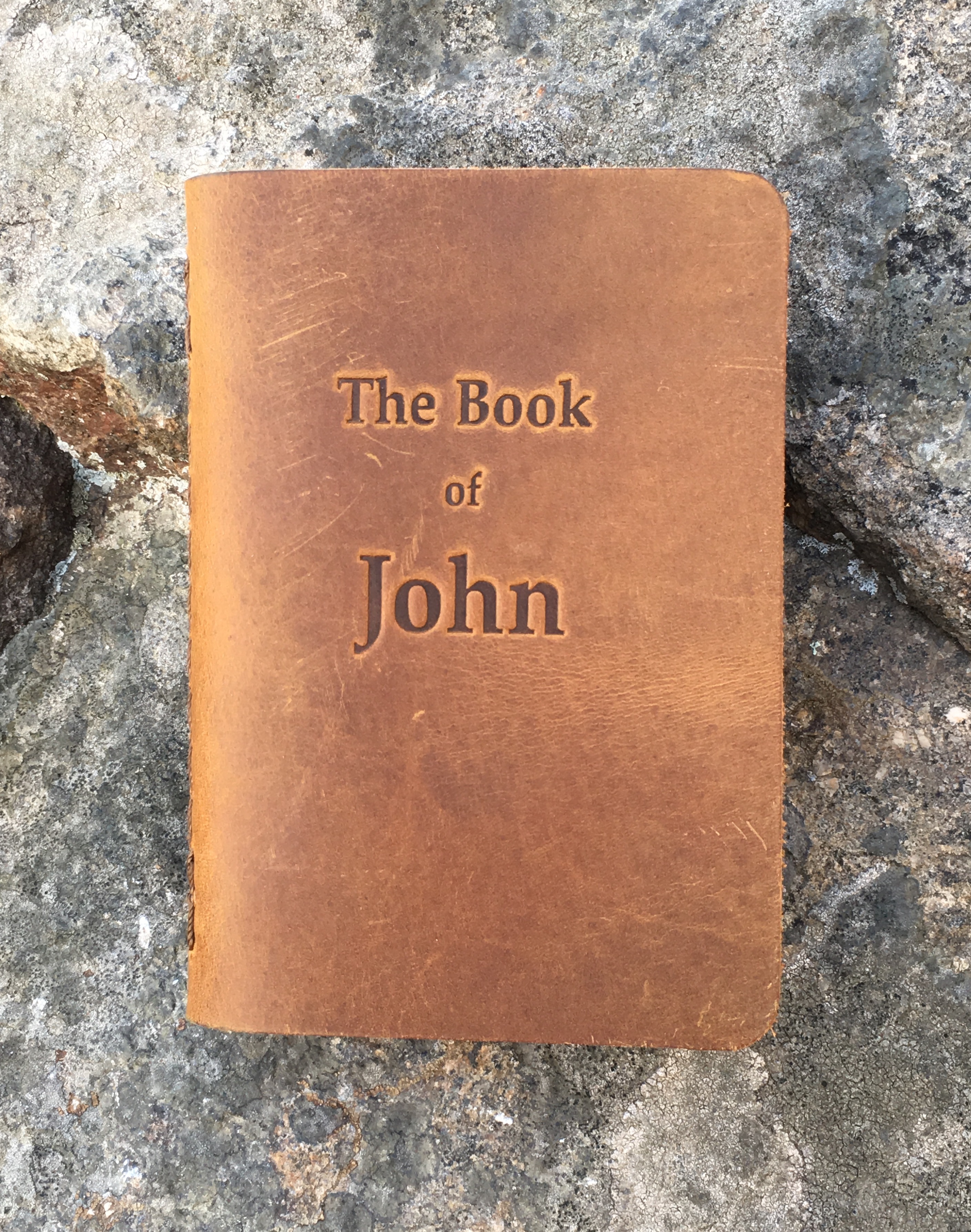
A tool won’t necessarily make me a better memorizer, but thinking it could help, I sprang for the Saddleback Leather Gospel of John Bible portion. You readers of this blog know I like good leather. You know I like pocket notebooks. And of course I like pocket notebooks with leather covers. So why not have a portable Scripture portion covered in leather?

This has actually been a desideratum of mine for some time, so I was really excited to see that Saddleback Leather has just released a set of three books of the Bible (John, Proverbs, and Revelation), each stitched into a leather cover. These are not inserts that can be exchanged–they are permanently stitched to their covers.

Lemme show you.


0_Two Balms
Lip Balm, Life Balm


The book is passport size (think 3.5″ x 5″ Baron Fig Apprentice rather than 3.5″ x 5.5″ Field Notes or Word. Notebooks). This means it’s a great front pocket fit.


1_Pocket View


Here it is, front and back:


Words of the Word on the Rock
Words of the Word on a Rock


3_Back on Rock
Rock on, You Rock on the Rock


Here’s a look at how the uber-tough paper is stitched into the leather:


4_Inside Stitching


5_Outside Stitching


That paper, by the way, is “YUPO synthetic paper: 100% recyclable, waterproof, tree-free, durable, and easily wipes clean.”


7_Inside Stitching Up Close


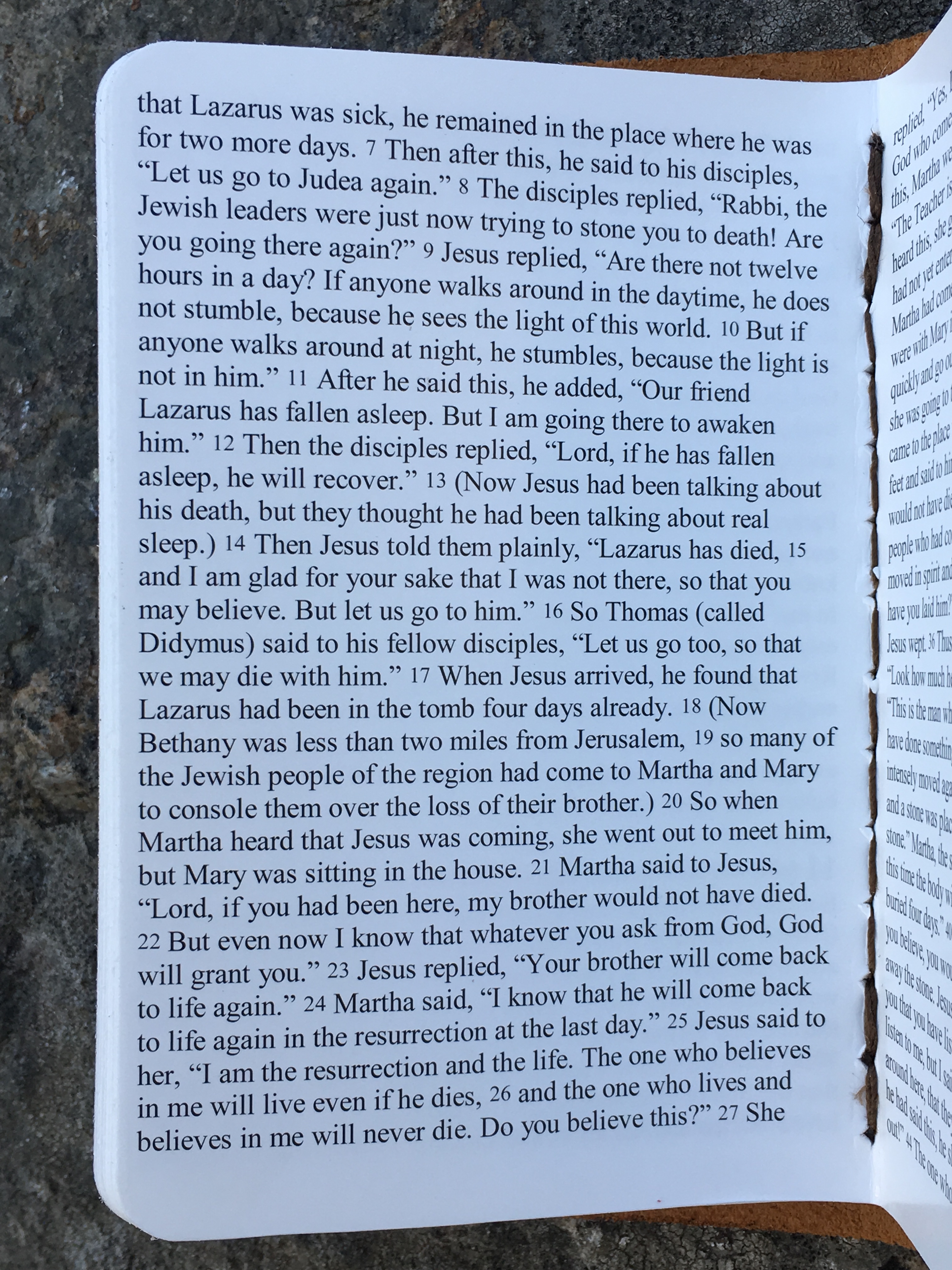
Bible production is notoriously challenging, and I’m quite sure this piece was no exception. A bummer is that there is virtually no margin to the pages. The font is small, but the lack of white space is the larger issue:


8_Full Page Text


This especially becomes a problem as some pages don’t lay 100% flat:


Crammed margins
Crammed margins


The leather is full grain and wonderful, as with all of Saddleback’s stuff. It smells good, of course. It will last forever. The paper looks just as tough, too. I don’t quite feel like trying to rip it to see if it’s truly tear-free, but it’s the kind of paper you could take on a camping trip and not have to worry.

Surprisingly, given the excellent workmanship on Saddleback products, the leather stitching was a little crooked, even though it’s machine-stitched:


6_Outside Stitching Up Close


6a_Stitching Not Straight


The insides are the NET Bible, which I appreciate as a translation for its rich footnotes. Those are not included here, which is inevitable, since the font is already small to get John to fit in.

There are 30 pages (15 sheets), including–oddly–five blank pages at the end, which means that one less sheet could have been used. (Maybe these are for notes?)

Back to why I got this thing–to memorize. The NET Bible does not lend itself well to memorization. Consider John 1:1-5 in the 1984 NIV:

In the beginning was the Word, and the Word was with God, and the Word was God. He was with God in the beginning.

Through him all things were made; without him nothing was made that has been made. In him was life, and that life was the light of men. The light shines in the darkness, but the darkness has not understood it.

Here it is in the NET Bible:

In the beginning was the Word, and the Word was with God, and the Word was fully God. The Word was with God in the beginning. All things were created by him, and apart from him not one thing was created that has been created. In him was life, and the life was the light of mankind. And the light shines on in the darkness, but the darkness has not mastered it.

I dislike the translation of the generic Greek ανθρωπος as “man” in the 1984 NIV. “Humanity” or “humankind” is better in 2016–even the NET footnote cedes this option, but the text alone just gives you “mankind.” And though the footnote in fuller NET editions explains “the Word was fully God” well, NET has other such turns of phrase that make the version less than ideal for memorization.

There are also no paragraphs in this text. This means the 71-verse John 6 is a single paragraph in the Saddleback Leather Gospel of John. There is a single blank line between chapters, but especially with those five blank pages at the end, could not paragraph separations for greater readability have been employed?

One more minor production quibble: the cover text (“The Book of John”) is ever so slightly left of center, and the branding on the back is a little off-center. These are not really noticeable (like the stitching is), and maybe it’s just that I’ve come to expect near perfection from Saddleback!

I still, however, think it is absolutely awesome that Saddleback is making these things, so even though the NET Bible here isn’t quite the pocket-sized, leather-covered panacea I was seeking for Bible memorization (I know: I have issues), I would still buy this again, even if only to support the effort and have it to keep with me.

I imagine the production of these little books will only improve in time–if you’re going to get one, maybe give it a couple months and see if the next few production runs iron out the quality and layout issues.

(Personally, I’d love to see an easier-to-memorize version available in the future, too, like the NIV or NRSV.)

Saddleback’s site is here, with many wonderful leather things. You can also check out my review of their pen/sunglasses case as well as their leather Bible Cover.

Here is the Gospel of John via Saddleback, as well as a larger set of three books of the Bible, similarly bound.


This was not a review sample–I paid for it, but was fortunate to have received a handsome discount code (as a newsletter subscriber) for the item.

Systems Thinking 101: How Your Church Family Works (Steinke)

Steinke_Healthy CongregationsA “system” is a process with its distinct yet interrelated parts. Interlocking systems (nervous, skeletal, respiratory) make up the one human body. The human body is itself a sort of system of systems.

The Bible uses systems imagery when it describes the body in Romans 12: “For just as each of us has one body with many members, and these members do not all have the same function, so in Christ we, though many, form one body, and each member belongs to all the others.” In a healthy body, all the systems do their part and work together as one toward balance and health. As Peter L. Steinke says in Healthy Congregations: A Systems Approach, “Health is a continuous process, the ongoing interplay a of multiple forces and conditions.” One thinks of the biblical notion of shalom, where health, wholeness, peace, and justice are all present.

Systems thinking offers what Steinke calls “a way of thinking about life as all of a piece… and how the relationships between the parts produce something new.” The key is not just the individual parts, but the interrelatedness of the parts and the dynamics they produce and reinforce together.

In How Your Church Family Works: Understanding Congregations as Emotional Systems, precursor to Healthy Congregations, Steinke suggests that the church is “an emotional unit” and that “the same emotional processes experienced in the family operate in the church” (xvi). Just like the hand cannot say to the foot, “I don’t need you!”, the budget-setting process of the church cannot say to the strategic planning process, “I don’t need you!”

Similarly, anxiety in one part of the system or church affects what is happening in another part of the system or church, as when a parishioner loses a loved one and directs the anger outward at a church leader or other member. (Steinke later refers to this as shifting the burden.) Systems crave homeostasis, and sometimes anxiety in the system causes its members to pursue survival in less than healthy ways.


 *   *   *   *   *   *


In How Your Church Family Works Steinke aims to

conceptualize emotional processes so that we can recognize them and, ultimately, let them serve rather than corrupt the purpose of our bonding together–“for the sake of ministry, for building up the body of Christ” (Ephesians 4:13), that “every tongue confess that Jesus Christ is Lord, to the glory of God the Father” (Philippians 2:11).

There are two main parts to the How Your Church Family Works. First there is “Conceptualizing Emotional Processes.” Here Steinke talks about systems and their “emotional processes” (“anxiety and reactivity,” “stability and change,” and so on). Second is “The Congregation as an Emotional System,” which uses anecdotes to show the theory of the book’s first half in action.


The Whole, Not (Just) Parts


How Your Church Family Works is one of the most insightful books I’ve read in a long time. My first exposure to systems thinking a decade ago (through Peter Senge’s book The Fifth Discipline) permanently altered how I make sense of relationship dynamics, especially in an organizational setting. The idea of systems thinking is generative for creativity and problem solving. “Instead of seeing isolated, unrelated parts, we look at the whole” (3). But it’s far easier in pastoral ministry to fixate on isolated parts, or to fail to see an interaction as situated within a larger system. I have personally experienced what Steinke says, that systems thinking “deepens our understanding of life” (4).


Anxiety and Its Targets


Steinke_How Your Church Family WorksI loved Steinke’s section on anxiety. He remarks, “The most vulnerable or responsible people in the relationship network are the usual targets” (15) when anxiety hits. This would explain why pastors (and other organizational leaders) serve as lightning rods when the people’s anxiety is high. It’s not that anxiety itself is bad, Steinke says. It can provoke positive change (16), but only if it’s regulated. Otherwise, “what is stimulus becomes restraint” (16). In part this is because of the automatic reactive processes from the 15% of our brain’s functioning that is rooted in the brain stem (“survival processes”) and limbic system (“emotional response”) (17).

I’ve been in the Church long enough to no longer expect that a Christian community should magically be conflict-free. Neither do I expect that conflict is always handled in a healthy way. Steinke brilliantly notes just what is going on when anxiety is high in the body of believers: “Threatened, any of us may dispense with our Christian convictions and values. Anxiety is no respecter of belief systems” (21). Indeed, since the stakes are higher in Christian communities (centered as we are around the deepest truths of life), unchecked reactions to anxiety may ripple throughout the system with even more impact.


Difficult? Do It


So how should church leaders respond to anxiety? Here was one of my favorite takeaways from the book for my own ministry. Leaders ignore anxiety in systems at their own peril. (People-pleasing pastors will especially be attempted to just keep the peace.) Steinke cautions:

But “benign neglect” only reinforces malignant processes. Moreover, ignoring is as reactive as placating or attacking. VICIOUS CIRCLES CAN ONLY BE DISABLED THROUGH EXPOSURE. They are enabled by secrecy and avoidance. (27, all caps are original to Steinke)

Exposure is difficult, but a Christian calling. One thinks of the warnings in the New Testament about deeds of darkness and bringing them into the light. I was fortified by Steinke’s quotation of Rainer Maria Rilke: “That something is difficult must be one more reason for us to do it” (43). Difficult ministry-related conversations get easier the more experience I have, but a part of me would would rather just keep the peace. However, to apply Steinke’s insight, that risks perpetuating anxiety and reactivity in a system, in a way that is less than helpful. The better thing is to seek (in humility, love, and confidence) to expose and address those parts of a system that seem to be exacerbating problems. (Realizing, too, that I myself am part of the system and capable of contributing for good or for ill.)


Case Studies


The book’s second half provides ample case studies to help the reader better understand the concepts. Steinke breaks down one church’s dysfunction into a series of triangulations, which he diagrams for clarity (84-5). Earlier in the book he describes a church he consulted with, where he encouraged them to redefine problems they’d articulated “without focusing solely on a person or issue as presented in the original problem” (57).

His “Presenting Problem” vs. “Redefined Problem” chart is a model for how to reframe conflict. His ten group reflection questions that follow are virtually alone worth the price of the book. Here are two highlights: “What would it take to have a pastor stay here ten years, twenty years?” (59) and, “How would you be willing to invest yourself in the process of creating the image you defined above?” (60) I photographed these ten questions and saved them to my Evernote, so I can access them for future work in church evaluation.

I’ll be mulling over these systems thinking concepts for years to come. Both of these books by Steinke are worth reading a.s.a.p.


Where to Find out More


How Your Church Family Works: Understanding Congregations as Emotional Systems: Amazon / Publisher’s page

Healthy Congregations: A Systems Approach: Amazon / Publisher’s page


Thanks to Rowman & Littlefield for the review copies of both books, given to me for review purposes but with no expectation as to the content or nature of my evaluation.

A Greek Word for the Twitter Age: σπερμολογος (spermologos)

Here’s a fun Greek word: σπερμολογος (spermologos). It appears only one time in the Greek New Testament, and nowhere in the Septuagint. Here it is in its context, Acts 17:18:

τινες δε και των Επικουρειων και Στοικων φιλοσοφων συνεβαλλον αυτω, και τινες ελεγον· τι αν θελοι ο σπερμολογος ουτος λεγειν; οι δε· ξενων δαιμονιων δοκει καταγγελευς ειναι, οτι τον Ιησουν και την αναστασιν ευηγγελιζετο.

A group of Epicurean and Stoic philosophers began to debate with [Paul]. Some of them asked, “What is this babbler trying to say?” Others remarked, “He seems to be advocating foreign gods.” They said this because Paul was preaching the good news about Jesus and the resurrection.

The NIV 2011 (above), NRSV, and KJV all translate σπερμολογος (spermologos) as “babbler.” HCSB has “pseduo-intellectual.” NASB has “idle babbler.” NET has “foolish babbler.” Not to be outdone, the Message offers, “What an airhead!”

Context determines meaning, which makes a word like this tricky, since it has no other uses in the Bible. The LSJ lexicon notes its use in, among other classic works, the play Birds by Aristophanes, where it refers to birds picking up seeds. In the 1st century B.C. history of Dionysius of Halicarnassus, σπερμολογος  describes a “frivolous” person. For the noun form LSJ offers, “one who picks up and retails scraps of knowledge, an idle babbler, gossip.”

BDAG has this: “in pejorative imagery of persons whose communication lacks sophistication and seems to pick up scraps of information here and there.” I also like its gloss of “scrapmonger”! In the part of the entry that covers the Acts verse, it says, “Engl. synonyms include ‘gossip’, ‘babbler’, ‘chatterer’; but these terms miss the imagery of unsystematic gathering.

Also helpful is Louw-Nida’s Greek-English Lexicon of the New Testament Based on Semantic Domains:

one who acquires bits and pieces of relatively extraneous information and proceeds to pass them on with pretense and show.

And then this gem, from the same source:

The term σπερμολογος is semantically complex in that it combines two quite distinct phases of activity: (1) the acquiring of information and (2) the passing on of such information. Because of the complex semantic structure of σπερμολογος, it may be best in some languages to render it as ‘one who learns lots of trivial things and wants to tell everyone about his knowledge,’ but in most languages there is a perfectly appropriate idiom for ‘a pseudo-intellectual who insists on spouting off.’

The implications for an easy-to-access information age are obvious–how much of the Internet is gathering information like seed and passing it on, without stopping to research and truly evaluate it?

We could pontificate, but back to Acts–this is what some Athenian philosophers called Paul: a σπερμολογος. The parenthetical statement in Acts 17:21, however, makes this the height of irony:

Αθηναιοι δε παντες και οι επιδημουντες ξενοι εις ουδεν ετερον ηυκαιρουν η λεγειν τι η ακουειν τι καινοτερον.

(All the Athenians and the foreigners who lived there spent their time doing nothing but talking about and listening to the latest ideas.)

Did you catch it? Louw-Nida says a σπερμολογος engages in “two quite distinct phases of activity: (1) the acquiring of information and (2) the passing on of such information.” Acts 17:21 says the Athenians themselves (who leveled the σπερμολογος charge against Paul) spent all their time in two phases of activity: talking (#2 above) and listening (#1) to “the latest ideas.”

Moral of the story: check yourself before you call someone a σπερμολογος.

“Can there be any day but this?” George Herbert’s “Easter”

As we are still in the Easter season, here is George Herbert’s “Easter,” quoted in N.T. Wright’s Resurrection and the Son of God.

I got me flowers to straw thy way;
I got me boughs off many a tree:
But thou wast up by break of day,
And brought’st thy sweets along with thee.

The Sunne arising in the East,
Though he give light, and th’East perfume;
If they should offer to contest
With thy arising, they presume.

Can there be any day but this,
Though many sunnes to shine endeavour?
We count three hundred, but we misse:
There is but one, and that one ever.

The Challenge of Preaching: John Stott, Abridged

The Challenge of Preaching is an abridged and updated version of John Stott’s Between Two Worlds. The book is clear in its aim:

This book sets out to encourage preachers by reminding them of the importance of their calling; to exhort them to spend time in careful and prayerful sermon preparation; and to remind them of the personal qualities that must characterize every faithful preacher of God’s word. (x)

It easily succeeds in this goal. I found myself bolstered in my sense of calling as a preacher. And the abridgment is compelling in its description of how the preacher should prepare (a) sermons and (b) himself or herself.

The book gets better as it progresses. I bristled at the first chapter where I thought there was both an overemphasis on the word in Christian communities, as well as only vague criticisms of the culture at large.


Words: The Church’s One Foundation?


Challenge of PreachingOf course I agree with Stott that “God chose to use words to reveal himself to humanity” (1), but I’m not sure we can rightly conclude that this is “the truth” which “Christianity is based on” (1). One might alternatively suggest a truth like, “God is love,” or the truth of John 3:16 as a more robust foundation than that of the written and spoken word as “the foundation on which all Christian preaching rests” (14). What I thought was an undue overemphasis on the word shows up elsewhere. The church, for example, is “the creation of God by his word” (21). That’s true as it goes, but leaves a lot out.

Even how the word/Word is interpreted is narrowly construed: “Everything in the rest of the text must relate in some way to the main issue” (55). And again, “Every text has an overriding thrust” (58). It’s difficult to think of biblical passages that support the notion that a biblical passage must have one overriding thrust. Why think this? I was left unconvinced by an assumed claim that I hear often repeated in some evangelical preaching traditions.

I agree with Stott on the primacy of the biblical text in preaching preparation: “We have to be ready to pray and think ourselves deep into the text, until we become its humble and obedient servant” (59). But herein, I think, lies the rub: while I desire to willingly submit to Scripture, isn’t it better to say that we are first humble and obedient servants of the Lord who stands behind Scripture, who breathed it into being, and who breathes life into us even now so we can understand and follow his words? This may seem a subtle nuance—and Stott is clear in emphasizing the role of the Holy Spirit in the process—but I think one has to be careful not to give too much weight to the written and spoken word. We don’t want to unwittingly fossilize it.


Challenges to Preaching


The first chapter is “Challenges to Preaching.” Here Stott mentions “Hostility to Authority” (2), “The Electronic Age” (5), and “The Church’s Loss of Confidence in the Gospel” (9). The criticisms are unfortunately broad and sweeping: “People have also become emotionally insensitive” (6). Which people? What constitutes “insensitive”? What is the basis for the assessment? Each of the challenges suffers from vagueness like this (“We must trust God, not our computers…” (8)). A better model for cultural criticisms is the depth and winsomeness so readily on display in David J. Lose’s Preaching at the Crossroads. I think this may just be a fault, however, of the book’s being abridged. The longer version includes more studies and citations to support the criticisms Stott makes.

Similarly, the second chapter (“Theological Foundations for Preaching”) includes assessments of the pastorate that wasn’t convinced were warranted. Bemoaning “today’s pastors” (which ones? in which denominations? according to which studies?) who don’t take the New Testament seriously (measured how?), Stott writes, “Instead, sadly, many pastors are more involved in administration” (25). Don’t get me wrong: I’ve read Acts 6, and I would love to spend 20 hours a week in sermon preparation, but I really do believe God has entrusted administrative aspects of church leadership to me (with others), whether it’s helping the leadership work toward a mission-driven budget, helping to organize Sunday school classes, etc. I appreciate Stott’s views, but I found them at times to be unmerited hermeneutical leaps.

(It’s worth pausing here to say: disagreements and frustrations with the first part of this book aside, if I could one day be half of half the pastor John Stott was, I would rejoice greatly.)


Metaphors for Preachers, and a Non-Neutral Pulpit


From the beginning of chapter 3 (“Preaching as Bridge-building”) and throughout the rest of the book, I found myself nodding in agreement and with conviction. Stott’s six metaphors the Bible uses to describe preachers is a compelling and really helpful way to frame the role of the preacher: heralds, farmers, stewards, shepherds, ambassadors, and workers. “In all of these New Testament images,” he says, “the preacher is a servant under someone else’s authority, the communicator of someone else’s word” (31). May God forgive me those moments when I take this truth for granted—it is at the heart of my preaching philosophy, and why I continue to get up into the pulpit Sunday after Sunday, seeking to communicate God’s love with God’s people. Seeing these specific ways to understand my role encourages me to continue to seek to be faithful in my calling.

Along these lines I found myself convicted by Stott’s line, “The pulpit cannot be neutral” (39) when it comes to social issues. Amen! He offers a set of examples that could make folks on all sides of the political spectrum (including centrists) squirm a little: “We also need to address issues of injustice, poverty, hunger, illiteracy and disease; the pollution of the environment; failure to conserve natural resources; abortion, mercy-killing or euthanasia and capital punishment; inhumane technocracy, bureaucracy and unemployment…” (38-39). A good word, indeed.

He adds a wise caution only a seasoned leader can: “We need wisdom not to go beyond what is written in Scripture and to speak carefully where Scripture is not clear” (39). May God give us preachers wisdom to know the difference!


Study and Character


Chapter 4 suggests some (realistic) habits of study in sermon preparation. The 5th chapter goes more in depth, including this great question for preachers to ask: “What response does the Holy Spirit want to this text?” (55) He calls for both study and prayer in equal measure (57). His suggestions (even in this abridged version) are specific, practical, and ones that a preacher could implement this week. I was especially intrigued by his suggestions that the preacher write the body of the sermon out, then the conclusion, and (only) then the introduction! (65) He reasons, “Only after doing this, will we be sufficiently clear about what we are introducing” (66). I’m in the habit of writing the introduction first, once I have my outline. I plan to try Stott’s proposed order first chance I get.

The final two chapters focus on the character of the preacher (chapter 6, “Sincerity and Earnestness” and chapter 7, “Courage and Humility”). The first appendix is an abbreviated (though still fairly robust) overview of the history of preaching. I thought it was wise to make this an appendix, though it serves as the first chapter in the longer Between Two Worlds.


Conclusion and Where to Get It


In the end, even if I didn’t agree with all of Stott’s approach, I found this book refreshing and inspiring. He quotes Spurgeon, who said to his students, “Our preaching must not be articulate snoring” (82). Stott’s passion for Scripture and wisdom in preaching are clear. Reading even this abridged version of his classic book serves as yet another reminder of a life well lived, and a ministry faithfully carried out. We preachers are fortunate to be able to access Stott’s hard-earned wisdom.

You can find the book at Amazon here. The publisher’s page is here.


Thanks to Eerdmans for thinking to send me a copy of the book.

The Near-Perfect Driftwood Leather Field Notes Cover (Popov Leather)

Now that your Field Notes: Sweet Tooth Edition have arrived (and they do not disappoint!), what are you going to put them in? Your pocket, of course. But unless you’re wearing chaps, you can’t put your notebook into your pocket and into leather at the same time.

Well, actually you can. And there’s hardly a better way to do it than with Popov Leather’s perfectly constructed and reasonably priced Leather Field Notes Cover. Popov has a wide array of leather covers (here). In this post I review the Driftwood leather cover with pockets ($49). You can protect your pocket notebooks, make them smell good, have pockets in your pockets, and avoid chaps–all with one piece of gear.

The packaging, if I may quote Kendrick Lamar, is A1:


0_In Wrapping


It looks great out of the wrapper–there’s even a personalization option:


1_Front Cover


The only lack I could perceive in this top-notch piece of EDC gear is a place to easily keep a pen. (And maybe, too, a way to keep the notebook shut, but it stays flat and closed on its own just fine.)

I made a slight modification to mine so I could have a pen with it at all times:


2_Fron Cover w Pen and Band


Inside on the left are two card slots for credit cards, cash, business cards, driver’s license, and so on:


3_Left Inside Pocket


When you order, you can select the color of thread–the blue pops, but not too much. It looks great.

And if you haven’t gathered already from the images above, the stitching is flawless (and done by hand):


5_Stitching Close-up


6_Stitching Close-up 2


7_Stitching Close-up 3


It was from the Popov Leather site, in fact, that I learned the mechanics of why hand-stitching lasts longer than machine-stitching.

You can easily fit two 3.5″ x 5.5″ notebooks:


4_Two Notebooks


Already the leather is softening and getting a distinctive look. What kind of leather, you ask? Horween’s Chromexcel, of course. And have I mentioned how detailed the Popov Leather site is? Lots of makers are using Horween, but why? Popov tells you.

I’ve got two use cases for this notebook cover that have worked really well.

Setup the First: Into the left slot goes the notebook I use for weekly meal menus and handwritten recipes or food prep notes. The right slot holds the notebook I use for shopping lists. (I know… that’s getting a little specialized on the Field Notes.) But then I can keep grocery store receipts in the card pockets and have everything in one place, which helps not just with long-range menu planning, but also budget tracking.

Setup the Second: Daily note-taking with more catch-all pocket notebooks. Card pockets for little notes and other scraps of paper.

So this one is a winner. A Popov Tweet suggests a pen loop may be in the works for future editions, but Field Notes covers with loops are the rarer breed anyway. Bonus: you get a free Field Notes notebook inserted into the cover.

The look, feel, smell, and craftsmanship of the Driftwood Leather Field Notes Cover are about as good as it gets. Check it out here.


Thanks to Popov Leather for sending the Driftwood cover for the purposes of the review. Their kindness in sending the sample did not keep me from an honest and objective assessment in my review. I also cross-posted this review at the new Words on the Goods.