I had a seminary professor who rightly noted the lack of ministers and churchgoers with a fully developed theology of justice.
“What’s your theology of justice?” he asked at the beginning of the class, which was met with blank but curious stares.
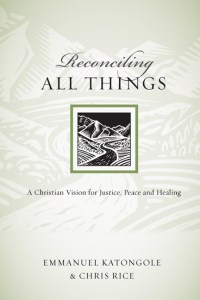
Reconciling All Things: A Christian Vision for Justice, Peace and Healing, more than any other book besides the Bible, has shaped my theological understanding of justice. Authors Emmanuel Katongole and Chris Rice develop a Christ-centered, Scripture-shaped, journey-oriented theology of justice reconciliation.
The authors urge that we slow down and take the time that is needed for true reconciliation—as a journey—to take hold. A question that permeates the book is, “Reconciliation toward what?” Katongole and Rice are aware that “reconciliation” calls to mind various “prevailing visions,” many of which lack theological rootedness in the Biblical story of God saving his people.
Reconciliation is, they suggest, a God-given gift to the world and the ultimate goal of the “journey with God from old toward new.” They write,
The journey of reconciliation hangs or falls on seeing Jesus. …For Christians, the compass for the journey of reconciliation is always pointing toward Jesus Christ.
Katongole and Rice make heavy use of Paul’s words to the Corinthians:
All this is from God, who reconciled us to himself through Christ and gave us the ministry of reconciliation: that God was reconciling the world to himself in Christ, not counting people’s sins against them. And he has committed to us the message of reconciliation. We are therefore Christ’s ambassadors, as though God were making his appeal through us. We implore you on Christ’s behalf: Be reconciled to God. (II Corinthians 5:18-20, TNIV)
Seen as a gift, then, reconciliation becomes something that is “not for experts only,” but something that God calls all his children to. To equip us for the journey God gives us gifts: a cloud of witnesses, communion, peace and harmony, Sabbath, and the gift of Scripture, which is to shape us as God’s story in the world.
Midway through the book the authors arrive at a biblically understood definition of justice:
Justice is an aspect of God’s shalom, a notion that carries with it the idea of completeness, soundness, well-being and prosperity, and includes every aspect of life—personal, relational and national.
Justice, they say, is to include the interpersonal, relational aspect; yet it must also attend to structural considerations. To speak about justice so holistically, against dichotomies that might otherwise render our work ineffective, is wise and instructive for our journey toward reconciliation.
Although written by a black, Catholic, African academician and a white, Protestant, American practitioner, the book does not specify what issues in reconciliation may occur between any two specific groups and how those groups (or individuals) might think about moving forward. The authors do give helpful anecdotal evidence of reconciliation that bridges and heals divides of race, class, and ethnicity. But the reader wanting, for example, to mend and redress the brokenness in black-white relations in the United States may have to look to supplemental reading for more practical hints.
However, in its development of a fairly robust theology of reconciliation and justice, Reconciling All Things lays the important groundwork on top of which such future work can be built. Its chapters on lament (“The Discipline of Lament”) and leadership (“The Heart, Spirit, and Life of Leadership”) are profound in their call for Christians to slow down, locate themselves (emotionally and physically) among the broken places of the world, and to mourn and lament in those places, together with those who mourn and lament.
The one who would lead, then, is less concerned with specific techniques, tools, and strategies, and more concerned with seeing a gap, being deeply moved in response, and belonging to the gap, long before she or he would make proposals to initiate change and issue directives. In laying this groundwork, Katongole and Rice actually leave the work of developing techniques and specific reconciliation “skills” to the reader.
In the end, “You find that God has surprised you and your companions over and over with all that you needed to go on….” The assurance of this ongoing gift of God’s provision gives the Christian who would practice reconciliation all she needs to begin discerning her role in practicing reconciliation in everyday life.
I bought this book. You should, too, or check it out from your local library. Here at Amazon; here at IVP.
There’s just one more day to enter to win a foldable bluetooth keyboard. Follow the link below for more details. The contest runs through 11:59 p.m. EDT, Monday, August 18.
School is starting soon. (Groans ensue.) But new school year, new possibilities, right?
Regardless of how you feel about going back, the start of a new school year is an occasion for prayer. One of the most popular Web searches that leads to this blog is “prayer for the first day of school,” which lands here.
Below is an adapted version of that prayer. It can be used responsively with your family, in a congregational worship setting, or individually. The prayer offers both gratitude and intercession to God at the beginning of the new academic year.
Prayer for the First Day of School
For the start of a new semester and all the promise that it holds:
We give you thanks, our God.
For the joy we have in seeing friends and teachers again:
We give you thanks, our God.
For those with whom we live and share meals:
We give you thanks, our God.
For the chance to come to you freely in prayer and worship:
We give you thanks, our God.
For all that we will learn, in the classroom, in labs, in practice rooms, in the library, on the field, in relationships, at school and away from it:
We give you thanks, our God.
For wisdom for all students, staff, and teachers, as they seek to offer their best in all they do:
Lord, please be near us.
For family relationships that now transition in their expression:
Lord, please be near us.
For perseverance and diligence in studies:
Lord, please be near us.
For healthy sleep patterns, motivation to play and exercise, and self-control in eating good, healthy foods:
Lord, please be near us.
For those areas of life in which we struggle, where we despair, and for those things of which we are ashamed:
One of the many things New Englanders are good at is taking a summer vacation. You see the evidence of this if you are driving on 128, 95, or 93 on a Sunday afternoon or evening, when everyone is coming back from a weekend or day away.
Nonetheless, our life’s work can easily take over if we’re not careful. We forget the truths of Psalm 127—that it is God who makes our work truly come alive. We do our work with a sort of Tower of Babel mentality… I’m just going to get this done really quick by myself.
Unless the Lord Builds….
Psalm 127:1-2 says:
Unless the LORD builds the house, its builders labor in vain. Unless the LORD watches over the city, the watchmen stand guard in vain. In vain you rise early and stay up late, toiling for food to eat— for he grants sleep to those he loves.
The other day I finished an intensive summer class on Cross Cultural Counseling. The final paper I turned in was in its 7th or 8th draft when I finally clicked the Send button to submit it to my professor.
So recently I can relate to “rise early and stay up late.” If your life’s work involves taking care of other people, early mornings or late nights when they are asleep might be your best time to work through your task list. These two verses don’t say not to do that. But they do caution us against squeezing more hours out of our day without deliberately inviting and acknowledging God’s presence in those working hours.
I can stand watch early over my work, but that work is good only because God stands watch with me. Work without God, Solomon says, is in vain.
Besides that, you need to sleep. God knows that. Sleep is part of the benefits package, if you will, of those who work with the God of Israel.
“He grants sleep to those he loves.” (I.e., to everyone.)
Our bodies have an amazing way of getting sleep when they need it. If we go for too long without enough sleep, our bodies just shut down. We may fall asleep involuntarily. This is one of the ways, I think, that God grants sleep to those he loves: When we’re tired enough, our bodies will sleep, whether we want them to or not. So you might as well get out of your chair or off the couch, brush your teeth, and get in your bed.
Why We Should Take a Sabbath
Another manifestation of God’s granting of sleep—rest—to the ones he loves is the gift of a Sabbath day. A Sabbath day of rest is part of the natural, biological rhythm that God set up from the very beginning of creation. God did his work—created the heavens and the earth, life and all that is in them—in six days. And on the seventh day, he rested. He didn’t do or create anything. Six days on, one day off.
We don’t need much intellectual convincing of the value of Sabbath-keeping. We know that practicing the Sabbath follows God’s pattern of six days on, one day off. (Work and rest, work and rest… not: work and work, work and work.)
We know that keeping a Sabbath re-orients us to God, in case we forgot about God during the rest of the week. We experience Sabbath as a gift of refreshment when we most need it, part of the full life that Jesus promised. (A Sabbath-less life is really only half a life.)
And who wants to eat what verse 2 of this Psalm calls “the bread of anxious toil”? We’ve ordered and eaten that dish, right? It’s disgusting. The bread of anxious toil leaves a bad aftertaste; it gives you heartburn.
Besides, we can’t really be productive 7 days a week anyway. Even multitasking doesn’t really give us an edge. A New York Times article says, “In fact, multitasking is a misnomer. In most situations, the person juggling e-mail, text messaging, [on] Facebook and [at] a meeting is really doing something called ‘rapid toggling between tasks,’ and is engaged in constant context switching.” We can’t just keep switching contexts and rapidly “[toggle] between tasks” for 7 days. That’s exhausting.
Sabbath: Not Just a Day, A Mindset
The practice and mentality and posture of Sabbath-keeping is not just for one day, but we can practice a Sabbath mindset in all of life, turning to God and acknowledging his presence in our work and in our rest, in our waking hours and in our sleeping hours.
Clement of Alexandria, one of those highly quotable early church dudes, said,
Practice husbandry if you’re a husbandman, but while you till your fields, know God. Sail the sea, you who are devoted to navigation, yet call the while on the heavenly pilot.
Here’s how The Message puts Jesus’ words in Matthew:
Are you tired? Worn out? Burned out…? Come to me. Get away with me and you’ll recover your life. I’ll show you how to take a real rest. Walk with me and work with me—watch how I do it. Learn the unforced rhythms of grace. I won’t lay anything heavy or ill-fitting on you. Keep company with me and you’ll learn to live freely and lightly.
That’s what we want. That sounds amazing. We need no convincing whatsoever of the value of Sabbath-keeping, both as a distinct day of the week and as an ongoing daily mindset.
Why We Don’t Keep Sabbath, Really: Internal Competing Values
And yet, we don’t take a Sabbath as we should. Or we do, but three days into the week, we forget to practice a daily Sabbath orientation toward God with complete reliance on him. We turn to our own inner resources to face our life’s work.
Euguene Peterson warns against “un-Sabbathed workplace” when he says,
[W]ithout a Sabbath…the workplace is soon emptied of any sense of the presence of God. The work itself becomes an end in itself. It is this ‘end in itself’ that makes an un-Sabbathed workplace a breeding ground for idols. We make idols in our workplaces when we reduce our relationships to functions that we can manage. We make idols in our workplaces when we reduce work to the dimensions of our egos and our control.
Why do we do this? We don’t really think about other people as just relationships to be managed, do we? We’re not really egomaniacs, right? At least, in the depths of our beings, we don’t want to live like that.
Is this as simple as just saying, “Okay, well, I guess we need to take a Sabbath more. We should practice a Sabbath mentality more often in our daily endeavors”? We’re just a forgetful and disobedient people and we need to obey to this 4th commandment.
There is some truth to that. But I don’t think it’s just disobedience or forgetfulness or laziness that leads to an un-Sabbathed life.
I think the main Christians don’t take a Sabbath, or don’t practice a daily Sabbath mentality, is because of our competing internal values.
Two educators at Harvard—Kegan and Lahey—have a diagnostic grid that I’ve found immensely helpful for unearthing my sometimes subtle competing values. It’s from their book How the Way We Talk Can Change the Way We Work.
The essence of their diagnostic is to begin with a commitment or value or belief—something where we say it’s really great if this happens. In this case, to adapt their language, “We are committed to the value or importance of… Sabbath-keeping,” both as a distinct day and as a mentality throughout the week.
Then we ask, “What are we doing or not doing that prevents this from happening?” So think for a moment, what are you doing or not doing that prevents Sabbath-keeping and rest from happening?
There may be some forces outside of your control—small children, an overbearing boss. But what are you doing that prevents a Sabbath rhythm in your life?
Underneath the answer to that question is a competing commitment or value or belief. Based on what I’m doing to undermine my Sabbath-keeping—checking email on a day off, not calling in anyone else for help–“I may also be committed to…” getting everything done myself and making sure it gets done right. Or, “I may also be committed to” just keeping going, because I have to.
Where Kegan and Lahey’s grid gets really fascinating is in what comes after you’ve unearthed your competing value. They suggest that each competing value carries with it a big assumption that may or may not be true.
If I don’t do this task, it will never get done, and there is no one else in the entire universe who can do it as well as I would.
Or, I’m committed to working 7 days a week (competing value), because (here’s the big assumption) if I stop and take a Sabbath, I’ll be so stressed out the day after the Sabbath with catching up, that it won’t have been worth it.
Or, if I slow down enough to practice a Sabbath mentality, I might become less productive.
Walter Bruegemmann talks about this kind of assumption as a scarcity mentality. He says:
There’s never enough time; there’s never a moment’s rest. … But how willing are we to practice Sabbath? A Sabbath spent catching up on chores we were too busy to do during the week is hardly a testimony to abundance. [It] does nothing to weaken the domain of scarcity. Honoring the Sabbath is a form of witness. It tells the world that ‘there is enough.’”
There is enough. There is enough time for us to stop on the 7th day, and to slow down on the other 6 days and to dwell in the watching presence of God.
It’s true that we have a bundle of competing values, commitments, and assumptions that keep us from fully practicing God’s call to a Sabbath rest.
But ultimately, a Sabbath way of life acknowledges that God is God and we are not.
God can and does complete building projects that we cannot finish. God can and does stay awake watching, guarding, protecting, so we can sleep.
A Modest Experiment: Four Weeks of Sabbath
Here’s the final square in Kegan and Lahey’s competing values diagnostic: Try “a modest, safe test.”
NO.
I had to pinch myself the other day when I saw a “Back to School” sign up at the store. Our summer just started! But we’re just a few weeks away from Labor Day.
It’s time to start planning your fall, if you haven’t already. And I would propose that as you do, you try a “modest, safe test,” with regard to Sabbath-keeping.
Plan a Sabbath each week for the next four weeks and keep it. Make it a Sabbath from technology. From your job. From household chores. And after four weeks, evaluate it. See how it went. See if all the things you thought would go wrong (if you took a break), actually did go wrong.
Or… see if you find yourself refreshed and living with a heightened awareness of God’s watching presence. See if you find the scarcity you feared… or, if you find instead an abundance of good gifts from the God who gives rest to the ones he loves.
I preached on Psalm 127:1-2 this last Sunday, from which the above is adapted. See my other Psalms sermons here.
If you are looking for a bluetooth (wireless) keyboard to pair with your mobile device or tablet, and would like a chance to win one for free, you’ve clicked on the right link.
I recently engaged in more than 20 hours of classroom lecture, using just an iPad mini and the bluetooth keyboard pictured above for note-taking. Everything I needed for the class could fit in my pocket:
I’ll post a full review of the keyboard soon. It was a welcome time-saver with a strong battery life, and easy to pair with my device.
It also, according to its product page, works with iPhone and Android devices.
The folks at iWerkz have offered me an additional keyboard (purple, as shown above) for giveaway here at Words on the Word.
Here’s how you can enter:
Simply comment on this blog post with a short sentence on how you’d use the keyboard. Or you can just say hi. For a second entry, share the link to this post on your Facebook, Twitter, via mind meld, etc., and let me know in the comments section that you did.
I’ll select the winner using a random number generator.
If you don’t want to wait for the results of the giveaway, you can find the keyboard on sale at Amazon here.
The giveaway is open through Monday, August 18, 11:59 p.m. EDT. On Tuesday I’ll notify the winner and post about it both here and in the comments below. (fine print: free shipping of keyboard to U.S. address only)
Yesterday I preached on Sabbath-keeping and what I think is the real reason it’s so hard for us to engage such a life-giving practice. As I’m reflecting further this week on cultivating a Sabbath-oriented mindset throughout my days, I remembered a book I read a few years ago that nourished me. It’s called Sabbath in the City: Sustaining Urban Pastoral Excellence.
Bryan P. Stone and Claire E. Wolfteich wrote this short yet compelling book on “what constitutes pastoral excellence in the urban context” and “what sustains it.” The authors use results from their project, “Sustaining Urban Pastoral Excellence,” which piloted a program of rest and renewal for 96 urban pastors across the country. According to Stone and Wolfteich, there are four primary activities or modes of being that make up pastoral excellence (which they also refer to as “virtue”):
The cultivation of holy, life-giving friendships, particularly with other pastors;
Regular Sabbath practices of rest that allow for acts of both creation and liberation;
A renewal of the spirit through disciplines like prayer, reading Scripture, and silence;
Study and reflection on the theology and practice of ministry (the authors tie this in with the above activity, renewal of the spirit).
While the authors note that pastoral excellence thus constituted is applicable to other, non-urban settings, they emphasize the uniqueness of the urban context and how it can challenge and fatigue urban pastors. They describe the city as “a place of distractions, busyness, and frenzied activity.” In contradistinction to more affluent suburban parishes, the urban church is likely to function as a full-service institution that addresses the variegated needs of the city in which it resides. The authors follow the group of 96 participants and show how the four practices listed above helped them to cultivate and sustain pastoral excellence.
Reading the book was itself an act of refreshment. Two aspects were most helpful to me:
First, the authors highlight the importance to pastors of cultivating holy, God-focused friendships. They write, “Friendships, then, are not simply a means of supporting a more healthy spiritual life. As some of the pastors in our project put it, ‘They are our spiritual life.’” The old African proverb is apropos here:
If you want to travel fast, travel alone. If you want to travel far, travel together.
Second, Sabbath-keeping is easier idealized than practiced. Stone and Wolfteich write,
[The] advice to accept the incompleteness of our work may be difficult to enact.
Though I didn’t have Sabbath in the City in mind at the time, the sermon I’ll post later this week interacts at length with this idea, i.e., why it is that we don’t take the Sabbath we know we want to take.
The book is intended for pastors in an urban setting, but even a suburban-dweller who is not involved in pastoral ministry will find rest and hope in Sabbath in the City.
You can find it on Amazon here and at Westminster John Knox Books here.
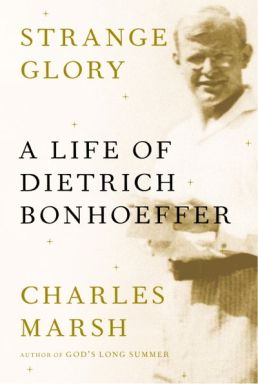
Was Bonhoeffer gay? That’s been a focus of inquiry and discussion since Charles Marsh has suggested the possibility in his new biography of Bonhoeffer, Strange Glory: A Life of Dietrich Bonhoeffer.
There is an excellent summary of the discussion from Sarah Pulliam Bailey here, which links to the major reviews of Strange Glory thus far, as well as offers insight on Bonhoeffer’s sexuality from a few Bonhoeffer scholars. (Her section heading “Speculation without confirmation” seems appropriate, though one could also question the appropriateness of the speculation itself.) There is also this New York Times review of the book, just published on the newspaper’s site today.
Wesley Hill offers some valuable and nuanced perspective (as does Charles Marsh, whom he quotes) in this post at the Spiritual Friendship blog.
Of course, Marsh’s biography covers much more territory than just the nature of Bonhoeffer’s relationship with Eberhard Bethge. I have the Marsh biography, though have yet to complete the Bethge biography. I look forward to reading Marsh firsthand soon.
The Biblia Hebraica Quinta (BHQ) will supercede the current scholarly edition of the Hebrew Bible, the Biblia Hebraica Stuttgartensia (BHS).
I reviewed the BHS module in Accordance Bible Software here, and posted at length about the BHQ here, if you want a primer. Short version: Emanuel Tov says it is “much richer in data, more mature, judicious and cautious than its predecessors. It heralds a very important step forward in the BH series,” though he notes that its notations are “more complex” and “less user-friendly for the non-expert.”
Here is BHQ on Amazon; here it is at Hendrickson Publishers’ site.
Hendrickson sent out an update today with the BHQ publishing schedule as it currently stands. Most volumes are “in preparation,” but the schedule (available here) notes that Ezekiel (ed. by Johan Lust) is coming in 2016 and Numbers (ed. by Martin Rösel) is coming in 2017.
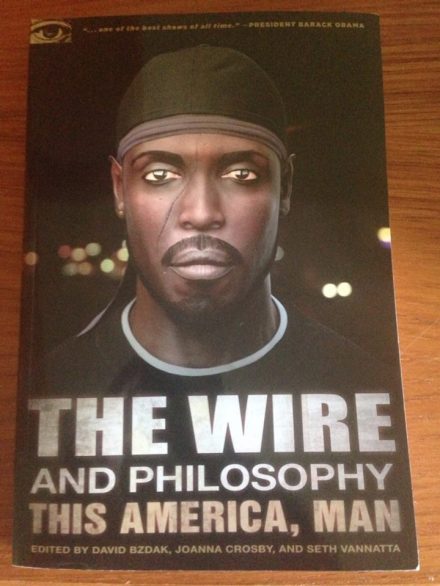
Coming soon to this blog… some interaction with The Wire. Stay tuned.
I’ll be linking to all kinds of writing and analysis of the show, offering my own thoughts here and there, and reviewing such works of literary creativity as this one:
Especially since Eerdmans has a large number of resources in production right now at Logos Bible Software, I’ve started paying more attention to Logos’s Pre-Publication program.
Logos puts titles into “Pre-Pub” to help gauge user interest in various resources. When users pre-order a resource, that helps to cover the cost of production. If/when enough users pre-order, the title goes into development and the user gets it at the discounted pre-pub price when it “ships” (i.e., when it is completed).
Here is a short description from Logos’s Pre-Pub About page:
Prices start low and increase over time so the sooner you pre-order, the less you pay. We don’t charge you until your pre-order is ready, and we’ll send you a reminder email a few weeks before. If you decide you don’t want the resource anymore, you can cancel your pre-order at any time.
Here is a compilation of the newest Pre-Pub titles. (This one from Oxford University Press is pricey but looks good; here is When God Spoke Greek, which had enough pre-pub orders that it’s already under development and will probably ship within a month.)
Here is the Pre-Pub list sorted by Progress or “ship date,” so you can see which ones are almost ready to go–with the pre-order discount still applying, at least for now. There’s a bunch of Eerdmans stuff that will go out on August 6, including this collection that looks especially useful to pastors, including the book that is pictured above.
Here’s a short overview video of how Pre-Pub in Logos works:

 I had a seminary professor who rightly noted the lack of ministers and churchgoers with a fully developed theology of justice.
 Although written by a black, Catholic, African academician and a white, Protestant, American practitioner, the book does not specify what issues in reconciliation may occur between any two specific groups and how those groups (or individuals) might think about moving forward. The authors do give helpful anecdotal evidence of reconciliation that bridges and heals divides of race, class, and ethnicity. But the reader wanting, for example, to mend and redress the brokenness in black-white relations in the United States may have to look to supplemental reading for more practical hints.



 We don’t need much intellectual convincing of the value of Sabbath-keeping. We know that practicing the Sabbath follows God’s pattern of six days on, one day off. (Work and rest, work and rest… not: work and work, work and work.)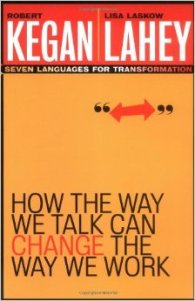











 Words on the Word