Scientifically Unproven But Pragmatically Effective Parenting Bedtime Pro Tip

I don’t remember where we first read this parenting advice, so I can’t guarantee its scientific backing, but here it is anyway.

Keep calm and sleepWhen your (hypothetical) six-year-old child is talking and singing to himself in bed at night–after you’ve put him to bed–as long as he’s not keeping his (hypothetical) siblings up… let him talk and sing.

Why? Because he’s processing his day in the ways he knows how. And if this (hypothetical) six-year-old son is in all-day kindergarten this year and has just moved this summer, that processing time is important to his development and well-being.

So we let our (not hypothetical) six-year-old son talk and sing after we put him to bed, as long as it’s quiet, and as long as it doesn’t go on for more than a half hour.

More times than not, he’s done in about 15-20 minutes and then fast asleep. And we haven’t gotten upset or into a verbal struggle with him. And–most important–he’s had some added processing time before he goes to bed.

Accordance Turns 20 (with a $20 Module Sale)

Accordance 20 years

Accordance Bible Software is 20 years old this month. Click here to see their celebration page.

They’re offering a host of 20 modules at $20 each in a 24-hour-sale that has been going on today. There were a couple of things that had been on my wish list for a while that I picked up this morning. Tomorrow (Friday, March 21) will introduce 20 more modules at the same price.

Praise to the Lord, the Almighty (Guitar Chord Charts for Hymns)

Hymnal

Praise to the Lord, the Almighty has always been one of my favorite hymns. Here (pdf) is a chord chart I put together for the hymn, in case you’ve been Googling “Praise to the Lord, the Almighty guitar chord charts” and haven’t found anything yet. Not all hymnals have chords, so hopefully this can be of help to some worship leaders.

Tuesdays in Lent with Bonhoeffer: His Early Life

Bethge_Bonhoeffer BioUntil recently I haven’t known much about Dietrich Bonhoeffer’s life, let alone his early years. I’m working my way through Eberhard Bethge’s thousand-page biography of Bonhoeffer. I’ve just finished reading about his early years and his first year as a university student.

Bonhoeffer was born on February 4, 1906. He was a twin (Sabine was his twin sister). Including Dietrich, there were eight (!) Bonhoeffer children. The death of his older brother Walter in World War I “left an indelible mark,” as Bethge tells it, on the 12-year-old Dietrich and his family–especially his mother.

Bethge describes a Bonhoeffer family who had money (servants, a summer home, a large house) but who were by no means ostentatious. Nor were the children spoiled, according to Bonhoeffer’s biographer. He writes:

The children’s day followed a disciplined pattern; they always knew where they were, and the routine never struck them as restrictive, for they also knew that their parents arranged happy surprises and outings every now and then.

Dietrich was a talented pianist and played the lute, so well that “for a time both he and his parents thought he might become a professional musician.”

At the age of 17, Bonhoeffer went to the University of Tübingen for a year, where his father had gone. Bethge notes that Bonhoeffer’s “priority was philosophy.” The prologue of the Gospel of John especially interested Bonhoeffer, who also took classes on the Psalms and Old Testament theology, among others. But primarily his foundation in that first year was philosophical:

That indeed summed up Dietrich’s year in Tübingen. It was characterized by his wide range of interest, without a firm commitment to any particular area, and by a persistent exploration of the epistemological field.

Bonhoeffer would continue his education at Berlin, beginning his dissertation at the age of 19 and completing it in a year and a half. He successfully defended that work at the age of 21.

This is the second post in “Tuesdays in Lent with Bonhoeffer.” See the first one (on forgiveness) here. I describe the series more here. Bethge’s biography of Bonhoeffer can be found here (Amazon affiliate link) or here

The Gospel of Matthew: A Socio-Rhetorical Commentary

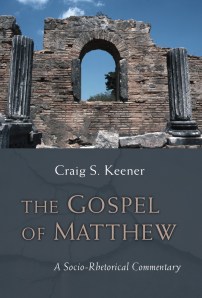
Craig S. Keener’s Gospel of Matthew: A Socio-Rhetorical Commentary utilizes two particular approaches to Matthew:

[A]nalysis of the social-historical contexts of Matthew and his traditions on one hand, and pericope-by-pericope suggestions concerning the nature of Matthew’s exhortations to his Christian audience on the other.

Keener is behind the ever-useful IVP Bible Background Commentary, now in a revised edition. And his exegetical commentary on the first two chapters of Acts is more than 1,000 pages, not counting the bibliography and indeces. Quantity does not always mean quality–it’s harder to write less than more, most of the time–but one can rightly expect Keener to be both thorough and insightful.

Let me jump right in with why I like (and trust) his Matthew commentary.

Layout Matters

The Gospel of Matthew is one of the best laid out commentaries I’ve used. The section on the Lord’s Prayer (“The Kingdom Prayer,” as Keener has it) is a good example. There’s a bold heading with an introduction to the prayer. Here Keener compares the prayer in Matthew to the version in Luke, while offering explanations as to why the two forms differ slightly. Then Keener goes through the passage phrase-by-phrase in eight parts, with the summary statement for each of the parts in bold.
Keener on Matthew

For example, he writes, “Second, the prayer seeks first God’s glory, not the petitioner’s own needs….” Then he uses italics for key questions or insights in each of the eight parts of the prayer. As here: “What did it mean in a first-century Jewish context for God’s name to be hallowed in the future?

The result is a commentary that is highly scannable and readable. Just the simple use of bold and italics, throughout the book, helps orient the reader to what Keener is doing–not to mention offers some really good ideas for how to preach or teach on the text. The layout also makes it easy to get a quick, cursory overview of how Keener understands a given passage.

Matthew, According to Keener

Keener’s humility is refreshing, as he writes that, “in contrast to [his] earlier opinion,” he is:

therefore presently inclined to accept the possibility of Matthean authorship on some level, although with admitted uncertainty. Perhaps the most probable scenario that incorporates the best of all the currently available evidence is the presence of at least a significant deposit of Matthean tradition in this Gospel, edited by the sort of Matthean school scholars have often suggested (though I believe the final product is the work of a single author, not a “committee”).

His judicious weighing of the consideration for and against actual Matthean authorship will allow the reader to have an informed opinion. Does it matter?

Yet what we do conclude about the author does affect our understanding of the Gospel. Matthew is clearly Jewish, in dialogue with contemporary Jewish thought, and skilled in traditional Jewish interpretation of the Old Testament…. Matthew also knows the context of his citations much better than many modern readers have supposed…, and he demonstrates familiarity with a variety of text-types….

On author and intended audience, Keener concludes:

Concurring with the perspectives of what is still probably the minority view, I find in the Gospel an author and audience intensely committed to their heritage in Judaism while struggling with those they believe to be its illegitimate spokespersons. On this reading, Matthew writes to Jewish Christians who, in addition to being part of their assemblies as believers in Jesus, are fighting to remain part of their local synagogue communities.

The introductory material covers the rest of the expected territory: dating, rhetoric, social settings, Gospel sources, the use of narratives in the early church, structure, and more. I found the introductory sections on Jesus (as teacher, as prophet-healer, as Messiah/King, as Son of God) especially illuminating for understanding Matthew as a whole. Keener also has a couple pages upfront about Matthew’s important “Kingdom of Heaven” theme, including this gem:

In short, the present significance of the future kingdom in early Christian teaching was thus that God’s people in the present age were citizens of the coming age, people whose identity was determined by what Jesus had done and what they would be, not by what they had been or by their status in the world.

Though the commentary is academic in nature, it also “will preach” pretty well, as Keener’s lines above make clear.

A Few More Highlights

As soon as picking up the commentary, one will want to read the Excursus on Pharisees (p. 538) and Excursus: Was Jesus Executed on Passover? (p. 622).

One should not expect to find lexical or grammatical comments on each keyword or phrase in Matthew. The comments on Matthew 6:25-34, for example, do not address the meaning of the oft-repeated “worry.” Keener points out that Jesus utilizes the Jewish qal wahomer (“How much more?”) argument to show God’s care for “people in his image and for his own beloved children.” That insight itself is in most commentaries already, but Keener goes further and covers yet more rhetorical territory:

Greek philosophers sometimes disdained such bodily needs altogether, complaining that their bodies were prisons because they were dependent on food and drink (Epict. Disc. 1.9.12) and advising that one turn one’s mind to higher pursuits (Marc. Aur. 7.16). …Jesus never condemns people for recognizing these basic needs…. Yet he calls them to depend on God for their daily sustenance, a provision that Jewish people considered one of God’s greatest miracles….

Keener consistently breaks passages down into main points, which helped me see both the flow of Matthew’s narrative and think about how I could apply each passage. For example, in Matthew 20:29-34 (“Persistent Prayer”) two blind men receive their sight when Jesus’ compassion leads him to heal them. Keener’s four sentences in bold (with a paragraph explanation after each) are:

First, these suppliants recognized the identity and authority of the one whose help they entreated (20:30).

Second, they refused to let others’ priorities deter them (20:31).

Third, Jesus’ compassion was the ultimate motivation for his acting (20:34).

Finally, recipients of Jesus’ gifts should follow him (20:34).

This 2009 edition is not essentially different from Keener’s 1999 Commentary on the Gospel of Matthew. (I.e., the Socio-Rhetorical Commentary is not a revised edition, per se.) There is, however, an addendum at the front of the commentary called, “Matthew and Greco-Roman Rhetoric.” Here Keener goes chapter-by-chapter through the book of Matthew and adds his recent insights into how Jesus and Matthew make use of known rhetorical practices in their teaching and writing, respectively. In the end, though, Keener finds that Jewish rhetoric offers “much closer analogies…than Greek or Roman rhetorical handbooks do.”

Finally, if you’ll permit me one more quotation of Prof. Keener, here is an example of the inspiring nature of his commentary:

But above all the teaching towers the figure of Jesus himself: King, Messiah, Son of Man, the rightful Lord of Israel whom their people would one day acknowledge (1:21; 23:39). The final judge, the true revelation of the Father (11:27), was the meek and lowly One who had walked among the first disciples and died for his people (11:29; 20:28; 21:5), the One who would also empower Matthew’s readers to fulfill the task he had given them (10:19-20; 11:28-30).

Bonus: The Bibliography

It may be strange to praise a book for its bibliography, but Keener offers 150 pages of bibliography on Matthew. Keener seems to not leave any stone unturned, whether it’s another commentary, monographs, or journal articles. He writes, “The purpose of this commentary does not allow me to summarize and interact in detail with all secondary sources on Matthean research.” And yet one would be hard-pressed to find a more thorough list of secondary sources for Matthew elsewhere. In this regard, Keener is successful in offering a commentary that “will contribute to further research.”

The reader should realize that, as noted above, though this commentary was published in 2009, it was not really a revision of the 1999 volume, so the bibliography has not been brought into the 21st century with any updates. (So Nolland and France, for example, are not listed.)

The commentary’s Index of Ancient Sources is 142 pages, taken “from a variety of narrative genres to illustrate Matthew’s narrative techniques, with special attention to ancient biography and historiography.” Copious references throughout the commentary give the researcher multiple good leads.

For all of Keener’s thoroughness, the use of bold and italics for main points keeps the commentary well-organized, so that the research does not become overwhelming. Keener’s heart seems to be pastoral, and his reverence toward the Jesus of Matthew is clear and an inspiration throughout the commentary.

You don’t need any Greek to use this commentary, but a good cup of coffee and a full night’s rest might help, as it can be dense and detailed (but not impenetrable) in places. The reader of Matthew who is willing to work at Keener’s commentary will be rewarded. This volume has already vaulted its way into my top four Matthew commentaries.

Thanks to Eerdmans for the review copy. You can find the book’s product page here. It is on Amazon here. Amazon links above are affiliate links, described further here.

Grammar of Septuagint Greek

Grammar of Septuagint Greek

A book that I desire to delve into more deeply is Conybeare and Stock’s Grammar of Septuagint Greek. The grammar itself is short, and still leaves to be desired a fuller grammar of Septuagint Greek. But the selected readings have Septuagint text with reading helps at the bottom of each page, and make for a nice bridge into reading Old Testament Greek. The readings section looks like this (click to enlarge):

From the reading on Joseph

You can access the whole book for free (and legally) here. The format there is a little unwieldy, so you might also consider checking it out in print (affiliate link).

The grammar is pretty dense, and feels sparse in places, but I haven’t had a chance to examine the book thoroughly yet. The selected readings have helped me in improving my Greek, though. It’s recommended reading on this Septuagint Sunday.


The LEGO Movie

A couple weeks ago I took my six-year-old son to his first ever movie at a theater–The LEGO Movie. He loved it.

There were a couple scenes that were maybe a little too intense for a six-year-old, and a wee bit of potty language (he doesn’t need any encouragement), but other than that, it was a movie I could feel good about taking him to. It’s funny, fast-moving, and has incredible animation. There are clearly a lot of creative minds behind the movie.

Here’s the trailer:

You might even like it if you’re a grown-up.

Matthew (Zondervan ECNT), reviewed

Matthew ZECNT

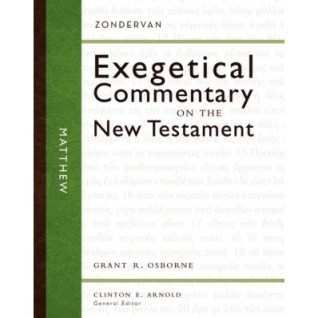
Now that I’ve been preaching through the early sections of Matthew for 10 weeks, I’ve had a chance to make regular use of a number of commentaries. I continue to value Zondervan’s Exegetical Commentary on the New Testament. Its Matthew volume is very much on par with the rest of the series (which I’ve reviewed here, here, and here). Author Grant R. Osborne primarily intends it for preachers, but I’ve seen it assigned as a seminary textbook, as well.

ZECNT Layout

Matthew, like the rest of the ZECNT series, includes:

  • The full Greek text of Matthew, verse by verse, or often split up phrase by phrase
  • The author’s English translation
    • First, appearing in the graphical layout for the entire passage
    • Second, verse by verse or phrase by phrase, next to the Greek
  • Matthew’s broader Literary Context for each passage
  • An outline of the passage in its immediately surrounding context
  • The Main Idea (probably the first place preachers would want to look)
  • Structure and Literary Form (with focus on source criticism)
  • A more detailed Exegetical Outline of the passage under consideration
  • Explanation of the Text, which includes the Greek and English mentioned above, as well as the commentary proper
  • A concluding Theology in Application section

This sounds like a lot, but the result is not a cluttered commentary. Rather, as one gets accustomed to the series format, it becomes easy to quickly find specific information about a passage. The section headings are in large, bold font.

The Greek font is aesthetically pleasing and readable. Here’s a picture:

ZECNT font

Osborne’s Introduction to Matthew

For a commentary of more than 1,000 pages, the introduction is surprisingly short (27 pages). Seven of those pages are a section called, “How to Study and Preach the Gospel of Matthew.” Osborne acknowledges,

[T]he details I chose to include in this commentary, both exegetical and theological, were chosen on the basis of one major question: What would I want to know as a pastor preparing a sermon on this passage?

So it’s fitting that he speaks directly to preachers at the very beginning of his introduction. He suggests understanding the Gospels as “history seen through theological eyes” and encourages the preacher to try to grasp the distinct “theological purposes of each [Gospel] author.”

Though the introduction is short, and someone doing extended work on Matthew will need to also look elsewhere for introductory concerns, Osborne is able to give an informative enough overview of dating, authorship, genre, purpose, audience (the thinnest subject in the introduction), sources, history, Matthew’s use of the Old Testament, and structure.

There are also more than 20 pages at the end of the commentary that cover the theology of Matthew. Although that section is tucked away, it’s not to be missed, especially Osborne’s coverage of Christology and of discipleship.

The Commentary Proper: Highlights and Observations

There is just enough Greek (grammar and word studies) to keep one’s Greek sharp. There’s not the level of detail found in the Baylor Handbook on the Greek Text series, which does not yet have a Matthew volume.

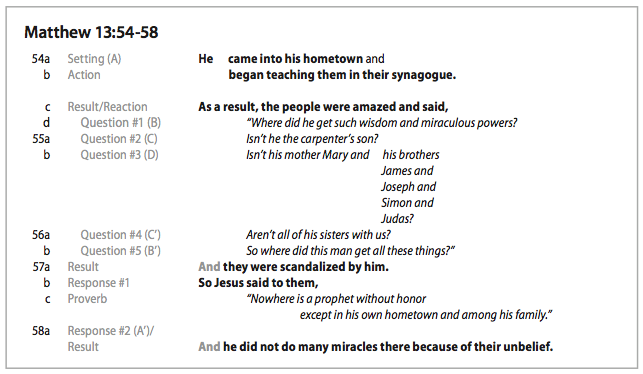
Matthew 13:54 begins, “He came into his hometown and began teaching (ἐδίδασκεν) them in their synagogue.” In the commentary you’ll find comments like this one:

The imperfect ἐδίδασκεν could refer to an ongoing practice but is probably ingressive, “began teaching” on this occasion (as in v. 8).

Osborne is sensitive to larger biblical context and theology–even in explaining individual words–so that one gets, for example, a fairly robust explanation of the “righteousness” Jesus talks about fulfilling in Matthew 3:15. And here is Osborne’s take on the “peacemakers” that Jesus calls blessed in 5:9:

The term “peacemaker” only appears elsewhere in verb form in Col 1:20, where Jesus made peace by his blood on the cross, but the concept is found often (Ps 34:14; Isa 52:7; Rom 12:18; 14:19; Jas 3:18; Heb 12:14; cf. 1 En. 52:11). This connotes both peace with God and peace between people—the latter flows out of the former. Jesus is the supreme peacemaker, who reconciles human beings with God through the cross (Col 1:20), so the supreme peacemaking is the proclamation of the gospel.

The graphical layout remains one of my favorite parts of the series. Look at Matthew 13:54-58 (from which the comment above is taken):

ZECNT passage flow

It’s readily apparent how Osborne sees the parts of a passage working together and relating to one another.

By way of critique, even with the commentary’s length there were times when I wanted more coverage. The “Explanation of the Text” section for Matthew 5:38-42, for example, barely covered two pages. The single paragraph on “turn the other cheek” addressed the main points that most other commentaries do, but given how many Christians have wrestled through this important passage (both on paper and in action), more could have been said.

Conclusion

Osborne succeeds in keeping the preacher in view throughout the commentary. I’ll give one last example, since this typifies Osborne’s blend of research and presentation in a way that will both assist and inspire preachers and teachers. In Matthew (and Luke) the Lord’s Prayer that Jesus gives his disciples to pray does not have the ending it does when prayed in liturgical settings (“for thine is the kingdom…”). Whether this should make it into a sermon or not is another question, but Osborne anticipates that readers and preachers will at least be wondering about it. He writes:

The traditional doxology (“for yours is the kingdom and the power and the glory forever. Amen”) appears in only a few late manuscripts (L W Θ 0233 et al.), and several of the best manuscripts end here (א B D Z et al.), with a variety of endings in others. This makes it almost certain that it is not original. It is possible that churches added their own doxology when praying this prayer, and this one emerged as the best summary of the contents of the prayer. However, it (and the other endings) is based on 1 Chr 29:11 – 13 and is meaningful, so it is not wrong to utter the ending as a personal prayer.

Where does the Matthew ZECNT volume rate among Matthew commentaries for preachers? Definitely toward the top. I still go to R.T. France’s NICNT volume first. And for Greek and history of interpretation, John Nolland (NIGTC) covers more territory. But Osborne’s constant eye on the larger literary context, the detailed structural outlines, the inclusion of Greek and English texts, the Theology in Application sections, and the graphical layout make his commentary a welcome guide for preaching and teaching through the First Gospel.

Thanks to Zondervan for the review copy. You can find the book’s product page here. It is on Amazon here. Amazon links above are affiliate links that help further the work of this blog, described here.

Tuesdays in Lent with Bonhoeffer: Forgiveness

Bonhoeffer Collected SermonsOn November 17, 1935, Dietrich Bonhoeffer preached at the gymnasium-turned-chapel of the Finkenwalde Preachers’ Seminary. His text was Matthew 18:21-35. In this “Parable of the Unmerciful Servant,” Peter asks Jesus how many times he should forgive the person who sins against him. I imagine Peter is already mustering all he can, and maybe even now proud of himself, when he asks, “Lord, how many times shall I forgive my brother or sister who sins against me? Up to seven times?”

Seven times to forgive the same person! Peter thinks that’s a lot and we probably do, too. (Haven’t they figured out by now how to stop hurting me?) But if God has forgiven us our “debts,” as Jesus’ parable shows, we are to forgive others their debts. Though this is 12 chapters removed from the Lord’s Prayer of Matthew 6, I can’t help but wonder if this isn’t some sort of extended riffing on “forgive us our debts, as we forgive our debtors.”

Both this parable and the Lord’s Prayer conclude with fairly stern words. Here’s Matthew 18:

34 In anger his master handed him over to the jailers to be tortured, until he should pay back all he owed.

35 This is how my heavenly Father will treat each of you unless you forgive your brother or sister from your heart.

Here’s the conclusion Matthew has Jesus making from the Lord’s Prayer in Matthew 6:

14 For if you forgive other people when they sin against you, your heavenly Father will also forgive you. 15 But if you do not forgive others their sins, your Father will not forgive your sins.

I don’t know whether Bonhoeffer did this deliberately or not, but I’m struck that in his sermon on Matthew 18, he adopts a similarly direct tone. He begins invitingly enough:

Right here at the beginning of this sermon, let us quietly and honestly ask whether we know anyone from our own circle of friends and family whom we have not forgiven for some wrong that person might have done us; a person from whom we once separated ourselves in anger—perhaps not even in open anger, but in quiet bitterness, thinking: I cannot stand it any longer; I can no longer have anything to do with this person.

I wish I could have been there. Because I really want to know how long he paused before he preached next:

Or are we really so inattentive that we say we do not know anyone like this? Are we so indifferent to other people that we do not even know whether we are living in peace or at odds with them? Whether one after another may not someday stand up and accuse us, saying: You separated yourself from me in discord—you could not tolerate me—you broke off fellowship with me—you found me unsympathetic and turned away from me—I once did you wrong, and you left me alone—I once wounded your honor, and you broke with me—and I could not find you again—I often looked for you, but you avoided me—and we never spoke frankly with each other again, but I wanted nothing more from you than your forgiveness, and yet you were never able to forgive me. Here I am now, and I am accusing you—do you still even know me?—Whether or not in that particular hour names will come back to us that we hardly recognize anymore— many, many wounded, rejected, poor souls whose sin we did not forgive. And among these people perhaps even a good friend, a brother or a sister, one of our parents?

Ahem. It’s getting awfully dusty in here! you can hear Bonhoeffer’s seminarians say.

From here Bonhoeffer unpacks the rest of the passage. We are to identify with the “roguish slave” of Jesus’ parable, he says. We can see other people’s sins, but we are blind to our own.

What hope do we have, then?

Here is a single sentence (at least in its English translation) in the sermon’s final paragraph. Its length would probably lead my erstwhile preaching professor to several uses of the proverbial red pen, but do read it slowly:

My dear friends, those who have experienced what it means for God to lift us up out of a great sin and to forgive us, those to whom God has in such an hour sent another brother or sister to whom we might then confess our sin, whoever knows how a sinner resists such help because the sinner simply does not want to be helped, and whoever nonetheless has experienced how a brother or sister genuinely can release us from our sin in God’s name and in prayer—that person will surely lose all inclination to judge or to hold grudges and will instead want but one thing: to help bear the distress of others, to serve, to help, to forgive—without measure, without qualification, without end—such a one can no longer hate sinful brothers and sisters, but will instead want only to love him all the more and to forgive them for everything, everything.

May God lead us, who have been forgiven so much, to be merciful toward others.

Tuesdays in Lent with Bonhoeffer

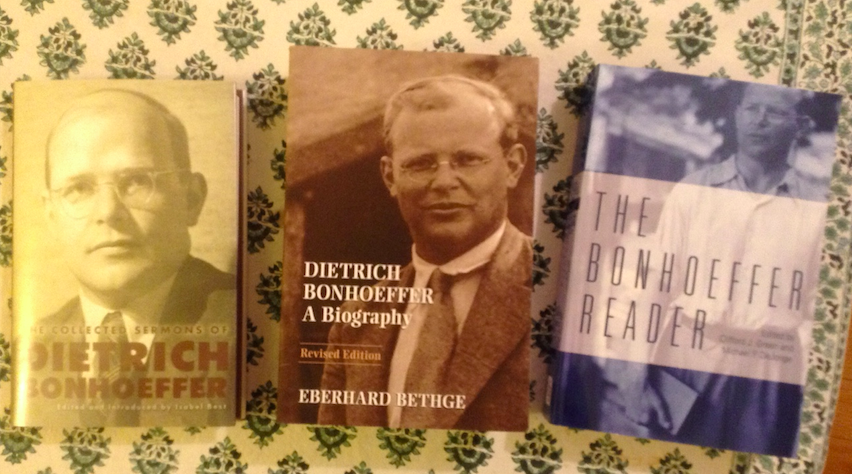
Three Lenten companions

I’m late to the Bonhoeffer party, but now I see what everyone’s been talking about. What a guy. I’ve had his Discipleship before me as I’ve worked my way through the Sermon on the Mount (see here). I interacted with his thought at greater length here, wondering how he might read “turn the other cheek” in light of Russia’s occupation of Ukraine.

Fortress Press has sent me the above three volumes for review at Words on the Word. I will review them, in due time, but I’m posting now to say: on Tuesdays during Lent I’ll post something Bonhoeffer-related. It may be as short as a quotation, or it may be as long as a mini-essay in which I interact with some facet of his life or writing.

Tuesdays are my day off, so while Bonhoeffer has very much been informing my preaching on Matthew so far, what I post here in coming weeks will not necessarily relate to (my) preaching. One of his books I’ll interact with is his Collected Sermons, however.

If you scroll back up to the top of this post, to the right, just under the search bar, is a subscribe option you can select to receive notifications of new posts. Just type in your email address (it won’t get shared elsewhere) and then click Subscribe/Follow. You can also follow Words on the Word via Facebook here.

I’m looking forward to interacting with more Bonhoeffer in the coming weeks. Check back again tomorrow for the first Tuesday in Lent with Bonhoeffer.

UPDATE: Here is the first post, on Bonhoeffer on forgiveness.