
Check out the June “Carnival of Biblical Studies” (a compilation of many, many posts on all things Biblical studies on the blogosphere in June). I’m grateful to have been mentioned!
Tag: Bible

Magnificent Monograph Monday: The Later New Testament Writings and Scripture, Reviewed
 Eisegesis. Not a label most evangelical Biblical interpreters want to wear. If exegesis is drawing the meaning out of a text–with a careful eye toward its original context and authorial intention–eisegesis is taking one’s own set of meanings and intentions into the text. Evangelical scholars aim to practice the former and avoid the latter, although of course everyone comes to any text with some presuppositions. (And new hermeneutics like reader response criticism may see this as a good thing anyway.)
My seminary teaches an exegetical method that majors on reading a text in its original context and understanding its original purpose. I’ve often thought that if New Testament writers submitted any of their works as exegesis papers, they’d fail because of the various “hermeneutical fallacies” they commit! It seems that New Testament writers freely appropriate or proof-text Old Testament passages for their own purposes, no matter the original context or intention of the passage at hand. They might even be accused of eisegesis, were they employing their methods today.
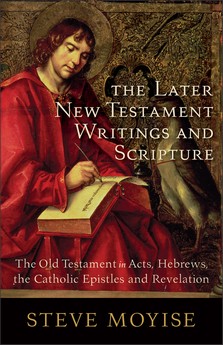
Baker Academic has just published the third volume of Steve Moyises’s de facto trilogy, in which he examines how Jesus, Paul, and the later New Testament writers use Scripture. He seeks to “give an account of” and “consider the use of Scripture” in the later NT writings. This is a “study” of “important engagements with Scripture.”
Just picking up the book before reading it was a pleasure–the layout is great, the paper quality is high, the font is clear and easy to read, and the cover design is appealing. Especially for a paperback, it’s an attractive volume to have on a bookshelf. (I note here that I received a free copy from Baker in exchange for an unbiased review.)
Moyise treats Acts, 1 Peter, Jude/2 Peter, James, Hebrews, Revelation, and includes a brief excursus on 1-3 John. He is thorough in the Scriptures he treats, which is especially aided by a UBS index in the back that serves as an index of all the quotations of the Old Testament in the above books. (There are full Scripture and author/subject indeces, too.)
The author groups the Scriptures thematically or by Old Testament book, rather than going verse by verse through each of the New Testament writings under consideration. In Acts, for example, he considers how the author Luke uses Old Testament Scripture to address themes like “Salvation for Jews and Gentiles,” “Christ’s death, resurrection, and exaltation,” “Judgement,” and so on. In 1 Peter Moyise has sections devoted to I Peter’s use of the Psalms, of Isaiah, etc. Moyise does this so as not to “miss the wood for the trees,” and he is successful. The reader, then, can conclude each portion of the book with a solid overview of how each NT writer uses the OT.
The text is accessible to a non-scholar or non-specialist in this field. For example, Moyise explains on p. 4:
[I]n some cases the New Testament authors appear to know a version of the text that differs from the majority of manuscripts that have come down to us. The discovery of the Dead Sea Scrolls (1948–) has shown that the biblical text existed in several forms in the first century and it is not always clear which form is being quoted.
He uses gray shaded boxes at various points to succinctly explain key concepts such as “typological interpretation” or to address things like 2 Peter’s use of the largely unknown 1 Enoch. The endnotes include more textual details and point the reader in the direction of the scholarly writings about each book. One does not need knowledge of the original language to read Moyise, but he does at times use transliteration of various Greek words if it helps his explanation.
The potential reader might be concerned that a book about intertextuality could end up as just a dry list of references. Moyise does thoroughly catalog the quoted OT passages, yet he draws conclusions from such use, as well:
Although James’s use of Scripture is not christological in a doctrinal sense, it bears comparison with Jesus’ own interpretation of the law, particularly his emphasis on seeing the law in the light of the twin commands to love God and neighbour. (63)
Moyise presents various interpretations in an even-handed, balanced way. I felt more than once like I was reading R.T. France, a favorite commentator of mine. He includes, too, the full text of many of the verses he cites, eliminating the need to flip back and forth through other reference works while reading this one. Jude and 2 Peter have a helpful table of comparisons where the two are lined up side-by-side, and this feature is present for other passages also.
There were a couple times where I thought Moyise might be guilty of the fallacy of post hoc ergo propter hoc (inferring causation just because one thing chronologically follows the other). In Revelation, for example (which he notes quotes no Scripture explicitly but is full of allusions), he speaks in terms of the “source” of (129, 137) or “inspiration behind” (130) John’s descriptions of his visions. My response to this was–just because John’s language has much in common with the Scriptures that came before him, do they therefore have to be his source? What if his source was, in fact, the vision he had, and he just used Scriptural language to express it?
Finally in the conclusion to his section on Revelation, Moyise addresses this very question. In fact, he is quite aware of questions like mine, and in the end treats it thoroughly and fairly, citing those who advocate a “scribal model” (where John is said to have basically just compiled Scriptures into a new presentation) and those who advocate a “rhetorical model” (where John uses OT language to express something new that he actually saw).
My question about whether or not NT writers are in some sense eisegetes is not an uncommon one. Students often ask: If we’re not supposed to handle Scripture that way, how can they? Though Moyise doesn’t necessarily set out to answer that question in this volume, he answers it beautifully:
The important point in all this is that the Scriptures did not exist in a vacuum. They were part of a living tradition where text and interpretation were transmitted together. (148)
In describing Revelation’s use of Daniel, for example, he says it is “not necessarily an ‘improper’ use of Scripture but hardly what Daniel had in mind” (140).
Moyise (87) quotes Susan E. Docherty from her book The Use of the Old Testament in Hebrews:
The author of Hebrews as much as any ancient Jewish exegete…regarded it as legitimate interpretation to seek out what scriptural texts imply as much as what they actually say, presumably believing that the new meaning he gave them was inherent in the original revelation, which he regarded as having endless depths of meaning and real contemporary relevance.
That Moyise’s trilogy of books on NT use of Scripture exists is a testament to the depth of Scripture. Moyise is a fantastic guide for exploring what can be confusing and difficult territory.
(Here’s the book at Amazon.)
Share this:

Junia is Not Alone: Review of Scot McKnight
 In Junia is Not Alone, Scot McKnight asks, “Why are we so obsessed with studying the ‘subordination’ of women to men but not a woman like Deborah, who subordinated men and enemies?” And, “Why is there so much silence in the church about the women in the Bible?”
Noting how few of his students (i.e., none) had heard of Junia and other women in the Bible, he dedicates his short ebook to “ending the church’s deafening silence on women in the Bible.”
Junia “appears innocently enough” in just one verse of the New Testament, Romans 16:7, “alongside her husband, Andronicus.” (See my Junia post here.) McNight goes on to say that Junia “had no idea she would someday be the subject of endless discussions,” although unfortunately his own discussion of her ends pretty quickly.
On the bright side, McKnight does what often goes undone in conversations about the apostle Junia–he explains what the term “apostle” means in Romans 16:7. He writes,
So, we conclude that there was a first-century relative of the apostle Paul named Junia; she entered into Christ before Paul did; and this Junia was an apostle. Which means (because this is what apostles did) she was in essence a Christ-experiencing, Christ-representing, church-establishing, probably miracle-working, missionizing woman who preached the gospel and taught the church.
Nice. Unfortunately, however, readers who are looking for anything else about Junia will be disappointed. Of course there is only the one Bible verse that mentions her, and no other first century documents where she is known to appear (although someone please correct me if I am wrong?). But there is a long history of interpretation and textual criticism around “Junia” and Romans 16:7, which I would have liked to see McKnight delve into a bit more. As it is he merely favorably summarizes the conclusions of Eldon J. Epp (the text does read “Junia,” not a male “Junias”; she was an actual apostle).
In addition to Junia, McKnight mentions other women in the Bible–Priscilla, Mary, Phoebe, Deborah, Miriam. Although his listing these women and briefly discussing their ministry is helpful, he says very little about each (Miriam: led Israel in song). Perhaps this is due to the nature of a deliberately short ebook, but I was left wanting more.
McKnight helpfully traces the history of the Greek New Testament editions, and how “Junia” became “Junias.” But his conclusion feels dramatic:
The editors of Greek New Testaments killed Junia. They killed her by silencing her into non-existence.
All I could think about after reading that line was Dan in Real Life, where one of Steve Carell’s teenage daughters (whose romantic relationship he is trying to end) storms off and says, “YOU! ARE A MURDERER… OF LOVE!” McKnight again: “They murdered that innocent woman by erasing her from the footnotes” (my italics). A bit much.
But I’ll give McKnight that even Bible translations can be “political” and motivated by other external factors. He says it better here: “Who says New Testament texts and translations are not political?” Some editors/translators think that a woman couldn’t hold the office of apostle, so they essentially tamper with the text… if he’s right that that has been a common motivation for reading “Junias” and not “Junia,” then I agree; it’s poor form. Actual textual evidence for “Junias” would be a good reason to read “Junias” in the text, but there is not much. All the same, the charge of murder seems harsh.
In the end McKnight asks about Junia, “Do you hear her voice?” But ultimately the God who calls, gifts, and equips women and men alike for ministry is the one whose voice we ought to be listening for. McKnight knows this, and I get his point, but I think his appeal could have been strengthened by calling the Church to hear and heed Junia’s example and to let her significant ministry as an “outstanding apostle” inspire us. Junia didn’t write anything (at least that we have today), so what “voice” are we to listen for, and how? It almost sounds like she is supposed to speak to me from the grave or via some warp in the space-time continuum.
I’d wager that’s not what McKnight is getting at, however. I think he simply wants the “silence” about women in the Church to end. Although the preponderance of Biblical heroes are male (for cultural but not theological reasons, in my opinion), there are some pretty significant ministry roles that women play in both testaments.
And my criticisms notwithstanding, I’m with McKnight–those women’s stories need to be told more often and more fully as preachers and teachers expound the whole Bible to their congregations. Where there is silence about how God has used and continues to use women to spread his Gospel, the silence should end. I just wish McKnight himself –as someone fully qualified to do so–had made more noise about Junia and the other women who join her in the pages of Scripture.
Share this:

Best Commentaries
A few posts back I mentioned a great series that a blog called Reading Acts is doing, suggesting five good commentaries to own for each book of the New Testament.
There is also a site that I frequent, called Best Commentaries, that compiles and averages user reviews and ratings to rank the best commentaries on all the books of the Bible. The rankings are somewhat subjective and open to disagreement, but the site is quite helpful all the same. You can look up commentaries by book of the Bible or by commentary series. The site also notes the “academic level” of each commentary, so you know if Greek/Hebrew is required to understand it (“Technical”), if it’s ideal for sermon prep and heavy exegesis (“Pastoral”), or if it’s of a more “Devotional” nature.
(Of course, I think some commentaries fit into all three categories at once.)
Best Commentaries has served me multiple times already as a helpful guide. I highly recommend it.
Share this:
Prophetic Whiplash…God of Mercy or God of Wrath?
 Reading the Biblical prophets (like Micah) can give the reader emotional whiplash. The prophets often alternated abruptly between communicating God’s good news and bad. So which one is it: does God graciously forgive his people’s sins, or does he harbor his anger against them in judgment?
The prophets didn’t feel a need to necessarily resolve this tension; both are true in some measure. But in the end the witness of the Hebrew Bible–very much confirmed in the New Testament–is summed up in Exodus 20:5-6 (AKJV):
Do not worship any idol, and do not serve them, for I am Yahweh your God, a zealous God. For the sins of parents I hold accountable their children, to the third and fourth generations of those who hate me. But I show covenant loyalty to thousands of generations of those who love me and who keep my commandments.
Insofar as the tension between God’s mercy and God’s anger finds resolution, the Bible indicates that mercy is the overriding attribute of God.
Micah’s bifid structure, alternating as it does between woe and weal, seems to resolve at the end in favor of God’s mercy to his unfaithful people. This is Septuagint Sunday at Words on the Word, so a bit of Greek is in order. (You don’t have to know Greek to follow here.)
Micah 1:1 is the book’s superscription (=title page, essentially) where Micah identifies himself as a messenger of Yahweh, who has received his word to give to his people. The very first prophetic utterance, in the next verse (AKJV, from the Greek), is,
Hear these words, people, and let the earth and all that is in it pay attention. The Lord will serve as a witness (εἰς μαρτύριον) against you, the Lord from his holy dwelling place.
What follows in chapter 1 is fairly damning lawsuit language that calls God’s people into a courtroom setting for their transgressions of God’s covenant… where, of course, they have no defense. The woe-weal or wrath-mercy alternation continues through the rest of the book, until Micah concludes in 7:18-20 with a hymn of praise to God (AKJV again, from Greek):
Who is a God like you, who forgives injustices and overlooks the sins of the remnant of his inheritance?
He does not retain his anger as a witness (εἰς μαρτύριον), for he is one who delights in mercy. He will turn and have compassion on us. He will sink our injustices and hurl all our sins into the depths of the sea.
You will give truth to Jacob and mercy to Abraham, just as you swore to our ancestors from ancient days.
Of special note is how εἰς μαρτύριον (“as a witness”) serves as bookends for the book. In the first few verses, God himself is a witness against his people that they have committed sin against him. But in the final verses, he chooses not to call himself (specifically, his anger) to the stand as a witness (εἰς μαρτύριον) against his people. Rather, he overlooks (ὑπερβαίνων) their sins, sinking them into the depths of the sea.
Quite a different use of εἰς μαρτύριον to close out the book! In his last verses, Micah echoes the Exodus passage, that God forgives our wrongdoings and shows mercy, even with all he has to call as a witness against us.
God’s wrath is real, and our sins deserve it, yet in the end he has chosen to have mercy on his people.
Share this:

Verses of Scripture to Pray for Youth
 I’m convinced that one of the best things youth ministers can do is to pray for their youth. In fact, in my 10 years of church-based youth ministry, when people asked me how they could help the youth ministry, the first answer I always gave was: please pray for our young people.
God has given youth workers influence over the teenagers in their midst, but God changes hearts and reaches people before any of us ever do.
One of the best ways I have found to do this is to pray particular Scriptures over students. With some help from the mom of one of my small group guys some time ago, here is a compilation of Bible passages that can help direct our praying for youth and their families. To use these prayers in a public worship setting, simply substitute the youth’s name into the passage of Scripture.

 Words on the Word