BibleWorks in the pew? (Not quite, but the next best thing)

[GEEK ALERT] In an effort to integrate my learning of Biblical languages with church attendance and participation, I can be spotted at my church carrying this and this around. If I had an extra hand, I’d bring this, too. At first I feared it would look pretentious–it still may–but my motives are just to use my Greek and Hebrew in the context of corporate worship, while Scripture is being read aloud (in English, in my church’s case). So I follow along the Scripture readings, as best I can, in the original languages.
By Gerard Whyman (http://www.gerardwhyman.co.uk/)

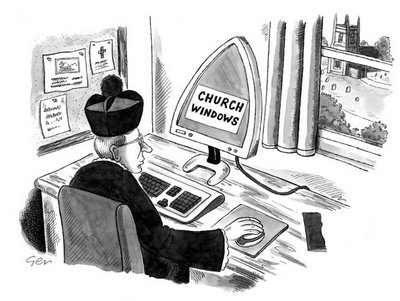
To take it a step further, some time ago on the BibleWorks forums there was a user-initiated discussion about whether it is appropriate to have a laptop with BibleWorks open in the middle of a church service.

While I personally find the idea of a pew-sitter with a laptop tacky, I do understand the sentiment behind wanting to look at the Bible in the original languages while it’s being read and exposited in church. Hence my solution of having a print Bible with me. That’s not quite as out of place as a laptop would be.

So having my Greek and Hebrew Bibles with me is the next best thing to having BibleWorks open during church. However, there are two other next best things that do involve BibleWorks. First, there is a free user-created module that has the Revised Common Lectionary, linked to texts in BibleWorks. I rarely have time to use it on Sunday morning as we rush out the door, but I have at times been able to look ahead to the texts we’d be reading in church that week and use BibleWorks to work my way through them. The RCL module is really nifty. More about it here.

Today I found myself with the unexpected blessing of some time to play around with BibleWorks a bit. (I just received BibleWorks 9 in exchange for an unbiased review, which I will be offering in parts in coming weeks. Consider this a prologue of sorts.) Using the Report Generator, I was able to create a “Reader’s” version of Jeremiah 23:1-6, the Old Testament reading in church from the RCL this morning. Here’s the screen shot of how to get there, which also shows how I have my BibleWorks set up for Septuagint study. (Click on image for larger, or open it in a new tab.)

Once there, I set the Report Generator in the following way:

Then I clicked on “Build Report” and got a report with the text of Jeremiah 23:1-6 in Greek, followed by the listing of all words used in that passage, with frequency counts, followed by lexicon entries. After some manual organizing, I ended up with the below. Resources like this exist for the Hebrew Bible and the Greek New Testament (what I take to church with me), but there is not as of yet a “Reader’s” Septuagint.

Fellow language-lovers… what do you think? And do you take your languages with you to church? If so, how?

Jeremiah 23:1-6 (Rahlfs Septuagint)

–with footnoted vocabulary (glosses) for words that appear less than 200 times in entire Greek Bible (LXX+NT together). Glosses from here: print / BibleWorks module.

1 Ὦ[1] οἱ ποιμένες[2] οἱ διασκορπίζοντες[3] καὶ ἀπολλύοντες τὰ πρόβατα τῆς νομῆς[4] μου.
2 διὰ τοῦτο τάδε λέγει κύριος ἐπὶ τοὺς ποιμαίνοντας[5] τὸν λαόν μου Ὑμεῖς διεσκορπίσατε[6] τὰ πρόβατά μου καὶ ἐξώσατε[7] αὐτὰ καὶ οὐκ ἐπεσκέψασθε[8] αὐτά, ἰδοὺ ἐγὼ ἐκδικῶ[9] ἐφ’ ὑμᾶς κατὰ τὰ πονηρὰ ἐπιτηδεύματα[10] ὑμῶν·
3 καὶ ἐγὼ εἰσδέξομαι[11] τοὺς καταλοίπους[12] τοῦ λαοῦ μου ἀπὸ πάσης τῆς γῆς, οὗ ἐξῶσα[13] αὐτοὺς ἐκεῖ, καὶ καταστήσω αὐτοὺς εἰς τὴν νομὴν[14] αὐτῶν, καὶ αὐξηθήσονται[15] καὶ πληθυνθήσονται·
4 καὶ ἀναστήσω αὐτοῖς ποιμένας[16], οἳ ποιμανοῦσιν[17] αὐτούς, καὶ οὐ φοβηθήσονται ἔτι οὐδὲ πτοηθήσονται[18], λέγει κύριος.
5 Ἰδοὺ ἡμέραι ἔρχονται, λέγει κύριος, καὶ ἀναστήσω τῷ Δαυιδ ἀνατολὴν δικαίαν, καὶ βασιλεύσει βασιλεὺς καὶ συνήσει[19] καὶ ποιήσει κρίμα καὶ δικαιοσύνην ἐπὶ τῆς γῆς.
6 ἐν ταῖς ἡμέραις αὐτοῦ σωθήσεται Ιουδας, καὶ Ισραηλ κατασκηνώσει[20] πεποιθώς, καὶ τοῦτο τὸ ὄνομα αὐτοῦ, ὃ καλέσει αὐτὸν κύριος Ιωσεδεκ[21].


[1] ὦ (109) woe (to)
[2] ποιμήν (99) shepherd
[3] διασκορπίζω (64) scatter
[4] νομή (39) pasture
[5] ποιμαίνω (65) shepherd
[6] διασκορπίζω (64) scatter
[7] ἐξωθέω (31)  force out
[8] ἐπισκέπτομαι (181) visit
[9] ἐκδικέω (97) exact vengeance
[10] ἐπιτήδευμα (58) practice, way of living
[11] εἰσδέχομαι (20) gather
[12] κατάλοιπος (98) remnant
[13] ἐξωθέω (31)  force out
[14] νομή (39) pasture
[15] αὐξάνω (63) grow
[16] ποιμήν (99) shepherd
[17] ποιμαίνω (65) shepherd
[18] πτοέω (39) tremble
[19] συνίημι (144) have understanding
[20] κατασκηνόω (70) dwell, settle
[21] Ιωσεδεκ (18) proper noun (name)

Sex as colonization?

This morning I followed a friend’s Facebook link to a Gospel Coalition blog post. Here is the post I read. It’s hard to summarize, but the basic topic is the “good, God-honoring, and body-protecting authority and submission between husbands and wives.” That part sounds not so bad, but the blog post quotes a guy named Douglas Wilson who says:

In other words, however we try, the sexual act cannot be made into an egalitarian pleasuring party. A man penetrates, conquers, colonizes, plants. A woman receives, surrenders, accepts. This is of course offensive to all egalitarians, and so our culture has rebelled against the concept of authority and submission in marriage.

You can go to the post to read the quote in a bit of a fuller context, but I was still amazed to read this at a site that is usually as exegetically careful as the Gospel Coalition. Once you’ve read the initial blog post, I’ve reproduced the comment I left at that site here:

This, of course, is the most difficult part of the initial quote:

In other words, however we try, the sexual act cannot be made into an egalitarian pleasuring party. A man penetrates, conquers, colonizes, plants. A woman receives, surrenders, accepts.

A key concept of discourse analysis (Steve Runge talks about this with reference to the Greek New Testament) is that “choice implies meaning.” So instead of the Biblical Hebrew “goes into,” Wilson chose “penetrates.” Instead of “establishes/builds,” he chose “colonizes,” etc. It’s his prerogative as an author to choose those words, whether one likes them or not.

The problem is, each of those words has meanings associated with them, whether we want them to or not. This is true whether or not a word *should* mean a certain thing. (I’m thinking of Jared’s comment, “It is difficult to understand, I’m sure, when they are defined with violence in mind. In this isolated passage Wilson has ruled that out.”)

I don’t agree that Wilson has sufficiently ruled that out (that last paragraph when he speaks against “devours” is too short to do that, but maybe the rest of Wilson’s work does?). But even if he has ruled out violence, his *choice* to use especially *colonizes* is confusing. As the immense and growing field of post-colonial literature attests, colonization has left untold trauma in its wake. And, yes, colonization was all too often violent. Rape often occurred as part of colonization, so that choice of word (remember, choice implies meaning) in this context (speaking about rape–even if against it) was particularly surprising and probably did not help the author’s case at all.

Also, Wilson’s saying “the sexual act cannot be made into an egalitarian pleasuring party” is just bizarre. Besides seeming like an unwarranted barb against egalitarians, what seems to be implied (with that sentence contextualizing the next two) is that there is no way (“cannot”) for *both* parties (“egalitarian”) to be *pleasured* (“pleasuring party”) all the time, since one is busy “penetrat[ing]” (with pleasure) and the other (merely) “receives” and “surrenders” (implied: even if she doesn’t receive pleasure from it?). You can see how it’s not a far leap in the reader’s mind from there to rape imagery, whether Wilson means this or not. I’m certainly not accusing him of anything. But it was, at best, a bad choice of words.

Is it egalitarianism that he is speaking against? Or is it against the idea of man and woman both having pleasure in sex? In other words, would Wilson approve of a “complementarian pleasuring party where the man penetrates and the woman receives, both receive pleasure, and if one does not, per I Cor 7:4-5, both stop out of mutual love for each other?” I’d assume he would, based on these comments above.

But “surrenders” in this context, especially when used unidirectionally and paired with “colonizes”–IF Wilson means to apply them specifically to the sex act, which it seems he does–is an unfortunate choice of words. If/when there is any “surrendering” in sex, it goes both ways, as the apostle Paul points out. (I know Paul is talking about *not* having sex, but his larger principle from I Cor 7:4 surely applies to having sex, too.) Neither has authority over his/her own body, but yields it to the other. “Colonizes” and “surrenders” are pretty difficult to square with this.

UPDATE: A reply and my reply to the reply here.

Prophetic Whiplash…God of Mercy or God of Wrath?

Reading the Biblical prophets (like Micah) can give the reader emotional whiplash. The prophets often alternated abruptly between communicating God’s good news and bad. So which one is it: does God graciously forgive his people’s sins, or does he harbor his anger against them in judgment?

The prophets didn’t feel a need to necessarily resolve this tension; both are true in some measure. But in the end the witness of the Hebrew Bible–very much confirmed in the New Testament–is summed up in Exodus 20:5-6 (AKJV):

Do not worship any idol, and do not serve them, for I am Yahweh your God, a zealous God. For the sins of parents I hold accountable their children, to the third and fourth generations of those who hate me. But I show covenant loyalty to thousands of generations of those who love me and who keep my commandments.

Insofar as the tension between God’s mercy and God’s anger finds resolution, the Bible indicates that mercy is the overriding attribute of God.

Micah’s bifid structure, alternating as it does between woe and weal, seems to resolve at the end in favor of God’s mercy to his unfaithful people. This is Septuagint Sunday at Words on the Word, so a bit of Greek is in order. (You don’t have to know Greek to follow here.)

Micah 1:1 is the book’s superscription (=title page, essentially) where Micah identifies himself as a messenger of Yahweh, who has received his word to give to his people. The very first prophetic utterance, in the next verse (AKJV, from the Greek), is,

Hear these words, people, and let the earth and all that is in it pay attention. The Lord will serve as a witness (εἰς μαρτύριον) against you, the Lord from his holy dwelling place.

What follows in chapter 1 is fairly damning lawsuit language that calls God’s people into a courtroom setting for their transgressions of God’s covenant… where, of course, they have no defense. The woe-weal or wrath-mercy alternation continues through the rest of the book, until Micah concludes in 7:18-20 with a hymn of praise to God (AKJV again, from Greek):

Who is a God like you, who forgives injustices and overlooks the sins of the remnant of his inheritance?

He does not retain his anger as a witness (εἰς μαρτύριον), for he is one who delights in mercy. He will turn and have compassion on us. He will sink our injustices and hurl all our sins into the depths of the sea.

You will give truth to Jacob and mercy to Abraham, just as you swore to our ancestors from ancient days.

Of special note is how εἰς μαρτύριον (“as a witness”) serves as bookends for the book. In the first few verses, God himself is a witness against his people that they have committed sin against him. But in the final verses, he chooses not to call himself (specifically, his anger) to the stand as a witness (εἰς μαρτύριον) against his people. Rather, he overlooks (ὑπερβαίνων) their sins, sinking them into the depths of the sea.

Quite a different use of εἰς μαρτύριον to close out the book! In his last verses, Micah echoes the Exodus passage, that God forgives our wrongdoings and shows mercy, even with all he has to call as a witness against us.

God’s wrath is real, and our sins deserve it, yet in the end he has chosen to have mercy on his people.

Bifid

The prophets in the Hebrew Bible knew how to throw down. They often ran the risk of death for their faithfulness in sharing God’s message with others. But that didn’t stop them.

One potentially confusing thing about the prophets is their frequent and sometimes abrupt transition between good news and bad news. Scholars refer to prophetical books like Micah as “bifid,” meaning that it has two primary kinds of prophecies: woe and weal. Woe prophecies are prophecies of bad things that will come to those who do injustice, who disobey God, who oppress the poor in their midst, etc. Weal prophecies are the comforting good news to God’s people: that though they are sinful and fall far short of God’s commands, yet he will have compassion and forgive.

The alternation between woe and weal in the prophets can be pretty unsettling to the reader, as I imagine it was to the people who first heard the prophecies. (“Oh, hey, cousin Asher… everything is cool! God’s going to forgive us. Wait… what’s he saying now? We’re going to perish in our transgressions?”)

Micah is a bifid book. One fairly common structural understanding of the book, which I first learned from my Hebrew professor, but have since seen elsewhere, has the book split up something like this:

1:1                Superscription (i.e., title) identifying Micah as a messenger of Yahweh

1:2-2:11       Punishment, part 1 (Woe):
Yahweh will punish Israel (the North) and Judah (the South) for their Idolatry

2:12-13        Restoration, part 1 (Weal):
Yahweh will gather the remnant of Israel like a flock

3:1-12           Punishment, part 2 (Woe):
Leaders, rulers, prophets, and priests are all corrupt, distorting justice.
Darkness will come over them and Jerusalem will be razed.

4:1-5:8          Restoration, part 2 (Weal):
Many nations will come to the mountain of Yahweh to worship the God of Jacob.
There will be peace.

5:9-7:6         Punishment, part 3 (Woe):
Yahweh will cut off idolatry from the land, destroying the unfaithful cities of Israel.

7:7-7:17      Restoration, part 3 (Weal):
The enemy will be trampled, the cities of Israel rebuilt.

7:18-7:20      Hymn of praise to God

There’s a particularly striking relationship between the first few and the last few verses of the book, that I think helps to resolve some of the tension that the reader experiences in the back-and-forth prophecies of Micah.

Reading through a short prophetical book like Micah with the above outline in hand can be a useful exercise in deepening one’s own understanding of Scripture and the character of God. Even as I’ve grown to deeply appreciate the book of Micah, I’ve found it quite challenging to work through.

I’ll post again in the future about how I think 1:1 and 7:18-20 work together to frame the book into a unified whole.

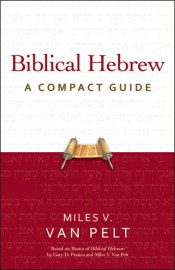
Review of Biblical Hebrew: A Compact Guide

At long last, a compact reference guide to Biblical Hebrew!  Not long ago Zondervan released Biblical Greek: A Compact Guide, a helpful and portable distillation of Mounce’s oft-used grammar. Many such little books already exist for easily reviewing Koine Greek: Dale Russell Bowne’s Paradigms and Principal Parts for the Greek New Testament, Paul Fullmer and Robert H. Smith’s Greek at a Glance, and even the back of Kubo’s Reader’s Lexicon has a good summary of Greek grammar with paradigm charts.

There seem to be more resources available to students of Biblical Greek than to students of Biblical Hebrew.  For example, while there is just one (excellent!) “Reader’s” Hebrew Bible (uncommon vocabulary is glossed at the bottom of the page), I am aware of at least three Reader’s Bibles that exist for the Greek New Testament.  So Van Pelt’s Compact Guide, based on his and Pratico’s Basics of Biblical Hebrew, is a welcome addition as far as this eager Hebrew student is concerned.

The book is not terribly dissimilar from Pratico/Van Pelt’s Charts of Biblical Hebrew, but unlike that work, A Compact Guide is more than just a collection of charts and paradigms.  Each section includes a distillation of what is in the grammar text, followed by paradigms and charts for quick reference.

Oddly enough, though, at times there seems to be more precision and detail in this little book than in the larger grammar.  Or perhaps it’s just more nuance that has come to articulation with the passage of time since the publishing of the grammar’s second edition.  For example, whereas the grammar lists three kinds of Hebrew prepositions (independent, Maqqef, and inseparable), the Compact Guide adds a fourth: compound prepositions, where “two different prepositions, or a preposition and a noun” (28) combine to make a new preposition.

The primary focus of the guide is morphology (how words are formed, including paradigm charts) and syntax (how words are used in sentences, i.e., grammar).  There is nothing in the work by way of vocabulary, save for a Hebrew-English mini-lexicon at the back of the book.  Unfortunately, at least in the digital galley version I viewed, there was no introduction or explanatory note as to what constituted inclusion on the lexicon.  By contrast, in Mounce’s Greek counterpart, his lexicon notes that it includes words that occur in the New Testament 10 times or more.

In addition to a thorough listing of paradigms (the 11-page section on pronominal suffixes is particularly helpful), the book is filled with examples from the Hebrew Bible (with English translation).  The Hebrew font used, while not as easy to read as that of the grammar, is readable enough.

The section on verbs is a particular strength of this work–in addition to examining all the forms and stems (both strong and weak), there are extensive listings of paradigms for easy review.

All in all, I give a hearty two thumbs up for this work–and express my gratitude that it is now on the scene for those who want to keep their Biblical Hebrew fresh!  For a beginner in Biblical Hebrew I would recommend the full-length grammar textbook, but for those with even a semester or two of Hebrew (and beyond), this small reference guide will be a valuable and inexpensive addition to their library.

The guide releases August 20, 2012, although you can preview some of it here now. (I received a digital galley for review through Net Galley.)

UPDATE: I review the hard copy, now released, here.