A Personal Reflection on Dietrich Bonhoeffer: What I’ve Found This Lent


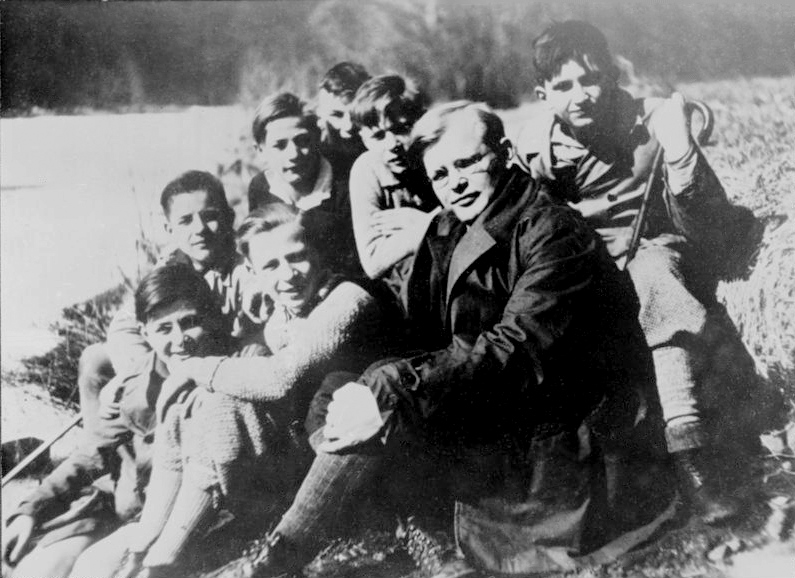
Bonhoeffer with Confirmands, 1932

I knew when I was preaching through the Sermon on the Mount recently that I would make good use of Dietrich Bonhoeffer’s Cost of Discipleship. I had no idea that a single question I asked would lead me–in my quest for an “answer”–so far into the life and writings of Bonhoeffer.

Of War and Peace: Which Bonhoeffer? (Revisited)

Russia invaded Ukraine in early March, just days after the Revised Common Lectionary reading was Matthew 5:38-48, which reads in part:

You have heard that it was said, ‘Eye for eye, and tooth for tooth.’ But I tell you, do not resist an evil person. If anyone slaps you on the right cheek, turn to them the other cheek also.

You have heard that it was said, ‘Love your neighbor and hate your enemy.’ But I tell you, love your enemies and pray for those who persecute you, that you may be children of your Father in heaven.

I wondered: does “turn the other cheek” apply just on an interpersonal level, or at a state level? I turned to Bonhoeffer, who rejected a privatized read of Jesus’ words. In 1937’s Discipleship he wrote:

The overcoming of others now occurs by allowing their evil to run its course. The evil does not find what it is seeking, namely, resistance and, therewith, new evil which will inflame it even more. Evil will become powerless when it finds no opposing object, no resistance, but, instead, is willingly borne and suffered….

Should Ukrainians (or other oppressed peoples) just let themselves be invaded (or oppressed)? I struggled with Bonhoeffer’s words:

There is no thinkable deed in which evil is so large and strong that it would require a different response from a Christian. The more terrible the evil, the more willing the disciple should be to suffer. Evil persons must be delivered to the hands of Jesus. Not I but Jesus must deal with them.

And yet in 1945 he was hanged for his involvement in a conspiracy to kill Hitler. This was not the “no opposing object” and “no resistance” that Bonhoeffer had talked about in Discipleship.

But maybe Bonhoeffer differentiated between evil done to him and evil done to others? Should the Christian be willing “to suffer” in the former instance but willing to act and resist on behalf of another in the latter instance?

As I asked these questions a month and a half ago, I found my own response to Matthew 5 and “turn the other cheek” to be more tension-filled than I would have liked.

Is There a Resolution to the Tension in Bonhoeffer? 

I had been hoping that further study of Bonhoeffer would help me to find some writing where he would essentially repudiate his non-violence stance in Discipleship, saying instead something like, “But when others are oppressed, take up force to eliminate evil, if necessary.”

Bonhoeffer never said any such thing. In fact, on July 21, 1944, the day after a bomb intended for Hitler failed to kill him, Bonhoeffer wrote from prison (about that 1937 book) to his good friend and biographer-to-be Eberhard Bethge:

Today I clearly see the dangers of that book, though I still stand by it.

He still stood by it. Did he mean he also stood by the line from that book, “Not I but Jesus must deal with them”? Was not his involvement in an effort to bomb Hitler a way of trying to deal with him? (Note: I’m not sure I fault Bonhoeffer either way.)

After a Lenten discipline of reading Bonhoeffer (and sections of his biographies) slowly and meditatively, I’m no closer to a resolution of such tensions than I was when I first discovered them. If anything, I’ve been encouraged to see other readers of Bonhoeffer wrestling with the same sorts of questions. This question of whether a ready-to-use-violence Bonhoeffer is consistent with the turn-the-other-cheek Bonhoeffer is, in fact, a fruitful question in Bonhoeffer studies.

What I’ve Found Instead

Tension in Bonhoeffer notwithstanding (and I’m actually coming to appreciate it), I’ve been deeply moved at nearly every turn as I’ve delved more deeply into the life and writings of an activist pastor.

I’ve found:

  • An inspired and passionate preacher, not afraid to tell the truth about life and about Jesus
  • A brilliant writer, already evident at age 19 and age 21
  • An eloquent catechist and Christian educator
  • A brave and gutsy man, who valued the life of others more than his own
  • A gifted poet with incisive awareness of the human condition

His preaching has encouraged mine. His deliberateness in pastoral care and visiting congregants has inspired me. I used one of his catechisms for our church membership class (his writing in that context was met with appreciation by all of us). His courage has bolstered mine, even if I don’t face the sort of trials that he did.

And, best of all, he has pointed away from himself and to the cross of Christ, so that my appreciation for Bonhoeffer doesn’t finally center on Bonhoeffer himself. Rather, through the writings of Dietrich Bonhoeffer–no doubt inhabited again by the Holy Spirit–I have come to see and know and love Jesus more deeply.

As Bonhoeffer says of the early disciples, listening to Jesus on the mountainside:

They have only him. Yes, and with him they have nothing in the world, nothing at all, but everything, everything with God.

A Short Review of R. Bethge’s Bonhoeffer: A Brief Life

Bonhoeffer_A Brief Life

Renate Bethge’s Dietrich Bonhoeffer: A Brief Life, is about as short a Bonhoeffer biography as there is. Renate’s husband was the late Eberhard Bethge, Bonhoeffer’s dear friend and biographer. Renate is also Bonhoeffer’s niece.

Whereas Eberhard’s bio is well over 900 pages, Renate’s Brief Life is under 90. It’s laid out nicely, with lots of photographs, wide margins, and quotations from Bonhoeffer’s writing and correspondence. Given how little text is actually on a page, it’s a quick read.

The book offers a succinct overview of Bonhoeffer’s life, yet it does not lack substance in its brevity. Highlights for me were the overview of his parents (and their character, and its effect on Bonhoeffer), a chapter called “Contacts with Jews,” and the personal touch of including some of Bonhoeffer’s correspondence. His beautiful poem “Who Am I?” is re-printed here in its entirety.

There are brief mentions of his writings: Life TogetherEthics, and Letters and Papers from Prison (but not, surprisingly, Discipleship). Page 87 offers a nice one-page summary chronology of Bonhoeffer’s life.

If you want to look at a couple sample pages from the book, Logos Bible Software has put some up here and here. (This book will soon be offered in Logos as part of its forthcoming Bonhoeffer Studies Collection.)

Someone looking for biographical detail will want to look elsewhere, but this only claims to be a “brief” biography, which has value especially for folks like me who are coming seriously to Bonhoeffer for the first time. As I continue to read through Eberhard Bethge’s biography, it was nice to put it aside for a bit to get a quick overview of all of Bonhoeffer’s life.

The above book was an unexpected  but welcomed gift from somebody (not a review copy from the publisher). It’s on Amazon here. See my other Bonhoeffer posts here.

In Memoriam: Bonhoeffer’s “Who Am I?”

Bonhoeffer in Prison

In July 1944, less than a year before Dietrich Bonhoeffer’s death (69 years ago today), Bonhoeffer wrote a poignant and self-probing poem called, “Who Am I?” It is found in his Letters and Papers from Prison. Here it is, in its entirety:

Who Am I?

Who am I? They often tell me
I step out from my cell
calm and cheerful and poised,
like a squire from his manor.

Who am I? They often tell me
I speak with my guards
freely, friendly and clear,
as though I were the one in charge.

Who am I? They also tell me
I bear days of calamity
serenely, smiling and proud,
like one accustomed to victory.

Am I really what others say of me?
Or am I only what I know of myself?
Restless, yearning, sick, like a caged bird,
struggling for life breath, as if I were being strangled,
starving for colors, for flowers, for birdsong,
thirsting for kind words, human closeness,
shaking with rage at power lust and pettiest insult,
tossed about, waiting for great things to happen,
helplessly fearing for friends so far away,
too tired and empty to pray, to think, to work,
weary and ready to take my leave of it all?

Who am I? This one or the other?
Am I this one today and tomorrow another?
Am I both at once? Before others a hypocrite
and in my own eyes a pitiful, whimpering weakling?
Or is what remains in me like a defeated army,
Fleeing in disarray from victory already won?

Who am I? They mock me, these lonely questions of mine.
Whoever I am, thou knowest me; O God, I am thine!

See my other Bonhoeffer posts here.

Bonhoeffer’s Last Words, Before He Was Hanged (69 Years Ago Tomorrow)

Source: German Federal Archive

Dietrich Bonhoeffer was hanged in the Nazi concentration camp of Flossenbürg on April 9, 1945, just two weeks before the U.S. military came to liberate it.

John W. de Gruchy describes the lead-up to that day in his Editor’s Introduction to Letters and Papers from Prison (Dietrich Bonhoeffer Works, volume 8):

On October 8 [of 1944], Bonhoeffer was taken to the cellar of the Gestapo prison on Prinz-Albrecht-Straße, where he stayed until February 7, 1945. From then on, all correspondence came to an end, and contact between Bonhoeffer and the family and [Eberhard] Bethge was broken. From there Bonhoeffer was taken first to Buchenwald and then, via the village of Schönberg in Bavaria, to the Flossenbürg concentration camp, where he arrived on April 8. That evening he was tried by a hastily rigged court and condemned to death. Early the next morning Bonhoeffer was executed along with several other coconspirators.

He was hanged April 9. His family would not learn about it for several months.

The July before he had written to his trusted friend (and later biographer) Eberhard Bethge, one day after the failed assassination attempt on Hitler’s life. He wrote:

How should one become arrogant over successes or shaken by one’s failures when one shares in God’s suffering in the life of this world? You understand what I mean even when I put it so briefly. I am grateful that I have been allowed this insight, and I know that it is only on the path that I have finally taken that I was able to learn this. So I am thinking gratefully and with peace of mind about past as well as present things. …

May God lead us kindly through these times, but above all, may God lead us to himself.

His final recorded words before his hanging–appropriate in this Lenten season that is about to give way to Easter–were:

This is the end–for me the beginning of life.

This post is part of “Tuesdays in Lent with Bonhoeffer.” See other gathered posts here.

A Reason to Praise: “Vicarious Representation”

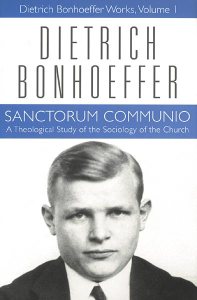
Sanctorum Communio

At the age of 21 Dietrich Bonhoeffer successfully defended his doctoral dissertation, Sanctorum Communio: A Theological Study of the Sociology of the Church. (Click on the cover image at right for more information about the book.) Bonhoeffer’s biographer Eberhard Bethge notes that Karl Barth said of Bonhoeffer’s early work:

I openly confess that I have misgivings whether I can even maintain the high level reached by Bonhoeffer, saying no less in my own words and context, and saying it no less forcefully, than did this young man so many years ago.

I’ve been reading excerpts from Sanctorum Communio (translated into English), from The Bonhoeffer Reader. And… wow. It’s unbelievably good–and would be even if Bonhoeffer had written it years later, but it’s especially remarkable coming at the age of 21.

For now, one quotation will suffice. This is Bonhoeffer on the “vicarious representation” of Christ:

God does not ‘overlook’ sin; that would mean not taking human beings seriously as personal beings in their very culpability; and that would mean no re-creation of the person, and therefore no re-creation of community. But God does take human beings seriously in their culpability, and therefore only punishment and the overcoming of sin can remedy the matter. Both of these have to take place within concrete time, and in Jesus Christ that occurs in a way that is valid for all time. He takes the punishment upon himself, accomplishes forgiveness of sin, and, to use Seeberg’s expression, stands as surety for the renewal of human beings. Christ’s action as vicarious representative can thus be understood from the situation itself.

In recent weeks I’ve gotten more consistent in fulfilling this blog’s original intent to offer Worship Leading Wednesdays each week. I’m not sure if in my capacity as worship leader–whether past or present–I would necessarily read the above paragraph in a service of worship… but it sure does inspire me to praise God, with a spirit of gratitude for the miraculous work of the cross.

Bonhoeffer: Pastor, Pacifist, Nazi Resister (MOVIE)

Bonhoeffer Movie

My wife recently checked out a Bonhoeffer DVD for me, which we started watching the other night. We’re halfway through, and it’s already quite moving. First Run Features put it out, called Bonhoeffer: Pastor, Pacifist, Nazi Resister (pictured above).

Here is the film synopsis:

The German theologian Dietrich Bonhoeffer was one of the first, and strongest, voices of resistance to Adolf Hitler. An acclaimed preacher, pacifist and author, Bonhoeffer came to the famed Abyssinian Baptist Church in Harlem on a teaching fellowship. When Bonhoeffer returned to Germany in 1932 he had a new awareness of racial prejudice and challenged Christian churches to stand with the Jews in their moment of need. Bonhoeffer eventually joined the unsuccessful plots to assassinate Hitler and was executed three weeks before the end of the war.

Here’s part of the movie, “Bonhoeffer Speaks Out Against Hitler”:

You can find the DVD here (affiliate link) or, most likely, at your local library. With how much Bonhoeffer I’ve been reading lately, it’s been nice to watch a filmic representation of his life–although further study of his life and struggle against Nazism is not for the faint of heart.

This is the fourth post in “Tuesdays in Lent with Bonhoeffer.” See the first one (on forgiveness) here. The second post covers Bonhoeffer’s early life, here. Some brilliance from 19-year-old Dietrich is noted here.

Excerpts from a Catechism by Bonhoeffer

DBW 11In 1932 Dietrich Bonhoeffer co-wrote a draft for a catechism called, “As You Believe, So You Receive.” The catechism is “for students in a confirmation class and yet is intended not only for them.” Bonhoeffer and his co-writing friend Franz Hildebrandt wrote it as a Lutheran catechism, but almost all of it is ecumenically appropriate.

Here are a few excerpts:

What is the gospel?

This is the message of God’s salvation that has appeared to us in Jesus Christ and has been conveyed to us through his Spirit. This is the message of the kingdom of God that is contested in the world and intended for God’s righteous. This is the message of God’s will, which speaks today and decides over life and death.

How does Jesus of Nazareth help me today?

To know about Jesus does not yet mean to believe in him. Merely considering him to be true is, of course, lifeless. Faith depends not on lifeless letters but rather on the living Lord who stands commandingly before us, above all doubt about the Bible and its stories.

Why is actually Jesus the Lord?

He is the answer to every human question. He is the salvation in all the sufferings of the world. He is the victory over all our sins. In him, you have God himself in his power and the human being in complete powerlessness.

Does the church, then, act according to the will of Christ?

The church knows today more than ever how little it obeys the Sermon on the Mount. Yet the greater the discord in the world becomes, the more Christ wants to have proclaimed the peace of God that reigns in his kingdom. The church still continues daily in prayer for the return of its divine Lord, and he lays his hand upon it, until he leads the church to its fulfillment.

What do we know of eternal life?

Whether we want it or not—as truly as God lives—our life has come under God’s judgment and has been sustained by God’s hand. Not flesh and blood, but rather spirit, soul, and body are to rise up from the dead. We know not when the hour will come, but the church looks forward with all creation to a new earth and a new heaven.

The catechism is short–barely 10 pages in volume 11 of Dietrich Bonhoeffer Works. (This particular catechism is also included in The Bonhoeffer Reader.) But even in its brevity there is much to take in, and the “carefully focused reading” that the introduction to the catechism calls for is greatly rewarded.

A Bit of Brilliance from the Boy Bonhoeffer

The Bonhoeffer Reader

At the age of 19 Bonhoeffer wrote a paper called, “Paper on Historical and Pneumatological Interpretation of Scripture.” When I was 19 I was just about to stumble upon the Hegelian dialectic, but I’m pretty sure I didn’t even know what “pneumatological” meant. Bonhoeffer was getting warmed up.

The Bonhoeffer Reader (pictured above) leads off with that paper, which Fortress Press has available as a sample on its Website, here (pdf). The Reader is “self-consciously a theological reader,” keeping specifically in mind “the general reader or beginning student of Bonhoeffer.” Here, by the way, are the seven major sections of the Reader:

  • Part 1, Student Writings: Berlin, Barcelona, New York
  • Part 2, University Lectures
  • Part 3, Ecumenical and Pastoral Writings
  • Part 4, Theology and the Third Reich
  • Part 5, Christian Life and Community
  • Part 6, Christian Ethics and Public Life
  • Part 7, Theology from Prison: Worldly, Religionless Christianity

The Reader excerpts all of Bonhoeffer’s major works, at length. Sanctorum Communio, his dissertation, is here, as well as DiscipleshipLife TogetherLetters and Papers from Prison, lectures, talks, and even a draft of a catechism he co-authored. It is rich.

Back to the 19-year-old Bonhoeffer. “Paper on Historical and Pneumatological Interpretation of Scripture” is engaging, dense, and refreshing, even if occasionally unclear or in want of a re-write here and there. Bonhoeffer wrote the paper in 1925 when he was a student in Berlin. In it he reflects on the historical-critical method of interpreting Scripture that was so popular in early 20th century Germany, as well as the idea of Scripture as God’s word, i.e., the locus of revelation–what Bonhoeffer calls “pneumatological interpretation.” Of the latter he writes:

The first statement of spiritual interpretation is that the Bible is not only a word about God but God’s word itself. In some way the decisive concept of revelation must be introduced here. When revelation is found, the extraordinary enters and its power is self-evident. The past is made present or—better—the contemporaneity and trans-temporality of God’s word are recognized.

As impressive as Bonhoeffer’s command of theology and language already is his use of Latin and Greek throughout the paper (which the editors of The Bonhoeffer Reader are gracious enough to translate).

The bit of brilliance that most inspired me was an almost throwaway clause where Bonhoeffer refers to God as the one

for whom the terms “God spoke” and “it became so” are identical.

Of course on a semantic and grammatical level it is not true that “God spoke” and “it became so” are identical, but Bonhoeffer’s point is that the phrases are, in fact, one and the same. God, as others have put it, spoke creation into being, so that his speaking and its becoming are one and the same act. Bonhoeffer would later develop this idea in his 1932-33 Creation and Fall lectures, also excerpted in the Reader. In a section not found in the Reader, Bonhoeffer would write,

That God creates by speaking means that in God the thought, the name, and the work are in their created reality one. What we must understand, therefore, is that the word does not have ‘effects’; instead, God’s word is already the work. What in us breaks hopelessly asunder–the word of command and what takes place–is for God indissolubly one. With God the imperative is the indicative.

It seems that even this early paper contains some buds that will more fully bloom in his later writing.

The paper closes:

Scriptural understanding, interpretation, preaching, i.e., the knowledge of God begins and ends with the plea: “Veni creator spiritus” [Come, Creator Spirit].

Scripture, for Bonhoeffer (and for us), is “where God speaks and… where it pleases God to be personally revealed.” In the moment that God speaks, it becomes so, and God is revealed.

This,” the Scripture readers say each Sunday, “is the Word of the Lord.”

Thanks be to God.

This is the third post in “Tuesdays in Lent with Bonhoeffer.” See the first one (on forgiveness) here. The second post covers Bonhoeffer’s early life, here. I describe the series more here. The Bonhoeffer Reader can be found at Amazon here (affiliate link) or at Fortress Press’s page here

A Short Note on God’s First Greek Words

The Greek of Genesis 1:3 reads,

καὶ εἶπεν ὁ θεός Γενηθήτω φῶς. καὶ ἐγένετο φῶς.

In English it reads, “And God said, ‘Let there be light.’ And there was light.”

The Septuagint straightforwardly translates the Hebrew, which is:

ויאמר אלהים יהי אור ויהי־אור

The Greek καὶ is versatile. The first καὶ in Genesis 1:3 is connected to what precedes it in 1:2 (darkness over the deep), but not necessarily inextricably so. In other words, one could leave it untranslated when going into English, with 1:3 beginning just, “God said….” The second  καὶ in 1:3, however, seems to be more closely related to what precedes it. “And there was light” follows immediately upon God’s calling for light. God said it, and it happened.

Susan Brayford, in her LXX Genesis commentary (Septuagint Commentary Series, Brill) writes:

God’s first words bring light into being in order to counter the darkness that was over the earth. In the first words attributed to God, LXX-G establishes a formulaic speech pattern that continues throughout the chapter, namely, a verb in the third person imperative (let x be), followed by ‘and,’ and concludes with a verb in the aorist (and x was). The pattern, similar to that in the MT noticed by Westermann and others, not only represents God as an orderly creator, but more importantly, as a powerful creator whose very words accomplish actions.

Dietrich Bonhoeffer has much to say about this in his Creation and Fall lectures on Genesis 1-3. On Tuesday I’ll post about his take on the link between God’s speech and the resulting creation.

Tuesdays in Lent with Bonhoeffer: His Early Life

Bethge_Bonhoeffer BioUntil recently I haven’t known much about Dietrich Bonhoeffer’s life, let alone his early years. I’m working my way through Eberhard Bethge’s thousand-page biography of Bonhoeffer. I’ve just finished reading about his early years and his first year as a university student.

Bonhoeffer was born on February 4, 1906. He was a twin (Sabine was his twin sister). Including Dietrich, there were eight (!) Bonhoeffer children. The death of his older brother Walter in World War I “left an indelible mark,” as Bethge tells it, on the 12-year-old Dietrich and his family–especially his mother.

Bethge describes a Bonhoeffer family who had money (servants, a summer home, a large house) but who were by no means ostentatious. Nor were the children spoiled, according to Bonhoeffer’s biographer. He writes:

The children’s day followed a disciplined pattern; they always knew where they were, and the routine never struck them as restrictive, for they also knew that their parents arranged happy surprises and outings every now and then.

Dietrich was a talented pianist and played the lute, so well that “for a time both he and his parents thought he might become a professional musician.”

At the age of 17, Bonhoeffer went to the University of Tübingen for a year, where his father had gone. Bethge notes that Bonhoeffer’s “priority was philosophy.” The prologue of the Gospel of John especially interested Bonhoeffer, who also took classes on the Psalms and Old Testament theology, among others. But primarily his foundation in that first year was philosophical:

That indeed summed up Dietrich’s year in Tübingen. It was characterized by his wide range of interest, without a firm commitment to any particular area, and by a persistent exploration of the epistemological field.

Bonhoeffer would continue his education at Berlin, beginning his dissertation at the age of 19 and completing it in a year and a half. He successfully defended that work at the age of 21.

This is the second post in “Tuesdays in Lent with Bonhoeffer.” See the first one (on forgiveness) here. I describe the series more here. Bethge’s biography of Bonhoeffer can be found here (Amazon affiliate link) or here