Baylor University Press Titles for Black History Month: 40% Off (and Free Shipping)


In honor of Black History Month, Baylor University Press is offering 40% off + free shipping on select titles.

The entire list is here, and it includes Bonhoeffer’s Black Jesus. Also included is a book I ordered during this sale last year called Muslims and the Making of America. Prices are cheaper than Amazon, and this way you can support the publishers (and authors) more directly.

The sale is good for February with discount code BFE8.


New Title from JPS: Justice for All


Readers of this blog (yes, it’s alive!) may recall my immense appreciation for commentaries and other works published by The Jewish Publication Society. You can find a host of JPS reviews and book notes I’ve written here.

JPS has just released Justice for All: How the Jewish Bible Revolutionized Ethics, by Jeremiah Unterman.

Biblical justice has been a recurring theme in our congregation this past school year–both in my preaching and in our adult Sunday school classes. I’m eager to dig in to this volume.

Here’s the publisher’s description:

Justice for All demonstrates that the Jewish Bible, by radically changing the course of ethical thought, came to exercise enormous influence on Jewish thought and law and also laid the basis for Christian ethics and the broader development of modern Western civilization.

Jeremiah Unterman shows us persuasively that the ethics of the Jewish Bible represent a significant moral advance over Ancient Near East cultures. Moreover, he elucidates how the Bible’s unique conception of ethical monotheism, innovative understanding of covenantal law, and revolutionary messages from the prophets form the foundation of many Western civilization ideals. Justice for All connects these timeless biblical texts to the persistent themes of our times: immigration policy, forgiveness and reconciliation, care for the less privileged, and attaining hope for the future despite destruction and exile in this world.

You can read a .pdf excerpt here. The book’s product page is here, and is also available through Amazon.

Baylor University Press Titles for Black History Month: 40% Off (and Free Shipping)

unnamed


In honor of Black History Month, Baylor University Press is offering 40% off + free shipping on select titles.

The entire list is here, and it includes Bonhoeffer’s Black Jesus. There’s also a new-ish book that I plan to order called Muslims and the Making of America. Prices are cheaper than Amazon, and this way you can support the publishers (and authors) more directly.

The sale is good for February with discount code BFEB.


From the Creator of Captain Underpants: Dog Man

Our children don’t need any encouragement in the area of scatalogical humor, but here we all have been anyway, laughing through the pages of Dav Pilkey’s new Dog Man. (Pilkey of Captain Underpants fame.) That is to say–this book would not be something to read to your four-year-old daughter. Unless, uh, she had two older brothers and was already unfazed by such humor.

Case in point:


one-day-this-happened


in-my-office-now


Dog Man, as Pilkey tells it, is the creation of George Beard and Harold Hutchins, two comic-writing friends whose teacher, Ms. Construde, clearly does not appreciate their “disruptive activity in my classroom.” All my kids love it, of course.

The premise itself is a little more violent than I would have liked for my (or any) kids: Dog Man is born when the evil cat Petey blows up Officer Knight and his dog Greg:

Doctor: I’m sorry Greg, but your body is dying. and your head is dying too, cop.

Officer: Rats! I sure hate my dying head!

But just when all seemed lost…

Nurse Lady: Hey! Why don’t we sew Greg’s head onto cop’s body?

Doctor: Good idea, nurse lady! You’re a genius!

Here “a brand-new crime-fighting sensation was unleashed.”

Dog Man the character is about what you would expect from somebody who is half man, half dog. He battles Petey, then Robo Chief, and then a giant, walking Philly cheesesteak mascot in chapter 4, “Weenie Wars: The Franks Awaken.” This last chapter was probably the funniest and best part of the book. Sample lines:

OH look! Little baby hot dogs are starting a revolution!!!!

We’re not little babies! we’re regular sized!

(Their subsequent claim to be “gangsta” will go over kids’ heads and seems to unfortunately engage in cultural appropriation.)

A fun feature that comes up at several points is the “Flip-O-Rama,” where you can create a little bit of animation by quickly flipping between pages. At this moment I’m looking at the book’s warning: “Remember—Flip it, Don’t Rip it!!!!!!”, which happens to be right next to a newly made rip in our edition. Oh, well.

The section in the back of the book with “How 2 Draw” different characters is icing on the cake.

For how inexpensive the book is, I was pleasantly surprised to see a sewn binding. The colors are vibrant and the lettering is what you would expect from Dav-Pilkey-as-two-kids-writing-a-comic. It inspired my own kids to write their own. (Details forthcoming, or maybe we’ll just try for a book deal.)

If you’re trying to avoid scatological humor, don’t get this book. If you’ve maybe slacked a little with your standards for your kids in that regard, they’ll probably love Dog Man.

You can find the book at Scholastic’s page here. It’s also available at Amazon here. Dav Pilkey’s got his own site, too.


Thanks to Scholastic for the review copy, given with no expectation as to the content of the review.

Mamoko: A World Where Kids Read to the Grown-Ups

mamoko-3000


Some of the best book gifts our oldest child has received have been Maps and Animalium from Big Picture Press, an imprint of Candlewick.

Our kids have also spent many collective minutes and hours poring over two books from The World of Mamoko series: The World of Mamoko in the Year 3000 and The World of Mamoko in the Time of Dragons.

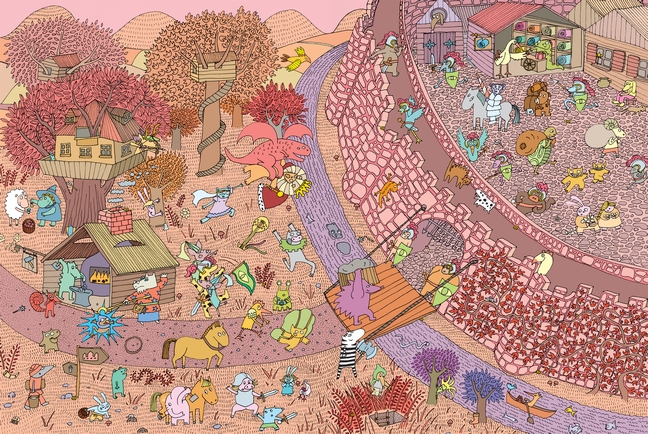
The premise of Mamoko is simple: “Use your eyes!” to “follow the adventures” of more than two dozen different characters through seven detailed spreads that span two pages each. The books are hardback, like giant board books, so they’ll last us a long time. The target age range is 5-8 years old, but my four-year-old (who can’t yet read) really enjoys looking at the pictures, too.

Here’s a spread from World of Mamoko in the Time of Dragons:


mamoko-in-the-time-of-dragons


It’s lots of fun. There are short descriptions of each character that help in knowing what to look for. For example, a pink elephant (holding a hammer?) is Othello Smith:

OTHELLO SMITH is feeling bummed out. What is the cause of his distress?

The book is pretty funny. And it’s big enough that, like the Where’s Waldo? books, two people can easily look for characters and their antics at the same time.

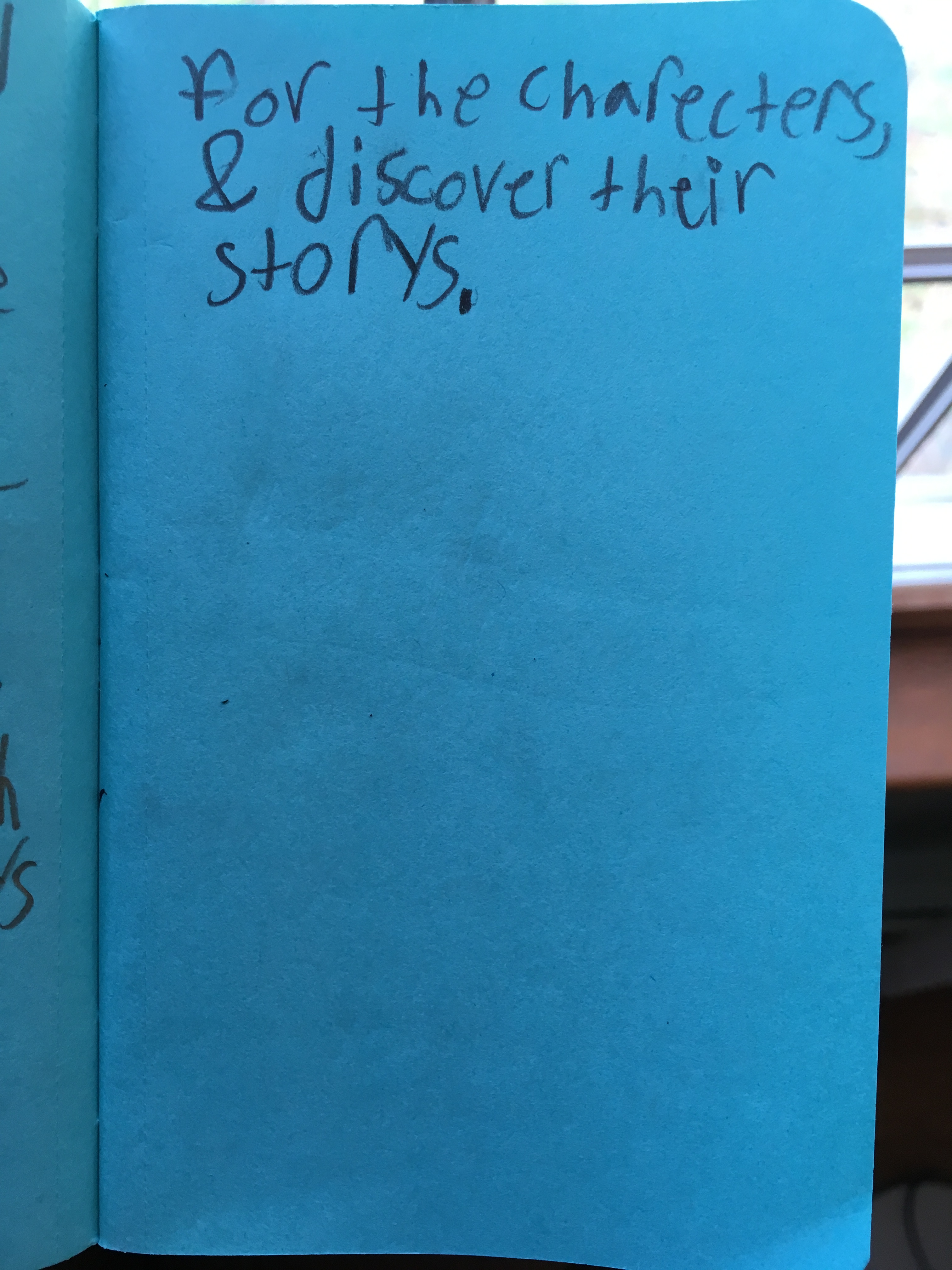
But I told Candlewick my kids would help me review these two books, and a promise is a promise, so… here are my nine-year-old’s review notes from The World of Mamoko in the Year 3000:


mamoko-3000-1


mamoko-3000-2


mamoko-3000-3


And here’s his short take on The World of Mamoko in the Time of Dragons:


mamoko-dragons


You can find all three Mamoko titles at Candlewick’s page here. They’re also available at Amazon here.


Thanks to Candlewick Press for the review copies, given with no expectation as to the content of the review.

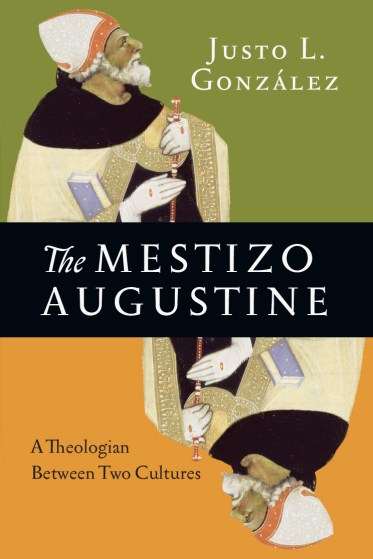
This Will Almost Undoubtedly Be the Best Theology Book This Fall: The Mestizo Augustine

Mestizo Augustine


A forthcoming book from IVP combines one of my favorite lenses for theology (mestizaje) with one of my favorite theologians (Augustine). And the author is none other than Justo González. I believe Michael Scott calls that win-win-win.

Here’s the publisher’s description:

Few thinkers have been as influential as Augustine of Hippo. His writings, such as Confessions and City of God, have left an indelible mark on Western Christianity. He has become so synonymous with Christianity in the West that we easily forget he was a man of two cultures: African and Greco-Roman. The mixture of African Christianity and Greco-Roman rhetoric and philosophy gave his theology and ministry a unique potency in the cultural ferment of the late Roman empire.

Augustine experienced what Latino/a theology calls mestizaje, which means being of a mixed background. Cuban American historian and theologian Justo González looks at the life and legacy of Augustine from the perspective of his own Latino heritage and finds in the bishop of Hippo a remarkable resource for the church today. The mestizo Augustine can serve as a lens by which to see afresh not only the history of Christianity but also our own culturally diverse world.

Coming in November! If you go to the publisher’s page, you can see the Table of Contents. Amazon has it up for pre-order. I’ll do my best to review it here this fall.

My Six-Year-Old’s Review of Shark Attack! (Scholastic)

Shark Attack


My six-year-old son wanted to start a blog to write book reviews, so I’m turning my blog over to him for today’s post. Below is his review of Shark Attack! (Scholastic, 2013), including a bit of Q and A between me and him. Enjoy.


I like this book.

Because it tells me about sharks. How long they can open their mouths.


What was your favorite part about this book?

When the shark does diving.

What was surprising about the book?

That sharks can hear.

How can they hear?

They sense it. “Sharks hear sounds too low for you to hear.”

Who would like this book?

Me.


Shark Attack Review


Where to find it: Amazon / Scholastic
Grade Level: 1 through 3
32 Pages, full color images

Perhaps a Good Time to Make Sure We Know What Plagiarism Is

Image via The Simpsons (Source: http://devosdevine.com/)


A lot of students and professors read this blog, so today’s news affords (among other things) an opportunity to clarify (whether for yourself or others) what plagiarism is. Two tutorials that could be useful are this one from Duke and this one from Indiana University.

I also like this post from a few years ago by Charles Halton, where I first learned about the Duke site.

Baylor University Press: 50% Off All Pre-2015 Titles


Baylor University Press Sale


Baylor University Press is currently offering 50% off all their backlist titles for grad students. (Though unlike previous sales, a .edu address is not required, so others can use the code, too). Two BUP titles I’ve reviewed at Words on the Word, that are both eligible for the sale, are Luke: A Handbook on the Greek Texand Malachi: A Handbook on the Hebrew Text (reviewed here and here). You might also consider Bonhoeffer’s Black Jesus or †Rod Decker’s Greek Handbooks on Mark.

The sale is good from today through Sunday, June 12. If you use the discount code “BJUN” you can order at a 50% discount!

Baylor Press’s page for the sale is here.

Honing in on Your CQ (Cultural Intelligence)

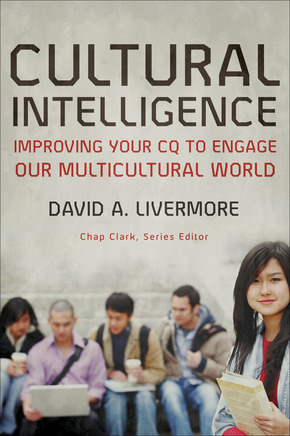
CQDavid Livermore’s goal in Cultural Intelligence is to effect cross-cultural transformation, rather than just impart information (12). Across the barriers of difference and “the barrage of cultures around us” (11), we still “have so much in common” (11). As we navigate the tensions of sameness and difference, Livermore notes, “These points of difference are where we find both our greatest challenges and our greatest discoveries” (11). Yet Livermore wants more than just cultural awareness. He says, “We must actually become more multicultural people so that we might better express love cross-culturally” (12).

Undergirding all levels of cultural intelligence is Livermore’s call to love, coupled with a robust theology of the Incarnation. I appreciated this theological and practical grounding. He writes, “The language of God is Jesus. The incarnation is the ultimate form of contextualization, the fullest embodiment of cultural intelligence” (33). As a result, Livermore warns those who think the Gospel can only be expressed in “one right way” (34). Jesus himself was a culturally situated figure, and yet a liminal one. The Gospels show Jesus’ interaction with 1st Century Palestine’s institutions and structures, where sometimes he embraced and other times he protested against the cultural values and practices of his day. Even if some readers will find his theological exposition familiar territory, it is nonetheless compelling.

CQ (cultural intelligence quotient) goes beyond educating ourselves about culture—even if it must start there. CQ “measures the ability to effectively reach across the chasm of cultural difference in ways that are loving and respectful” (13). An important step toward a fuller expression of love across lines of difference is growth in self-awareness. One must not only learn about other cultural mores and traditions, but one must know one’s own cultural heritage, and how that shapes one’s identity.

Livermore divides Cultural Intelligence into four basic types, which constitute the major sections of the book. First, there is Knowledge CQ, which pertains to a basic “level of understanding about culture and culture’s role in shaping behavior and social interactions” (48). This is CQ at the level of cognitive awareness. There are several important kinds of awareness: my awareness of my culture, my awareness of your culture, and my awareness of your perception of my culture (49). Livermore provides some practical metrics to help readers measure their Knowledge CQ: fluency in other languages, awareness of how other cultures resolve conflict, knowledge of cultural differences in how Christianity is expressed, lack of projecting our values onto others’ cultures, and so on (58, 61). Especially helpful is Livermore’s division of culture into three domains: socioethnic culture, organizational culture, and generational culture (93). His description of these domains addresses what would otherwise have been a concern of mine: that “culture” is not just a racial-ethnic phenomenon. I’ve worked at churches where the socioethnic culture and even generational culture were similar, but the organizational culture (“shared personality”) between the two was vastly different. Ministry methodologies and initiatives that worked in one church simply would not fly in the other.

Second, there is Interpretive CQ, which is metacognitive, since it relates to thinking about how one thinks. Interpretive CQ is essentially applied Knowledge CQ. If Knowledge CQ is basic exegesis, Interpretive CQ is hermeneutics. A key virtue here is that of empathy: “noticing what’s apparent about another person and trying to tune into her or his thoughts, emotions, and feelings” (158). Livermore connects Knowledge CQ and Interpretive CQ together into “cultural strategic thinking.”

Third, Livermore outlines Perseverance CQ, which is “our level of interest, drive, and motivation to adapt cross-culturally” (213). Anyone who has sought to form deliberate partnerships (or even just close friendships) across cultural lines is aware of the potential for discomfort, miscommunication, misunderstanding, and frustration, especially as intimacy builds. Perseverance CQ is the desire to push through these feelings for the sake of expressing love across the cultural gaps the author describes. Livermore offers an important set of questions and considerations:

What fuels our motivation? Why are we reaching into a new cultural context in the first place? We have to honestly face the motives behind our service, travel, and work. And we have to bear in mind that we are the Other to billions of other people. (225)

To push back, one may find oneself in cross-cultural relationships without deliberately engaging in service, travel, and work. They may exist “at home,” so to speak. Even so, the questions are worth asking. And the emphasis of othering the self that pops up throughout Cultural Intelligence is a needed (if difficult) perspective.

Finally, there is Behavioral CQ. This is the on-the-ground evidence that we love the Other. Livermore describes it as “the extent to which we appropriately change our verbal and nonverbal actions when we interact cross-culturally” (233). True CQ leads to action. We will not be able to “accomplish flawless cross-cultural behavior” (240), but we can become more faithful in “reflect[ing] Jesus to the Other through culturally intelligent communication” (241).

Cultural Intelligence concludes with a practical “What now?” chapter with “Twenty-four Ways to Advance Your CQ” (242). Then follows a CQ self-assessment, which is a brilliant inclusion. I first took the CQ self-assessment six years ago. I was surprised then to have tested so high (“excellent”) in the last two modes of CQ: Perseverance and Behavioral. Re-taking the test in 2016 I oddly dipped in Perseverance and Behavioral CQ, but went up in my “Cultural Strategic Thinking” (Knowledge and Interpretive CQ).

I wonder whether this is because my cross-cultural awareness has grown over the years, while my comfort with my own culture (and my being content with that comfort, to some degree) has led me to make cross-cultural stretching less of a priority. It’s not that I don’t interact with people from different cultures on a regular basis (whether socioethnic, organizational, or generational cultures); it’s just that given the choice I might default to monocultural settings, since they are “easier” (in some senses) to navigate. This is especially true when it comes to workplace and organizational culture. This may be sin I need to repent of—or just a reflection of my plate being over-full already, and the fact that my focus is strained until I graduate from seminary! I found the assessment to be somewhat limited, with its forced choices.

Readers will likely note at the beginning of Livermore’s book that the tasks the author sets out could be more difficult for “white” people who think of themselves as people who “have no ethnicity.” The outdated (but still present!) “Ethnic Foods” aisle is instructive here. “Ethnic” is understood all too often in opposition to “non-ethnic,” or “regular,” which then becomes culturally normative. The insidious danger is when this move happens subconsciously. Everyone has ethnicity, and all foods (and churches) are “ethnic.” The question is rather, “Of which ethnicity?” Livermore’s book reads, in some senses, as being geared toward such a person. However, even those who have done more extensive reflection on their own ethnic and cultural identity can benefit from his work.

Cultural Intelligence is an excellent primer for anyone seeking to enhance their cross-cultural fluency. Livermore is patient with the reader, but not overly so—he’s not afraid to challenge where needed. His truth-telling and practical step-by-step explanations combine to have a powerful impact. Anyone who gets lost in the various interdisciplinary concerns of the book will have a handy Glossary to refer to. Church leaders, Christians, and concerned citizens alike should carve out the time to not just read but also work through the concepts of the book—maybe even with someone with whom they have cultural differences.

You can find the book here at Amazon or here at the publisher’s page. Go here to read a .pdf sample.