Faith and healing in the Gospel of Mark: a brief reflection

Jesus healsFaith is closely connected with healing in Mark. Jesus heals the paralytic on the basis of the faith of his friends (and of the paralytic himself, too?) in 2:5. Mark 5:34, 7:29, 10:52 feature similar healings where the faith of the healed seems to be at least a partial basis for Jesus’ healing.

At the same time, Jesus shows his frustration with lack of faith. He exhorts his disciples in 4:40 after he calms the storm, since they are afraid and not showing faith. In 6:6 and 9:19 Jesus expresses disapproval of the crowd who does not have faith in him. And in Mark 11:22 Jesus tells the disciples, “Have faith in God” (or, “Have the faith of God,” ἔχετε πίστιν θεοῦ).

Causation in general is difficult to prove, and although some hold that Mark 6:5-6 say that lack of faith limits Jesus’ power, one should be careful not to conclude from Mark that if someone is physically sick or mentally ill, it is just because that person does not have enough faith. At the same time it is clear that in Mark Jesus heals those who have faith. Mark seems to convey that Jesus’ act of healing is at least in some sense related to their faith, if not a direct result of it.

Robert A. Guelich, in his commentary on Mark, writes, “Faith represented the critical link in one’s relationship with Jesus” (312-3). And, “although Mark does not actually define ‘faith,’…it meant much more than being impressed with Jesus’ words and deeds in view of his modest family background. …To those who came to him in faith seeking help…, he responded by meeting their need” (313).

Just as Jesus tells the disciples (as noted above) to “have faith,” he says in Mark 9:23, “All things are possible for the one who believes.” The father of the boy with an evil spirit says, “I believe (πιστεύω), help my unbelief (ἀπιστία)!”

Mark’s Gospel finally reaches a Christological culmination in the profound profession of faith by the centurion in chapter 15, who declares Jesus to be truly the “Son of God.” Such faith!

Greek Isaiah in a Year, Week 1=Isaiah 1:1-25 (with Ottley text)

It is now Week 1 of Greek Isaiah in a Year. Here, for ease of reference, is the schedule for this week along with screenshots of the public domain R.R. Ottley text. (Download all of Ottley’s Book of Isaiah According to the Septuagint as a pdf here.) Sunday, December 2 could perhaps be spent reading all of the week’s text one time, then each day could go more in depth.

Monday, December 3: Isaiah 1:1-5

Isa 1.1-5

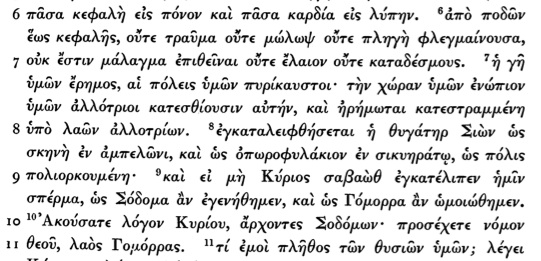
Tuesday, December 4: Isaiah 1:6–10

Isa 1.6-10

Wednesday, December 5: Isaiah 1:11–15

Isa 1.11_tempIsa 1.12-15_temp

Thursday, December 6: Isaiah 1:16–20

Isa 1.16-20

Friday, December 7: Isaiah 1:21–25

Isa 1.20-25a_tempIsa 1.25b_temp

See here for more resources and links to texts for Greek Isaiah.

Greek Isaiah in a Year: the reading plan, free online LXX texts, and more resources

Isaiah

The beginning of Greek Isaiah in a Year is nigh upon us. There are more than 100 people participating via Facebook, and others besides. This post compiles the reading plan, some texts of Greek Isaiah, and other resources. I’ll be adding to this post as often as I can.

The reading plan

Here it is. 5 verses a day (give or take), 5 days a week (Monday through Friday). 12/20/13 update: Here is the reading plan for the 2014 Greek Isaiah in a Year, the Sequel.

Texts of Greek Isaiah

Folks in the group will be reading whatever Greek texts they have available. My initial foray into Greek Isaiah has suggested that Codex Alexandrinus (A) is a better text than Codex Vaticanus (B) for this particular book. Moisés Silva writes, “While this important manuscript [Vaticanus=B] preserves an excellent text for most books of the LXX, it is less trustworthy in the case of Esaias [Isaiah].” R.R. Ottley and Ken M. Penner, both linked below, agree. Ottley bases his work on Alexandrinus, writing, “In the Book of Isaiah… it is thus quite allowable to suggest that B falls below its usual standard, relative or absolute.”

Without further ado, then, some texts to consider, and where to find them:

Rahlfs LXXIsaiah in Rahlfs LXX (German Bible Society, eclectic/critical text). Find it free, legal, and online here. Note that due to copyright restrictions I cannot post the Rahlfs text myself publicly, but you can access the whole thing from the site above. The Rahlfs edition has been called “semi-critical,” so that the textual notes in his apparatus are not extensive. But he does not base his text only on one manuscript.

Isaiah LXX OttleyR.R. Ottley’s Book of Isaiah According to the Septuagint (based on Codex Alexandrinus). See the archive.org site with description here. Or download a compressed pdf (17 MB instead of 57 MB) here from my site. (Thanks to Jim Darlack for combining both volumes 1 and 2 into a single pdf!) Volume 2 has the full Greek text with Ottley’s notes in an apparatus. This commentary is a gold mine of information about the Greek text, the Hebrew it translated, and more.

Isaiah in Swete’s edition (based on Codex Vaticanus). That’s here.

Isaiah in the NETS (New English Translation of the Septuagint), with an introduction by Moisés Silva. This is the leading English translation of the Septuagint. Find the pdf of Isaiah with intro here.

Isaiah by ZieglerThe Göttingen edition of Isaiah. Whereas everything above is available for free online, Göttingen is not. It’s here on Amazon (affiliate link) and here at the publisher’s site. It’s not cheap, but you may be able to find a used edition somewhere. This edition, edited by Joseph Ziegler, is also available from Accordance Bible Software as a single volume here, and from Logos Bible Software as part of a larger collection here. (If it’s Göttingen you’re using, I’ve begun a short primer on how to read and understand the Göttingen editions, their apparatuses, etc.)

More resources for Greek Isaiah

Ken M. Penner, who is writing the Isaiah volume for the Brill Septuagint Commentary series, graciously shared some of his notes with the Biblical Greek Forum last year. See here and here for detailed notes and discussion.

Do you like vocabulary? Like it or not, Septuagint vocabulary is more expansive than New Testament vocabulary. Here is a list (pdf) of all the words in Isaiah that occur 100 times or less in the Septuagint, sorted by frequency. Here is that same list sorted alphabetically. My friend, co-worker, and fellow churchgoer M. Ryan has put the vocabulary list into Quizlet.

The Great Isaiah Scroll (1QIsaa) from the Dead Sea Scrolls is available online for viewing. When you hover over a part of the scroll, an English translation pops up. The scroll is in Hebrew, and is close to the Masoretic Text (MT) of Isaiah, which you can access here, if you want to look at the Hebrew of Isaiah at any point.

Did I miss anything? Please let me know in the comments, and I’ll keep this page updated. Happy reading! Before Monday I will post again with the coming week’s schedule and text.


Biblical Studies Carnival (November)

carnival

Bob MacDonald hosts this month’s Biblical Studies Carnival here. What, you thought blogs were so 2008? Well, they were. But they’re pretty 2012, too. Bob compiles a long list of blog posts in the field of Biblical Studies from the month of November.

I’m hosting the carnival next month, so if you know of good links I should include (anything that will be posted in December), please feel free to let me know.

Speed reading in another language?

Daniel R. Streett has some good thoughts on reading Greek, summarizing some information presented at the Society of Biblical Literature meeting last week:

For proficient reading, automaticity is necessary. In SLA [second language acquisition], automaticity means automatic recognition and understanding of a word or phrase. It actually happens involuntarily, without intervening analysis. It is not subject to introspection.

He continues to note that “reading is hearing.” He says:

Of course, the only way you can “hear” the words in your mind is to have heard them before in real-life, communicative situations where they were used in a comprehensible context.

I don’t disagree with this post (read the rest here). I do find it interesting, though, that one of the tenets of speed reading is to silence that inner voice you would otherwise hear when you read. Streett is not talking about speed reading, but wouldn’t it be great to get to the point of speed reading even in another language? It’s hard enough for me in my first language!

In the meantime, I’m getting stoked to start reading through Greek Isaiah (slowly) in less than a week and perhaps the Greek New Testament (at a bit of a quicker rate) starting January 1.

Anybody out there proficient in speed reading in a second language?

Resources for reading through Greek Isaiah

One more week until more than 50 folks and I start a read-through of Greek Isaiah! There’s an already active Facebook group page for the endeavor.

One of the readers has been working on the Isaiah volume in the Brill Septuagint Commentary Series. He’s graciously shared links with the group to some of his notes on Greek Isaiah, which he posted in the “B-Greek” Biblical Greek group last year.

Look here and here to see what Ken Penner has compiled. I’m really looking forward to his input and guidance as we work through Isaiah.

Read through Greek New Testament in a Year?

When I had a chance to ask N.T. Wright one question in January, I asked him how to improve my Greek. His reply: “Read the text. Read the text. Read the text.”

I decided not long ago to read through the Greek version of Isaiah in a year, starting one week from today. Amazingly, more than 50 people have already joined the corresponding Facebook group; we will be reading together.

On a related note, there are just 260 chapters in the Greek New Testament. This means that, even cutting the longer chapters in half, one can read through the New Testament (in Greek or any other language) with just a chapter a day.

That seems doable. Already in the Greek Isaiah Facebook group and through this blog, I’ve been able to correspond with folks who have read the Greek New Testament in a year. All of them have described it as a rich and rewarding experience.

So I’m not sure I’ll commit to reading all of the Greek NT in 2013, but I’m at least going to give it a shot. For anyone interested in doing the same, Lee Irons has a helpful two-page briefing on how he goes about it. He’s posted reading plans in years past, too (see here for 2012). He recommends using the Reader’s Edition of the Greek New Testament in the image above, which is my favorite Greek Bible for reading.

If anyone reading this post wants to leave a comment as to your experience with reading through the New Testament (Greek or otherwise) in a year, I’d love to hear about it. I do know that if I take it on, it will be to improve my Greek, yes, but primarily it will be a devotional exercise in which I seek to more fully immerse myself in God’s Word.

Amazed by Jesus

Amazement is a common crowd reaction to Jesus’ teaching and to his miraculous powers of healing and exorcism in the Gospel of Mark.

Mark uses the Greek words ἐκπλήσσω, θαμβέω, ἐξίστημιθαυμάζω to depict others’ amazement at Jesus. In Mark 1:22 the people are “amazed by his teaching.” In 1:27, they reiterate their amazement at his teaching and at his command of unclean spirits. 2:12 shows the people amazed at the healing of the paralytic. In 5:20, “All were amazed” (πάντες ἐθαύμαζον) after Jesus healed the Gerasene Demoniac. 6:2 shows the people amazed again at his teaching.

Then in 6:6, whereas the subject of the verb “amaze” has been the people, Jesus is amazed (ἐθαύμαζεν) on account of the lack of faith (ἀπιστία) of the people. The prior verse has said, “And he could not do any miracle there, except to lay his hands on a few sick people and heal them” (AKJV). This is odd. Just as Jesus’ miracles lead to amazement, now his lack of miracles in 6:5 lead to a lack of belief on the part of the people, and this leads to Jesus’ amazement at the people’s lack of faith.

In 6:51 the disciples are amazed at Jesus’ walking on the water, and in 10:24 and 10:26 at his pronouncement that it is difficult for the rich to enter the kingdom of God. In 7:37 the crowd has gone back to being amazed at Jesus’ curing of a deaf man. In 11:18 and 12:17 they stand amazed (ἐξεπλήσσετο) at his teaching.

In 15:5 there is a new subject who is amazed: Pilate is amazed at the lack of a reply from Jesus in his own defense at his trial.

The theme of amazement is significant in the Gospel of Mark. Jesus in Mark is the divine Son of God who has authority to teach, heal the sick, and cast out demons. Because of this the crowds and his disciples are amazed. (Except in 6:5-6, where they are not.) And yet Jesus is not the political Roman empire-conquering Messiah that many Jewish people expected, so there is amazement even on Pilate’s part in 15:5 when Jesus does not respond.

Though no “amazing” words are used, the centurion in Mark 15:39 seems to have the final word of amazement in the Gospel. Having watched Jesus die, he utters in astonishment, “Truly this man was the Son of God!”

Greek Isaiah in a Year: Facebook group to join

I plan to read through the Greek version of Isaiah this coming year, starting December 2. (Here’s a vocab list I’ll use to help.)

If you want to join along, Greek Isaiah in a Year on Facebook is the central place for discussion, helpful files, questions, companions, etc. Come join in!

Why did Jesus tell the disciples not to tell anyone about him?

Why did Jesus sometimes tell people not to tell others about who he was, or about how he healed them? This passage from Mark 8:27-30 (NIV) looks almost anti-evangelistic:

Jesus and his disciples went on to the villages around Caesarea Philippi. On the way he asked them, “Who do people say I am?”

They replied, “Some say John the Baptist; others say Elijah; and still others, one of the prophets.”

“But what about you?” he asked. “Who do you say I am?”

Peter answered, “You are the Messiah.”

Jesus warned them not to tell anyone about him.

This hard-to-understand aspect of Jesus’ ministry is often called the “messianic secret.” I.e., Jesus wanted his messiah-ness kept secret (at times). As the Handbook on Biblical Criticism (4th ed.) puts it, the “Messianic Secret refers to a discernible phenomenon in the Gospels, most especially in the Gospel of Mark, in which Jesus explicitly conceals his messianic character and power until the closing period of his ministry” (124).

The messianic secret is not an attempt on the part of Jesus to keep people from knowing, believing in, and following him. But Jesus did seem to be careful throughout the Gospel of Mark to keep his identity as divine Son of God/Messiah from spreading. There are at least two reasons for this that I can see.

First, though Jesus is identified early in the Gospels as a miraculous healer and exorcist, early in his ministry is not yet time for his identity to be revealed. The fullness of time has simply not come. Perhaps Jesus had certain ministry objectives that needed to be accomplished before his crucifixion? He knew, either way, that as his fame spread, he would be tried and crucified for it. But this could only happen in due time.

Second, Jesus may have been cautious that a misunderstanding of the title “Messiah” would result if people were to say things like, “Here is the Messiah!” He was not the military insurrectionist and ruler than many Jews were expecting (I wrote more about this here), and he wanted to prevent title confusion, I suspect. So he often warned the evil spirits and those who received healing (and, as above, even the disciples!) not to tell anyone about him.

Even with those explanations in view, I still find the “messianic secret” difficult to understand. But perhaps this is because I am like Peter, in Mark 8:33, who all too often has in mind the things “of humanity” rather than “of God.” The messianic secret remains, at least to me, something of a mystery.