Effective leaders coach. They view colleagues as experts of their own experience, and they challenge and support their colleague’s thinking.
“Open-ended questions” have pride of place in this approach: what? and how? instead of yes-or-no queries. Michael Bungay Stanier, for example, says in his book The Coaching Habit:
Instead of moving into advice-giving, solution-providing mode, you ask the Focus Question: “What’s the real challenge here for you?”
Giving advice has its place. Someone may explicitly want our advice. And the world is full of contributors and leaders whose expertise–however much drawn out–is not sufficient to the tasks at hand. So I wrestle with this tack.
But I also know how valuable it is to be coached where my intelligence, experience, and problem-solving skills are respected. And I remain convinced, with Paulo Freire, that a “banking model” of imparting knowledge has limited effectiveness.
As I move more deliberately into the practice of coaching, I am taking seriously the power the coachee has to frame the issues, explore the points of leverage, and effect change. As Bungay Stanier says, “The essence of coaching lies in helping others and unlocking their potential.”
New Testament scholar Michael J. Kruger didn’t expect to write a book about spiritual abuse in the church, but—a couple of chapters in to his new book Bully Pulpit—I’m glad he did.
Kruger says:
I never expected to write a book on Christian leadership. And I certainly never expected to write this one. After all, my prior writing projects have been more on the academic side of the spectrum—mainly on early Christianity and the origins of the New Testament—and not on practical aspects of Christian ministry.
But what does any of us really know about what God might some day call us to? In lines that resonate with me, he goes on:
But sometimes God leads you down pathways you never imagined you would take. And sometimes you do things not because you want to but because they need to be done.
I know the feeling: I could only write each of these posts after firsthand and secondhand experience.
Bully Pulpit’s sub-title is: Confronting the Problem of Spiritual Abuse in the Church. Here’s Kruger’s definition of spiritual abuse:
Spiritual abuse is when a spiritual leader—such as a pastor, elder, or head of a Christian organization—wields his position of spiritual authority in such a way that he manipulates, domineers, bullies, and intimidates those under him as a means of maintaining his own power and control, even if he is convinced he is seeking biblical and kingdom-related goals.
Then he unpacks the definition:
“Spiritual abuse involves someone in a position of spiritual authority” (more on this below)
“Spiritual abuse involves sinful methods of controlling and domineering others” (i.e., the abuser is hypercritical, cruel, threatening, defensive, manipulative)
“Spiritual abusers seem to be building God’s kingdom (but are really building their own)”—this allows for an important intent vs. impact distinction
Kruger notes that defining spiritual abuse can be tricky, but that shouldn’t keep us from trying:
But sins that are more difficult to spot are still sins. Pride may be one of the worst sins, and yet it is remarkably difficult to prove in any given individual. Yet if such difficult-to-spot sins would disqualify a person from ministry (1 Tim. 3:3; Titus 1:7; 1 Peter 5:3; 2 Tim. 2:24), then the church is obligated to assess them even if the task of doing so requires more nuance and care. Can the church ignore these requirements merely because they are more subjective than others? One might argue that the pileup of churches wrecked by domineering leaders over the last decade shows that the church needs to do better in this area. We have ignored these requirements at our peril.
One element I especially appreciate in Kruger’s definition of spiritual abuse is that the abuser can be a person “in a position of [any] spiritual authority.” The abuser may not be in a positional of formal authority in the church, in other words. Their power may come from years of spiritual influence in a congregation. They may be a beloved church musician with informal authority but lots of power. They may be a long-serving elder or lay leader or popular Sunday school teacher who has waited out multiple pastors over the decades.
Kruger will come to focus, I think, on lead pastors or organization heads. This is as it should be, although I eagerly await someone’s book on spiritual abuse perpetuated from the so-called second chair–and the pew.
Either way, whoever spiritually abuses does so because they have spiritual power in a community, and they take drastic, hurtful measures to maintain it.
Jesus’s “Not so with you!” is a great refrain already in Kruger’s book. He will build to a positive vision of “creating a culture that resists spiritual abuse.”
For now, though, I’m grateful for his delineating what spiritual abuse is, since it offers shared, specific language for a practice that causes real and lasting harm.
While I still think all those categories are relevant, I’ve been thinking in simpler terms lately:
Culture = Behavior
That’s it! Culture = Behavior.
This idea comes from the awesome Manager Tools podcast, that I have listened to since the days of my early blog.
They put it this way:
“Culture is nothing more than the sum total of all the behaviors of all of the people in your organization.”
Culture = Behavior.
And behaviors come from specific people.
More from Manager Tools:
“We managers are the guardians of an organization’s culture, because we can see and hear the individual behaviors that make up its culture. The organization’s leaders… really can only proclaim, pronounce, educate, tout… and they can hopefully set an example. The key is: managers are the ones who make culture happen by communicating about effective vs. ineffective behaviors.”
And:
“As managers, as leaders, we have to do what we can with what we’ve got. And the way we can do that is at a behavioral level, where the results (are what) matter anyway.”
Of course, an organization has its own life, more than just “the sum total” of its parts. This is why the Yankees (and the Red Sox, for that matter) still can’t buy their way to a World Series. Systems dynamics matter.
But something as amorphous as “culture change” comes much sharper into focus when considering that culture change = behavior change.
So the leader looking to preserve organizational culture can ask: what specific behaviors are working well for us, creating this irresistible environment, and advancing our mission? And the leader can find specific actors who practice those behaviors, to hold them up as examples.
Similarly, the leader looking to improve organizational culture can ask: what specific behaviors are hurting us, creating this harmful environment, and working against our mission? And the leader can address those specific behaviors and actors, starting with one-on-one conversations.
Mobilizing others (and ourselves) for behavior change is still hard work. But at least it’s more specific than the more intimidating “culture change.”
Here are great lines from Czech playwright and activist Václav Havel (shown also in the image above):
A genuinely fundamental and hopeful improvement in “systems” cannot happen without a significant shift in human consciousness, and… it cannot be accomplished through a simple organizational trick. It’s hard to imagine the kind of system I’ve tried to describe here coming about unless man [sic], as I’ve said, “comes to his senses.” This is something no revolutionary or reformer can bring about; it can only be the natural expression of a more general state of mind, the state of mind in which man can see beyond the tip of his own nose and prove capable of taking on—under the aspect of eternity—responsibility even for the things that don’t immediately concern him, and relinquish something of his private interest in favor of the interest of the community, the general interest. Without such a mentality, even the most carefully considered project aimed at altering systems will be for naught.
I think he’s right. As a leader who seeks to effect change in systems (and in individuals), I find this sobering and ultimately liberating. There’s only so much change any one person can actually bring about. In the end, each needs to take responsibility for themselves.
(It’s been a long time since I read this quote in context, so I don’t know if Havel makes this connection, but the Parable of the Prodigal Son uses this same phrase to describe the younger son’s turnaround in Luke 15:17–“he came to his senses.”)
As a Christian, I would add, there is the power of the Holy Spirit at work in the “senses” of humankind. That can significantly change any person, system, and organization–if we would let it.
The authors of the book, Erika H. James and Lynn Perry Wooten, write, “Crises are never one-off events. They happen again and again, although we never seem to expect them.”
James and Wooten wrote The Prepared Leader to help leaders prepare for crises, but why don’t we already? They write:
A crisis can feel like it hits you and your organization out of the blue. In reality, certain types of crisis can simmer in the background until the conditions are just right for disaster to materialize. These smoldering crises can be hard to predict, even if they are technically foreseeable.
Crucially, this is because these crises “are often tied to failure in organizational culture or procedures—the same failure that allows them to happen while also making them hard to see or track.” Bury sexual harassment claims, for example, and it will eventually turn into a crisis. (And, worse than whatever “crisis” befalls an organization, real people get hurt behind this stuff.)
I think of Charlie Brown and Lucy and the running football gag by Charles M. Schulz. Like a crisis that could have been avoided or at least prepared for, it gets Charlie Brown every time.
Why is this?
James and Wooten list five biases (“cognitive distortions”) that prepared leaders need to recognize—and overcome:
Probability Neglect: we “underestimate the probability that something (bad) will happen to us.” They give the example of COVID-19, and how many North Americans thought it was all the way over there in China and would never reach us.
Hyperbolic Discounting: it’s easier to focus on the present than the future, even if (especially if?) the problems of the future feel overwhelming.
Anchoring Effect: we “tend to cleave to the first impression or understanding we form about a risk or threat.” This especially serves us poorly if we know such-and-such a person as someone who would never do that, even though they’ve just been credibly accused by multiple people. The cognitive dissonance in such cases is painful and difficult to resolve.
Exponential Growth Bias: this is bias against the exponential growth that a crisis tends to have. In other words, we think situations unfold in a linear, straightforward way. They often don’t.
Sunk-Cost Fallacy: “once we have settled on a course of action, and invested time, effort, and resources, it’s hard to change direction.” Once Charlie Brown is running toward that football, even though he knows Lucy is going to pull it out from under him, he still follows through and tries to kick it.
The Prepared Leader calls all of us to hold these cognitive distortions up to the light right now, because “the next crisis is already heading your way.” Or you’re in one right now. They warn readers not to “let your guard down,” which may be our default mode, especially when our biases almost hard-wire us to miss warning signs.
Is there good news here? Yes! Chapter 1 of The Prepared Leader profiles Adam Silver, commissioner of the NBA, and his brilliant (and seemingly lightning-fast) move to implement a “Bubble” when COVID-19 hit, so that the season could continue.
Silver’s actions remind us that we have agency, even in the midst of a crisis. In short, we should “have a learning organizational culture, with processes and protocols in place to surface and share information and to resolve any blockages in knowledge flow.”
Leaders and organizations that try to wish a crisis away (tempting as it is) won’t do much better with the next one. Examining and trying to overcome our cognitive biases is an important start.
Erika H. James and Lynn Perry Wooten are experts in organizational leadership, especially leadership through crises. They each moved into major new roles of leadership at the start of 2020: Dr. James became Dean of The Wharton School of the University of Pennsylvania; Dr. Wooten became the President of Simmons University. They describe what would already be a set of daunting, exciting, high-stakes challenges in leadership positions.
“Then,” they write, “COVID-19 hit.”
I can relate (albeit on a smaller scale). The church I pastored for nearly eight years was confronting its own constellation of challenges as Fall 2019 turned to Winter 2020. I was already experiencing the reality James and Wooten describe: “A crisis will invariably test your leadership to the very limits of your abilities.”
Then COVID-19 hit.
In early 2021 I accepted a call to pastor a diverse, urban church in the heart of Boston. When I began pastoring there, the church was still not far removed from the previous Pastor’s departure; there had been about a year of the Pastor position’s being vacant; COVID-19 was still raging; and we didn’t have a building to meet in.
It seemed the congregation had experienced loss upon loss. Loss may not always be the same thing as crisis, but the congregation that had just called me had had its leadership tested “to the very limits of [its] abilities.”
We’ve stabilized since then, thanks be to God. I’m a month away from the two-year mark as Pastor there. Most if not all of us have been vaccinated, with all the boosters. We rent space in a church just a block or two away from our previous location.
But that doesn’t mean we don’t face new crises—now or lurking around the corner.
As I started the introduction, I realized this book would be powerful and instructive for me, even if there had never been a COVID-19. But seeing how Drs. James and Wooten integrate findings from that new (and still present) global health crisis make their work especially relevant.
Without downplaying the negative disruptive potential of a crisis, they describe how crises can be opportunities:
If there’s one thing we have learned about crises in our research over the years, it is that they bring opportunities as much as they bring risks. Crises are opportunities to sharpen your leadership skills and to unearth new expertise—often in surprising places. They are also opportunities to learn—to determine which important lessons a crisis has to share and to embed those lessons in your leadership practice going forward.
There’s so much wisdom to receive and unpack here—and this is just in the Introduction! As I read these lines, here are all the opportunities a crisis brings, according to the authors:
Crisis brings opportunities to become a more skilled leader
Crisis brings opportunities to find new expertise in your organization
Crisis brings opportunities to discover that this new expertise could be somewhere (or with someone) you didn’t expect
Crisis brings opportunities to learn important lessons
Crisis brings opportunities to integrate these lessons into leadership in the future
I know that crises, loss, and threats all bring opportunities with them. I’ve heard this before. And I don’t disagree, but it’s a truth that—if I’m honest—I’ve had a hard time appreciating. “Consider it pure joy,” the biblical book of James says, “whenever you face trials of many kinds.” No, I consider it pure joy when I don’t have to face any trials!
But James goes on, “Because you know that the testing of your faith develops perseverance. Perseverance must finish its work, so that you may become mature and complete, not lacking anything.”
Trials mature us. The testing of our faith forms our character, even makes us more like Jesus.
Do I like that reality? Not really. If I were God, would I try to create a set of conditions whereby people could develop perseverance without the trials? Maybe, but then again, any sentence that begins with “If I were God…” (especially when I write it) is a bad one.
I believe that Apostle James, Dr. James, and Dr. Wooten are not only right about the formative effect of crises/trials—I think they are preaching an essential life truth.
Crises are inevitable, The Prepared Leader says. Jesus said, “In this world you will have much trouble.” The Psalmist wrote, “Many are the afflictions (troubles, dangers, trials) of the righteous.”
The questions are: how will we respond to a crisis, what will we learn from it, and how will we prepare for the next one?
It’s rare the book that I want to write about after just the introduction, but The Prepared Leader has been as good as a cup of coffee with an engaging Executive Coach (or two, in this case).
Next time I’ll write about James and Wooten’s insights about why we fail to foresee crises, even when a crisis give us hints that it might be coming.
The pandemic has afforded many of us an extended opportunity to think and re-think our jobs: Am I in the right one? Can I live out my values at work? Am I doing what I’m good at? Is my work environment a healthy one? How can I best contribute to the world?
We don’t answer these questions in isolation—even those of us who are solo staff or who work remotely. Work is inevitably work with others. So what to do when those others are hard to work with?
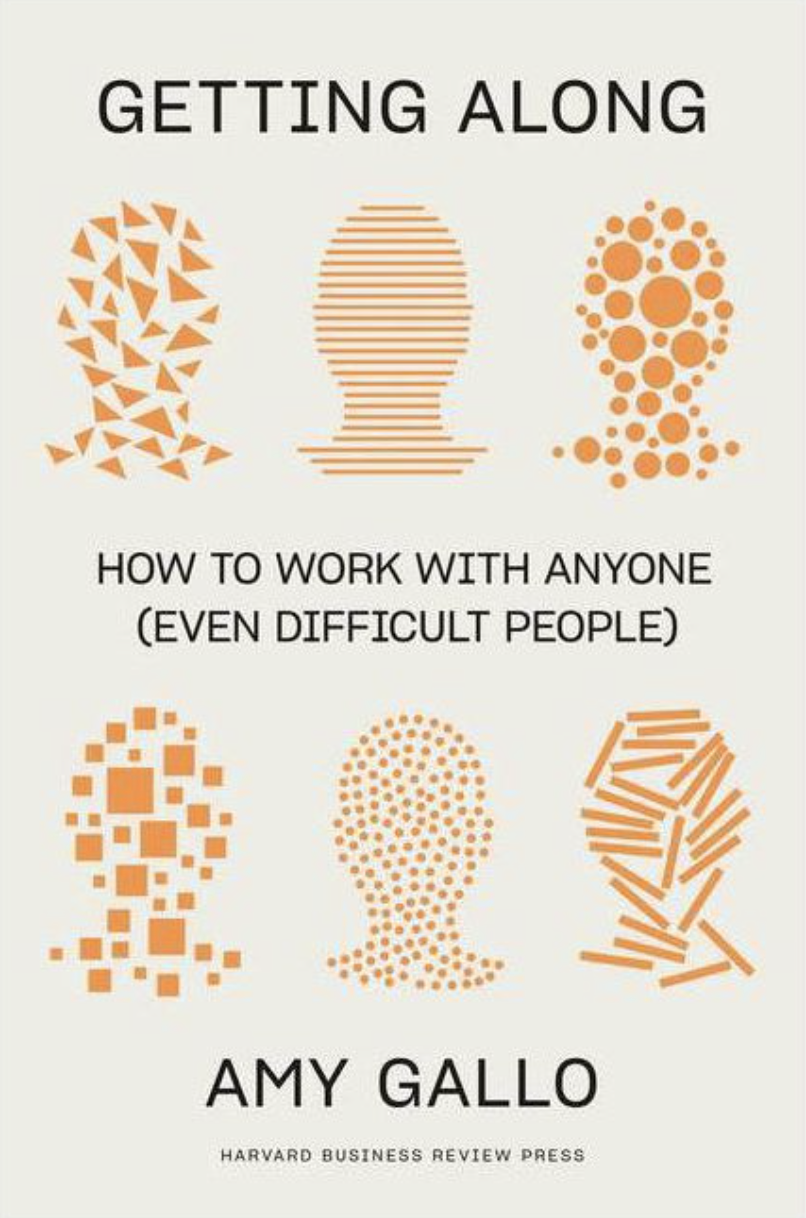
Last fall Harvard Business Review Press published Amy Gallo’s Getting Along: How to Work with Anyone (Even Difficult People). It offers strategies for how we work with challenging others. And it looks at how interpersonal stressors can affect one’s own mental health. Gallo suggests numerous practical ways for us workers to care well for ourselves in tough settings.
Gallo wrote the book “to provide a more nuanced, practical, evidence-based approach, one that acknowledges the complexity of unhealthy relationships at work and the immense discomfort they can create“ (7). She wants to help readers develop “interpersonal resilience” (9). She makes a big promise, on which she delivers:
With the advice in this book, you’ll be able to put work conflict in its place, freeing up valuable time and mental capacity for the things that really matter to you. (9)
Gallo lists “eight archetypes,” eight categories of difficult people we might expect to face in the workplace:
the insecure boss
the pessimist
the victim
the passive-aggressive peer
the know-it-all
the tormentor
the biased coworker
the political operator
Each of these archetypes gets a chapter, with Gallo admitting there can be overlap between archetypes. She gives background to each archetype, names some “costs” to working with such a person, lists “questions to ask yourself” (this inward turn is hard but needed), and ends with “tactics to try.” For those working with “the pessimist,” for example, she suggests you “reframe cynicism as a gift” (77) and “give them a role to play” (78), but that you also “help them understand when their pessimism helps and when it hurts” (80). Toward the end of each chapter Gallo gives a list of “phrases to use,” which I think was one of the best parts of the book.
As practical as Gallo is, I benefited from the time she spent in the first two chapters laying the groundwork for navigating difficult relationships. I agree it is true, after all, that “you’re better off trying to create a workable situation with your colleague now than hoping things will improve if they leave” (238). So how to make it workable? Why bother? Gallo’s early chapters talk not only about why work relationships are worth investing in; she also suggests the idea of actually making friends with your co-workers! And she details how relational stress impacts the brain in a way that really motivated me to keep reading.
The final chapters are great, too. Having run through the archetypes, there are still lingering questions. Gallo addresses them all, and well: Should I just quit? How can I stay in a sustainable way? Is there someone I can escalate this to? How do I take care of myself? Gallo suggests these two powerful mantras: “It’s OK to feel hurt” and, “Who I am is not shaped by this person’s beliefs” (247). I found the last one especially affirming.
I really appreciated this book. It comes at a great time for a lot of us, and Gallo’s years of experience and passion show. Getting Along is accessible and practical, as well as backed up by research and lots of interpersonal interactions across industries.
I also thought Gallo does a good job of thinking inclusively. Early on she notes, “Not everyone experiences the workplace in the same way—and particular groups are often the targets of incivility to a disproportionate degree” (8). Throughout the archetypes she uses lenses of racism and sexism and other -isms to analyze difficult interactions. It feels like this level of analysis is often missing in self-help or workplace productivity books.
If I have a critique or two of this book, it’s that—based on the title and book description—I expected to see more writing on how to address a co-worker who has a distinct mental health issue. This would probably make the book much longer, but what if your boss actually is a narcissist? Gallo jumps right in on this possibility in the “know-it-all” chapter (starting on p. 118), but I worry she might have too quickly dismissed a reality some folks face, even if she’s right that we shouldn’t be armchair psychologists and even if “pathological narcissism” is rare. Or, to take another archetype, what if your “pessimistic” co-worker is (also) clinically depressed or has an anxiety disorder? Should that shape how you interact with them? If so, how? Are you on the hook to try to get them help? Do you need to be more careful about how you word things? Or not?
Finally, I wonder if readers who are in a persistently (or even occasionally) abusive work environment might need to look elsewhere for help on how to navigate their toxic environment. Gallo does much to help readers work toward health, and I think (I hope!) what she offers will cover the vast majority of workplace personality difficulties. But I can call to mind settings where something like a more trauma-based lens might be needed to help the worker navigate their setting. How to respond, in other words, when you believe you are being abused at work—physically, emotionally, sexually, or psychologically? To be fair, Gallo’s chapter on “the biased co-worker” offers an in-depth response to discrimination and microaggressions in the workplace, although I think the chapter on “the tormentor” could have covered abuse dynamics more fully.
I don’t mean these final comments to take away from how truly affirming, helpful, and empowering Getting Along is. I appreciate how an author of a book like this may be putting themselves out there. And it seemed clear to me that Gallo has heard about, coached people through, and lived through more than a fair share of workplace conflict and difficulty. That she shares her hard-earned wisdom in such an engaging book is a gift to anyone who would read it.
You can find Amy Gallo’s Getting Alonghere. Her own Website is here (where I have just signed up for her monthly newsletter).
Thanks to Harvard Business Review Press for sending the review copy, which did not (at least not consciously) affect how I reviewed the book.
It’s not written from a religious perspective, but I thought it applies especially well in the body of Christ. Summary:
Earlier in our careers, speed and energy are important components. But there comes a point where you actually can’t speed up any more. You need to rely less on what you can personally achieve (your “ego-drive”) and more on what you can achieve with others (your “co-drive”). Instead of being energetic, you need to become energizing. Instead of setting the pace, you need to teach others to self-propel. Instead of delegating, you need to allow people to congregate. As you shift from proving yourself to helping others perform, your key question is not “How can I push harder?” but “Where can I let go?”
First, a three-sentence review of the idea of “mental toughness”:
I want it, I work toward it, and I want my kids to have it—especially given the global and local challenges facing us in 2022.
As a practicing Christian, I wonder what “mental toughness” looks like in light of 2 Corinthians 12:9: “And He said to me, ‘My grace is sufficient for you, for my strength is made perfect in weakness.’”
Those lines come from the Apostle Paul, who was as mentally tough a person as I know of, and yet he rejoiced in his weakness, because—perhaps counterintuitively—his weakness was the site of God’s strength made perfect.
Even with that re-framing in mind, “mental toughness” is a desideratum for me. So I read in its entirety HBR’s 10 Must Reads on Mental Toughness, from Harvard Business Review Press. At 160 pages—and with compact trim size—it’s one of the shorter volumes in the 10 Must Reads series, but it’s full of powerful and inspiring ideas.
Here’s the list of 10 (actually 11, counting the “bonus” article) articles in the book:
“How the Best of the Best Get Better and Better,” by Graham Jones
“Crucibles of Leadership,” by Warren G. Bennis and Robert J. Thomas
“Building Resilience,” by Martin E.P. Seligman
“Cognitive Fitness,” by Roderick Gilkey and Clint Kilts
“The Making of a Corporate Athlete,” by Jim Loehr and Tony Schwartz
“Stress Can Be a Good Thing If You Know How to Use It,” by Alla Crum and Thomas Crum
“How to Bounce Back from Adversity,” by Joshua D. Margolis and Paul G. Stoltz
“Rebounding from Career Setbacks,” by Mitchell Lee Marks, Philip Mirvis, and Ron Ashkenas
“Realizing What You’re Made Of,” by Glenn E. Mangurian
“Extreme Negotiations,” by Jeff Weiss, Aram Donigian, and Jonathan Hughes
“Post-Traumatic Growth and Building Resilience,” by Martin Seligman and Sarah Green Carmichael
Every article has good ideas worthy of implementation. And across the 160 pages there are a handful of ideas I could probably do without. Here are some highlights:
In Martin Seligman’s “Building Resilience,” he talks about “post-traumatic growth” (my emphasis), a phrase I’d never heard before reading this book. He mentions post-traumatic stress disorder (PTSD) and then asks: what about the growth that can ensue after traumatic events? The best sentence in the whole book describes people who have post-traumatic growth: “They, too, first experience depression and anxiety, often exhibiting full-blown PTSD, but within a year they are better off than they were before the trauma” (29). Better off than they were before the trauma!
Similarly, “Crucibles of Leadership” (Bennis and Thomas) is encouraging, as it tells stories of leaders who “emerged from the crucible stronger and more sure of themselves and their purpose” (11).
“Cognitive Fitness” (Gilkey and Kilts) offers a two-page spread (48-49) titled, “Exercising Your Brain: A Personal Program.” Many of the ideas they offer are common sense but easy to forget (“ready funny books,” “play games,” “try new technologies,” “learn a new language or instrument,” etc.).
“Stress Can Be Good Thing If You Know How to Use It” (Crum and Crum) was such a good article, I emailed a link to it (with my own reflection) to my church’s elders right away. Best line: “[W]hat did you expect—that climbing Everest would be a walk in the park?” (73) The authors recommend “reframing anxiety as excitement” (74).
Scattered throughout some articles are pep-talky ideas I’m ambivalent about. On the first page of the first article (“How the Best of the Best Get Better and Better”), for example, there is, “[I]n sports as in business, the main obstacle to achieving ‘the impossible’ may be a self-limiting mind-set” (1). Yeah, may be. But for some things “mind over matter” may itself be a limiting approach, since it may fail to take into account external factors.
“How to Bounce Back from Adversity” (Margolis and Stoltz) is excellent, although I disagree with the authors’ conclusion that when analyzing setbacks, we need to stop thinking about their causes and focus instead on our response. Why not both? Interestingly, another article (“Rebounding from Career Setbacks”) has a section called “Figure Out Why You Lost” (90). On the upside, Margolis and Stoltz’s “resilience regimen” offers a series of practical and empowering questions that almost ensure forward movement. For example:
“Visualizing: What do I want life to look like on the other side of this adversity?
“Specifying: What can I do in the next few minutes, or hours, to move in that direction?
“Collaborating: What sequence of steps can we put together as a team, and what processes can we develop and adopt, to see us through to the other side of this hardship?” (86)
Glenn E. Mangurian’s “Realizing What You’re Made Of” is the most inspirational of the articles. It begins with the provocative (ridiculous?) claim: “Those who have survived a traumatic, life-altering event often convey a curious sentiment: They wouldn’t have it any other way” (97). He then talks about working through (and with, not against) his own experience of paralysis. It’s a moving read. “In my new life,” he says, “I am able to use all of my assets, including my paralysis, to be a new kind of leader” (106).
There is some overlap between this and other published HBR collections. As HBR continues to publish its 10 Must Read series, and multiple other best-of collections, they’ll want to keep an eye on not overusing certain articles.
I’ll refer back to this volume again, and it took me about a year to work through it, because I kept savoring/procrastinating working through the ideas and exercises.
Find the book here, and thanks to HBR Press for sending the review copy, which did not (at least not consciously) affect how I reviewed the book.
In a recent chapter of Uproar that our church’s elders read together, Peter Steinke writes, “Distress is not always an obstacle to learning. Pain can be a teacher. Real learning begins when the threat of pain emerges.”
There is the idea that our call in the church is not to shield people from pain1 but to walk with them through it.2 You may seen this described as a “ministry of presence,” “accompaniment,” or just “sitting in the mud” with someone. If we can’t make the hard stuff go away, at least we can be there.
In a similar way, an author and leadership consultant, Jack Shitama, writes:
A big mistake we make is to think we can relieve other people of their emotional pain. This does them no favors. In life, pain is an opportunity for growth. The best thing you can do for a friend is stay connected to them, go alongside them, while they deal with their own pain. They will be stronger for it.
Theologically, it helps me to remember that pain by itself does not make us stronger, but inviting the presence and power of God into our pain can transform it and actually strengthen us: “My grace is sufficient for you, for my power is made perfect in weakness.”
Then, with God’s help, we can ask how pain might become an opportunity to grow. We can ask how we might channel anxiety to motivate positive change.
I read an article recently called, “Stress Can Be a Good Thing If You Know How to Use It.” You can read it here. The article is good as is—I would just add that reading it as a Christian, we can also say: Stress Can Be a Good Thing (Or Turned Into a Good Thing), If We Give it to God and Allow God to Use It!
BUT… If the pain is coming from, for example, an oppressor or system of oppression, we ought to consider how we might actively stand against the source of pain. ↩











 Words on the Word