One good monograph to read on the Septuagint is First Bible of the Church. And if you want to get in-depth with the critical edition of the LXX, I have offered reviews of the Göttingen Septuagint in Logos and Accordance softwares. And, perhaps as important, I suggest how one might actually make sense of that critical edition, noted here and here, with an ever-elusive third part of the primer still to come.
But right now, I’m going to go play outside in the snow with my kids. Happy LXX Day!
Suzanne at BLT has been writing about childshippe. I haven’t been able to fully digest it all, but given the preponderance of the word “son”/υἱός in the New Testament, I want to spend more time thinking through why so many translations opt for “son” when both male and female “children” seem to be in view. She writes more here and here.
Jim promises a review of de Gruyter’s Die Göttinger Septuaginta. And check out the Dust blog for a post called, “How much we take for granted, the publishing process and the Septuagint,” here.
Also, it wasn’t updated in January, but I just found out about what looks like a good LXX-related blog.
Did I miss anything? Feel free to leave more January 2014 LXX links of interest in the comments. And Happy (almost) International Septuagint Day!
It’s the first day of a new month (and new year), which means that the Septuagint Studies Soirée has arrived. Here is a collection of what the LXX-blogosphere had to offer in December 2013.
Old School Script has an interesting post (with some good questions to think about) regarding lexicography and instincts. (E.g., “How much do we trust our (next-to-nothing?) intuitive powers?”)
J.K. Gayle asks the provocative question, “Was David a virgin when his soul was pregnant?” to “bring some attention to the way in Bible reading and translation we highlight gender and sex and motherliness so dogmatically.” Gayle seems to “know” a bit about the Bible’s “sex verbs,” as he discusses ἐγίνωσκεν in Matthew 1 here. One other post of his worth reading (all his posts are worth reading) says, “The Greek / Hebrew names here for the baby Jesus are rather political in contrast to the Empire of Alexander and the Empire of the Caesar.”
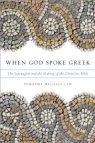
T. Michael Law’s book about the Septuagint made #2 on Near Emmaus’s year-end books list.
Though it wasn’t on a blog, per se, James K. Aitken posted a chapter on LXX neologisms (thanks, Jim, for the tip). He writes, “There is a need for more descriptors of so-called new words, identifying them as semantic extensions, unattested compounds, morphological extensions, foreign loans, and so on.” One other non-blog, LXX-related url, if you want a daily LXX fix via the Twitter, is here.
Brian Davidson at LXXI made a couple of short videos about using Logos for a sort of MT-LXX Two-way Index.
Speaking of Brian, he’s taking over Greek Isaiah in a Year (which just finished) and leading a group through Isaiah again in 2014! Join them here.
Did I miss anything? As prevalent as women are in Septuagint studies, I didn’t find any LXX blog posts by women in December, but I might have missed one! Feel free to leave more December 2013 LXX links of interest in the comments. And in case you didn’t see it, the first Septuagint Studies Soirée is here; the second one is here; the third one is here; the fourth one is here.
Here are a few blog posts from November, regarding the Septuagint, that are worth taking a look at:
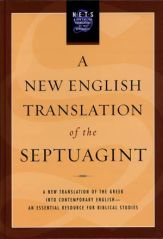
J.K. Gayle considers the question of whether the Septuagint translator of the Hebrew Song of Songs might have been a woman, then raises some challenges inherent to that view, at least as it is presented by the NETS (see image at left). J.K. also offered insight into the possible motherliness of God and the patriarch Joseph. Suzanne responded here, preferring to talk about “wombly feelings” instead of “motherly” ones. Kurk writes back again, noting some “maternal” language (with help from Greek Isaiah) in the “Our Father.”
I’ve just this month learned of a blog called Old School Script, which focuses on linguistics and biblical languages. Check out as much as you can of that site, starting with an October post that I missed last month, “Word Order in Septuagint Judges.” Note also some extended exploration this past month about Paul’s use of the LXX. Said blog also pointed this month to Randall Buth’s thinking about an SBL session on the Greek perfect.
Also, this month Logos Bible Software released (for free) Codex Sinaiticus, includingits Septuagint portions.
Did I miss anything? Feel free to leave more November 2013 LXX links of interest in the comments. And in case you didn’t see it, the first Septuagint Studies Soirée is here; the second one is here; the third one is here.
One other thing to note–a reading group of nearly 200 folks on Facebook (and more who are not on Facebook) finished a reading plan last Friday through Greek Isaiah.
Though it was a quiet month in the Septuagint blogosphere, J.K. Gayle turned up the heat with some top-notch posts. Gayle looked at the phrase “ἄρσεν καὶ θῆλυ” (a “Greek frozen phrase”) in “Aristotle,” “Moses,” and Paul. Gayle writes:
As my son and my daughters grow into adulthood more in this world, I long for English counterpart terms like the Greek ἄρσεν καὶ θῆλυ and the Hebrew זכר ונקבה. These phrases do not have a default sex for the sex, the gender, of adult human beings the way our English “men and women” and “male and female” do. So I do tend to try to use “boys and girls” even when referring to adults, even though I always have to explain what I mean since the term applies to children not grown ups. I also like “masculine and feminine” since the phrase includes equal counterparts that does not place one over the other.
A section titled, “The Reception of ‘ἄρσεν καὶ θῆλυ’ in Contemporary Sexist Theology” concludes the post. Read it all here.
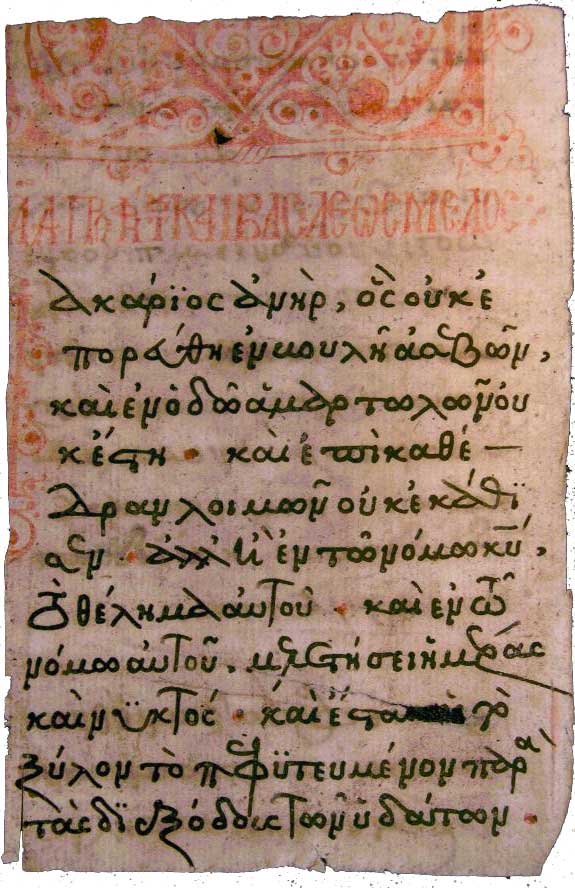
When I read Psalm 34 in the Greek (aka the Septuagint’s Psalm 33), I have lots of questions. For example, does the psalmist have a possibly-pregnant female soul?
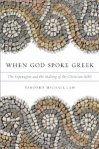
Brian Davidson reviewed some Hermeneia volumes, including the one on 2 Maccabees by Robert Doran. Michael Bird reviewed T.M. Law’s When God Spoke Greek at Patheos.
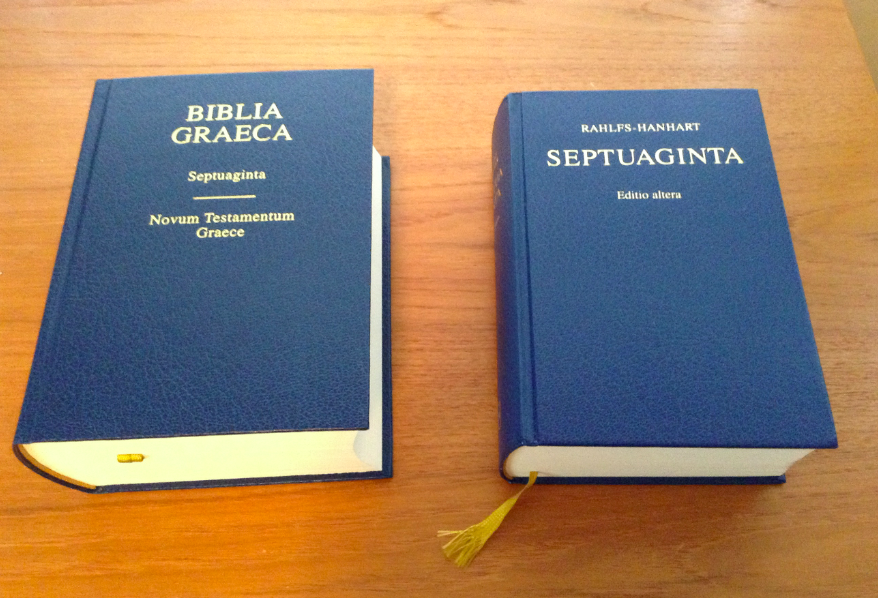
And this beauty is now available:
Jim West took a picture of it here. I reviewed it here.
To help alleviate October’s LXX lacunae–the dearth of Septuagint mirth–you could check out the Greek Isaiah in a Year group. We’re on Facebook here. It’s not too late to join! We’re just 60 chapters in.
Did I miss anything? (It seems I checked at least 70 or 72 blogs.) Feel free to leave more October 2013 LXX links of interest in the comments. And in case you didn’t see it, the first Septuagint Studies Soirée is here; the second one is here.
It’s the September Septuagint Studies Soirée! Come on in–you won’t have to stay long. It was a quiet month in the Septuagint blogosphere, at least as far as I could find. Everyone is back to school, it seems. But there are still some noteworthy posts.
Suzanne at BLT (Bible*Literature*Translation) wrote about “several curious matters in the vocabulary of Amos 6:1 in Hebrew, in Greek and in English.” It was an early September post, but that verse was included in the OT lectionary reading for today, incidentally.
James Dowden also posted about the vocabulary and translation of a single verse (or part of a verse): Lamentations 3:35a. This one compares Hebrew, Greek, English, and Welsh.
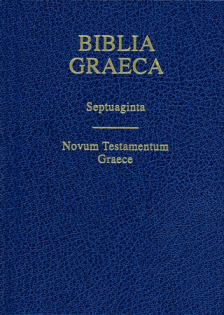
CBD says this beauty is in stock now
“Where is the center of gravity for LXX studies?” asked T. Michael Law. It’s a spot that may still be “for the taking,” in his analysis. TML also announced a new series on the history of interpretation of the Apocrypha, by Oxford University Press. He and David Lincicum are editing it together.
John Meade posted two parts of a response to Law’s When God Spoke Greek. In part the first he inquires as to just what kind of a book it is. Part the second focuses on the vexing question of canonization and seeks to “interact with a crucial part of chapter three [of Law’s book]: Was there a Bible before the Bible?” Meade promises future posts on the book.
A Septuagint symposium called “Looking Ahead for Dialogue. A Multiplicity of Approaches in Septuagint Studies” will be taking place in Belgium in October. (This via Jim Aitken on the FB, who will be presenting.)
Did I miss anything? Feel free to leave more September 2013 LXX links of interest in the comments. And in case you didn’t see it, the first Septuagint Studies Soirée is here.
As soon as I announced the first-ever Septuagint Studies Soirée (and here it is!), J.K. Gayle responded with “Breast God: women in the male literary imagination of Genesis 49.” Find his post here. In it he writes about how the Greek translators of Genesis 49 rendered God’s Hebrew title Shaddai… or, rather, didn’t:
Then I recall what the Septuagint translators did with Shaddai in Genesis 49. They were men, weren’t they? Yes, breasts are mentioned, and womb. These motherly wifely womanly female images are in the Hebraic Hellene. And absence, margin, lack is there.
James Dowden offered further lexical analysis (I loved the detail) with a response here. These two gents are fine thinkers. And they are, indeed, gents. Gayle makes a point to recognize this in his WOMBman’s Bible blog, with a post in which he asks whether the Septuagint itself might not be some sort of soirée. I always need to spend some time with Gayle to really plumb the depths of his insights, but it’s time well spent. A sampling:
In many fascinating ways, this act of translating into Hellene opens up the text. It opens the text up into the debates over how Greek males (such as Alexander’s teacher Aristotle) may control the Greek language for elite educated men of the Academy. The language control was to exclude not only women but also sophists, rhetoricians, ancient epic poets, more contemporary poets, colonists such as those in Soli who committed “solecisms” in writing, and BarBarians who spoke in foreign barbarisms.
Along similar lexical lines, Suzanne McCarthy (Gayle blogs with her at BLT) tackled “another pesky Hebrew gender question” via Hebrew, Latin, English, and, of course, Greek. McCarthy also wrote about Adam’s nose (rendered “face,” but should it be?) here.
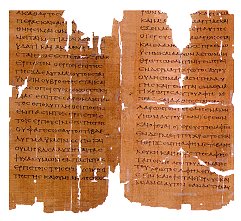
LXX Leviticus. Source: The Schøyen Collection
Jim West complained about Septuagint-o-mania (has he read the New Testament? has he read BLT blog???) but then posted a bunch of LXX-related links not long after (phew–he has read his NT, at least).
In two of the more substantive Septuagint posts this month, Nijay Gupta (who has impeccable taste in seminaries) wrote about the importance of the Septuagint (with an eye to pastors, among others). Part 1 is here. His Part 2 looks more closely at the Apocrypha. (“There is ample evidence to show that Jesus, Paul, James, and others certainly were acquainted with the Apocrypha and probably positively influenced by texts like Wisdom of Solomon and Sirach.”) His part 2 concludes with the promise of more to come.
Speaking of which, Jessica Parks was posting some great stuff on LXX Susanna earlier in the summer, so keep an eye out for anything LXX-related she may post in the future. She is now posting on Cataclysmic blog.
Brian LePort posted a good bit on the Septuagint in August (and before). He wrote about exegeting the Septuagint (with attention to its literary context) and even theologizing from it!
This pre-dates August, but Blog of the Twelve posted a few LXX-related resources for consideration. And while we’re still dipping (but only briefly) back into July, Brian Davidson wrote about Matthew as a new Genesis.
Larry Hurtado mentioned that a book he co-edited with Paul L. Owen is now in (affordable) paperback. It’s called “Who Is This Son of Man?” The Latest Scholarship on a Puzzling Expression of the Historical Jesus, found here.
These are not blogs proper, and not terribly active of late, but still worth checking out are this B-Greek forum (link malfunctioning at time of posting) and this Yahoo! group for LXX. The IOSCS (mentioned above) has a great page with some news and announcements here.
Feel free to leave more August 2013 LXX links of interest in the comments.












 Words on the Word