A New Testament Scholar Defines Spiritual Abuse


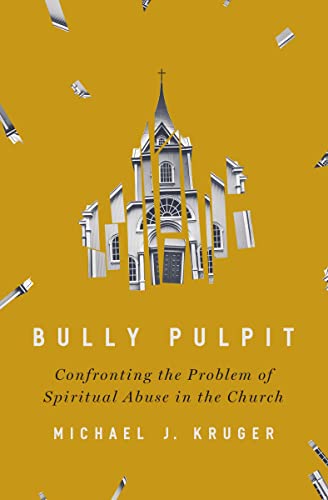
New Testament scholar Michael J. Kruger didn’t expect to write a book about spiritual abuse in the church, but—a couple of chapters in to his new book Bully Pulpit—I’m glad he did.

Kruger says:

I never expected to write a book on Christian leadership. And I certainly never expected to write this one. After all, my prior writing projects have been more on the academic side of the spectrum—mainly on early Christianity and the origins of the New Testament—and not on practical aspects of Christian ministry.

But what does any of us really know about what God might some day call us to? In lines that resonate with me, he goes on:

But sometimes God leads you down pathways you never imagined you would take. And sometimes you do things not because you want to but because they need to be done.

I know the feeling: I could only write each of these posts after firsthand and secondhand experience.

Bully Pulpit’s sub-title is: Confronting the Problem of Spiritual Abuse in the Church. Here’s Kruger’s definition of spiritual abuse:

Spiritual abuse is when a spiritual leader—such as a pastor, elder, or head of a Christian organization—wields his position of spiritual authority in such a way that he manipulates, domineers, bullies, and intimidates those under him as a means of maintaining his own power and control, even if he is convinced he is seeking biblical and kingdom-related goals.

Then he unpacks the definition:

  • “Spiritual abuse involves someone in a position of spiritual authority” (more on this below)
  • “Spiritual abuse involves sinful methods of controlling and domineering others” (i.e., the abuser is hypercritical, cruel, threatening, defensive, manipulative)
  • “Spiritual abusers seem to be building God’s kingdom (but are really building their own)”—this allows for an important intent vs. impact distinction

Kruger notes that defining spiritual abuse can be tricky, but that shouldn’t keep us from trying:

But sins that are more difficult to spot are still sins. Pride may be one of the worst sins, and yet it is remarkably difficult to prove in any given individual. Yet if such difficult-to-spot sins would disqualify a person from ministry (1 Tim. 3:3; Titus 1:7; 1 Peter 5:3; 2 Tim. 2:24), then the church is obligated to assess them even if the task of doing so requires more nuance and care. Can the church ignore these requirements merely because they are more subjective than others? One might argue that the pileup of churches wrecked by domineering leaders over the last decade shows that the church needs to do better in this area. We have ignored these requirements at our peril.

One element I especially appreciate in Kruger’s definition of spiritual abuse is that the abuser can be a person “in a position of [any] spiritual authority.” The abuser may not be in a positional of formal authority in the church, in other words. Their power may come from years of spiritual influence in a congregation. They may be a beloved church musician with informal authority but lots of power. They may be a long-serving elder or lay leader or popular Sunday school teacher who has waited out multiple pastors over the decades.

Kruger will come to focus, I think, on lead pastors or organization heads. This is as it should be, although I eagerly await someone’s book on spiritual abuse perpetuated from the so-called second chair–and the pew.

Either way, whoever spiritually abuses does so because they have spiritual power in a community, and they take drastic, hurtful measures to maintain it.

Jesus’s “Not so with you!” is a great refrain already in Kruger’s book. He will build to a positive vision of “creating a culture that resists spiritual abuse.”

For now, though, I’m grateful for his delineating what spiritual abuse is, since it offers shared, specific language for a practice that causes real and lasting harm.

Crises Are Inevitable. Why Do We Miss The Warning Signs?

Inspired by The Prepared Leader: Emerge from Any Crisis More Resilient Than Before, I recently wrote about the inevitability of crises in organizational settings.

The authors of the book, Erika H. James and Lynn Perry Wooten, write, “Crises are never one-off events. They happen again and again, although we never seem to expect them.”

James and Wooten wrote The Prepared Leader to help leaders prepare for crises, but why don’t we already? They write:

A crisis can feel like it hits you and your organization out of the blue. In reality, certain types of crisis can simmer in the background until the conditions are just right for disaster to materialize. These smoldering crises can be hard to predict, even if they are technically foreseeable.

Crucially, this is because these crises “are often tied to failure in organizational culture or procedures—the same failure that allows them to happen while also making them hard to see or track.” Bury sexual harassment claims, for example, and it will eventually turn into a crisis. (And, worse than whatever “crisis” befalls an organization, real people get hurt behind this stuff.)

I think of Charlie Brown and Lucy and the running football gag by Charles M. Schulz. Like a crisis that could have been avoided or at least prepared for, it gets Charlie Brown every time.

Why is this?

James and Wooten list five biases (“cognitive distortions”) that prepared leaders need to recognize—and overcome:

  1. Probability Neglect: we “underestimate the probability that something (bad) will happen to us.” They give the example of COVID-19, and how many North Americans thought it was all the way over there in China and would never reach us.
  2. Hyperbolic Discounting: it’s easier to focus on the present than the future, even if (especially if?) the problems of the future feel overwhelming.
  3. Anchoring Effect: we “tend to cleave to the first impression or understanding we form about a risk or threat.” This especially serves us poorly if we know such-and-such a person as someone who would never do that, even though they’ve just been credibly accused by multiple people. The cognitive dissonance in such cases is painful and difficult to resolve.
  4. Exponential Growth Bias: this is bias against the exponential growth that a crisis tends to have. In other words, we think situations unfold in a linear, straightforward way. They often don’t.
  5. Sunk-Cost Fallacy: “once we have settled on a course of action, and invested time, effort, and resources, it’s hard to change direction.” Once Charlie Brown is running toward that football, even though he knows Lucy is going to pull it out from under him, he still follows through and tries to kick it.

The Prepared Leader calls all of us to hold these cognitive distortions up to the light right now, because “the next crisis is already heading your way.” Or you’re in one right now. They warn readers not to “let your guard down,” which may be our default mode, especially when our biases almost hard-wire us to miss warning signs.

Is there good news here? Yes! Chapter 1 of The Prepared Leader profiles Adam Silver, commissioner of the NBA, and his brilliant (and seemingly lightning-fast) move to implement a “Bubble” when COVID-19 hit, so that the season could continue.

Silver’s actions remind us that we have agency, even in the midst of a crisis. In short, we should “have a learning organizational culture, with processes and protocols in place to surface and share information and to resolve any blockages in knowledge flow.”

Leaders and organizations that try to wish a crisis away (tempting as it is) won’t do much better with the next one. Examining and trying to overcome our cognitive biases is an important start.

Crises as Learning Opportunities

Wisdom and Fuel


Erika H. James and Lynn Perry Wooten are experts in organizational leadership, especially leadership through crises. They each moved into major new roles of leadership at the start of 2020: Dr. James became Dean of The Wharton School of the University of Pennsylvania; Dr. Wooten became the President of Simmons University. They describe what would already be a set of daunting, exciting, high-stakes challenges in leadership positions.

“Then,” they write, “COVID-19 hit.”

I can relate (albeit on a smaller scale). The church I pastored for nearly eight years was confronting its own constellation of challenges as Fall 2019 turned to Winter 2020. I was already experiencing the reality James and Wooten describe: “A crisis will invariably test your leadership to the very limits of your abilities.”

Then COVID-19 hit.

In early 2021 I accepted a call to pastor a diverse, urban church in the heart of Boston. When I began pastoring there, the church was still not far removed from the previous Pastor’s departure; there had been about a year of the Pastor position’s being vacant; COVID-19 was still raging; and we didn’t have a building to meet in.

It seemed the congregation had experienced loss upon loss. Loss may not always be the same thing as crisis, but the congregation that had just called me had had its leadership tested “to the very limits of [its] abilities.”

We’ve stabilized since then, thanks be to God. I’m a month away from the two-year mark as Pastor there. Most if not all of us have been vaccinated, with all the boosters. We rent space in a church just a block or two away from our previous location.

But that doesn’t mean we don’t face new crises—now or lurking around the corner.

Against those backdrops, I eagerly began reading James and Wooten’s new book, The Prepared Leader: Emerge from Any Crisis More Resilient Than Before, recently published by Wharton School Press. (Thanks to the press for the review copy, provided with no expectation of me.)

As I started the introduction, I realized this book would be powerful and instructive for me, even if there had never been a COVID-19. But seeing how Drs. James and Wooten integrate findings from that new (and still present) global health crisis make their work especially relevant.

Without downplaying the negative disruptive potential of a crisis, they describe how crises can be opportunities:

If there’s one thing we have learned about crises in our research over the years, it is that they bring opportunities as much as they bring risks. Crises are opportunities to sharpen your leadership skills and to unearth new expertise—often in surprising places. They are also opportunities to learn—to determine which important lessons a crisis has to share and to embed those lessons in your leadership practice going forward.

There’s so much wisdom to receive and unpack here—and this is just in the Introduction! As I read these lines, here are all the opportunities a crisis brings, according to the authors:

  • Crisis brings opportunities to become a more skilled leader
  • Crisis brings opportunities to find new expertise in your organization
  • Crisis brings opportunities to discover that this new expertise could be somewhere (or with someone) you didn’t expect
  • Crisis brings opportunities to learn important lessons
  • Crisis brings opportunities to integrate these lessons into leadership in the future

I know that crises, loss, and threats all bring opportunities with them. I’ve heard this before. And I don’t disagree, but it’s a truth that—if I’m honest—I’ve had a hard time appreciating. “Consider it pure joy,” the biblical book of James says, “whenever you face trials of many kinds.” No, I consider it pure joy when I don’t have to face any trials!

But James goes on, “Because you know that the testing of your faith develops perseverance. Perseverance must finish its work, so that you may become mature and complete, not lacking anything.”

Trials mature us. The testing of our faith forms our character, even makes us more like Jesus.

Do I like that reality? Not really. If I were God, would I try to create a set of conditions whereby people could develop perseverance without the trials? Maybe, but then again, any sentence that begins with “If I were God…” (especially when I write it) is a bad one.

I believe that Apostle James, Dr. James, and Dr. Wooten are not only right about the formative effect of crises/trials—I think they are preaching an essential life truth.

Crises are inevitable, The Prepared Leader says. Jesus said, “In this world you will have much trouble.” The Psalmist wrote, “Many are the afflictions (troubles, dangers, trials) of the righteous.”

The questions are: how will we respond to a crisis, what will we learn from it, and how will we prepare for the next one?

It’s rare the book that I want to write about after just the introduction, but The Prepared Leader has been as good as a cup of coffee with an engaging Executive Coach (or two, in this case).

Next time I’ll write about James and Wooten’s insights about why we fail to foresee crises, even when a crisis give us hints that it might be coming.

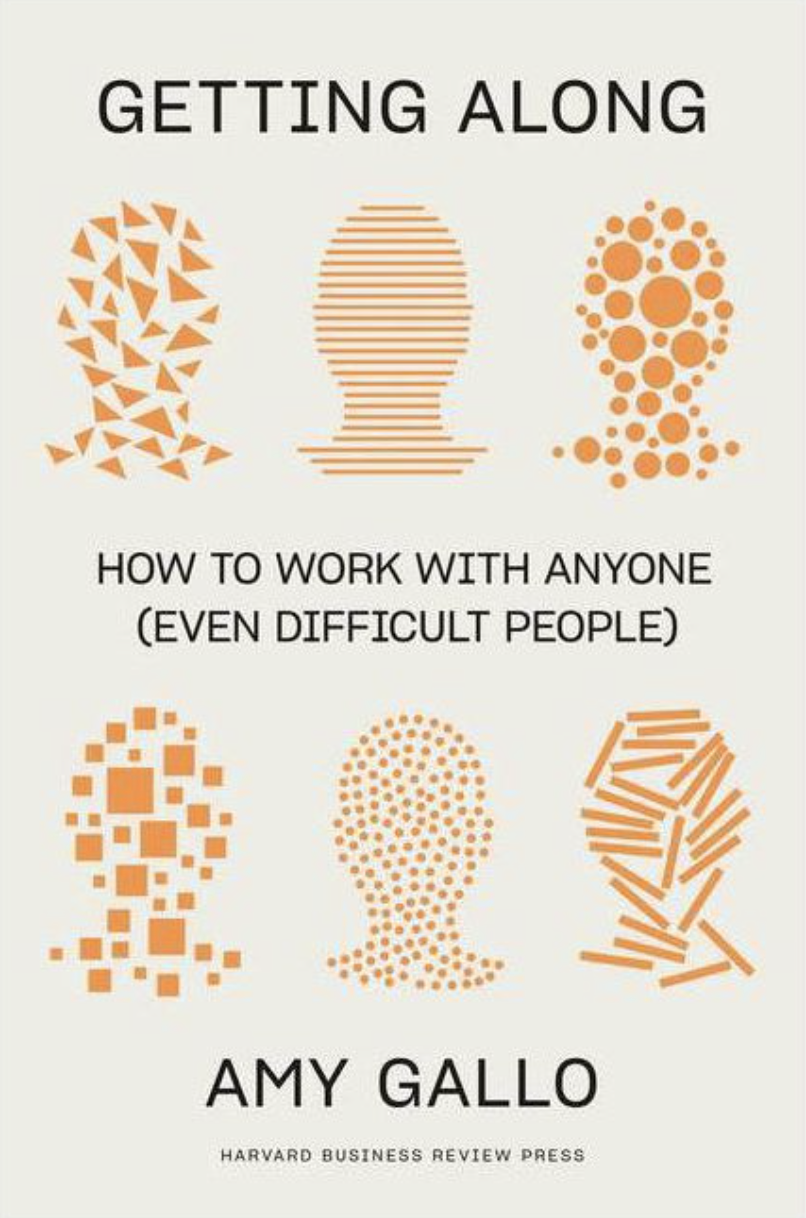
Review of Getting Along: How to Work with Anyone (Even Difficult People)

The pandemic has afforded many of us an extended opportunity to think and re-think our jobs: Am I in the right one? Can I live out my values at work? Am I doing what I’m good at? Is my work environment a healthy one? How can I best contribute to the world?

We don’t answer these questions in isolation—even those of us who are solo staff or who work remotely. Work is inevitably work with others. So what to do when those others are hard to work with?

Last fall Harvard Business Review Press published Amy Gallo’s Getting Along: How to Work with Anyone (Even Difficult People). It offers strategies for how we work with challenging others. And it looks at how interpersonal stressors can affect one’s own mental health. Gallo suggests numerous practical ways for us workers to care well for ourselves in tough settings.

Gallo wrote the book “to provide a more nuanced, practical, evidence-based approach, one that acknowledges the complexity of unhealthy relationships at work and the immense discomfort they can create“ (7). She wants to help readers develop “interpersonal resilience” (9). She makes a big promise, on which she delivers:

With the advice in this book, you’ll be able to put work conflict in its place, freeing up valuable time and mental capacity for the things that really matter to you. (9)

Gallo lists “eight archetypes,” eight categories of difficult people we might expect to face in the workplace:

  • the insecure boss
  • the pessimist
  • the victim
  • the passive-aggressive peer
  • the know-it-all
  • the tormentor
  • the biased coworker
  • the political operator

Each of these archetypes gets a chapter, with Gallo admitting there can be overlap between archetypes. She gives background to each archetype, names some “costs” to working with such a person, lists “questions to ask yourself” (this inward turn is hard but needed), and ends with “tactics to try.” For those working with “the pessimist,” for example, she suggests you “reframe cynicism as a gift” (77) and “give them a role to play” (78), but that you also “help them understand when their pessimism helps and when it hurts” (80). Toward the end of each chapter Gallo gives a list of “phrases to use,” which I think was one of the best parts of the book.

As practical as Gallo is, I benefited from the time she spent in the first two chapters laying the groundwork for navigating difficult relationships. I agree it is true, after all, that “you’re better off trying to create a workable situation with your colleague now than hoping things will improve if they leave” (238). So how to make it workable? Why bother? Gallo’s early chapters talk not only about why work relationships are worth investing in; she also suggests the idea of actually making friends with your co-workers! And she details how relational stress impacts the brain in a way that really motivated me to keep reading.

The final chapters are great, too. Having run through the archetypes, there are still lingering questions. Gallo addresses them all, and well: Should I just quit? How can I stay in a sustainable way? Is there someone I can escalate this to? How do I take care of myself? Gallo suggests these two powerful mantras: “It’s OK to feel hurt” and, “Who I am is not shaped by this person’s beliefs” (247). I found the last one especially affirming.

I really appreciated this book. It comes at a great time for a lot of us, and Gallo’s years of experience and passion show. Getting Along is accessible and practical, as well as backed up by research and lots of interpersonal interactions across industries.

I also thought Gallo does a good job of thinking inclusively. Early on she notes, “Not everyone experiences the workplace in the same way—and particular groups are often the targets of incivility to a disproportionate degree” (8). Throughout the archetypes she uses lenses of racism and sexism and other -isms to analyze difficult interactions. It feels like this level of analysis is often missing in self-help or workplace productivity books.

If I have a critique or two of this book, it’s that—based on the title and book description—I expected to see more writing on how to address a co-worker who has a distinct mental health issue. This would probably make the book much longer, but what if your boss actually is a narcissist? Gallo jumps right in on this possibility in the “know-it-all” chapter (starting on p. 118), but I worry she might have too quickly dismissed a reality some folks face, even if she’s right that we shouldn’t be armchair psychologists and even if “pathological narcissism” is rare. Or, to take another archetype, what if your “pessimistic” co-worker is (also) clinically depressed or has an anxiety disorder? Should that shape how you interact with them? If so, how? Are you on the hook to try to get them help? Do you need to be more careful about how you word things? Or not?

Finally, I wonder if readers who are in a persistently (or even occasionally) abusive work environment might need to look elsewhere for help on how to navigate their toxic environment. Gallo does much to help readers work toward health, and I think (I hope!) what she offers will cover the vast majority of workplace personality difficulties. But I can call to mind settings where something like a more trauma-based lens might be needed to help the worker navigate their setting. How to respond, in other words, when you believe you are being abused at work—physically, emotionally, sexually, or psychologically? To be fair, Gallo’s chapter on “the biased co-worker” offers an in-depth response to discrimination and microaggressions in the workplace, although I think the chapter on “the tormentor” could have covered abuse dynamics more fully.

I don’t mean these final comments to take away from how truly affirming, helpful, and empowering Getting Along is. I appreciate how an author of a book like this may be putting themselves out there. And it seemed clear to me that Gallo has heard about, coached people through, and lived through more than a fair share of workplace conflict and difficulty. That she shares her hard-earned wisdom in such an engaging book is a gift to anyone who would read it.

You can find Amy Gallo’s Getting Along here. Her own Website is here (where I have just signed up for her monthly newsletter).

Thanks to Harvard Business Review Press for sending the review copy, which did not (at least not consciously) affect how I reviewed the book.

Mental Toughness: A Review

First, a three-sentence review of the idea of “mental toughness”:

  1. I want it, I work toward it, and I want my kids to have it—especially given the global and local challenges facing us in 2022.
  2. As a practicing Christian, I wonder what “mental toughness” looks like in light of 2 Corinthians 12:9: “And He said to me, ‘My grace is sufficient for you, for my strength is made perfect in weakness.’”
  3. Those lines come from the Apostle Paul, who was as mentally tough a person as I know of, and yet he rejoiced in his weakness, because—perhaps counterintuitively—his weakness was the site of God’s strength made perfect.

Even with that re-framing in mind, “mental toughness” is a desideratum for me. So I read in its entirety HBR’s 10 Must Reads on Mental Toughness, from Harvard Business Review Press. At 160 pages—and with compact trim size—it’s one of the shorter volumes in the 10 Must Reads series, but it’s full of powerful and inspiring ideas.

Here’s the list of 10 (actually 11, counting the “bonus” article) articles in the book:

  1. “How the Best of the Best Get Better and Better,” by Graham Jones
  2. “Crucibles of Leadership,” by Warren G. Bennis and Robert J. Thomas
  3. “Building Resilience,” by Martin E.P. Seligman
  4. “Cognitive Fitness,” by Roderick Gilkey and Clint Kilts
  5. “The Making of a Corporate Athlete,” by Jim Loehr and Tony Schwartz
  6. “Stress Can Be a Good Thing If You Know How to Use It,” by Alla Crum and Thomas Crum
  7. “How to Bounce Back from Adversity,” by Joshua D. Margolis and Paul G. Stoltz
  8. “Rebounding from Career Setbacks,” by Mitchell Lee Marks, Philip Mirvis, and Ron Ashkenas
  9. “Realizing What You’re Made Of,” by Glenn E. Mangurian
  10. “Extreme Negotiations,” by Jeff Weiss, Aram Donigian, and Jonathan Hughes
  11. “Post-Traumatic Growth and Building Resilience,” by Martin Seligman and Sarah Green Carmichael

Every article has good ideas worthy of implementation. And across the 160 pages there are a handful of ideas I could probably do without. Here are some highlights:

  • In Martin Seligman’s “Building Resilience,” he talks about “post-traumatic growth” (my emphasis), a phrase I’d never heard before reading this book. He mentions post-traumatic stress disorder (PTSD) and then asks: what about the growth that can ensue after traumatic events? The best sentence in the whole book describes people who have post-traumatic growth: “They, too, first experience depression and anxiety, often exhibiting full-blown PTSD, but within a year they are better off than they were before the trauma” (29). Better off than they were before the trauma!

  • Similarly, “Crucibles of Leadership” (Bennis and Thomas) is encouraging, as it tells stories of leaders who “emerged from the crucible stronger and more sure of themselves and their purpose” (11).

  • “Cognitive Fitness” (Gilkey and Kilts) offers a two-page spread (48-49) titled, “Exercising Your Brain: A Personal Program.” Many of the ideas they offer are common sense but easy to forget (“ready funny books,” “play games,” “try new technologies,” “learn a new language or instrument,” etc.).

  • “Stress Can Be Good Thing If You Know How to Use It” (Crum and Crum) was such a good article, I emailed a link to it (with my own reflection) to my church’s elders right away. Best line: “[W]hat did you expect—that climbing Everest would be a walk in the park?” (73) The authors recommend “reframing anxiety as excitement” (74).

  • Scattered throughout some articles are pep-talky ideas I’m ambivalent about. On the first page of the first article (“How the Best of the Best Get Better and Better”), for example, there is, “[I]n sports as in business, the main obstacle to achieving ‘the impossible’ may be a self-limiting mind-set” (1). Yeah, may be. But for some things “mind over matter” may itself be a limiting approach, since it may fail to take into account external factors.

  • “How to Bounce Back from Adversity” (Margolis and Stoltz) is excellent, although I disagree with the authors’ conclusion that when analyzing setbacks, we need to stop thinking about their causes and focus instead on our response. Why not both? Interestingly, another article (“Rebounding from Career Setbacks”) has a section called “Figure Out Why You Lost” (90). On the upside, Margolis and Stoltz’s “resilience regimen” offers a series of practical and empowering questions that almost ensure forward movement. For example:

       “Visualizing: What do I want life to look like on the other side of this adversity?

       “Specifying: What can I do in the next few minutes, or hours, to move in that direction?

       “Collaborating: What sequence of steps can we put together as a team, and what processes can we develop and adopt, to see us through to the other side of this hardship?” (86)

  • Glenn E. Mangurian’s “Realizing What You’re Made Of” is the most inspirational of the articles. It begins with the provocative (ridiculous?) claim: “Those who have survived a traumatic, life-altering event often convey a curious sentiment: They wouldn’t have it any other way” (97). He then talks about working through (and with, not against) his own experience of paralysis. It’s a moving read. “In my new life,” he says, “I am able to use all of my assets, including my paralysis, to be a new kind of leader” (106).

  • There is some overlap between this and other published HBR collections. As HBR continues to publish its 10 Must Read series, and multiple other best-of collections, they’ll want to keep an eye on not overusing certain articles.

I’ll refer back to this volume again, and it took me about a year to work through it, because I kept savoring/procrastinating working through the ideas and exercises.

Find the book here, and thanks to HBR Press for sending the review copy, which did not (at least not consciously) affect how I reviewed the book.

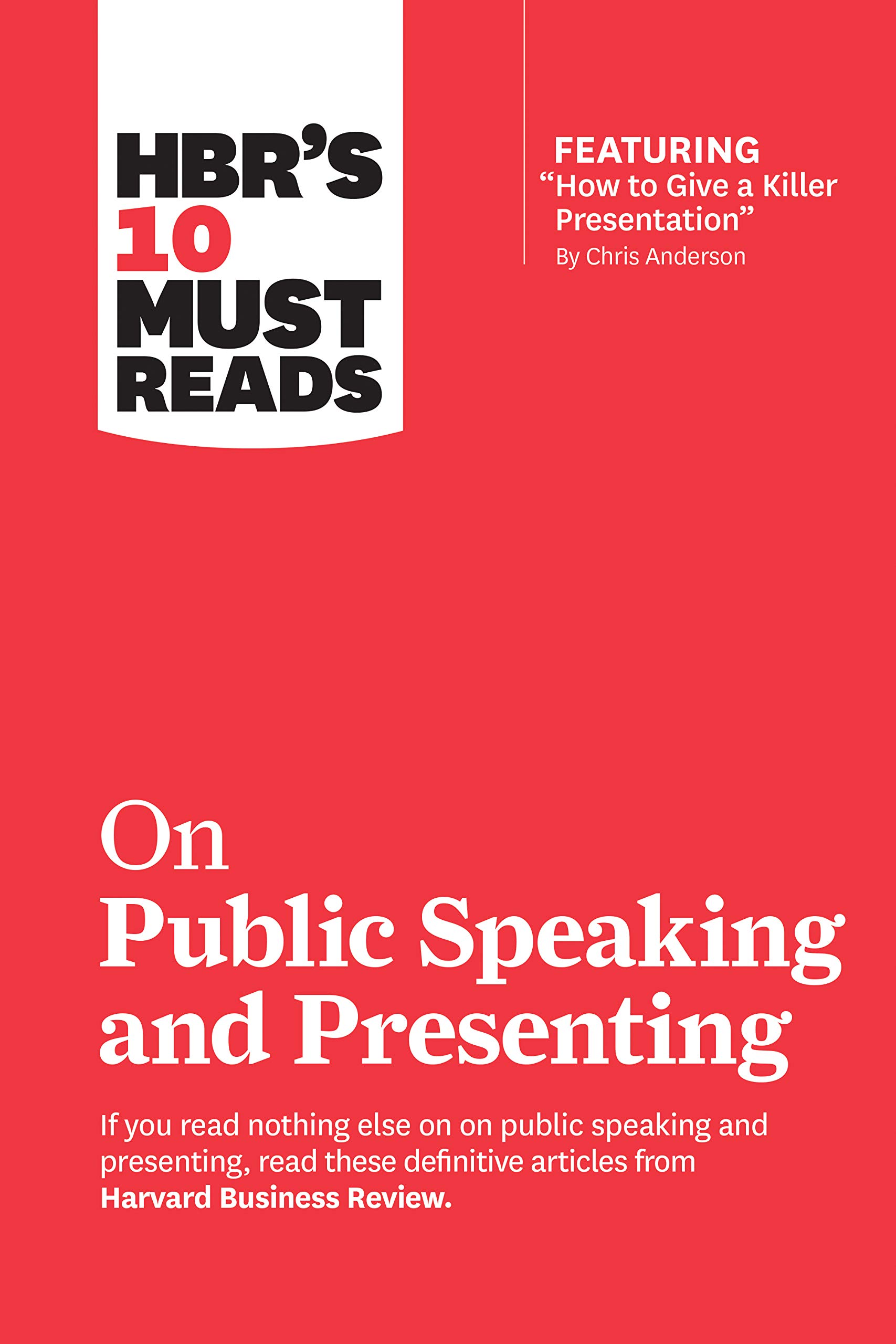
Review: HBR’s 10 Must Reads on Public Speaking and Presenting

You probably already realize how much of in-person communication is non-verbal. But did you know that audiences perceive non-verbal signals as having more weight than the words you are actually saying?

Nick Morgan notes as much in his Harvard Business Review article, “How to Become an Authentic Speaker”:

If your spoken message and your body language are mismatched, audiences will respond to the nonverbal message every time.

Why?

You’re probably coming across as artificial. The reason: When we rehearse specific body language elements, we use them incorrectly during the actual speech—slightly after speaking the associated words. Listeners feel something’s wrong, because during natural conversation, body language emerges before the associated words.

Recently in a natural conversation I tried to notice which came first—my hand gestures or the words they accompanied. And Morgan is right!

So if you’re going to script non-verbals into your public speaking, well… maybe just don’t. Those need to be natural, or the listeners will know something is off.

Morgan’s article is in HBR’s 10 Must Reads on Public Speaking and Presenting, a compelling and informative read that has already helped me as a preacher.

Here is the list of articles included:

  • “How to Give a Killer Presentation,” by Chris Anderson
  • “How to Become an Authentic Speaker,” by Nick Morgan
  • “Storytelling That Moves People: A Conversation with Screenwriting Coach Robert McKee,” by Bronwyn Fryer
  • “Connect, Then Lead,” by Amy J.C. Cuddy, Matthew Kohut, and John Neffinger
  • “The Necessary Art of Persuasion,” by Jay A. Conger
  • “The Science of Pep Talks,” by Daniel McGinn
  • “Get the Boss to Buy In,” by Susan J. Ashford and James R. Detert
  • “The Organizational Apology,” by Maurice E. Schweitzer, Alison Wood Brooks, and Adam D. Galinsky
  • “What’s Your Story?” by Herminia Ibarra and Kent Lineback
  • “Visualizations That Really Work,” by Scott Berinato
  • (“bonus” article) “Structure Your Presentation Like a Story,” by Nancy Duarte.

I don’t think there’s a dud in here. Chris Anderson’s lead article is an inside look into the world of TED Talks. As the curator of the conferences, he’s coached plenty of speakers, and here distills some of his advice.

I especially appreciated the focus in a few articles on good storytelling. Even if data is part of a presentation, tell a story about it, rather than presenting it in drab charts and graphs. (Or use charts and graphs, but make them visually compelling.) “What’s Your Story” is about how to frame and re-frame career transitions—especially relevant to the so-called “Great Resignation” happening across workplaces today.

Harvard Business Review and its books have always appealed to me, though as a church leader I often have to translate the wisdom into a somewhat unique context. This particular volume, however, is immediately relevant to anyone speaking or presenting to people.

Check it out here.

Yeah, But He’s *Our* Hananiah: When the One Who Misleads Is One of Us

The Prophet Jeremiah, by Gustave Doré (1832–1883)

I keep coming back to this arresting passage in Jeremiah:

For from the least to the greatest of them,
everyone is greedy for unjust gain;
and from prophet to priest,
everyone deals falsely.
They have treated the wound of my people carelessly,
saying, “Peace, peace,”
when there is no peace.

— Jeremiah 6:13-14

Any declaration of peace calls for discernment. Anyone can say there is “peace” in a place when there’s really not. In fact, folks with positions of power (formal or informal) have a vested interest in “saying, ‘Peace, peace,’ when there is no peace.”

That way they can preserve the status quo (from which they benefit). They can avoid “conflict” (or taking a long, hard look at reality and themselves). They can curry favor with those who love to hear that there is peace (don’t we all?).

In Jeremiah it was prophet and priest who were “dealing falsely,” saying “Shalom!” when shalom was decidedly not God’s word for the people. Shalom did not reflect the hard realities.

I find it sobering to remember that prophet and priest are appointed, sacred offices, established by God.

Yes, even sacred communities are susceptible to the abuse of lying leaders who declare peace where there is none.

A hard truth, but I think the even greater challenge is to think about how these verses might apply to our own settings.

It’s easy to call out Jeremiah’s Hananiah, his nemesis who persuaded the people “to trust in lies.” It’s easy to point at pastors, priests, and bishops who have lied and misled people in other communities. It’s easy to call for the resignation of a deceitful and unrepentant church leader in another faith community (or president of a country). Indeed, we should.

But what about when the false prophet is my false prophet? What about when the fake peace proclaimer is our fake peace proclaimer? What about when the deceit is coming “from inside the house”?

We might try to minimize:

  • Yeah, but she’s been a huge part of our community for decades!
  • Well, he thinks there is actually “peace” here, and he’s prophesying sincerely.
  • They’re doing the best they can under the circumstances; how about some grace?

Or the even more insidious: “Who can even know what peace is?”

It’s harder to navigate when Hananiah is one of us… when we have worshiped with Hananiah… when we have shared meals with Hananiah… when we have done mission together… when we celebrated birthdays and holidays and baptisms together. We might even think that Hananiah has somehow earned the right to be wrong, the right to (occasionally?) misrepresent God to the people. Jeremiah’s Hananiah is clearly in the wrong but my Hananiah gets a mulligan.

Jeremiah 6:16 goes on:

Thus says the LORD:
Stand at the crossroads, and look,
and ask for the ancient paths,
where the good way lies; and walk in it,
and find rest for your souls.

Instead of an uncritical acceptance of our Hananiah’s lying, instead of asking, “How can we even know?”, God calls the people to stand and look and ask. (“Seek and you shall find.”) And then to walk in “the good way.”

And then there is the last line of Jeremiah 6:16—indeed, it often goes unquoted:

But they said, “We will not walk in it.”

May God have mercy on us, for all the times we choose not to walk in God’s good way. And may God give us the discernment and the courage to acknowledge the truth about Hananiah and his prophecies, even when he’s “one of us.”

Gossip Destroys, Especially When We Think We’re Not Gossiping but Really Are

From HBR, via ICHIRO/Getty Images

I recently saw a survey given to young people that asked them something like, “Do you use your computer inappropriately?” The number was low, 10% or so of respondents answering yes. The next question was something like, “Do your peers use their computer inappropriately?” The number was much higher; if I recall, close to a majority of respondents said yes. In other words, I don’t do that, but they do.

I suspect that pattern holds with other destructive habits. Take gossip, for example. Deborah Grayson Riegel points out that in her coaching work, her clients often deny participating in workplace gossip, “with a look on their faces that indicates that they are insulted to have been asked such a question.” But when Grayson Riegel reframes the question, the response changes:

When I ask them whether they have ever participated in a “confirmation expedition” — whereby they 1) ask a colleague to confirm their own negative or challenging experience with a third colleague who is not present, or 2) welcome a similar line of confirmation inquiry from another colleague about a third colleague who is not present, most admit that this is, in fact, a regular part of their daily work life.

She talks about the importance of naming gossip (or a “confirmation expedition”) as such:

First, call gossip “gossip” to stop it in its tracks. If you are engaging in “informal and evaluative talk in an organization, usually among no more than a few individuals, about another member of that organization who is not present,” — especially if the aim is to confirm your experience rather than get constructive solutions — then you are participating in gossip.

The intertestamental book of Sirach goes further than just calling gossip “gossip.” It says, “Curse the gossips and the double-tongued, for they destroy the peace of many” (Sirach 28:13, NRSV). Gossip destroys the well-being of persons and disrupts whole communities.

The apostle Paul also warns his first century churches about “gossips,” which in Greek sure seems like an onomatopoeia: psithuristēs (whisperer). Think: “whisper networks,” but not the good, truth-telling kind that rightly bring down folks like Harvey Weinstein et al.

One of the dangers of gossip is that it seeks to confirm information (or at least claims to), but it risks getting reality wrong, because not all the involved people are in the room, including folks who may know more about a situation at hand. Not to mention that such furtive whispering is hard to hear, and often inaccurately conveys information when passed from one person to another (as happens in the kids’ game of “Telephone”).

Grayson Riegel has excellent advice for what to do about this dynamic (see her Harvard Business Review article here). I especially appreciate her “Let people know that you have a policy of ‘if you have a problem with me, please tell me first.’” (Although I think we need to be ready for the unfortunate possibility that some may simply ignore this request.)

I would add this prayer from Psalm 139:23-24, which could help us avoid doing what we are sure only others do:

Search me, O God, and know my heart; test me and know my thoughts.

See if there is any wicked way in me, and lead me in the way everlasting.

Deep Work… for Parents?


A working mom and productivity app publicist Tweeted, “How to do #DeepWork even when you have deep responsibilities (spoiler alert: that means kids) – by @lvanderkam.”

The accompanying image was Vanderkam’s right-on-the-money critique of Cal Newport’s Deep Work, which held up Carl Jung as an example for shutting himself off to do “deep work.” Translation: he neglected his kids?

Newport starts by writing (in a laudatory fashion) about Carl Jung secluding himself in a tower so he could ponder his breakthrough ideas. Newport notes that there were sacrifices involved in his decision. For instance, it “reduced the time he spent on his clinical work.” Not mentioned: when Jung bought this retreat property in 1922, he and his wife had five children. It’s safe to say locking himself off from the world locked himself off from those responsibilities. And while perhaps that was par for the course for a man in 1922 (and maybe especially for Jung, who was allegedly an unfaithful husband), someone had to be around the family.

Newport is a working father, but as journalist Brigid Schulte suggests in Overwhelmed: How to Work, Love, and Play When No One Has the Time, working fathers don’t carry the same load at home as working mothers. Maybe Newport has this all worked out with his family and work in a fair and agreeable way. But as I’m reading it, Schulte’s work is making a strong case that the ability to perform deep work is a gendered phenomenon. Culturally (in the U.S., at least) it’s still easier for dads than moms to get away and carve out large blocks of uninterrupted, focused time.

Be that as it may, “deep work” for any engaged parent can be hard to come by. Working from home is a beautiful thing, but how often have I felt tinges of guilt as I told my children I couldn’t play right now because I was working, barely glancing up from the computer to let them know? In that case both the work and (more important) the child receive less than what I would hope to give.

Someone needs to write a Deep Work for Parents book. Who knows? Maybe that will be Newport’s follow-up. And Vanderkam has great ideas here. (Her website is sub-titled, “Writing about Time Management, Life, Careers & Family.”)

How about you, working parents who read this blog? How do you get focused, high-level work done when your “job” isn’t your only job? How do you handle interruptions if you work from home? How do you find energy to cook dinner and do bedtime routines after working all day outside the house?

All ideas welcomed in the comments below.

The Busy Pastor’s Guide to Inbox Shalom

Screenshot 2017-07-24 14.58.10


I’ve recently had a new article published at CTPastors.com: “The Busy Pastor’s Guide to Inbox Shalom.”

It begins:

A ministry supervisor once told me a quick way to lose respect in ministry: Don’t return people’s phone calls. The same holds true for email.

The article suggests how pastors (or anyone) can reset to Inbox Zero in two minutes, and then recommends some strategies for keeping your Inbox in a state of shalom.

You can read the whole article here.